The transcript for every video lecture is provided. You can go to the Video Series Homepage, scroll down to “CONTENTS LISTING,” and download the PDF transcript notes for each installment.
The Sevens were posted back in July of 2020, so it’s been a while. =)
Heck, between the last video I made in this series and the making of this one, I re-illustrated a whole new edition of the SKT, now in full-color, released the first printing, and sold out of the first printing.
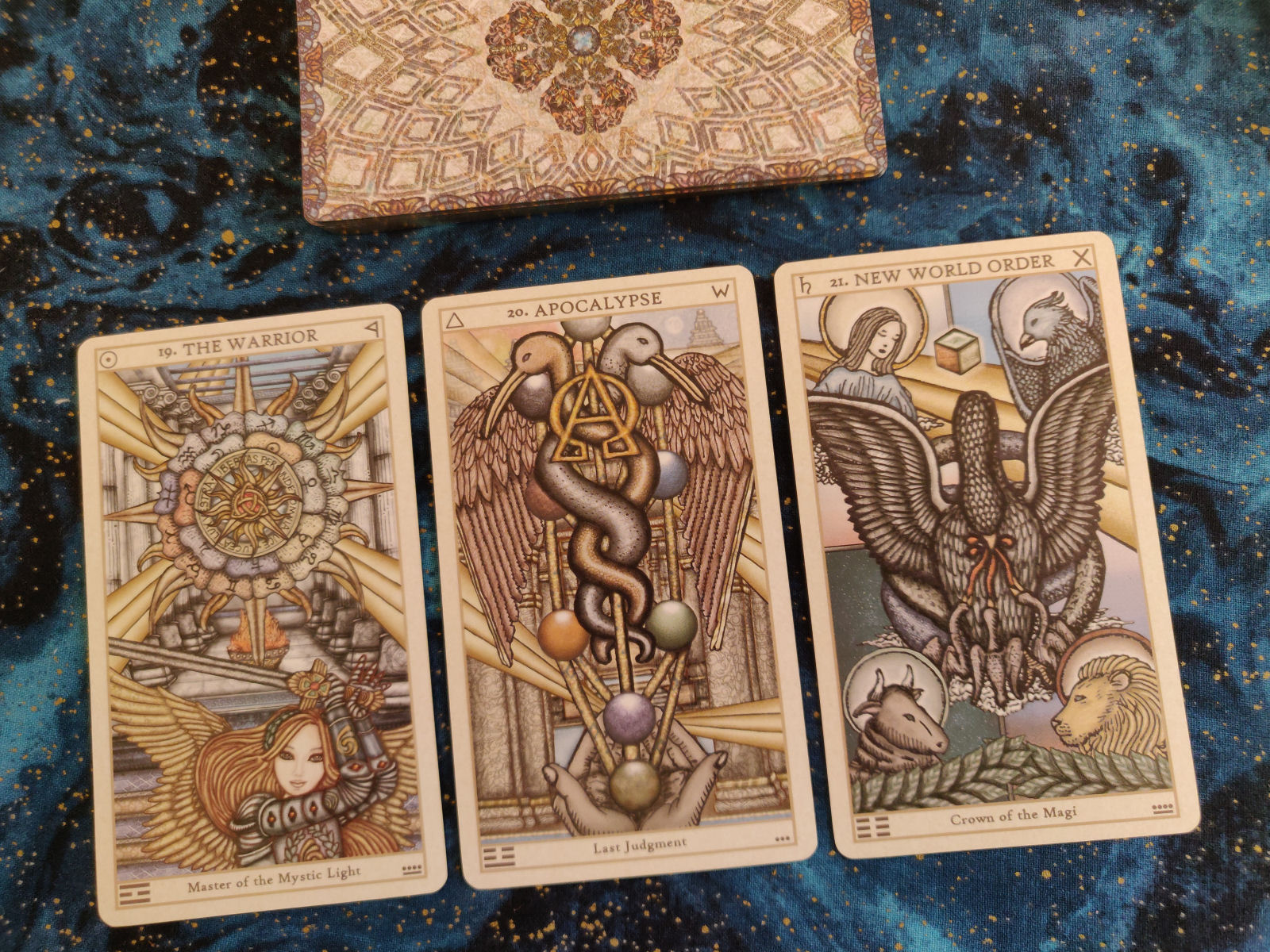
I’ve made the decision to just focus on the full-color Revelation Edition of SKT going forward and keep the videos centered on the TdM, RWS, and Thoth comparisons. I figure you’re not watching these videos for SKT, and if you do want more info on the SKT card meanings specific to how I’ve illustrated the cards, that’s in the Book of Maps.
Rather, the SKT cards are included in the series so you can do a visual comparison of the SKT to the predecessor decks.
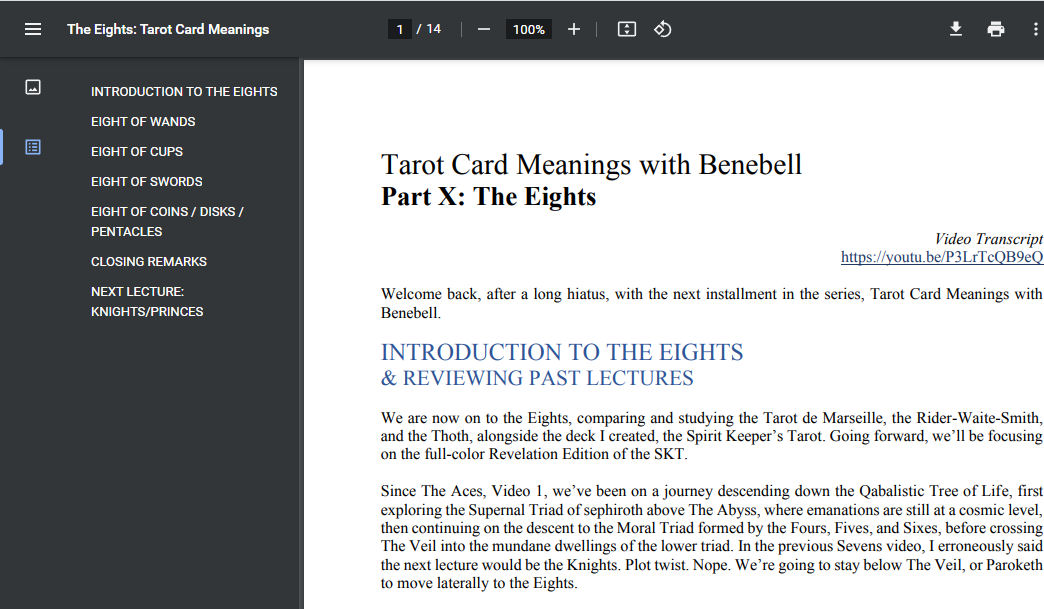
The transcript for every video lecture is provided. You can go to the Video Series Homepage, scroll down to “CONTENTS LISTING,” and download the PDF transcript notes for each installment.
If you’re working off the digital docs, you can open up the navigation pane and jump between the bookmarked sections.
The above-linked Introduction page will give you an overview of what this series is about and provide a course contents listing.
HELP KEEP THIS CONTENT FREE!
Purchase an Independent Study Course
Check out the lineup of self-paced online courses offered.
To support free content like this video installment on the tarot Sevens, please consider purchasing one of my independent study courses. A listing of all online courses offered is provided here: Independent Study.
I had the incredible opportunity of meeting Dr. Yolanda Robinson in London a few years back, where she gifted me with a copy of Studies on Mystical Tarot: The Court Cards, published in 2013.
Sourced from Studies on Mystical Tarot: The Court Cards (2013) by Yolanda M. Robinson
Robinson is a professor of transformational psychology and a member of BOTA, the Builders of the Adytum, a western mystery school tradition dedicated to the study of Qabalah and the Tarot. Studies on Mystical Tarot explores the tarot courts through a Rosicrucian lens, contextualizing the courts through Hermetic Qabalah and modes of inner alchemy.
This Sightsee the Tarot video installment will guide you through two self-reflection meditative exercises with the court cards in your favorite tarot deck. The first will focus on the four Kings to reaffirm your personal power and the second will be working with the Page of Pentacles.
I’m tickled by the coincidence of 2021 being the year the Revelation and final edition of the Spirit Keeper’s Tarot was released and it also being my Key 20: Judgement year. Traditionally this card was named Last Judgment and depicts prophetic scenes from the Book of Revelation.
My birthday is September 24 (9 + 2 + 4 = 15), which you then add to the digits for the given year (2 + 0 + 2 + 1 = 5) for the sum 20.
Major life shifts happened to me in 2021. What feels universally true about Judgement moments is that the past flashes before your eyes in an instant. Meanwhile the present is happening in slow motion, and your sense of the future is exciting yet uncertain. If Tower events are when you feel like the world you had built is crumbling down around you, then Judgement events are when you feel like you’re hydroplaning.
Ancestral Tarot (Red Wheel Weiser, 2021) by Nancy Hendrickson, a genealogist and tarot master, is an incredible journey into self-discovery through ancestor work. This Sightsee the Tarot video is a guided meditation and three-card reading from Ancestral Tarot— how to commune with your Ancient Ones. You’ll find this spread in Chapter 5, Ancestors of Blood.
I’ve reviewed the Life Line Tarot by Thomas of Hermit’s Mirror before here, and I’m loving that there’s a companion or sequel Life Line Lenormand! Actually, it’s the Life Line Lenoracle because this is three deck packs in one.
For each year of your life, you have a card from the Major Arcana called the Tarot Year Card, which represents the tests and lessons you’ll experience in any given year. Your Tarot Year Card indicates the kind of archetypal energies that are constellated in that year, suggesting personal qualities you can work with.
In Archetypal Tarot (Weiser, 2021), Mary K. Greer connects astrology and numerology to the tarot to create an in-depth personality profile that can be used for self-realization and personal harmony.
This video workshop will explore Chapter 14 from Greer’s text. We’ll reflect on your Tarot Year Card from 2021 and write out forecasts for the year to come in 2022.
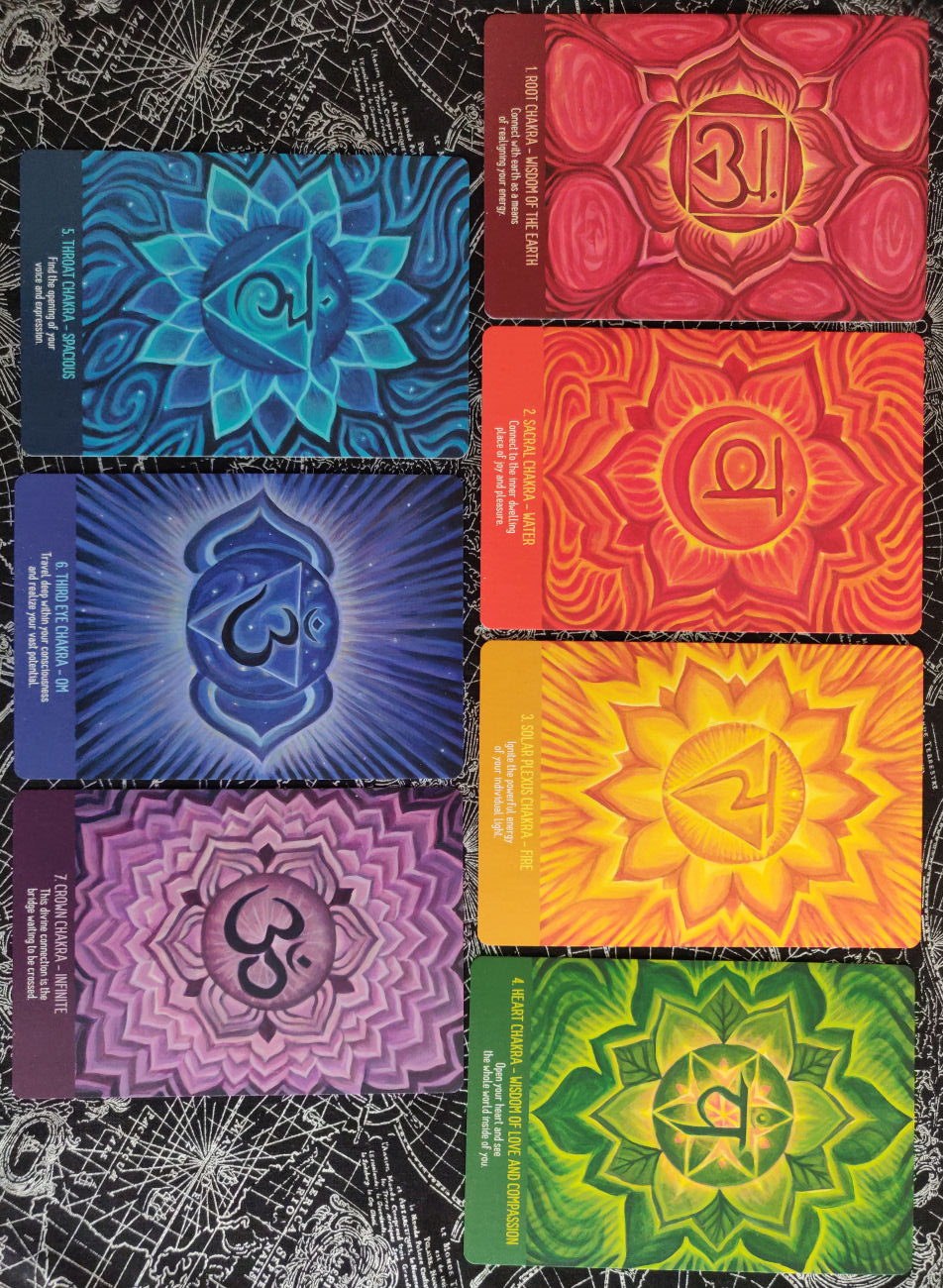
Infinite Wisdom of the Chakras, a deck with art by Dhira Lawrence and a guidebook authored by Alison DeNicola, is a multi-faceted toolkit for your personal spirituality. You might recognize DeNicola’s name– she’s also the creator of the Divine Feather Messenger Oracle Cards and Mudras: For Awakening the Energy Body. She also created the Yoga Cats Deck, which I have, but huh– interesting– I don’t have a review posted for it.
Infinite Wisdom focuses on cultivation of your seven main chakra centers along your center meridian, but then also guide you through yoga asana or yoga poses that will help you realign your energy centers.
There are animal spirits and divinities to work with, guides for focused meditation, working with essential oils, healing sounds, and, of course, oracle card divination. There’s workings with Ganesh to help you remove obstacles that have been keeping you from achieving abundance, or the Bear spirit for harnessing the powers of protection.
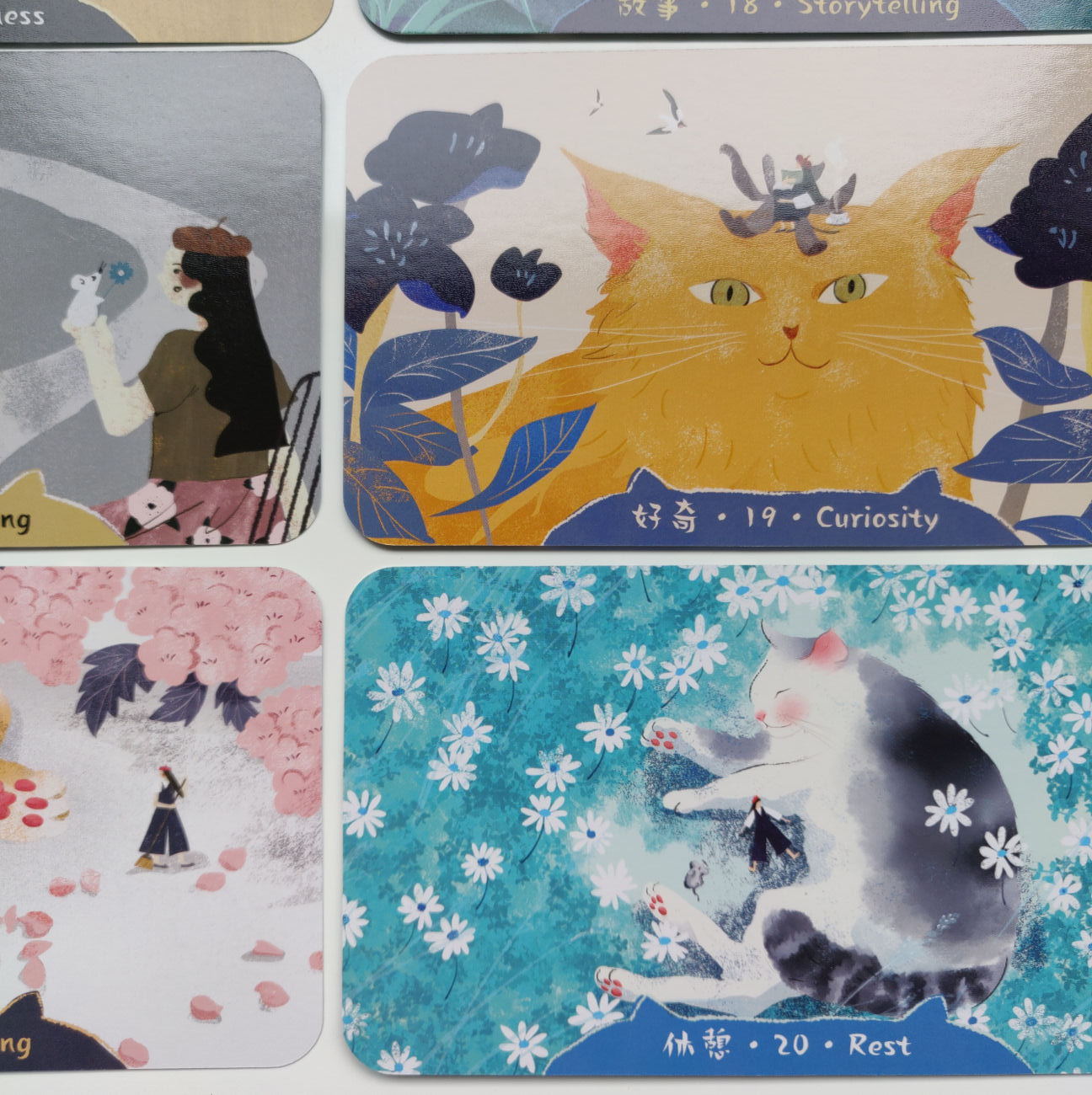
The Spirit of Cats Oracle deck is a Chinese-published deck, but the guidebook is written by my dear friend and Llewellyn author Jaymi Elford. It’s a simple, intuitive 24-card deck for cat lovers. “Cats are mirrors of humanity,” writes Elford. The Spirit of Cats Oracle will tap in to your connection to cat spirits to guide you to a deeper understanding of yourself and the undercurrent of your life.
Each cat depicted is larger than life, in scale to the humans pictured on the cards. I love that! These cards are 24 archetypes of the human soul, manifested as cat spirits. Aw, look at the Cat of Rest– I’m amused by the role reversal between the human and the cat here.
A video I watched inspired me to hit the record button and share these thoughts. But this is no longer a direct VR to that video (and in fact this video might have taken on a more melancholic tone than intended).
Instead of being a direct VR to the video inspiring this sharing, I will be commenting on what my own experiences have been like.
Here are some of my thoughts 7 years in.
This video is unlisted, which means it won’t appear on my YouTube channel or on the public YouTube platform. I will be experimenting with moving away from that platform and posting more unlisted videos here on the personal website.
Video Transcript
For those who prefer reading over watching a video, here’s a cleaned up, polished transcription of the video:
This began as a possible video response to something I watched recently—a video where someone shared their thoughts on being a pagan author. But then, my ramblings diverged into something else entirely. Still, for context, this started as a reflection on the social and professional pressures of being a pagan author.
Specifically, I was thinking about how, once you’re published, people start to treat you differently. Your voice becomes memorialized in a public, two-dimensional space with a lot of visibility—and when that happens, something reductive tends to occur to your personal identity. The audience no longer sees the full human behind the words. They reduce you—the author, a red-blooded, complex person with a past, biases, emotions, and opinions, some of them flawed—into a flat, two-dimensional caricature.
Once you become a pagan author, you’re no longer allowed to be multifaceted. You’re no longer seen as someone with complex or evolving thoughts. Heaven forbid you once published something a decade ago that no longer reflects who you are today—it will still haunt you.
When you brand yourself as an author, you’re branding yourself as a single archetype. And yet, a fully developed human being is made up of many archetypes at once. If your branding is successful, then people will only see that one archetype you’ve presented. And they will judge you as that limited version of yourself.
How people perceive that reduced archetype—this caricature—is often polarized. You’re either pure brilliance or pure awful. You’ll either be the hero on a pedestal or the villain someone is determined to take down. And when they do take a swing at you, they get to be the underdog hero that the audience roots for.
The irony is that most of us who become authors—most writers—are shy, introverted, insecure people. We’ve experienced marginalization. We were often the outcasts, the underdogs, the kids who got picked on. And now, suddenly, because we’re published, we’re perceived as the Goliath. But not a single bone or nerve in your body actually feels like Goliath.
There’s a kind of dissonance there—I don’t even know if I’m using the word “cognitive dissonance” correctly—but something happens when you’re faced with that mismatch between how you’re perceived and who you know yourself to be.
People say, “Never meet your heroes,” and now, bizarrely, they’re referring to you.
And with the rare exception of the narcissistic bad apples in any field, I can assure you—no author wants to be a hero. No one wants to be seen that way. And it’s not about false modesty. It’s just the truth. When you call someone a hero—when they’re just an ordinary person trying to live their life—you’re setting them up to fail.
An author is just someone who took the time and effort to sit down and write out their thoughts in a (hopefully) cohesive, organized way—and had the grit to see the manuscript through to publication. That’s it. That’s all it is.
I don’t think Noam Chomsky or Eckhart Tolle necessarily has more brilliant ideas than, say, my husband James hasn’t already come up with himself—while sitting in the bathtub with a beer in hand. You know what I mean? The difference is that a published author has a particular skill set and stamina for completing manuscripts that maybe Joe Plumber hasn’t developed, or hasn’t had the time or opportunity to develop yet.
To the new pagan author: I warn you—people will forget that you have feelings. Or worse, they won’t forget. They’ll realize you have feelings and just not care.
And to be fair, it’s not entirely the public’s fault. It’s partly our fault, or maybe the industry’s. There’s intense pressure to brand yourself as an author. If people can’t sum up who you are and what your work is about in three words, you won’t gain popularity. But if they can sum you up in three words—congratulations, you’ve branded well—and you’ll be rewarded with visibility.
But then, to maintain that visibility, you have to stay on brand all the time. There will be constant external pressure for you to stay in your lane. A private person who hasn’t branded themselves can have different opinions on all kinds of topics. No one asks them for sources or a CV. But as a public figure, you don’t get that grace anymore—not after publication, and certainly not if your branding is successful.
Once you become known for something, you’ll only be “allowed” to speak on that narrow range of subjects. You’ll be told to stay in your lane. People will say that author branding is a double-edged sword—and they’re right. The more successful your branding, the more your voice seems to matter. But at the same time, the more your true self gets lost in the process.
Live by the sword, die by the sword, I guess.
To the new pagan author: I warn you that, at some point, you will be called a gatekeeper.
Let’s say in your book, you write something simple, like, “Personally, I think strawberry jam is better than blueberry jam. I’m not particularly fond of blueberry jam.” That’s all you said. But people will misinterpret it. They’ll claim you said blueberry jam is inferior to strawberry jam. That you’re disparaging people who like blueberry jam. That you’re dismissing the entire population who prefers it.
And before you can even clarify, you’ve become that author—the one who gatekeeps jam.
To the new pagan author: seasoned authors will often tell you not to care what others think. Don’t worry about what people say. Shrug it off. Don’t pay attention to the negativity.
I’m still conflicted about whether that’s healthy advice. I really don’t know.
We should care what our loved ones think of us—because how they perceive us is a reflection of how we’ve treated them. And in my personal spiritual worldview, we should treat everyone as our loved ones. We should love all people. And if we do love people—truly—then we should care about what they think of us. Their thoughts and feelings about us reflect, whether we like it or not, how we’ve been treating them.
So in that sense, shouldn’t we care? Shouldn’t we be open to hearing when someone thinks something negative about us—and ask, “Is that a fair reflection of how I’ve treated them?”
But then again—what do you do when it’s the entire internet calling you a terrible human being?
How do you process that in an emotionally healthy way?
Here’s the conundrum: when you publish a book, you need to consent—at least intellectually—to being critiqued. To being criticized. That’s part of the deal. And if your voice becomes influential, then for the sake of intellectual checks and balances in a democratic society, your ideas should be vigorously challenged.
If you’re smart, then on some level, you understand that.
But… do we ever really grow out of being that little kid who got picked on for being different?
Why does public condemnation of your publicly celebrated work feel so much like the bullying you endured as a kid, when you were nobody?
So to the new pagan author, I’ll just say this: For some reason, the grass is always going to feel greener on the other side.







 benebell wen