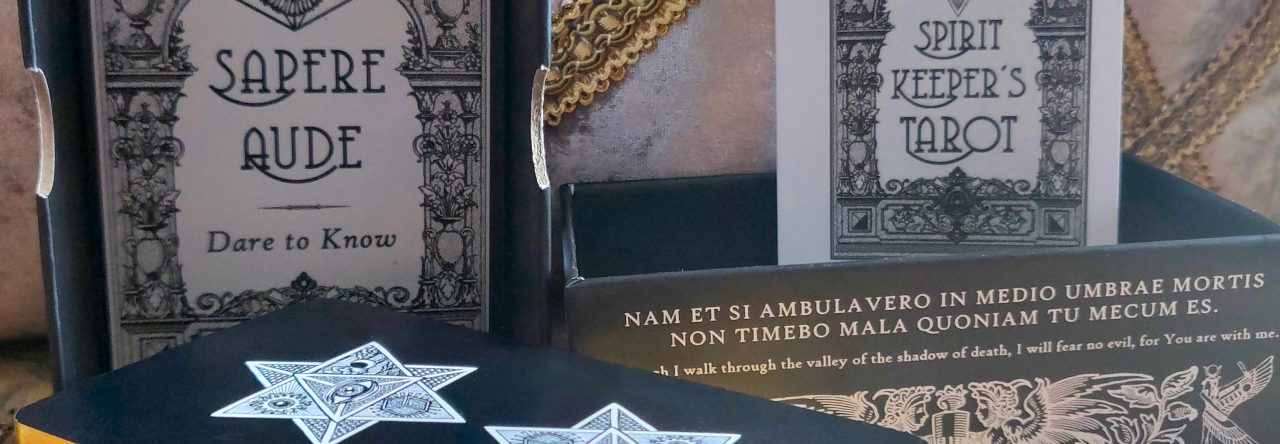
The following is from a keynote presentation I did at the Northwest Tarot Symposium in 2022, the materials now made freely and publicly available.
The subject of this presentation was one more often seen as taboo: using the tarot to do health readings.
Spiritual health and its interaction with physical, psychological, and social wellness had been gaining serious attention in medical literature. So I wanted to consider those perspectives in a discussion on spiritual health and tarot.
What this post provides is a summary of the workshop, the PowerPoint presentation slides I used during the keynote that you can now download and walk through, and all the handouts and resources that were provided to the attendees.
Just a note for those who might be interested: the “Learning the Opening of the Key” video and workbook course from 9 years ago is now freely available.
You’ll first want to click onto the below hyperlinked page to download the workbook PDF and all supplemental materials:
Botanical Dreams Oracle by Lynn Araujo and Catrin Welz-Stein
I partook in this thought leadership workshop and learned about the five categories of questions to ask for more effective, strategic decision-making. Being me and having the interests I do, of course I immediately connected these learnings to tarot, I Ching, and in general divinatory readings.
Teachers in nearly every divinatory tradition or system talk at length about the importance of how you ask and frame questions for divination. The quality of answers you receive — be that in strategic leadership, personal development, or divination – is directly influenced by the clarity, precision, and intention behind the questions you’re asking.
Apothecary Spirits Oracle by Eric Maille, Michael Anthony, and Thomas Witholt
A well-framed question acts like a lens. It brings your focus to what truly matters, and in the case of readings, hones the focus narrowly on what it is you most want or need to know. The better your question, the more noise will get filtered out of the reading result, enhancing meaningful insight.
Thinking about how to frame questions through the principles of these five categories is really helpful, I think. Hence, this share.
The Playful Heart Tarot and the PipSpeak Tarot by KittenChops
You may be familiar with the Playful Heart Tarot by Kitten Chops (Zaara), based on the RWS, whereas the latest creation from the KittenChops studios is a Marseille-based pip deck, the PipSpeak Tarot.
After completing the RWS-based Playful Heart Tarot, Zaara redefined her work with the tarot by unpacking her RWS framework and re-learning the tarot with the Marseille. The result is the PipSpeak Tarot, which became a liberating experience. Likewise, this might just be the very deck to get a seasoned RWS reader out of a rut.
From the little white book (LWB) for the PipSpeak Tarot
“Fortune tellers and cunning folk have been reading with Marseille and playing card/pip decks for hundreds of years,” writes the artist. “Instead of esoteric intellectual prowess, these readers have been relying on their common sense, their understanding of human nature and key card reading wisdom passed down from generation to generation.”
If you’re from the corporate world you might have heard of the Six Sigma quality management methodology or the acronym DMAIC blah blah but even if you haven’t, no worries. This is just a tarot spread inspired by Six Sigma principles and that process flow of D (Define), M (Measure), A (Analyze), I (Improve), and C (Control).
This card reading method (it’s workable with an oracle deck, not just tarot) is less in the space of mysticism or divination, and more in the space of pragmatism and driving you to be a more creative and critical thinker.
For a ballpark sense of how many videos are now unlisted, as of this posting only 129 of 405 total videos are publicly visible in the general Videos tab and thus only those 129 videos are searchable on the YouTube platform.
Psychism vs. Psychology: Transcending the Binary Bias in Tarot
For the 2023 Masters of the Tarot Conference held at the Omega Institute, the theme is magic, mysticism, and neuroscience.
My presentation will be on practical reading methods for transcending innate binary bias. We’ll be talking about what that binary bias is in both neuroscience and the world of tarot and how to bridge the binary through assigned correspondences and guided imagery, a tempered method for bilateral cognitive stimulation.
Due to the layering of images to create animation effects, you’ll need to view the slides in Slide Show.
INSTRUCTIONS FOR VIEWING: Along the upper row of tabs, click on “Slide Show.” Then click on the icon “From Beginning” to start the animation.
You will have received a printout copy of the above downloadable handout. Here are the digital files in case you want additional copies, or you would like to integrate this information into your personal working journals.
7/18 REVISION: Please re-download the handout with the correct correspondence table. Recall there was a typo between the Water and Air columns under “Physical Body” correspondences.
This is a compilation of notable sources I found discussing brain lateralization, with bullet point summaries of the contents of each resource.
“Tarot’s Chinese sister, the I Ching.”
– Rachel Pollack, A Walk through the Forest of Souls
HOMEWORK
As an additional bonus step, and to further symbolically bridge the binary, combine your two card readings from the workshop to yield an I Ching hexagram reading. As Rachel Pollack notes, the I Ching is “Tarot’s Chinese sister.”
Begin by identifying the corresponding Ba Gua trigrams to the two tarot cards you pulled during the workshop.
Click on image file to download
The first card you had pulled, reading elemental correspondences per Body, Mind, and Spirit, will be the Lower Trigram (left most column).
The second card you pulled, for the guided imagery exercise, will be the Upper Trigram (top most row).
Here’s an alternate version of the table for your archives:
Click on image file to download
Use the below cross-reference table to identify the six-line hexagram that your two tarot cards form:
Click image file to download
Here’s the I Ching cross-reference table found on your workshop handout. It’s the same as above, but without the hexagram images.
Click image file to download
Once you’ve identified the resulting hexagram, look up its short form oracle message in the below download:
The above book of short form oracles summarizing the meaning of the 64 hexagrams is excerpted from my forthcoming book, I Ching, The Oracle, published by North Atlantic Books (September, 2023).
This is Video 14 in an educational series on the tarot cards. Closed captioning is provided for all videos in this series. A written transcript is also provided as a free pdf download.
The transcript for every video lecture is provided. You can go to the Video Series Homepage, scroll down to “CONTENTS LISTING,” and download the PDF transcript notes for each installment.
I’m so close to completing the Minor Arcana for this series. =) Here we are on the Tens, then the Pages, and done. At least for the Minors. After that, the Majors.
But as of this moment, I’m anticipating that the Majors should go fairly quickly. I plan on doing a septenary per video, so that’s 7 of the Majors knocked out in each installment. I dunno. What do you prefer– long videos covering more cards? Or short videos with less cards covered in each?
The transcript for every video lecture is provided. You can go to the Video Series Homepage, scroll down to “CONTENTS LISTING,” and download the PDF transcript notes for each installment.
The transcript for every video lecture is provided. You can go to the Video Series Homepage, scroll down to “CONTENTS LISTING,” and download the PDF transcript notes for each installment.