I’m an I Ching aficionado and also a tarot aficionado, wrote chonky books on both subjects, so naturally I’ve thought long and hard about how the two systems reconcile. This page is a download of a tarot and I Ching correspondence table for your easy go-to referencing.
Frater Setnakh is one of the most incredible, detail-oriented artisans of ritual artifacts I’ve come across. I’ve previously reviewed the 72 Angels Talisman Coins and Cards he sent me, which I keep on display in my sitting room. Here I’ll be showcasing his latest offering, Tarot Coins, along with the Guardian Angel Coins, or Seven Archangels.
The detailing on these coins is incredible, so I’ll also be showing a zoomed-in view of several of the coins, photo essay style. You can click on any of the images and magnify the photo to see just how fine the craftsmanship is here and each coin’s delicate engraving.
Per the ritual artifact description, this is the “world’s very first collection of tarot coins inspired by the Rider-Waite deck.” And personally I have yet to see tarot coins crafted at this level of detail and intricacy. They’re simply exquisite.
Left or Right – Which one do you prefer? The left G-rated version that leans more into psychological pain? Or the right bloody version that leans more into the physical manifestation of our suffering?
First three left to right are representative of the TdM, RWS, and Thoth, respectively; fourth is from the DruidCraft Tarot, and fifth is from the Tarot of the Owls by Elisabeth Alba and Pamela Chen
The Ten of Swords in tarot has come to be associated with betrayal, treachery, backstabbing, the pain of being double-crossed, and the breach of trust. So how a deck creator illustrates the Ten of Swords reveals a lot about their unconscious processing of these themes.
It’s also the soul wound, a crisis of faith, where faith and reason are at war. It’s the mob mentality vs. individuality. Seeing an artist’s rendering of the Ten of Swords will reveal to you that artist’s relationship to the archetype of the ego-death.
You’re probably quite familiar with the “For Dummies” learning series that were popularized in the 90s. The book series published by Wiley & Sons de-mystifies difficult subjects and is known for accessible, easy-to-understand, plainspoken writing. Wiley could not have chosen a better author for the task than my dear friend Charles Harrington.
Although the “For Dummies” series catches a kitschy rep, this is in all seriousness a legit, no-nonsense, superb beginner’s book on tarot and oracle decks — and I love the dual coverage this compact yet comprehensive book packs for you.
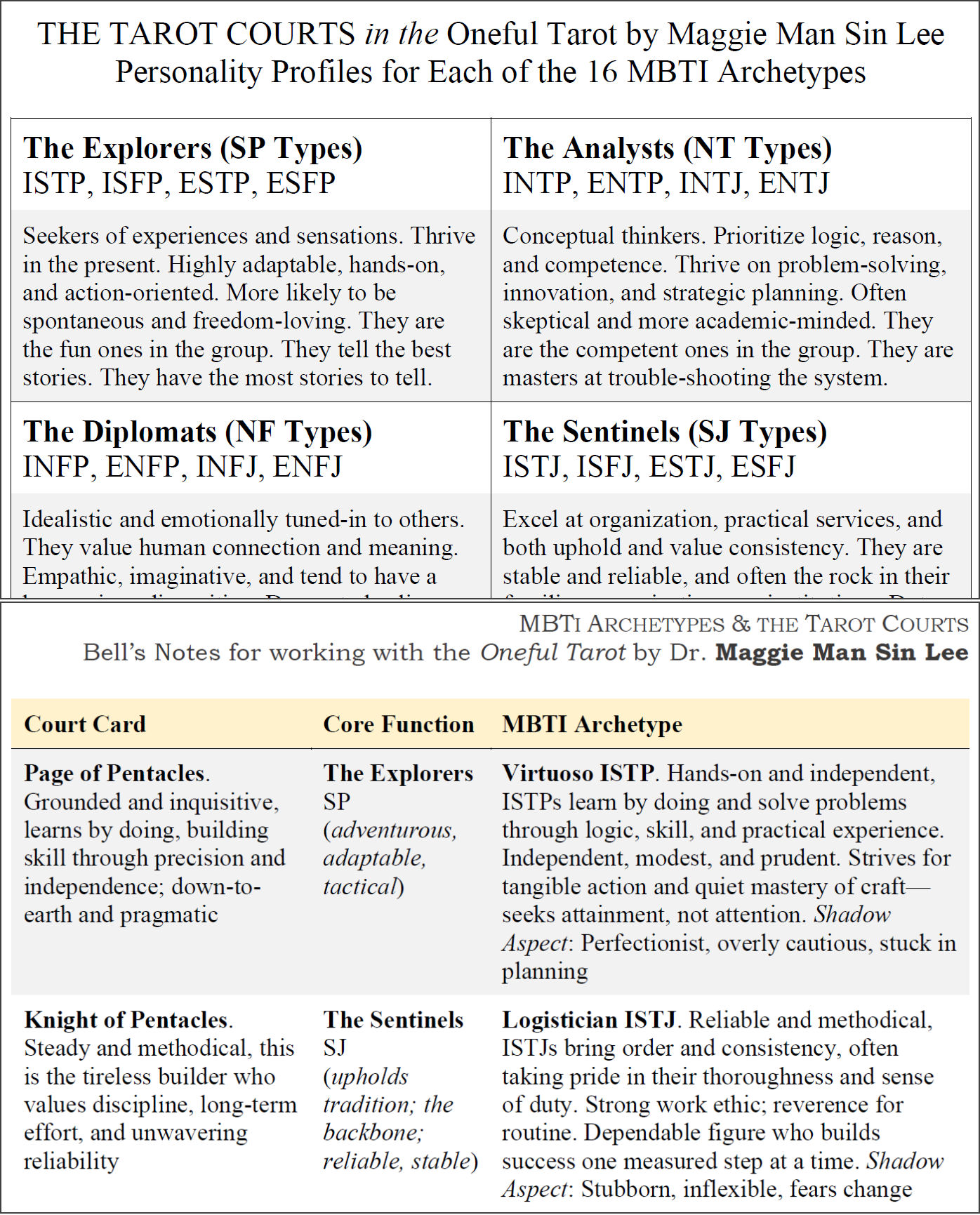
The Oneful Tarot is inspired by MBTI (Myers-Briggs Type Indicator) personality archetypes and using the tarot to recognize our personality patterns. It was created by Dr. Maggie Man Sin Lee, a Hong Kong-based academic researcher, caregiver advocate, naturopath, and corporate wellness consultant, and brought vividly to life by illustrator Chinkal Pareek.
NOTE: If you’d like to download my personal notes on the MBTi personality profiles for the tarot court cards, which I use as reference in tandem when working with the Oneful Tarot, scroll down to the end of the deck review.
“When rationality runs dry, it’s Red that will reconcile this world, a hue vibrant and vital inside its brown.”
And so opens Chapter 1, Zero, of Red Tarot: A Decolonial Guide to Divinatory Literacy by Christopher Marmolejo. This is going to be a tarot book like no other. I can tell already. :: hearts for eyes ::
“To be born, this work broke open my heart, and so let this reading be opened by my blood offering, a requisite pound of flesh…”
Marmolego’s writing is going to draw out your feels, that’s for sure. Either you will be fully onboard this train or you will be left scratching your head. You’ll see what I mean. Let’s continue.
Red Tarot is not an easy read, but it’s not intended to be. It’s filled with dense layers covering symbolism, mythology, history, present day politics, literature, and so much more. This book is about shedding red light on each card in the tarot to reveal it as a prism of political praxis, inspired after Prof. Sandy Grande’s Red Pedagogy.
Each tarot card entry draws from four key disciplines:
literary fiction as political expression,
gender studies and theory,
anti-colonialist philosophy of education and decolonizing pedagogy, and
performance studies, whereby theatrics, divination rituals, ceremonial rites, and social expressions are revelatory of core truths in the human experience.
This is achieved by weaving in the teachings of Toni Morrison, bell hooks, Paulo Freire, and José Esteban Muñoz.
The Masonic Tarot came out in October 2022, created and illustrated by Chilean artist and academic Patricio Diaz Silva, and it is in the top 10% of the most well-done tarot decks in recent years. The illustrations for the Major Arcana are exquisite, as are the court cards.
Do note, however, that this deck has elected to go with non-narrative illustrations for the pips, which works for the Masonic Tarot given its ceremonial leaning purposes.
The deck is designed as a “gateway into the secret mysteries of the soul” integrating the sacred symbolism of Freemasonry. The premise melds together the arcana of the tarot with models from Masonic rites, with heavy emphasis on alchemy.
Psychism vs. Psychology: Transcending the Binary Bias in Tarot
For the 2023 Masters of the Tarot Conference held at the Omega Institute, the theme is magic, mysticism, and neuroscience.
My presentation will be on practical reading methods for transcending innate binary bias. We’ll be talking about what that binary bias is in both neuroscience and the world of tarot and how to bridge the binary through assigned correspondences and guided imagery, a tempered method for bilateral cognitive stimulation.
Due to the layering of images to create animation effects, you’ll need to view the slides in Slide Show.
INSTRUCTIONS FOR VIEWING: Along the upper row of tabs, click on “Slide Show.” Then click on the icon “From Beginning” to start the animation.
You will have received a printout copy of the above downloadable handout. Here are the digital files in case you want additional copies, or you would like to integrate this information into your personal working journals.
7/18 REVISION: Please re-download the handout with the correct correspondence table. Recall there was a typo between the Water and Air columns under “Physical Body” correspondences.
This is a compilation of notable sources I found discussing brain lateralization, with bullet point summaries of the contents of each resource.
“Tarot’s Chinese sister, the I Ching.”
– Rachel Pollack, A Walk through the Forest of Souls
HOMEWORK
As an additional bonus step, and to further symbolically bridge the binary, combine your two card readings from the workshop to yield an I Ching hexagram reading. As Rachel Pollack notes, the I Ching is “Tarot’s Chinese sister.”
Begin by identifying the corresponding Ba Gua trigrams to the two tarot cards you pulled during the workshop.
Click on image file to download
The first card you had pulled, reading elemental correspondences per Body, Mind, and Spirit, will be the Lower Trigram (left most column).
The second card you pulled, for the guided imagery exercise, will be the Upper Trigram (top most row).
Here’s an alternate version of the table for your archives:
Click on image file to download
Use the below cross-reference table to identify the six-line hexagram that your two tarot cards form:
Click image file to download
Here’s the I Ching cross-reference table found on your workshop handout. It’s the same as above, but without the hexagram images.
Click image file to download
Once you’ve identified the resulting hexagram, look up its short form oracle message in the below download:
The above book of short form oracles summarizing the meaning of the 64 hexagrams is excerpted from my forthcoming book, I Ching, The Oracle, published by North Atlantic Books (September, 2023).
This is Video 14 in an educational series on the tarot cards. Closed captioning is provided for all videos in this series. A written transcript is also provided as a free pdf download.
The transcript for every video lecture is provided. You can go to the Video Series Homepage, scroll down to “CONTENTS LISTING,” and download the PDF transcript notes for each installment.
I had the incredible opportunity of meeting Dr. Yolanda Robinson in London a few years back, where she gifted me with a copy of Studies on Mystical Tarot: The Court Cards, published in 2013.
Sourced from Studies on Mystical Tarot: The Court Cards (2013) by Yolanda M. Robinson
Robinson is a professor of transformational psychology and a member of BOTA, the Builders of the Adytum, a western mystery school tradition dedicated to the study of Qabalah and the Tarot. Studies on Mystical Tarot explores the tarot courts through a Rosicrucian lens, contextualizing the courts through Hermetic Qabalah and modes of inner alchemy.
This Sightsee the Tarot video installment will guide you through two self-reflection meditative exercises with the court cards in your favorite tarot deck. The first will focus on the four Kings to reaffirm your personal power and the second will be working with the Page of Pentacles.