Witchcraft vs. Ceremonial Magic?

First posted in a newsletter e-mail 2019 Dec. 5 to talk about my Western Witchcraft I: The Fundamentals and Doctrinal Basis independent study course

What is the difference between witchcraft and ceremonial magic?

I’ve been struggling to understand for myself what the distinction is between witchcraft and ceremonial magic. Because the immediate go-to points of differentiation you often hear people reach for feel kinda superficial.

There are more significant differences between two different traditions under the heading “witchcraft” (or two different traditions under “ceremonial magic”) than there are the alleged differences between the main generic headings “witchcraft” or “ceremonial magic.”

It was all “maleficia“…

Pretty much up until witchcraft or maleficia was no longer outlawed, what we today might associate with ceremonial magic would have been tucked under the heading “witchcraft.”

The law (back when the law cared about public accusations of maleficium…) lumped it all together and while I was doing historic research for my novel, bishops and otherwise powerful men had gotten accused of witchcraft and for being witches (though in those cases, they were probably false accusations; those men were just challenging political power).

Continue reading “Witchcraft vs. Ceremonial Magic?”

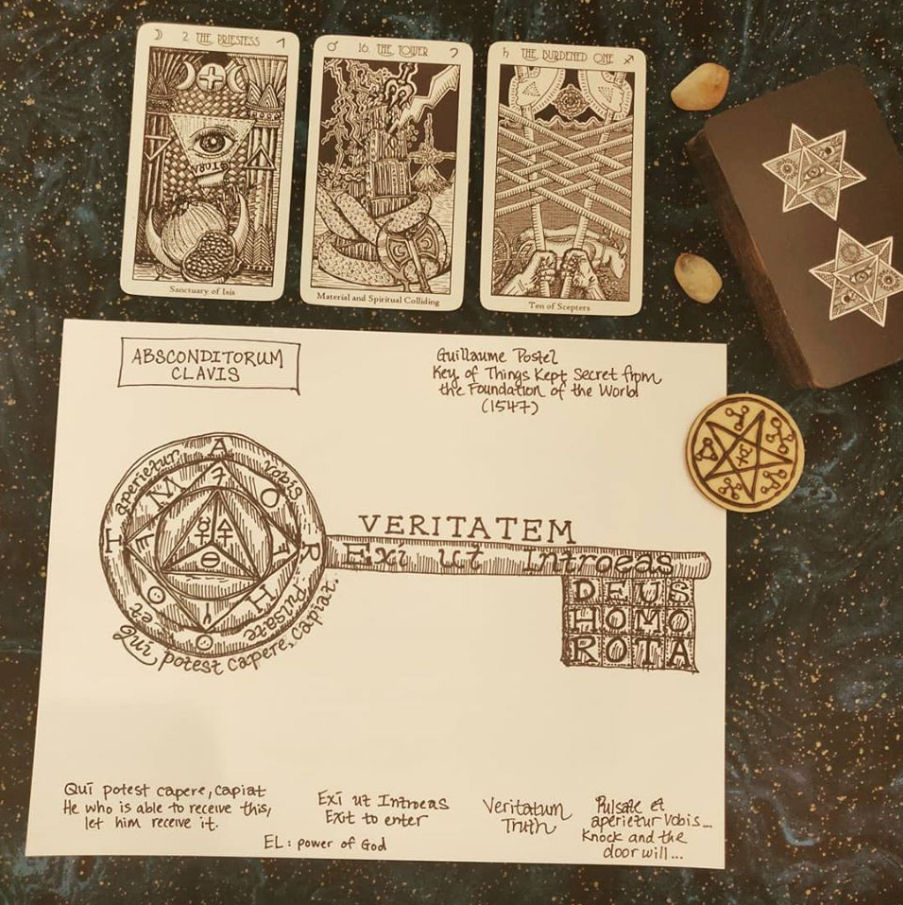
Postel’s Key of Things Kept Secret (1547)

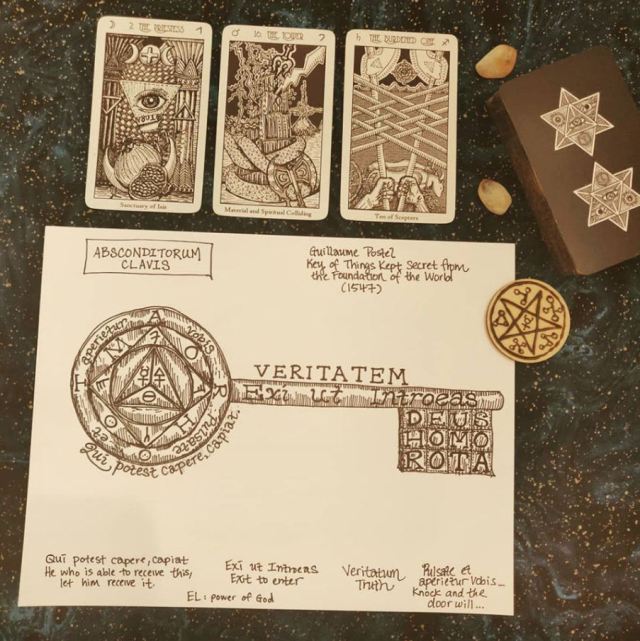
Published in 1547, Guillaume Postel’s Key of Things Kept Secret from the Foundation of the World (full title Clavis, Absconditorum a constitutione mundi clavis) proposed the notion of a universal wisdom and truth that underlies all religions, languages, and symbolic systems, and that there was a unifying language — a divine script — by way of symbolism and math (sacred geometry) with correspondences into each human language, which unlocks that universal wisdom and truth.
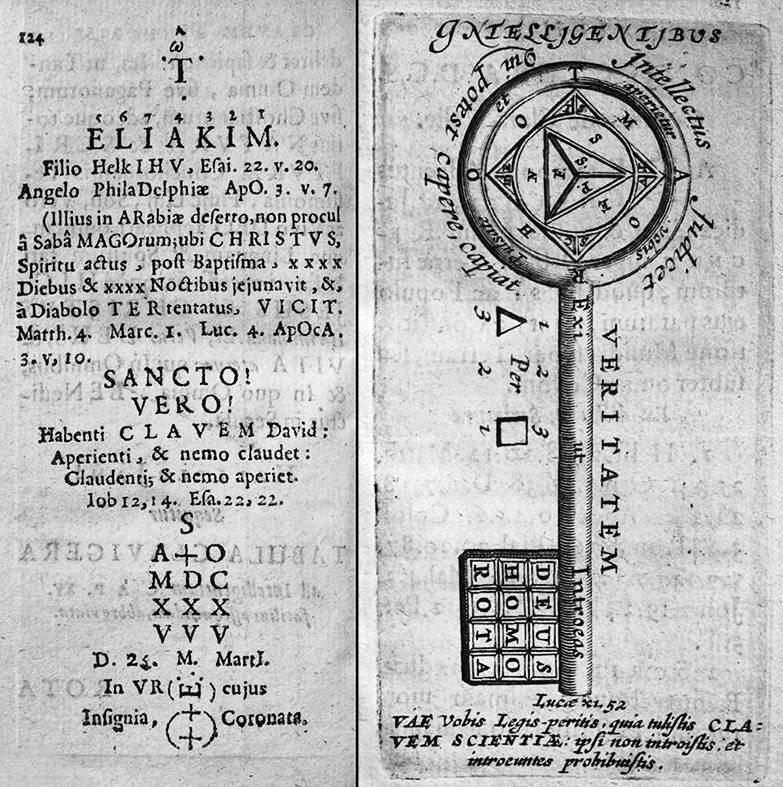
To access that unifying language, one would need a Key to decode from the language you speak now to that language, and French occultist and mystic Eliphas Levi would later revive this concept as the Key to the Great Mysteries, which he said was the tarot, and all this became a key principle in Western esotericism.

Guillaume Postel (1510 – 1581) was a French scholar, diplomat, Christian Kabbalist, and mystic who traveled widely across the Middle East where he learned Hebrew, Arabic, and Syriac. His Key of Things Kept Secret came at the height of the Renaissance’s prisca theologia movement, this intellectual current that believed all religions and philosophies derive from a single, ancient, and divine source. Postel sought to reconcile Christianity, Judaism, Islam, and all human traditions through what he called Orbis Concordia, or a universal harmony of the world. And the Key, the Clavis was the methodology for deciphering that prisca theologia.

Postel believed in the Eastern esoteric concept of soul dualism, though he framed it differently, i.e., instead of saying “yin and yang” aspects of soul, he said “female and male” aspects of the soul, with one being emotion and the other being intellect. Oh. Wow. Anima and animus, anyone? (Yeah, yeah, I know, not the same…) Nonetheless, bear in mind that Postel pre-dates Carl Jung by some odd 365 years.

Concept Postel’s View
The Key The universal code that reveals divine order in all things
Basis Hebrew Kabbalah + Christian theology + Hermetic correspondences
Purpose To restore humanity to its original divine knowledge
Means Study of sacred language, numbers, and symbols
Outcome The reunification of all religions and nations under divine harmony

The more you dig into Postel, the more interesting it gets. At one point he believed himself to be a prophetic interpreter in possession of such a Key, and that as a result, he is here to proclaim that there would be a female messiah, a Mater Mundi, who would usher in a new age of universal harmony. Needless to say, he eventually found himself a target of the 16th century Inquisition and was subsequently imprisoned and forced to recant his propositions. At one point, Clavis was even a banned text.
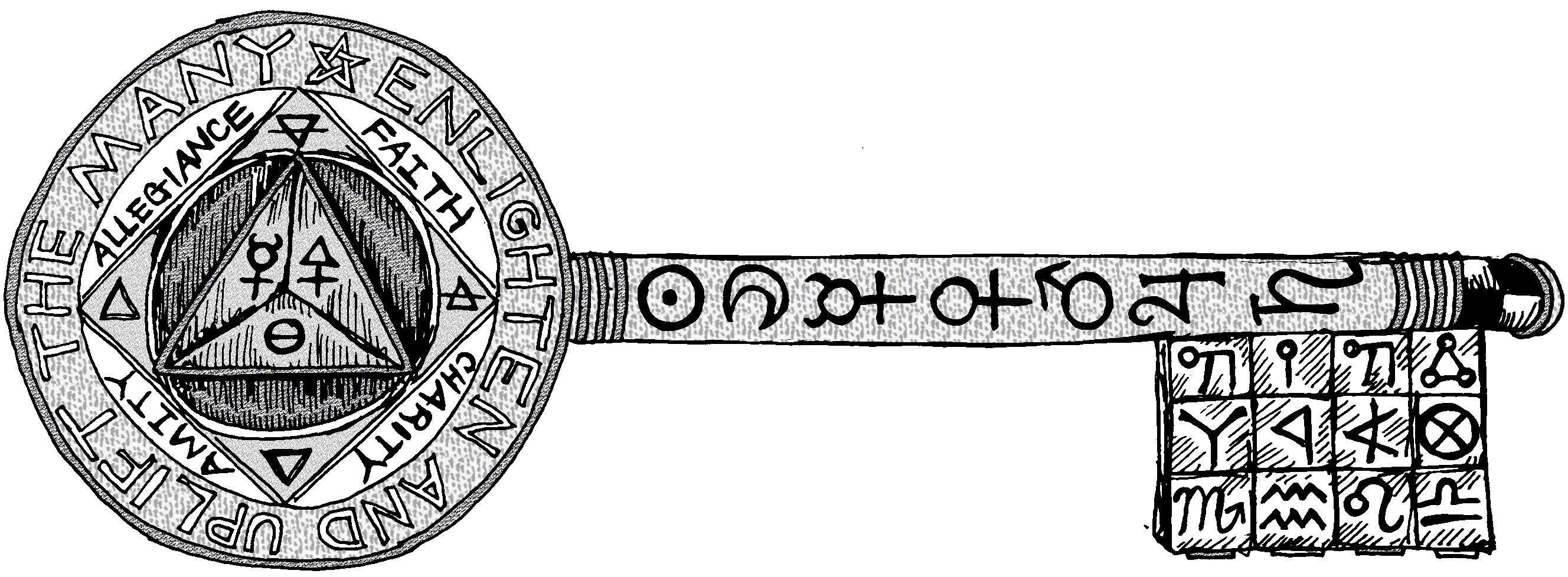
Postel’s Key endeavored to unlock a universal code for deciphering any mystery or esoteric wisdom, with the “translation” work happening by way of correspondences. In other words, the “Key” isn’t a physical instrument, but a methodology for interpreting Matter and Spirit.

Continue reading “Postel’s Key of Things Kept Secret (1547)”

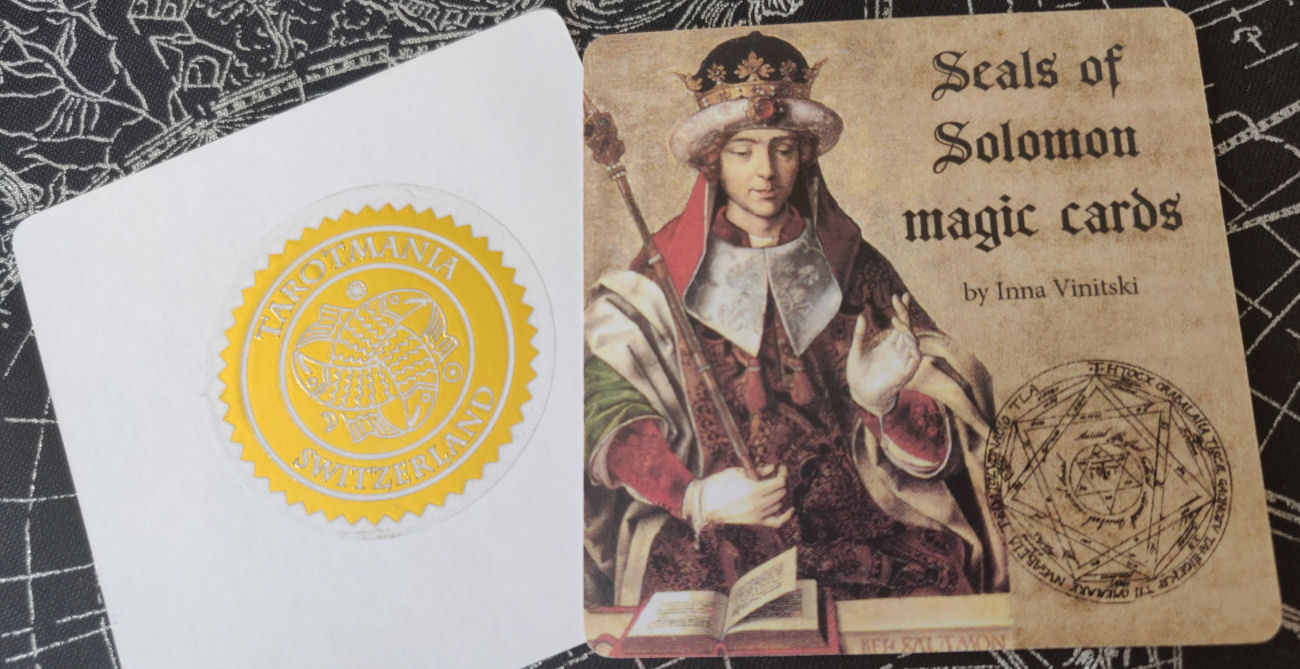
Seals of Solomon Magic Cards by Inna Vinitski

Inna Vinitski’s Seals of Solomon Magic Cards are the perfect companion tool to go along with your copy of the Key of Solomon, or Clavicula Salmonis, which I offer a free download of here. So although this deck does not come with a guidebook, everything you need to know about these seals and now to work with them can be found in that free download. I’m going to be making page references to that free download pdf of Key of Solomon.

I think the single most compelling reason to acquire this deck for your toolkit is to use them as easy, go-to charging plates for your charms, talismans, gemstones, crystals, and other metaphysical knick-knacks. Here, Inna Vinitski has already done the work for you. Once you get these cards, consecrate them and voila! Incredible! A set of tools for planetary magic at your fingertips!

This post will both showcase the Seals of Solomon cards, which I urge you to get if you want to deep-dive into working with the Key of Solomon, and also get into what the Key says about these seals, or pentacles.

To start, let’s try a little something, shall we? Below in the photo of the three magic cards, take a moment to gaze at each one, connecting your third eye (that space just between your brows) with the eye depicted on the card back. For one of these three cards, the tug at that space between your brows will feel stronger, more intense than for the others. Note which of the three cards gives you the strongest intuitive sensation.

Remember it, because we’ll be returning to your card selection later.

Continue reading “Seals of Solomon Magic Cards by Inna Vinitski”

The Keys of Solomonic Magic and Spirit Conjures

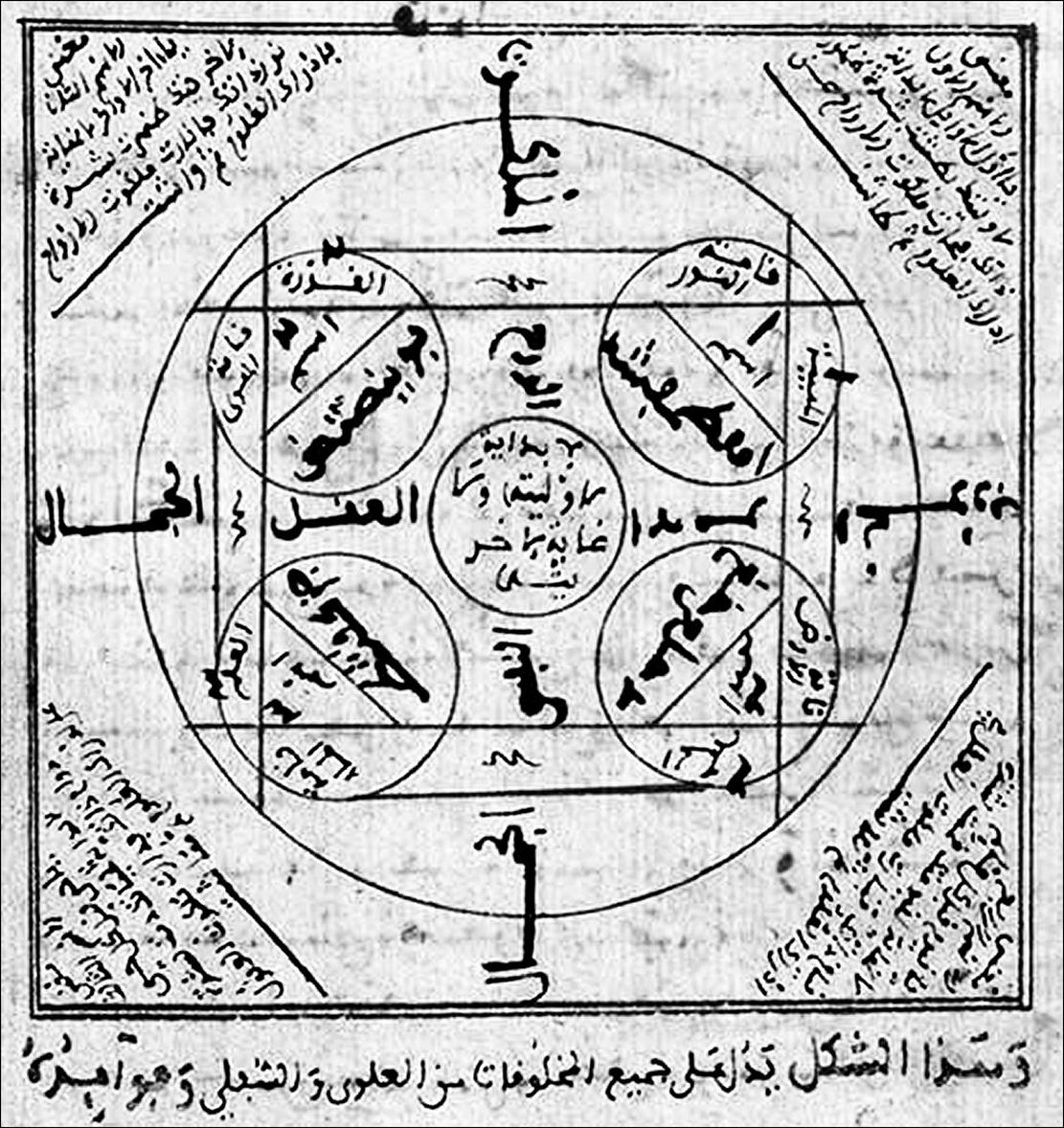
Clavicula Salomonis, grimoire in Arabic

Solomonic magic is pretty much the foundation of occultism, modern witchcraft, and ceremonial magic west of India and China, encompassing Europe, the Middle East, and now the Americas.

What you will discover within the pages of this book I’m sharing, you’re going to find to be the keystones of Persian magic and witchcraft, the magical practices of Muslim-influenced Southeast Asian countries, the Golden Dawn (though many of their correspondences differ), hoodoo, Wicca, and maybe even the traditions you’ve inherited and have been wondering where those traditions might have come from.

If you’re serious about your occult studies, then I hope you’ll add this text to your library and read through it cover to cover at least once.

From my vantage point, this book is essential reading, even if for no other reason than to take it apart to realize once and for all this is not for you. That, too, is invaluable. Whether you want to strengthen the connection to these roots or you want to sever ties with the roots altogether and grow anew, either choice calls for an examination of this text.

The images from historically significant grimoires, the essence of the ritual instructions provided, and the methodology behind the crafting of seals, devising the magical scripts, and even how to prepare for ritual can help to inspire your own creativity, offering sparks and revelations for how to do Craft your way.

From the Tractatis de Nigromatia (16th century), A grimoire on necromancy

If you’re a total beginner, then please do not try out any of these rituals or operations on your own. Plus, the instructions are pretty clear that most of these conjurations should never be performed solitary.

At the beginner and intermediate level, a light read of this text is going to be the best introduction to ceremonial magic, witchcraft, and occultism west of the Indies you can get.

This should be your orientation manual into the Craft and the beginner steps for realizing your Great Work. Levi even says as much, which is why in a course I was putting together focused on Levi, I ended up having to back-track and start first with the Key of Solomon.

Continue reading “The Keys of Solomonic Magic and Spirit Conjures”

SKT Tarot Readings Diary (Free Download)

This is the tarot readings diary keyed specifically to the Spirit Keeper’s Tarot deck that I promised back when I shared the downloads for the tarot journal collab with Scarlet, linked here.

SKT Tarot Readings Diary

This is a Tarot Readings Diary keyed specifically to the SKT. That means the “Classes & Workshops Log of Notes” is a note-taking section for all video courses outlined in the Free Esoteric Tarot Online Course for the Spirit Keeper’s Tarot, linked here.

The short form card meanings compiled from both the First Edition LWB and the Vitruvian Edition LWB are provided in the back of the Tarot Readings Diary for your convenience of reference.

Continue reading “SKT Tarot Readings Diary (Free Download)”

Tarot Card Meanings with Benebell (Study Journal Free Download)

This is the tarot study journal keyed with the SKT that I promised back when I shared the downloads for the tarot journal collab with Scarlet, linked here.

Tarot Study Journal

The Tarot Study Journal is for you to record all your card meanings and correspondences reference material. The structure of this journal is the same as the one previously shared for the tarot journal collab, except this one includes the Spirit Keeper’s Tarot deck. In other words, it’s a study journal for the Tarot de Marseilles, Rider-Waite-Smith, Thoth, and the SKT.

For those who have been following along the Tarot Card Meanings with Benebell video lecture series, this Tarot Study Journal is basically keyed to that video lecture series. So you can print out a copy of this journal and take all your notes from the lecture series in these pages.

Continue reading “Tarot Card Meanings with Benebell (Study Journal Free Download)”

Your Tarot Journal (Collaborating with Scarlet Ravenswood)

Scarlet Ravenswood from Arcane Alchemy and I have teamed up to talk about keeping a tarot journal. Earlier this week I chatted with Scarlet and her co-host Dan on their podcast Cosmic Keys. Be sure to check it out. =)

Subscribe to Scarlet over on YouTube and Follow Her on Instagram.

She and I also teamed up to put together two free downloads for you. The Tarot Study Journal is, in short, where you keep card meanings and your research. The Tarot Readings Diary is where you log readings you’ve been doing for yourself or for others.

I will be creating these two journal versions for those with the Spirit Keeper’s Tarot deck (I’ve got the e-mail addresses for all purchasers) so stay on the look-out for that! I’ll be sending the downloads to your e-mail inbox in the next few weeks.

Scarlet and Benebell’s

Tarot Study Journal

PDF download, 516 interior pages

Psst… If you’re working with the SKT deck, then hold out for a version of these two journals that include sections keyed for the SKT. I’m going to be contacting you all via the SKT Newsletter with a ton of downloads, DOCX and PDF.

Continue reading “Your Tarot Journal (Collaborating with Scarlet Ravenswood)”

Tarot Correspondences by T. Susan Chang

This book is such a must-have. Those of you who’ve been following along in my orientation video series for Spirit Keeper’s Tarot will have seen that I recommended Tarot Correspondences as the tarot book to get if you want to work with correspondence systems.

Chang’s Tarot Correspondences is tailored to all levels of tarot proficiency, whether you’ve “been reading for decades” or “you just picked up your first deck,” (as noted in the Introduction). “Correspondences,” she writes, “are patterns and connections inherited from esoteric systems. In tarot, correspondences line up with specific cards.”

Working with tarot correspondences is premised on the doctrine of sympathy, a Hermetic principle that the way one system goes with the other is part and parcel to the magic that happens. Correspondences, notes Chang, are the bridge between worlds. And I couldn’t agree with her more.

Continue reading “Tarot Correspondences by T. Susan Chang”

Zoroastrian Magical Protection Charm

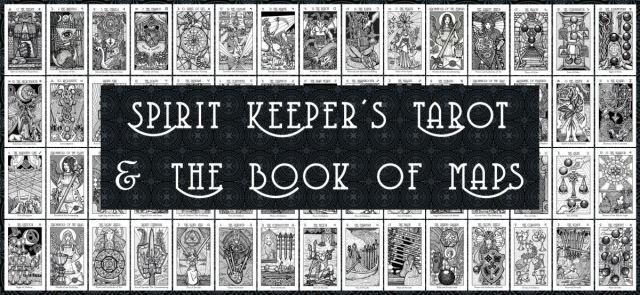
The following is an excerpt from The Book of Maps, the companion guidebook to the Spirit Keeper’s Tarot, a hand-illustrated black and white tarot deck crafted with practitioners of the mystic arts in mind. The pen and ink drawings were inspired by woodcut prints from the late Renaissance. Symbology called upon is based predominantly on medieval European alchemy, astrology (the Sacred Seven), Hermeticism, Zoroastrianism, Abrahamic angelology, Kabbalah, Catholicism/Christianity, Sufism, and Egyptian mythology.

For more information about the deck, go to:

Excerpt from The Book of Maps

Zoroastrian Magical Protection Charm

In an Avestan text dated to the 9th and 10th centuries, Ahura Mazda reveals to Zoroaster the magical powers of the falcon feather. The Magus who prays over a falcon feather can empower the feather into a charm that will ward off evil, cure and cleanse one of evil possession, and protect whosoever wields the feather against demons.

Continue reading “Zoroastrian Magical Protection Charm”

Grimoire Inspiration: The Wooden Books Series

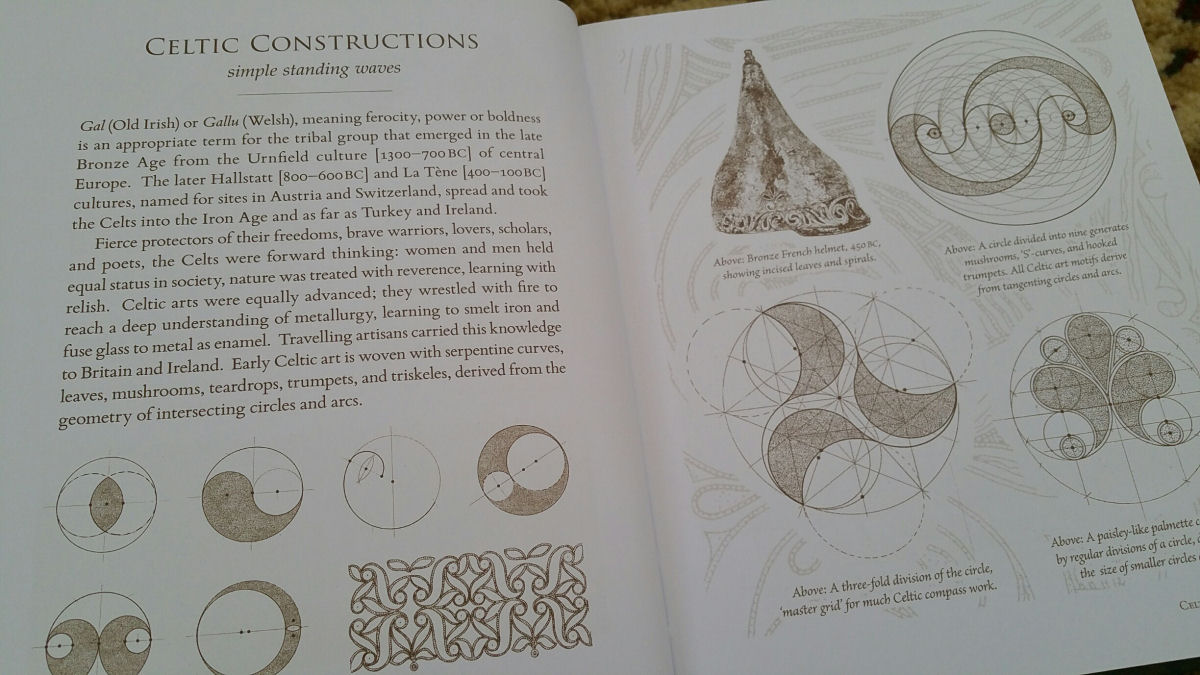
By far my favorite source of inspiration for my grimoire comes from the Wooden Books series published by Bloomsbury. I have the four-book set shown above, which I like to keep displayed out on a coffee table in our living room.

I reach for these books often and you’ll see why once you peek inside the page spreads. One of the questions I get asked the most is about my grimoire or personal book of methods/book of shadows.  I’ve given my thoughts into how you might structure and organize your grimoire here (How to Create Your Grimoire: Inspiration From One Approach) and you can check out a three-video series I did for the 2017 YouTube Pagan Challenge where I share the pages of my own private book.

Each one of these four books informs my grimoire work in a different and valuable way. You can click on the photos in this post for the enlarged 1200 pixel-side image file for a closer viewing. I’m hoping these few snapshots already start to generate amazing ideas and inspiration for you.

Designa I use to inspire decorative borders, ornamentation, and just the design elements in my grimoire pages. If you’ve ever seen a flip-through of my book and now see these page spreads from Designa, you’re going to see the influence for sure.

What I most love about using these books for inspiration is not just the design elements, but the explanatory entries as well. That way I’m informed about the design elements I’m using and I can use them with intention and significance. Everything in my grimoire is meaningful to me and symbolic, and much of that capacity comes from consulting these books.

Continue reading “Grimoire Inspiration: The Wooden Books Series”