Eliphas Levi, considered one of the most influential occultists in Western ceremonial magic and witchcraft, asks and then answers that question.
His answer:
The knowledge of great secrets and the consciousness of power.
Those are my two objectives for you in this course: (1) to confer to you the knowledge of great secrets, and (2) to endow you with the consciousness of your personal power, to show you the heights that your power can achieve.
At every single point of my work in putting this course together, I thought, how do I facilitate development of the most powerful, most knowledgeable, most versatile, wisest, and most formidable occultist there ever was? How do I show you how to be that person?
And that was the inspiration and the ambition behind this course.
Western Witchcraft I focuses on the doctrinal basis and theoretical fundamentals of transcendental magic. This course is an immersive study of the first 12 chapters in Eliphas Levi’s Doctrine, Part I, of the greater collected work Transcendental Magic: Doctrine and Ritual, and structured like a one semester 400-level university elective.
Be prepared for an intense amount of reading. The video lectures only supplement the reading assignments and are not a replacement for them. In addition to the reading assignments, the weekly practicum, ritual, and energy training is also demanding on your time and your efforts.
COURSE OBJECTIVES:
Attain familiarity with the doctrinal basis and theoretics of Western ceremonial magic
Study the first 12 chapters of Eliphas Levi’s Transcendental Magic, Part I: Doctrine (and to supplement, pick up selected key principles from the first 12 chapters of Part II: Ritual)
Gain essential insights from Levi’s Key to the Great Mysteries, the book he wrote after Doctrine and Ritual
Craft your first four altar tools and use Levi’s Conjuration of the Four ritual to charge and empower those tools (main focus in this course will be on the wand and the pentacle, per Levi’s assertion that the wand is first and foremost your most important ritual tool and second in importance to the wand is your pentacle)
Craft a divine lamp for ritual use and work through a prophetic astral vision
Train yourself to harness the Astral Light, then learn techniques to both strengthen and increase your flexibility with the Light to produce the Magic Chain
Build a rock solid foundation in the theoretical and magical principles of Western witchcraft and ceremonial magic, which will then be able to support the structure and edifice of any mystery tradition or Path you subsequently pursue
A future course offering, Western Witchcraft II, will advance upon the fundamentals established in this course. Western Witchcraft II will conform to Levi’s Ritual, Part II and delve into spell-crafting, talismans, seals and sigils, spirit conjuring, and the many forms, types, and purposes of ritual in transcendental magic.
A “Seal to Defeat All Foes”? Oh, snap. That sounds badass. We definitely need to give this one a try, right?
You’ll find my write-up of this in one of the back-end appendices of Key of Solomon and Collected Studies on Spirit Conjure. It’s a free e-book download here, and if after checking out the pdf version you realize you want it in physical hard copy paperback, that link will give you instructions on how to order one.
“Bell Chimes In” is a video series on my YouTube channel where I pick a topic that is oft talked about and chime in with my perspective. You can click on the below links to see past episodes from 2017 and 2018.
This posting is a master list of all Bell Chimes In installments from 2019.
Bell Chimes In 2019
If the subject matter of an episode was of great interest to you, then be sure to click in to the blog post, because I’ll expand and go further in-depth on that subject in the companion write-up to the video. This year there were only 10 installments.
The “Star of Bethlehem” is when Saturn, Jupiter, and Mars are in conjunction under the same sign. It is based on the mythology that around 2 B.C., there was a conjunction of Saturn, Jupiter, and Mars and three sage astrologers, or the “three wise men,” predicted the birth of a child to be a savior to the people, located at the point where the terrestrial latitude and longitude of the triple conjunction is the same as the celestial latitude and longitude (and in the midheaven) of that geographic location. Such a child would become the initiator of a new epoch in world history.
The last incidence of a Star of Bethlehem was in the year 2000. This coming year in 2020, there will be a Star of Bethlehem. Then the next Star of Bethlehem won’t be until 2040. So basically, they occur about once every 20 years, give or take.
Reflecting on this last decade, from 2010 to 2019, is on everybody’s minds. And I’ve been thinking about how the tarot world has evolved through these years.
Balancing the paragraphs of text will be photos of decks published in the 2010s that I’ve reviewed in the past. Please know that the placement of images will not relate in any way with the text around it– after having written this piece, I went back and inserted the images at random. (Oh, and click on any of the photos to read my review of the pictured deck.)
Tarot Mucha
While I get into a little social commentary here, I do want to emphasize that I’m speaking from my perspective only, so I can only report what I experienced through the decades (yep, I want to start with the last decade, 2000 to 2009). How old I was, where I was in my life, what my primary interests were at any given time– all of that factors in to my experiences and interactions with the tarot world.
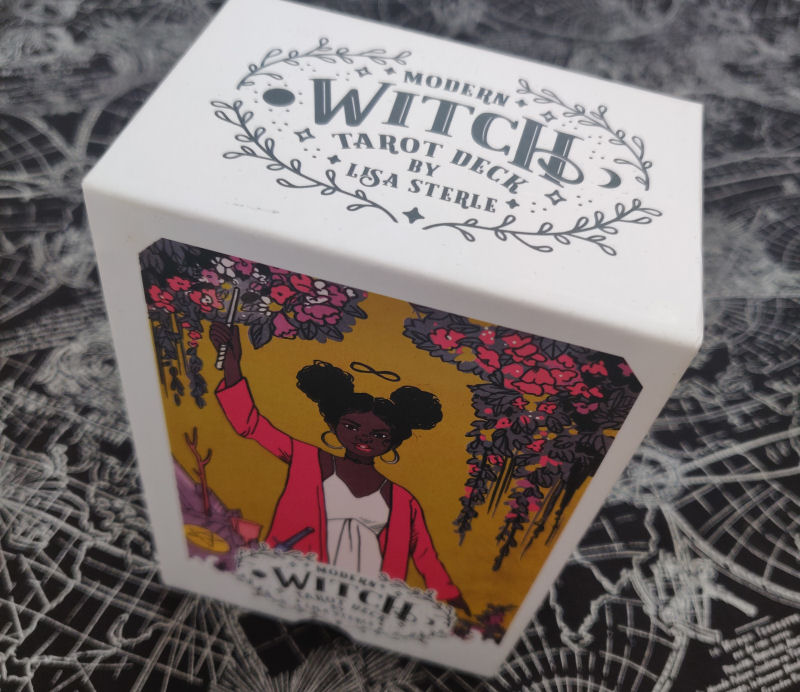
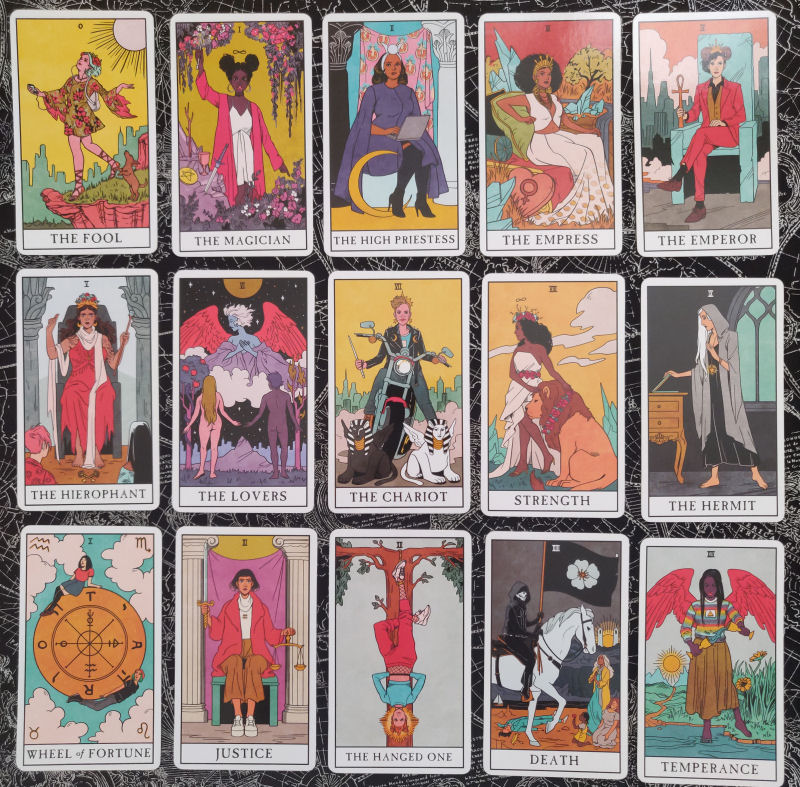
The Modern Witch Tarot by Lisa Sterle is a faithful RWS updated for this decade. Everything about it encapsulates what 2010 to 2019 has celebrated. Sterle has revitalized a deck from 1910 with youth, mondern-day intersectional femininity, and given the tarot new currency.
I love the fresh cartoon-style illustration and can see the value in modifying some of the esoteric symbolism in the original Rider pack to reflect 21st century alternative spirituality, such as changing the Tetramorph in Key 10 to featuring the four astrological symbols of the fixed signs, or featuring what looks like a white anemone on Death’s flag.
In this post I’m going to share how I modify the instructions from the Key of Solomon for the First Pentacle of Mercury and adapt the core principles from Key to make it my own.
The more common representation of the First Pentacle is what you’ll see above, where the Hebrew letters for the angelic spirit name AGIEL (אגיאל) are inscribed around the pentagram counter-clockwise and then around the outer ring clockwise.
Above, in the carved wood disc on the left page spread, you can compare it to the original instructions and see how I’ve changed it up so it’s more “me.”
I was working with birch wood for the wood’s protective qualities (metaphysical correspondences) and carved the design into the wood with a wood-burner (pyrography– writing with fire! ooh, how fun!). My pentacles are also two-sided. I’ll talk about what I did with the back side of the pentacle later in this walk-through.
Left: Features Phoenician alphabet letters, heavily stylized; Right: Features the Celestial Alphabet from Agrippa (1533)
I made two different versions, which you’ll see above. The left one is a stylized version of the Phoenician alphabet equivalent, and the right one above is in the Celestial Alphabet.
Worth noting here that practitioners will hold very different and conflicting perspectives on just how much you can embellish or modify the original seals. I think, like any other science, it depends on how you’ve modified the original seal.
Working with the doctrine of analogies, it really is just like cooking. You can swap in different ingredients, but exactly what ingredients you’re swapping with will affect the taste of the resulting dish. Some ingredients are enough like the original that you probably can’t taste a difference, though there will still be subtle undertones you can pick up on; and with others, you’re probably basically creating a totally new dish.
What is the difference between witchcraft and ceremonial magic?
I’ve been struggling to understand for myself what the distinction is between witchcraft and ceremonial magic. Because the immediate go-to points of differentiation you often hear people reach for feel kinda superficial.
There are more significant differences between two different traditions under the heading “witchcraft” (or two different traditions under “ceremonial magic”) than there are the alleged differences between the main generic headings “witchcraft” or “ceremonial magic.”
It was all “maleficia“…
Pretty much up until witchcraft or maleficia was no longer outlawed, what we today might associate with ceremonial magic would have been tucked under the heading “witchcraft.”
The law (back when the law cared about public accusations of maleficium…) lumped it all together and while I was doing historic research for my novel, bishops and otherwise powerful men had gotten accused of witchcraft and for being witches (though in those cases, they were probably false accusations; those men were just challenging political power).




 benebell wen