I Ching Divination with Moon Blocks

I’ve covered moon block (Jiao Bei, 筊杯) divination before here in a past Tinkering Bell video. And this downloadable PDF linked here is a quick reference sheet for using moon blocks.

When you walk into a Buddhist or Taoist temple anywhere in the southern regions of the Mainland, Taiwan, Singapore, Malaysia, heck– just in general the East Asian cultural sphere– you are going to see moon blocks. Baskets full of moon blocks. It’s so you can ask your question of the patron divinity or spirit, then toss the moon blocks and receive an answer from beyond.

Moon blocks can also be used for divination with the Zhouyi (I Ching).

Continue reading “I Ching Divination with Moon Blocks”

Changes to the YouTube Channel and Access to Past Videos

In an effort to curate the publicly visible videos on the Benebell Wen YouTube channel, many past videos are now unlisted but still publicly available via the Playlists tab.

For a ballpark sense of how many videos are now unlisted, as of this posting only 129 of 405 total videos are publicly visible in the general Videos tab and thus only those 129 videos are searchable on the YouTube platform.

Continue reading “Changes to the YouTube Channel and Access to Past Videos”

Lady of the Nine Heavens and the I Ching

This video is part of a companion course series leading up to the release of my third book, I Ching, The Oracle. I’ve covered this topic previously here, “Mysterious Lady of the Ninth Heaven (Jiu Tian Xuan Nü, 九天玄女).” However, given the personal relevance, we’re revisiting the Lady of the Nine Heavens, now within the context of my Purpose for publishing this new translation of the Book of Changes.

Continue reading “Lady of the Nine Heavens and the I Ching”

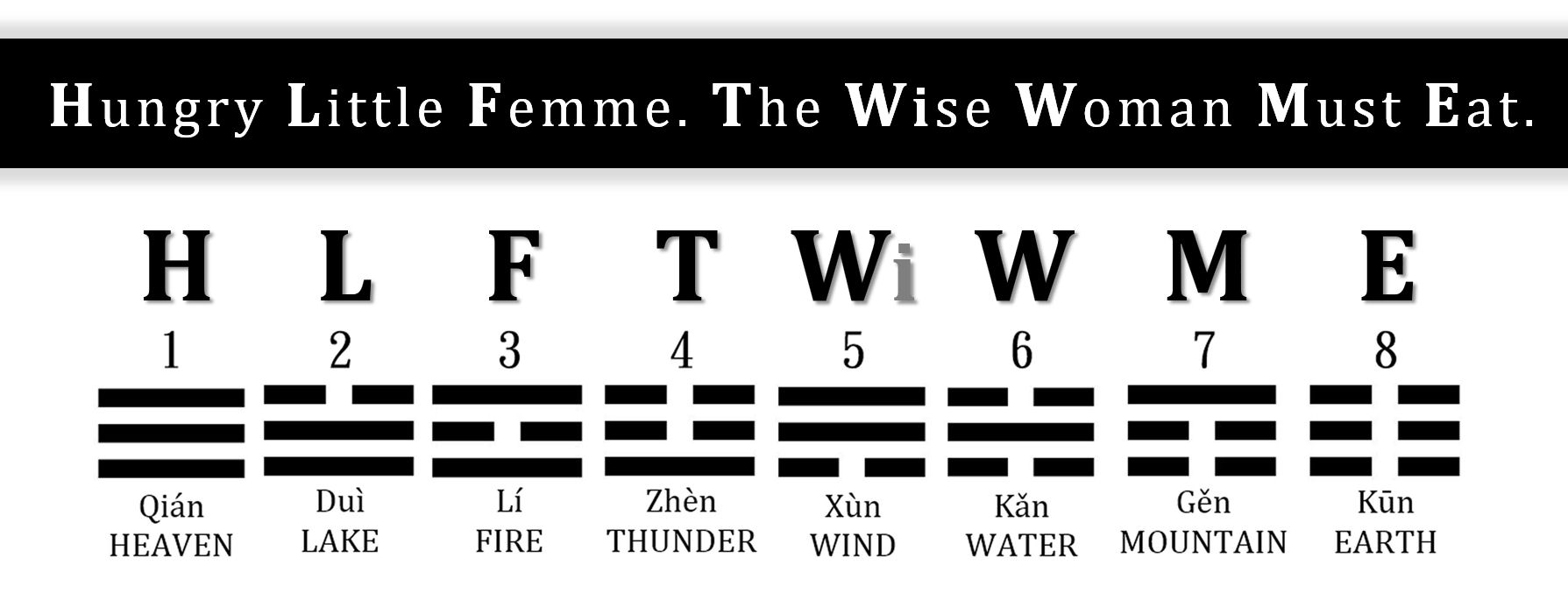
Ba Gua: The Eight Trigrams

This video lecture course is an overview of the eight trigrams (八卦, Bā Guà). It is part of a companion course series leading up to the release of my third book, I Ching, The Oracle.

Ba Gua Correspondences Table

My goofy mnemonic for remembering the order of the trigrams

Timestamps provided in the video description box (you’ll have to watch on the YouTube platform). Apologies, the editing and audio are a bit choppy. The timing of the slides and voiceover narration are off in a few places.

Continue reading “Ba Gua: The Eight Trigrams”

Taoist Magic for Beginners: How to Get Started

This is a companion write-up to the above video.

Continuing from what I said in the video chat, if this is something you seriously want to do, then start by getting that three-ring binder. Though I think organizing it into eleven sections is sufficient, I noticed you can’t buy packs of just eleven binder dividers. They come in sets of 12, so that’s fine. Having a final “Miscellany” tab is always a good idea anyway.

Continue reading “Taoist Magic for Beginners: How to Get Started”

Complete Book of North American Folk Magic, edited by Cory Thomas Hutcheson

Cory Thomas Hutcheson, author of New World Witchery: A Trove of North American Folk Magic (2021), has brought together an incredible assembly of folk practitioners from across North America– Mexico, the United States, and Canada.

You will get an own voices insider perspective of Appalachian mountain magic, brujeria, curanderismo, Detroit hoodoo, Florida swamp magic, French Canadian sorcellerie, Irish American folk magic, Italian American magic, Melungeon folk magic, New England cunning craft, New Orleans voodoo, Ozark folk magic, Pennsylvania powwow and braucherei, Slavic American folk magic, Southern conjure, and more.

North America stretches five thousand miles across, nestled in between two great oceans, and within that space, frozen tundra, glaciers, pine forests, deciduous rainforests, blooming deserts, prairies, and towering groves of redwood.

This is the homeland of hundreds of Indigenous nations for millennia, a land ravaged with invasions and displacements, of dark legacies but also a hope for and collective effort to forge a brighter future.

Continue reading “Complete Book of North American Folk Magic, edited by Cory Thomas Hutcheson”

Taoist Spirit Maps (Líng Tú 靈圖)

Líng Tú 靈圖, or spirit maps, are oft referenced in the Taoist Canons (道藏經). They’re a recurring feature in the Canons that have always intrigued me, and how the term “Líng Tú” is used in the scriptures.

So that’s the topic for video #6 in this series.

修真歷驗鈔圖, one of the scrolls in the 洞真部靈圖類 of the Taoist Canons

Let’s summarize the three classifications of spirit maps: (1) maps of spirit realms for the purposes of astral journeying or spiritual cultivation, (2) enshrining divinities or creating thresholds for which communication between the physical and spirit realms can take place, and (3) Fu, which are talismanic edicts or petitions to regulate spirit forces in a way that will influence physical forces.

Continue reading “Taoist Spirit Maps (Líng Tú 靈圖)”

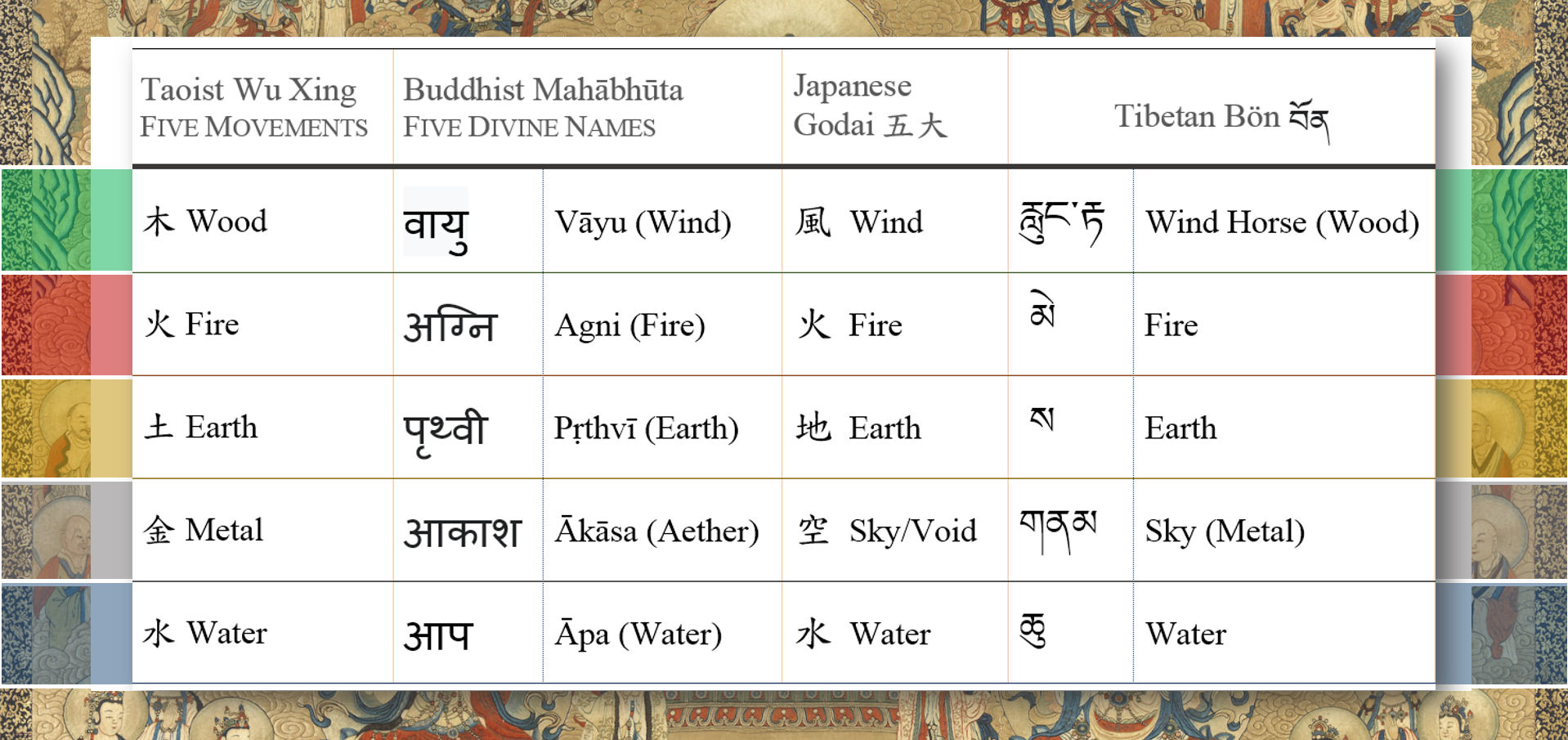
Wu Xing: Five Movements 五行 · 오행

This is a crash course on the Wu Xing 五行, Five Dynamic Movements, though you’ll often see it called the Five Elements of East Asian metaphysics. These are five alchemical agents of change to describe how yin and yang qi create, destroy, and thus transform the physical world.

Download PDF
The Five Changing Phases and Their Correspondences
Download DOCX
The Five Changing Phases and Their Correspondences

1/30/2023 Erratum Update: A few of the correspondence rows in the Metal and Earth columns got flip-flopped in the subsequent reference chart. If you downloaded the table before 1/30/2023, please delete it and re-download the rectified version. ❤

I say “East Asian” here because it’s not limited to any one culture, ethnic group, or nationality, not to mention the concept itself is much older than modern-day borders.

Continue reading “Wu Xing: Five Movements 五行 · 오행”

What Does It Mean (to Me) to Be Taoist?

Since I made reference to some of these regions, below is an excerpted Appendix E from I Ching, The Oracle (North Atlantic Books, forthcoming 2023).

While the maps are not drawn to scale (I did them myself, by hand…) at least they help to give you a mental reference of where these kingdoms or states are located in geographical relation to one another.

Excerpt from Appendix E of I Ching, The Oracle (June, 2023):
Shang (1600 – 1045 BC) and Zhou (1046 – 256 BC)

Continue reading “What Does It Mean (to Me) to Be Taoist?”

Asian Wheel of the Year: Lunisolar Astrology

Is there an Asian “Wheel of the Year”?

Maybe. Sorta.

Consider these eight solar terms, their dates based on solar longitude (the path of the sun) and how they compare to close equivalents in the pagan Wheel of the Year:

The Four Beginnings  四立
1. 立春 Start of Spring Feb. 3–5
2. 立夏 Start of Summer May 5–7
3. 立秋 Start of Autumn Aug. 7–9
4. 立冬 Start of Winter Nov. 7–8

Equinoxes & Solstices  分/至
5. 春分 Vernal Equinox Mar. 20–22
6. 秋分 Autumnal Equinox Sep. 22–24
7. 夏至 Summer Solstice Jun. 21–22
8. 冬至 Winter Solstice Dec. 21–23

I apologize in advance if my mode of presentation here is going to be a bit overwhelming. In retrospect, I should have taken more time thinking on pedagogy and how best to organize this material so it’s less everything-all-at-once. =)

Continue reading “Asian Wheel of the Year: Lunisolar Astrology”