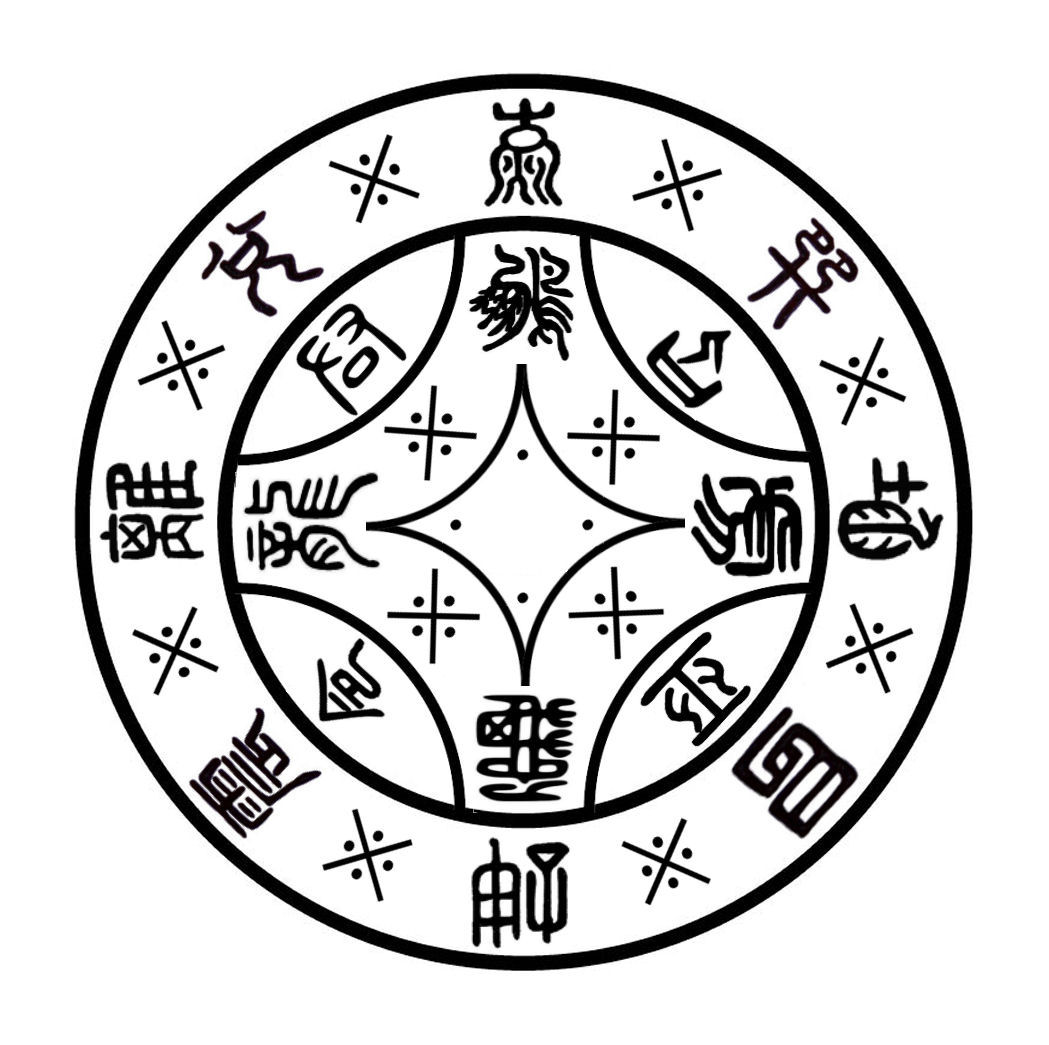
The Seal of Changes is a template for crafting 64 talismanic sigils that harness the 64 powers encoded into the I Ching: Book of Changes. In this practicum video, I’ll share with you my favorite one: the Seal for Raising an Army based on Hexagram 7.
This work is dedicated to the public domain.
Download the blank template for the Seal of Changes:
If you want to fully understand how to operate the Seal of Changes for controlling the 64 powers from the I Ching, then you’ll first need to understand the 64 hexagrams of the I Ching and some of their metaphysical and occult correspondences. A great place to attain a solid foundation to that regard is my “I Ching and Practitioner” course, which you can find and order below.
On an unintentionally related note, the way I did my makeup for the video is reminiscent of how Chinese demons get depicted in film. It was totally unintentional. Hence, interesting. Hmm. Anyway.
Figure I’d expand more on the juicier bits of the subject here in writing rather than in the video because guess how many people are going to watch the video but not read this post. Hidden in plain sight, yada yada. Right?
Demonology and the nearly universal cultural tendency to peg all ills of humanity on the work of demons is fascinating to me. Sick with disease? Acting out of the ordinary? Getting a bit too emotional for people’s comfort? Commit a crime? Oh. Demon possession. Of course. What else could it be?
I made a Tinkering Bell practicum video on crafting Holy Anointing Oil, as it had been instructed in the Book of Exodus, and also the derivatives found in later occult texts, such as the Book of Abramelin, a medieval grimoire on Kabbalistic magic, and Aleister Crowley’s Book of the Law.
Today, the day of the posting, January 15, we see the sun and moon in Capricorn already (quite the stellium going on in Capricorn right now actually). Tomorrow January 16 is the new moon in Capricorn and at 6:00 pm Pacific Time (you’ll need to do a time zone conversion accordingly), both the sun and moon will be at exactly 26 degrees. I’m sharing this practicum one day before the new moon so you have some time to make preparations as needed, should you want to try crafting the oil for yourself.
This accompanying blog post is an addendum to the video, where I reflect on my personal impressions. What I’m sharing here are based on the journal entries I logged while crafting this oil.
Watch the video first before reading any of the below, as everything onward will presume you’ve already seen the video.
The Great Compassion Mantra of Avalokitesvara (Kuan Yin) is a dharani to be recited for purification, protection, and healing.
The image associated with the Great Compassion Mantra is the thousand-armed Avalokiteshvara, representative of the innumerable divine manifestations of Avalokiteshvara and from whose body sprung the birth of many other divine beings. In East Asia, Zhǔn tí púsà 準提菩薩, the Great Buddha Mother, is a manifestation of Kuan Yin. Matsu 媽祖, a goddess of the South Pacific, though Taoist in origin, has also become an expression of Kuan Yin consciousness. Or Ārya Tāra 多羅菩薩, a divine manifestation evolving from Avalokiteshvara.
A consecrated copy of the text is considered a powerful protection talisman. The dharani represents the spoken words of Kuan Yin as she recites the names of deities from many pantheons, including references to Shiva, Vishnu, and Indra. The Great Compassion Mantra is bestowed upon us by Kuan Yin so that we might overcome our suffering and—for those who seek it—achieve awakening.
Per Buddhist mythology, during a gathering of the Buddhas, bodhisattvas, and gods on a remote mountain, Avalokiteshvara rose and requested permission to recite words to be transmitted to the people, so that the people could always commune and call to Avalokiteshvara through those utterances and be protected from karmic suffering.
Said Avalokiteshvara:
I have a mantra, the Great Compassionate Heart dharana, and now wish to proclaim it, for comforting and pleasing all living beings; for healing all illness; for living beings to attain additional lifespan; for living beings to gain wealth; for extinguishing all evil karma and weighty sins; for keeping away from hindrance and disasters; for producing merits of pure Dharmas; for maturing all virtuous roots; for overcoming all fears; for fulfilling all good wishes. Please be merciful and allow me to speak.
The deities permitted it and Avalokiteshvara proceeded to recite the syllables of the Great Compassion Mantra dharani. Anyone who recites the dharani with sincere heart will call out to Avalokiteshvara and will be able to seek refuge from any danger, harm, pain, or suffering.
The dharani represents the spoken words of Kuan Yin as she recites the names of deities from many pantheons (including references to Shiva, Vishnu, Indra, among others). As the mythology goes, the Great Compassion Mantra is Kuan Yin’s gift to us, a Key that will gain us access to spiritual awakening, greater understanding, wisdom, Divine Sight, and the strengthening of divine senses (also referred to as the four clairs–clairvoyance, clairaudience, clairsentience, and claircognizance).
In the Fall of 2017, I started a fun little series on my YouTube channel, called “Bell Chimes In.” Here’s a refresher of the 18 episodes that came out last year:
“Bell Chimes In” is a video series on my YouTube channel where I pick a topic that is oft talked about and chime in with my perspective. In doing so, I hope you’ll chime back. After the video, please join in conversation with me through a video response, blog post of your own, or by adding your thoughts in the comments section of the video.
I hope this series won’t be about me. I hope that it will be about us, about discourse, and the collective ideas of a community. There will be a new “Bell Chimes In” video every Sunday for the first quarter of the year.
Imagine yourself at Point A and you need to get to Point B, which is several winding hallways away. You are focused with this one objective, to get to Point B. However, as you start your way through the halls, flanking both sides of the hall are television and radio sets, every one of them on full blast, images of compelling narratives blinking at you from the glaring bright screens, and you catch snippets of phrases from the radio that sound important, that you wish very much you could stop and listen to acknowledge, but you’ve got to get to Point B and none of what’s bombarding your senses in these hallways relate to your destination.
The practical maybe even all too obvious advice is to ignore the distractions, stay focused, and get yourself to Point B, stat.
Now what if all those television and radio sets buzzing at you also happen to represent sincere cries for help. What if those weren’t television and radio sets but telephones, each one ringing at you and every ring is someone calling for you, hoping you’ll answer and give just one minute of your time, just one little moment, so that you can use your know-how and skill sets to help them solve their life problems.
What do you do? Do you still ignore the “distractions,” stay focused, and get yourself to Point B, stat? Or do you stop and answer those calls? If you stop to answer every call, you’ll never arrive at Point B, which is a destination you really, really want to arrive at. Do you stop to answer only some of the calls but not others? How do you discern which to answer and which to ignore? Speaking of calls, what’s your calling? In the midst of this chaos, you start to wonder: what exactly is your calling anyway? Is it to stop and answer as many of these calls as you can and that in and of itself is your life purpose? Or is your life purpose still to try to arrive at that destination Point B?
That’s the irony, or maybe paradox, I don’t know which, of the empath (which, by the way, my digital device keeps telling me is not a word and keeps wanting me to change to “empathy”).
Chinese moon block (Jiao Bei, 筊杯) is a form of divination that you’ll often find at Taoist or Buddhist temples. There may be a dish of moon blocks by the altar and the purpose is for you to ask your question to the deity venerated at that site, then throw the moon blocks for a yes or no answer. They’re used to communicate directly with gods and spirits. The traditional perception here is unequivocally that of divine communion.
Predecessors to the moon blocks are covered in the video, from the tortoise shells to the clam shells. I also instruct on how to clean out two clam shells from your next seafood dinner and ritualize them in preparation for divination uses.
Priests, priestesses, shamans, and witches, in particular witches from those cultures who lived by the seas, would use clam shells (or small tortoise shells) for divination.
Eventually, the concept evolved into the red moon blocks that are commonplace today. They’re one of the oldest forms of Chinese divination, alongside the I Ching, though throughout history, have taken many forms.
This video practicum teaches you how to divine with moon blocks (or clam shells, tortoise shells, etc.) and how to consecrate and empower a set to become used exclusively for divinatory purposes.
Supplemental Handouts
The following ritual instruction is for charging and empowering your divinatory tool, specifically your moon blocks, to be used for spirit communications. The instructions can be followed for either clam shells or tortoise shells.
Your Divination Cheat Sheet is a quick reference guide for the meaning of each divinatory result from your moon blocks. Alternatively, if you opt to use clam shells or tortoise shells instead, an interpretation guide is provided for both as well.
If you’re feeling enthusiastic about traditional moon block divination, then you might be interested in buying your own set of moon blocks. You can often find international sales of these through E-Bay or Etsy.
My general personal recommendation, if you are buying it international, is to source from Taiwan. Broadly speaking the Taiwanese tend to be more superstitious and religious about these things, and so they are going to be more attentive, more thoughtful, and craft-wise, more serious about their moon block production. Culturally, mainland China is more atheistic and capitalist-oriented, so just in terms of probability, you’re not as likely to find a seller who is actually a practitioner of craft.
Homework: Your Practicum
Following each installment of the series will be a suggested practicum, or homework, for you to try out. Homework material presumes that you are an occult practitioner who is working on developing your craft.
Craft Your Own Moon Block Set: I say “moon block” for convenience of reference here. You can use clam shells (probably the easiest for most people to source) or empty tortoise shells (if that’s something you have access to). Even if you decide you really like the red wooden moon blocks and end up buying a set for yourself, I recommend crafting your own divination set because the process of crafting your own divination set from scratch is insightful on its own merits. You can even cut two cross-section slices of a thick branch for two disks to be used. Paint one side one color to represent yin, and the other side a contrasting color to represent yang. Or find two flat, rounded stones of about equal size and inscribe the two sides to symbolize yin and yang. Then follow the “Empowering Your Moon Blocks” reference guide provided above to consecrate and charge your divination set for divine communion.
Grimoire Reference Page: Before you memorialize this divination method in your personal grimoire, work with the method first. Take some time to try different approaches to the method first, such as crafting your own moon block set, trying different materials, from the clam shells to wood disks or stones, etc. Your creativity is your only limitation. If you really want to get your hands on the red moon blocks, then do so and work with that for a few moon cycles. Finally, once you’ve got a personalized hang of the process and how it operates for you as opposed to what I say in this tutorial, log your divination how-to in your grimoire. Be sure to take notes during the video lecture on the historical and cultural background of the divination method and include those in your grimoire as well for context.
In this episode, I answer a question that was presented to me: Can a non-Asian craft and sell Fu talismans to the public?
I recorded the video rather on the fly on the same day the question was presented to me, and didn’t fuss over my face before recording, so now in retrospect when I see the video, I cringe. Ugh. This is what happens when you don’t check your hair or makeup (the eyeliner was already smudging after a long working day) before you hit “record.”
The Fu talisman is a form of Chinese sigil magic that dates back to 400 BC and was later integrated into Taoist mystery traditions around 100 AD. If you’re not familiar with what a Fu talisman is, check out the below links:
“Poison magic” is the English translation for a tradition of black magic, or malevolent spell-crafting, found in Chinese witchcraft and Taoist sorcery, called Gu Dao (蠱道) or Gu Shu (蠱術) [Long form: 蠱道巫術 or Gǔ Dào Wū Shù]. You might also find it translated as Ku.
Those who have read Chapter 13 from The Tao of Craft know my stance on so-called white magic versus black magic, i.e., energy work inherently is neither good nor evil, but it is the intentions that humans put into the work that we may categorize as either good-intentioned or evil-intentioned.
Thus, it is important to note here that Gu Dao is not necessarily evil-intentioned. The tradition of Gu Dao, or Ku, is multi-faceted, nuanced, and complex, which I hope this video will be able to expound upon.
Plus. What better way to talk about baneful magic than through a campy Tinkering Bell video? Exactly.
In my world view, it’s important to start occult study with the elephant in the room. I don’t understand why practitioners would wait until the very end to cover malevolent spell-crafting or not even address it at all. Not addressing it doesn’t change the fact that it exists. Better to address it head-on, with eyes open, get yourself informed, figure out what your own bright line ethical boundaries are, and then continue on your course of study.
Following each installment of the series will be a suggested practicum, or homework, for you to try out. Homework material presumes that you are an occult practitioner who is working on developing your craft.
Your Code of Ethics: Take this opportunity to reflect on your own code of ethics when it comes to craft. Where do you draw the line when it comes to baneful magic? While I am a strong proponent that all practitioners learn as much about metaphysical craft and occult study as they can, including aspects of craft they might not necessarily agree with as a form of personal practice, I also advocate that you draw bright lines for yourself, write down what those bright line rules are, and then never cross them. For reference, also consider watching two Bell Chimes In videos: (1) Curses and Baneful Craft, and (2) Can’t Curse, Can’t Heal?
Three Poisons Karmic Requital Spell: If the three poisonous ingredients I mentioned in the video are ones you can source easily where you live, then use those. Otherwise, take some time to do research on natural poisons and what can be sourced locally for you. During the episode, take notes on the instructions for how to follow the Three Poisons Karmic Requital spell, a form of Ku, or poison magic. Formalize and organize your notes into a comprehensive how-to that you can add to your personal grimoire. Before adding it to your grimoire, research different poisons and include that research as reference material in your grimoire to go along with the Three Poisons Karmic Requital Spell.
This is the third installment of a video series on my YouTube channel called Tinkering Bell where I showcase my personal esoteric tinkerings.
Episode #3 Description
There is a common denominator among mystery traditions across the world that instruct on a perfected way for harmonizing human architecture with deity and with nature. In “Architecture of Sacred Space,” I share with you the basic criteria I follow for ensuring a sanctified living space.
This is Part 2 of 2 videos on the architecture and design of sacred space. Part 1 covered harmonic resonance. Part 2 (Episode #3) will cover magnetism, orientation, water, and anchoring. In touring each of these fundamental principles, we also touch down into feng shui, spell-crafting, and so much more.



 benebell wen