The Angel Tarot and Occult Tarot by Travis McHenry first came out via Kickstarter, and then got picked up for traditional publication by Rockpool, which launched earlier this year. I’ll be covering both in this review.
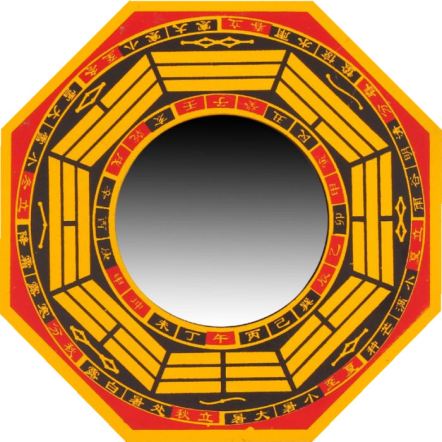
Learn a little more about this common ritual tool in traditional Asian folk magic. I’m inviting you to give the ba gua or eight trigrams mirror a try.
This video covers a few pointers on how to use a ba gua mirror to tell whether you’ve been hexed or cursed (a folksy practice that’s interesting to learn about, at the very elast), how a ba gua mirror can amplify your spell-crafting techniques, a simple intention-setting candle spell, how to make your own ba gua mirror if you can’t source one, and how to integrate this one tool and folk practice into what you’re already doing.
One of my favorite personal rewards from launching the Witchcraft Fundamentals course is the Google Group, where all of us are exchanging insights, asking tough questions, trying to answer tough questions, and getting to know each other. To give you a sampling of what that e-mail list-serv group is like, I’m sharing something I wrote on there in one of the threads started by a practitioner of both Eastern and Western metaphysics.
The question presented is, in short, how do you reconcile Eastern elemental-directional correspondences with Western elemental-directional correspondences?
By the way, scroll all the way down for the PDF downloads of this post, which you can then print out and tuck into whatever reference manual for your metaphysical studies you have going on.
IN THIS WESTERN WITCHCRAFT COURSE, you’ll learn fairly soon that there are different systems of elemental-directional correspondences even within the umbrella of Western occult philosophy, and we cover three of them in this course:
This is a supplemental lecture in Module 11 of the Witchcraft Fundamentals course, titled “The Magic Chain.” If you’re working through the course in the order outlined by the syllabus, then watching this video lecture would come after having watched the video lecture for Chapter XI in the Doctrinal Basis workbook.
However, this supplemental lecture is being provided for free public access.
“written by an idiot only looking to be trendy through appropriation”
“hot mess of an article”
“absolutely shameful”
“ignorant and frankly disappointing and offensive”
“piece of shit”
“articles like this just piss me the fuck off”
“a smug shithead”
“I just read the vomit in question and I am fucking livid”
“dipshit sneer piece … 85% dumb jokes”
“complete horseshit”
“wildly offensive article”
“fucking idiot”
“hex that bitch”
Love and light, apparently.
The salient takeaway point from the article, however, is the one fueling the anger and animosity: Radford’s conclusion that witchcraft is in “dogged resistance to logic” and requires a “suspension of belief in the scientific underpinnings of the universe.”
And my private response to myself after reading her article? Oh, man… We as a collective (so clearly I’m not saying we unanimously believe, but the dominating voice after averaging high and low and everything in between together) have put out a particular narrative about modern witchcraft, and then when we see exactly that narrative being reflected back at us tinged with a smidge of snark, we go off our rails because clearly none of the shadow work or meditation we’ve been doing has had any success.
A “Seal to Defeat All Foes”? Oh, snap. That sounds badass. We definitely need to give this one a try, right?
You’ll find my write-up of this in one of the back-end appendices of Key of Solomon and Collected Studies on Spirit Conjure. It’s a free e-book download here, and if after checking out the pdf version you realize you want it in physical hard copy paperback, that link will give you instructions on how to order one.
In this post I’m going to share how I modify the instructions from the Key of Solomon for the First Pentacle of Mercury and adapt the core principles from Key to make it my own.
The more common representation of the First Pentacle is what you’ll see above, where the Hebrew letters for the angelic spirit name AGIEL (אגיאל) are inscribed around the pentagram counter-clockwise and then around the outer ring clockwise.
Above, in the carved wood disc on the left page spread, you can compare it to the original instructions and see how I’ve changed it up so it’s more “me.”
I was working with birch wood for the wood’s protective qualities (metaphysical correspondences) and carved the design into the wood with a wood-burner (pyrography– writing with fire! ooh, how fun!). My pentacles are also two-sided. I’ll talk about what I did with the back side of the pentacle later in this walk-through.
Left: Features Phoenician alphabet letters, heavily stylized; Right: Features the Celestial Alphabet from Agrippa (1533)
I made two different versions, which you’ll see above. The left one is a stylized version of the Phoenician alphabet equivalent, and the right one above is in the Celestial Alphabet.
Worth noting here that practitioners will hold very different and conflicting perspectives on just how much you can embellish or modify the original seals. I think, like any other science, it depends on how you’ve modified the original seal.
Working with the doctrine of analogies, it really is just like cooking. You can swap in different ingredients, but exactly what ingredients you’re swapping with will affect the taste of the resulting dish. Some ingredients are enough like the original that you probably can’t taste a difference, though there will still be subtle undertones you can pick up on; and with others, you’re probably basically creating a totally new dish.
What is the difference between witchcraft and ceremonial magic?
I’ve been struggling to understand for myself what the distinction is between witchcraft and ceremonial magic. Because the immediate go-to points of differentiation you often hear people reach for feel kinda superficial.
There are more significant differences between two different traditions under the heading “witchcraft” (or two different traditions under “ceremonial magic”) than there are the alleged differences between the main generic headings “witchcraft” or “ceremonial magic.”
It was all “maleficia“…
Pretty much up until witchcraft or maleficia was no longer outlawed, what we today might associate with ceremonial magic would have been tucked under the heading “witchcraft.”
The law (back when the law cared about public accusations of maleficium…) lumped it all together and while I was doing historic research for my novel, bishops and otherwise powerful men had gotten accused of witchcraft and for being witches (though in those cases, they were probably false accusations; those men were just challenging political power).






 benebell wen