Key 21 from the Rosenwald Tarot Uncut Sheets (1501), Key 21 from the Soprafino Tarot (1835)
I shared my 2021 reflections last December, when Judgement was my year card. In 2022, my year card was Key 21: The World. And what a climactic, intense, fruitful, and life-changing year it’s been. I’m not quite sure yet whether “life-changing” is an exaggeration, but I mean, what’s transpired in 2022 has and will have a significant impact on the course of my life from here on out.
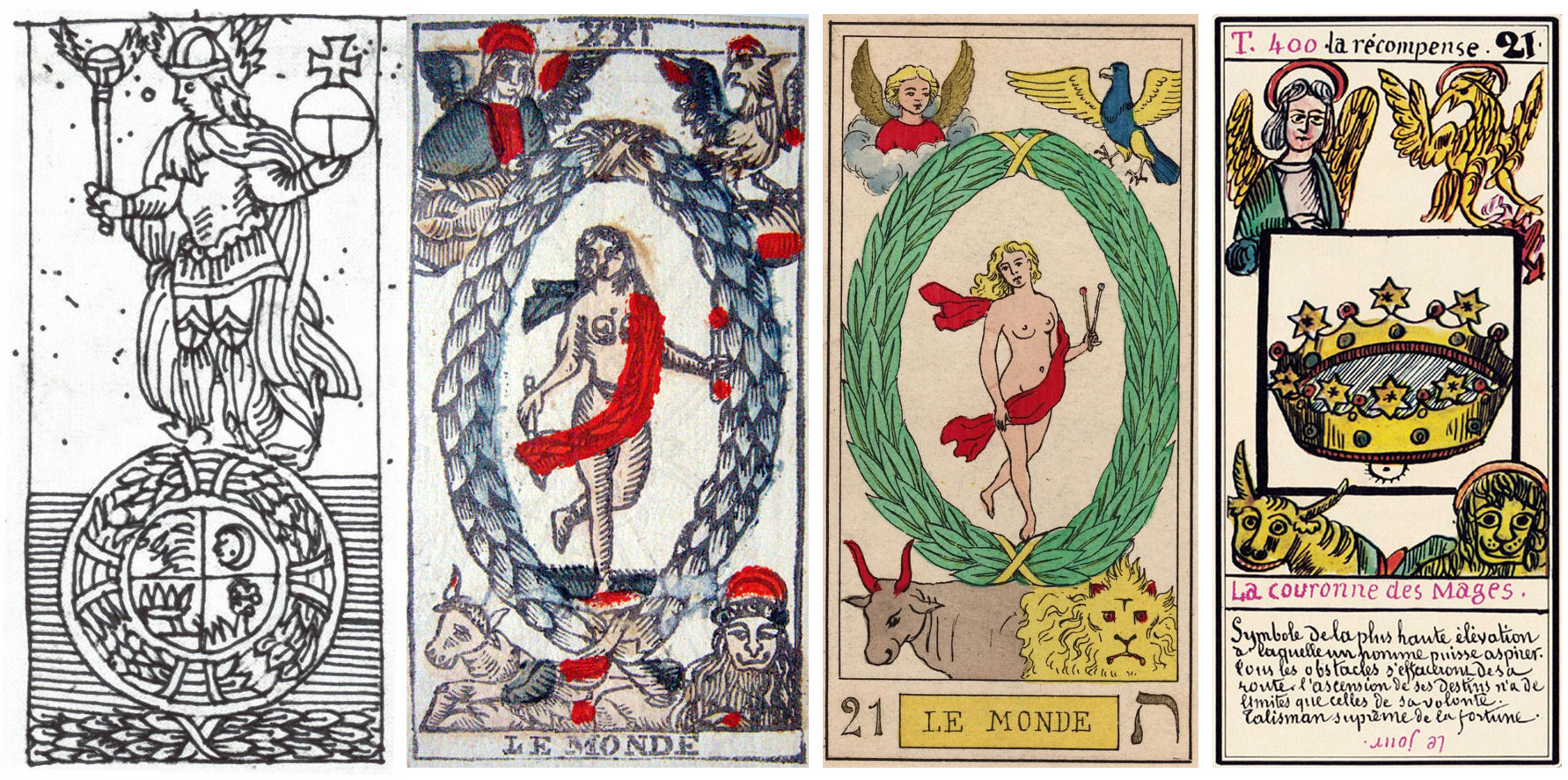
Bolognese Tarocchi (1442), Jean-Baptiste Madenie Tarot (1739), Arcanes du Tarot Kabbalistique (1889), & Grand Tarot Belline (1863)
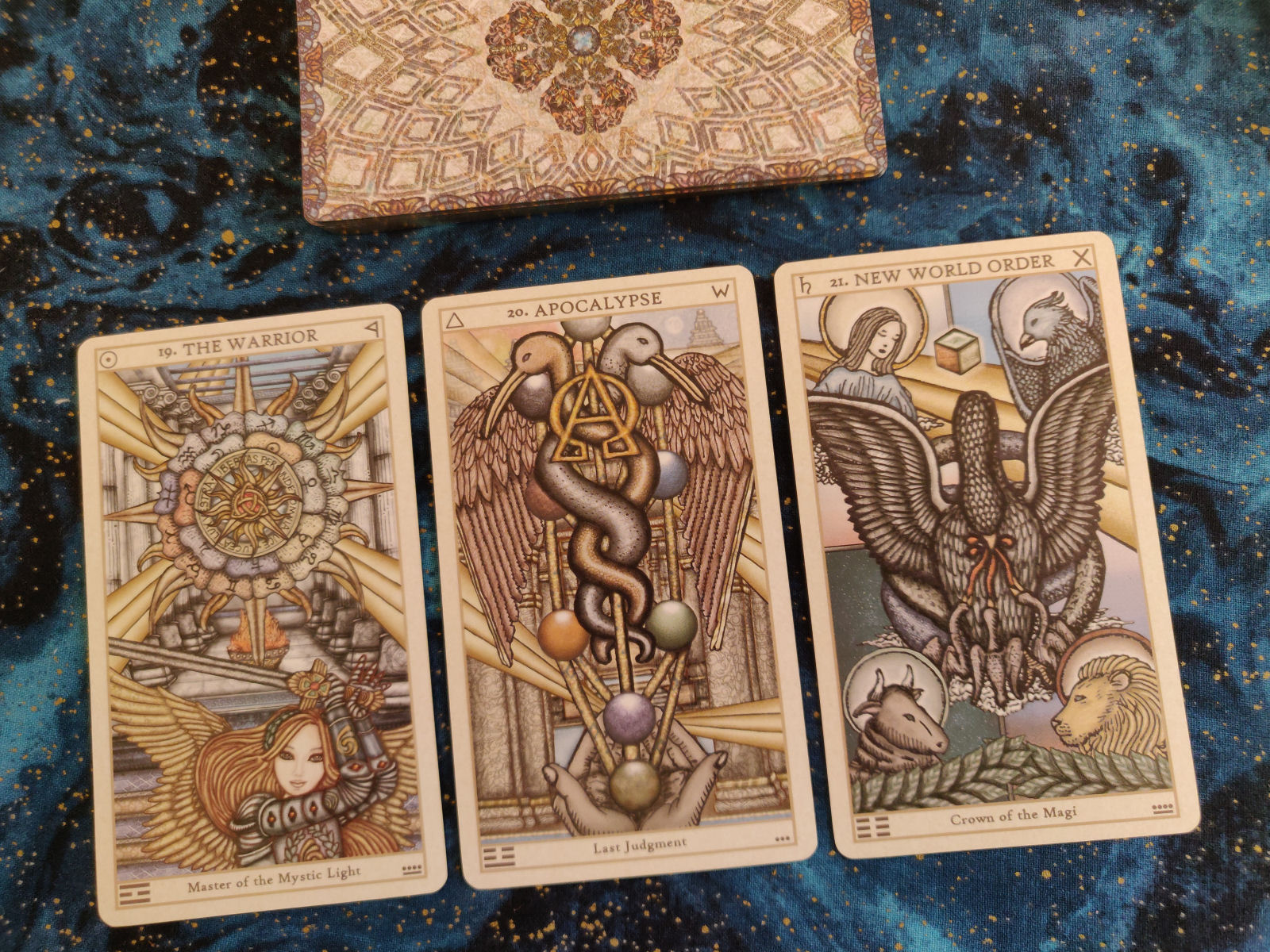
It’s kind of crazy how my 2021 really reflected a Judgement year (Apocalypse, in the SKT, which was quite an apt descriptive for my 2021…) and 2022 a World year.
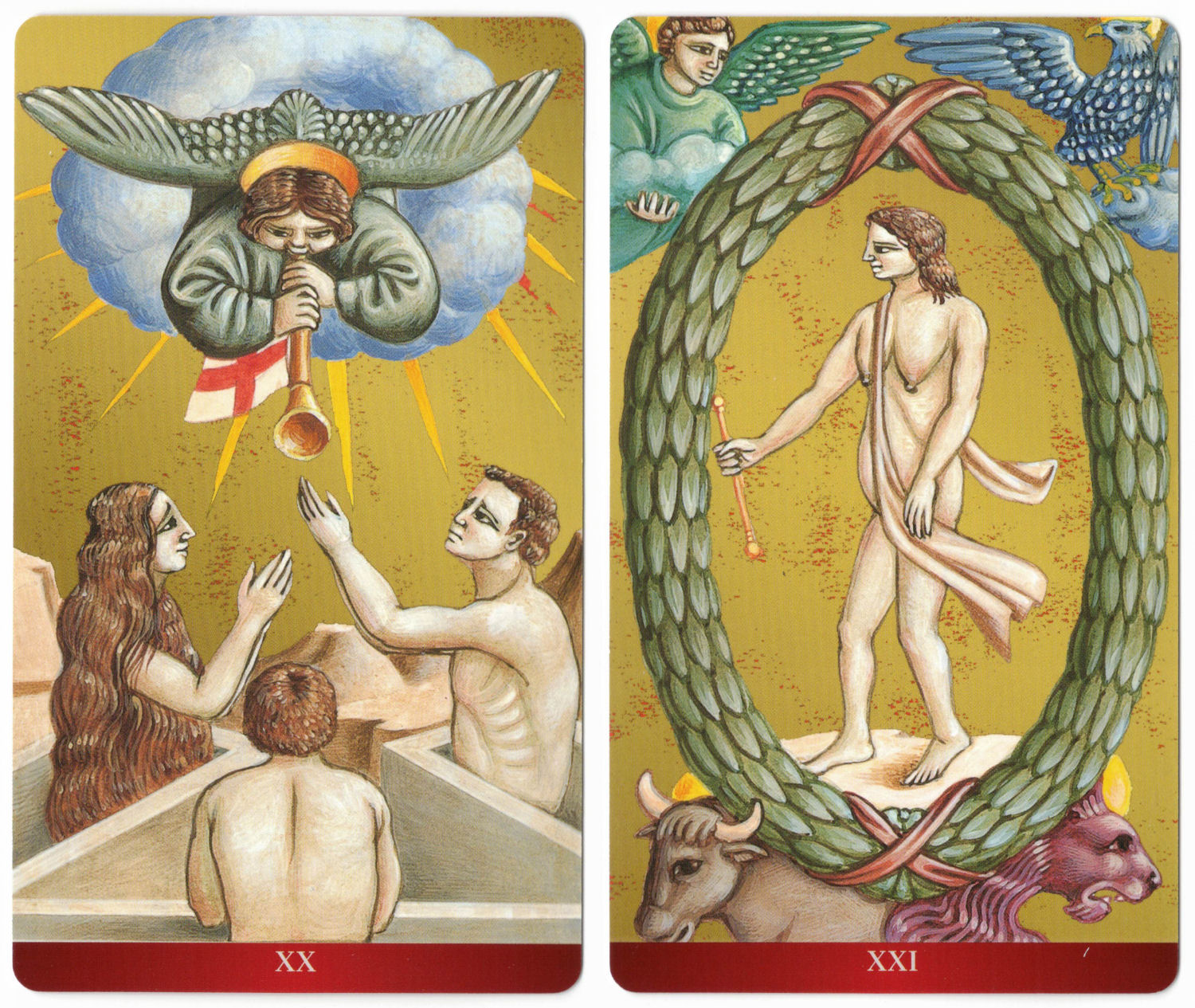
Dante Tarot by Guido Zibordi Marchesi (Lo Scarabeo)
Last year it was like the tectonic plates beneath my feet were tremoring. And this year, many of the pieces that fragmented in 2021 fell into place. Re-reading my 2021 year in review with the Judgement card, I sure vague-booked how crazy that year actually was. “Major life shifts happened to me in 2021,” I had written. Ha. What an understatement.
And in 2022, the tremors stopped, whatever pieces were quaking fell into position, and it just so happened that my luck shot up. All the pieces landed in all the right spots.
We have an abundance of persimmons this year and I remarked to the father-in-law about how I wanted to make hoshigaki, using the traditional method.
Crystallized sugars coming to the surface of the dried persimmons
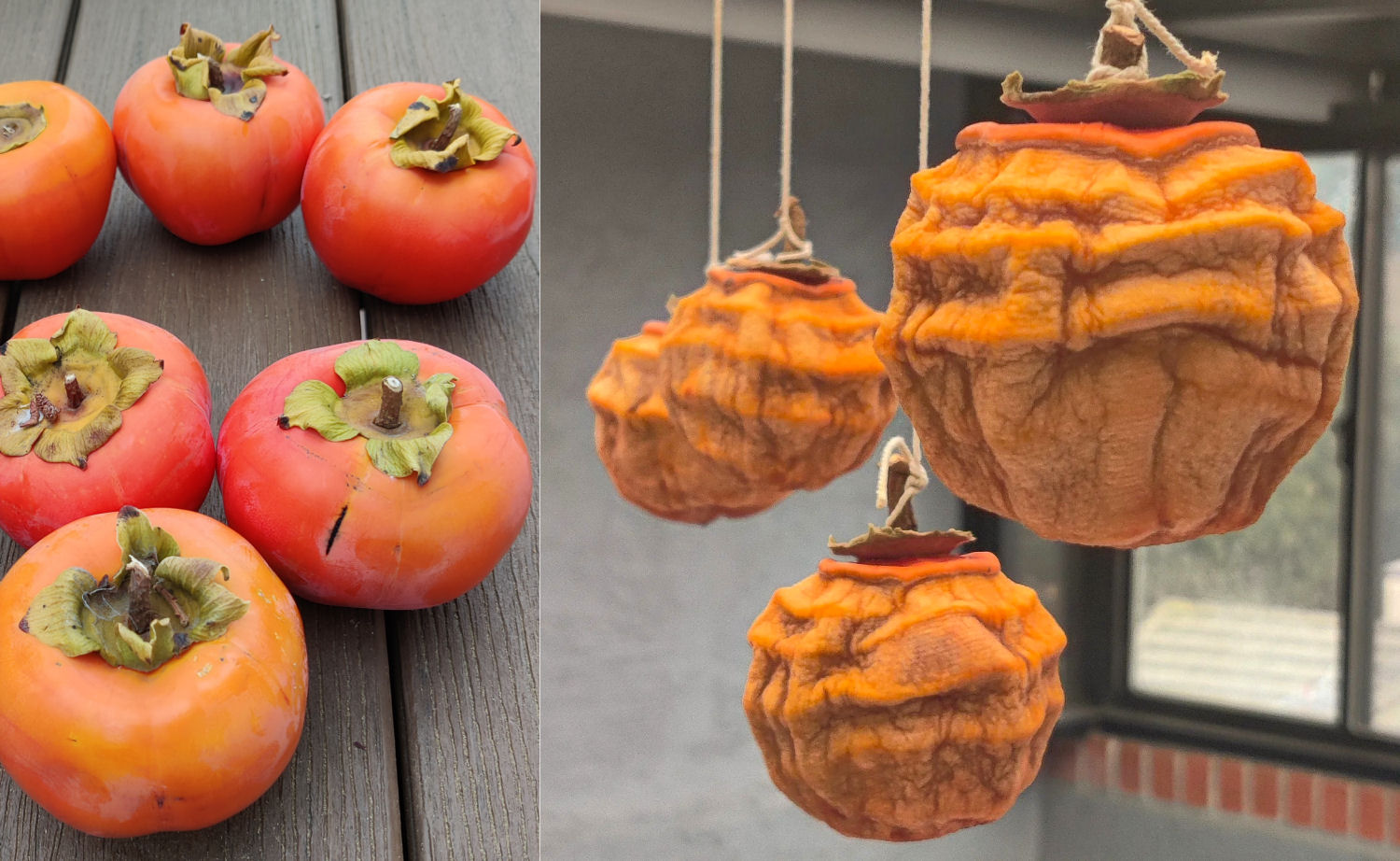
Hoshigaki are peeled persimmons that you hang up to sun-dry for four to seven weeks (depending on climate/weather), and then you have to massage every persimmon weekly so it ferments evenly and the natural sugars get coaxed up to the surface of the fruit, forming this light dusting of finely crystallized sugar dust.
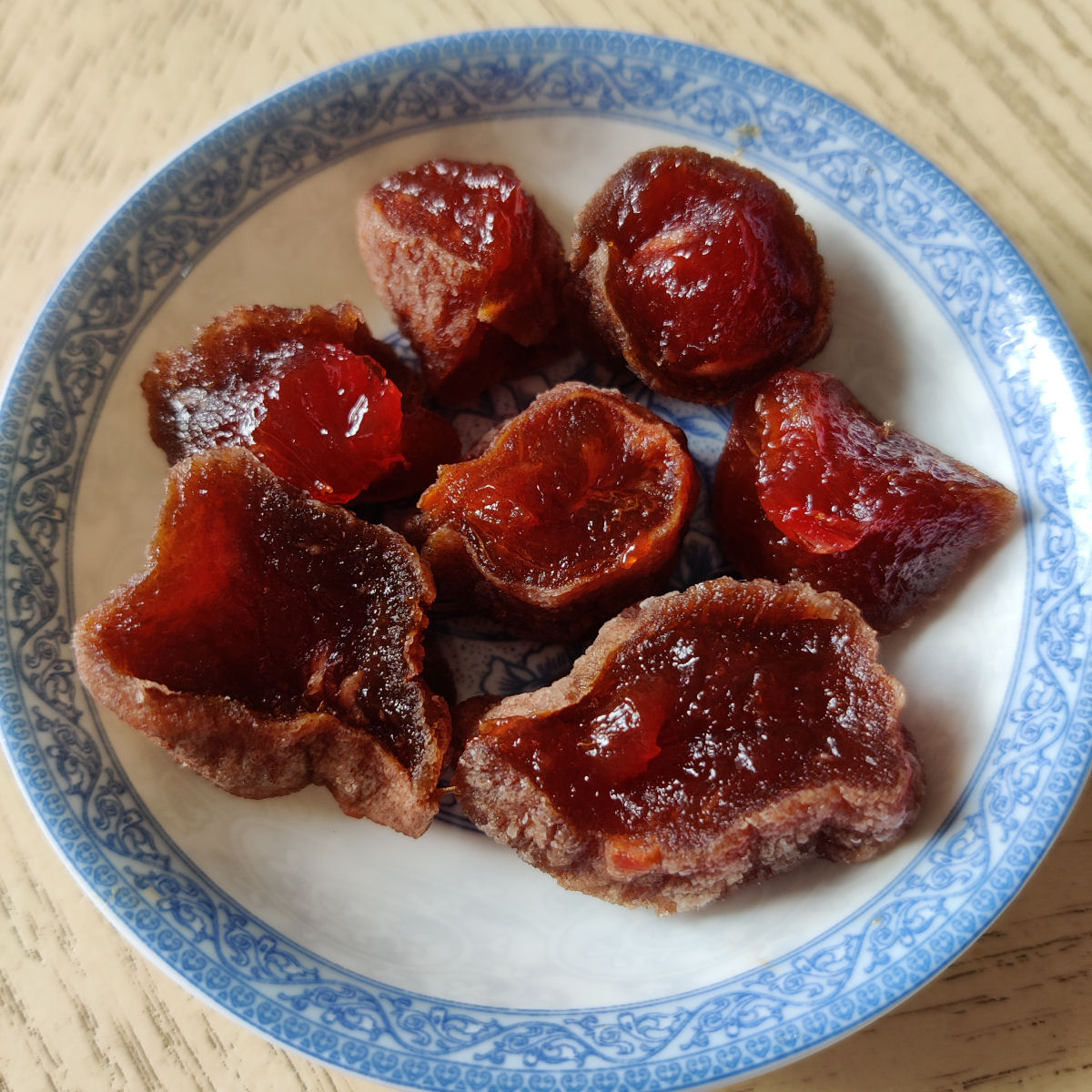
Sliced hoshigaki, final result
Is it magic or chemistry? I’m not quite sure. =) Meanwhile the fruit becomes deliciously gummy, like chewy candy. It is one of the sweetest and most delectable desserts you can have.
Final stage of hoshigaki — when it gets that natural crystallized sugar coating on the surface!
Immediately, before I could even complete my explanation of the process, the father-in-law shot the idea down, listing out all the ways this could go wrong, all the reasons this is not worth the trouble, just one negative statement after another.
This is his personality, his habit. He’s been doing this to James since hubby was a boy. If you’re sparked by an idea that’s just slightly more labor-intensive or slightly more aspirational than ordinary, the father-in-law’s immediate response is to shoot down the idea and be really negative about all the ways this is stupid.
Oh and if you haven’t guessed already, this is a personal blog post. Not in any way tarot, esoterica, or “in line with my branding” related. Just me sharing what’s actually been on my mind as of late, and ranting. Continue reading “How a Parent Makes or Breaks a Child’s Dream”→
Since I made reference to some of these regions, below is an excerpted Appendix E from I Ching, The Oracle (North Atlantic Books, forthcoming 2023).
While the maps are not drawn to scale (I did them myself, by hand…) at least they help to give you a mental reference of where these kingdoms or states are located in geographical relation to one another.
Excerpt from Appendix E of I Ching, The Oracle (June, 2023):
In my previous blog post recapping NWTS 2022, I talked about how much I enjoyed the “Which Witch is Which” lunch panel discussion. So that you don’t have to click between pages, here’s what I said about it:
The best part of all? Hands down, the Which Witch is Which lunch panel discussion. Each practitioner on the panel represented a different perspective on witch identity and witchcraft, from whether they identify with the moniker “witch” (some yes, some no), what is witchcraft anyway, and their takes on covens, solitary practice, closed vs. open traditions, altars, ancestor work, and more.
Thank you, Mat, for giving a shout-out to Taoist ceremonial magic! And wish the incredible Onareo, who was present in the audience with me, could have also been up there on the panel to represent brujeria.
In this Bell Chimes In video chat, I wanted to ruminate on my own responses to the questions “Do you identify as a witch?” and “What is witchcraft, to you?”
Answers to those two questions are not at all easy to arrive at.
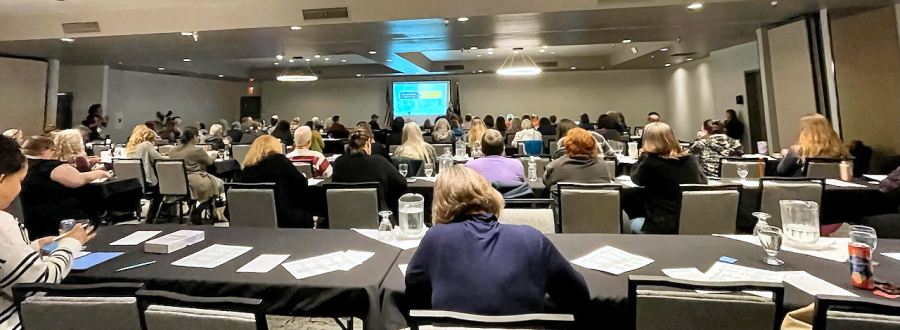
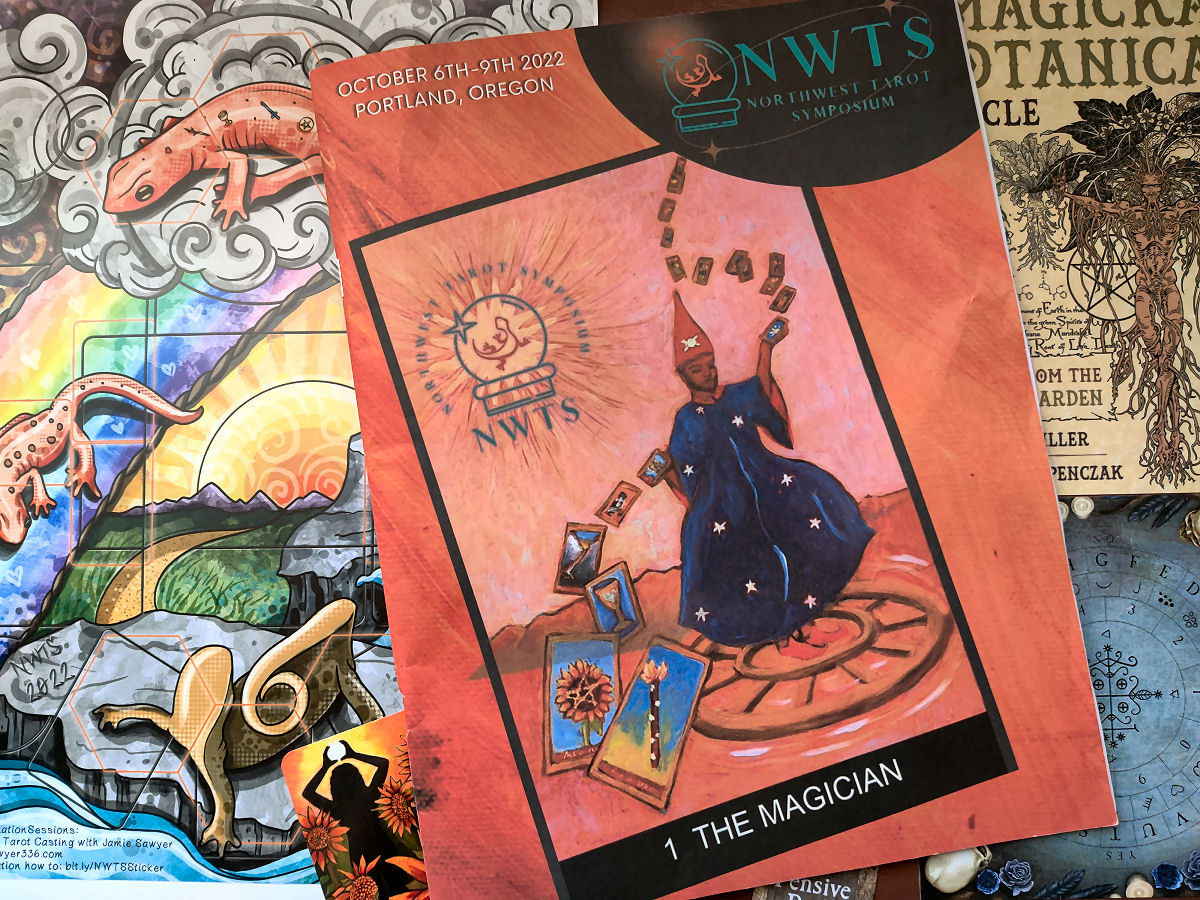
Whew! NWTS 2022 was a blast! This was Michelle and Roger of SoulTopia’s inaugural year as the organizers of NWTS, the Northwest Tarot Symposium in Portland, Oregon. And wow, what a comeback for NWTS, thanks to SoulTopia’s tireless efforts, persistence, and stewardship. This year, the tarot community really showed up for an impressive turnout, to the point where we might’ve outgrown the Monarch Hotel! Time for a bigger even more spacious venue? =)
Anyway, this is a casual recap of the event from my vantage point.
But since then there have been new developments in this subject area so I thought I might revisit the topic.
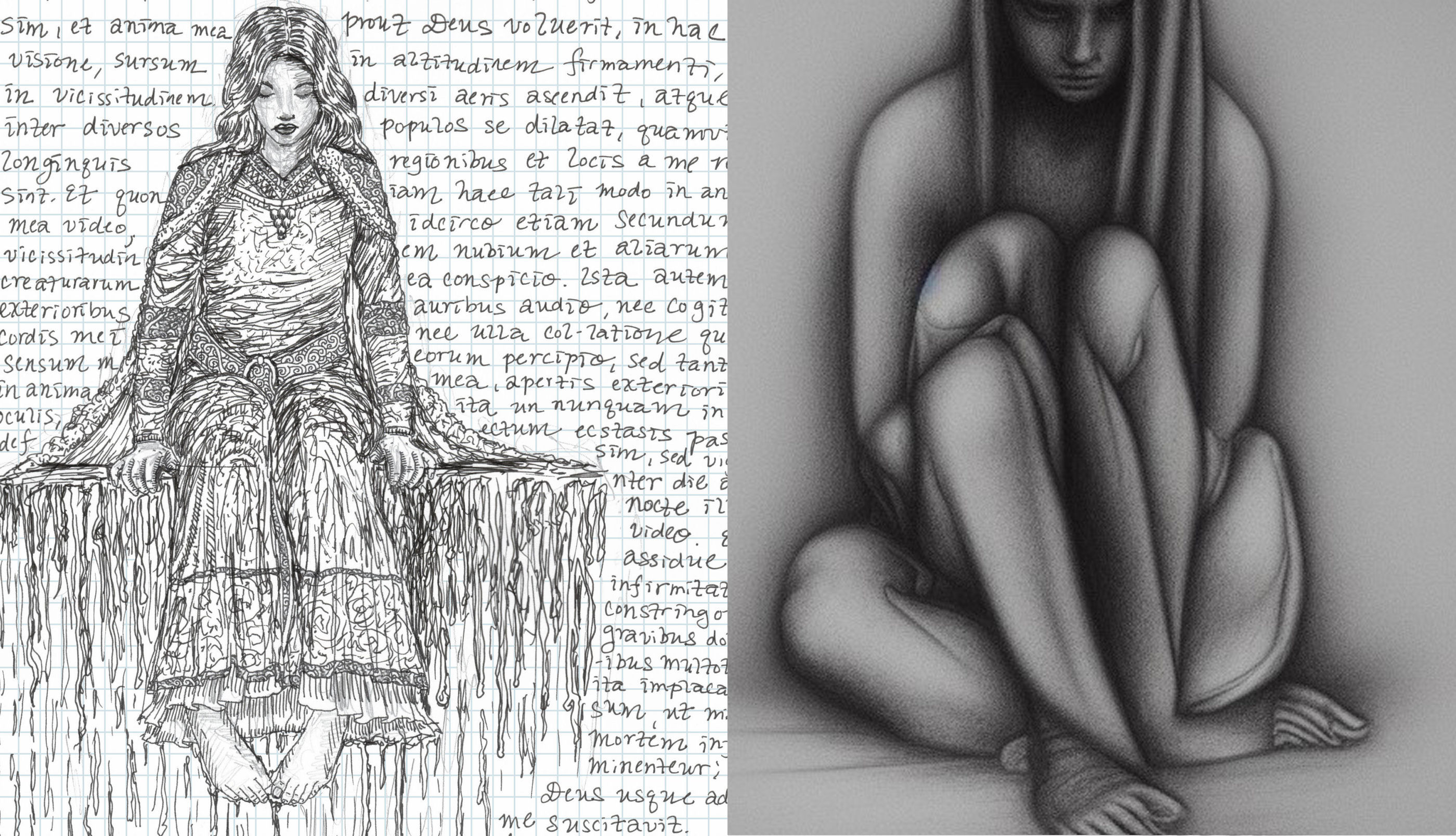
Left: My illustration, by hand in pencil and ink. Right: NightCafe, art style: “Charcoal”
Some Personal Dabblings with AI Art
Above to the left is a sketch I did by hand, first in pencil, then outlined in ink. I started with the following prompt, text I typed out myself and stared at for a good five minutes before putting pencil to paper: Solitude. Contemplating. Maiden in a moment of self-questioning.
I copied some text written by Hildegard of Binden on the transcendental experience of God, to fill the blank space. What you see took me two hours. Uh, tbh, probably longer than two hours. I lose track of time when I’m doodling. (The barely-there blue grid lines was added digitally, because that’s just something I like to do when I share my doodles to the public.)
What you see to the above right was produced via NightCafe, an AI art generator, with the same exact text as the prompt: Solitude. Contemplating. Maiden in a moment of self-questioning. I selected the art style “Charcoal” to see how close to a pen and ink sketch it could go. The illustration to the right took the program two minutes.
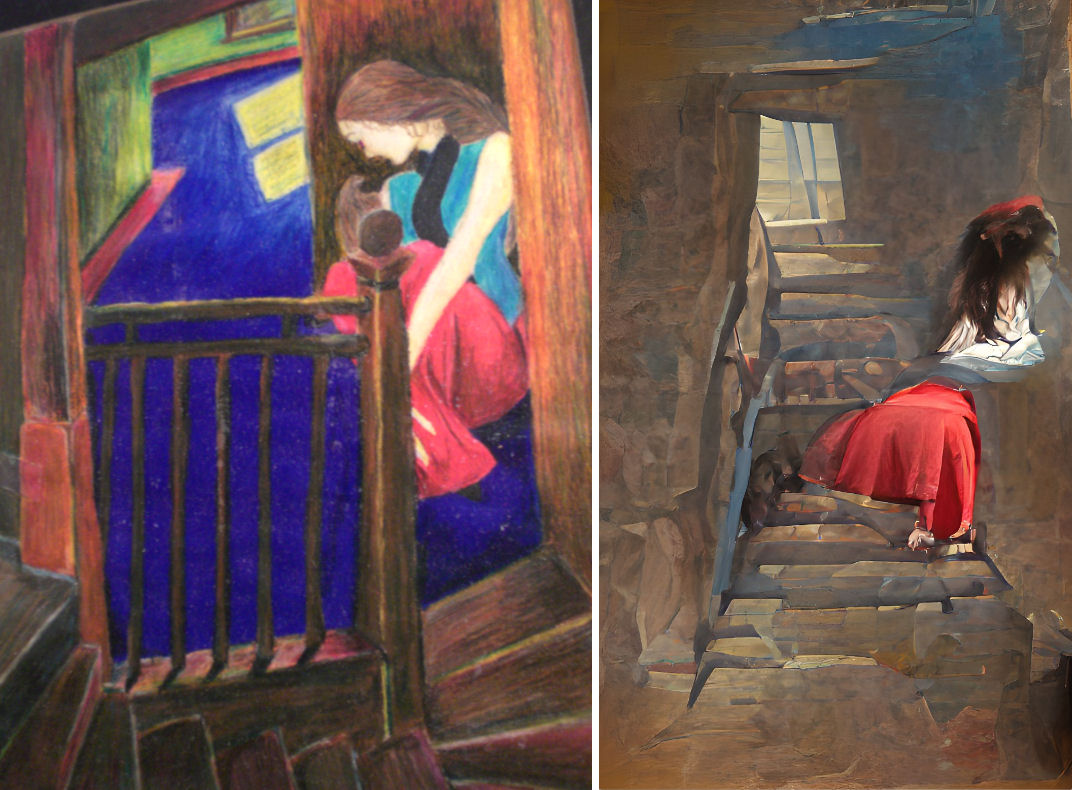
Left: High school art by yours truly, from the 90s. Colored pencil. Right: AI generated art based on text description of illustration to the left, via Wombo
I’m fascinated by how similar the interpretations were, between me, a human, and AI tapping in to collective knowledge. In fact, in the past I’ve drawn illustrations in charcoal very similar to what the AI produced!
The pose, the facial expression, the way the hair falls, the vulnerability– if I rummage through my old art portfolio from high school, I can excavate a charcoal or pastel drawing that looks more or less the same with that!
“You Are the Journey” by @KaliYuga_ai via MidJourney (AI art)
Does AI Art Lack Soul?
I explored the question “does AI art lack soul” here in an earlier rumination on the subject. In that blog post, I talked about how this advent of AI generated art has shifted my former paradigm on the mind-soul relation.
This declaration you’ll hear oft repeated — AI art lacks soul; AI lacks soul — is one I’m most apprehensive about. Perhaps we can say we don’t understand the soul of AI, but to declare that AI art lacks soul… I dunno. It doesn’t sit right with me.
I’m not convinced that these works “lack soul.” If I’m getting all psychic and woo, I might say the impression of the soul that’s present feels different from a human sapient soul, just like an animal’s sentient soul or a tree’s soul feels different. You hear people critique the evident style or aesthetic consistent in AI generated art, but just because you don’t love an artist’s style or technical approach doesn’t mean that artist suddenly lacks soul.
So while I have many conflicting thoughts about AI art, the accusation that it lacks soul isn’t one of them. If anything, I wonder if the full body of AI generated art is mirroring back something deep within us collectively, for us to see.
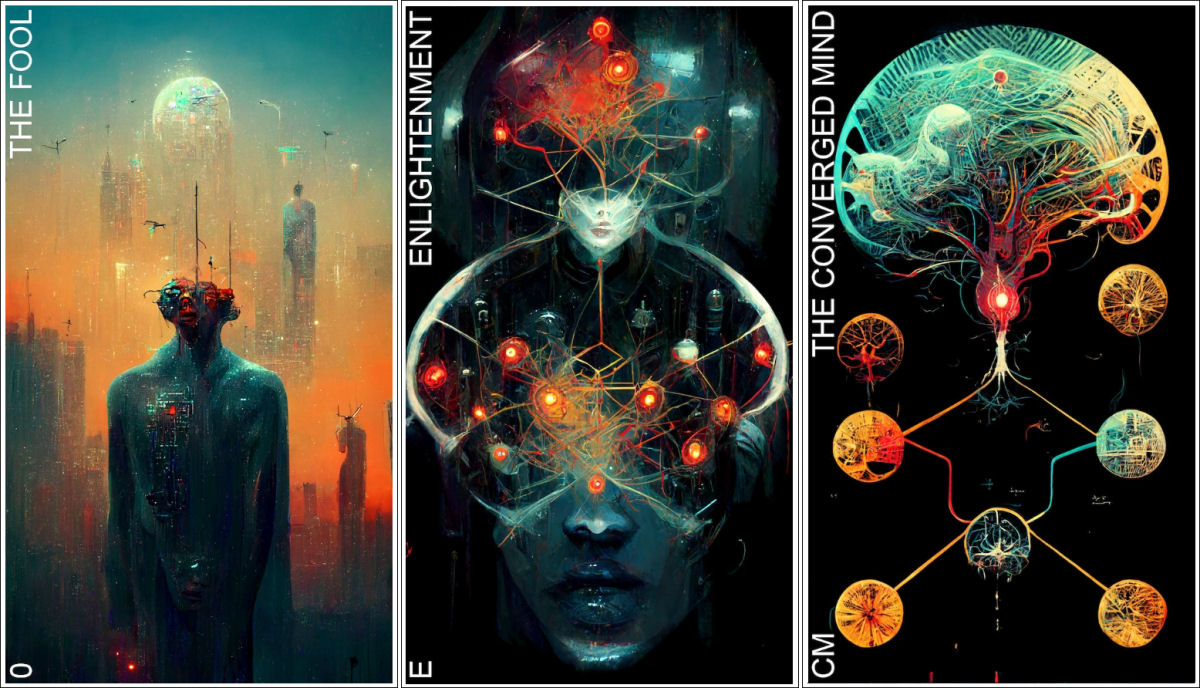
Technomage Tarot by Lee Duncan in collaboration with AI, via Kickstarter campaign (last visited 2022 Sep. 30)
A Rising Popularity of AI Generated Art Decks
Oh, and to illustrate what the community has been buzzing about with regard to AI-generated tarot decks (or in collaboration with AI) coming on to the market, I’ll feature several throughout this commentary.
I’ve had a working draft of this blog post, on this topic, started in 2020, and already I was feeling late to it, since it was a topic trending in 2019. Life and other priorities got in the way so I left this draft unfinished.
In 2021 I started seeing this topic discussed with fervor again. It inspired me to reopen this post. I worked on it some more, but again, just didn’t care to finish my train of thought, for whatever reason.
Now it’s 2022 and this same exact topic of conversation in the tarot community is still going strong.
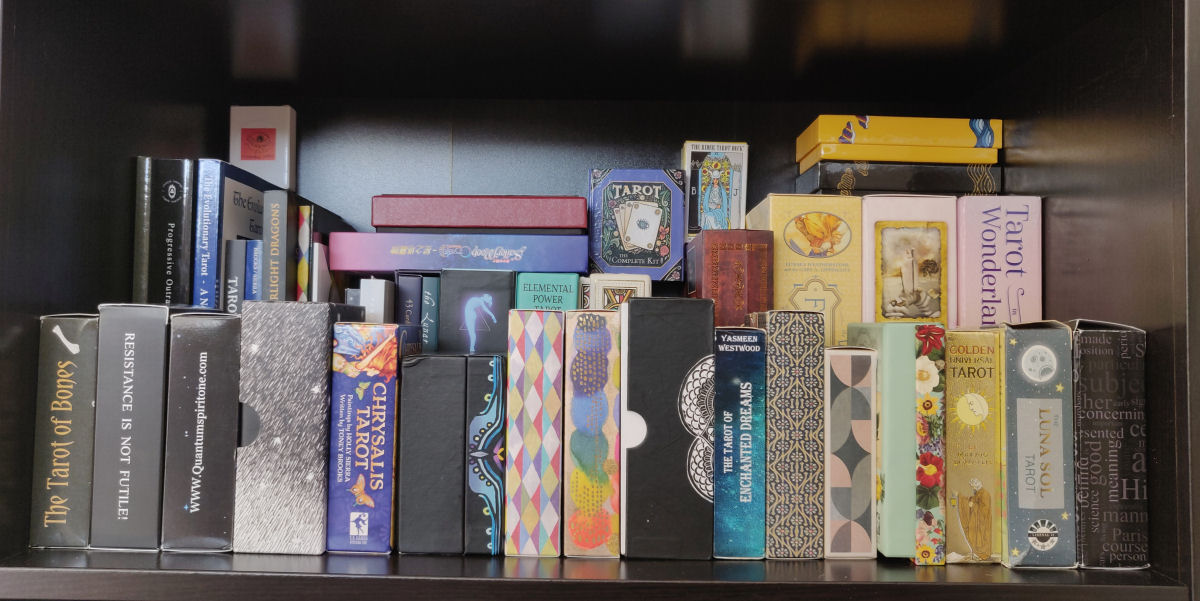
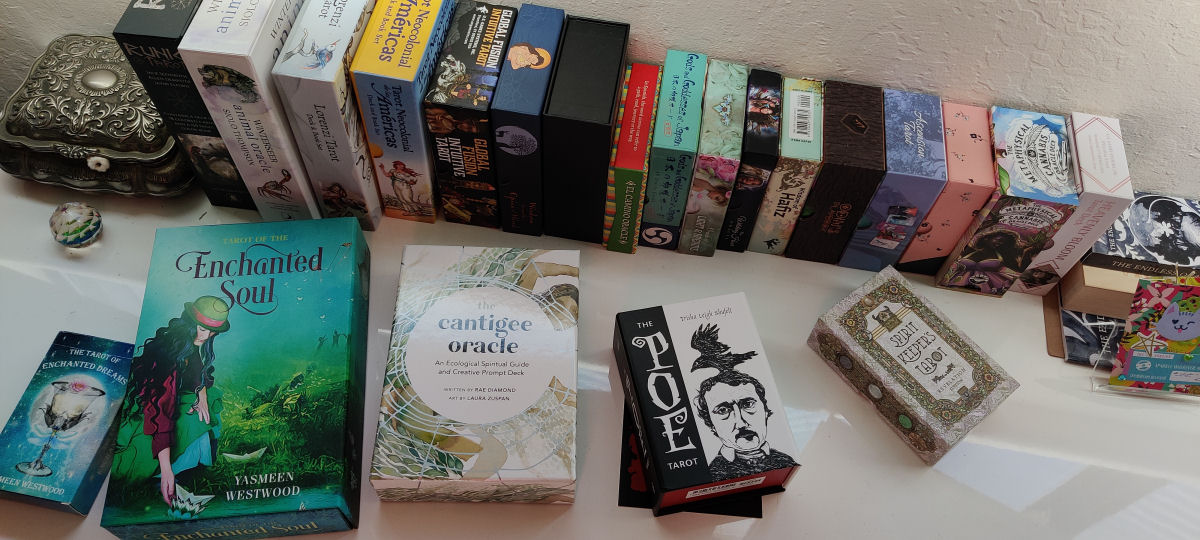
Maybe this time I can finally finish what I was trying to say. I’ll divide up my thoughts by the recurring subtopics or points of argument you hear when community members start talking about tarot deck collecting, culling, and consumerism.
To balance out the paragraphs of text, I’ll be sharing random photos of decks you’d spot around my house.
I’m tickled by the coincidence of 2021 being the year the Revelation and final edition of the Spirit Keeper’s Tarot was released and it also being my Key 20: Judgement year. Traditionally this card was named Last Judgment and depicts prophetic scenes from the Book of Revelation.
My birthday is September 24 (9 + 2 + 4 = 15), which you then add to the digits for the given year (2 + 0 + 2 + 1 = 5) for the sum 20.
Major life shifts happened to me in 2021. What feels universally true about Judgement moments is that the past flashes before your eyes in an instant. Meanwhile the present is happening in slow motion, and your sense of the future is exciting yet uncertain. If Tower events are when you feel like the world you had built is crumbling down around you, then Judgement events are when you feel like you’re hydroplaning.
A video I watched inspired me to hit the record button and share these thoughts. But this is no longer a direct VR to that video (and in fact this video might have taken on a more melancholic tone than intended).
Instead of being a direct VR to the video inspiring this sharing, I will be commenting on what my own experiences have been like.
Here are some of my thoughts 7 years in.
This video is unlisted, which means it won’t appear on my YouTube channel or on the public YouTube platform. I will be experimenting with moving away from that platform and posting more unlisted videos here on the personal website.
Video Transcript
For those who prefer reading over watching a video, here’s a cleaned up, polished transcription of the video:
This began as a possible video response to something I watched recently—a video where someone shared their thoughts on being a pagan author. But then, my ramblings diverged into something else entirely. Still, for context, this started as a reflection on the social and professional pressures of being a pagan author.
Specifically, I was thinking about how, once you’re published, people start to treat you differently. Your voice becomes memorialized in a public, two-dimensional space with a lot of visibility—and when that happens, something reductive tends to occur to your personal identity. The audience no longer sees the full human behind the words. They reduce you—the author, a red-blooded, complex person with a past, biases, emotions, and opinions, some of them flawed—into a flat, two-dimensional caricature.
Once you become a pagan author, you’re no longer allowed to be multifaceted. You’re no longer seen as someone with complex or evolving thoughts. Heaven forbid you once published something a decade ago that no longer reflects who you are today—it will still haunt you.
When you brand yourself as an author, you’re branding yourself as a single archetype. And yet, a fully developed human being is made up of many archetypes at once. If your branding is successful, then people will only see that one archetype you’ve presented. And they will judge you as that limited version of yourself.
How people perceive that reduced archetype—this caricature—is often polarized. You’re either pure brilliance or pure awful. You’ll either be the hero on a pedestal or the villain someone is determined to take down. And when they do take a swing at you, they get to be the underdog hero that the audience roots for.
The irony is that most of us who become authors—most writers—are shy, introverted, insecure people. We’ve experienced marginalization. We were often the outcasts, the underdogs, the kids who got picked on. And now, suddenly, because we’re published, we’re perceived as the Goliath. But not a single bone or nerve in your body actually feels like Goliath.
There’s a kind of dissonance there—I don’t even know if I’m using the word “cognitive dissonance” correctly—but something happens when you’re faced with that mismatch between how you’re perceived and who you know yourself to be.
People say, “Never meet your heroes,” and now, bizarrely, they’re referring to you.
And with the rare exception of the narcissistic bad apples in any field, I can assure you—no author wants to be a hero. No one wants to be seen that way. And it’s not about false modesty. It’s just the truth. When you call someone a hero—when they’re just an ordinary person trying to live their life—you’re setting them up to fail.
An author is just someone who took the time and effort to sit down and write out their thoughts in a (hopefully) cohesive, organized way—and had the grit to see the manuscript through to publication. That’s it. That’s all it is.
I don’t think Noam Chomsky or Eckhart Tolle necessarily has more brilliant ideas than, say, my husband James hasn’t already come up with himself—while sitting in the bathtub with a beer in hand. You know what I mean? The difference is that a published author has a particular skill set and stamina for completing manuscripts that maybe Joe Plumber hasn’t developed, or hasn’t had the time or opportunity to develop yet.
To the new pagan author: I warn you—people will forget that you have feelings. Or worse, they won’t forget. They’ll realize you have feelings and just not care.
And to be fair, it’s not entirely the public’s fault. It’s partly our fault, or maybe the industry’s. There’s intense pressure to brand yourself as an author. If people can’t sum up who you are and what your work is about in three words, you won’t gain popularity. But if they can sum you up in three words—congratulations, you’ve branded well—and you’ll be rewarded with visibility.
But then, to maintain that visibility, you have to stay on brand all the time. There will be constant external pressure for you to stay in your lane. A private person who hasn’t branded themselves can have different opinions on all kinds of topics. No one asks them for sources or a CV. But as a public figure, you don’t get that grace anymore—not after publication, and certainly not if your branding is successful.
Once you become known for something, you’ll only be “allowed” to speak on that narrow range of subjects. You’ll be told to stay in your lane. People will say that author branding is a double-edged sword—and they’re right. The more successful your branding, the more your voice seems to matter. But at the same time, the more your true self gets lost in the process.
Live by the sword, die by the sword, I guess.
To the new pagan author: I warn you that, at some point, you will be called a gatekeeper.
Let’s say in your book, you write something simple, like, “Personally, I think strawberry jam is better than blueberry jam. I’m not particularly fond of blueberry jam.” That’s all you said. But people will misinterpret it. They’ll claim you said blueberry jam is inferior to strawberry jam. That you’re disparaging people who like blueberry jam. That you’re dismissing the entire population who prefers it.
And before you can even clarify, you’ve become that author—the one who gatekeeps jam.
To the new pagan author: seasoned authors will often tell you not to care what others think. Don’t worry about what people say. Shrug it off. Don’t pay attention to the negativity.
I’m still conflicted about whether that’s healthy advice. I really don’t know.
We should care what our loved ones think of us—because how they perceive us is a reflection of how we’ve treated them. And in my personal spiritual worldview, we should treat everyone as our loved ones. We should love all people. And if we do love people—truly—then we should care about what they think of us. Their thoughts and feelings about us reflect, whether we like it or not, how we’ve been treating them.
So in that sense, shouldn’t we care? Shouldn’t we be open to hearing when someone thinks something negative about us—and ask, “Is that a fair reflection of how I’ve treated them?”
But then again—what do you do when it’s the entire internet calling you a terrible human being?
How do you process that in an emotionally healthy way?
Here’s the conundrum: when you publish a book, you need to consent—at least intellectually—to being critiqued. To being criticized. That’s part of the deal. And if your voice becomes influential, then for the sake of intellectual checks and balances in a democratic society, your ideas should be vigorously challenged.
If you’re smart, then on some level, you understand that.
But… do we ever really grow out of being that little kid who got picked on for being different?
Why does public condemnation of your publicly celebrated work feel so much like the bullying you endured as a kid, when you were nobody?
So to the new pagan author, I’ll just say this: For some reason, the grass is always going to feel greener on the other side.
Evolving from the pen and ink line drawing you see above to the digitally-remastered in-color version of The Priestess was a journey. As 2021 comes to a close and I send out the final shipment of first print run decks of the Revelation Edition, I’d like to share my reflections on this journey.
Fair warning upfront: This is going to be a looooong blog post. I also share some tips, from direct personal experience, to aspiring indie deck creators.
Completing the Revelation Edition is one of the coolest things I’ve ever achieved, because I leveled up so much in terms of my own art. I did something I didn’t even know I was capable of doing.










 benebell wen