I used to do this by newsletter, but I accidentally deleted my regular newsletter mailing list in Mailchimp and then couldn’t figure out how to get it back. Oops.
To write up this year in review, I took out my 2018 Metaphysician’s Day Planner and went through the pages, the months at a glance, weeks at a glance, the divinatory forecasts, reflection notes, and everything I documented this past year. I’m gearing up to write in all my goals, resolutions, and plans for 2019 soon.
If you’d like to order a Metaphysician’s Day Planner for 2019, you can read more about it here before you buy.
If you’re into that whole tarot year thing (where you add up the digits for your month of birth, day of birth, and then this current year, 2018, then reduce it down to a number 1 through 22), then 2018 was a Strength/Justice year for me (depending on how you ascribe Key 8 in the Majors). I’m gonna guess my life path has programmed itself to the RWS system because it was definitely more of a Strength-y year than Justice-y.
Presenters were announced for the 2019 PantheaCon scheduled programming and segments of the community weren’t happy about two of those presenters. The trans community reported concerns with Max Dashu’s alleged stance against trans women participating in events intended to celebrate biologically-born women.[*] Pagans of color reported concerns with Witchdoctor Utu’s alleged cultural appropriation. In both instances, I want to emphasize “alleged” not just for legal reasons, but because there really are disputes about whether these allegations are even true or have, at least in part, been misrepresented and factually distorted.
[*] – Psst… please see updated notes at the end of this post.
In response, the organizers at PantheaCon then un-invited the two controversial presenters. Yes– their presentations were accepted, announced to the public, and then in response to the reported concerns, un-invited publicly and neither will now be presenting at PantheaCon 2019.
PantheaCon has also issued a public statement here (undated) noting that it was “a mistake to include Max Dashu in the program” because having Dashu at the event could pose a safety issue for the trans community. Furthermore, “all trans-exclusionary advocates and those in close association with them will not be presenting at PantheaCon for the foreseeable future.”
Further note that members from all camps on all sides have reported receiving death threats, hateful and demeaning even defamatory remarks, trolling, and doxxing. Several members of the pagan community who dared to take a public stand along one of those noted position lines then had to subsequently disable all their social media accounts because they began receiving death threats, hate, and harassment. I believe every one of those members who say they’ve received death threats and harassment because I get those too for the most asinine reasons– like, “I hate what you said about reiki/starseeds/hexes/the tarot and you’re a total ignorant stupid bitch I hope you die a miserable lonely death and watch out my coven is going to curse you fuck you bitch die die die.” Not kidding. So I’m not one bit surprised people are sending death threats over serious controversial issues like the ones presented here.
Video installment #11 in the orientation course series for the Spirit Keeper’s Tarot is a guided meditative tarot reading rendered through accessing the Akashic Records. The direct link to the video on YouTube is here or you can check out the entire course series on this page here.
In this post I’ll be documenting an Akashic Tarot Reading I did for myself, guided by Video #11. I’m using it as a case study so that it might help round out your own approach with the reading exercise and to think about how you can interpret your own results from the Records.
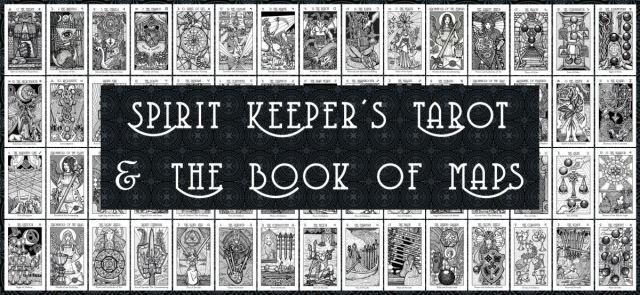
The following is an excerpt from The Book of Maps, the companion guidebook to the Spirit Keeper’s Tarot, a hand-illustrated black and white tarot deck crafted with practitioners of the mystic arts in mind. The pen and ink drawings were inspired by woodcut prints from the late Renaissance. Symbology called upon is based predominantly on medieval European alchemy, astrology (the Sacred Seven), Hermeticism, Zoroastrianism, Abrahamic angelology, Kabbalah, Catholicism/Christianity, Sufism, and Egyptian mythology.
By the way, the date of this posting is the mid-point between Waite’s birthday and Crowley’s birthday. How fun is that!
Excerpt from The Book of Maps:
Evocation of Waite and Crowley
My purpose for including this section is to document my personal ritual practices in attempting to evoke the spirit presence of A. E. Waite and Aleister Crowley, with my own Holy Guardian Angel present, while conceiving Spirit Keeper’s Tarot. This is not a how-to instructional nor does it purport to teach anything about evocation. Treat this section as nothing more than a memoir of what I did to create my tarot deck.
I set out on the Major Arcana cards with the intention of evoking Waite and Crowley, but sincerely did not feel like I succeeded during the crafting of the Majors. I never actually felt their presence (tenuous and subjective as it is anyway) but did feel the very strong and powerful presence of my Holy Guardian Angel, who I’ve opted to leave unnamed in this Book.
Instead, I felt like my work on the Major Arcana was being used as a test or trial, to see whether I was worthy of being given assistance in my endeavor. So the crafting of the Majors was very much my own. It wasn’t until commencing the Minors, beginning with the Four of Scepters (Four of Wands) that I felt the very strong and powerful presence of both Mr. Waite and Mr. Crowley.
Before writing this chapter of the Book of Maps, I had decided to keep this part of my crafting process private, in large part because I had no idea what I was doing. I was also aware that revealing such practice could be construed as a marketing ploy, which I certainly did not want. So I made no mention of it.
Before undertaking a Key set (i.e., Realm of Twos, Realm of Threes, etc.), I’d light two long taper candles, one white and one black, with W etched in gold on the white candle and C etched in silver on the black. I placed the white candle on a hand-drawn mat of Waite’s rectified birth chart (birth chart rectification is an astrological calculation used to best guess the time of birth when it is unknown). Considering the number of times the word “rectified” comes up in Waite’s Pictorial Key, I personally found a lot of humor in having to use a rectified birth chart for his evocation.
A year ago from this day, in fact on the anniversary exactly, I posted a review of the Labyrinth Wisdom oracle cards by Tony Christie. That oracle deck remains as one of my favorites. They’re powerful and insightful for personal readings and great as an addendum or clarifying reading to a professional tarot session with a client. Now I get the pleasure of reviewing the companion book to Labyrinth Wisdom— Labryinth: Your Path to Self Discovery.
The first line of the Introduction hooked me instantly: “In life you experience a series of doorways, gateways, and openings to love, light, and wisdom that, if taken, will bring you to a higher state of existence.”
I’ve always been fascinated by the metaphor of the labyrinth and the rich history that it comes with, so I have read many books on the subject that I can compare with Christie’s. In that comparison, Christie’s book comes out on top. The explanatory power that these 267 pages plus an extensive bibliography for further reading is just incredible. If this is a topic that intrigues you the way it does for me, get Labryinth. It will deepen your knowledge and understanding of the subject area.
We begin with clear definitions of what a labyrinth is, types of labyrinths, and its origins. The labyrinth, in short, is a symbol of your journey in life with its twists and turns as you make your way toward your personal center. It can also be used as a form of divination meets walking meditation: journey through a labyrinth with a specific question in mind, and the labyrinth takes on the symbolic meaning of that question.
The following is an excerpt from The Book of Maps, the companion guidebook to the Spirit Keeper’s Tarot, a hand-illustrated black and white tarot deck crafted with practitioners of the mystic arts in mind. The pen and ink drawings were inspired by woodcut prints from the late Renaissance. Symbology called upon is based predominantly on medieval European alchemy, astrology (the Sacred Seven), Hermeticism, Zoroastrianism, Abrahamic angelology, Kabbalah, Catholicism/Christianity, Sufism, and Egyptian mythology.
For more information about the deck, go to:
Excerpt from The Book of Maps
Zoroastrian Magical Protection Charm
In an Avestan text dated to the 9th and 10th centuries, Ahura Mazda reveals to Zoroaster the magical powers of the falcon feather. The Magus who prays over a falcon feather can empower the feather into a charm that will ward off evil, cure and cleanse one of evil possession, and protect whosoever wields the feather against demons.
The ball is now officially in motion. It’s well past the point of no return. Also, fair warning: this is a really long progress update.
I ended up not having to convert my card image files from JPG to PDF, and could submit them directly as JPG files, which I was really happy about. By the way, if you want to see all finalized images, I’ve shared a Gallery of All Cards here.
Proofs Line Sheet #2
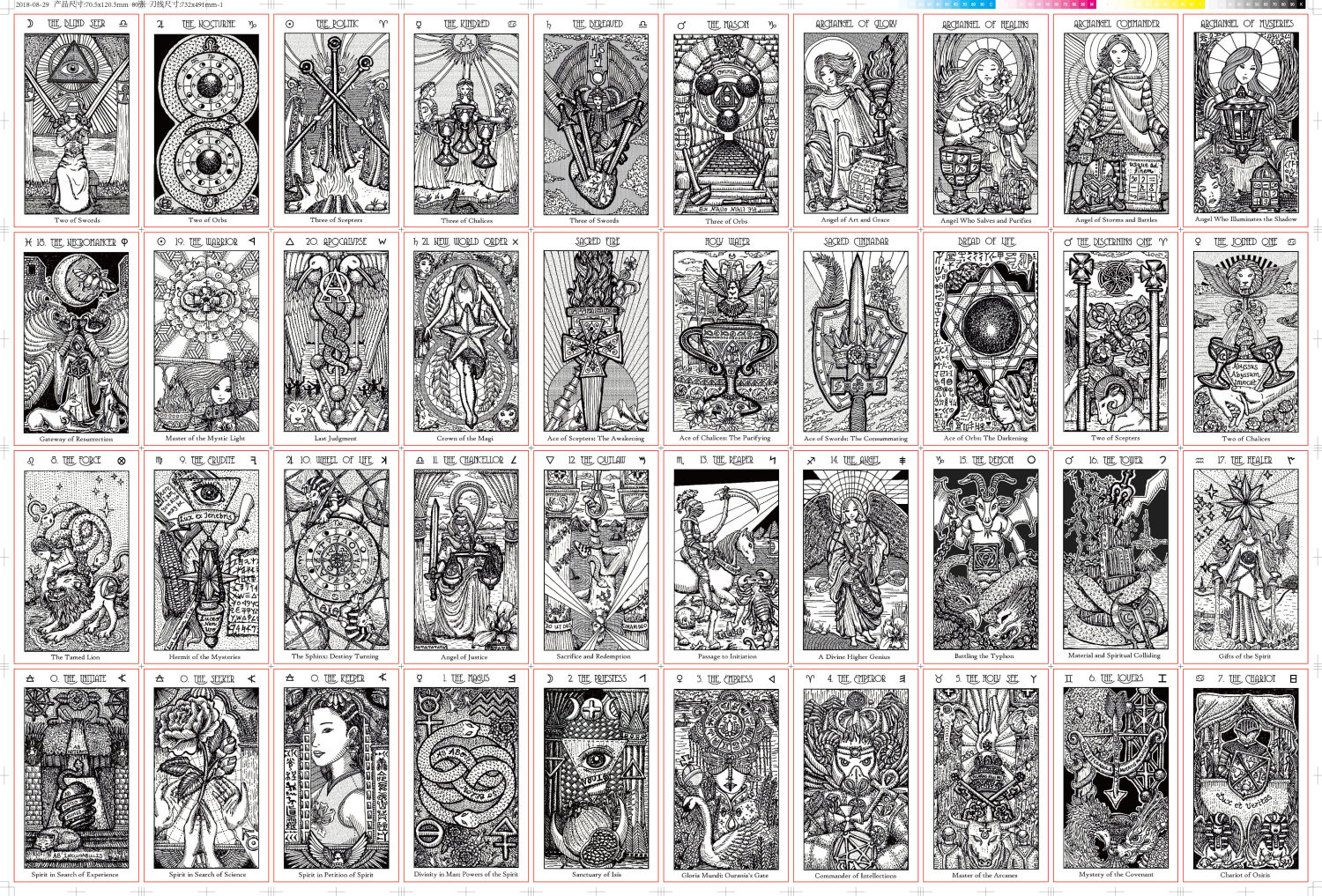
Also, aspiring tarot deck creators: from the line sheets I’m sharing, you can now see why it makes sense to design 80 cards, right? Even if you are sticking to the 78, I would still recommend creative ways to utilize the remaining 2 cards. Even if you say you’re going to print 78 cards only instead of 80, you’re getting charged for 80 anyway. Do you see my point?
And check out the ordering of the cards on the line sheet. My educated guess is that the automated printing machine will be cutting the cards starting from the bottom row of the sheet, going left to right. (Not all that important to know, but for the curious nerds, something fun to observe.) You’ll see what I mean.
I know that adult coloring books are all the rage right now, but I wanted to produce a tarot coloring book for children, which sure, adults can use, too. The premise of the coloring book is to use the tarot, and namely, my Spirit Keeper’s Tarot deck, to impart everyday insights to children. So it’s instructive to the extent of “everyday wisdom, but with a slight universal-religious bent.”
While writing the text to go along with the card drawings, I pictured only one particular child and envisioned myself talking to her. So I have written this book entirely to her. Her parents come from a particular background and faith, and so do her grandparents (and she’s being raised by her grandparents), so all wording is with that in mind. Whether it ends up being applicable to anyone else in this world, that remains to be seen. But just so you know, I wrote this book to her.
I don’t know if I’m good with children. I don’t have any myself. But I do have a bunch of nieces and nephews. I’m the kind of aunt who–true story– when tasked to babysit for the day, will teach your four-year-old kid how to play chess or a simplified version of Beethoven’s Fur Elise on the piano. I tend to start from a place of presuming that children are brilliant and capable of anything.
In case you want. Also, title of post intentional, to fly under the radar of the SEO spirits.
Just a doodle I did that didn’t end up becoming a tarot card in Spirit Keeper’s Tarot, though I’ve included it in one of the frontispieces of the companion guidebook, The Book of Maps. (Both deck and book forthcoming.)
Drawing the cards in sets of three, actual card size. This is how I begin.
I’ve been struggling with how to depict the tarot courts since back when I was still doing the Majors. And the whole time, I’ve been reading, brainstorming, researching, thinking– though no drawing– how the heck am I going to do this, and do this with any semblance of justice.
The more texts I studied on angelic correspondences to the elements, directions, and/or astrology, the more confused I got. Do I go Golden Dawn since up to this point so much of my point of view with the deck has been GD-influenced, or do I follow the lead of religious scholars turned mystics who say some of the Golden Dawn attributions for the Kabbalah are anti-Semitic in their source origins? How do I reconcile Christian mysticism, Jewish mysticism, and Islamic mysticism when it comes to angels? How do I also do it all with resonant subtext to Chinese, Taoist, and Buddhist ideas of angelic(-like) realms?
Also, when deck creators want to incorporate multiculturalism, they typically follow– shit–what’s his face–I can’t think of the name without looking it up. I’ve got it in an end note citation in Holistic Tarot if you really care. Anyway, Eden Gray followed what’s-his-face and everybody after Eden Gray followed Eden Gray so we go with this whole notion of Wands medium-hair, fair-eyed, Cups light-hair, light-eyed (or those two swapped), Swords dark-hair, medium-eyed, and Pentacles dark-hair, dark-eyed, so we typically end up with Asian or Middle Eastern for Swords and then Middle Eastern, Native American, or African for Pentacles. I opted not to go that route.
Agrippa made note of correspondences between geography, directionality, and the four elements, though he kept it relatively vague. Crowley then gave his thoughts on geography, directionality, and the four elements. His directionality conflict with Agrippa’s, but the geography and four elements kind of lined up. Well, lined up close enough to work for me. So that’s what I went with instead of what has become the more popular and trending ethnic associations for the four courts.
And that was just the tip of the iceberg of daunting considerations for the courts.
Drawing angel wings on the knights assembly line style…
The more I thought into it, the more stressed and nervous I got. And I did not want to go the direction of “screw everything and everyone, I’m gonna follow my intuition and channel it from my own higher consciousness” or whatever it is people say when they don’t want to listen to precedent or read books. How do I honor precedent and still acknowledge my intuition?
The art style for the deck I opted for is in the spirit of Renaissance humanism, a time when Christian mysticism and paganism merged in eclectic ways and mystics of that time were far more cosmopolitan and worldly than we folks today give them credit for being. I think the louder establishment voices of that time in history for structured Catholicism and the Church came as a knee-jerk reaction of the establishment to the subversive undercurrent of diverse thoughts that were emerging at the time.