For visual interest, there will be random photos of pretty tarot decks accompanying my responses – no connection between the photos and my responses beyond coincidence.
I kind of feel bleh for talking about AI so much, but everyone in every nook and corner of my life, personal and professional, is talking about it, so it’s hard to avoid wanting to chime in.
When you’ve got multiple thumbs in varying (and very different) pies, you’re exposed to a diversity of opinions, and wow is it diverse. If you’re only mingling in liberal arts circles, then you’re not hearing, truly hearing, the discussions about AI happening in the scientific circles, and if you’re only mingling in scientific circles, then you’re not hearing, truly hearing, the discussions about AI happening in the liberal arts circles. And so it’s been interesting hopping from one camp over to the other and back to witness the contrast.
For a ballpark sense of how many videos are now unlisted, as of this posting only 129 of 405 total videos are publicly visible in the general Videos tab and thus only those 129 videos are searchable on the YouTube platform.
There was a TikTok video that kinda sorta went viral among tarot people. All my tarot friends were chattering about those “six ways” and so many feels got riled up. Heck, the fact I made my VR two weeks ago and am still talking about it right now with an addendum blog post shows I got a little riled up, too.
In my (probably misplaced) priority of trying to keep videos short and succinct, I didn’t flesh out the thoughts I had wanted to share. And then many tarot colleagues continued and extended the discussion, so now I have even more thoughts. =)
If I tried to list out all the impactful video discussions on AI art I’ve been loving, it would just go on and on, so I won’t link to the more popular takes from artists themselves. Plus, you can find them via any quick keyword search on YouTube.
I’ve been quite verbose myself when it comes to sharing my thoughts and commentary on AI art. See below hyperlinks to three past blog posts. As an assist I’ve outlined bullet point lists of subtopics each blog post covers.
But I thought I might add a candid video chat, too. =)
Don’t forget– if it helps, turn the closed captioning on! =)
When I say “open tradition,” I mean a culture-specific practice of a magical system and set of doctrinal beliefs integrated into that practice that anyone at all can work with for themselves, that it’s free and open to the public.
When I say “closed tradition,” I mean a culture-specific practice of a magical system and set of doctrinal beliefs integrated into that practice that can only be honorably accessed if certain conditions are met, such as initiation, heredity, clan or ethnic group membership, or a formally established master-student bond.
Esoteric Taoist practices, broadly speaking, are openly accessible to anyone and all, but not anyone and not everyone who seeks it will find alignment with this Path. It’s for anyone, but it’s not for everyone.
But when we’re having this conversation about esoteric Taoist traditions here in the West, then to be clear, the conversation is probably more about cultural appropriation, spiritual gatekeeping, and how to engage respectfully with living traditions.
Taoism is, by the nature of the philosophy, even occult philosophy, is syncretic. It absorbs indigenous shamanic traditions, other established religious traditions, and in terms of the values that are the compass for how to navigate the syncretism, it’s nature. It’s the study and understanding of qi in nature.
It’s about nature, but humans are part of nature, and humans have minds that formulate ideas that become aggregated into establishments, you can’t ignore the establishments. So in reality, a human – the practitioner – will study how the many establishments engage with the qi in nature and then work with what works, for them. Since that’s Taoist mysticism in a nutshell, it’s an open practice.
Lineaged traditions, on the other hand, are unequivocally closed. Some are initiatory. Some are hereditary. Some are a combination of both. The premise is a group of people have cultivated an elite access to potent qi in nature through a highly-specialized methodology, and they aren’t about to share that methodology with just anyone. So there are very limited ways to access that specific methodology. Some form of ritualized transmission must take place to receive access.
But what about non-lineaged individuals crafting, say, Fu talismans, performing Taoist rituals, be that ones they’ve made up themselves or followed step by step from a canonical grimoire, or working with Taoist ritual tools? To be fair, that’s where it gets a bit more complicated, and political.
You’re going to encounter folks who say no, unless you’re lineaged, you cannot. That or it’s more of a warning that if you’re just chaotically doing it on your own, it’s way too easy and too high a risk of going off the rails and getting yourself into spiritual hot water. There’s a kernel of truth there, in my opinion, which is why I believe strongly in being religious and cultivating a strong moral compass and code of ethics first before dabbling with the occult. If there isn’t going to be a teacher there to rap your hands with a stick when you’ve been bad, then you’ve got to be disciplined enough to self-monitor.
Whereas I’ve always made my personal opinion clear. It’s open access with an asterisk. It won’t be me (and I don’t believe it should be another human) who puts up walls or locks the gate to keep you out. It’s gonna be the gods. It’s The Craft itself. The Esoteric Tao lets in who it lets in.
As for cultural appropriation, I’ve always taken the view that, you’ll know it when you see it. It’s hard to come up with a one-definition-applies-to-all-case-analyses metric for determining what’s okay and what’s not okay. Not to mention each person’s appetite for something possibly appropriative is gonna vary. Plus, overly-worrying about whether you yourself are culturally appropriating is more demonstrative of caring too much about yourself than actually caring about the cultural tradition you’re working with. If truly your heart is with the culture, you’ll naturally focus on its people, its communities, with an organic passion to learn as much as you can. I don’t have to tell you to be reverent; you just will. And if somebody has to remind you to be reverent, then buddy, I think you’re already in the wrong.
My third book, I Ching, The Oracle: A Practical Guide to the Book of Changes, published by North Atlantic Books, is forthcoming mid-2023. It’s my translation and annotations of the Oracle with cultural and historical references that honor the shamanic origins of the I Ching.
What it really is, though, is a magical grimoire. I began with an aspiration to write a grimoire on Taoist mysticism and magical practices, and then decided to do so through the framework of the I Ching. This is going to be a practical hands-on primer on East Asian modalities of witchcraft and folk magic. A deep-dive learning experience into the history and mythological references found in the Book of Changes is the bonus.
Leading up to the release of I Ching, The Oracle will be this series of videos where I lay the foundation for working with this third book. If this is of interest to you, stay tuned! ❤
In my previous blog post recapping NWTS 2022, I talked about how much I enjoyed the “Which Witch is Which” lunch panel discussion. So that you don’t have to click between pages, here’s what I said about it:
The best part of all? Hands down, the Which Witch is Which lunch panel discussion. Each practitioner on the panel represented a different perspective on witch identity and witchcraft, from whether they identify with the moniker “witch” (some yes, some no), what is witchcraft anyway, and their takes on covens, solitary practice, closed vs. open traditions, altars, ancestor work, and more.
Thank you, Mat, for giving a shout-out to Taoist ceremonial magic! And wish the incredible Onareo, who was present in the audience with me, could have also been up there on the panel to represent brujeria.
In this Bell Chimes In video chat, I wanted to ruminate on my own responses to the questions “Do you identify as a witch?” and “What is witchcraft, to you?”
Answers to those two questions are not at all easy to arrive at.
A video I watched inspired me to hit the record button and share these thoughts. But this is no longer a direct VR to that video (and in fact this video might have taken on a more melancholic tone than intended).
Instead of being a direct VR to the video inspiring this sharing, I will be commenting on what my own experiences have been like.
Here are some of my thoughts 7 years in.
This video is unlisted, which means it won’t appear on my YouTube channel or on the public YouTube platform. I will be experimenting with moving away from that platform and posting more unlisted videos here on the personal website.
Video Transcript
For those who prefer reading over watching a video, here’s a cleaned up, polished transcription of the video:
This began as a possible video response to something I watched recently—a video where someone shared their thoughts on being a pagan author. But then, my ramblings diverged into something else entirely. Still, for context, this started as a reflection on the social and professional pressures of being a pagan author.
Specifically, I was thinking about how, once you’re published, people start to treat you differently. Your voice becomes memorialized in a public, two-dimensional space with a lot of visibility—and when that happens, something reductive tends to occur to your personal identity. The audience no longer sees the full human behind the words. They reduce you—the author, a red-blooded, complex person with a past, biases, emotions, and opinions, some of them flawed—into a flat, two-dimensional caricature.
Once you become a pagan author, you’re no longer allowed to be multifaceted. You’re no longer seen as someone with complex or evolving thoughts. Heaven forbid you once published something a decade ago that no longer reflects who you are today—it will still haunt you.
When you brand yourself as an author, you’re branding yourself as a single archetype. And yet, a fully developed human being is made up of many archetypes at once. If your branding is successful, then people will only see that one archetype you’ve presented. And they will judge you as that limited version of yourself.
How people perceive that reduced archetype—this caricature—is often polarized. You’re either pure brilliance or pure awful. You’ll either be the hero on a pedestal or the villain someone is determined to take down. And when they do take a swing at you, they get to be the underdog hero that the audience roots for.
The irony is that most of us who become authors—most writers—are shy, introverted, insecure people. We’ve experienced marginalization. We were often the outcasts, the underdogs, the kids who got picked on. And now, suddenly, because we’re published, we’re perceived as the Goliath. But not a single bone or nerve in your body actually feels like Goliath.
There’s a kind of dissonance there—I don’t even know if I’m using the word “cognitive dissonance” correctly—but something happens when you’re faced with that mismatch between how you’re perceived and who you know yourself to be.
People say, “Never meet your heroes,” and now, bizarrely, they’re referring to you.
And with the rare exception of the narcissistic bad apples in any field, I can assure you—no author wants to be a hero. No one wants to be seen that way. And it’s not about false modesty. It’s just the truth. When you call someone a hero—when they’re just an ordinary person trying to live their life—you’re setting them up to fail.
An author is just someone who took the time and effort to sit down and write out their thoughts in a (hopefully) cohesive, organized way—and had the grit to see the manuscript through to publication. That’s it. That’s all it is.
I don’t think Noam Chomsky or Eckhart Tolle necessarily has more brilliant ideas than, say, my husband James hasn’t already come up with himself—while sitting in the bathtub with a beer in hand. You know what I mean? The difference is that a published author has a particular skill set and stamina for completing manuscripts that maybe Joe Plumber hasn’t developed, or hasn’t had the time or opportunity to develop yet.
To the new pagan author: I warn you—people will forget that you have feelings. Or worse, they won’t forget. They’ll realize you have feelings and just not care.
And to be fair, it’s not entirely the public’s fault. It’s partly our fault, or maybe the industry’s. There’s intense pressure to brand yourself as an author. If people can’t sum up who you are and what your work is about in three words, you won’t gain popularity. But if they can sum you up in three words—congratulations, you’ve branded well—and you’ll be rewarded with visibility.
But then, to maintain that visibility, you have to stay on brand all the time. There will be constant external pressure for you to stay in your lane. A private person who hasn’t branded themselves can have different opinions on all kinds of topics. No one asks them for sources or a CV. But as a public figure, you don’t get that grace anymore—not after publication, and certainly not if your branding is successful.
Once you become known for something, you’ll only be “allowed” to speak on that narrow range of subjects. You’ll be told to stay in your lane. People will say that author branding is a double-edged sword—and they’re right. The more successful your branding, the more your voice seems to matter. But at the same time, the more your true self gets lost in the process.
Live by the sword, die by the sword, I guess.
To the new pagan author: I warn you that, at some point, you will be called a gatekeeper.
Let’s say in your book, you write something simple, like, “Personally, I think strawberry jam is better than blueberry jam. I’m not particularly fond of blueberry jam.” That’s all you said. But people will misinterpret it. They’ll claim you said blueberry jam is inferior to strawberry jam. That you’re disparaging people who like blueberry jam. That you’re dismissing the entire population who prefers it.
And before you can even clarify, you’ve become that author—the one who gatekeeps jam.
To the new pagan author: seasoned authors will often tell you not to care what others think. Don’t worry about what people say. Shrug it off. Don’t pay attention to the negativity.
I’m still conflicted about whether that’s healthy advice. I really don’t know.
We should care what our loved ones think of us—because how they perceive us is a reflection of how we’ve treated them. And in my personal spiritual worldview, we should treat everyone as our loved ones. We should love all people. And if we do love people—truly—then we should care about what they think of us. Their thoughts and feelings about us reflect, whether we like it or not, how we’ve been treating them.
So in that sense, shouldn’t we care? Shouldn’t we be open to hearing when someone thinks something negative about us—and ask, “Is that a fair reflection of how I’ve treated them?”
But then again—what do you do when it’s the entire internet calling you a terrible human being?
How do you process that in an emotionally healthy way?
Here’s the conundrum: when you publish a book, you need to consent—at least intellectually—to being critiqued. To being criticized. That’s part of the deal. And if your voice becomes influential, then for the sake of intellectual checks and balances in a democratic society, your ideas should be vigorously challenged.
If you’re smart, then on some level, you understand that.
But… do we ever really grow out of being that little kid who got picked on for being different?
Why does public condemnation of your publicly celebrated work feel so much like the bullying you endured as a kid, when you were nobody?
So to the new pagan author, I’ll just say this: For some reason, the grass is always going to feel greener on the other side.
Thank you to the hundreds (according to YouTube at least, who knows, right?) who showed up to participate this morning in the chatroom when the above video premiered.
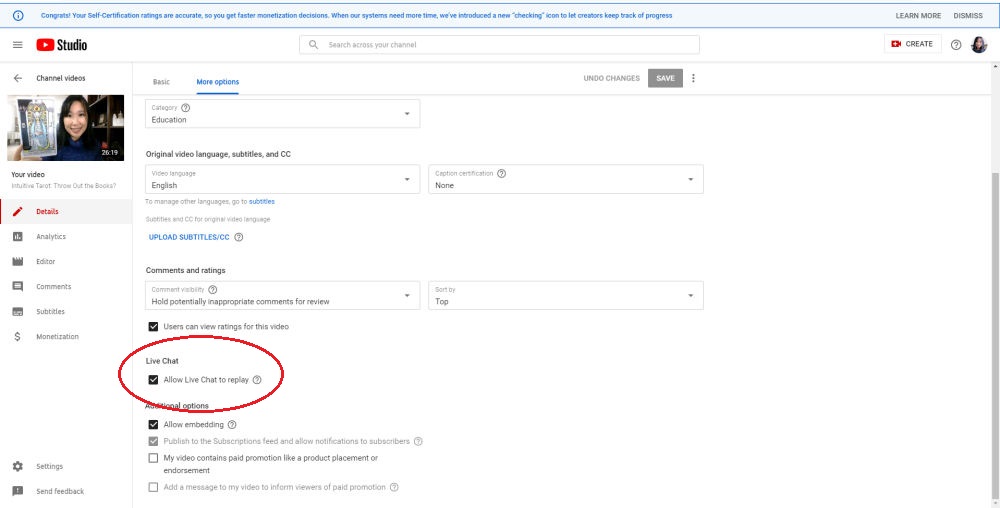
By the way, can any of you help me with this? I really thought I had the recorded LiveChat transcript function turned on. I checked it several times before the video premiered and I checked it after. It’s on. However, it seems like the chat transcript from this morning has disappeared.
Does anyone know how I can make the chat transcript from this morning available to all? What everyone shared was so insightful and more valuable to the topic than just what I had to say in this video, so I want that chat transcript to be available to you. However, the function doesn’t seem to be working for me. Any help you’re able to give is welcomed. Thanks!
“Bell Chimes In” is a video series on my YouTube channel where I pick a topic that is oft talked about and chime in with my perspective. You can click on the below links to see past episodes from 2017 and 2018.
This posting is a master list of all Bell Chimes In installments from 2019.
Bell Chimes In 2019
If the subject matter of an episode was of great interest to you, then be sure to click in to the blog post, because I’ll expand and go further in-depth on that subject in the companion write-up to the video. This year there were only 10 installments.




 benebell wen