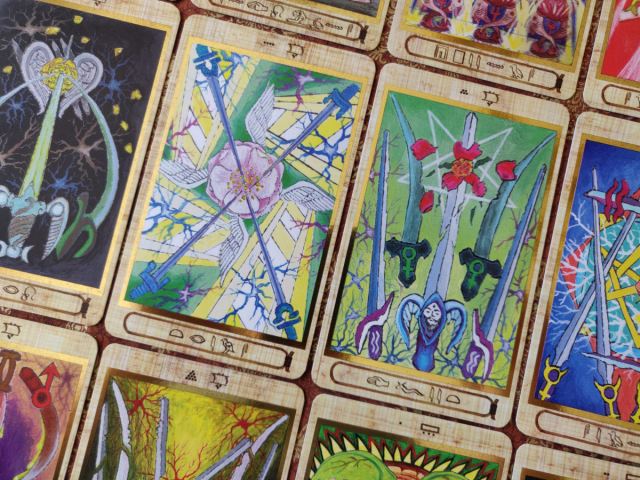
Oracle of Dr. John Dee by John Matthews and Wil Kinghan

The Oracle of Dr. John Dee by the illustrious John Matthews and one of the tarot community’s favorite artists Wil Kinghan was first published in 2013. Anything with the name John or Caitlin Matthews on it is guaranteed to be well-researched and worth your while.

John Dee was an alchemist, astrologer, mathematician, geographer, philosopher, and historian. In other words, a polymath. Dee met Edward Kelly, who claimed to be a powerful medium. In a vision, Kelly told Dee that he saw Archangel Michael seated on a throne with a kneeling figure at the archangel’s feet, and that figure was none other than John Dee. Needless to say, Dee took a liking to this Kelly.

Dee and Kelly formed a partnership where, over the course of several months, the two downloaded an entire language system from Heaven, the language Adam used to converse with the Creator and the angels. Dee called this language Enochian.

Continue reading “Oracle of Dr. John Dee by John Matthews and Wil Kinghan”

The Field Tarot by Hannah Elizabeth Fofana

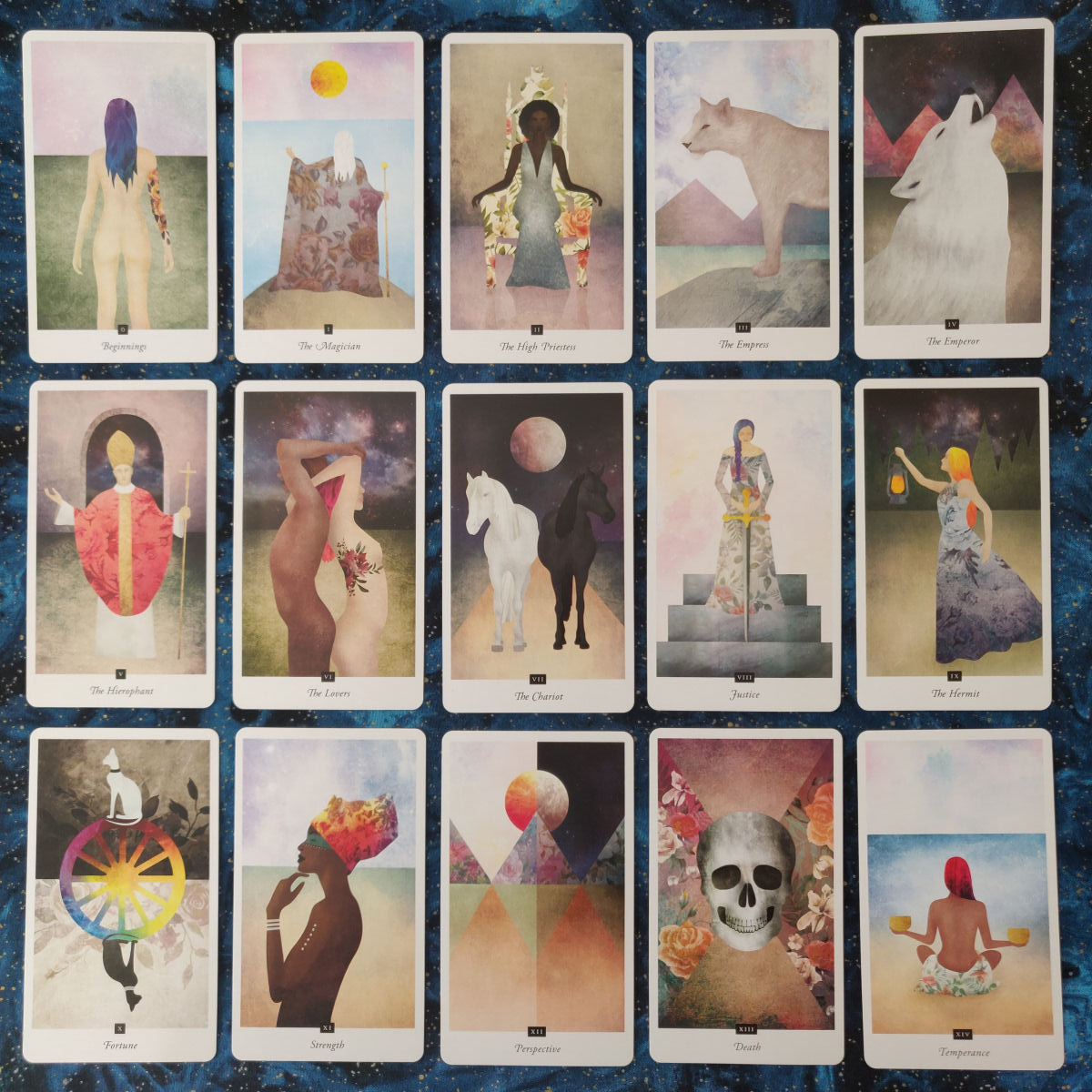
The Field Tarot created by graphic designer and artist Hannah Elizabeth Fofana definitely intrigues me. It feels a bit like a futuristic mystery thriller with an indie ethereal, quasi-vintage (the floral patterns evoke this) aesthetic.

The deck was created to guide readers through the sacred space (“the field”) where the tarot narrative takes place. Noted in the guidebook: “The prominent horizon line used throughout many of the cards puts you, the reader, within this space, allowing you to connect the traditional tarot journey to your own.”

With Justice in the place of Key 8 and Strength as Key 11, plus something about how the deck resonates intuitively, this feels deeply Thoth-inspired.

Continue reading “The Field Tarot by Hannah Elizabeth Fofana”

Download My Art Study Journal

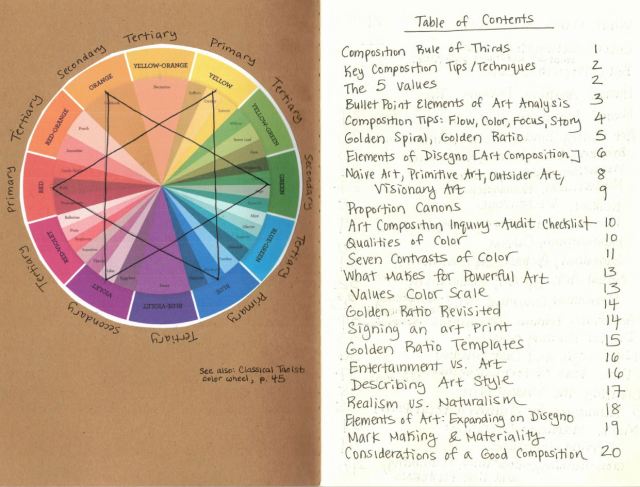
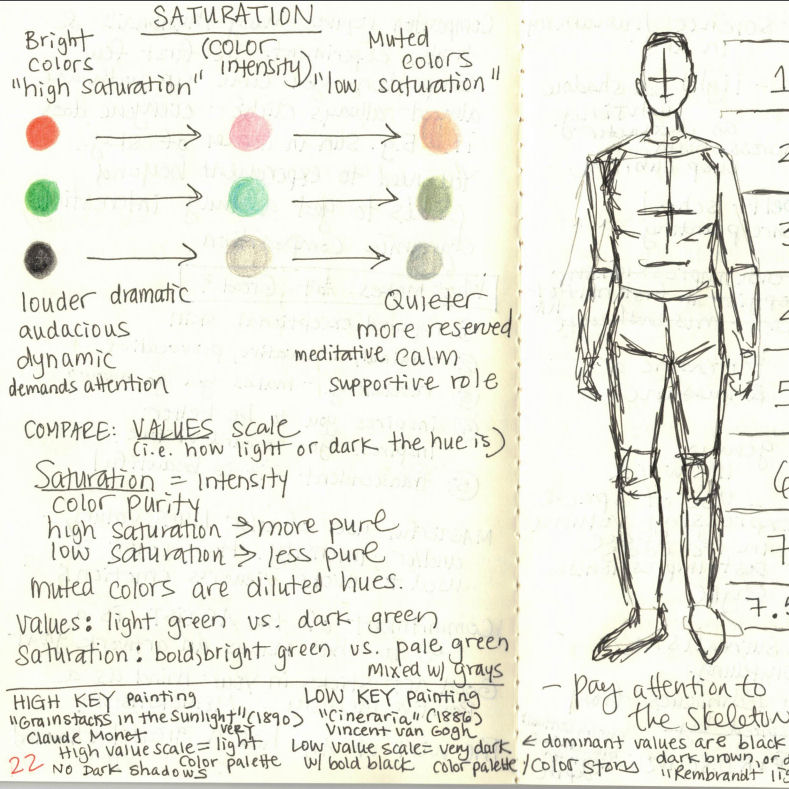
A while back on my Instagram feed, I shared photos of my 2020 art study journal. Now here’s the whole thing, though it’s still just a slim and sparse booklet.

I kinda didn’t wanna share this because it’s so, ew, a hot mess, disorganized, and you can even witness my mood changes as my handwriting teeters from neat and meticulous to hasty and illegible.

Continue reading “Download My Art Study Journal”

SKT Delivery Update and New Lessons Learned Re: Import-Export

Incorrect Bill of Lading. Sigh.

In my last SKT update sharing the Bill of Lading, I shared the version with the ship my decks were supposed to be on. But something happened with the manufacturer, they didn’t get the boxes on board in time, so it was delayed. It had to wait for another vessel, and the manufacturer simply didn’t think to update me until I proactively reached out and asked.

Here’s the actual Bill of Lading:

Correct, updated Bill of Lading.

I was tracking the vessel named “EVER FEAT” thinking that was the boat my decks were on.

But no.

My decks never made it on to EVER FEAT due to delays.

Instead, it’s on CMA CGM LOIRE (click on the hyperlink to track the ship).

Continue reading “SKT Delivery Update and New Lessons Learned Re: Import-Export”

Tarot Cards: High Art or Low Art

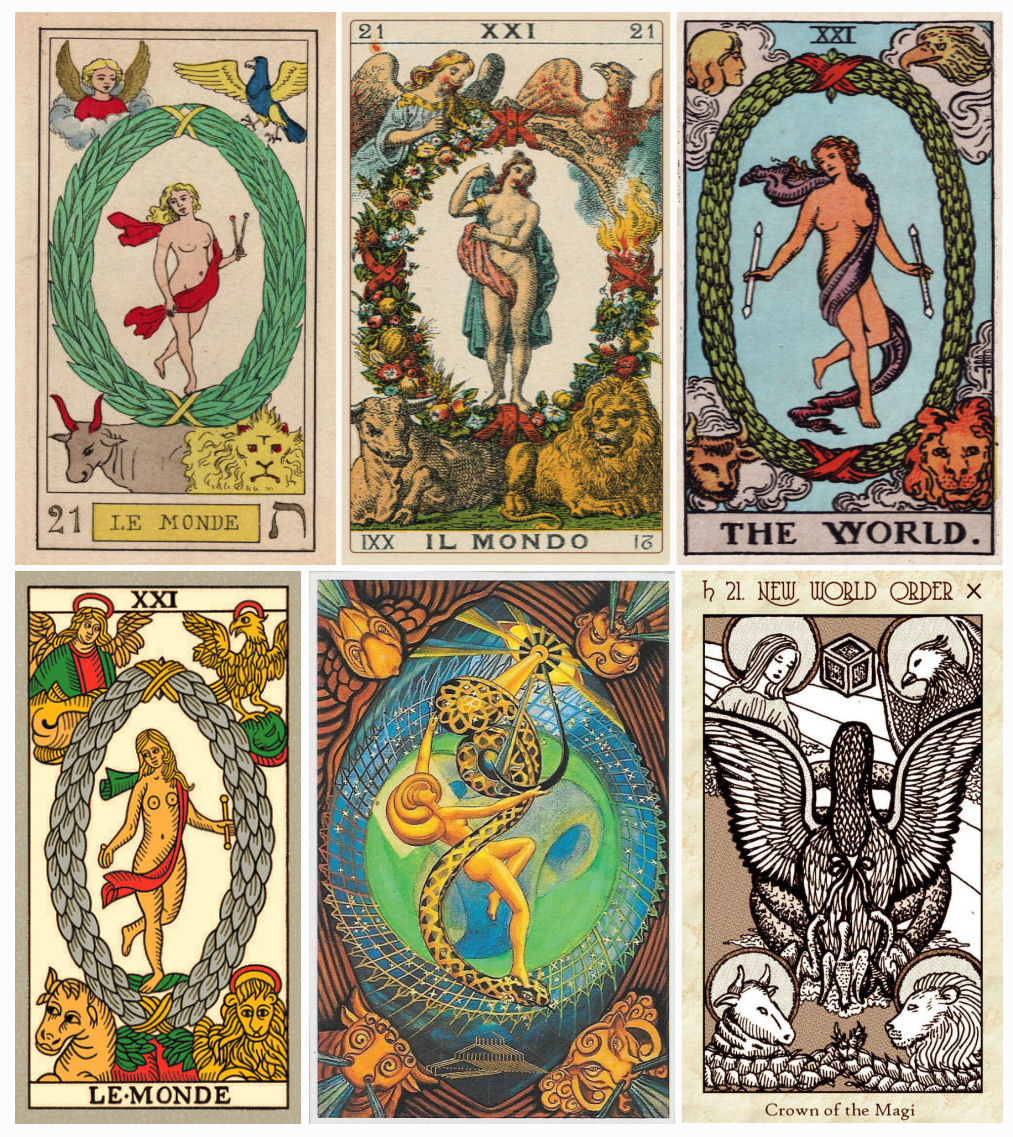
Top, Left to Right: Oswald Wirth Tarot, Soprafino, RWS. Bottom: Convers TdM, Thoth, Spirit Keeper’s Tarot

Lately I’ve been pondering whether tarot card art is high art (i.e., fine art) or low art (because it’s considered illustration).

It’s hard to argue that tarot card illustrations are anything other than low art.

It was made intended to be functional, it’s commercialized, it’s a craft rather than a form of fine art, and it’s formulaic. So of course it’s low art.

And if it’s digitally done, then of course it’s low art. (Words in italics emphasized in an affected manner wrought with contempt. Of course.)

From The Cards (2021) by Patrick Maille

Plus, today tarot is by and large mass-produced, and as a mass-produced commodity, created with the intention of it appealing to as wide a market audience as possible. Many of the modern decks at the moment can even feel like kitsch art. Except… is kitsch art a form of high art? Even that is a question to ponder.

Image source: Il Meneghello, studio of hand-painted Italian tarots

Yet I’m equally unconvinced that the works of Il Meneghello isn’t a form of high art, even while it conforms to definitions of “low art,” such as it being a craft, functional, and formulaic in the sense that it’s reproducing a structured tarot deck.

The Rosetta Tarot

The Mary El Tarot. The Thoth Journey Tarot. The linework on the Tarot of the Abyss. The Dracxiodos Tarot, to me, is modern art that is fine art. Navigators of the Mystic Sea. Both the Rosetta Tarot and the Tabula Mundi. Or how about the Palekh miniature paintings commissioned specifically for the Russian Tarot of St. Petersburg deck?

Continue reading “Tarot Cards: High Art or Low Art”

Shadowscapes Tarot by Stephanie Pui-Mun Law

The Shadowscapes Tarot is one of Llewellyn’s evergreen decks, meaning it remains a consistent bestseller since its first publication in 2010. And that’s no surprise. Oakland-based artist Stephanie Pui-Mun Law is indisputably one of the most talented illustrators to set her hand on to creating tarot art.

This is one of those decks you want to take a magnifying glass to. With the delicate threadbare lines and inlays of elaborate ornamentation, it would be almost disrespectful to not devote hours of meditative study to the details.

Three Septenaries of the Major Arcana. Click to enlarge.

How would I describe the deck art? If Asgard of Old Norse saga and Tianchao, the Celestial Empire of Chinese mythos merged into one kingdom inhabited by factions of magical creatures in which an epic fantasy was set, then you’d get the Shadowscapes Tarot.

Continue reading “Shadowscapes Tarot by Stephanie Pui-Mun Law”

Tarocchi dei Celti (Tarot of the Celts) – Majors Only Deck

Tarocchi dei Celti, or Tarot of the Celts, is a Majors only deck published in Italian. The artwork is done by Italian illustrator Antonio Lupatelli (1930 – 2018), “evoking the ancient people of the Celts, with illustrations that are full of humor and sweetness” (thank you, Google Translate).

Laughs nervously. Okay, I’m wholly unqualified to be reviewing this deck. I have no idea what any of the key titles say, and when I tried typing the words into Google Translate, for instance with “Fintan mac Bochra,” the application tells me this phrase doesn’t exist in Italian, and in Arabic, allegedly it means “Venta is not good.” Not only is there the language barrier, there’s also the cultural barrier– I’m not all that familiar with Celtic mythology.

Ah, wait a minute– now if I type in a whole paragraph, the translation result is better. For Key 0 (il Matto), it’s Fintan mac Bóchra, and that’s a name. He was a Druid known as “The Wise.” I like that play of Fintan the Wise on the tarot Fool card. The salmon pictured on the card is a reference to Fintan being able to shape-shift into a salmon, and a reference to the Salmon of Knowledge in Irish lore.

As for the artwork, there’s certainly a whimsy to these illustrations. Of what I can read, note Morrigan for Key III (The Empress card). You may need to click on the above image file for a zoomed-in close-up view. Oh, and I’m guessing Key II (The High Priestess) is Brig or Brigid.

Due to a severe lacking in my knowledge of Celtic mythology, I’m not going to comment on any of the associations, so whether The Morrigan as the tarot Empress card makes any sense… I have neither the information nor knowledge to offer intelligent commentary. =)

Continue reading “Tarocchi dei Celti (Tarot of the Celts) – Majors Only Deck”

The Goddess Tarot by Kris Waldherr

Kris Waldherr’s Goddess Tarot was the deck I read with in college at sorority houses and Greek mixer events. It would be this deck, pulled out of my messenger bag. The room would hush, because people still get a little nervous around tarot cards, and I’d have the querent shuffle the cards while focusing on her question, and then when she was ready, to cut the cards in three, restore to a single pile, and hand back to me. Then I’d lay out the Celtic Cross.

Back then I found that some people could get antsy around the RWS, so I couldn’t use the yellow box RWS without a risk of someone freaking out. Whereas no one ever freaked out when I read with the Goddess Tarot. The artwork is soft, with low contrast and low saturation, light values, and if I had to speculate on the medium used, I would guess watercolors and maybe some colored pencil.

The only male representation in this deck are in the Princes and Kings, and that was done intentionally by the artist. The Goddess Tarot is a “celebration of the Divine Feminine” (quoted from its LWB) with drawings of goddesses from around the world. Writes Waldherr, “My intention in creating the art and design for The Goddess Tarot was to create a tarot deck that would speak directly to women using our stories, while incorporating the archetypal power and symbols of the tarot.”

Continue reading “The Goddess Tarot by Kris Waldherr”

The Crystal Unicorn Tarot by Pamela Chen

The Crystal Unicorn Tarot by Pamela Chen and illustrated by Lisa Higuchi lets the unicorns and rainbows loving child in you become the Oracle. With the standard symbology of the Rider-Waite-Smith deck in place, this deck is interchangeable with the original Rider pack.

This deck was blowing up everyone’s feed a while back, and I can totally see why. They are absolutely adorable. Like the extra card, “Donut Worry.” That the Donut Worry card is a cheeky bonus the way the Happy Squirrel card is and this one features a little squirrel by the unicorn… Omg. ::dies::

Candy colors remind me of the pre-Kindergarten girl I used to be, getting up early on weekday mornings to watch cartoons. (My personal favorites, if anyone’s asking, were My Little Pony, Glo-Worms, Strawberry Shortcake, and Care Bears.) By the way, a world-renowned psychologist and professor did research on beneficial effects of kawaii on us, which I’ll get into toward the end of this review, reinforcing why a deck like Crystal Unicorn holds such power.

The cards feature two unicorns, one with pink hair and one with purple hair, and they’re the two protagonists that appear throughout the scenes. The Fool’s Journey becomes a story of love, or maybe friendship, or both.

Crystal Unicorn Tarot reminds me of my girlhood because in my grade school years, I loved sketching unicorns. One time my father sat down and observed me doodling unicorns (horse figures), but didn’t voice any comment. A short while later, there was a hardcover drawing reference book on horses waiting for me on my bedroom desk. Unfortunately I was eight years old and the drawing reference book was most likely intended for university-level art major students, so it went straight over my head and I absorbed nada.

Continue reading “The Crystal Unicorn Tarot by Pamela Chen”