Crowley’s Book of Thoth assigns zodiacal domains to the Kings (Thoth Knights), Queens, and Knights (Thoth Princes). Each rulership begins at 21° and ends at 20°.
So, for example, the Queen of Swords begins her reign at 21° Virgo and ends at 20° Libra. At 21° Libra, the Knight (Thoth Prince) rules until 20° Scorpio.
It’ll be fun to superimpose this over your birth chart to see which court cards rule over your natal planets and personal sensitive points.
Madhouse Tarot by the tarot powerhouse duo Eugene Vinitski and Elsa Khapatnukovski is a gripping storybook that captures the human experience of unreason. This is a deck that delves into that part within every one of us, the unreason that is the reason we feel alienated, exposing the piece of our soul that’s been fragmented from turmoil.
These illustrations explore the supernatural. From portraits of horror and torment to unsettling visions, with the aesthetic of a Victorian asylum meets the Roaring Twenties (you’re going to see quite a few references, including well-known figures from that time period), the premise of this deck is in a class all its own.
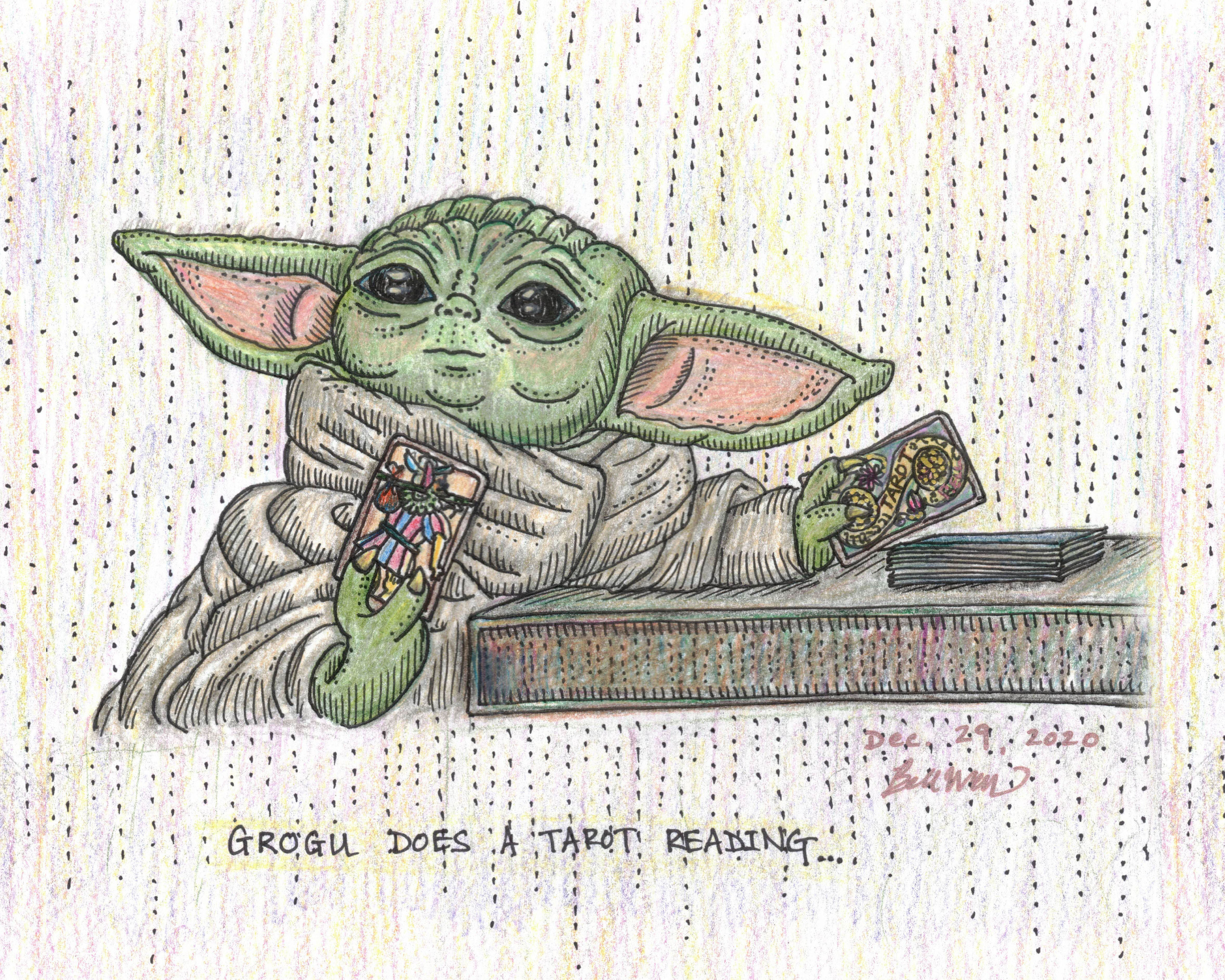
You can click on the above image to download the 4.26 MB, 500 dpi art print, if you want. It’s 8″ x 10″, which you can print centered on a standard US Letter 8.5″ x 11″ sheet of paper. Make sure to check your printer settings. You could also select “print to fit” and print the drawing borderless.
And if you want to make your own Stuff with this cute little doodle, click on and download the below.
(click to download)
You can create your own custom T-shirts, coffee mugs, stickers, whatever. You do you.
If you don’t like my saturation, color, or contrast levels and you know a thing or do about photo editing, then go ahead and edit the images until you’re satisfied.
The Tarot of the Thousand and One Nights was published back in 2005 by Lo Scarabeo, with the artwork collection edited by Pietro Alligo. It’s art deck featuring the works of the late 19th and early 20th century French painter Léon Georges Jean-Baptiste Carré, living around the time Waite and Crowley.
Carré moved to Abd-el-Tif, Algeria and concentrated his body of work on Orientalist subjects. (Orientalism is the European and Western study and commentary on Middle Eastern culture.)
I’m intrigued by the strong opinions that tarot readers can hold for collaborative decks. Collaborative are decks where the artwork is done by a cast of different artists and illustrators, often of varying experience in art, from the amateur or self-taught to the professional. The Button Soup Tarot was organized by the Cult of Tarot forum members and the result turned out really well.
I speculate that the collaborative deck appeals mainly to a rather special, rare, eclectic, and liberal-minded personality. Each and every card is going to feature a different style, created with a different medium, ranging from traditional to digital art. I’m loving this particular collaboration. It feels celebratory and there’s such a joy to it.
The Muses of Tarot is a book and deck set by Ethony Dawn, with illustrations by Lena and Sasha Semenkova. The book is about 13 muses of the tarot that came to Ethony in her visions and channeled messages to her that correspond with the 78 cards of the tarot deck. In addition to the book, you get a set of 13 Muse oracle cards, 13 altar cards for those Muses, 13 invocation cards, and 7 chakra energy amplifier cards.
The 13 names of the Muses are original conceptions by Ethony that describe universal or archetypal spirits, and by “spirits” here I mean an embodiment that our superconsciousness can take on. They also represent 13 types of tarot readings. For example, Adoria is the Muse of love & relationship readings. Brujula is the Muse to invoke for tarot readings about big changes coming up in your life. Divina is the Muse of predictive tarot readings. Holistix is the Muse of health, healing, and wellness readings. Veilia is the Muse of mediumship. And so on.
In terms of production quality, you always get luxury from Ethony. Everything from cardstock, full-colored guidebook pages, and every fine detail of the packaging design is top rate. The finish on the box, book, and cards is this velvety rose petal texture that’s ultra matte. The box features a magnetic strip closure and every aspect of the graphic design is clean, fresh, feminine, fun, and has that cosmopolitan vibe to it.
This illustration is one of my favorites in the deck.
When it comes to production values, this is perfection. This is what deck creators ought to strive for. Love it all. Now let’s talk about the content.
The premise for this deck and book set, and the manifestations of the 13 Muses must have been a comet of divine inspiration that nose-dived straight into Ethony’s inner genius. I love what she says about the Muses:
“When I work with my creative muses, I believe I am making an agreement with a daemon to bring something from the ether into the material world. . . . The muse and I have a creative love affair. I bring my background, experience, personality and flair to the project, but I am also working with an element of pure magic.”
These images are provided to the public for free download and under a Creative Commons Attribution license, which means the following:
You can share the images. You are free to copy and redistribute the illustrations in any medium or format.
You can adapt the images. You are free to transform, build upon, redesign, edit, revise, and in any way remix the illustrations for any purpose, including commercial purposes. Yes, you are free to profit financially from your adapted images of the SKT Vitruvian Majors, Aces, and Archangels.
Attribution or credit notes. My preference is that you make it very clear what part of the image or adapted image is attributed to my original work and what part is attributed to your creative additions. In other words, if you color in one of these black & white images and then sell your colored in SKT image, please make it clear in your product description that I am the artist for the black & white image while you are the artist for the coloring application. If you have traced part of my original art and then redesigned it, transforming it from the original, please include a note about what parts were my original and what parts you’ve redesigned and transformed. I say “my preference” because if you unintentionally forget to do that, I’m not going to be mad at you. =) But just please try not to forget.
While this license is free, if you do commercialize your SKT-based work, I’d be beyond thrilled to receive some merch! =) Send to the below address.
Benebell Wen
P. O. Box 20021
Castro Valley, CA 94546
Works-in-progress drafts only; final production subject to change
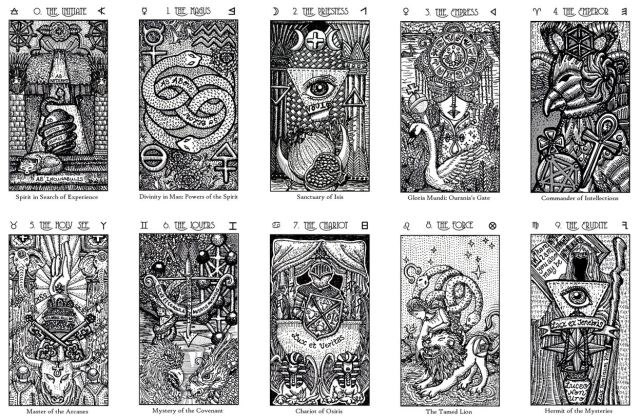
If you might recall, Key 1: The Magus was the very first card I learned digital painting on. The line work was done by hand, scanned in, and the color was subsequently done via digital painting software programs. Then it was Key 2: The Priestess, and so on.
It’s amusing to look back on those first five keys, because it’s painfully obvious how scared of color I was. =) I didn’t know what I was doing. I was winging it. And you can tell.
It’s not until Key 6: The Lovers card that a noticeable improvement happens. Then after Key 7: The Chariot, off I went! =) Now that I know how to color, after finishing the Tens I’m going to return to Keys 1 through 5. I’ve already made notes on how I want to revise them.
You can click on any of these image files for an enlarged view.
Josephine McCarthy is one of the preeminent magicians of our time. She is the founder of Quareia and author of several incredible tomes, among which I’ve read The Work of the Hierophant and The Exorcist’s Handbook. I’m also a big fan of her deck, LXXXI, which I’ve reviewed here. I am now so excited to be sharing with you my thoughts on her latest endeavor, a comprehensive book on tarot that covers both the mundane and the magical meanings of each card.
The edition I received for review is hardcover, with a beautiful velvety matte book jacket. I love that the title anchors the book in the 21st century, while the book’s aesthetics feel Old World to me. I haven’t seen this quality and caliber of production value in a tarot book for quite some time now, so there is something quite exquisite about learning tarot from McCarthy’s text.
The book begins with a strong introduction, giving you a sense of who your teacher, the author, will be, and the context from which classical tarot interpretation sprang. Having read dozens of tarot books published in the last few years, this one is refreshing in its traditionalism, formality, and also its design as a handbook to teach tarot as a venerated practice.
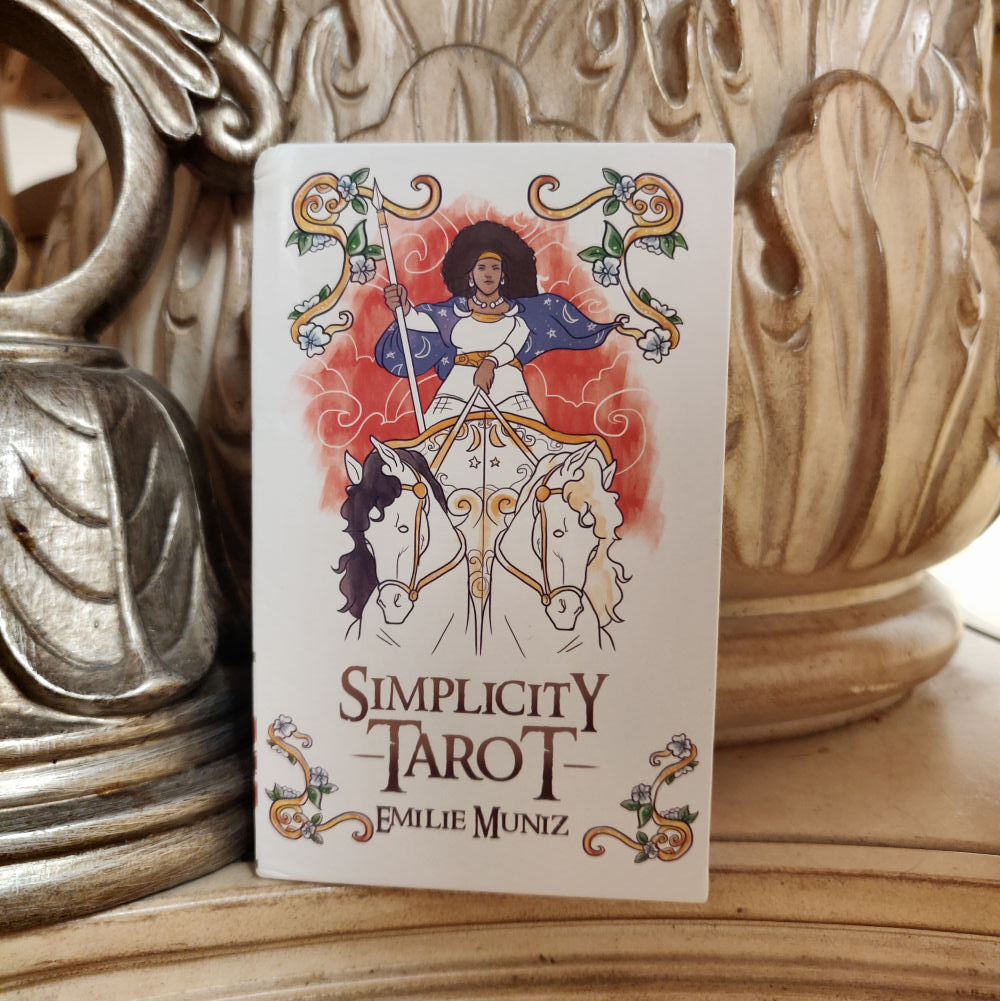
The Simplicity Tarot by Emilie Muniz is this perfect RWS-based deck that checks all the boxes that people keep saying they want in a tarot deck, but don’t seem to notice that Simplicity Tarot exists. It flies quietly, humbly under the radar, and I have no idea why. Muniz’s deck features all the hallmarks for what our community keeps saying we want in a tarot deck, and yet this deck isn’t trending. Why is that?
Here is this deck with imagery that feels classic, timeless, not overly modern, with refinement and elegance, beautiful on any reading table spread, and has the diverse representation so many of us readers today want in a deck.







 benebell wen