What Is Tarot Reading? (The Hocus Pocus Version)

I came across a Howcast production on “What Is Tarot Reading?”–

The host of the Howcast, Paula Roberts declares with dogmatic conviction that “No real psychic reads for themselves.” The rationale, claims Roberts, has to do with the issue of objectivity. One cannot objectively read for oneself.

There is nothing objective about tarot readings, however. In fact, she starts off by saying there are different ways to read tarot, one being the mechanical approach where you assign a set meaning to each card and then apply those meanings objectively. What an interesting thing for her to say, considering that would be the only time tarot readings are objective, which she agrees with and yet contradicts when she says a psychic cannot read for herself due to the lack of objectivity. Um… what?

A good tarot reading isn’t a trial where a verdict has to be rendered. Of course if a tarot reading was like a trial, then I’d agree with Roberts and say you cannot render your own verdict. But tarot isn’t about objectivity at all. It is the unabashed embrace of the subjective. When you read for yourself, it is about what the signs and symbols of tarot mean to you and the significance of those meanings to you. Whether you are reading for others or for yourself, the interpretive process is wholly subjective, completely within the confines of the mind, though therein lies its power.

A tarot reading, at least a good one, has a way of triggering the mind into action and that action then becomes externalized, objective. The whole objective part happens much later in time, however, after the tarot practitioner and Seeker have parted ways.

If we want to take this one step further into the beyond, let’s say there is a universal life force that connects us all, that unifies the space-time continuum into one unit. I’ve heard it referred to as the Akashic records by some, especially psychics. Psychics contend that they have a stronger connection to the Akashic records than others and that is how they retrieve psychic knowledge that seem to defy the space-time continuum, i.e., they can see the future, the far past, talk to dead people, know what’s going on someplace far away, blah blah.

Let’s diagram this. We’ll illustrate the Akashic records or universal qi/life force as a unit circle.

psychiccircle

In theory, a psychic can connect to any point on the unit circle (aka the Akashic records aka the universal life force that connects us all and defies the space-time continuum) and see into certain information for a particular person, place, or event. If so, then why can’t a psychic read for him or herself? Is it because the psychic’s own consciousness is so opaque when it comes to the self that the psychic can’t reach past it to access the Akashic records?

I’m not claiming I have any idea. I’m just saying that you can read tarot for yourself and to say that no real psychic, whatever the hell that means, does it is just Roberts’ way of imposing her position onto others. There is no concrete limitation like that applied uniformly across the board. Maybe she cannot use the tarot for divination purposes for herself, but that for sure doesn’t mean others cannot do so effectively.

True, there are many ways to read tarot, as Roberts mentioned, and I refer to this so-called “psychic” approach to tarot reading as the hocus pocus version because that’s what it reminds me of: birthday party magicians who are able to wow the naïve but there is nothing special, gifted, or magical about what they do; it’s a mechanical application that anyone can learn. Likewise, tarot requires your intuition, but it’s something we all have and like our muscles, it’s something that can be developed and enhanced with training.

No “psychic” will read tarot for him or herself. Pah, I say. Psychics can. Most simply choose not to for philosophical reasons.

Like my application of tarot, predictive readings and fortunetelling do more harm than good. It takes wisdom to distinguish between what you should know and what level of your brain you should know it at (conscious, subconscious, unconscious…). Those with wisdom and strong intuitive abilities will opt not to bring to their conscious certain information from their unconscious because through their wisdom, they understand that knowing such information about themselves won’t be beneficial.

However, for some of these psychics, this is only a self-imposed philosophy. They understand that everyone is different and if someone feels he or she could be helped by knowing and the psychic can help tap into that knowledge, then the psychic will. In that case, the psychic has opted– out of voluntary will– not to read for herself, but to remain open to reading for others. It has nothing to do with whether she can or cannot read for herself. It’s about imposing one personal moral philosophy on the self but not imposing the same on others.

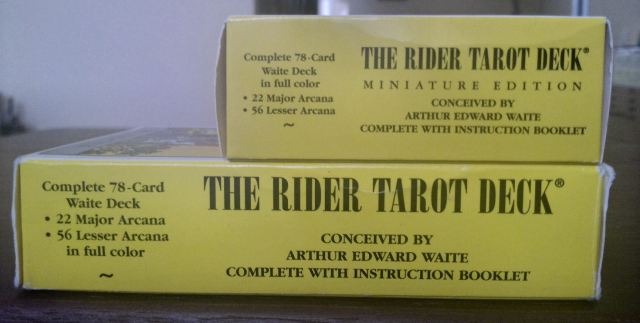
The Rider Tarot Deck Miniature Edition

RWS_vs_RWSmini_4

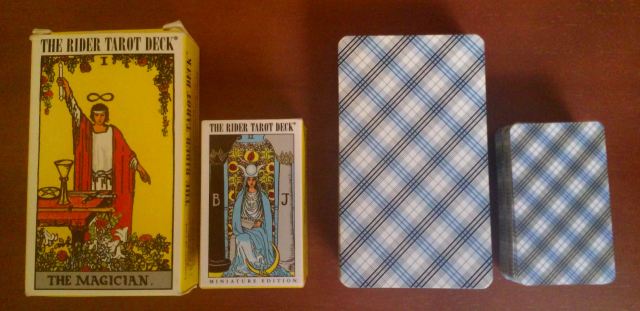
My 20-year-old Rider Tarot is my go-to reading deck. Since I’m often mobile and now doing tarot readings online, which I can do from my portable tablet from, well, anywhere, I found that I needed to get a tarot deck that was equally portable. I found it. The Rider Tarot Deck Miniature Edition. I love it!

RWS_vs_RWSmini_1

Cute, though it does bother me to have The Magician on the big version and The High Priestess on the mini. Not very feminist. But moving on. The above photo offers a size comparison.

The original box is 2.9″ x 4.75″ x 1.2″. The mini box is 1.9″ x 3.0″ x 1.2″. Heck, I can toss the mini into my clutch!

Continue reading “The Rider Tarot Deck Miniature Edition”

The Lenormand: Nutshell Summary of the Petite Lenormand, from History to Practice

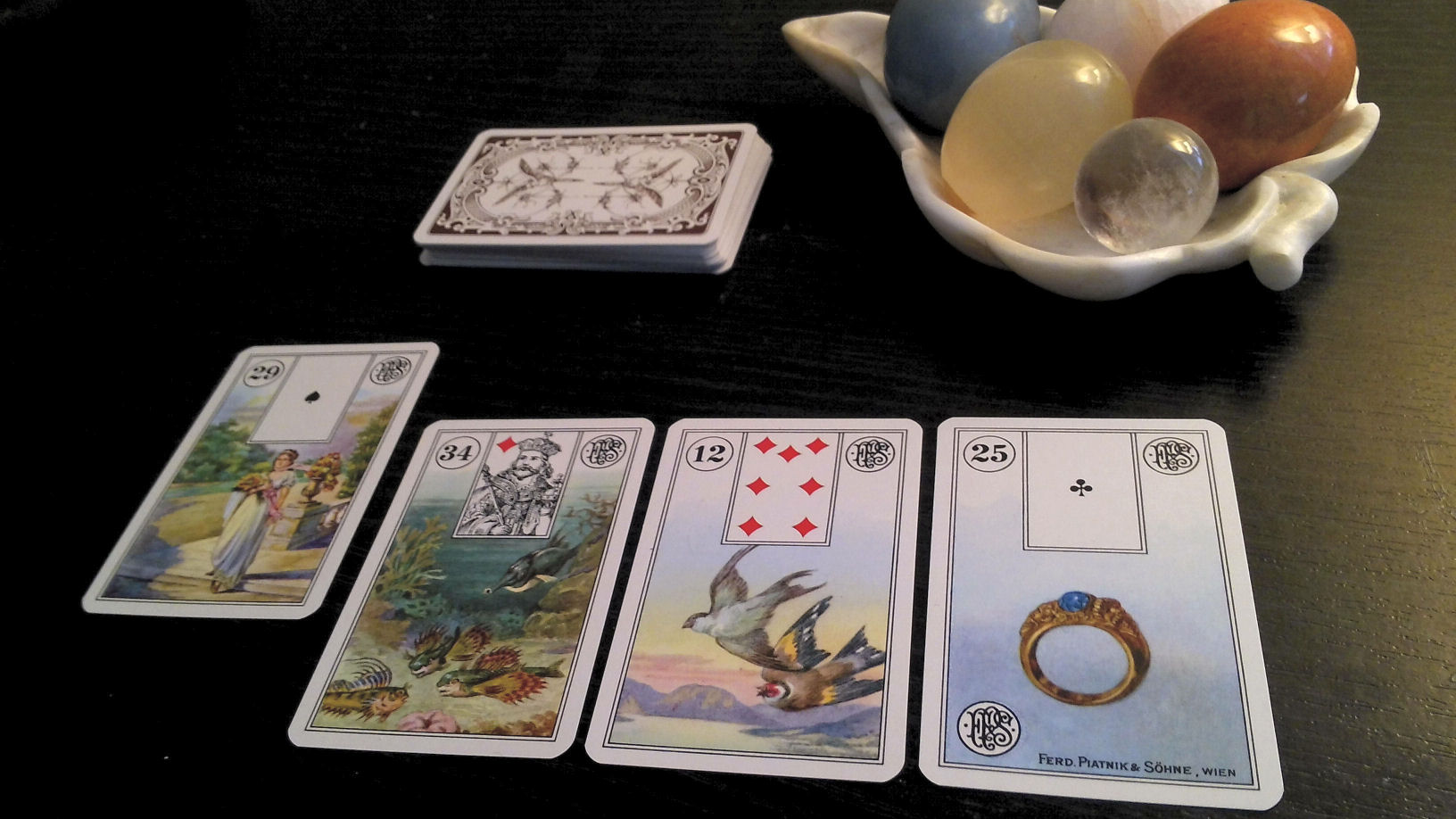
lenormand1

The popularity of Lenormand cards seem to have been revived for contemporary times, at least here in the U.S. Lately it seems that every tarot enthusiast will go through a phase of intrigue for these Lenormands. Well the other day a student asked me to guide her studies of the Lenormands. From there, I decided to write this nutshell summary. For the tarot enthusiast who has now suddenly taken on an interest in Lenormand cards, this post will serve as an introduction.

Overview

They’re oracle cards, not tarot, and generally speaking, they’re sub-divided into 2 kinds: the Petit Lenormand, with 36 cards total, which is the more popular version here in the U.S., and the Grand Jeu Lenormand, with 54 cards. I have not yet dabbled with the Grand Jeu Lenormand due to difficulties in getting a deck where I live (that is, for an economically reasonable price…because, sure, you can buy anything via the Internet these days), so I’ll focus on the Petit Lenormand only.

The oracle cards are named after Marie Anne Lenormand, who is considered one of the greatest and most influential French cartomancers of all time. However, the cards were not conceived by her. They were conceived after her death and may or may not have even been based on any of the cards used by Marie Anne Lenormand. They’re called “Lenormand cards” pretty much for marketing purposes. In fact, they may not even be French. Johann Kaspar Hechtel, a German businessman and factory owner, is credited with designing the Petit Lenormand cartomancy deck, initially as a parlour game called “The Game of Hope.” So in many ways, the name “Lenormand cards” might be a bit misleading.

Continue reading “The Lenormand: Nutshell Summary of the Petite Lenormand, from History to Practice”

The First Operation: Adapting a Traditional Method in the “Opening of the Key” to Contemporary Tarot Applications

The First Operation is the first step to an extensive divination method called the “Opening of the Key,” a method associated with the Golden Dawn approach to tarot reading. Paul Foster Case’s book, Oracle of the Tarot (1933) provides a great instructional on the First Operation. A PDF of the book can be downloaded HEREFor a recent publication on “Opening of the Key,” read “The Golden Dawn Opening of the Key Method” by Marcus Katz of Tarot Professionals, linked HERE.

Now I’ve extracted the First Operation method from the Opening of the Key to use contemporaneously with modern approaches to tarot reading.

Selecting the Signifier

There are many ways of selecting a signifier card, also known as the significator. A classic “old school” Golden Dawn approach is to use The Magician for a male and The High Priestess for a female. However, I was taught to use court cards. The following is my court card approach to selecting the signifier:

Astrol. Signs, Sun Sign Dates

Suit

Court Card Signifier
Aries, MAR 21 – APR 19

WANDS

PAGE for young female
Leo, JUL 23 – AUG 22 KNIGHT for young male
Sagittarius, NOV 22 – DEC 21 QUEEN for adult female
KING for adult male
Cancer, JUN 21 – JUL 22

CUPS

PAGE for young female
Scorpio, OCT 23 – NOV 21 KNIGHT for young male
Pisces, FEB 19 – MAR 20 QUEEN for adult female
KING for adult male
Libra, SEPT 23 – OCT 22

SWORDS

PAGE for young female
Aquarius, JAN 20 – FEB 18 KNIGHT for young male
Gemini, MAY 21 – JUN 20 QUEEN for adult female
KING for adult male
Capricorn, DEC 22 – JAN 19

PENTACLES

PAGE for young female
Taurus, APR 20 – MAY 20 KNIGHT for young male
Virgo, AUG 23 – SEPT 22 QUEEN for adult female
KING for adult male

Continue reading “The First Operation: Adapting a Traditional Method in the “Opening of the Key” to Contemporary Tarot Applications”

Tarot on Shahs of Sunset?

shahsofsunset1

Okay, so it looks more like straightforward cartomancy than it does tarot, but still. Also, it looks like I have to own up to a guilty pleasure before proceeding: yes, that’s right, I’ve been watching BravoTV’s Shahs of Sunset, a reality show that follows a cast of socialite Persian Americans in Beverly Hills.  In Season 2, Episode 2, two of the main cast members, Asa and Reza consult with a Persian psychic, Shohreh.

shahsofsunset2

Sitting in a Los Angeles cafe, Habibi Cafe to be exact, Shohreh uses a deck of oversize cards to read about Reza. From what I could see, there are pip cards, as opposed to the pictured suits of the RWS, Thoth, or other contemporary decks.

shahsofsunset3

Also, whatever it was the psychic told Reza, he seemed thoroughly impressed. And where did she get that oversize deck? I want one.

Yes, this was a meaningless post. Just happy to see cartomancy get some air time.

Asians and Tarot Reading

Photo Credit: Tungstar via Sina.

Where are the Asian Tarot Readers? I wrote an article for 8Asians.com that addresses the intersection of tarot reading and Asians/Asian Americans. Link: http://www.8asians.com/2013/04/29/where-are-the-asian-tarot-readers/ (last visited 4/30/2013).

People of color, especially Asians, form associations around their race for every topic– blogging, voting, golfing, farming, realtors, lawyers, doctors, chess players, musicians, journalists, kidney donors, Republicans, Democrats, pole dancing, basketball, you name it, there is probably a group of Asians who have formed an association. Yet there are no Asian American tarot associations, no gatherings of Diasporic Asians who are interested in tarot. Why not?

The experience of writing it was the most amazing part, because I had the blessed opportunity to interview Joanna Ash of Sun Goddess Tarot, Zach Wong, the creator of the Revelations Tarot deck, and Deedra Wong of Tarot Perspectives, three really amazing individuals in the tarot community. I love what they’re doing, each one of them walking a slightly different path through tarot studies and practice.

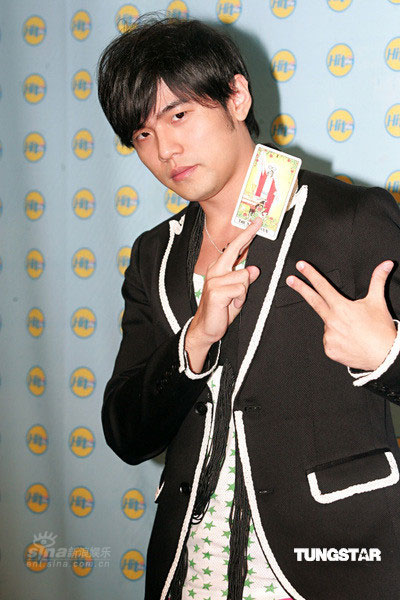
I was surprised to find that tarot is more common in Asia than I first expected. For those not in the know, the above photo is of a Taiwanese celebrity, Jay Chou, a music, singer-songwriter, and actor. He was in the 2011 film Green Hornet. Chou purportedly consulted the tarot to ask about the success of his forthcoming music albums. Link: http://jaychoustudio.com/archives/jay-chous-career-and-love-told-through-tarot-cards-deeply-influenced-by-rumours/900 (last visited 4/30/2013).

Jolin Tsai, another Taiwanese pop sensation, features tarot divination in one of her music videos. Seems like it isn’t quite as taboo for mainstream public figures in East Asia to associate themselves with tarot as it seems to be here in the U.S. We seem to be irrevocably Puritan when it comes to our open-mindedness to such practices.

I ended the article with this, and a silly quoted statement from my friend:

[Asian tarot readers] see no problems with the few individual Asian tarot readers who exist to assimilate into the greater tarot associations at large rather than group-identifying with Asians only.

“That’s because only white-washed Asians do tarot,” said one of my friends. “Asian Americans who are anchored solidly in the Asian American community aren’t into that kind of stuff. If they were, there’d be an Asian American tarot group like the one you’re asking about. The absence of such an Asian American tarot group is your proof that activist Asian Americans aren’t into it.”

. . . Have you had any experiences with the tarot? With Asians who practice tarot? And why the heck isn’t there an Asian American tarot association?

In spite of how common and acceptable tarot practice is in East Asia and its seeming endorsement from Asian celebrities, in the States, Asian Americans consider tarot to be “white-washed,” meaning Asians who reject their ethnic heritage to act as whitebread as possible are the ones who are thought to be tarot practitioners. Interesting juxtaposition there.

One of the commenters below the post, Jonathan V, an Asian American male tarot reader, pointed out an authenticity and exotification issue that I immediately related to, since I also practice both tarot and I Ching. There tends to be doubt about the “authenticity” of my tarot readings, but then non-Asians seem to love it when I use I Ching. I’m suddenly an “authentic” I Ching divination practitioner simply because of how I look. I look the part, i.e., I’m Asian. Nevermind that I was born and raised here and just as competent and just as inept as the next John or Jane Doe I Ching student over.

In any event, I hope that article expands the dialogue of Asian American tarot practitioners and the correlation of tarot to race and culture.

A Tarot Deck Library: The Hobby of Collecting

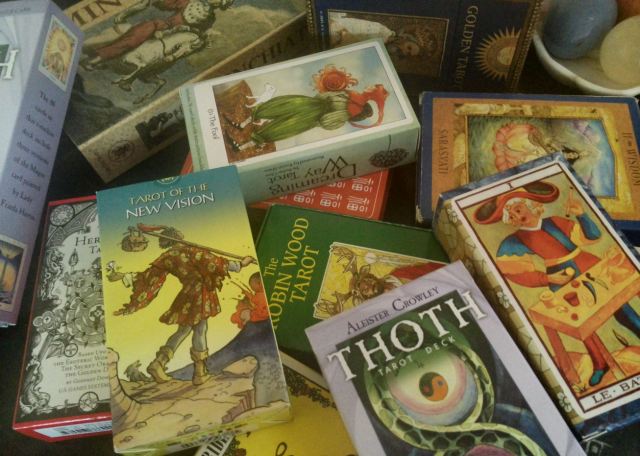
alldecks

I will start by saying that you only need one tarot deck to be a practitioner. Every deck over one is excess. That being said, if you’re a tarot enthusiast, there will be no convincing you to stop hoarding tarot decks. I mean, you probably only need one pair of shoes, and yet I have fifty. I like to collect. So if you, too, must collect, then at least try to keep your collecting focused. This post will offer tips on building a tarot deck library.

Continue reading “A Tarot Deck Library: The Hobby of Collecting”

Tarot Certification: My Experience from CATR to CTM

I read tarot privately for 15 years before I heard about certification through the Tarot Certification Board of America (TCBA). In November 2012, just for the experience, because after I learned it existed, tarot certification made it on my bucket list, I applied for the first level of certification and over the next few months, made my way to the level of certified tarot master.

The folks behind the TCBA are fantastic people. I have had an incredible, pleasurable, rewarding experience with every one I interacted with, from the examiners to the mentors to the board directors. I literally have not one negative thing to say about them. And yet I want to proceed with my account of the certification experience objectively and critically. So here you go. I warn you this is going to be a long posting. I’ve tried to compensate for the verbosity by including cartoon caricatures of my certification journey, comics I’ve created with the help of bitstrips.com.

bitstrips-tarotcertification

Continue reading “Tarot Certification: My Experience from CATR to CTM”

30 Day Tarot Challenge Meme (Questions 26-30)

This posting will conclude the 30 Day Tarot Challenge meme, which I completed in 6 days because I’m impatient.

For the first five sets of questions answered, see the following:

Questions 1-5 (Day 1)

Questions 6-10 (Day 2).

Questions 11-15 (Day 3).

Questions 16-20 (Day 4).

Questions 21-25 (Day 5).

stuff

26. Have you ever regretted a particular reading, either for yourself or another?

No. I have no regrets for how I have conducted myself in all my past readings because I always give my best, but after the reading, I have on a few occasions regretted reading for that particular person.

27. Do you have a special time and/or place that you use your Tarot?

I like to read in the mornings. I can read anywhere, so long as it’s quiet, secluded, and I’ve got a few comfort crystals around me. I refuse to read at parties, cafes, conventions, or anywhere that people are bustling about.

28. Does anyone you know not agree with your Tarot practices?

Yes. My husband, for starters. Well, it’s not that he’s against it vehemently, but he does roll his eyes and walk away when he sees me dabbling. Also, I don’t openly advertise my tarot practice, so I’m sure if everyone in my life knew of it, there would be much greater backlash against it. Right now, only those I trust or complete strangers know of my tarot work.

29. Do you have a Tarot mentor?

Not really. Yes and no. There have been seasoned tarot practitioners who have taught me particular aspects of the practice, but no mentor per se.

30. Do you practice any other forms of divination? If so, what is it, and do you use them alongside the Tarot as to gain more insight or as something separate entirely?

I Ching. The Four Pillars analysis using Chinese astrology. The Lo Shu square. I like to combine tarot and the I Ching for a fusion practice.

* * * * * * * * * * *

Read the engaging and thought-provoking responses to the challenge from others in the tarot blogosphere: