The Chinese Have Given the Number 4 a Bad Rep

from the CBD Tarot de Marseille by Yoav Ben-Dov (cbdtarot.com)

I grew up trained to fear the number 4. In any scenario where I had to be assigned a number, I would sit there praying that the number 4 would not appear in my assignment and dreading that it would. If my seat number in the exam room had a 4 in it, I’d take it as an omen of impending failure.

I’m not the only one. There’s a name for it: tetraphobia. If they’ve got a name for it, it means I’m not alone. The Taiwanese and South Korean navies avoid assigning the number 4 to their ships. In Hong Kong, Taiwan, Japan, and many other parts of East Asia, you’ll hardly ever see a 4th floor. It’s the 1st floor, 2nd, 3rd, and then 5th. For a race stereotyped to be good at math you’d think they’d know how to count. Hospitals don’t have a 4th floor for sure, and no room number in those hospitals will have a 4 in it.

To the Chinese, 4 means death. 4 means bad luck. 4 means misfortune. 4 means you’re going to suck at life. 4 means you are not a Chosen One. Chosen Ones never get number 4. They get, well, 1. Or 8. Chinese people love the number 8 the way tarot readers love the Ace of Cups or The World card. As for The World card, by most counts it is the 22nd card in the Majors and the theosophic reduction of 22, 2 + 2, is 4 and so take that tetraphobic Chinese people!

I guess back in the day in Chinese grammar schools, the concept of homonyms got glossed over. Everybody there missed the lesson on how a homonym is when two words sound the same but have different meanings. Different. So even though pronouncing the number 4 in most East Asian languages and dialects sounds the same way one might pronounce the word for death, the two words should still retain their different meanings.

Not so to the Chinese. Just because the number 4 sounds like the word for death, suddenly 4 means death. There’s some serious issues with logical reasoning there, which is hilarious to me, because in the Western tradition, 4 means logic, rationality. More on that later.

When I first started study of the tarot, especially when reading with a Marseille deck, numerological associations for the number 4 tripped me up. The numerological association for 4 seemed all too clear: you were doomed. 4 in batons? You’re doomed to fail at work. 4 of cups? You’re doomed to fail in love. You get the pattern. Growing up in the Chinese culture meant I hyperventilated just a little when the number 4 appeared in my life.

Tarot helped me overcome that fear of the number 4. Don’t laugh. I’m serious.

The_Fours_in_Tarot

The Emperor might not be all sunshine and rainbows, but it is still a strong card with an empowering message. In western numerology, 4 symbolizes stability, like the four legs of a table or chair, the four corners of the universe, the four elements, the telegrammaton YHVH. 4 is the number of rationalism. Hey, I like rationalism– 44 means great power and physical vigor. 444 is said to be an omen of the Divine’s presence.

When four Fours appear in a tarot spread, there will be peace and order. The Four of Wands in the Rider Waite Smith deck is all about prosperity. The Four of Cups: introspection. Introspection is hardly death and doom. Four of Swords: repose, recuperation; not your preferred state of being but there is a positive message latent in the card–the loved ones awaiting your return depicted in the stained glass window, the secret weapon underneath you– whereas the number 4 according to the Chinese is straight up bad, no nuances.

Those of Life Path 4 are indispensable to a society. They’re our builders, our planners, our architects, the designers of all social constructs. People of Life Path 4 make things happen. Donald Trump, Oprah Winfrey, and Bill Gates are all 4s. Leonardo da Vinci, Mark Twain, J. P. Morgan, Paul McCartney? All 4s with 4s littered throughout their numerology charts.

Even more intriguing is how 4 is so not a big deal even in traditional Chinese metaphysics. Take the I Ching hexagrams. Hexagram 4 suggests naiveté, not death. Hexagram 14 is abundance, validation, all good stuff, like the Four of Wands. Hexagram 24 hints at progress. Hexagram 34 is a powerful, positive omen. So okay, Hexagram 44 is getting a bit darker. Entropy ain’t great news, but still. Hexagram 54 is back to positive again. I’m using the terms positive and negative very loosely here, by the way, as neither tarot nor the I Ching can be characterized with absolutes. And Hexagram 64 is like the Judgement card, give or take huge liberties with the interpretation.

The Four Pillars of Destiny (四柱命理學), which is said to date back to the Song Dynasty, is founded on the idea that there are four components to mapping out a person’s destiny chart. That destiny chart, based on month, day, year, and time (the four pillars) of birth, is supposed to be a playbook of your life. Four for life, people, not four for death!

Understanding quells fears. It is now my dedicated mission to alleviate tetraphobia among the Chinese. Or– okay– at the very least, the Chinese in my arm’s length social network…
A Heartwarming Response Piece to a Tarot Reading

trt

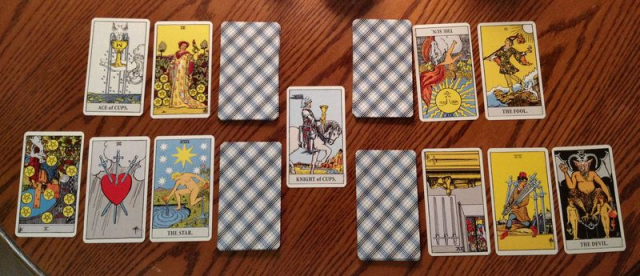
Here’s how it went down. Stacey H., an editor over at Best American Poetry asked if I’d like to guest-write for a week. Insecure about having nothing of note to write about, I brainstormed weeks in advance, and only got up to 4 pieces. A week is 5. Argh. I posed the question to myself: As a writer/poet who might be convinced to be interested in tarot if given a compelling enough reason, what topic at the intersection of writing and tarot might interest me? Well, duh. How do I use tarot to help along my writing? I figured I’d try to write about that. Finally. 5 pieces.

Tons have been written about using tarot cards as writing prompts, but that doesn’t interest me too much as a writer/poet. Now… reading tarot for my writing specifically… that concept is intriguing.

Then I had to put the hat of the tarot practitioner back on. Can I do it? Is reading tarot for what amounts to a manuscript (more often than not an incomplete unfinished manuscript no less) being the querent-client something that can even be done? I read for people, don’t I, and in every instance, people who are more or less incomplete, unfinished manuscripts. So why not a book? Oh, for sure, after this endeavor I can no longer laugh at practitioners who read tarot for cats and dogs…

I spent some time thinking about how it could be done, my approach, crafting the techniques to be employed, and how I’d even go about selecting a signifier card for a manuscript, and then reached out to my arm’s length network. Stacey H., the editor, was the first to reply and asked if she could help spread the word by re-posting my call. Go for it! I still kept one eye on my own circle. Then she said she found someone. Oh dear. A complete stranger.

Heck, why not. That is how I “met” Amy G. From our initial terse e-mail exchanges, I couldn’t get a sense of who she was and truly, as she says in her response piece, which I will link later, I didn’t read her manuscript and knew very little about her poetry. In fact, prior to reading tarot for her, I swear I have never read any of her poetry, or writings of any kind for that matter, other than the e-mail exchanges. This exercise was as much for me as it was for her, to see if it could be done, and so I didn’t want anything to cause any sort of bias at all. I wanted to know as little about her and her work as possible.

First, the signifier. Intuitively without even looking at the cards, just going through the archive of memories of the cards in my mind, I gravitated toward the Knight of Cups, but then the Rational Side of me said, “No, that’s not an appropriate signifier. She’s female. The knight is a boy.” However, it just felt right and the more I pressured myself to seek out another signifier, the more wrong every other card felt. So, I surrendered. Knight of Cups it is. Whatever. If she ends up thinking it is ridiculous, so be it.

Once I set my mind and heart to it, though, without direct interaction with her, when the cards were set down, I have to say, I really felt like I was getting to know her. It’s a funny thing to say, especially to the skeptic, but it’s my best way of articulating what happened. I felt her poetry, if that makes any sense, and it was really, really freakin’ beautiful poetry. I made a mental note to myself to look up her work after the tarot reading, because it just felt it would be aligned with what I love to read.

Here’s the tarot reading for her book (plus a how-to on using tarot to read about writing): http://blog.bestamericanpoetry.com/the_best_american_poetry/2014/02/reading-tarot-for-writing.html

It was well after the tarot reading that I got to know Amy’s writing and my feelings were right on. I really do love her poetry and even her casual blog posts at Best American Poetry, posts that are always filled with fire, spirit, humor, truth.

She wrote a response to give feedback on my tarot reading, here: http://blog.bestamericanpoetry.com/the_best_american_poetry/2014/02/the-tarot-master-read-my-book-now-i-just-need-to-write-it-by-amy-glynn.html

The universe has a lovely, balanced way of always making sure we’re “compensated.” Now that I’ve been reading some of Amy’s poetry, I get why there was this meeting of the spirits. Her poetry helps to express and validate some of what I’ve been going through in my personal life, and does so in ways I couldn’t have done for myself. Had this whole situation, any part of it really, never taken place, I’m honestly not sure I would have ever had the pleasure of coming across Amy’s work. That was the bargained-for exchange that I didn’t even know I bargained for.

A Review of the Golden Universal Tarot

IMG_1384

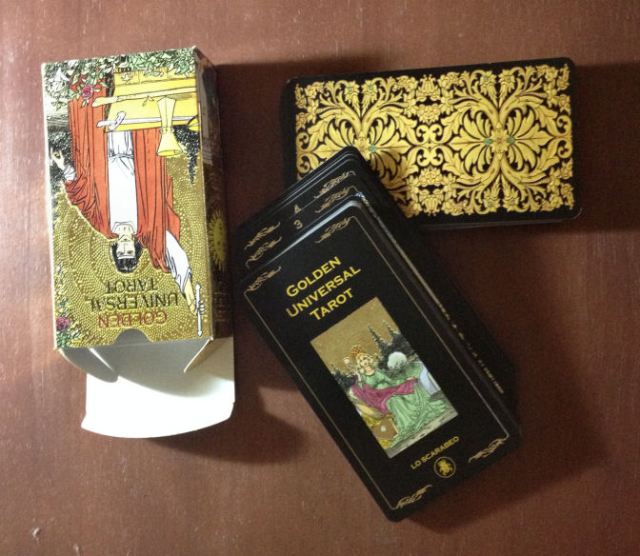
Imma not even gonna make excuses. I bought the Golden Universal Tarot (illustrated by Roberto De Angeles and published by Lo Scarabeo) because it is shiny. I guess I’m a magpie in that respect. I like shiny.

It isn’t a bad deck. For public readings where complete strangers will be handling my tarot cards, I wouldn’t mind bringing this one. And while that speaks positively of the deck’s versatility, function, and imagery, it also shows it’s not one of my favorites. For collectors, I don’t think this is worth adding to a collection, if one is truly on a budget. Also, for teaching tarot, I would stick with the classic Rider Waite Smith. All that said, for the professional tarot reader who does a lot of public readings and lets their clients handle the decks, this is a great one and definitely worth getting for that purpose.

Golden Universal Tarot

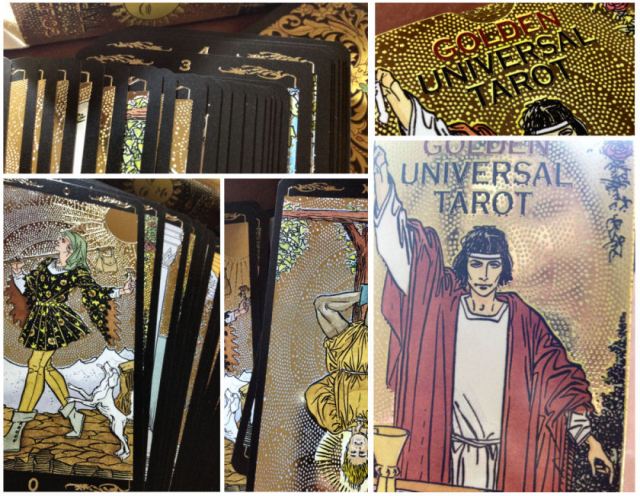
The deck is mostly beautifully gilded (I’ll get to why I say “mostly” in a bit) and per the current trend this past year, the borders are black rather than white. The backs are reversible, so for those who read with reversals, this deck works to that end. The cards are approximately 4.25″ x 2.5″, which means they’re very easy to shuffle, cut, and work with, unlike many of the big, fancy decks that have been released as of late. That is in part why I say this deck is great for public reading usage. Quality of stock, like almost all decks I’ve been coming across in the last few years, is going down from what they used to be in the 80s and 90s but what can you do. Thus, while noticeably flimsier than the RWS decks of yore, it’s not so bad. You’ll work just fine with these. And if it matters to anyone, the box says this deck was made in Italy.

Golden Universal Tarot - snapshots

(Look how shiny the gilded cards are! In the above bottom right photo, you can see my face reflected behind the Magician!)

For those who can’t connect to the classical RWS deck because of its rudimentary artwork, the Golden Universal is a viable alternative. However, I appreciate Waite and Smith’s original version for its symbolism and rely heavily on every detail, the precise coloring of the sky and the clothing worn by the characters, and every little leaf and bird in the backdrop. As a result, working with the Golden Universal means I miss out on some of the details. Some of what seems to be minor changes doesn’t work for me particularly well.

Continue reading “A Review of the Golden Universal Tarot”

A Tarot Reader Guest Blogs at Best American Poetry

bap

I am the guest blogger this week over at Best American Poetry and am feeling a bit like a fraud since I’m not a poet, at least not since the angry-histrionic adolescent years of poems about boys who won’t give me the time of day, printed in font size 14 in comic sans or some other curly girly font and center-aligned down the page. Hm, actually in college there was a brief period of doing slam poetry on themes of an Asian Diaspora ravaged by post-colonial ambivalence and cultural imperialism but that period is really best left forgotten too. I am, however, an avid consumer of poetry and have bookshelves at home filled with poetry collections and chapbooks, half of poets you’ve all heard of and half of poets you’ve probably never heard of.

I’m trying to think of when I first learned about the Best American Poetry series, and it turns out I can’t seem to remember a time when I was aware of literature and not aware of BAP. I read it in high school, college, and even recall sending a letter to David Lehman directly one time about a decade ago telling him I felt the BAP series didn’t include a fair representation of Asian American poets. The current series has been much better, I think, about diverse representation.

This week BAP is letting a tarot reader (me) run loose on their blog (http://blog.bestamericanpoetry.com/) and here’s what’s going to happen:

Continue reading “A Tarot Reader Guest Blogs at Best American Poetry”

A Review of Palmer’s Tarot: Voice of the Inner Light, a Reference Manual

palmer-tarot

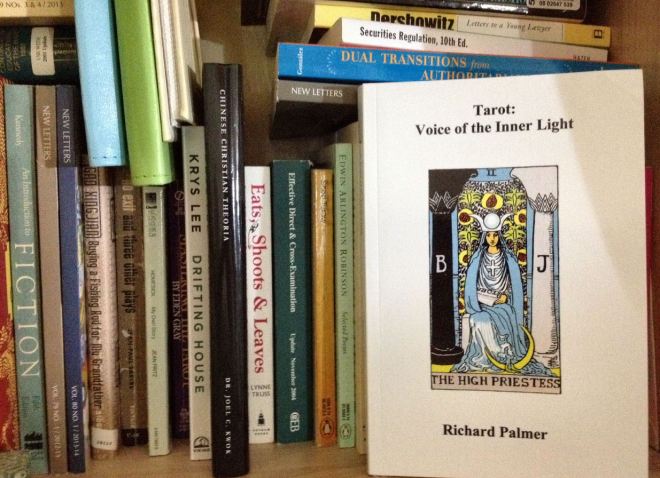
I’ve got a new amazing addition to my personal library: Richard Palmer’s Tarot: Voice of the Inner Light (Custom Book Publishing, 2008). If this book had existed in the 90s, I would have advanced in my tarot practice so much faster. When I started out in tarot, there weren’t limitless online references and glossaries on card meanings, which by the way I still do not find all that useful, as much of it is the blind leading the blind, with no indication of the source of the card meanings provided or no identification of the tradition used.

(Oh and please do not mind the unorganized bookshelf. Hubby and I are preparing to move to a new house, so I figured I’d wait until we settled in to organize a library. Right now I have literary fiction next to books on law next to classical poetry next to Christian theology next to Buddhist philosophy next to my little collection of stuff on the esoteric and the occult. Anyway.)

The first lines of the Introduction tells you exactly what you’ll get: “There are many complex and profound books written on the subject of the Tarot. This isn’t one of them. The aim of this work is to bring the practical knowledge of how to use the Tarot into the life of anyone who is willing to put forth the minimum effort necessary to understand this remarkable gift.” Voice of the Inner Light is give or take a 240 page reference book, about 60,000 words if I had to guestimate. In essentially 10 pages upfront, the book teaches you how to begin using your tarot deck. There is no longwinded research on history, origins, philosophy, or theosophy. I understand that most advanced practitioners are looking for theory, but this book is not targeted at that kind of reader. This book is targeted at that starting practitioner who may have read 1 or 2 more comprehensive books on tarot and is now looking for a go-to reference manual to keep on the desk for readings.

Per my own analysis of Palmer’s book, his card meaning interpretations are based heavily on Hermetic Qabalah. Palmer is also a renowned astrologer, and so Voice of the Inner Light is going to be indispensable to tarot practitioners who integrate Western astrology with tarot.

Each card is covered in 2-3 pages. A card description and key symbolism is provided, then the card’s astrological association, and then the practical application of the card when upright and when reversed. Then a concluding remark is offered on Qabalistic correspondences. Such concise coverage of card meanings is the primary purpose of the book. Other than how to read a single card or perform a simple 3-card reading, Voice of the Inner Light is not for teaching spreads or how to intuitively read multi-card spreads. The book’s purpose is for the foundational understanding of each and every card.

Thus, I consider it an intermediate reference manual. If you have read a few beginner books on tarot, this book is a useful supplemental next step. However, for advanced practitioners who want to begin building a repertoire of spreads and how to use the tarot in complex reading techniques, this won’t be the right book for that. Voice of the Inner Light will be an integral supplement to such goals. As you learn complex reading techniques, you will need a book that provides in-depth interpretation of each card, in which case Voice is one of the best. Also, those with a particular leaning for the GD interpretive method, Voice will be highly appealing as opposed to the more what I call New-Agey-keyed reference manuals.

Cleansing a Tarot Deck

Image1

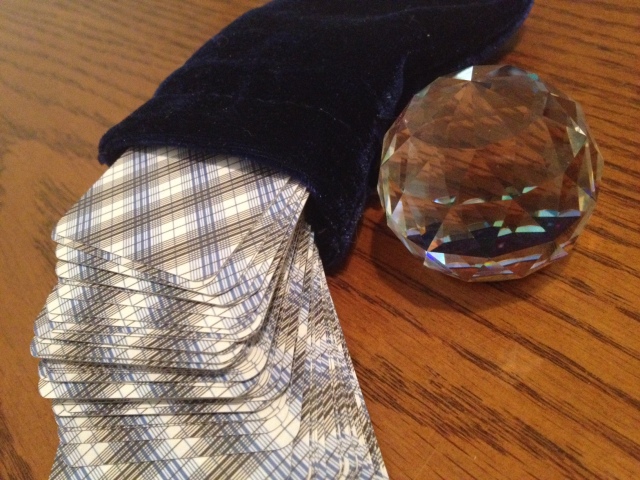
Many traditional Asian societies follow the lunar calendar (I once litigated a case involving an elder Taiwanese woman and all the document evidence she had was dated per the lunar calendar, which completely tripped us lawyers up and a lot of conversion work had to be done, but that is neither here nor there; just mentioning it to affirm that it really is still used today) and the super-traditional even believe that certain energies are more dominant during certain phases of the moon. Not kidding: they’d schedule major surgeries around certain phases of the moon because they believe they’ll bleed less and chances of success will be higher. They consult the Chinese almanac, which is based around the lunar calendar, for everything, from when to launch a business or throw a wedding ceremony to the optimal time for a funeral.

I’ll say that I haven’t lived or observed the universe long enough to confirm whether there is any validity to following moon phases, but if it worked for my ancestors and there is no actual adverse effects from continuing the tradition and it makes me personally feel closer to my heritage, then why the heck not. My mom was adamant about calibrating Hubby’s and my engagement and marriage to moon phases. Did it work? So far so good I’d say.

Anyway, that was a long tangent of an introduction. Sorry. This post is about cleansing a tarot deck.

1 cleansing tarot deck

To demonstrate, I’m using the DruidCraft Tarot deck by Philip and Stephanie Carr-Gomm and Will Worthington (a highly recommended deck, by the way; though there is a great bit of nudity in the illustrations, which I understand why would be featured in a Wiccan-Druid-based deck, but just does not resonate well with me).

Continue reading “Cleansing a Tarot Deck”

Self-Guided Intermediate Tarot Course: Integrating the Five Components of Circumstance

screenshot

DOWNLOAD COURSE PRESENTATION

(Note: Must watch in Slide Show format, due to layered animations.)

I’ve created a self-guided intermediate tarot course on a cross-cultural interpretive framework for reading tarot that I have not seen anyone present before. The Five Components of Circumstance is a cosmological theory based on the Chinese maxim that one’s fortune is based on five factors: 1) fate, 2) luck, 3) feng shui, 4) karma, and 5) education. That theory is a cornerstone in Chinese metaphysics and is used to diagnose an individual’s personal formula for success.

By integrating Five Components analysis with tarot reading, the tarot practitioner will have a new set of vocabulary for interpreting a spread, any spread in fact, and can more precisely pinpoint the strengths and weaknesses in a querent and what adjustments need to be made to expedite the querent’s goals.

Continue reading “Self-Guided Intermediate Tarot Course: Integrating the Five Components of Circumstance”

The Unindemnified Cost of Tarot Reading

tarotspi

I am preaching to the choir when I write this to an audience of tarot practitioners: If your personal energy could be quantified like battery life, then reading tarot for others will drain it like streaming a movie on your smartphone over 4G connection. Reading tarot depletes me in a way I cannot fully convey. Sometimes I get the sense that non-tarot practitioners who request tarot readings from me don’t have any idea.

On its face, a tarot reading seems to be an effortless dealing of a deck of cards, and then blurting phrases based in some part on the card imagery. What could be so hard about that?

Tarot is a tool, a metaphysical one if you will, that connects two individuals’ energetic fields together for the duration of a reading. The nature of the relationship between practitioner and seeker is that of give and take, respectively. A practitioner feels his or her energy draining out and going into the cards to provide the reading that the seeker is receiving. Seekers often talk about readings being rejuvenating, cathartic, an enriching experience. They’re picking up on that channeling effect. In contrast, tarot readers talk about feeling exhausted, needing to recharge.

Very few tarot readers make enough cash from their readings to compensate for their time spent. That, though, we will chalk up to simple economics and just acknowledge that at least from a free market standpoint, that part is fair.

I draft business contracts for a living and almost every one of them contains an indemnification clause. Indemnification is often one of the main points of negotiation and contention between the parties. In the course of a commercial dealing, some poo always makes its way to the fan– costs of damage resulting from the initial transaction that weren’t accounted for in the contract price– and everybody needs to figure out who owes what to who and how much to compensate for the loss. That’s indemnification.

When I make reference to the unindemnified price of tarot readings, I’m talking about that energetic loss that tarot practitioners sustain but no one accounts for, or heck, even acknowledge. Some seekers can be borderline parasitic, though I believe never intentionally so. Most tarot practitioners are by nature empaths and so of course their first inclination will be to yield and give and feel.

As an empath with a law degree, when I first started my legal career, I felt every client’s problem and took home a briefcase of emotional baggage every night. I’d think about their issues in the shower, while brushing my teeth, before I fell asleep, the first thing when I woke up, while I made my coffee… Yet senior partners at the firm seemed to master such control. They compartmentalized. One might be tempted to say they were apathetic, that they were desensitized, or they did not care. That is not true at all. They cared and they cared deeply about their clients. But they have been at this a long time and they know that to truly be in a position to help as many as possible, they needed to take care of themselves first. Selfishness is a form of selflessness. They knew exactly when it was time to step away from a case, recharge themselves, and live their own lives for a change, instead of living for others, which is exactly what lawyers do, though they rarely get seen by that side of them.

Tarot practitioners must take a cue from these partners. Newbies rarely possess the prudence to know when they must step away and focus on themselves. They get caught up in the exhilaration of uplifting others–an admirable trait–but ironically (since we are tarot readers…) fail to foresee the pending crash. That is why burn-out is such a problem among startup tarot practitioners.

There is no indemnification for that spiritual energy drain that is part of the tarot reader’s work. Thus we are the ones who must keep ourselves in check. Always take time to recharge and learn to say “no.”

Are You Psychic? The Sum of Intuition and Ego

candle-up-close

As children my younger sister would say she was psychic and tell me about her psychic experiences. I recall, for better or worse, vehemently discouraging such a line of thought. I would tell her that she is not a psychic and if she continued to say she was, then she was a liar. Dismayed, she eventually stopped announcing that she was a psychic to us sisters and maybe even stopped letting herself acknowledge so-called “psychic” experiences when she had them. In retrospect I regret my harsh and ignorant stance, but at the time (and I was a tween myself) I believed it was for her own good: she couldn’t run around in public telling people she was psychic. How would people take her intellect seriously if she did?

Now I have always been convinced that my sister may have had strong intuitive abilities for what may be beyond the five physical senses, not unlike the way all the women from my maternal line are drawn to the preternatural. My grandmother, my mother, my first cousins descending from my grandmother, and my sisters all display a heightened awareness of the logically inexplicable. But psychic?

I saw it this way: when you are a voracious reader, at some point you will want to give it a try and become a writer yourself. Likewise, if you’re fascinated by metaphysics and occult phenomenon, at some point you will want to be part of it, and maybe even convince yourself that you’re psychic. Not too different from how I try to convince myself that I’m a writer even though I have yet to publish a damn thing.

Sure, I am convinced that intuition is real. Intuition is the perception of a truth, occurring incident, circumstance, or event independent of any logical reasoning, actual knowledge, experience, or cognitive deductive process. It is synchronicity. It is a prickling of what is about to happen before it happens. It is the sensation of energies that you can’t physically see, hear, smell, touch, or taste, a sensation for when those energies are in balance and when they are out of balance, and the enigmatic knowing of how you might be able to balance it if you were to try.

Being intuitive is like being detail-oriented, or organized, or calculating differential equations. Not everybody is detail-oriented, organized, or able to do math, but anybody can be with enough effort. It is just a skill, albeit a remarkably empowering one when we use it. It might also be a trait. Some seem naturally disposed to it and others need to really work to acquire the skill. I guess somehow those who seem naturally disposed to being intuitive have come to be referred to as psychic.

My question is: where on the continuum of intuitive ability must one be for that person to qualify as “psychic”?

Continue reading “Are You Psychic? The Sum of Intuition and Ego”

Minchiate Cards for Divination: My Review

minchiate

It is said that like tarot, the origins of the minchiate are not verifiable, but was probably a card game played in the late medieval period. The version I have at home is a reproduction of the Etruria deck from 18th century Florence. Like tarot, the imagery on the cards and scope of the depictions seem extraordinarily well suited for spiritual, metaphysical, or divination work and in many ways, the minchiate even more so than tarot.

There are 97 cards in total, consisting of trumps like tarot, 22 with the addition of 4 cards representing the theological virtues, 4 cards representing the elements, and 12 cards representing the zodiac signs. That’s 41 trumps and 56 numbered cards, with the numbered cards similar to tarot: 4 suits, Ace through Ten, and then 4 court cards.

The photograph below shows the unnumbered Madman (corresponding with tarot’s The Fool) and Keys I, II, III, IIII (IV), and V. Key I is the Performer, which corresponds with tarot’s The Magician. Keys II, III, and IIII (IV) in the minchiate are the Grand Duke, the Western Emperor, and the Eastern Emperor, which some say correspond with tarot’s Empress, Emperor, and Hierophant respectively. Key V is Love, corresponding with tarot’s Key VI, The Lovers.

The numbering of the keys in the Minchiate is significantly different from the tarot. For example, in minchiate the Temperance card is Key VI while in tarot it is Key XIV. There is no Hermit card per se, but there is Father Time, which is said to correspond with the Hermit. Most notably, the final card of the Trumps is not The World as in tarot, but rather the Trumpets, corresponding with the tarot Judgement card.

Minchiate_Trumps0to5

After the minchiate Key XV The Tower, there are the four theological virtues: Key XVI, Hope; Key XVII, Prudence; Key XVIII, Faith, and Key XIX, Charity. See below.

Minchiate_4Virtues

Although there is no direct correspondent in minchiate to the tarot High Priestess card, some speculate that the Faith card corresponds with the High Priestess. For me, in the Etruria deck, the illustrations are confusing. The picture on the first card above calls to mind Faith for me, but it’s the Hope card. The second card (left to right) reminds me of vanity for some reason, rather than a virtue, and yet it’s Prudence. The third card shows a woman, likely from the laboring class, looking at or reading something. It only somewhat fits my conception of Faith. The last card, Charity– either you know the meaning or you don’t. Little about the card’s imagery strikes me as denoting charity. But hey, this is all just me.

Michiate_4Elements

Following the four theological virtues are the four classical elements in the following order: Fire, Water, Earth, and Air. (Compare that to the order of the elements per the contemporary majority view in tarot practice: Fire, Water, Air, and Earth.) When the Fire card appears in a reading, it suggests the relevance of innovation, passion, ambition, and leadership. The Water card denotes alliances, intuition, and compassion. The Earth card, stability, conservatism, conviction, and resourcefulness. Air, idealism, intellectualism, communication, and also ambition, though the Fire-based ambition usually relates to progress while the Air-based ambition relates to conquest.

Minchiate_12ZodiacSigns

In the minchiate there are also cards for the 12 signs of the zodiac. Pictured above in the numerical order they appear in the trumps:

Top Row (L to R): Libra, Virgo, Scorpio, Aries, Capricorn, Sagittarius

Bottom Row (L to R): Cancer, Pisces, Aquarius, Leo, Taurus, Gemini

After the Trumps, the 56 numbered cards in the minchiate are similar to the tarot. There are four suits and their correspondences are as follows: Wands for work or career; Chalices (Cups) for emotions and relationships; Pentacles for money matters; and Swords for the abstract and philosophical. Among the court cards, Knaves (or Pages) denote education and learning; Knights about courage, action, and choice; Queens about a relationship; and Kings about decision-making and authority. Note further that the minchiate correspondents to the Pages are specifically 2 Knaves for the active suits (Fire and Air) and 2 Maids for the passive suits (Water and Earth).

Continue reading “Minchiate Cards for Divination: My Review”