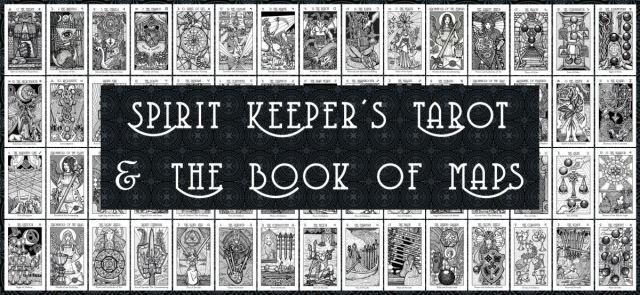
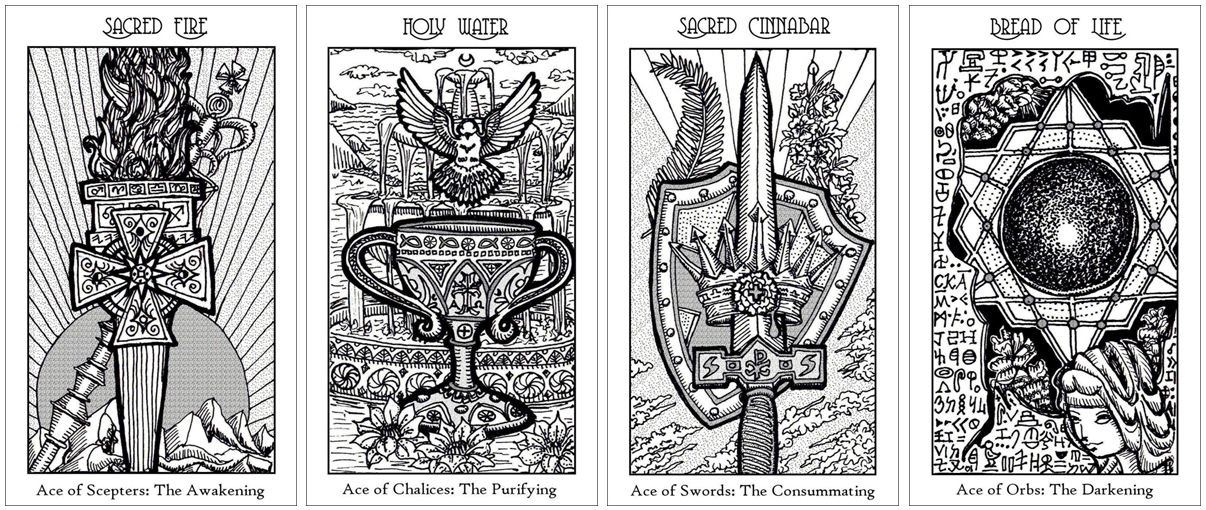
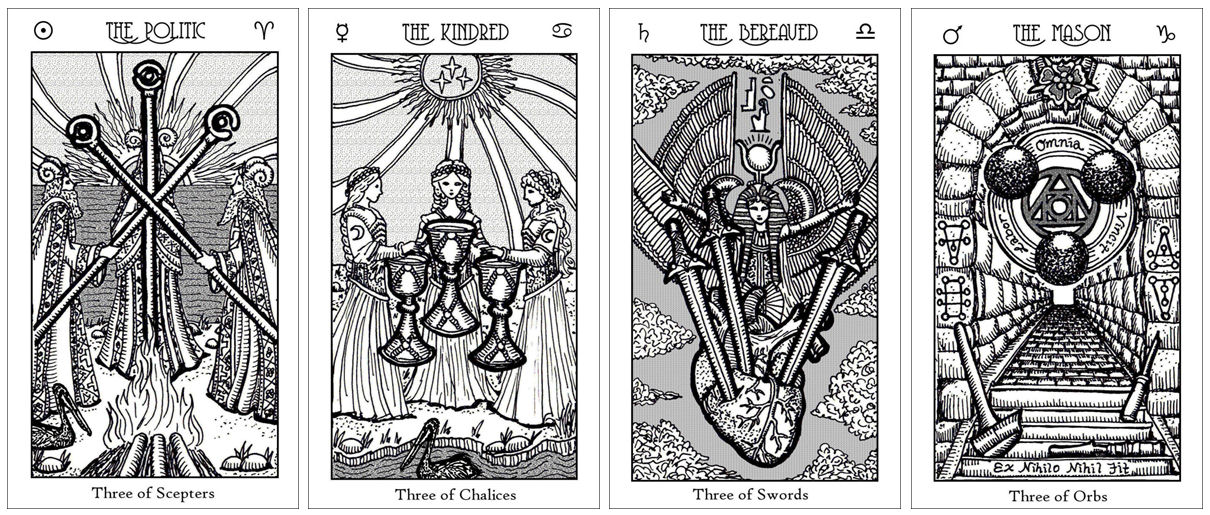
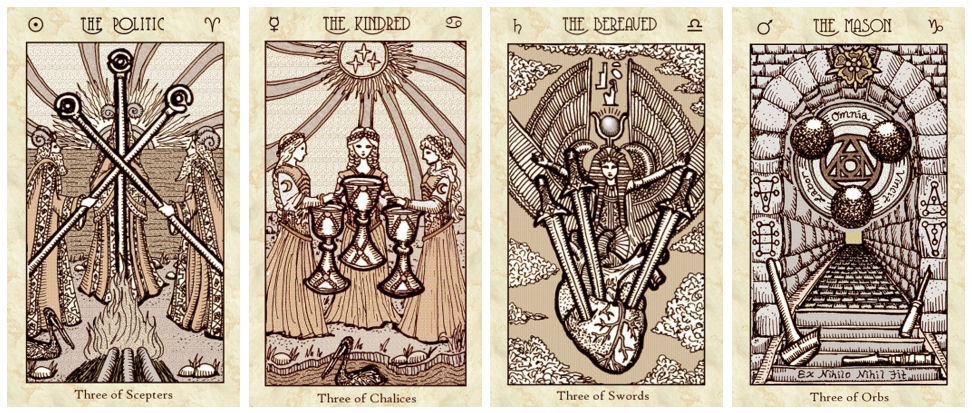
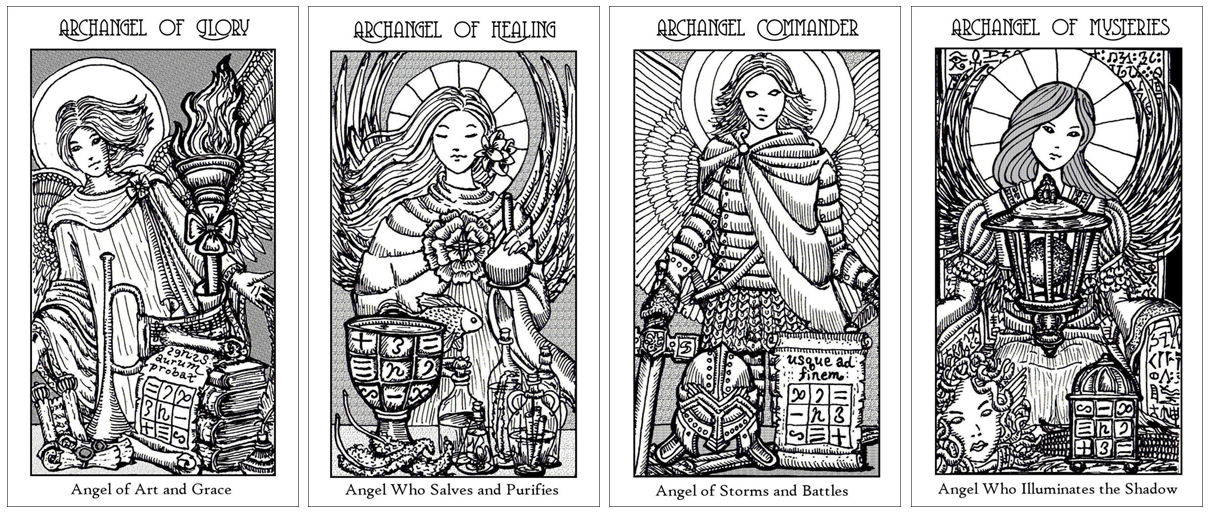
The following is an excerpt from The Book of Maps, the companion guidebook to the Spirit Keeper’s Tarot, a hand-illustrated black and white tarot deck crafted with practitioners of the mystic arts in mind. The pen and ink drawings were inspired by woodcut prints from the late Renaissance. Symbology called upon is based predominantly on medieval European alchemy, astrology (the Sacred Seven), Hermeticism, Zoroastrianism, Abrahamic angelology, Kabbalah, Catholicism/Christianity, Sufism, and Egyptian mythology.
For more information about the deck, go to:
Excerpt from The Book of Maps
Zoroastrian Magical Protection Charm
In an Avestan text dated to the 9th and 10th centuries, Ahura Mazda reveals to Zoroaster the magical powers of the falcon feather. The Magus who prays over a falcon feather can empower the feather into a charm that will ward off evil, cure and cleanse one of evil possession, and protect whosoever wields the feather against demons.
I wanted to post this for the aspiring deck creators to crush your dreams. I’m kidding. Sorta. Here’s the thing. If you’re aspiring to self-publish your own tarot deck, then I want to make sure you go in fully informed and with a very comprehensive strategic plan. Can you arrive at the other side of all this having earned some money? Yes, you can. If you’re smart. I’m hoping this post will help you to be smart.
A lot of indie deck creators kind of just wing it, forget to account for certain costs, and end up losing money on their venture. The rare success stories are lauded with such fervor that we start to believe that a financially successful tarot deck is the norm. Well it’s not. The norm is the deck creator who didn’t do the math right, and even though a healthy dollar amount was raised through crowdfunding, much of what was earned was inadvertently wasted, and the tarot deck never makes it past its first print run.
So if you plan on crowdfunding your deck production through a Kickstarter or Indiegogo campaign, then this post can help you ascertain how much you’ll really need to ask for. Or if you go the route of bootstrapping it yourself, what is that going to look like? How are you going to maneuver your budget planning?
To keep the topic streamlined, the only thing we’ll talk about here is money. Numbers. So we’re beginning the train of thought assuming you have a marketable tarot deck. If your deck is shit none of this matters. So assuming you have a product that can generate a healthy level of demand, let’s proceed.
In each of the tables here, you’ll see the line items are numbered along the left column. My notes will correspond with each numbered line item.
YOUR COSTS
Let’s begin by itemizing your anticipated costs and expenses. How much money, in U.S. dollars, does it take to self-publish your tarot deck of 78 cards, packaged in a box, and accompanied by a little white booklet?
Also, don’t just look at the tablesand end there. You have to read the line notes that explain where each expense description is coming from. Some line items you can probably cut out. Some will be cheaper for you. Though some may be more expensive. It all depends. So read the notes.
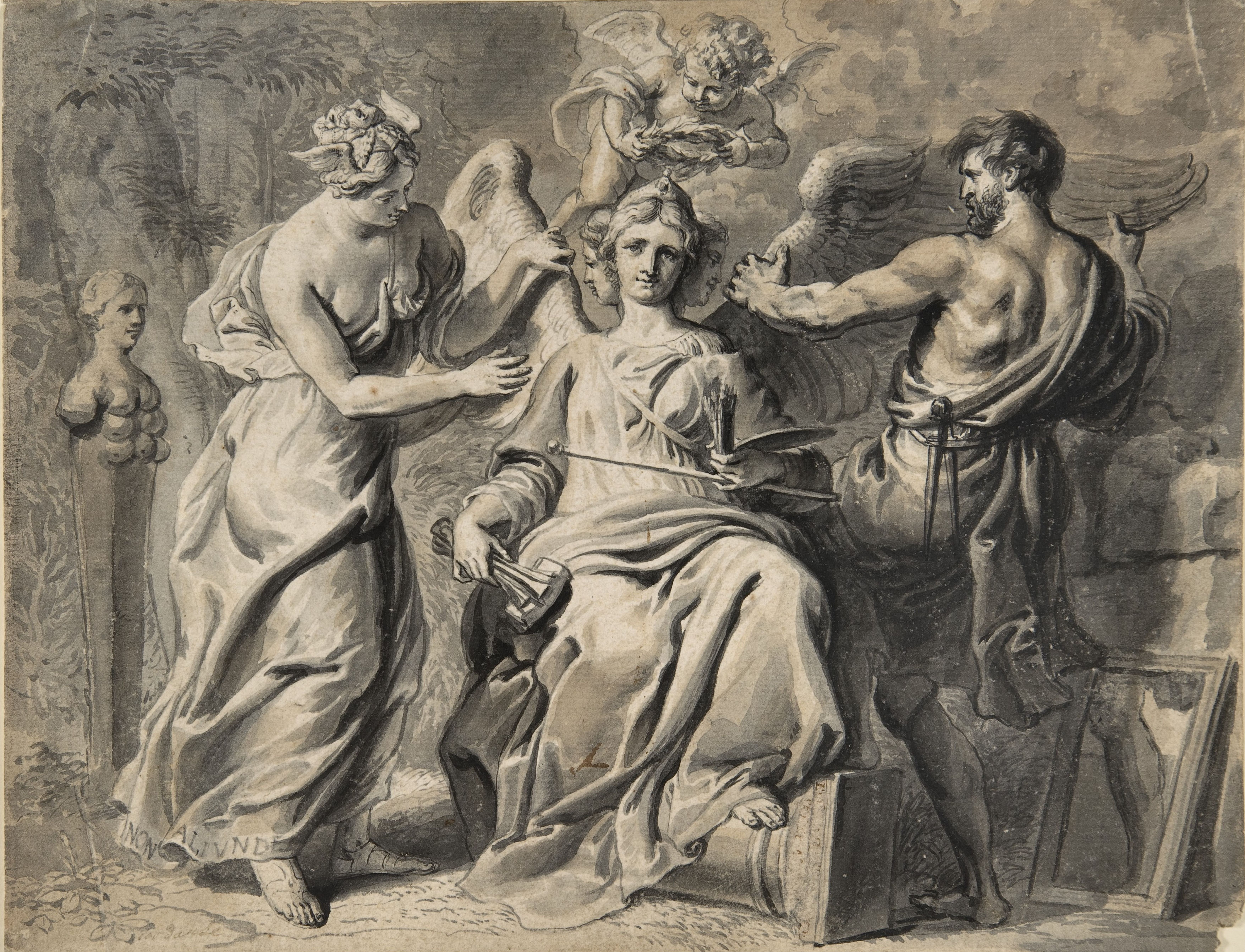
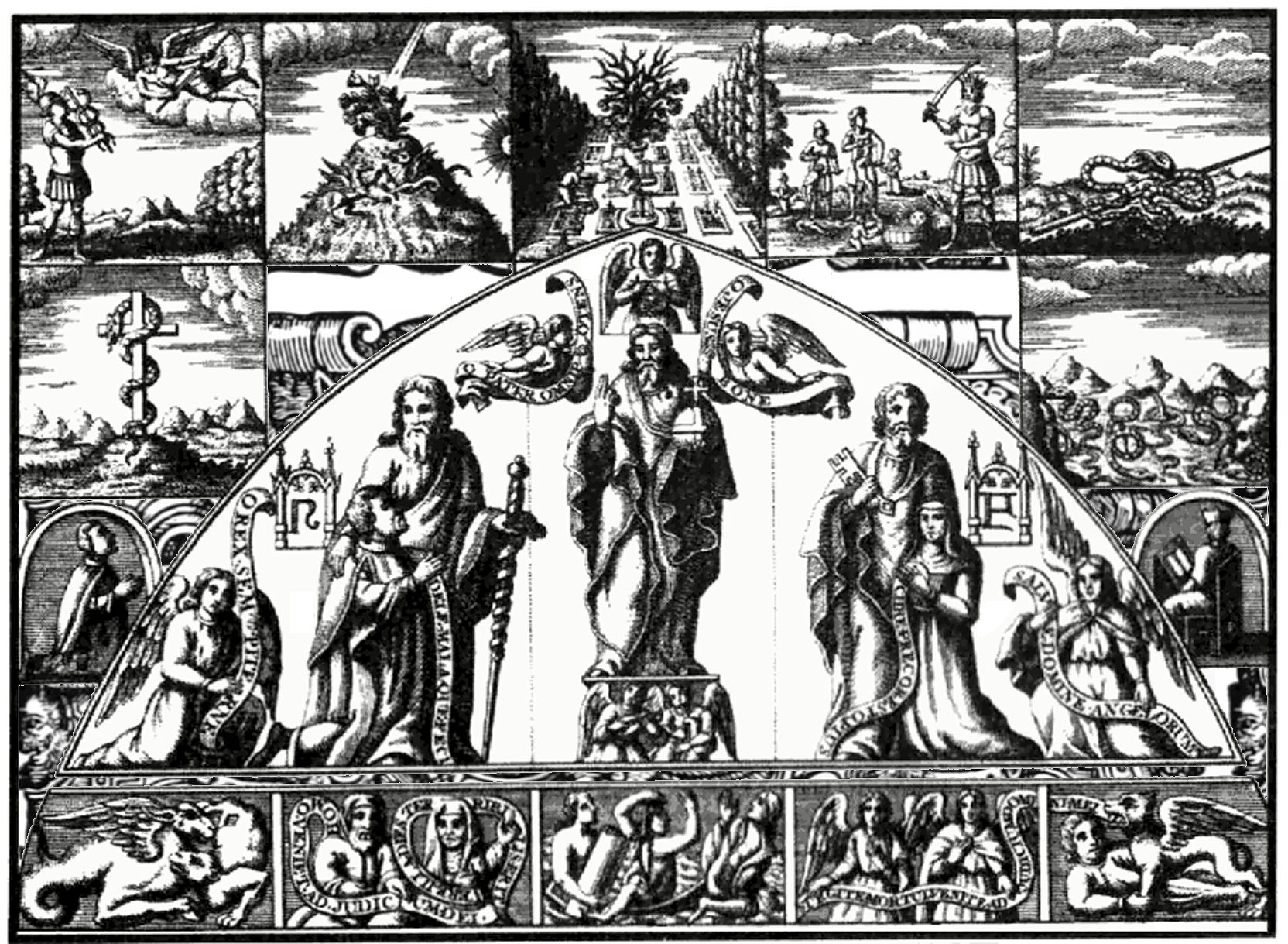
Allegory of the Arts with Isis and Geometry Attending the Three-Headed Angel, by Erasmus Quellinus the Younger (1607 – 1678)
Medieval philosophers and mystics on the quest to memorialize a single, universal theology searched beyond the borderlines of their own traditions. While their doctrines were based largely in Christian and Jewish mysticism, metastasized by the integration of Platonic philosophy and Sufism, the quest for that universal theology led these thinkers to consider Hinduism, Buddhism, and even a return to unearth the deeper heritage of their own pagan roots.
Cultural integration is conceptual alchemy that blends what had been separate artistic, intuitive paths of wisdom into one unified system of evolved thought.
Integration of diverse doctrines is necessary for the advancement of metaphysics and science. That which closes itself off from integration will not evolve, and if you don’t evolve, then you can’t transcend.
Alchemical figures carved on the tomb of Nicholas Flamel (1418)
The advanced civilizations of history were products of cultural integration. At the age of twenty, a Macedonian king—and a student of Aristotle—succeeded his father to the throne and with his newfound reign, expanded his father’s empire across Africa and Asia.
Alexander the Great launched the Hellenistic Period (323 BC to 31 BC), when Greek culture, religion, mythos, and esotericism spread throughout Europe and later to the New World out West, changing the ideologies of the societies that Greek thought integrated into.
Consequentially, the Hellenistic culture was indelibly changed by the people that Alexander’s armies conquered. Alexander himself personally adopted many of the customary practices of the Egyptians and Persians. Thus, Egyptian and Persian culture wove their way into the global fabric in ways that now cannot be untangled.
Greco-Buddhism, a religious syncretism between Hellenistic and Buddhist philosophies, produced mutual, tempered change in both the East and West. Alexander’s reign changed the spiritual landscape of Central Asia, leaving notable Greek influences over the Buddhist art of antiquity.
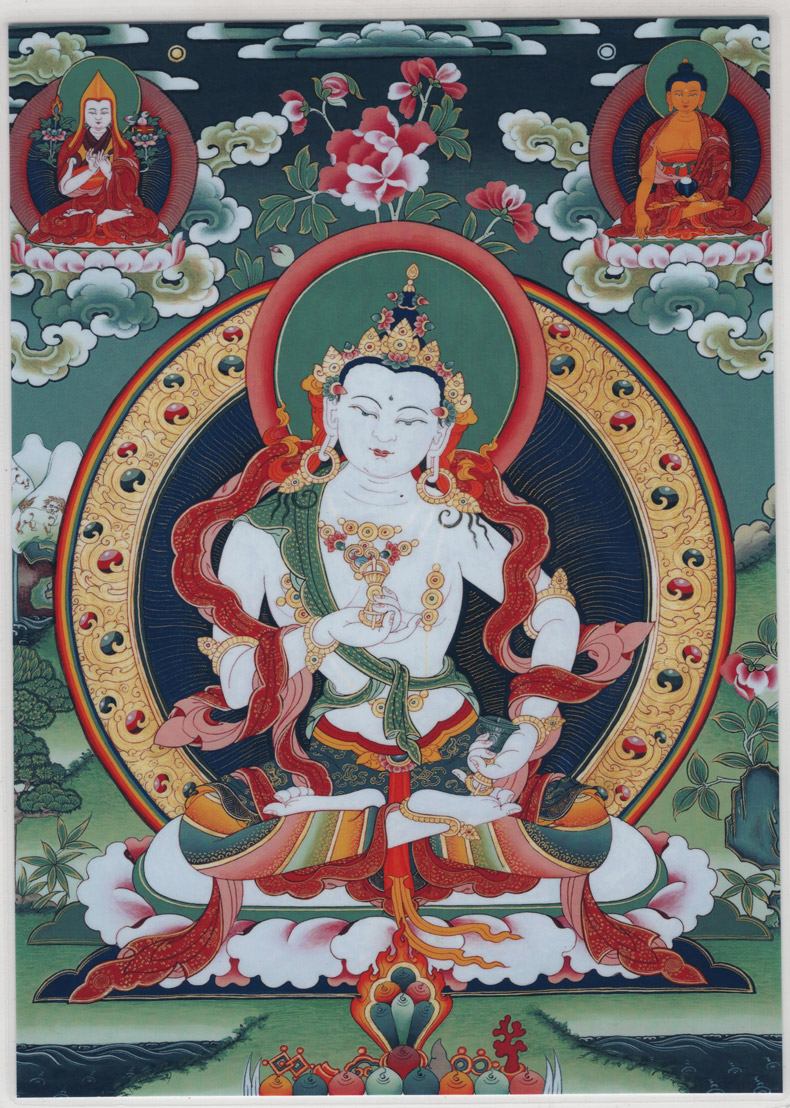
Vajrapani (金剛薩埵佛), also known as the Secret Master, holding a vajra in the right hand and a bell in the left
For instance, 4th century Mahayana Buddhist depictions of the Vajrapani—a Buddha in some sects and a bodhisattva in others—is associated with the golden thunderbolt. The mythologies of Vajrapani as a heroic character and great protector of the Gautama Buddha were influenced by the Greek mythologies of Hercules/Heracles. The Hercules-inspired Vajrapani bodhisattva depictions then in turn inspired the Niō, divine guardians in Japanese Buddhism.
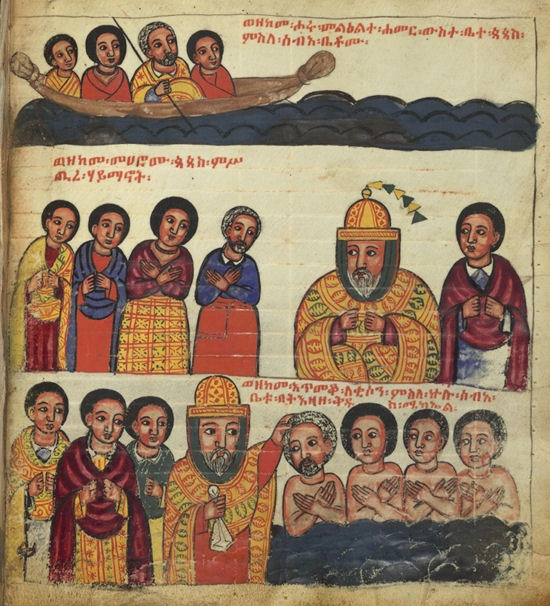
The Story of Qison (from a 17th century Ethiopian manuscript about Archangel Michael)
Reciprocating, Buddhism made its way into Christianity. The Greek orthodox Christian story of Barlaam and Josaphat that was popular in the Middle Ages is just one example of that syncretism.
The story of Barlaam and Josaphat is based loosely around the life story of the Gautama Buddha, which historians believe was the result of Manichaean doctrines syncretizing Christianity and Buddhism.
In this Manichaean version, a king’s astrologer predicted that the crown prince would become a Christian. To thwart destiny, the king kept his son Josaphat isolated in the castle. However, Josaphat managed to escape the castle grounds, where he met the hermit Barlaam, and subsequently converted to Christianity.
The story, which was popularized in the Eastern Orthodox Church, is a Christian retelling of the Buddha’s origins story. At the end of this book, there’s a chapter, “Introduction to Manichaeism,” that explores the Gnostic doctrines of Mani in a little more detail.
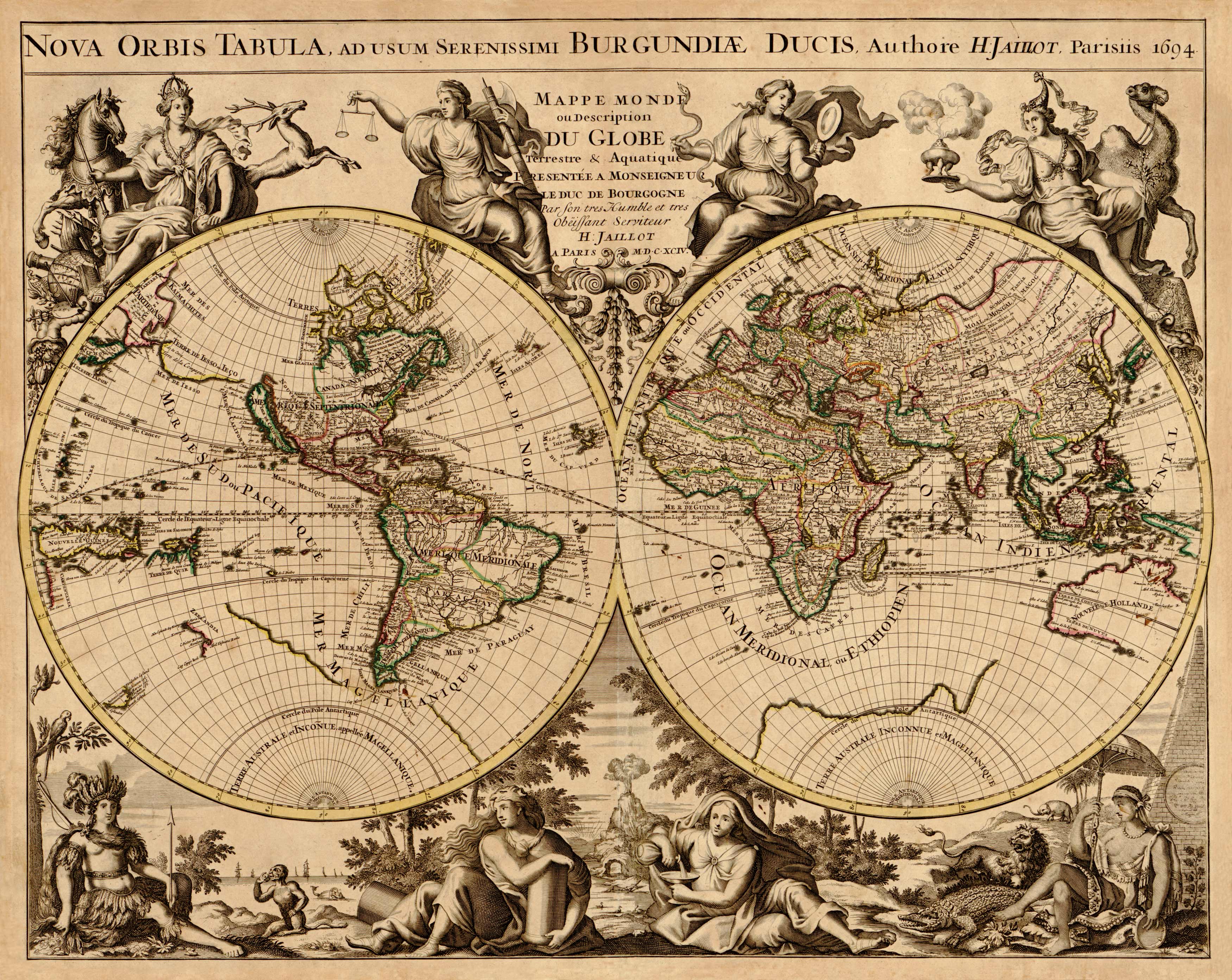
Nova Orbis Tabula, ad usum Serenissimi Burgundiae Ducis (1694) by Charles Hubert Alexis Jaillot (1632 – 1712)
As permeating as Greek thought was across the ancient world, ancient Greek mystery traditions themselves were a syncretic blend of Mesopotamian and Persian thought, with Zeus being a Hellenized version of the Egyptian god Amun.
During the Roman Empire, the polytheistic Roman traditions evolved to fold in Celtic and Germanic mythologies, in addition to the intimate syncretism between Greek and Roman mythology.
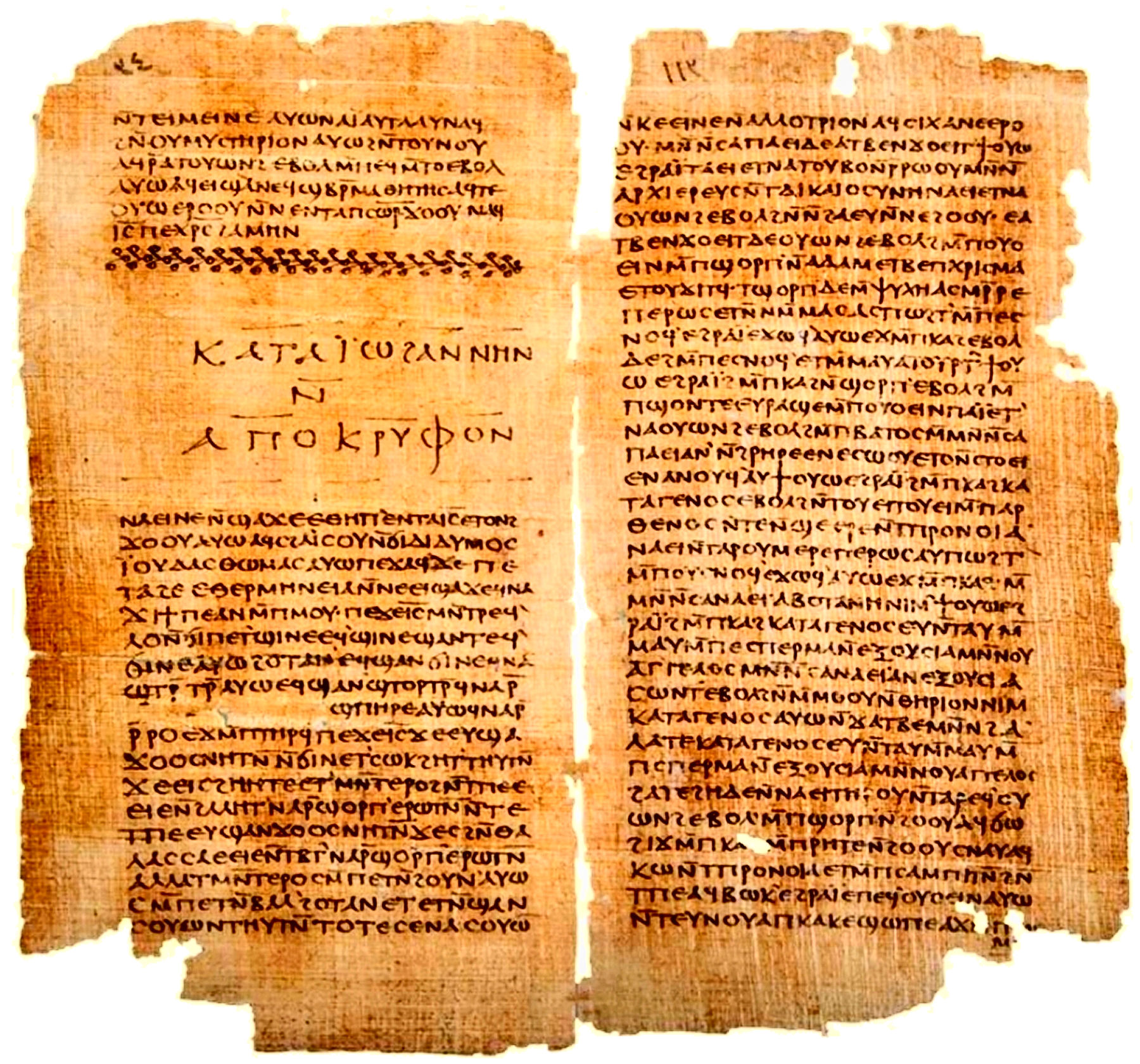
Gospel of Thomas and The Secret Book of John from the Nag Hammadi papyrus manuscripts, 3rd – 4th c. AD
Gnosticism in the first and second centuries was a blending of Jewish and Christian mysticism and even religious thought from the East, such as Zoroastrianism, Aramaic and Mesopotamian thought, with modern scholars speculating syncretism with Mahayana Buddhism as well, given the undeniably strong parallels between Gnosticism and Buddhism.
The Byzantine Renaissance (867 to 1056 AD) was another period when cultural integration (and thus the arts and sciences) flourished. Greek and Roman aesthetics intersected with Latin, Persian, and Egyptian culture, all blending in to Orthodox Christianity, giving rise to Byzantine art, which later shaped the Italian Renaissance.
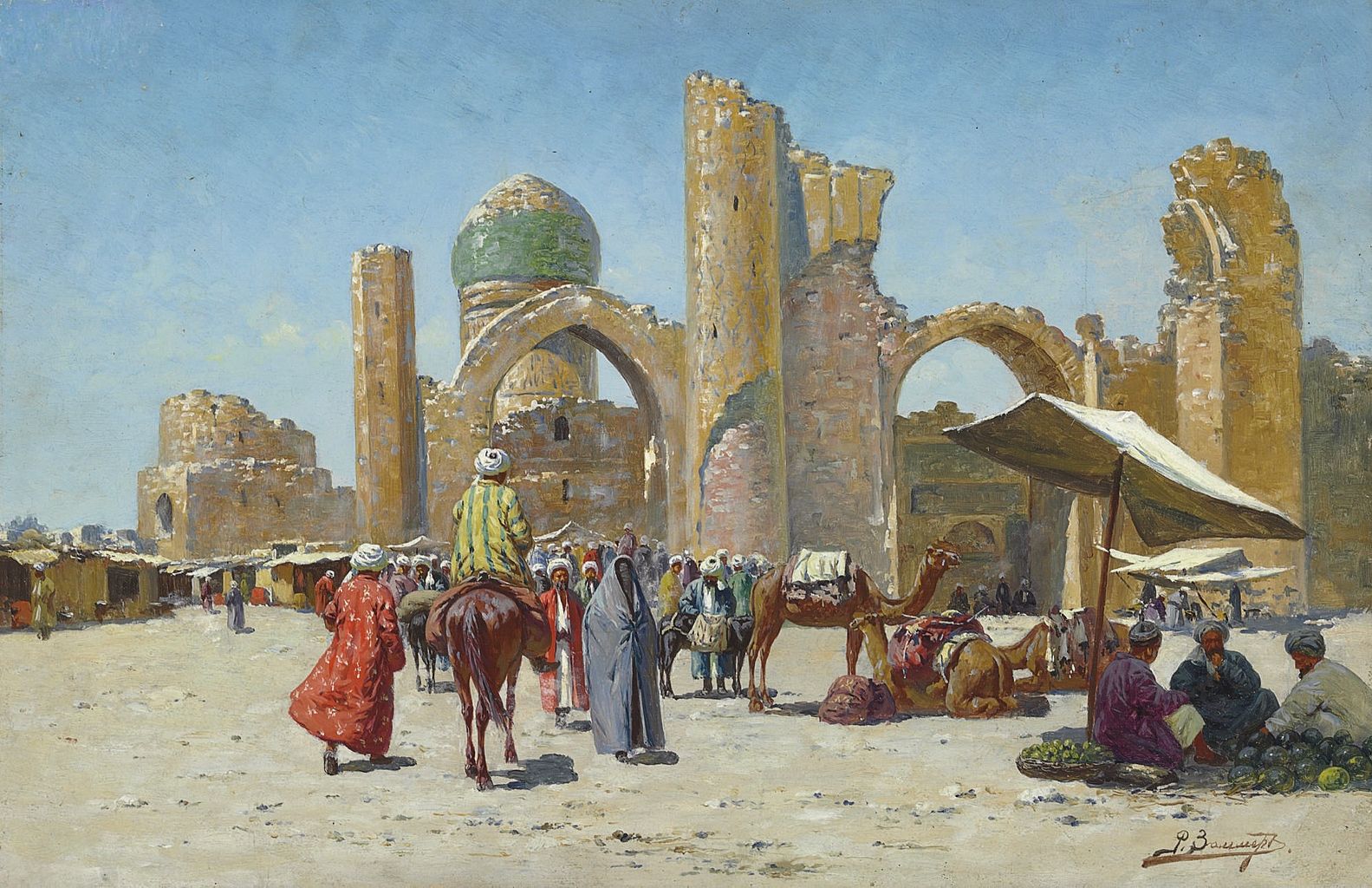
Bibi-Khanym Mosque (1910) by Richard-Karl Karlovitch Zommer
In the 12th and 13th centuries, Genghis Khan’s reign over a broad and diverse empire brought about another wave of cultural integration. Though he was a Tengrist (a form of Central Asian paganism that consists of shamanism and animism), he nonetheless invited a diverse range of thought leaders into his court.
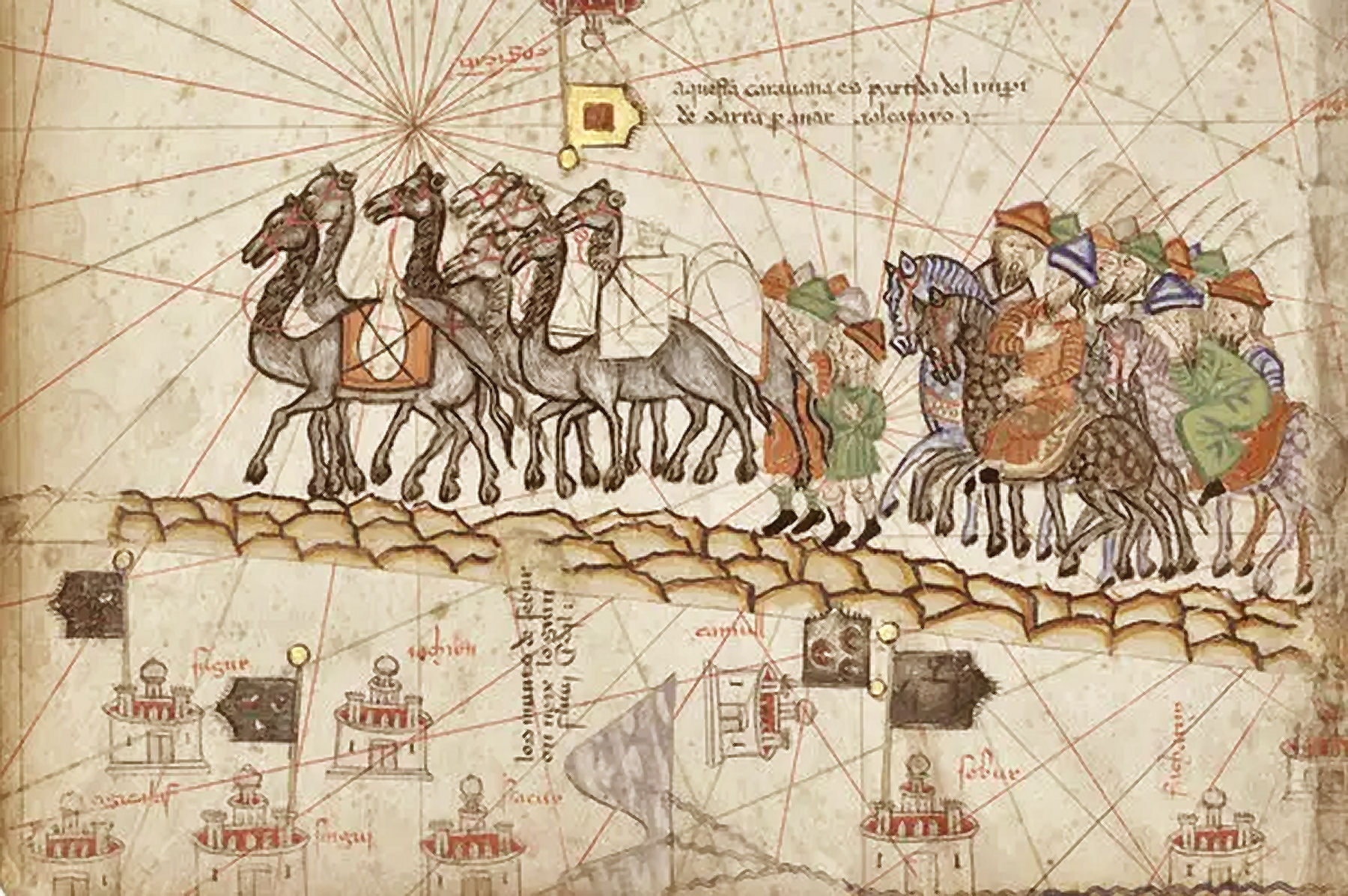
Genghis Khan is credited by historians as crystallizing the irrefutable economic relevance of the Silk Road, a trade network connecting the East and West, and the source of profound syncretism between Eastern and Western cultural thought so that the invention of playing cards could travel from China, through the Mamluk empire, and into Renaissance Italy to become the tarot.
Marco Polo’s Caravan on the Silk Road (1375) by Abraham Cresques
However, the Silk Road precedes Genghis Khan by almost 1,500 years, its namesake coming from the precious silk trade during the Han Dynasty (202 BC–220 AD) and enduring for dynasties thereafter.
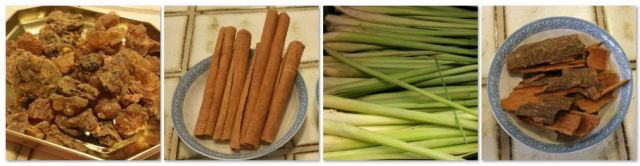
In antiquity, spices, such as Ceylon cinnamon (which was also imported from Egypt into Europe), cassia cinnamon, and frankincense moved from East to West, becoming so prized in the West that the Abrahamic religious traditions considered them holy. The ingredients of the Biblical holy oil in the Book of Exodus, and even the ingredients listed in the later version memorialized in the Book of Abramelin, are all spices native to Asia brought to Europe through the Silk Road.
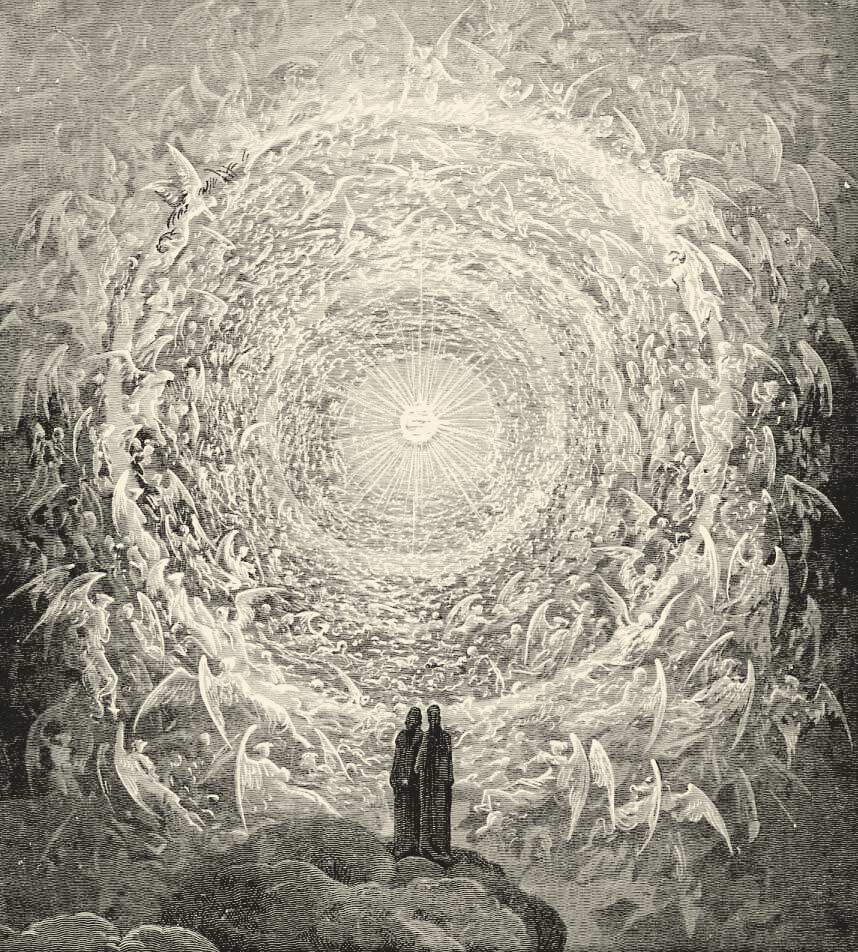
Angelic Choirs Circling the Abode of God [Paradiso] (1892) by Gustave DoreStill other cultures showcase fascinating instances of cultural integration. The Kingdom of Aksum, situated in what is now modern-day Ethiopia, was a formidable global power, in significant part because it was a critical connecting point between the Mediterranean and the Orient.
It was also a kingdom open to integrating Judaism, Christianity, and Hellenism. Even the civilizations of antiquity were culturally integrated, such as ancient Egypt, where Cleopatra, ruler of Egypt, was of Greek ancestry, and her society was one that integrated Libyans, Berbers, Nubians, and Parthians.
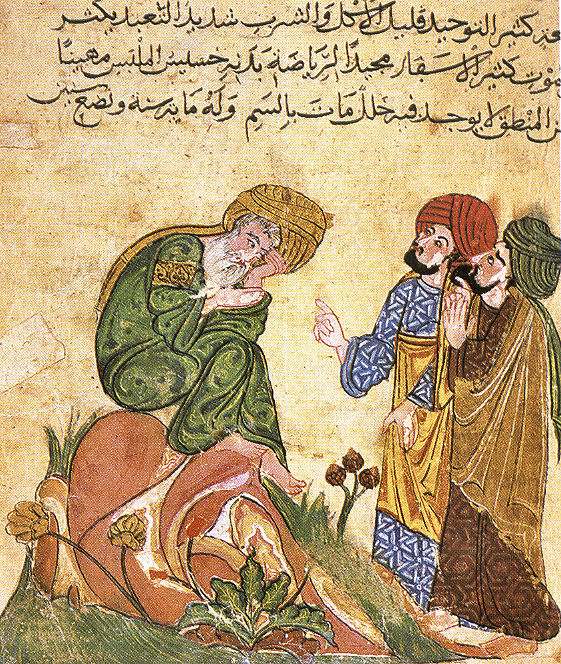
Disputa, or Disputation of the Holy Sacrament (1510) by Raphael
During the Renaissance, the theory of prisca theologia evolved from the merger of Hellenistic corpora (the collection of written texts on Greek mystery traditions and cults) and Kabbalistic literature, both of which were filtered through a Christian perspective. And yet the origins of the prisca theologia concept, i.e., a first theology, or philosophia perennis, an eternal philosophy, has its roots in Islamic thought.
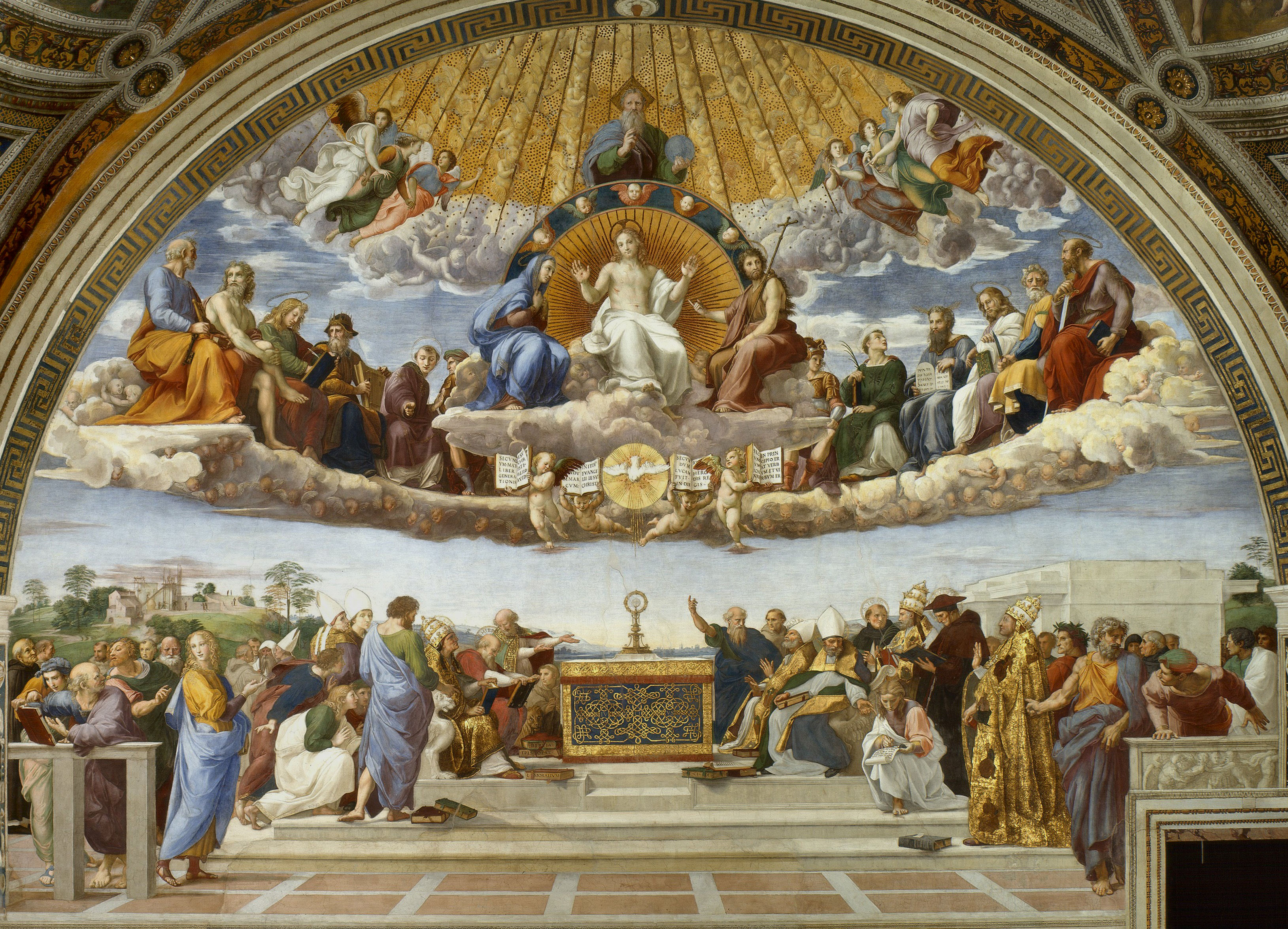
Manuscript of Sughrat (Socrates), circa 13th century
Sohrevardi (1154 – 1191), full name Shahāb ad-Dīn Yahya ibn Habash ibn Amirak as-Suhrawardī, was the founder of Illuminationism, or Wisdom of the Rising Light, a philosophical and esoteric mystery school from the Islamic Golden Age that espoused the first principles of Light (a concept likened to what Eliphas Levi would later refer to as the Astral Light), how it manifests as intellectualism, as angels, as divine genius, and as Reason.
He blended Islamic thought with occult Emanationism, Zoroastrian angelology, Hermeticism (Sohrevardi referred to Hermes as the Father of Philosophers), and Neoplatonism. His school of thought also centered on intuitive mystical experiences for achieving Gnosis. Eventually Sohrevardi was charged with crimes of heresy and executed.
Studies of the Fetus in the Womb (1513) Leonardo da Vinci
It wasn’t until the 15th century during the Italian Renaissance that pursuit of the prisca theologia took popular hold in Western Europe, with one significant milestone occurring around 1463 when Cosimo de’ Medici took a keen interest in the Corpus Hermeticum and commissioned a translation by Marsilio Ficino (1433 – 1499), a Neoplatonist, scholar, physician, astrologer, and Catholic priest.
This early manifestation of the prisca theologia sought to reveal a common denominator among Egyptian, Greek, Jewish, and Christian thought.
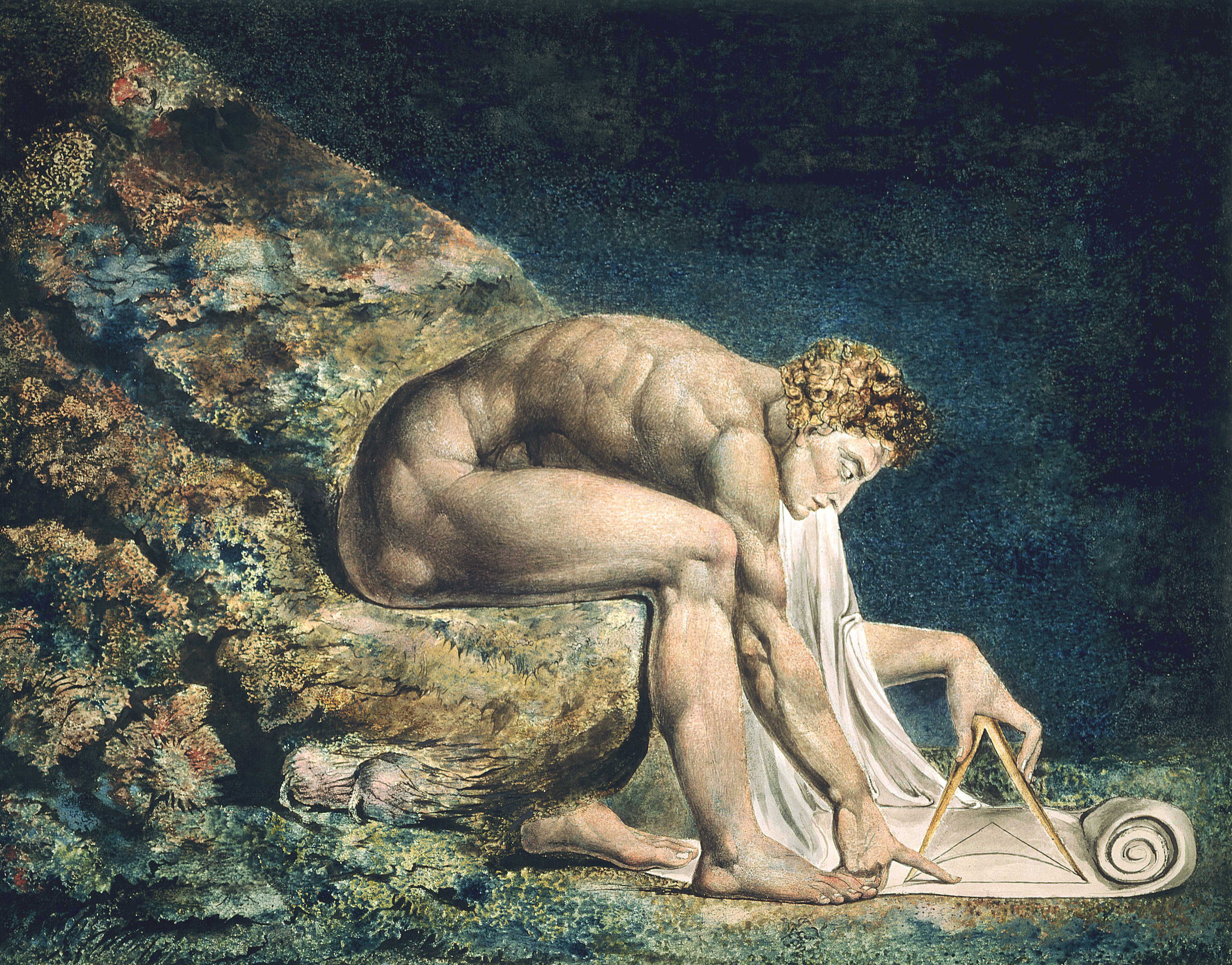
Sir Isaac Newton as a Divine Geometer (1805) by William Blake
Interest in exploring the prisca theologia was revived in the 18th and 19th centuries to be integrated into the esoteric schools or mystery traditions of the time. Rosicrucianism, Theosophy, and later Thelema integrated the principle of a primordial religion, one that the mystery traditions of that time believed could be learned through the ancient Egyptian religions, Zoroastrianism and the Persian magi, Hinduism, the Eleusinian Mysteries of ancient Greece, and Jewish mysticism.
During the Industrial Revolution, occultists of the time sought intersecting points that would connect Hindu, Taoist, and Buddhist principles with Western esotericism.
The epiphenomenon (a secondary or incidental event) to pursuing the prisca theologia is a scholarly reexamination of folk wisdom, deciding not to dismiss superstitions, oral history, or old wives’ tales, and to not treat them as inferior to modern metaphysical inquiries.
I’ve openly shared the animistic premise of the Spirit Keeper’s Tarot—I decided to take seriously and as truth the primitive supposition that all things, from people, animals, and plants to rocks, land formations, and even what is created by our handiwork, such as a deck of tarot cards, all hold a sentient spirit essence with the potential for agency. That sincere openness to animist beliefs is an example of an epiphenomenon arising from pursuit of the prisca theologia. The other is cultural integration.
Mamluk playing cards. Topkapi Palace Museum.
Tarot itself is the product of cultural integration. It arose in popularity during the Italian Renaissance (between 1300 and 1600 AD), evolved from the Mamluk playing cards of Persia, which came from the invention of playing cards in China, with the earliest records dated to 800 AD.
The Silla Kingdom (57 BC – 935 AD) on the Korean peninsula popularized a divinatory practice of silk strips etched with insignia organized into eight suits corresponding with the eight trigrams, numbered one through nine. I dare speculate that such a practice is part of the tarot’s ancestry.
Medieval Chinese playing cards were often illustrated with scenes or characters from popular novels. A common one during the Ming Dynasty (1368 – 1644 AD) was Water Margin (水滸傳), a 14th century classic about 108 outlaws—36 heavenly spirits and 72 earthly demons. The protagonist journeys to a Taoist monastery seeking a cure for the plague that’s ravaging the capital city. While there, he frees 108 outlaw spirits and the rest of the novel documents their adventures.
Ming Dynasty playing cards featuring characters from the Water Margin
Records of playing cards in Mamluk Egypt appeared around the 12th and 13th centuries. The Mamluk Sultanate was a caliphate that ruled from Cairo between 1261 and 1517. They were predominantly Muslim, though Sufism (Islamic mysticism) was also widespread during this time.
During this period, Mongols from the Yuan Dynasty in China, the Crusaders arriving from Western Europe, and the Mamluks encountered each other in their battles over the Holy Lands. On the trade front, Mamluk and Islamic art made its way to Venice, which historically served as a liaison between Europe and Asia. By the 15th century, Venetian artists were borrowing heavily from Islamic Near East influences, brought by way of the Mamluks and Ottomans.
It would not be a far stretch of speculation to presuppose that merchants and soldiers from the Song, Yuan, and Ming Dynasties brought Chinese playing cards with them westward, inspiring Mamluk playing cards. The Mamluks designed their playing cards with Islamic art styles. Crusaders from Western Europe along with Venetian merchants then carried the Mamluk playing cards with them back home.
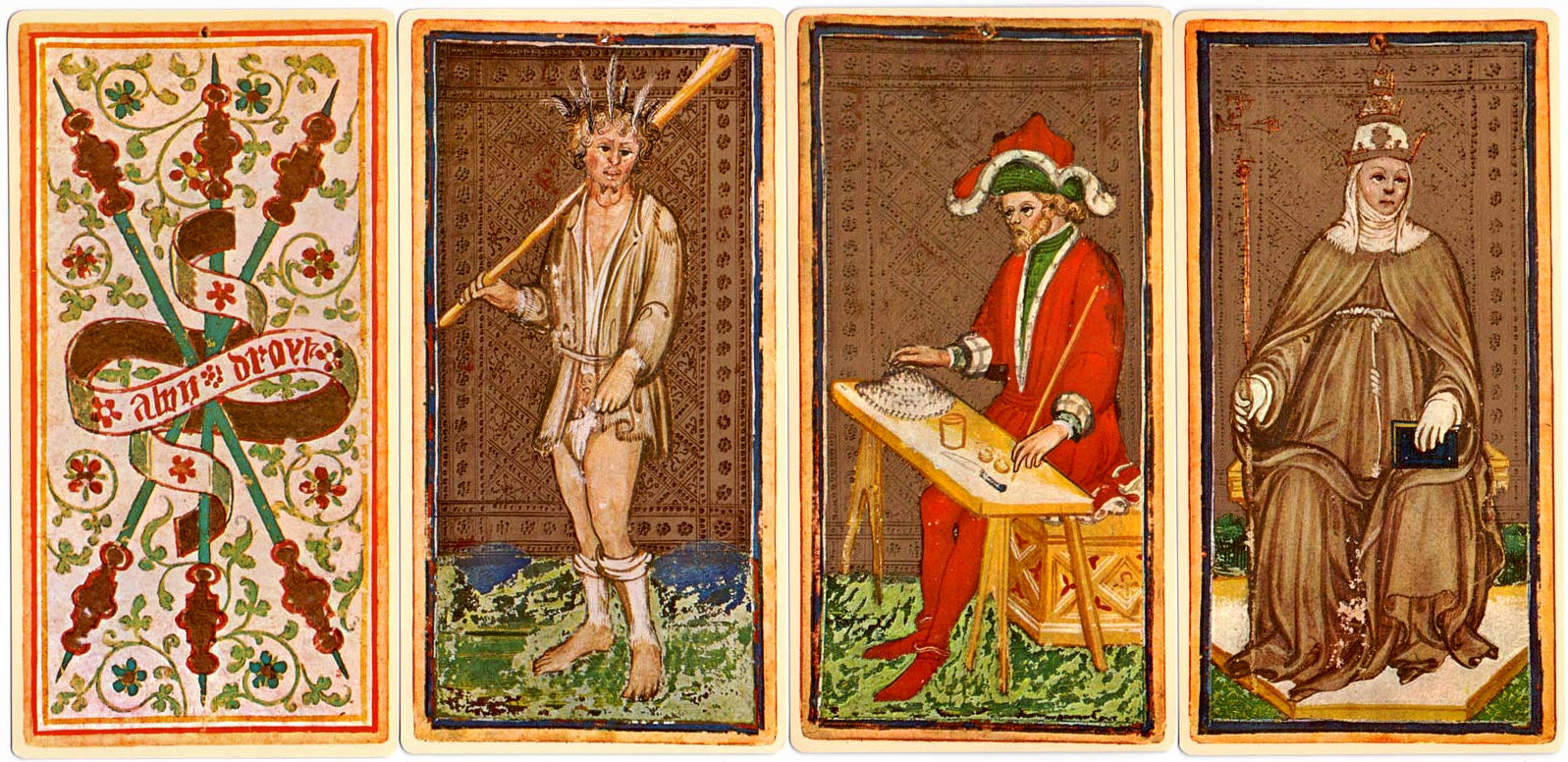
The Visconti Sforza Tarot. The Morgan Library.
The Franks then changed the designs to reflect Christian sensibilities. A version of Italian playing cards, Tarocchi, surfaced in the 15th century, and like the Chinese adding references to their beloved narrative Water Margin to their cards, the Italians added references to Dante’s Divine Comedy (1320) to illustrate the Tarocchi.
Wheel or Rota of William Postel, from the Absconditorum Clavis (1547), also known as Postel’s Key, purported to be a codex revealing the Tree of Knowledge, of Good and Evil, and illuminating the Mysteries. Alternatively referred to as Clef de David (Key of David), a wheel within a wheel through which its holder will come to understand the true meaning of the Tetragrammaton.
The interest in tarot took a notable turn during the Age of Enlightenment (1685–1815), when the occultists of the time saw patterns of Egyptian magic, Jewish mysticism, Greek mystery traditions, and Hermeticism in the symbols on the tarot cards, paving the groundwork for the Victorian and Edwardian eras when the tarot became culturally integrated into Western ceremonial magic. Thus, although the tarot is not necessarily occult, study of Western occultism is tethered to the study of tarot symbology.
Aleister Crowley’s work was influenced heavily by Eastern esotericism, from Hinduism to Taoist ceremonial magic. Crowley himself believed that he was the reincarnation of Ge Xuan, a 2nd century Chinese alchemist and occultist.
Clavicula Salomonis en andere magische tractaten en voorschriften, version belonging to Petrus de Abano (1250-1315)
During his travels through China, his magical work focused heavily on invocations of his Holy Guardian Angel, namely through recitations of the Bornless Ritual (adapted from a Preliminary Invocation, which Crowley and Macgregor Mathers linked to the Goetia, or the Lesser Key of Solomon).
Carl Jung, who seemed likely to have subscribed to a pantheistic form of spirituality, was convinced as a psychologist that the fundamental purpose of human life was spiritual transcendence, and to evolve beyond our physical bodies into a form of psychic or spiritual union with a Divine.
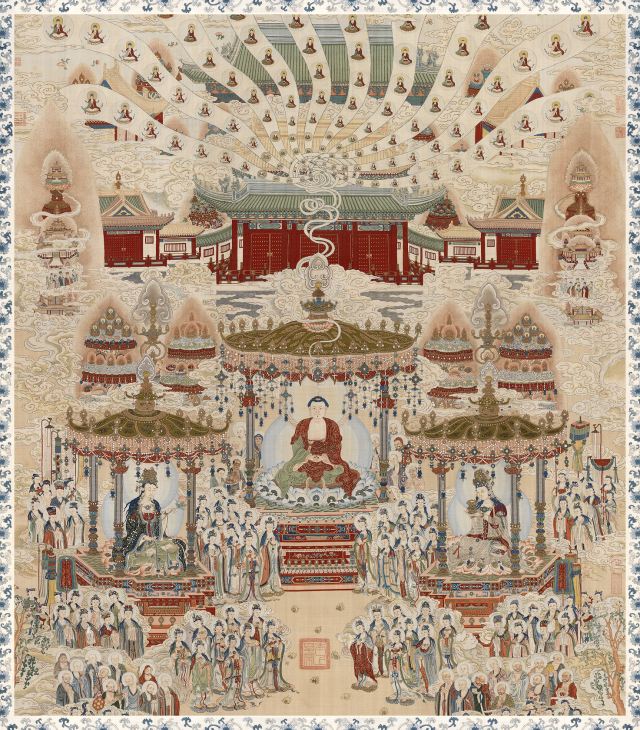
Depiction of the Mahayana Buddhist Pure Land (Qing Dynasty)
His conclusions came from dedicated study of Eastern religions such as Hinduism, Buddhism, and Taoism, which he integrated with his studies of Christianity and Gnosticism.
Another renowned figure in occultism, Gerald Gardner traveled to East Asia in his 40s, making his way through Vietnam, China, Singapore, and the Philippines, where his primary interest was cultural anthropology. It’s hard not to notice the remarkable similarities between Taoist esotericism and Asian folk magic with Wiccan thought.
Venetian Ambassadors in Damascus (1511) by Giovanni di Niccolò Mansueti
Emboldening cultural integration is not to dismiss cultural appropriation, however. The balancing plank between the two is a socially dangerous one to tread, with an unreliable fulcrum.
To seize upon the ideas of a culture and not genuinely honor its people is to lack the compassion and empathy necessary for transcendence, and so that attempt at integration fails.
To construct theology beholden to normalized dogma will chain the spirit to the body, binding it against transcendence, and so that attempt at integration also fails.
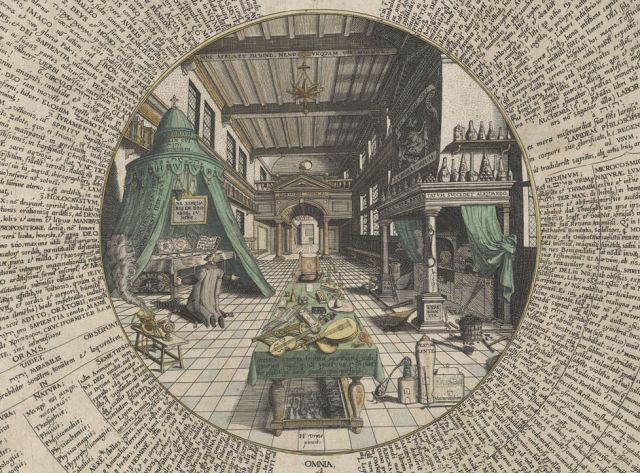
Alchemists Laboratory (1595) by Hans Vredeman de Vries, from Amphitheatrum Sapientiae Aeternae (Amphitheatre of Eternal Wisdom) by Heinrich Khunrath
The seeker of the divine mysteries must dare to push boundaries and comfort zones, but also must accept the risks of treading so close to the tiger’s tail. When the tiger snaps around and bites, you cannot then say in retrospect that you had no idea you would be bitten.
If social inhibitions disempower you from daring to tread upon the balancing beam of cultural integration, then it is still a distant day before you can come to know the prisca theologia for yourself.
Will you find yourself accused of doing the heretical rather than the divine? Probably. If history is any indication, every philosophizing mystic who has adopted cultural integration in pursuit of Truth have all found themselves charged with heresy. Today in the 21st century, charges of heresy take on a different patina, but make no mistake—that’s what it is.
Archangel Michael in front of a Shingon Buddhist Temple to Kuan Yin, Daishō-in (大聖院) on Mount Misen. Itsukushima, Hiroshima prefecture
Cultural appropriation is a reality. It’s brought to reality by lived experiences of being compelled to erase your own culture for the sake of assimilating into a dominant culture. Meanwhile the dominant culture takes a fancy for sporting your culture as a trend. Where you’re condemned for being yourself, they’re celebrated for wearing that same identity they condemned in you.
And yet progressive cultural integration must coexist with conservative orthodoxy—therein lies a great paradox. An enlightened civil society will celebrate free, unfettered, and unencumbered discourse between pillars of progressive thought and pillars of dogmatic establishment.
There must always be a light-bearer of unclouded tradition and a dynamic challenger to that tradition. We need both the magisterial gatekeeper and the rogue who outwits the gatekeeper.
Sun on a Lion, with a Shield of the Triple Moon and Moon on a Griffin, with a Shield of the Radiant Sun, Jousting [Metaphor of Alchemical Integration to Achieve the Magnum Opus]. From Aurora consurgens [Rising Dawn], 15th c. Latin alchemical treatise
I wonder if that great paradox is the riddle the mystic needs to solve to arrive at Gnosis. Your spiritual liberation requires an encounter with dogma and establishment, and a battle of that dichotomy must take place. Alchemical integration is achieved after a jousting of the opposites.
The notion of a one true religion is not objective, but subjective, though subjectivity in no way takes away from its veracity.
It’s in that way that these practices draw the analogy to quantum physics—not that quantum mechanics is subjective, but rather that there are a host of individualized case by case factors at play.
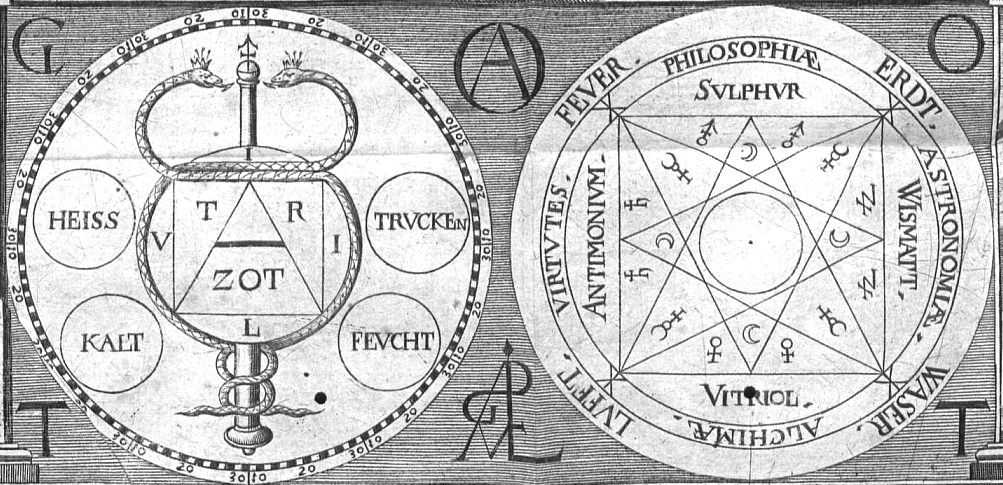
Detail from Cabala, Speculum Artis Et Naturae In Alchymia (1615) by Stephan Michelspacher
A formula must be versatile enough to account for all probable events, and because the whole of the cosmos is too vast and nebulous of an abstraction with far too many probable events for one human to express absolutely, we must look to the quanta, the individualized parts and specific incidences of variables that fluctuate from case to case—that is the only chance any of us have at ever comprehending the whole of the cosmos.
Even in an atomic microcosm, observed facts can be subjective. Observers, by each one’s individuality, will influence reality. There is no singular immutable reality, because reality forms around the position of the observer.
The Aeon. Personification of Cosmic Time. Divine beings that were thought forms created by the Holy Father, per Valentinius (100-160 AD). From Aurora consurgens [Rising Dawn], 15th c. Latin alchemical treatise
The one true religion is not a simple culturally integrated patchwork of religious doctrines built from as many traditions as you can assemble.
Rather, I’ve come to view the philosophia perennis—the perennial wisdom of all ages—as an alchemical process, not a defined doctrine.
While its 1540 origins with Agostino Steucho, a Renaissance humanist and Biblical scholar, were to validate Christianity by presenting classical philosophies from different civilizations as essentially Christian, I use the term to describe the process of validating your own personal gnosis through realization of its congruence to classical philosophies from different civilizations.
Aldous Huxley contended that the foundation of studying the philosophia perennis for yourself is spiritual practice and morality, while its zenith is contemplation of metaphysical truths. The tarot can guide at both strata. And in that spirit, I’ve presented the myths, philosophies, and mysteries of many peoples to facilitate your process of realizing congruence, because where you find congruence is where you’ll validate your personal gnosis.
Aqua Permanens, symbolic of Sol and Luna dissolved in water in unity, called the Flying Bird or Bird of Hermes. The Bird of Hermes is perched upon the Colcotar, a serpent or lizard devouring its own tail, also called the Caput Mortuum, symbolic of the Four Sages, or four elements, in unity. The small bird up top is the scion of the Bird of Hermes. The cooking athanor they’re contained in symbolizes the Work
The ball is now officially in motion. It’s well past the point of no return. Also, fair warning: this is a really long progress update.
I ended up not having to convert my card image files from JPG to PDF, and could submit them directly as JPG files, which I was really happy about. By the way, if you want to see all finalized images, I’ve shared a Gallery of All Cards here.
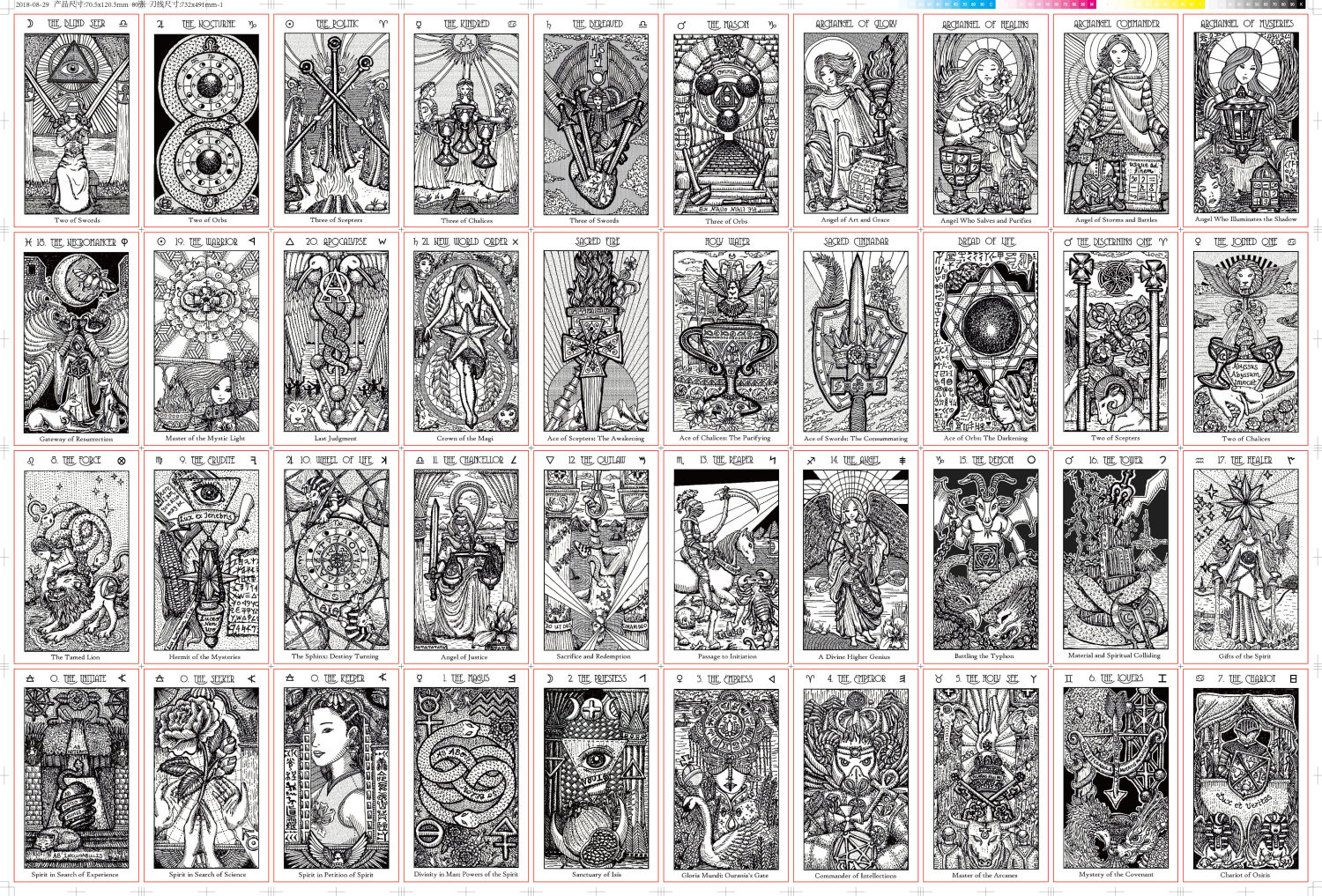
Proofs Line Sheet #2
Also, aspiring tarot deck creators: from the line sheets I’m sharing, you can now see why it makes sense to design 80 cards, right? Even if you are sticking to the 78, I would still recommend creative ways to utilize the remaining 2 cards. Even if you say you’re going to print 78 cards only instead of 80, you’re getting charged for 80 anyway. Do you see my point?
And check out the ordering of the cards on the line sheet. My educated guess is that the automated printing machine will be cutting the cards starting from the bottom row of the sheet, going left to right. (Not all that important to know, but for the curious nerds, something fun to observe.) You’ll see what I mean.
The following is an excerpt from The Book of Maps, the companion guidebook to the Spirit Keeper’s Tarot, a hand-illustrated black and white tarot deck crafted with practitioners of the mystic arts in mind. The pen and ink drawings were inspired by woodcut prints from the late Renaissance. Symbology called upon is based predominantly on medieval European alchemy, astrology (the Sacred Seven), Hermeticism, Zoroastrianism, Abrahamic angelology, Kabbalah, Catholicism/Christianity, Sufism, and Egyptian mythology.
For more information about the deck, go to:
In the weeks leading up to the pre-order launch, I’ll be posting excerpts from The Book of Maps while continuing the deck creator’s progress notes.
Excerpt from The Book of Maps:
What is a Beneficent Spirit?
At numerous points throughout The Book of Maps, I’ve referred to the spirits that you interact with through the Spirit Keeper’s Tarot as beneficent, noting for comparison that malefic spirits, or spirits who do not support your highest good and best interests, are blocked from interacting with you through the cards. A psychic barrier has been crafted into place so that only that which seeks to do good, cause good to be done upon you, and to confer benefits can come through.
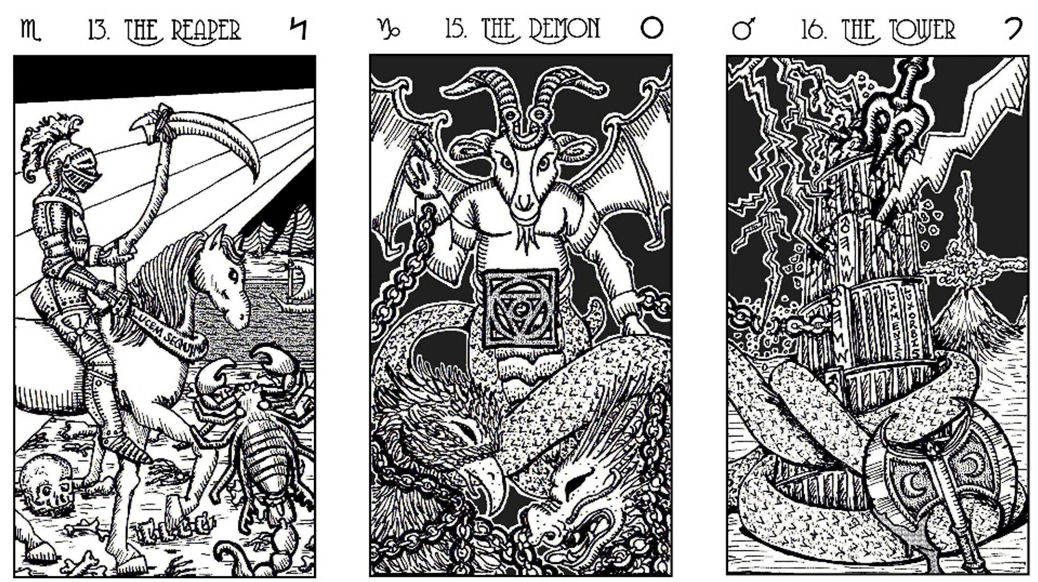
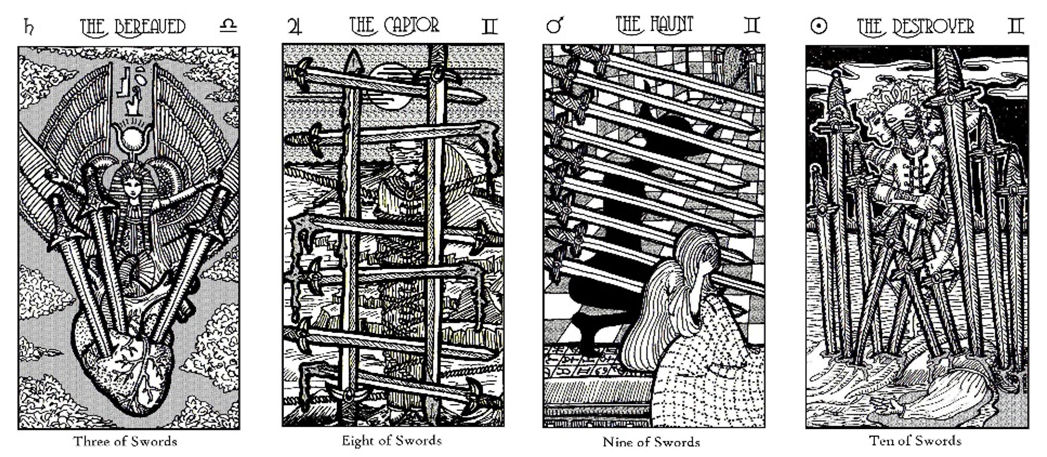
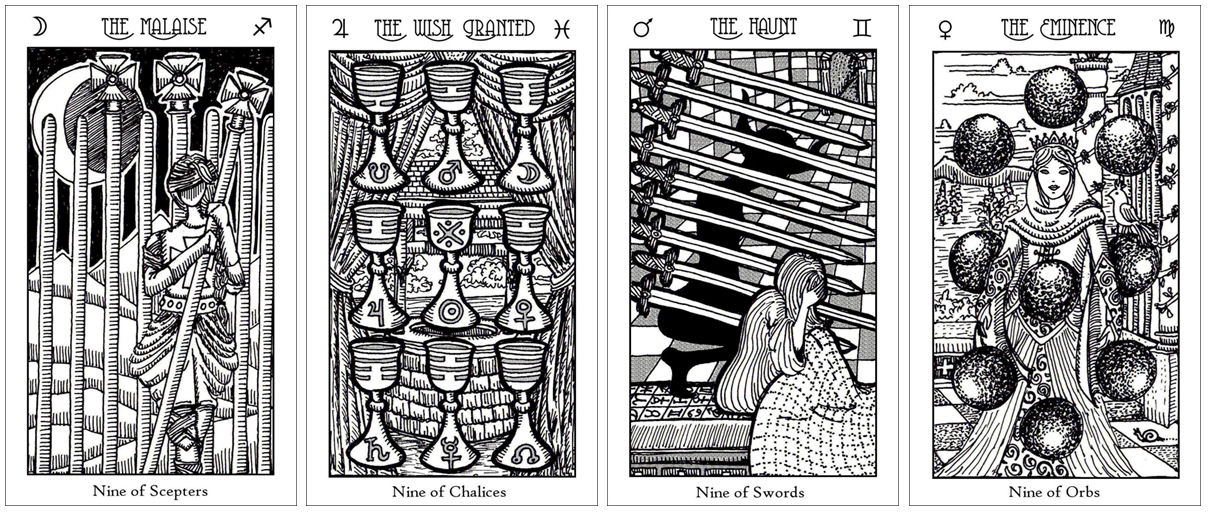
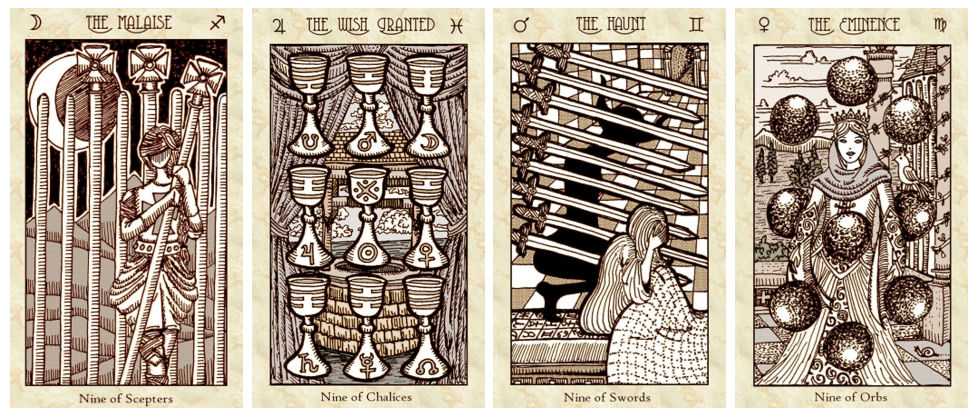
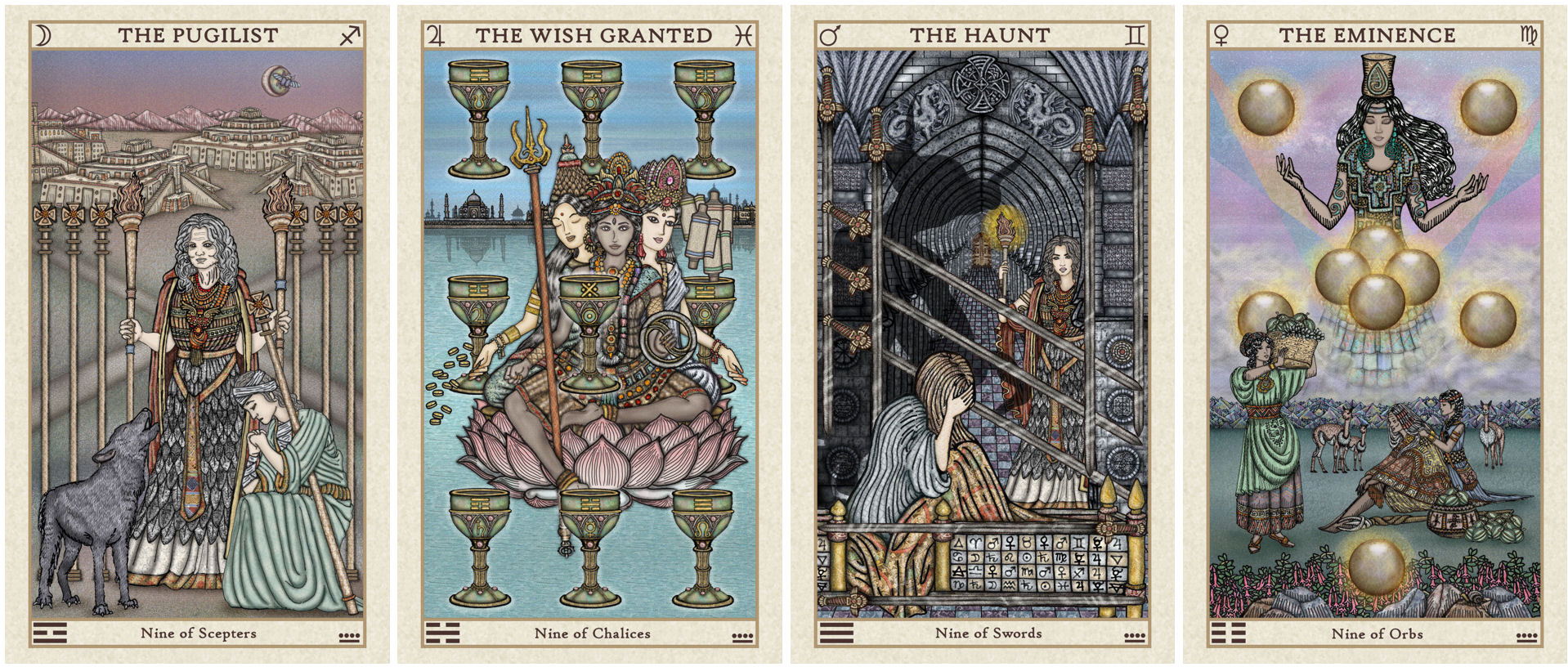
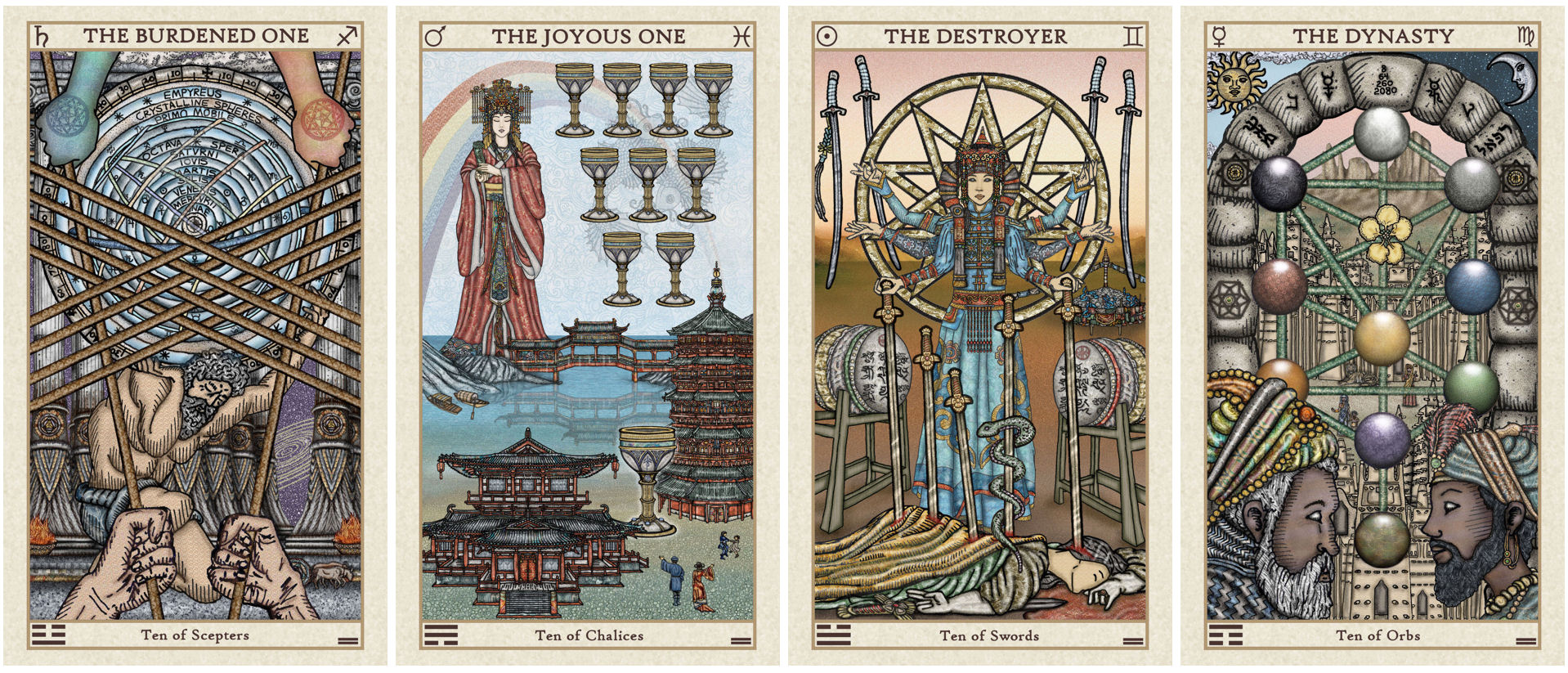
However, what do I mean exactly by a beneficent spirit? Key 15: The Demon, for example, might not look beneficent to most of us. Few of us think of Death (Key 13: The Reaper) as beneficent, though if we’re being realistic, we can at least acknowledge that death is neutral. We might not be sure about what’s going on in the Ten of Swords, but The Destroyer isn’t our first impression of a beneficent spirit.
I would still categorize these spirits, even The Haunt in the Nine of Swords, and yes, all of the spirits herein as beneficent. Beneficent doesn’t mean dressed in white, glistening with a pastel ombré, a golden halo, smiling, and the persona of gentility. That’s dressing, and it’s neither good nor evil. It’s just dressing.
In fact, we’ve all encountered corruption and nefarious intents dressed up in a way that gives a superficial impression of goodness. It’s only when you look through the surface and past the superficiality can you pick up on the ill intent underneath.
The beneficent spirits as depicted in Spirit Keeper’s Tarot and as they can manifest through the cards can at times appear wrathful, ominous, or grim, but they are still by their natures beneficent spirits. Why? Because they act in your best interest. They seek to uplift you, not tear you down. They want to see you in a place of abundance, fulfillment, and empowerment, not a place of weakness, deficiency, or damnation. They never want to see you under prolonged suffering. However, they may let you endure pain in the short term if it means that tribulation will build the strength and character you need to achieve greatness.
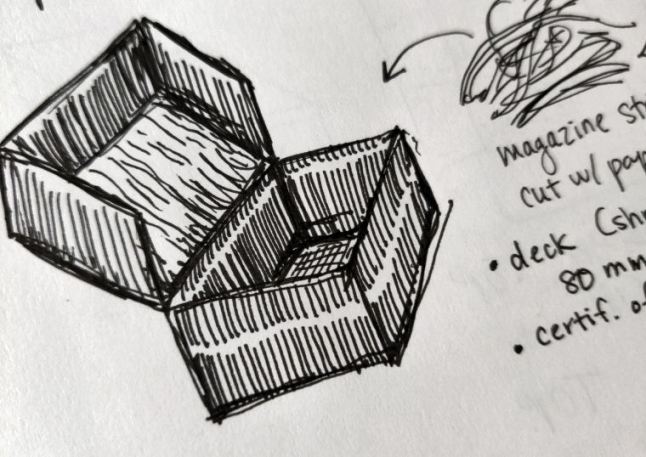
Okay so first, I’m blogging pretty much in real time as I learn these things. Based on known specs and some brainstormed ideas for shipping, we figured out this custom size box that the deck would fit snugly into, how much it’d cost to bulk order the thousand custom shipping boxes we’d need, and so on, you know, your run of the mill biz calculations for cost.
I’ll save you the in-between stuff and get right to the point. In the U.S., if I ship a package that’s under 13 ounces, I can use my own custom box and ship first class for around $5.50.
The moment it goes over 13 ounces, in fact, just 1 ounce more at 14 ounces, it starts at $8.20. So if your package is over 13 ounces, then you wouldn’t go first class anymore. Instead, you’d have to opt for flat rate priority mail.
My box was 1 pound and 1.6 ounces exactly. That’s roughly 18 ounces. Dammit. Way over for economical shipping in a custom box.
So then that means my “only” option is to go priority mail, flat rate. Next hurdle here we go.
Designing the box and packaging for your own tarot deck
For the making of my budding tarot deck, I’m logging a journal of progress notes to document my entire process. From June 13 to June 28, I shared my card by card drawings for the Majors, rough drafts, and pen and ink linework via Instagram. From June 29 to July 20, I completed the Minor Arcana cards. A listing of all posts about that are in the Progress Diary. That weekend of the 21st and 22nd, James and I decide to independently publish the tarot deck, so I got to work on researching what the heck that entails. Journal entries in the Progress Diary then evolved to commentary on the independent publishing process, working with a manufacturer, and the logistics of getting your deck and any companion guidebooks you’ve written in print.
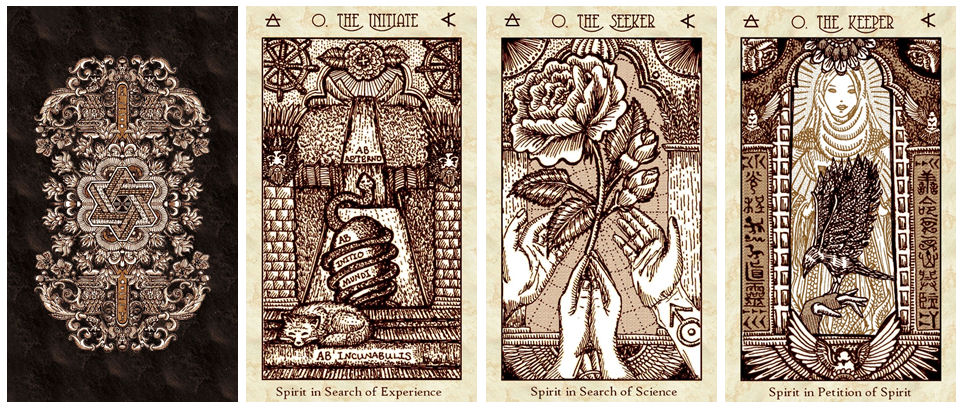
During the new moon in Leo and a partial solar eclipse, I finished the crafting of product packaging for Spirit Keeper’s Tarot. I spruced up some public domain decorative borders and old frontispieces ranging from the medieval era to Victorian and piecemealed them to fit with the specs and dimensions of my tarot box. I also merged them with clips of my own illustrations from the tarot deck.
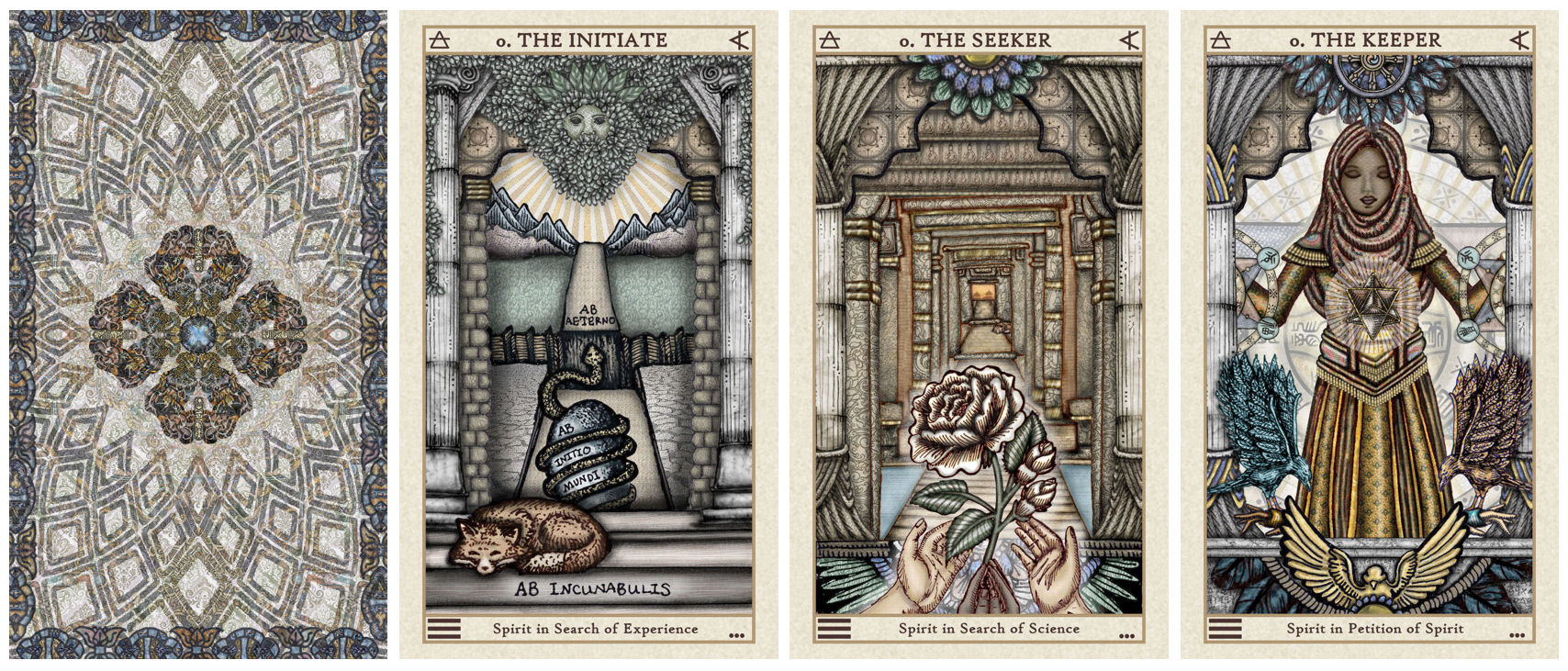
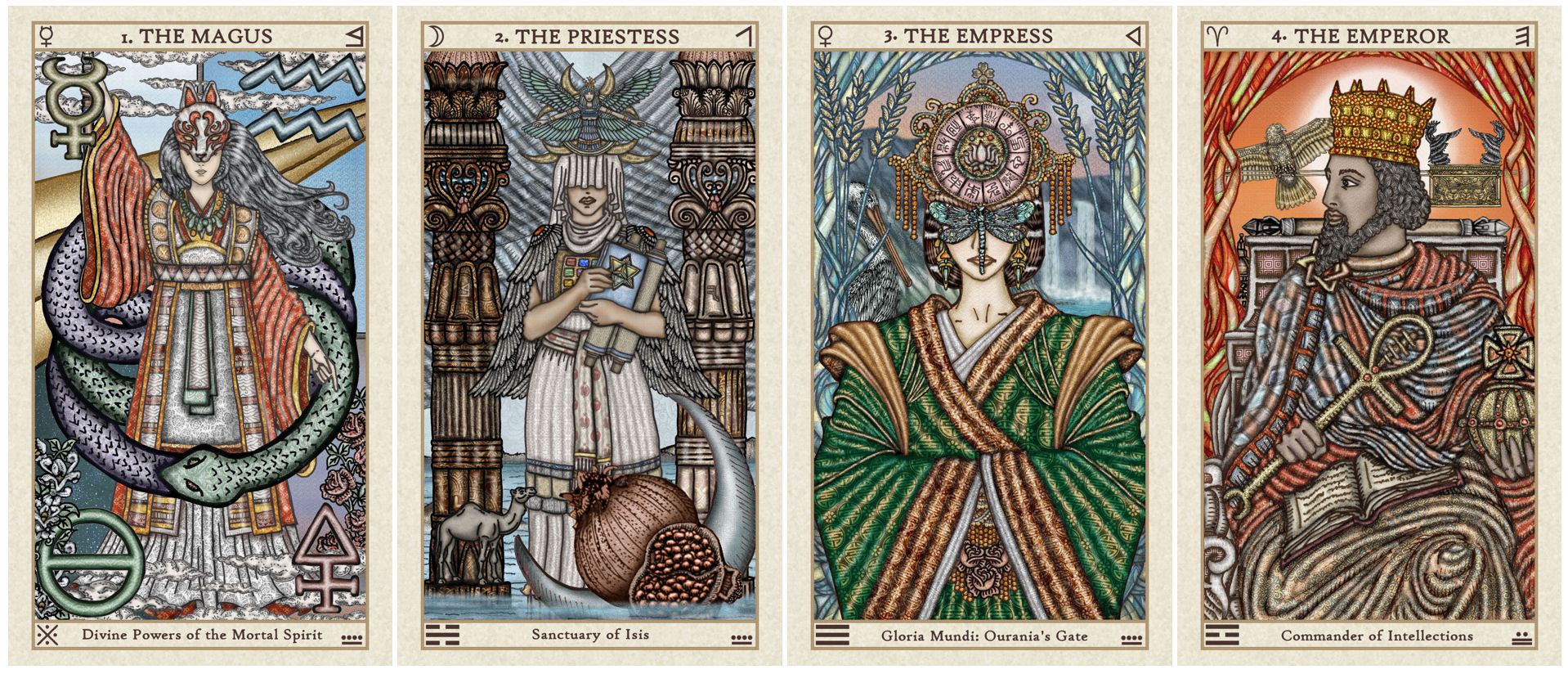
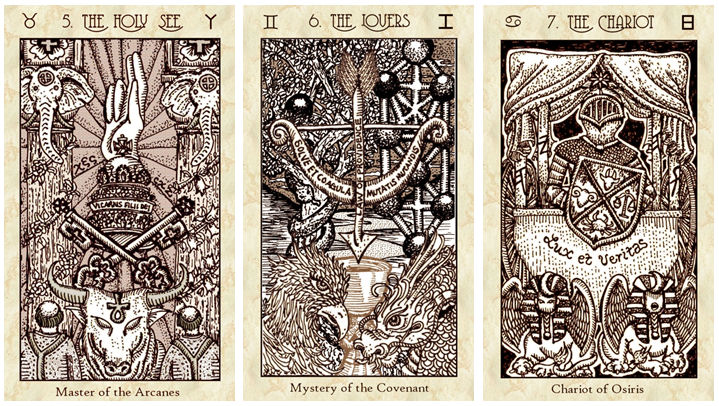
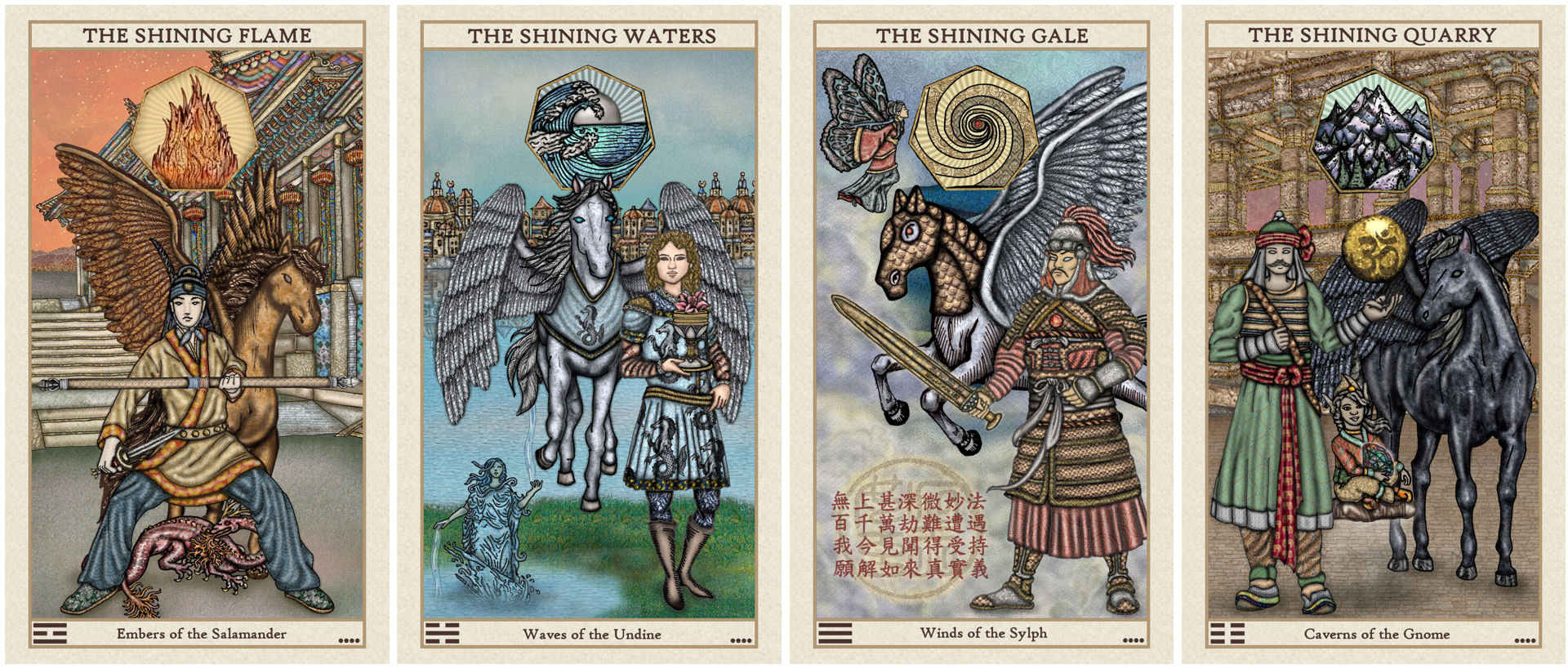
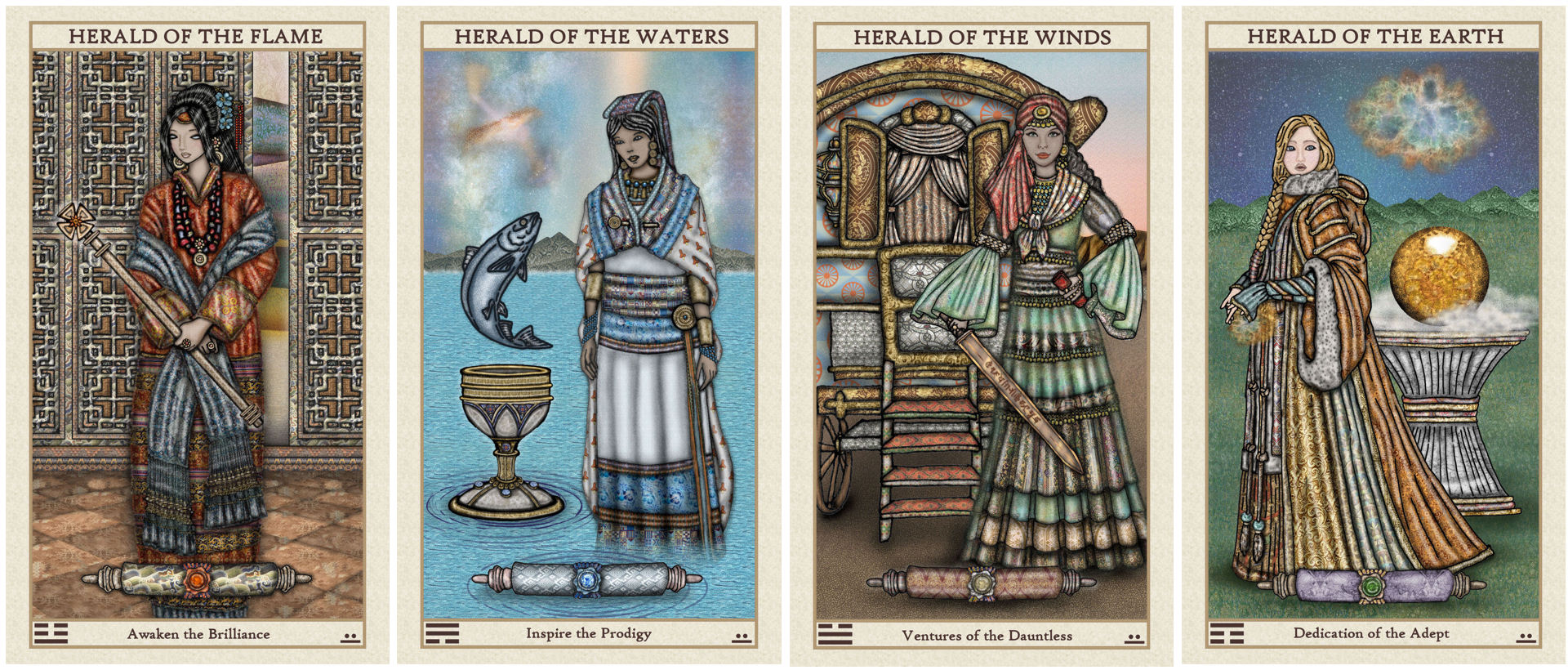
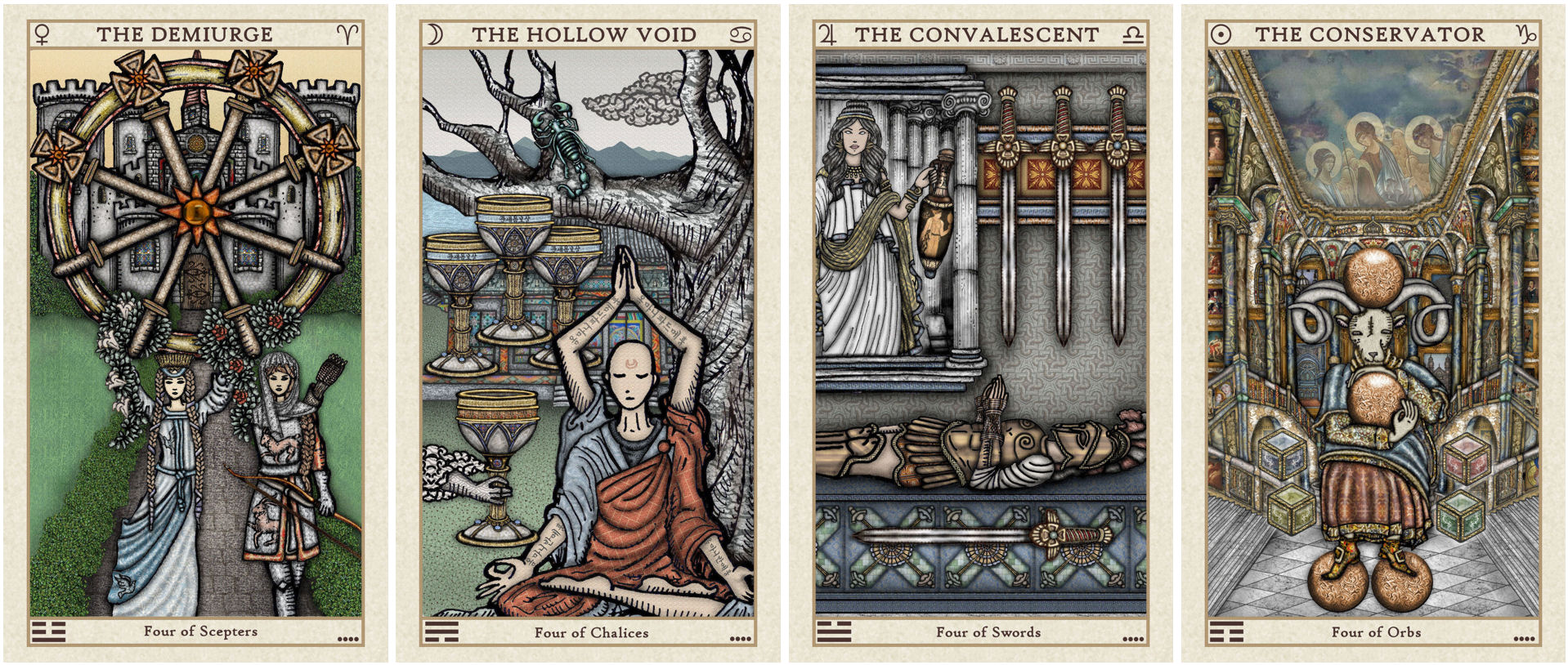
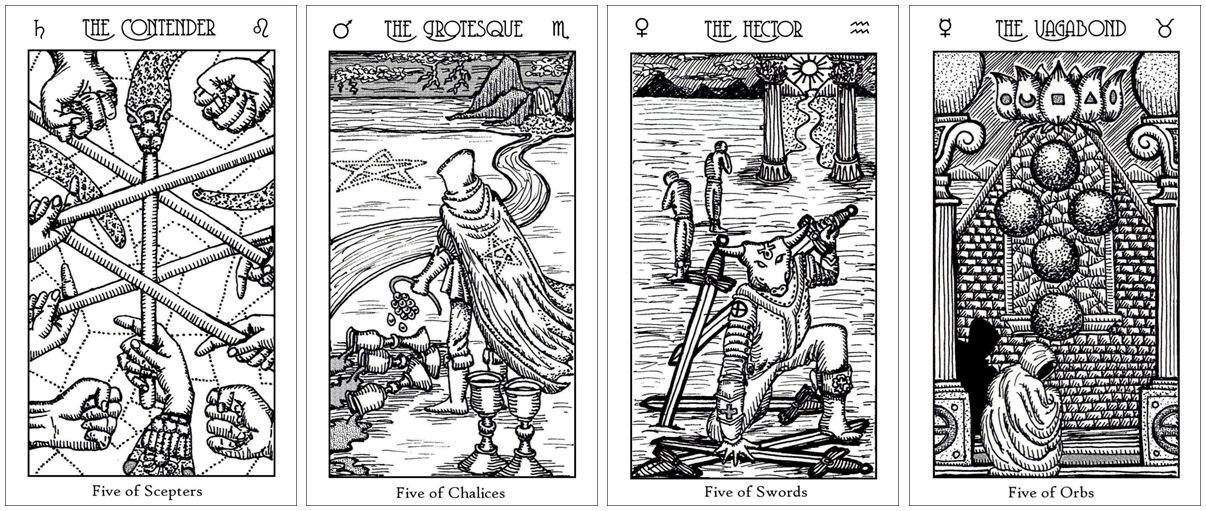
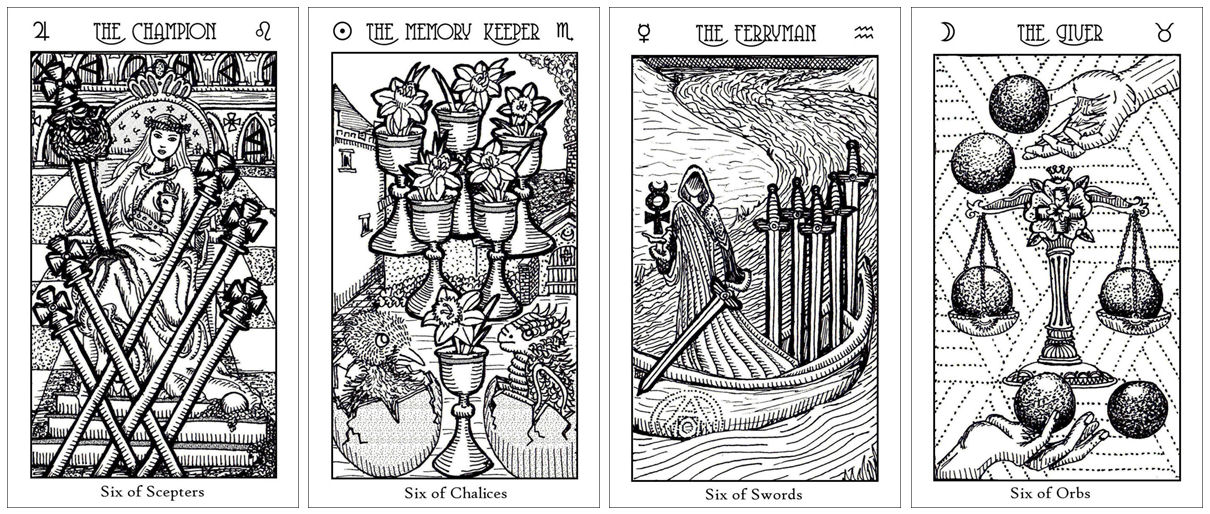
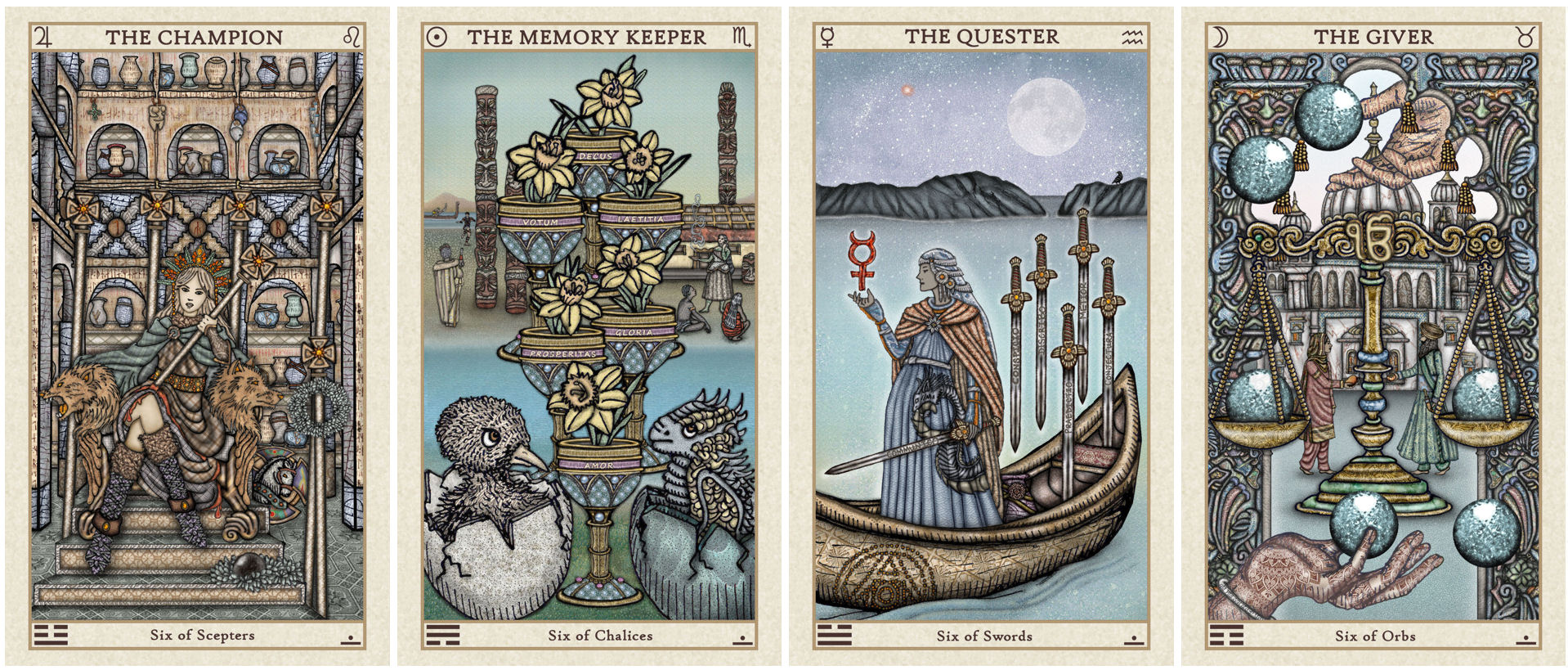
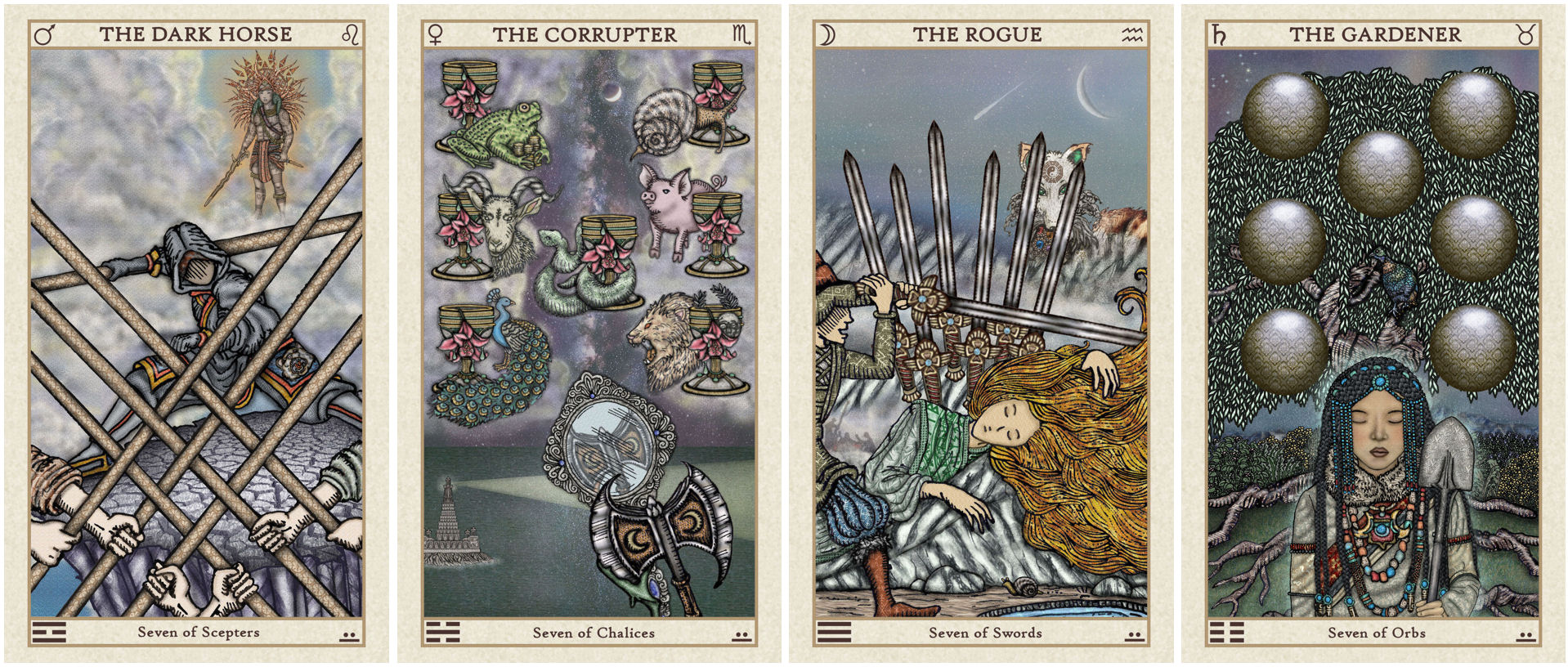
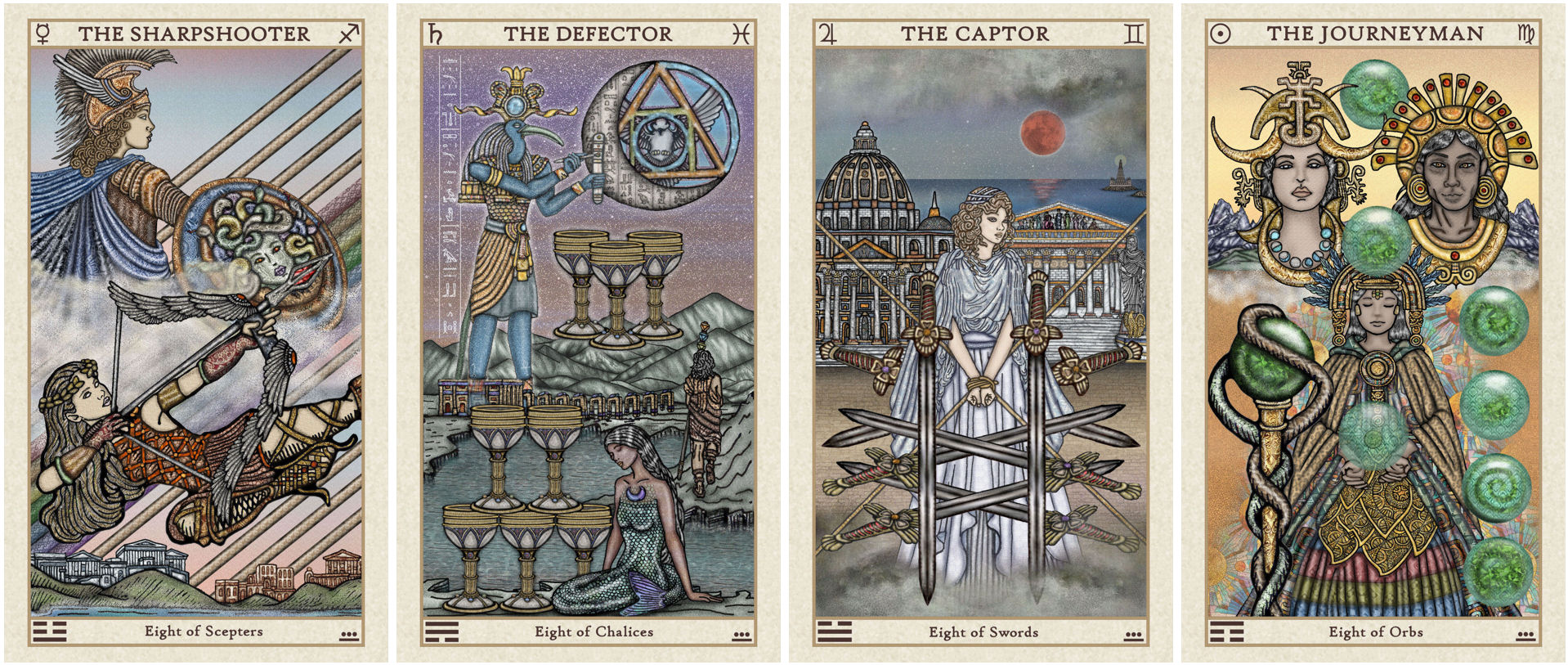
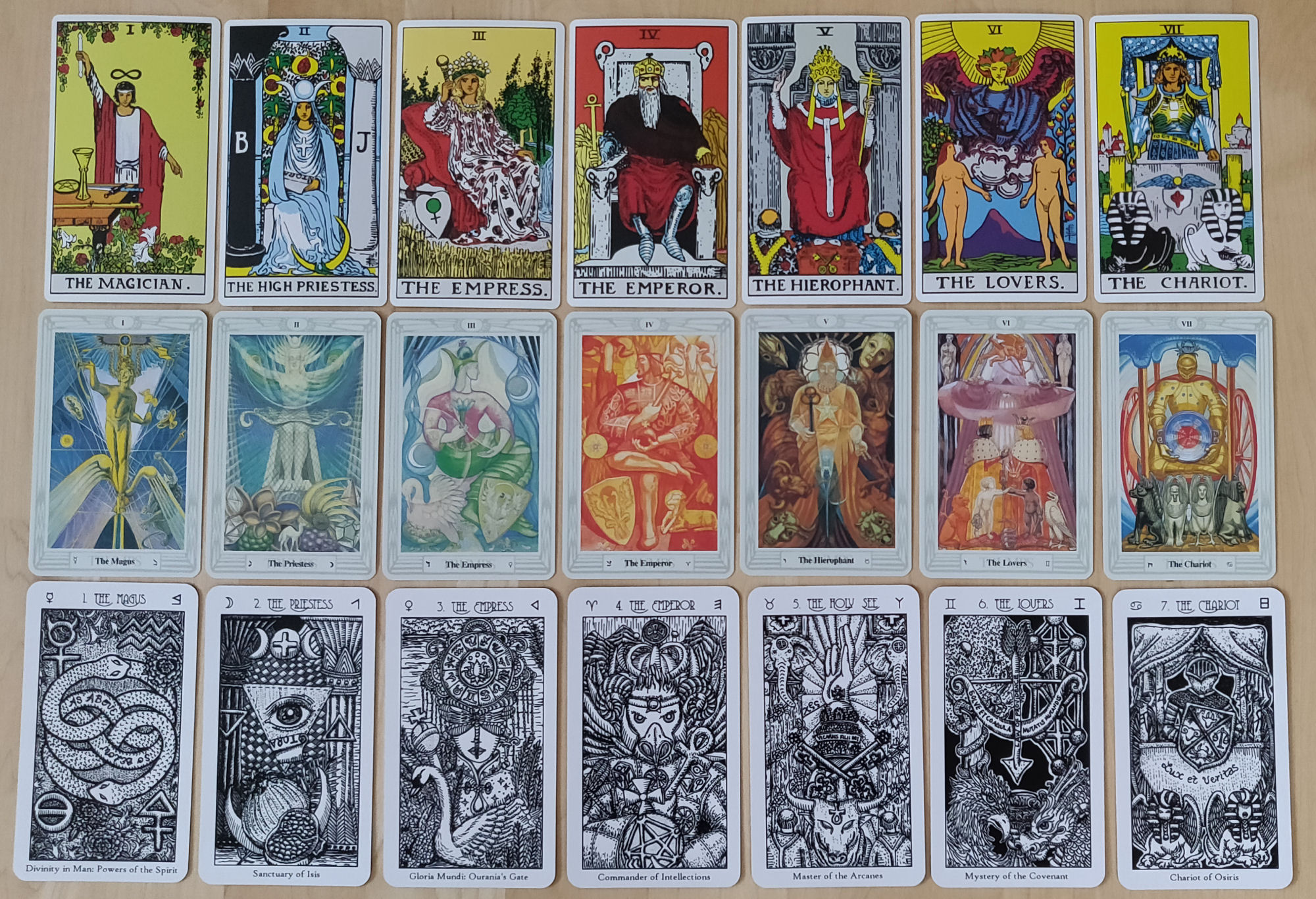
Over the last few months as I shared progress photos of my card illustrations, especially when we got to the Minors, RWS folks started to get confused by my pictorial interpretations, though I think that’s because Thoth influences started to show up more prominently.
On my shortlist of objectives for creating Spirit Keeper’s Tarot, one of those objectives was to harmonize the RWS and the Thoth together, which I’m going to say right up front turned out to be a lot harder than I thought it would be. It was so hard for me that in fact at many points during the process, I was beating myself up and lamenting, damn, I’m failing so bad at this.
I figure a side by side review of the decks will help clarify some of the confusion about where I’m getting what for the symbolism I’ve opted to go with in Spirit Keeper.
To do that, I’m using The Original Design Tarot Deck published by Siren Imports for the RWS and the Thoth Tarot Deck published by U.S. Games for the Thoth. I printed a sample copy of my deck, which you see above on the very right, but this is not what’s going to be produced for sale. I printed this physical copy to scrutinize the lines, production quality, alignment, that kind of thing, and because of that, I’ve already spotted things that need to be fixed, which will get fixed before final production. So just bear in mind that what you see here for the Spirit Keeper’s Tarot is pretty damn close to what will be offered for sale later down the line, but with editorial improvements.
Speaking on the design of the Majors from my frame of mind, the voice of what I might describe as my inner genius came through more distinctly. And by genius I don’t mean hey look at me I’m objectively a genius, no. I mean that inner genius we all have that we need to go through the structured, methodical process to unlock. That inner genius is what I’m saying really came out.
I say that because I think something shifts by the time I reach the Minors. More on that later.
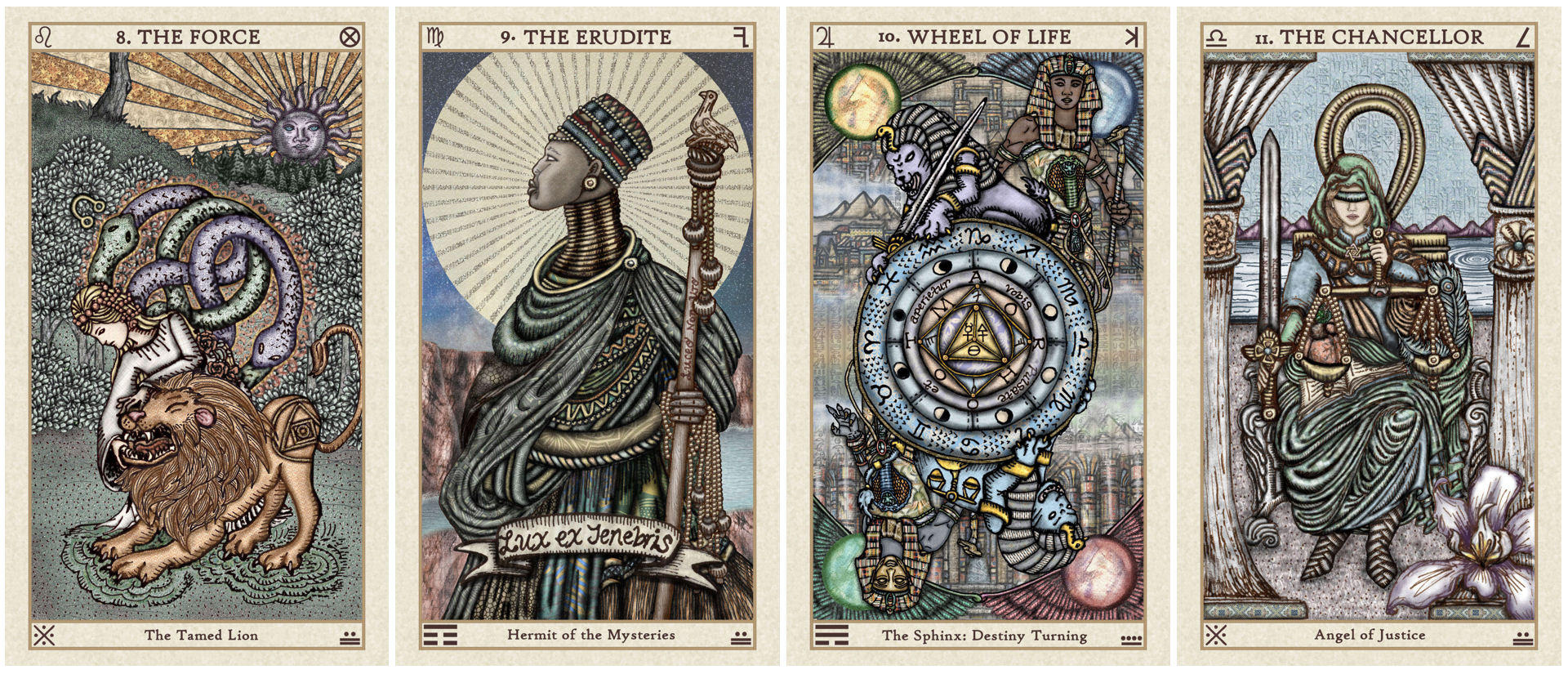
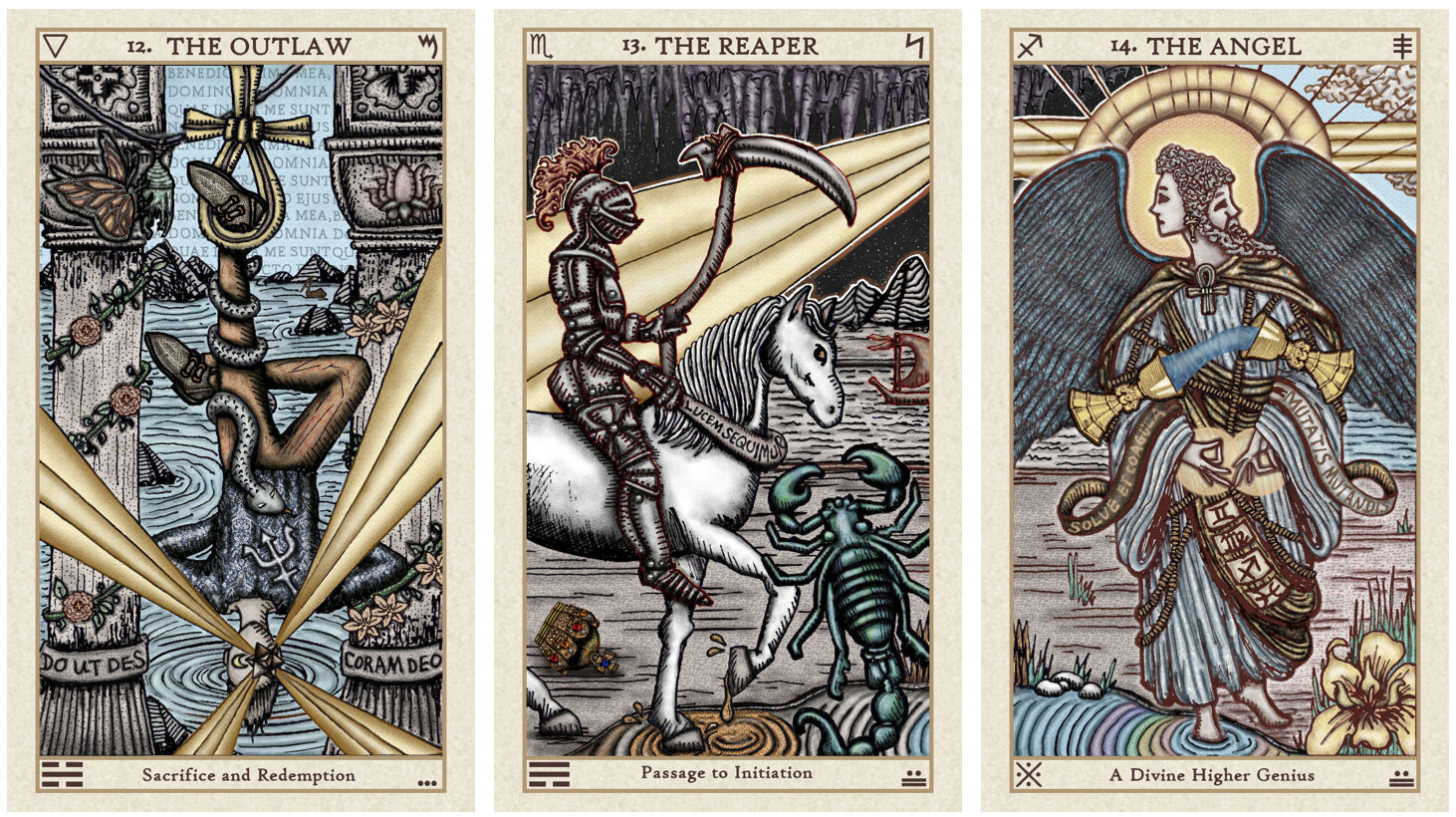
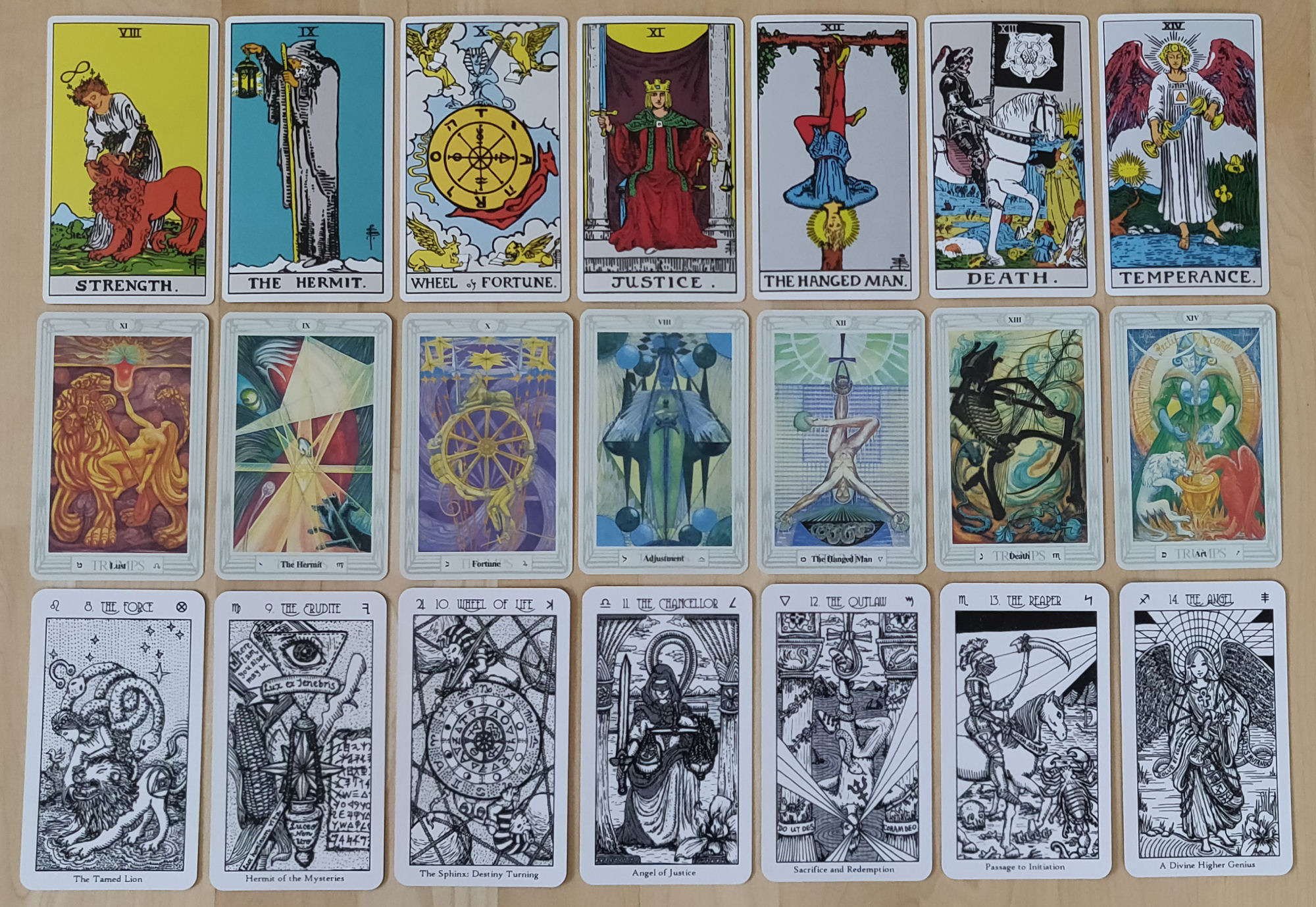
Keys VIII to XIV (with Thoth VIII and XI switched intentionally)
I’m picturing the cards in the exact order I drew them. You’ll see back in the First Septenary Keys I to VII, there were no human figures depicted. I had started the project with the intent on having no depictions of humans. Where human-like figures would be used, they’d be, like, you know, with an animal head or something, the way you see in The Emperor, or most of the face concealed from view, like The Empress.
Then I got to Key 8 Strength and broke that rule. Doh.
By the way, I devote a whole section in The Book of Maps, the companion guidebook that will go along with Spirit Keeper’s Tarot, to the Key 8 and Key 11 situation and my struggle with deciding how to approach the 8 and 11 switch, which funny enough, involves the Justice card and those goddamn balancing scales.
I felt like there had to be more to the reasoning for Waite’s switch than the order of the zodiac wheel. My speculation at the end of that struggle is it had to do with differing theology, so then I had to decide where my own theologies aligned.
Since I went with Key 8 for Strength and Key 11 for Justice, following Waite’s switch, for an easier comparison, in the above photo I switched 11 for 8 and vice versa in the row of Thoth cards.
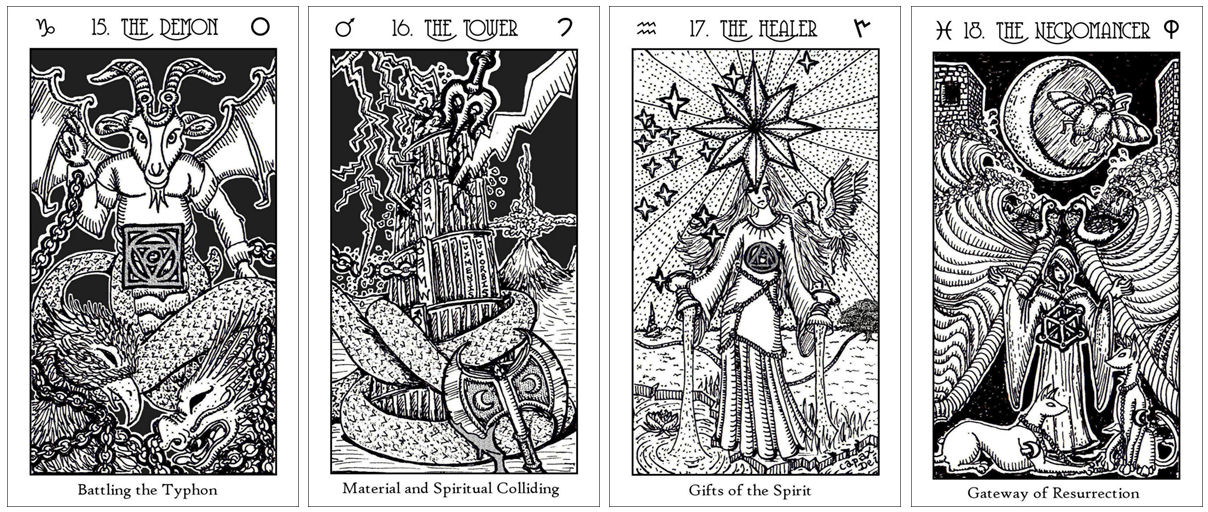
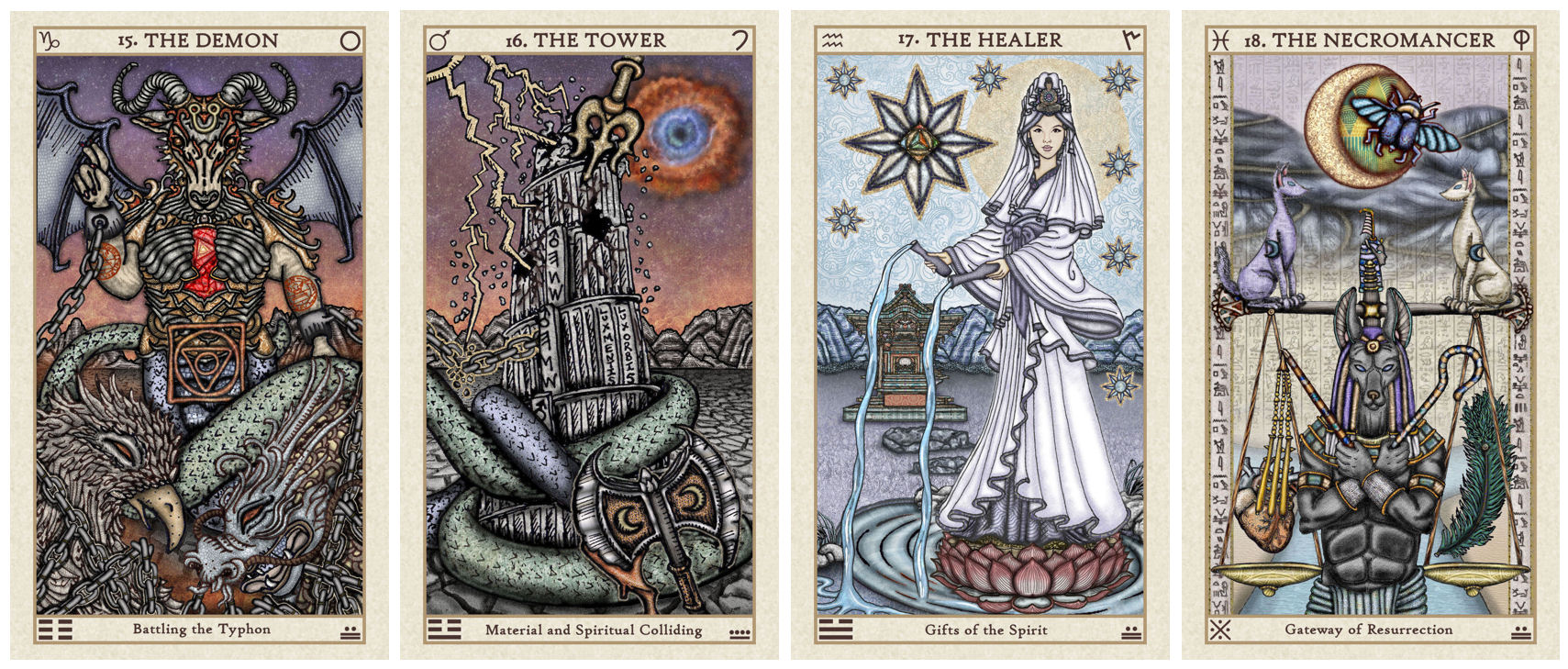
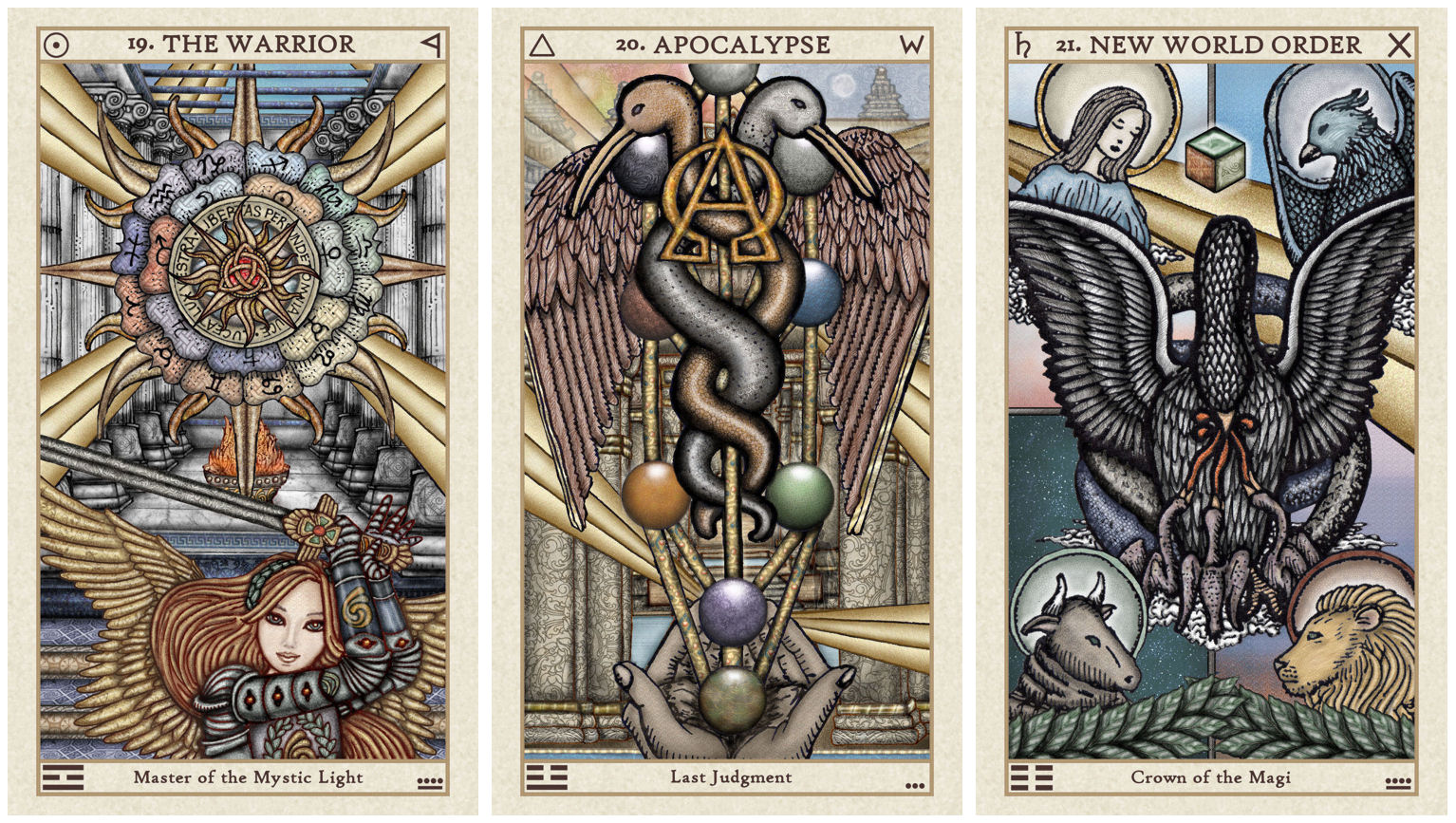
Keys XV to XXI
Although there are inevitable nods to the Marseille, the reason I didn’t focus my intentions on actively integrating the Marseille is because for Spirit Keeper, my focus is on the esoteric and occult expression of the tarot. The Marseille is by original intention a deck of playing cards that later got appropriated into a form of divination or fortune-telling, whereas both RWS and the Thoth were from beginning to end intended as esoteric and occult expressions of the tarot. You could even argue that both the RWS and the Thoth tarot decks are the product of spell-crafting, born from fertile pools of knowledge and magical experience. That is why these two in particular are the chosen parents.
I know that adult coloring books are all the rage right now, but I wanted to produce a tarot coloring book for children, which sure, adults can use, too. The premise of the coloring book is to use the tarot, and namely, my Spirit Keeper’s Tarot deck, to impart everyday insights to children. So it’s instructive to the extent of “everyday wisdom, but with a slight universal-religious bent.”
While writing the text to go along with the card drawings, I pictured only one particular child and envisioned myself talking to her. So I have written this book entirely to her. Her parents come from a particular background and faith, and so do her grandparents (and she’s being raised by her grandparents), so all wording is with that in mind. Whether it ends up being applicable to anyone else in this world, that remains to be seen. But just so you know, I wrote this book to her.
I don’t know if I’m good with children. I don’t have any myself. But I do have a bunch of nieces and nephews. I’m the kind of aunt who–true story– when tasked to babysit for the day, will teach your four-year-old kid how to play chess or a simplified version of Beethoven’s Fur Elise on the piano. I tend to start from a place of presuming that children are brilliant and capable of anything.



















































 benebell wen