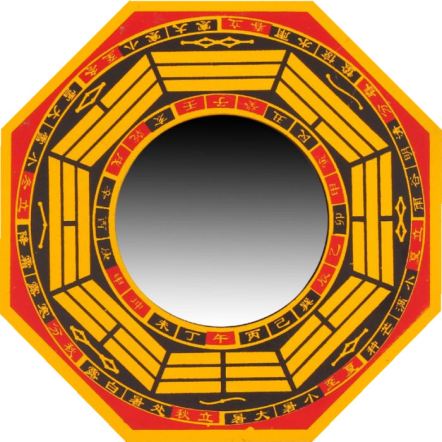
Learn a little more about this common ritual tool in traditional Asian folk magic. I’m inviting you to give the ba gua or eight trigrams mirror a try.
This video covers a few pointers on how to use a ba gua mirror to tell whether you’ve been hexed or cursed (a folksy practice that’s interesting to learn about, at the very elast), how a ba gua mirror can amplify your spell-crafting techniques, a simple intention-setting candle spell, how to make your own ba gua mirror if you can’t source one, and how to integrate this one tool and folk practice into what you’re already doing.
What challenges and trials do you face along your life path that might be sourced from karma, however you define karma?
What facets of your shadow self can be revealed by your birth chart?
How might we express that part of your inner self that is divine? What facet of Divinity do you inherit so that you might carry out missions that the Divine has set for you?
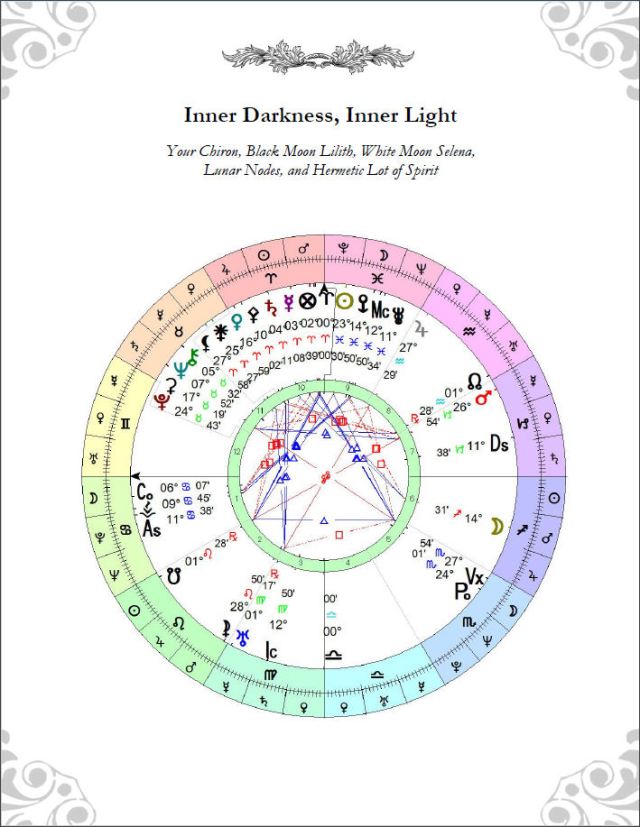
We begin the search for answers by studying your birth chart, a map of your life path designed by the heavens.
These are the astrological features we’ll be covering:
Chiron: Your Soul’s Purpose
Your Social Responsibility (House 11 & Ascendant)
Black Moon Lilith: The Inner Darkness
White Moon Selena: The Inner Light
Hermetic Lot of Spirit: Your Guardians
North Lunar Node: Karmic Traits
South Lunar Node: The Shadow Self
Planetary Hour of Birth
Several years ago I started offering this astrological reading and since then have prepared thousands of these reports. If you are interested in getting one, please read through the service description carefully so you have a clear sense of what you’re getting.
One of my favorite personal rewards from launching the Witchcraft Fundamentals course is the Google Group, where all of us are exchanging insights, asking tough questions, trying to answer tough questions, and getting to know each other. To give you a sampling of what that e-mail list-serv group is like, I’m sharing something I wrote on there in one of the threads started by a practitioner of both Eastern and Western metaphysics.
The question presented is, in short, how do you reconcile Eastern elemental-directional correspondences with Western elemental-directional correspondences?
By the way, scroll all the way down for the PDF downloads of this post, which you can then print out and tuck into whatever reference manual for your metaphysical studies you have going on.
IN THIS WESTERN WITCHCRAFT COURSE, you’ll learn fairly soon that there are different systems of elemental-directional correspondences even within the umbrella of Western occult philosophy, and we cover three of them in this course:
This is a supplemental lecture in Module 11 of the Witchcraft Fundamentals course, titled “The Magic Chain.” If you’re working through the course in the order outlined by the syllabus, then watching this video lecture would come after having watched the video lecture for Chapter XI in the Doctrinal Basis workbook.
However, this supplemental lecture is being provided for free public access.
“written by an idiot only looking to be trendy through appropriation”
“hot mess of an article”
“absolutely shameful”
“ignorant and frankly disappointing and offensive”
“piece of shit”
“articles like this just piss me the fuck off”
“a smug shithead”
“I just read the vomit in question and I am fucking livid”
“dipshit sneer piece … 85% dumb jokes”
“complete horseshit”
“wildly offensive article”
“fucking idiot”
“hex that bitch”
Love and light, apparently.
The salient takeaway point from the article, however, is the one fueling the anger and animosity: Radford’s conclusion that witchcraft is in “dogged resistance to logic” and requires a “suspension of belief in the scientific underpinnings of the universe.”
And my private response to myself after reading her article? Oh, man… We as a collective (so clearly I’m not saying we unanimously believe, but the dominating voice after averaging high and low and everything in between together) have put out a particular narrative about modern witchcraft, and then when we see exactly that narrative being reflected back at us tinged with a smidge of snark, we go off our rails because clearly none of the shadow work or meditation we’ve been doing has had any success.
The Rat is the start of the zodiac cycle, much like Aries in the Western zodiac. Thus, any year of the Rat is going to be prognosticated as a year of beginnings, of starting over, and new opportunities that come your way.
The Rat is considered to be business-savvy and entrepreneurial, so sole proprietorships are going to be more prosperous than usual. It’s a lucky year for small businesses or new startup ventures.
With 2020 being the year of the Metal Rat, we’re going to see a global focus on technology.
Metal years, no matter what the animal sign, are also more prone to social conflicts, so we may see more of that across the world stage. This is a year of nations and leaders trying to show off their power.
On the other hand, in terms of culture and humanities, it should be a great year for music.
These were prepared specifically for enrollees of the Witchcraft Fundamentals course, but maybe you might find them helpful, too. Pictured above is the back pocket folder I recommend you making with the last pages of your Doctrinal Basis workbook.
Oftentimes tarot books with card meanings focus on the practical, mundane indications of the cards. Heck, that’s what Holistic Tarot did, and did so almost exclusively.
That means when you’re using the deck for readings where the purpose is spiritual (meaning, directed more toward religiosity or aspirations of personal transcendence), reading for card meanings out of a text like…. well, I’ll just keep throwing myself under the bus… like Holistic Tarot is not going to be too insightful. Maybe a little bit. (I’m proud of that book.)
But trying to make sense of Pictorial Key or Book of Thoth if you’re not already acclimated to that style of writing may be presenting a barrier of entry that we can quite easily break down right now.
Eliphas Levi, considered one of the most influential occultists in Western ceremonial magic and witchcraft, asks and then answers that question.
His answer:
The knowledge of great secrets and the consciousness of power.
Those are my two objectives for you in this course: (1) to confer to you the knowledge of great secrets, and (2) to endow you with the consciousness of your personal power, to show you the heights that your power can achieve.
At every single point of my work in putting this course together, I thought, how do I facilitate development of the most powerful, most knowledgeable, most versatile, wisest, and most formidable occultist there ever was? How do I show you how to be that person?
And that was the inspiration and the ambition behind this course.
Western Witchcraft I focuses on the doctrinal basis and theoretical fundamentals of transcendental magic. This course is an immersive study of the first 12 chapters in Eliphas Levi’s Doctrine, Part I, of the greater collected work Transcendental Magic: Doctrine and Ritual, and structured like a one semester 400-level university elective.
Be prepared for an intense amount of reading. The video lectures only supplement the reading assignments and are not a replacement for them. In addition to the reading assignments, the weekly practicum, ritual, and energy training is also demanding on your time and your efforts.
COURSE OBJECTIVES:
Attain familiarity with the doctrinal basis and theoretics of Western ceremonial magic
Study the first 12 chapters of Eliphas Levi’s Transcendental Magic, Part I: Doctrine (and to supplement, pick up selected key principles from the first 12 chapters of Part II: Ritual)
Gain essential insights from Levi’s Key to the Great Mysteries, the book he wrote after Doctrine and Ritual
Craft your first four altar tools and use Levi’s Conjuration of the Four ritual to charge and empower those tools (main focus in this course will be on the wand and the pentacle, per Levi’s assertion that the wand is first and foremost your most important ritual tool and second in importance to the wand is your pentacle)
Craft a divine lamp for ritual use and work through a prophetic astral vision
Train yourself to harness the Astral Light, then learn techniques to both strengthen and increase your flexibility with the Light to produce the Magic Chain
Build a rock solid foundation in the theoretical and magical principles of Western witchcraft and ceremonial magic, which will then be able to support the structure and edifice of any mystery tradition or Path you subsequently pursue
A future course offering, Western Witchcraft II, will advance upon the fundamentals established in this course. Western Witchcraft II will conform to Levi’s Ritual, Part II and delve into spell-crafting, talismans, seals and sigils, spirit conjuring, and the many forms, types, and purposes of ritual in transcendental magic.







 benebell wen