Líng Tú 靈圖, or spirit maps, are oft referenced in the Taoist Canons (道藏經). They’re a recurring feature in the Canons that have always intrigued me, and how the term “Líng Tú” is used in the scriptures.
So that’s the topic for video #6 in this series.
修真歷驗鈔圖, one of the scrolls in the 洞真部靈圖類 of the Taoist Canons
Let’s summarize the three classifications of spirit maps: (1) maps of spirit realms for the purposes of astral journeying or spiritual cultivation, (2) enshrining divinities or creating thresholds for which communication between the physical and spirit realms can take place, and (3) Fu, which are talismanic edicts or petitions to regulate spirit forces in a way that will influence physical forces.
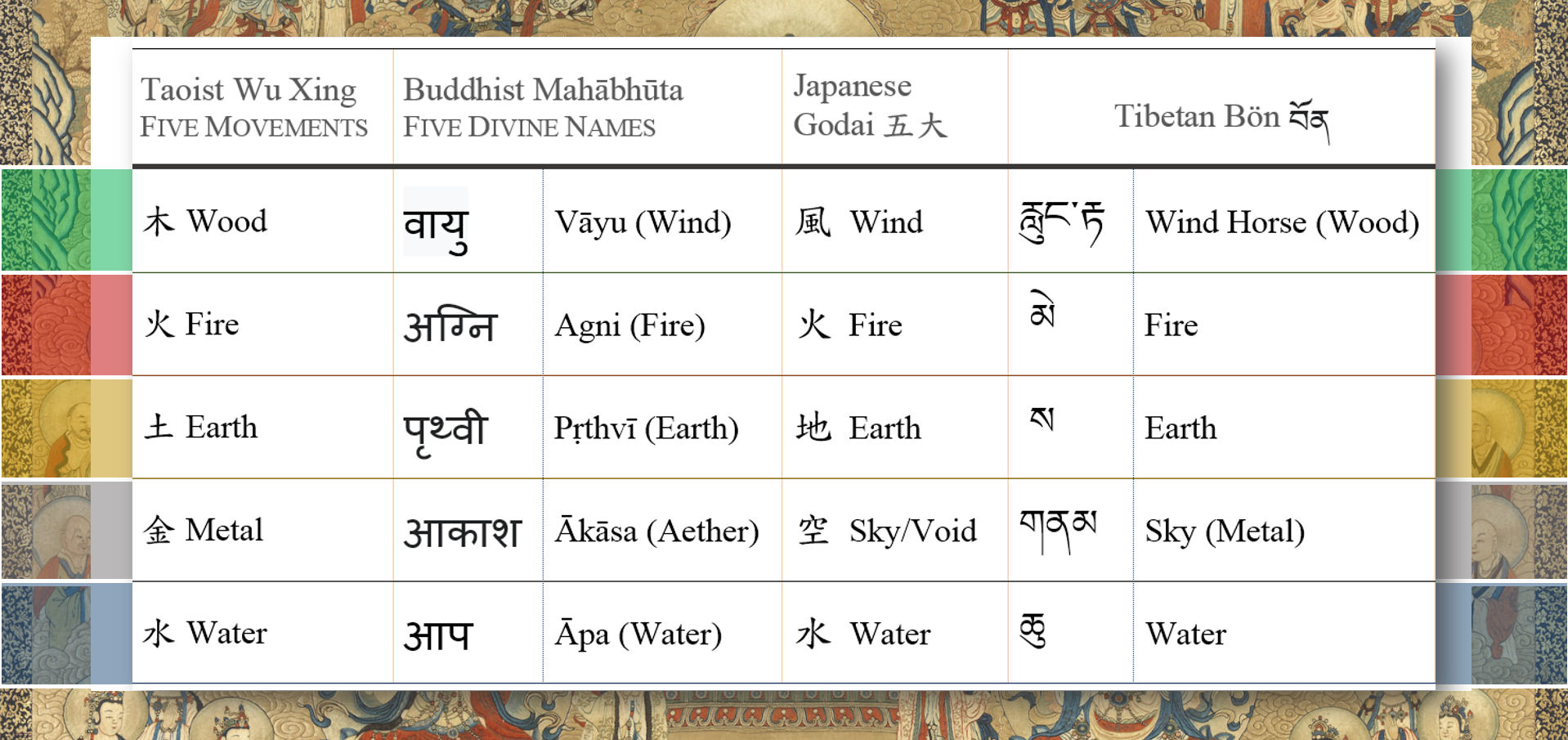
This is a crash course on the Wu Xing 五行, Five Dynamic Movements, though you’ll often see it called the Five Elements of East Asian metaphysics. These are five alchemical agents of change to describe how yin and yang qi create, destroy, and thus transform the physical world.
1/30/2023 Erratum Update: A few of the correspondence rows in the Metal and Earth columns got flip-flopped in the subsequent reference chart. If you downloaded the table before 1/30/2023, please delete it and re-download the rectified version. ❤
I say “East Asian” here because it’s not limited to any one culture, ethnic group, or nationality, not to mention the concept itself is much older than modern-day borders.
I’ll start by saying it’s gimmicky to claim a list of “the most auspicious” hexagrams in the I Ching. The Book of Changes doesn’t work like that. Not to mention as the sequential lines move through the Changes, line 1 up to line 6, different points of that movement of change can indicate different turns and degrees of auspices.
And so while I Ching practitioners wouldn’t necessarily say there are “good” vs. “bad” hexagrams, in moments of fun, sure, everybody’s got their own shortlist of favorite hexagrams.
I received a question by letter, which I wanted to answer privately, but didn’t have an e-mail address or even mailing address. So here’s to hoping this post is seen by who it’s intended for. ❤
The question presented:
Dear Benebell,
I am a Taoist witch, but my religious family thinks I am a Baptist Christian and therefore against non-Baptist religious practices.
Last night my dad and I were watching a Taiwanese movie and an ancestor veneration scene came up. My dad began a conversation about Taoist traditions and said, “When I die, please don’t venerate me like a Catholic or Taoist would.”
I am a strong believer in ancestor veneration and plan to venerate both of my parents when they pass away.
I do not want to go against my father’s personal wishes as I love and respect him, but I also do not want his spirit to go un-venerated because I love him dearly.
What, in your opinion, is the best way to go about this?
Most Eastern esoteric paths espouse that a practitioner of any esoteric art should proactively cultivate and strengthen the personal Qi, or life force, because when you do any form of intense metaphysical work, you’re drawing from that pool of personal Qi. If you’re not mindful of replenishing that Qi, then the constant weakening of your life force from the occult work that you do (this includes divination) can cause physical and mental health concerns. So to maintain optimal wellbeing–and that’s physical, mental, and psychic-spiritual wellbeing–cultivation practices are necessary.
Image source: pxhere.com
The Metaphysician’s Qi
Divination, ceremonial ritual, mediumship, channeling, pathworking, spell-crafting, astral journeying—these practices are believed to exhaust a lot of your personal life force, and so as a metaphysician, you want to establish a routine practice of cultivating and strengthening your Qi, or life force, to maintain your wellbeing. Otherwise, you can become more susceptible to illness, both of the physical and mental variety.
Taking measures to cultivate and strengthen personal Qi is a practice everyone and anyone can benefit from, much like how everyone and anyone should be mindful of nutrition and physical exercise. However, the nutritional needs of your everyday office worker is very different from the nutritional needs of an Olympic swimmer. So we can make the comparison here of an occultist to the Olympic swimmer, because it’s considered an out-of-the-ordinary lifestyle, and so your nutritional needs– in this case psychic-spiritual nutritional needs– will be different from the average person.
Let’s cover six ways a metaphysician can cultivate Qi:
I’m writing this post mostly for my own benefit because I get the question asked so often and I’m kind of getting to the point of laziness where I dread typing and rehashing out my answer. Now in the future I can link to this post.
Everything I share….everything…is set with the intention, the hope, and aspiration that if you’ve found it, resonate with it even when it’s not your culture or even anywhere close to what ordinarily enters your personal path and craft, that you will nonetheless feel an untainted, anxiety-free freedom to integrate it into your path.
Among Western mystery traditions, you often hear about eclectic witchcraft, can even loop chaos magic into the scope of this topic, and those who observe esoteric practices in a way that blends different cultures and religions. Taoist religious scholars refer to this particular way of practicing religion as syncretism. I say Taoist here because Taoism, as a religion, tends to be syncretic.
In Bell Chimes In #4, I make a case for syncretic religious practice. Today very few of us stay sequestered within a homogenous framework. Not only do we travel physically to interact with different cultures, become geographical and cultural transplants ourselves, but with the Internet at our fingertips and our own curiosities to navigate that web, we have access to a diversity of religious ideas in a way our ancestors did not.
As we engage with different faces of the Holy Spirit, we’re able to discover and formulate our own unique Key of access to that Holy Spirit, or connection to Shen (I talk about this in the video), that fits our physiology, karma, life experiences, and psychic imprint. To not reach out and seize upon such opportunities is what I’d describe as rejecting authenticity. Following one fixed religious doctrine from its Point A to its Point Z that conforms to what a textbook says is historical is not “authenticity.” Authenticity, I argue, is about following what’s in your bones and in ways that maybe no one else will ever truly understand. And what’s being guided by your bones may appear to be eclectic.




 benebell wen