Create Your Own Metaphysician’s Day Planner: Downloadable Templates

A few weeks ago I announced that we were retiring the annual Metaphysician’s Day Planner offering, after nine consecutive years of making them, each one custom-made to order with your birth chart and that year’s solar return chart. Plus the companion Metaphysician’s Guide that comes with the year ahead’s astrological forecasts, auspicious dates, inauspicious dates, and the dates to notable astrological or astronomical events.

Although we won’t be selling and making them anymore, we also didn’t want to leave you in a lurch, especially since we acknowledge that many of you have come to rely on it year after year. First, thank you so, so very much for your support over so many years. That’s amazing! Second, thank you for your understanding, patience, and sympathies that it’s just no longer feasible for us to be doing this, as our process is entirely manual and “old school” in this new world of everything getting generated instantly by digital automation.

I changed my mind and I am offering a “MDP Lite” version for 2026, which you can learn more about HERE. The layout design for many of the classic sections have been updated, and I will be updating some of the reference content as well.

You can still download the templates for the past day planner design and layout, however.

Continue reading “Create Your Own Metaphysician’s Day Planner: Downloadable Templates”

Overview of Western Art Movements: Art History Timeline (Handout Download)

Back in 2021 after completing SKT the Third, I shared a scan of my personal art study notes here, “Download My Art Study Journal.”

I converted the handwritten notes from pages 25 – 33, and integrating notes from other pages in that notebook into the following cleaned-up and expanded handout:

Download Handout

Art History Timeline

PDF

DOCX

The PDF file will be easier to work with. However, for those who want to cut and paste or edit the contents in the handout to create something more custom-tailored to your own needs and purposes, feel free to do so from the DOCX file.

Continue reading “Overview of Western Art Movements: Art History Timeline (Handout Download)”

Critiquing Your Own Art (Handbook)

I’ve written about my self-taught art journey during the pandemic here. I found a bunch of MFA art program syllabuses online and aggregated them together into my own curriculum, then scoured the interwebs for online courses, video lectures, tutorials, books, blogs, anything and everything I could get my hands on to learn composition and the core principles of art making.
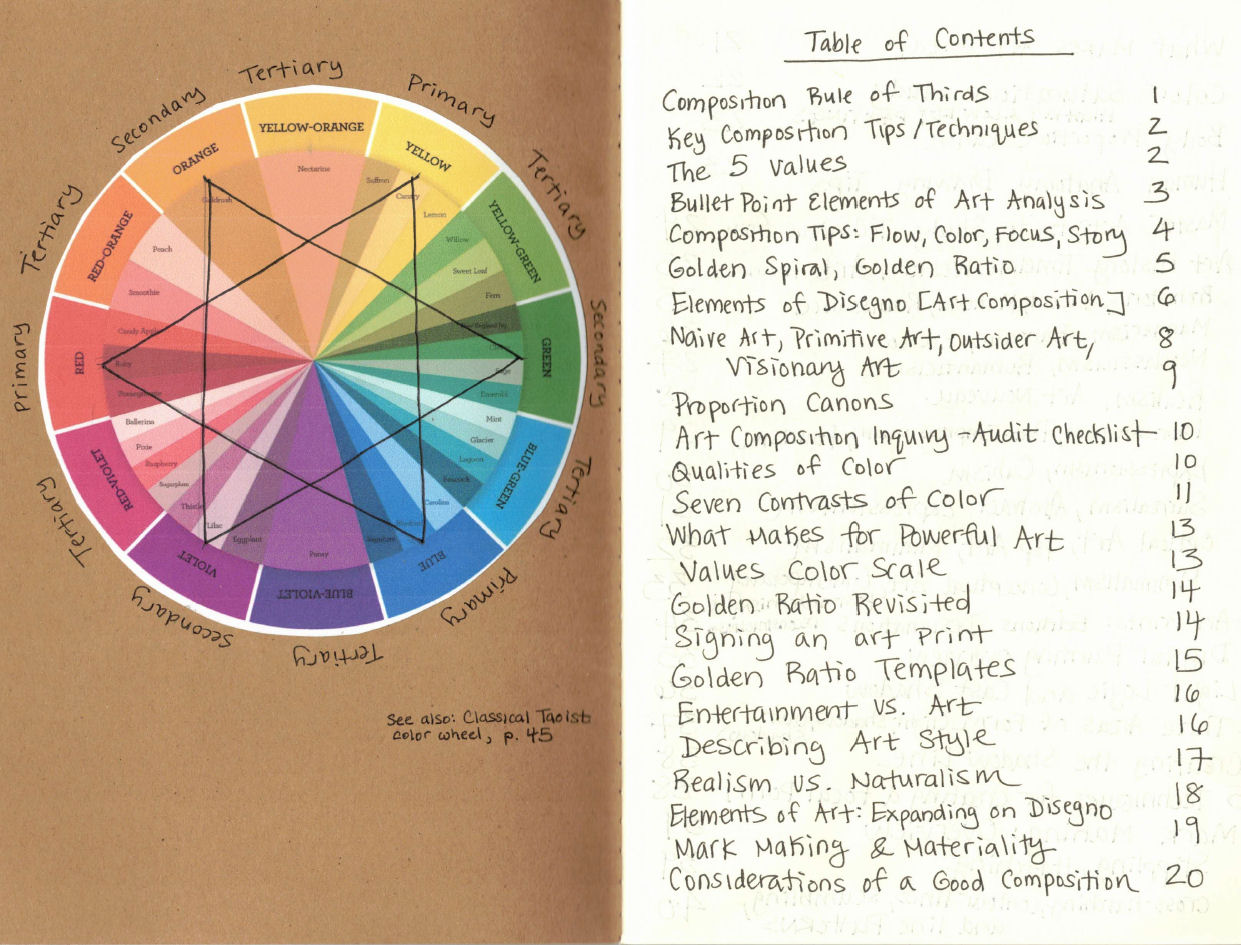
You can also download my art study journal here, which is what this handbook, a free download, is based on.

Critiquing Your Own Art

PDF Download

It reads as if after you’ve produced a work of art, you’re supposed to run through the checklist of items for review page after page in this handbook and self-audit how well you did in each of the categories. Yes and no.

It’s funny, whenever I endeavor to unpack something into its parts to analyze, people accuse me of being too analytical at the cost of creativity and intuition.

But if you observe me in the everyday, you’d think me a hypocrite, because in life, I very much operate off intuition rather than pure, cold logic. I go off my feelings way more than I go off rational deduction.

Yet rational analysis is the necessary checks and balances to your supposed intuition. Your intuition can get tainted by bias. So you have to be hyper self-aware and mindful.

While I would be the first to agree that you do not need a checklist to determine and define what is or is not great art, there is some value to deconstructing why we consider certain pieces “great art” and others not.

And if you can deconstruct that, can you then use it as elements to construct “great art”? I don’t know, but why not try? Even if you fail, you’re going to learn valuable lessons from that failure, so I welcome it, don’t you?

If anything, this sort of guided checklist helps you to more likely spot areas for improvement in your craft.

Anyway, that’s how this handbook got started, and you’ll see that the contents are extracted from that art study journal from 2021, which I kept as reference throughout 2020 while I was working on the Spirit Keeper’s Tarot. I converted the content into, well, a bunch of concrete, tangible points for consideration when critiquing your own art.

It’s not like every single one of the points in this handbook will be 100% applicable to you. It’s more about using it as a general reference, to help you navigate self-assessment of your craft.

Here’s the MS Word doc version for those who want to cut and paste around, and change it up to make it personalized:

Critiquing Your Own Art

DOCX Download

The content within this handbook is free for you to use, share, adapt, and build upon in any way that serves you, be that for personal or commercial purposes. Whether you distribute the PDF or DOCX as-is, remix it into your own content, my goal is for this to reach those who will benefit from it. So do whatever you Will with it.
Trademark Registration DIY (USPTO)

If you’re not a very disciplined, organized, love-to-do-research, always-did-your-homework Type A personality with strong Virgo vibes, then skip this blog post entirely and do not try to DIY intellectual property law. Hire an attorney.

Even if you are all that, this is not legal advice. I am not your attorney. This is a free-for-all blog post you came across on the internet, on a website about fruity-tutti metaphysical arts no less, so if you leave with even a few nuggets of insight to get you started on the right track, call it a win. Which is to say, do not blissfully rely on what I’ve said here. Apply critical thinking.

But… For an attorney to do the due diligence, put together the application, and steer your trademark through registration with the USPTO, it can cost around $2,500 if it’s a simple, un-problematic trademark. And if you’ve got unique circumstances or someone ends up challenging your mark, then the fees will skyrocket out of control.

If that sounds like way more than you’re willing to spend, well the good news is technically you can file a trademark without a lawyer. Yes, technically it can be DIY, though that comes with quite a bit of risk. If you do it wrong, your application will get rejected, you won’t get your trademark registered, and you will be out of pocket the $250 or $350 you paid for the filing fee (no refunds).

Nevertheless, I’ve always been a do-it-yourself (DIY) type and if you’re kinda like that too, and you are willing to roll up your sleeves and do a lot of research, homework, and study yourself, and you accept the risks of DIY trademark registration, then maybe you don’t need to hire a lawyer or take your chances with one of those discount run-of-the-mill legal services websites. Maybe you can shoot your shot and try to register your trademark on your own.

Here are the basics.

Continue reading “Trademark Registration DIY (USPTO)”

I Ching Oracle Cards (Free Printables)

Download the digital files to a text-driven 64-card I Ching oracle deck for a free companion tool to my book, I Ching, The Oracle (North Atlantic Books, 2023).

This is a serviceable everyday personal divination deck that also doubles as an easy, accessible introduction to the I Ching.

It makes for a great study tool as flash cards and for learning the Ba Gua trigram and Wu Xing alchemical phase correspondences.

For your convenience, I’ve also uploaded the files onto makeplayingcards.com. External link and info below.

The listing is $23.20.

  • $22.95 of it goes to makeplayingcards.com, not me.
  • Only $0.25 of it goes to me.

Yes, that’s right. A quarter.

But if you are on a tight budget, you can download the printables file and crafty craft your own DIY copy of the deck.

Apart from the six-line hexagram images, the card faces are text only. No one is trying to wow you with artistry here. =P

This deck is intended to be a functional beginner’s tool for learning the I Ching, to be used in tandem with the book, I Ching, The Oracle.

Continue reading “I Ching Oracle Cards (Free Printables)”

Egyptian Gods and Goddesses (1870), 12 Prints

Download zip file:
Twelve Ancient Egyptian Deities

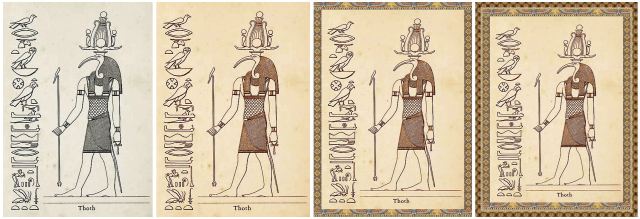
These twelve images are sourced from an 1870 publication, Bilder-Atlas – Ikonographische Encyklopädie, a multi-volume compendium of reference books in German. The images are formatted to print at 5.0” x 7.0”, but the resolution isn’t the sharpest. Nonetheless, they still printed okay.

Oops! Please ignore the typo.

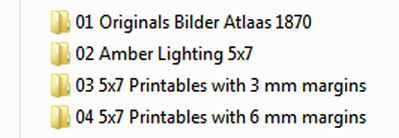
After you unzip the file, you’ll see four folders for four different versions of the twelve images. I’ve included the originals, a version where I converted the images to a warmer sepia tone, then two versions with borders for printing.

I’m sharing the files here for those who are fascinated by these sorts of finds.

If you want about 3 mm of patterned border to show and you’re using makeplayingcards.com to print your deck, then go with the 6 mm margin files.

Continue reading “Egyptian Gods and Goddesses (1870), 12 Prints”

AI Generated Art + Tarot and Oracle Decks with AI

Back in December 2021 I covered the topic of AI generated art and what it might mean for the marketplace of tarot and oracle decks here (“How Do We Value Art? What AI art means for tarot and oracle deck publishing“) and here (“I Ching Oracle Cards with AI Generated Art“).

But since then there have been new developments in this subject area so I thought I might revisit the topic.

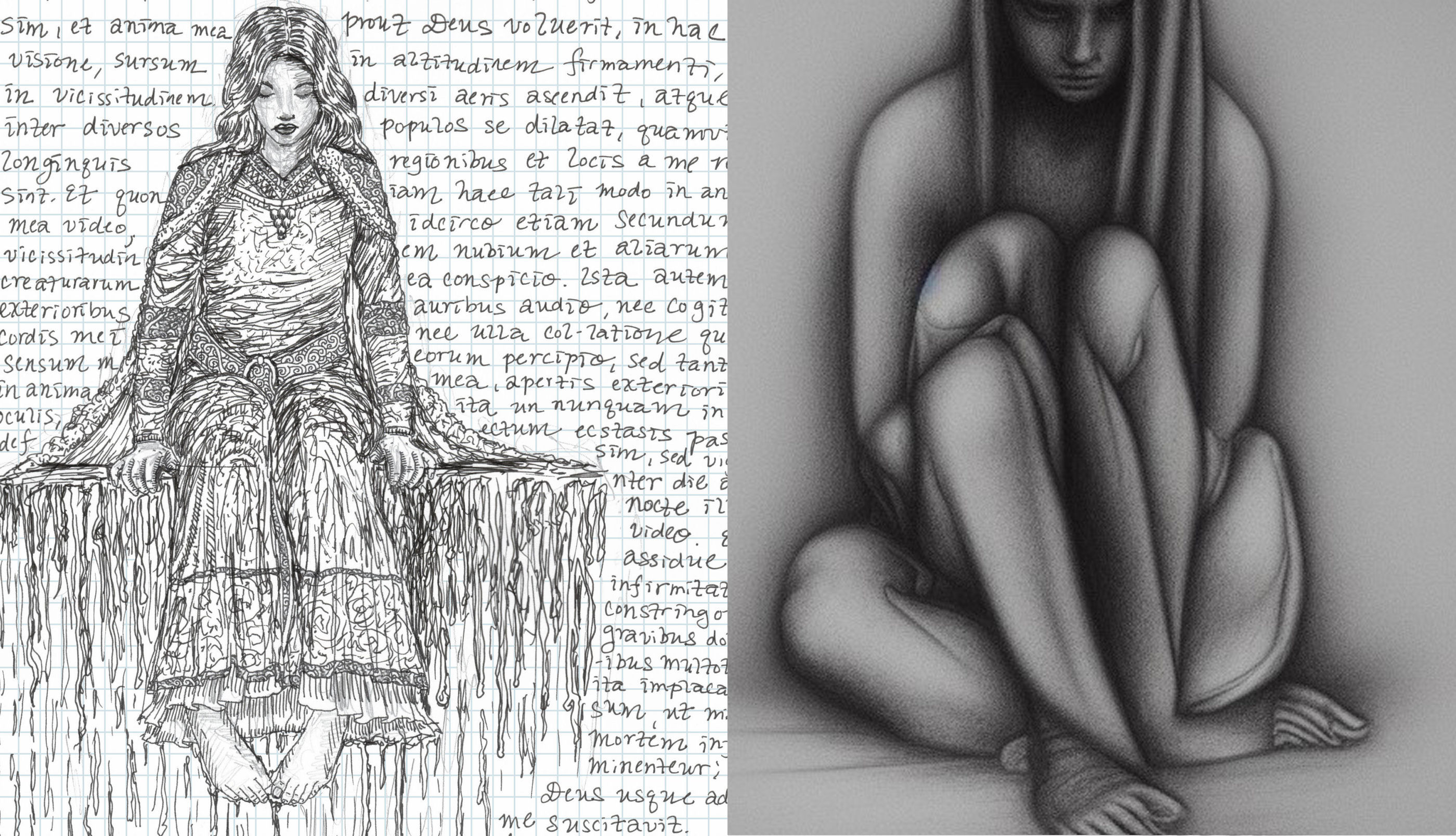
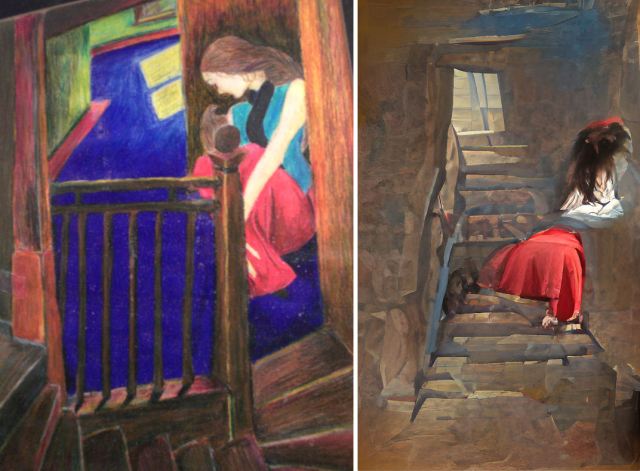
Left: My illustration, by hand in pencil and ink. Right: NightCafe, art style: “Charcoal”
Some Personal Dabblings with AI Art

Above to the left is a sketch I did by hand, first in pencil, then outlined in ink. I started with the following prompt, text I typed out myself and stared at for a good five minutes before putting pencil to paper: Solitude. Contemplating. Maiden in a moment of self-questioning.

I copied some text written by Hildegard of Binden on the transcendental experience of God, to fill the blank space. What you see took me two hours. Uh, tbh, probably longer than two hours. I lose track of time when I’m doodling. (The barely-there blue grid lines was added digitally, because that’s just something I like to do when I share my doodles to the public.)

What you see to the above right was produced via NightCafe, an AI art generator, with the same exact text as the prompt: Solitude. Contemplating. Maiden in a moment of self-questioning. I selected the art style “Charcoal” to see how close to a pen and ink sketch it could go. The illustration to the right took the program two minutes.

Left: High school art by yours truly, from the 90s. Colored pencil. Right: AI generated art based on text description of illustration to the left, via Wombo

I’m fascinated by how similar the interpretations were, between me, a human, and AI tapping in to collective knowledge. In fact, in the past I’ve drawn illustrations in charcoal very similar to what the AI produced!

The pose, the facial expression, the way the hair falls, the vulnerability– if I rummage through my old art portfolio from high school, I can excavate a charcoal or pastel drawing that looks more or less the same with that!

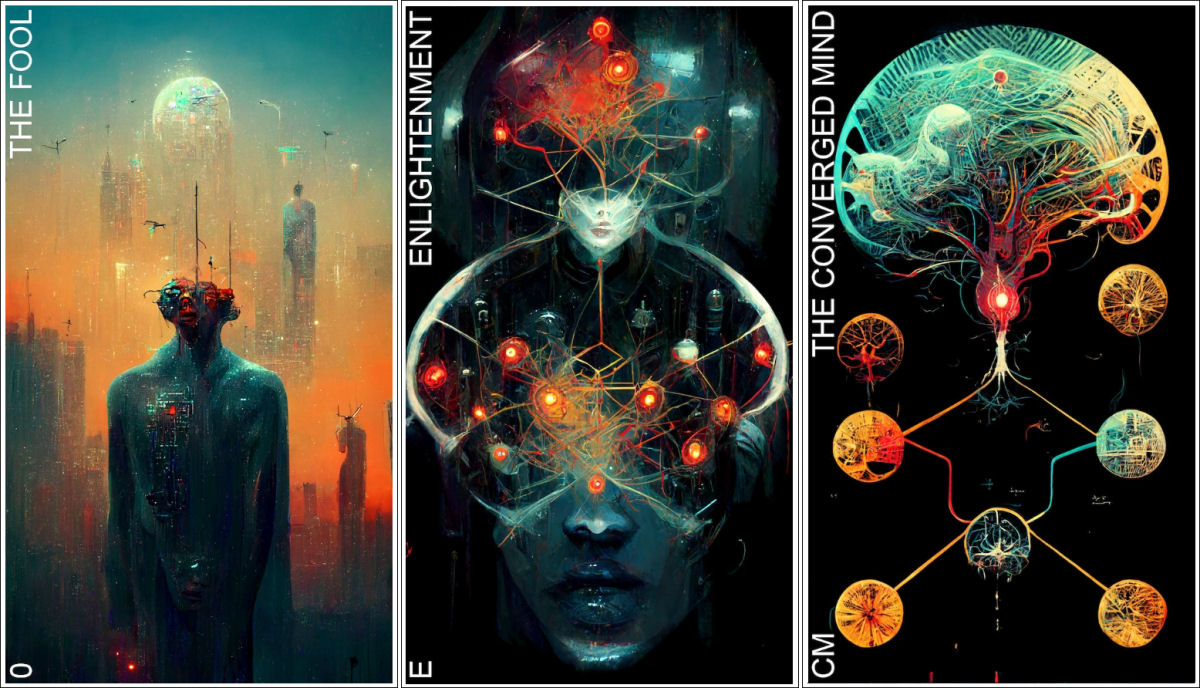
“You Are the Journey” by @KaliYuga_ai via MidJourney (AI art)
Does AI Art Lack Soul?

I explored the question “does AI art lack soul” here in an earlier rumination on the subject. In that blog post, I talked about how this advent of AI generated art has shifted my former paradigm on the mind-soul relation.

This declaration you’ll hear oft repeated — AI art lacks soul; AI lacks soul — is one I’m most apprehensive about. Perhaps we can say we don’t understand the soul of AI, but to declare that AI art lacks soul… I dunno. It doesn’t sit right with me.

I’m not convinced that these works “lack soul.” If I’m getting all psychic and woo, I might say the impression of the soul that’s present feels different from a human sapient soul, just like an animal’s sentient soul or a tree’s soul feels different. You hear people critique the evident style or aesthetic consistent in AI generated art, but just because you don’t love an artist’s style or technical approach doesn’t mean that artist suddenly lacks soul.

So while I have many conflicting thoughts about AI art, the accusation that it lacks soul isn’t one of them. If anything, I wonder if the full body of AI generated art is mirroring back something deep within us collectively, for us to see.

Technomage Tarot by Lee Duncan in collaboration with AI, via Kickstarter campaign (last visited 2022 Sep. 30)
A Rising Popularity of AI Generated Art Decks

Oh, and to illustrate what the community has been buzzing about with regard to AI-generated tarot decks (or in collaboration with AI) coming on to the market, I’ll feature several throughout this commentary.

Continue reading “AI Generated Art + Tarot and Oracle Decks with AI”

Reading with the Livre du Destin (or Book of Fate)

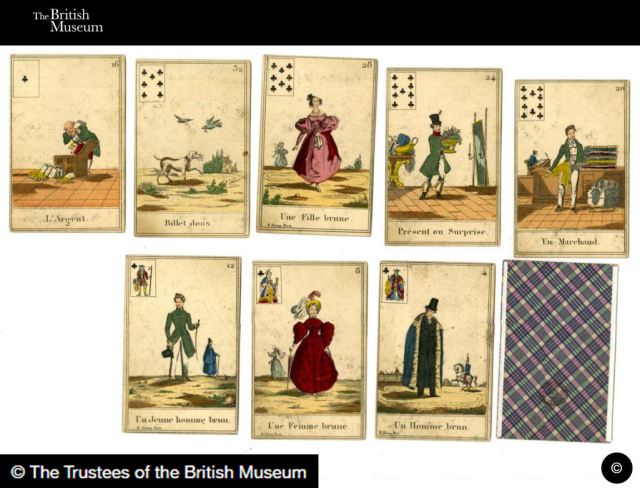
A while back I shared zip file downloads of the above deck here. I called it the Petit Etteilla, because that’s what it was called on the British Museum page that I got the images from.

And then much smarter cartomancy community members pointed out that it’s actually a deck called the Livre du Destin, or Book of Fate.

Continue reading “Reading with the Livre du Destin (or Book of Fate)”

Petit Etteilla, Paris: H. Pussey, 1860-1886 (32-card piquet pack download)

What we call the “Petit Etteilla” refers to a class of 32-card piquet decks for cartomancy based on Etteilla’s 1770 text, which used the courts (Kings, Queens, Jacks), Aces, Tens, Nines, Eights, and Sevens from a playing card deck. To the 32-card pack, Etteilla added a 33rd card called “Etteilla” to designate the querent. And thus he proposed that the original Egyptian tarot pack consisted of 33 cards.

UPDATE: I referred to this deck as a “Petit Etteilla” because that’s how the British Museum referred to it. However, one of our community’s preeminent tarot historians, with a particularly vast amount of knowledge on the Etteilla, John Choma, came back with some clarifications.

This is not a Petit Etteilla deck, but an unrelated deck called the “Livre du Destin” (or Book of Fate), created some time in the mid-1800s. You can check out a few historic examples (thank you, John, for the links!): here (M. Violet, éditeur), here (Le Livre du destin), and here. These images are also notably similar to other 19th-century oracle decks like the 53-card Sibylle des Salons and the 36-card Petit Cartomancien.

This download of Petit Etteilla card images, courtesy of the British Museum, is the edition published between 1860 and 1886 by Jean-Henri Pussey in Paris, France. The originals were 70 mm x 111 mm, hand-colored etchings on pasteboard.

Petit Etteilla

(Originals, 70 mm x 111 mm)

CLICK ON LINK TO DOWNLOAD ZIP FILE

If you’re savvy with digital photo editing and graphic design, then work directly from the 70 mm x 111 mm originals, and format the layout design to your personal preferences.

Continue reading “Petit Etteilla, Paris: H. Pussey, 1860-1886 (32-card piquet pack download)”