A secret in archery for hitting the bull’s-eye is to detach from the desire to hit the bull’s-eye. Preoccupation with the target can cause inconsistent form, thereby leading to a missed shot. Instead, focus on consistent form and a shooter is more likely to hit the target. The single most important aspect to archery is the shooter’s mind. Archery is a mental game and to succeed, the mind has to focus on form, not on the bull’s-eye. Consistent form is what facilitates consistent bull’s-eye shots.
Like archery, the cultivation of prosperity is a mental game and to attain wealth, the aim should not be on wealth; it should be on the form and the work that you do, which incidentally leads to wealth. The common denominator for the plethora of books on how to become a millionaire and treatises for attaining wealth is to treat the attainment of wealth as a mental game. If the modes for attaining wealth are rooted in the mind, then that mindset needed for attaining wealth is what I describe as prosperity consciousness.
Over the last few months as I shared progress photos of my card illustrations, especially when we got to the Minors, RWS folks started to get confused by my pictorial interpretations, though I think that’s because Thoth influences started to show up more prominently.
On my shortlist of objectives for creating Spirit Keeper’s Tarot, one of those objectives was to harmonize the RWS and the Thoth together, which I’m going to say right up front turned out to be a lot harder than I thought it would be. It was so hard for me that in fact at many points during the process, I was beating myself up and lamenting, damn, I’m failing so bad at this.
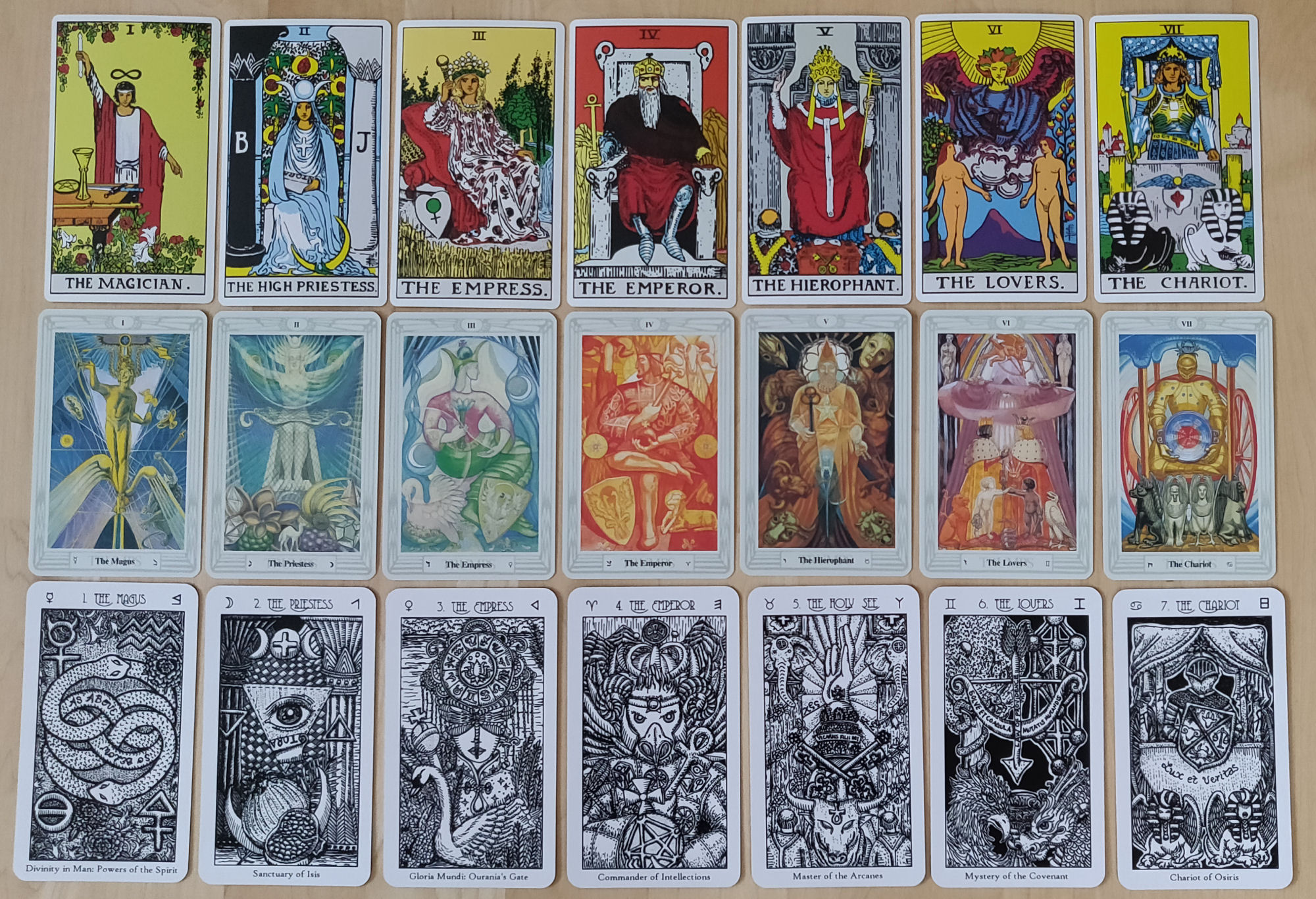
I figure a side by side review of the decks will help clarify some of the confusion about where I’m getting what for the symbolism I’ve opted to go with in Spirit Keeper.
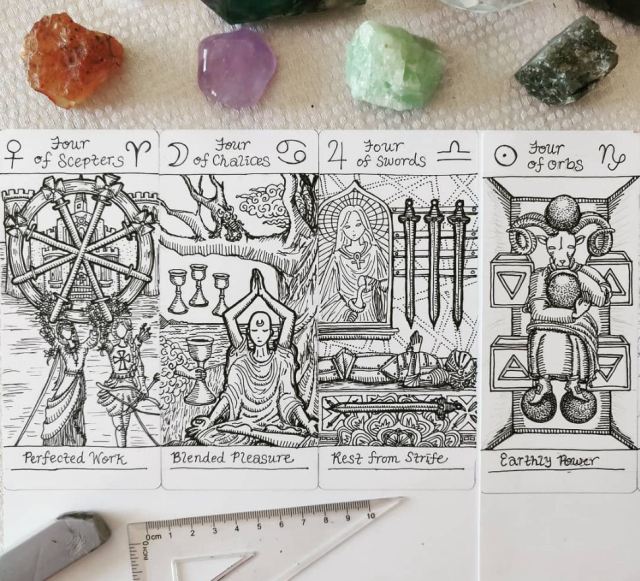
To do that, I’m using The Original Design Tarot Deck published by Siren Imports for the RWS and the Thoth Tarot Deck published by U.S. Games for the Thoth. I printed a sample copy of my deck, which you see above on the very right, but this is not what’s going to be produced for sale. I printed this physical copy to scrutinize the lines, production quality, alignment, that kind of thing, and because of that, I’ve already spotted things that need to be fixed, which will get fixed before final production. So just bear in mind that what you see here for the Spirit Keeper’s Tarot is pretty damn close to what will be offered for sale later down the line, but with editorial improvements.
Speaking on the design of the Majors from my frame of mind, the voice of what I might describe as my inner genius came through more distinctly. And by genius I don’t mean hey look at me I’m objectively a genius, no. I mean that inner genius we all have that we need to go through the structured, methodical process to unlock. That inner genius is what I’m saying really came out.
I say that because I think something shifts by the time I reach the Minors. More on that later.
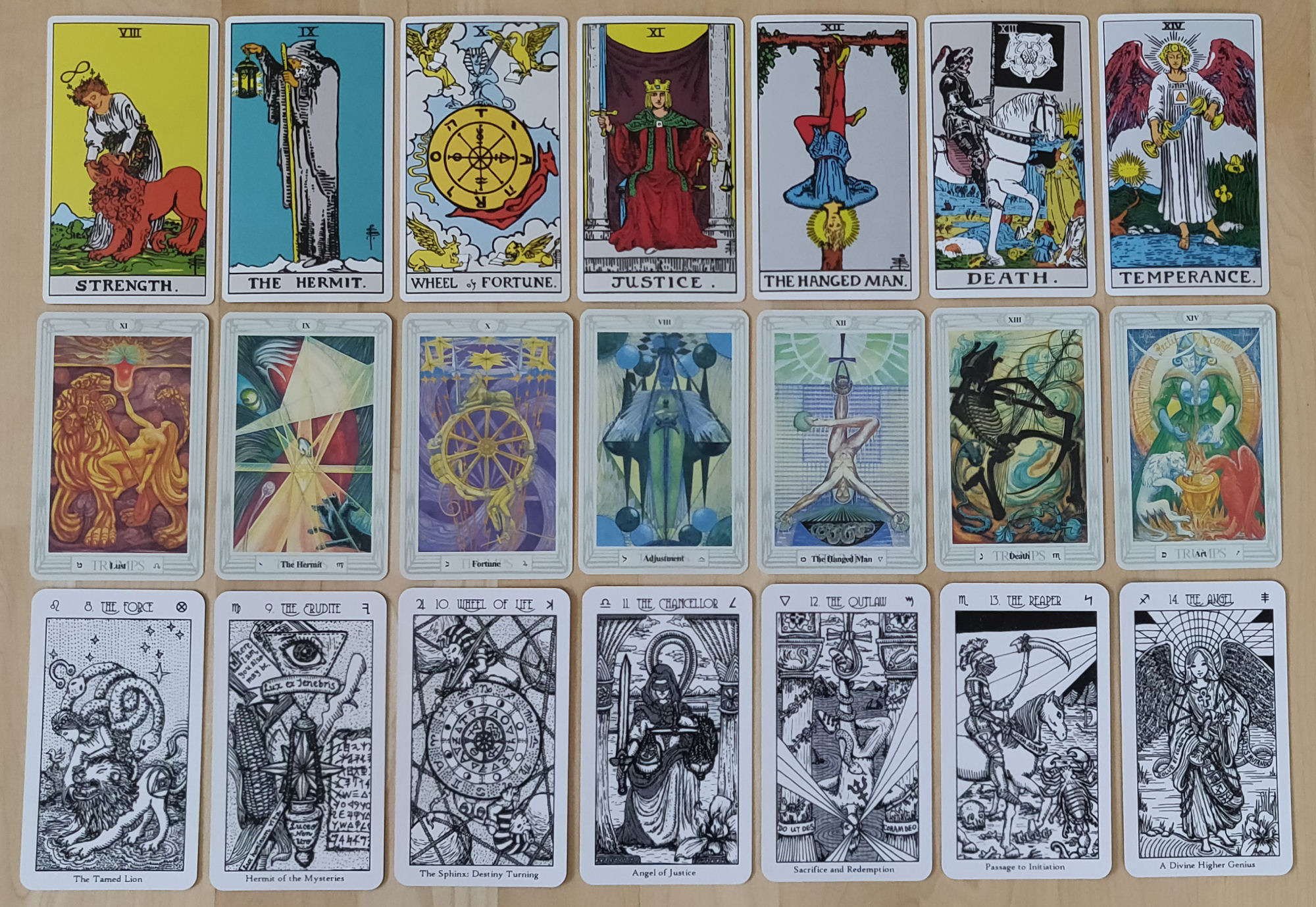
Keys VIII to XIV (with Thoth VIII and XI switched intentionally)
I’m picturing the cards in the exact order I drew them. You’ll see back in the First Septenary Keys I to VII, there were no human figures depicted. I had started the project with the intent on having no depictions of humans. Where human-like figures would be used, they’d be, like, you know, with an animal head or something, the way you see in The Emperor, or most of the face concealed from view, like The Empress.
Then I got to Key 8 Strength and broke that rule. Doh.
By the way, I devote a whole section in The Book of Maps, the companion guidebook that will go along with Spirit Keeper’s Tarot, to the Key 8 and Key 11 situation and my struggle with deciding how to approach the 8 and 11 switch, which funny enough, involves the Justice card and those goddamn balancing scales.
I felt like there had to be more to the reasoning for Waite’s switch than the order of the zodiac wheel. My speculation at the end of that struggle is it had to do with differing theology, so then I had to decide where my own theologies aligned.
Since I went with Key 8 for Strength and Key 11 for Justice, following Waite’s switch, for an easier comparison, in the above photo I switched 11 for 8 and vice versa in the row of Thoth cards.
Keys XV to XXI
Although there are inevitable nods to the Marseille, the reason I didn’t focus my intentions on actively integrating the Marseille is because for Spirit Keeper, my focus is on the esoteric and occult expression of the tarot. The Marseille is by original intention a deck of playing cards that later got appropriated into a form of divination or fortune-telling, whereas both RWS and the Thoth were from beginning to end intended as esoteric and occult expressions of the tarot. You could even argue that both the RWS and the Thoth tarot decks are the product of spell-crafting, born from fertile pools of knowledge and magical experience. That is why these two in particular are the chosen parents.
Nevermind that the premise of the Major Arcana for Spirit Keeper’s Tarot is to connect you to your Holy Guardian Angel, and therefore by definition is an angel tarot deck, which we all know occultists immediately giggle at, but now as I study how some of the imagery for the cards are coming along, I can’t help but giggle to myself and confess: oh man, I’m creating a fluffy tarot deck.
Maybe I can defend such an accusation by saying it’s not fluffy, it’s just a strong statement in favor of self-empowerment and an expression of religious faith. (But isn’t that what all designers of fluffy decks say? Crap.) Take The Tower, for instance. More commonly, the focus here is on a punishing Act of God, or having to tear down what you’ve so meticulously and painstakingly built, because you’ve built it wrong. There’s typically a forceful sense of calamity when you consider The Tower.
Yet here I’ve added a talisman to The Tower: I’ve given the Seeker an axe. There’s also blood dripping from the axe, suggesting that you’ve done this before; this isn’t your first time at the rodeo, so you know what you’re doing–you can do this. Also, if you consider the bigger picture here, we see that the serpent tail of the Demon is coiled around this tower, along with chains binding this tower to the Demon, so this destruction also destroys servitude to the Demon. There’s an element of liberation here.
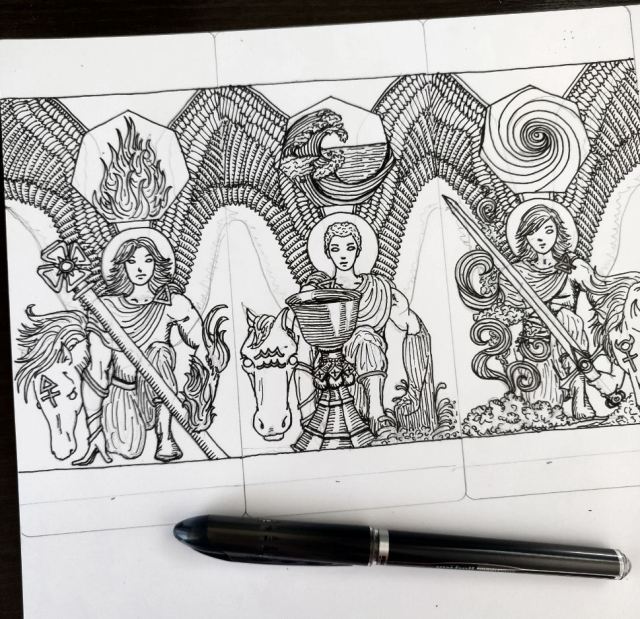
Drawing the cards in sets of three, actual card size. This is how I begin.
I’ve been struggling with how to depict the tarot courts since back when I was still doing the Majors. And the whole time, I’ve been reading, brainstorming, researching, thinking– though no drawing– how the heck am I going to do this, and do this with any semblance of justice.
The more texts I studied on angelic correspondences to the elements, directions, and/or astrology, the more confused I got. Do I go Golden Dawn since up to this point so much of my point of view with the deck has been GD-influenced, or do I follow the lead of religious scholars turned mystics who say some of the Golden Dawn attributions for the Kabbalah are anti-Semitic in their source origins? How do I reconcile Christian mysticism, Jewish mysticism, and Islamic mysticism when it comes to angels? How do I also do it all with resonant subtext to Chinese, Taoist, and Buddhist ideas of angelic(-like) realms?
Also, when deck creators want to incorporate multiculturalism, they typically follow– shit–what’s his face–I can’t think of the name without looking it up. I’ve got it in an end note citation in Holistic Tarot if you really care. Anyway, Eden Gray followed what’s-his-face and everybody after Eden Gray followed Eden Gray so we go with this whole notion of Wands medium-hair, fair-eyed, Cups light-hair, light-eyed (or those two swapped), Swords dark-hair, medium-eyed, and Pentacles dark-hair, dark-eyed, so we typically end up with Asian or Middle Eastern for Swords and then Middle Eastern, Native American, or African for Pentacles. I opted not to go that route.
Agrippa made note of correspondences between geography, directionality, and the four elements, though he kept it relatively vague. Crowley then gave his thoughts on geography, directionality, and the four elements. His directionality conflict with Agrippa’s, but the geography and four elements kind of lined up. Well, lined up close enough to work for me. So that’s what I went with instead of what has become the more popular and trending ethnic associations for the four courts.
And that was just the tip of the iceberg of daunting considerations for the courts.
Drawing angel wings on the knights assembly line style…
The more I thought into it, the more stressed and nervous I got. And I did not want to go the direction of “screw everything and everyone, I’m gonna follow my intuition and channel it from my own higher consciousness” or whatever it is people say when they don’t want to listen to precedent or read books. How do I honor precedent and still acknowledge my intuition?
The art style for the deck I opted for is in the spirit of Renaissance humanism, a time when Christian mysticism and paganism merged in eclectic ways and mystics of that time were far more cosmopolitan and worldly than we folks today give them credit for being. I think the louder establishment voices of that time in history for structured Catholicism and the Church came as a knee-jerk reaction of the establishment to the subversive undercurrent of diverse thoughts that were emerging at the time.
Let’s recap. On June 13 of this year, I got into my head this fantastical idea of drawing my own tarot deck. It was supposed to be a ha-ha fantasy but then I couldn’t shake the ha-ha fantasy out of my head, so immediately I got to work.
I shared all my digital files for the Major Arcana from the tarot deck I’m currently drawing at the end of June, 2018 here: Spirit Keeper’s Tarot (Majors Only). Then went on to explain the purpose for ritual coloring of the Majors, among other thoughts, here in a subsequent video and blog post: Ritual Coloring of the Major Arcana, though there I share some draft images from the Minors as well. If you’re not subscribed to my Instagram, then you probably don’t know that I’ve been sharing progress photos of my work as I go along. In the event that interests you, subscribehere, IG: @bellwen.
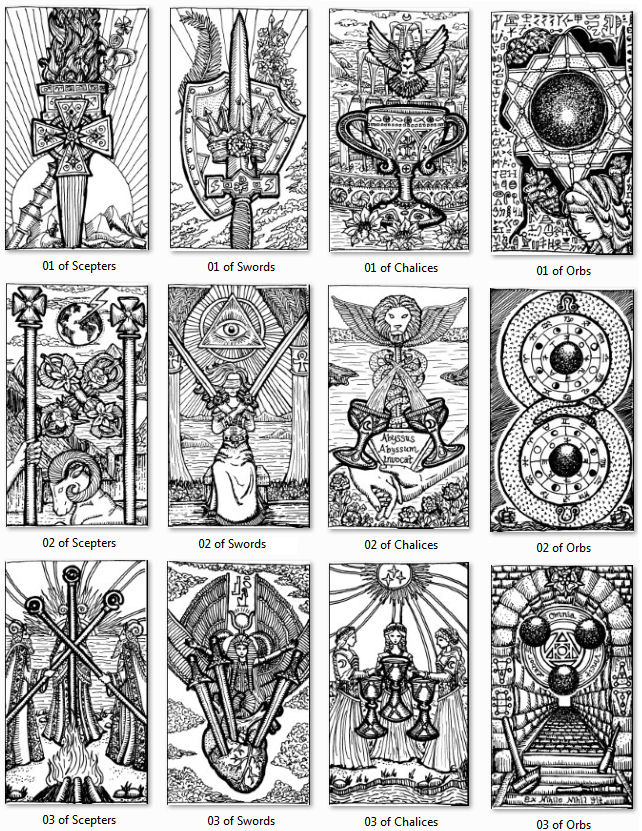
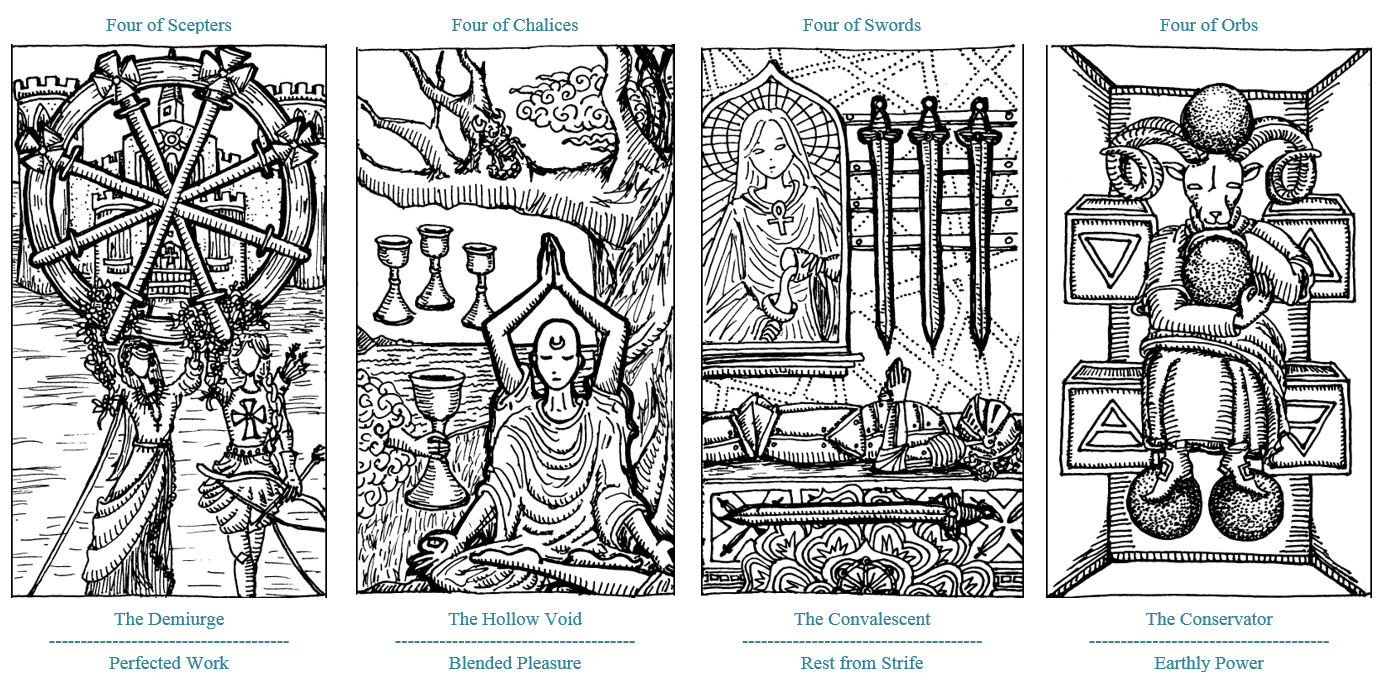
So as I explained in the last blog post on drawing my own deck, after completing the Majors and beginning on the Minors, I started with the Fours. And the suit order I’m going in for each number set is Wands, Cups, Swords, and Pentacles, which I’ve renamed to Scepters, Chalices, Swords, and Orbs. Lots of really specific reasons for the renaming. I definitely didn’t do it just for shits.
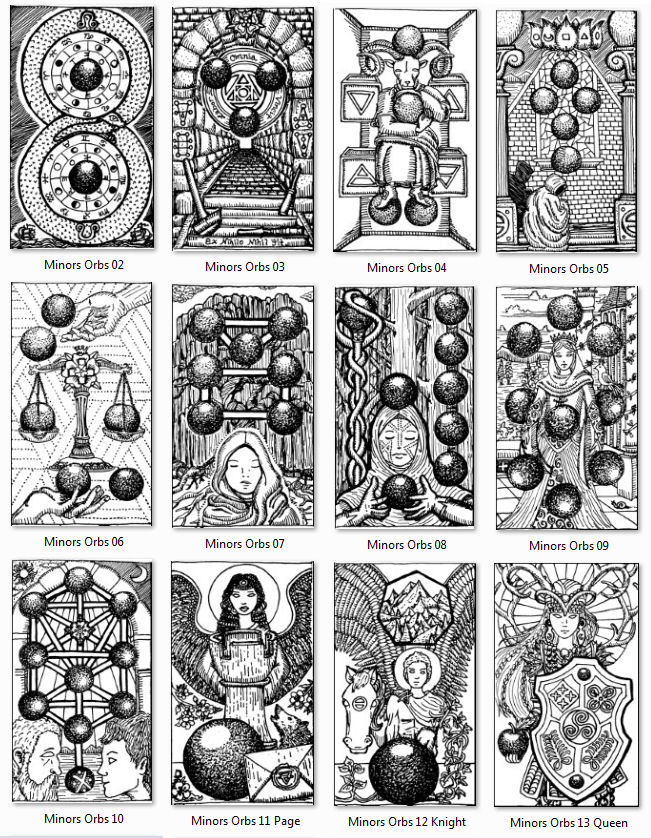
The above thumbnail snapshot does not show the cards in the order I completed them. Because of the digital filenames, when I take a screen shot of the file folder that the scans of these images are in, they’re in alphabetical order. Also, these screen shots don’t include the titles and captions.
I posted a video over the weekend in which I ramble in many different directions. It was supposed to be a video in which I introduce you to the black and white line drawings of the Major Arcana from the Spirit Keeper’s Tarot, which are now available for your free download. It was also supposed to be me making a case for undertaking a ritualized process of coloring in the black and white line drawings.
And instead, I went off on a tangent about God, the Devil, my lifelong love of art, and the role of religion in occult study. I do at a couple points keep to topic and mention the tarot deck and coloring in a tarot deck, but I’m afraid most of it is just a winding road of rambles.
Yes, you can tell I’ve cut and edited the clips because the original rambling was even longer, which all but turned into an unfiltered incoherent video diary of what I did for each Key. When I went to edit the video clips, I thought, yeah, I’m not going to post a one hour video, so I literally cut about half of the footage. Hence the noticeable heavy-handed cutting here. Don’t worry, I promise you, you’re not missing out: the cut ramblings were very boring.
If you haven’t already downloaded the Majors-only black and white line drawings (all umteen zip file folder versions of them…) and the companion guidebook (your operation manual), go here:
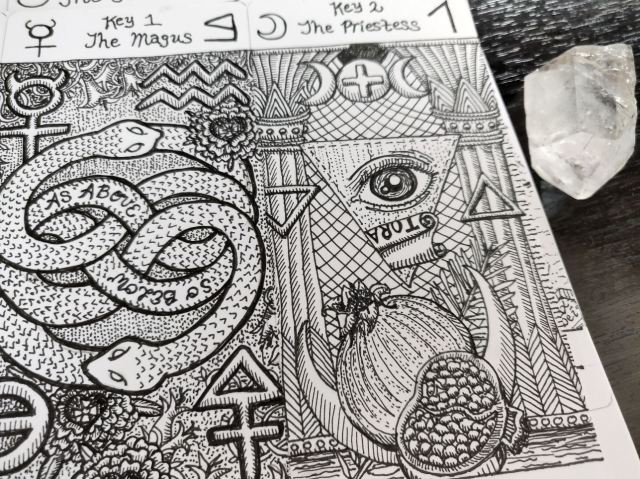
Original pen and ink art on white heavyweight cardstock, 100 lb. cover (270 gsm) at 8.5″ x 11″, so I draw three cards per sheet.
I’m now at work on the Minors, but it’s going to take a lot longer to complete than what it took for the Majors, because I need to return my focus to other projects in the pipeline, both professional and personal.
For the Majors, I worked on them pretty much during every single millisecond of non-day-job-work time I had for sixteen days (new moon in Gemini to the full moon in Capricorn). I won’t be able to commit that full-force on the Minors, so the time allotted for the Minors will need to be distributed out more evenly and in a more balanced way with my regular schedule.
Like I did with the Majors, my process for the Minors is to first read Mathers, Papus, Waite, and Crowley, find the common denominator (not easy at all; really struggled with this), then factor in my point of view, philosophy of life, and how I’m sensing that common denominator energy in today’s collective unconscious, and then depicting that personalized and updated extrapolation, all while attempting to keep with that medieval grimoire woodblock print art style.
Click to reserve your Season Pass! $199. Installments available.
This is my third year participating as a master class instructor at Tarot Summer School and the line-up is spectacular. You’re not going to want to miss this intense semester, so get the Season Pass!
You get lifetime access to any course you purchase. If there are 7 courses you’re interested in and you buy each separately, that’s almost the cost of the Season Pass. For $199, you’ll get all 13, and get access to the courses for life. So it’s not like you have to do all 13 courses this summer. Buy it this summer and save it for later. Revisit the courses as frequently as you like. It’s a pretty incredible deal when you think about it. Click on the banner above to book your Season Pass, or check out the courses separately below.
I’ve hyperlinked the titles to their respective course description page at the Tarot Readers Academy. There are also hyperlinks for each instructor’s own website or professional landing page. That way if there are any names you’re not familiar with, you can learn more about their work.
In feminist circles, the mother wound is oft talked about. The mother wound is the relationship tension often inherent between a mother and a daughter. It’s a daughter:
feeling like the mother is fundamentally disappointed in how the daughter has come out, that the daughter hasn’t met the mother’s expectations;
feeling dysfunctional because the mother has explicitly or implicitly conveyed to the daughter that there is something fundamentally wrong with the daughter;
feeling like you can never repay the enormous sacrifices the mother has made for the daughter; or…
feeling afraid that she might outshine the mother and therefore hurt the mother’s feelings somehow, so plays down her attributes intentionally, tries to be smaller and more helpless than she actually is.
For me, when ill-dignified maternal cards are consistently showing up in synchronistic patterns throughout a tarot reading for a querent who is biologically female, who identifies by gender as female, or has transitioned, I’ll explore the mother wound. The mother wound can be such a pervasive root cause of the internal conflicts in our lives.
If you intuit that you may be affected by the mother wound at some soul or fundamental level, a tarot spread programmed specifically to address that mother wound can help.
If you’re looking to explore the mother wound or just probe deeper into the spiritual implications of your relationship with a mother figure, try out this spread.
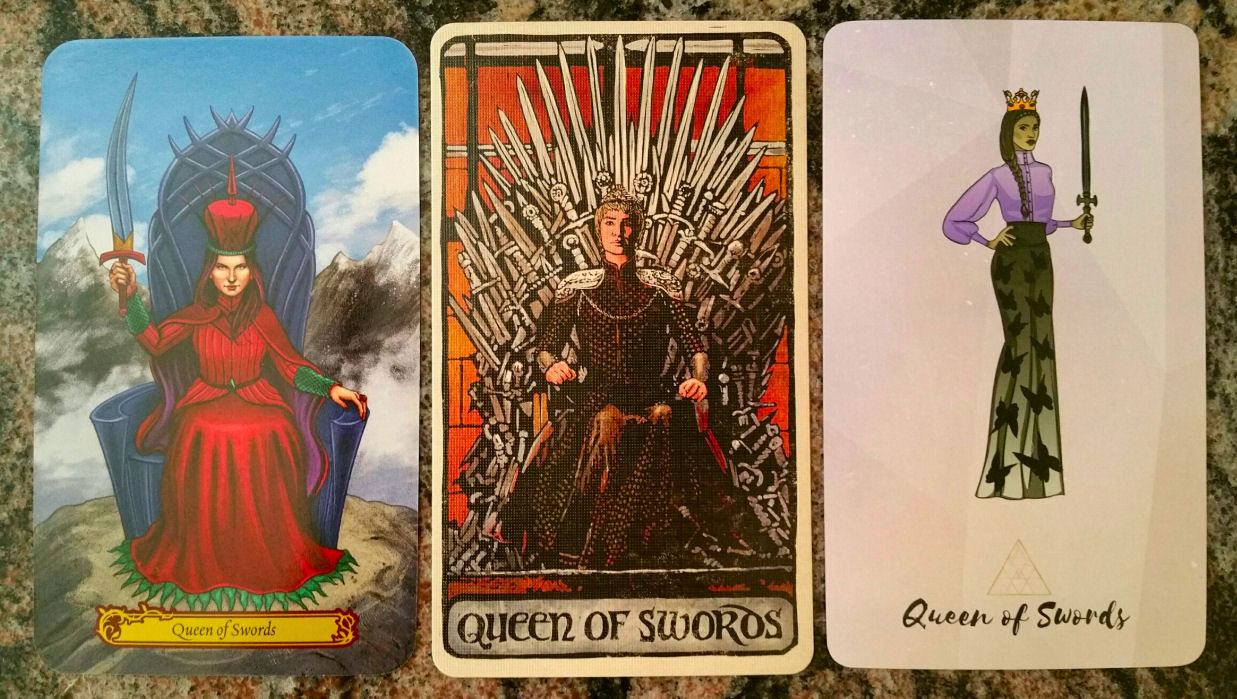
Queen of Swords from the Tarot in Wonderland (Barbara Moore); Game of Thrones Tarot (Liz Dean and Craig Coss); Bad Bitches Tarot (Ethony Dawn)
Even though I don’t personally buy in to generalizations about astrological sign compatibility, they sure are fun to read (and write). Instead of zodiac signs, I’m going even broader and exploring elemental compatibility between the tarot courts. Zodiac signs aren’t the only way to determine tarot court correspondences, but it’s the one I’m going to go with for the purposes of this blog post.
Since there are differing elemental correspondences for tarot out there, here’s the one I’m working with:
Those who are Fire signs are part of the Wands court, Water signs are Cups, Air signs are Swords, and Earth signs are the court of Pentacles. Psst… I’m the Queen of Swords by both sun sign and rising.
To determine your elemental court, you can use your sun sign (what is commonly referred to as your horoscope sign), but for some relationships, you may want to go with moon sign. Checking compatibility points for moon signs, rising, and Venus signs in addition to sun signs can bring a more well-rounded insight to a very specific romantic pairing. Closeness of friendships can also be determined through an account of the moon signs in addition to the sun.
The relationship compatibility I want to explore here is not limited to love. These considerations can be applied to friendships, acquaintances, or professional partners, or heck, even which public figures seem to resonate with you and which for some inexplicable reason just don’t.











 benebell wen