
This is Part II of what we started in Part I on the Lesser Mandala of Heaven. Part II covers the Greater Mandala of Heaven, and in doing so, provides an advanced introduction to Taoist alchemy.
We are continuing from Part I, so I’ll presume you’re already familiar with what we covered there. If you haven’t watched that video lecture “A Taoist Secret to Cultivating Personal Power: Inner Alchemy Basics,” please do before proceeding.
In this introduction, I want to explore the inner logic that underlies one of the world’s most sophisticated (in my opinion) systems of spiritual cultivation. I intend for this intro to be a deep-dive into the heart of Taoist alchemy by delineating the Greater Mandala of Heaven.
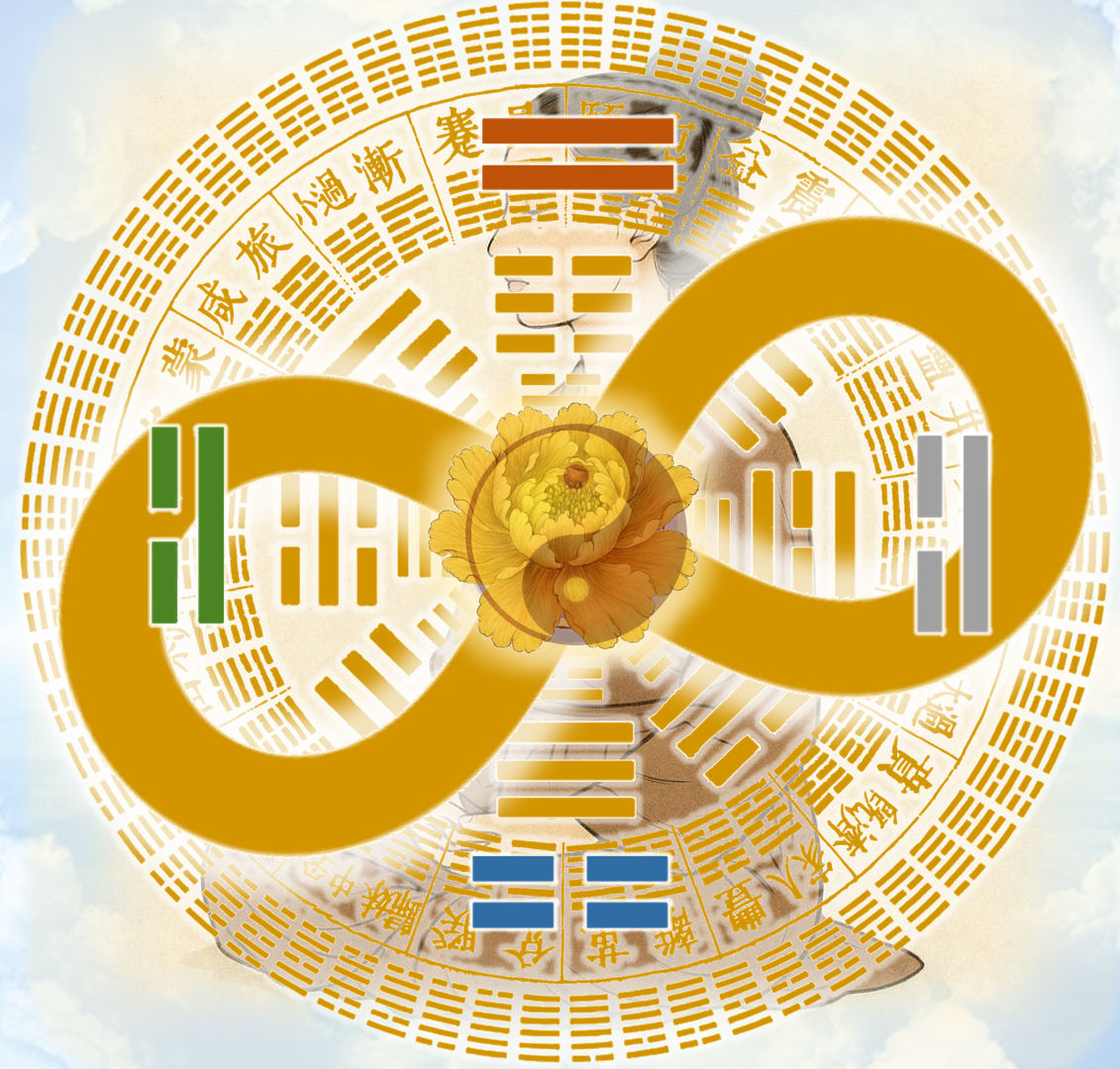
The ultimate goal of Taoist alchemy is to transform the finite into the infinite, matter into spirit, and limitation into transcendence. We cover this ground by first understanding the distinction made between inner alchemy and outer alchemy.
Philosophically, this is a system and tradition that presents a compelling perspective on how Change happens.
Historical Textual References
In addition to the two texts mentioned in Part I, these are some of the oft-cited sources of insight on the Greater Mandala of Heaven 大周天. The titles are hyperlinked to the full texts over at ctext.org (the Chinese Text Project). While CTP as a site has its limitations, it’s one of the best free, accessible, and online databases for primary sources of pre-modern Chinese texts, so it’s the most user-friendly for folks like you and me.
Fundamentals of Taoist Alchemy
The Qing dynasty text Dao Men Yu Yao 道門語要, Fundamentals of Taoist Alchemy, by Huang Yuan-Ji 黃元吉 (1271 – 1325) that I cited in the video probably has the most comprehensive — and popularly accepted — description of both the Lesser Mandala of Heaven (Scroll 7) and the Greater Mandala of Heaven (Scroll 8). The text dedicates an entire scroll (i.e., chapter) to each.
The titles of the two chapters already begin to tell you a lot about each. We covered what this text says about the Lesser, so here let’s focus on the Greater. A text dated earlier in time (True Transmissions of the Great Tao, which I’ll talk about below) says you need at least one year of Lesser Mandala cultivation before you’re ready for the Greater Mandala, but good news! Fundamentals says it’s only a hundred days! =)
Though it notes that during this hundred day period of cultivation, you can’t pollute the outside of your body, nor the inside, and so your environment, your diet, your behavior, your speech, and your thoughts must all be virtuous and pure. Any stains during this period will be stains on your cultivation practice.
The Greater Mandala begins with concentrated focus on the Lesser Mandala, slowly expanding the microcosmic orbit of the Lesser Mandala practice until you are able to sense attunement with the flow of greater forces in the universe, as to both Time and as to Space, and beyond. Cross-referencing to our canonical references on the Lesser Mandala, the Zhouyi Cantong Qi 周易参同契 provides guidance on aligning your energy cultivation practice with the structure and system that is the I Ching (also known as the Zhouyi 周易) as the optimal method of achieving this.
In other words, first map out the I Ching within your body, then map out the I Ching cycle of changes going on in nature and the cosmos, and then work on adjusting your inner I Ching map with the flow and rhythm of nature and the cosmos, based on its mapped out I Ching correspondences. That very first step of knowing yourself well enough to plot your inner points to the I Ching architecture and knowing the universe well enough to plot external points to that same architecture and adjusting the inner to align with the outer is the Work you’re doing leading you up to the Greater Mandala. Which is to say, with this inner alchemical practice, you’re mapping your body’s energy architecture to the I Ching, and then attuning yourself to the universe’s rhythms — that is why it’s called the “Da Zhou Tian 大周天,” meaning the orbital and cyclical cycles of the entire universe, now orbiting as one within you.
As noted in the video, the Greater Mandala is an achievement, a state of attainment, whereas the Lesser Mandala is the actively engaged process toward that achievement.
Once Water and Fire are balanced, and the Dragon and the Tiger do not fight each other, that’s when the Greater Mandala has been achieved. Your lower dantian will be — and I quote — “full, like the belly of a pregnant woman.” The metaphors continue: like a dragon nurturing a pearl, a hen incubating her eggs. It’s also likened to an out-of-body experience, when you are conscious of yourself outside your physical body, and you can “hear the clockwise rotation of your Qi, which is now Shen.”
To attain the Greater Mandala, “溫養, wen yang” is the way. Wen yang nei dan 溫養內丹, “nei dan” being inner alchemy, is commonly seen terminology in Taoist alchemy. It speaks to maintenance. Once you raise yourself to a certain “gong fu,” or attainment level, you gotta work at maintaining it at that level, and not slip backward.
The text goes on to say that attainment of the Greater Mandala means revelation of the Five Dragons 五龍. We’ve talked about dragon gods before, here, as land spirits.
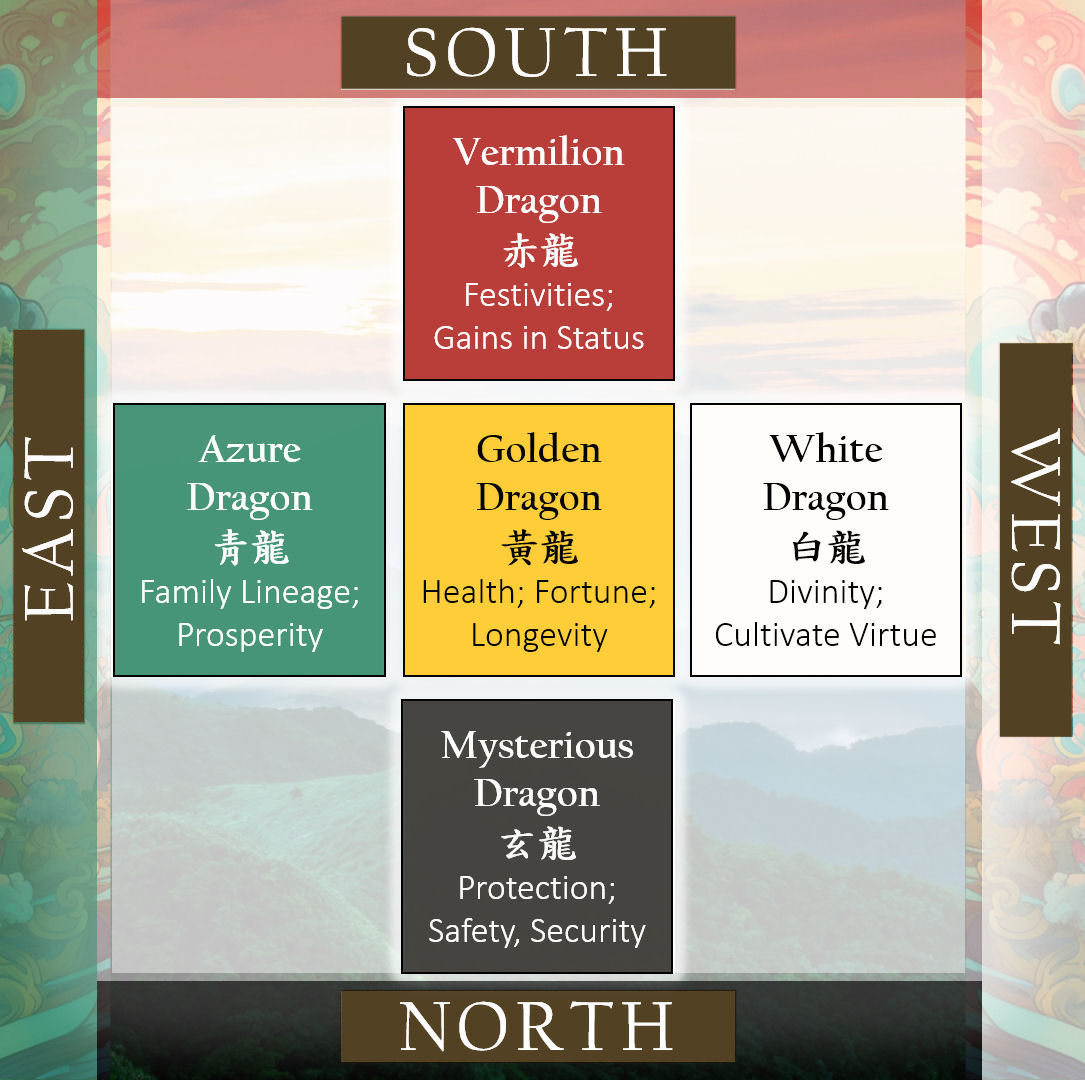
It’s the Wu Xing five elemental changing phases represented as five directional dragon guardians. But also, don’t get led astray — this is a metaphor, and even in native Chinese and in Taoist alchemy, they’re not necessarily dragon dragons. Dragon gods” means a great immortal, a great ascended master, likened to a guardian angel or spirit guide. Five exalted spirit guides will appear to you, each corresponding with what the five elemental changing phases themselves represent.
From that point on, it’s the five spirit guides that have appeared before you that guide the rest of your Way.
Finally, you’ll see in this text as you will in the others a warning about what happens if you pursue these paths without virtue — even if you don’t get plagued and possessed by ghosts and demons, your negative attributes will get amplified, the greedy practitioner becomes even greedier, the arrogant practitioner becomes even more arrogant, and your vices burden your soul. Without virtue, your faults become your own downfall.
The Secret of the Golden Flower
太乙金華宗旨 is another Qing dynasty text that, for reasons perplexing to native Chinese Taoists everywhere, gained popularity in the West, namely because Richard Wilhelm translated it, and Carl Jung commented on it.
To draw a Western analogy that will best articulate what this text is to native-born Taoist practitioners, think: The Kybalion. Sure, it’s got some good stuff in there, and yes, it’s based on some long-standing Hermetic principles, but is it really the text to be citing to when having serious conversations about Hermeticism? Or is it just a fun rompy more approachable page-turner with memorable sound bites? So yes: The Secret of the Golden Flower to Taoist inner alchemy is what The Kybalion is to Hermeticism.
But like I acknowledged, there’s some decent stuff in there.
Chapter 12 makes reference to the Greater Mandala. It starts by noting that the Mandala(s) of Heaven are represented by the union of Water and Fire. Only when yin and yang join in harmony will the central palace become aligned, and thus visible. That, then, is the Greater Mandala of Heaven.
It notes: “丹訣總假有為而臻無為,非一超直入之旨.” Translation: Alchemy, the teachings for formulating the Elixir, is diligent, persistent, and intensive action to achieve non-action (wu wei). The text also makes several references to ziran as the key principle for attaining the Greater Mandala. You put in effort, and more effort, and you don’t let up, until suddenly… it just comes naturally, like second nature…you’re coasting. That’s when the “金華” appears.
The “Golden Flower,” which is the English translation that Wilhelm went with for “金華,” is a description of the experience of transcendence, describing it as a radiant, golden light blooming like a flower.
True Transmissions of the Great Tao
Dà Dào Zhēn Chuán 大道真傳, or True Transmissions of the Great Tao, is a Ming dynasty text that has a bit of a version control problem. There are multiple versions of a text with this title, with similar content, but each one slightly different. At least in the version I’ve hyperlinked here, and in most versions of this text, it details both the Lesser Mandala and Greater Mandala of Heaven, and their relation to each other in inner alchemy.
In its first section, it starts by noting that the Lesser Mandala of Heaven practice is the prerequisite to the Greater Mandala of Heaven, and the only way you can even get to the Greater Mandala stage is if you’ve successfully “火候, huo hou,” meaning “slow and steady management of Fire.” It’s a cooking metaphor in inner alchemy, about the pacing of your cultivation practice. It’s got to be slow and steady, no shortcuts, no hastiness.
Once you’ve attained the level of mastery ready for the Greater Mandala, Heaven (the trigram) and Earth (the trigram) cross paths, or “乾坤相交,” likewise with Water and Fire, Metal and Wood. They meet in the center, then return, with particular references to the numerology or significance of nine and seven. The “Magpie Bridge 鵲橋” will thus appear. The Magpie bridge is a traditional cultural reference to the Milky Way, an astronomical phenomenon that appears on the seventh day of the seventh lunar month. There’s a whole mythology and legendary love story around the Magpie Bridge 鵲橋 if you care to go down that rabbit hole.
It notes that it takes a minimum of one (solar) year of slow and steady cultivation practices, namely with the Lesser Heaven, before one can be ready for the Greater Heaven. And maybe after the year, initial starts at the Greater Heaven aren’t great, and you flounder, which means back to square one and another year of the Lesser Heaven for you. Finally, when you’re ready, you’ll receive the “seven day transmission of the Heavenly Secrets for attaining the Great Medicine” (七日口授天機而採大藥). This transmission is something you will receive via clairaudience or claircognizance, something spoken by Spirit to you. Your success at achieving the Greater Heaven is entirely dependent on the foundational groundwork you paved while working on the Lesser Heaven, on your practice of virtue and strength of character.
There are implications here that once you’ve attained knowledge and understanding of the Greater Heaven, you’ll have unified inner (that which is within) and outer (that which is without), and realize that there is no separating division between the two.
The text advises temperance, and balance. Don’t go crazy with the cultivation practice, but also, it’s something you’ve got to routinely maintain. So you don’t be obsessive, but don’t get lazy either. In fact, it even says if you’re going hard at it and just hitting a brick wall, chill, stop, go do something else, then return to the practice once you’re more ready. (I swear, it says that, though sure, in fancier words.)
There is also a warning: Your intention must be true, you must find the right teacher, and you must “swear the oath” (meaning, practice loyalty and uphold virtue). If your intentions are not pure, or you are not virtuous, then when you go down this cultivation path you will encounter “mozhang 魔障,” basically the Buddhist concept of mara.
Huainanzi
We’re now going way back in time, to the Western Han dynasty, completed some time before 139 BC. It’s a collection of writings, from many different authors, covering Taoism, Confucianism, Yin-Yang philosophy, astronomy/astrology, and statecraft. Jupiter’s (approx.) 12-year orbital cycle, giving us the 12 zodiac animals, is described as the “大周天,” Greater Mandala of Heaven.
The passage is talking about a cosmological calendar system, beginning with the Big Dipper, then getting into the Greater Mandala of Heaven that is Jupiter’s 12-year cycle, and how the orbiting of this Greater Mandala of Heaven corresponds with the musical scale (tones, harmony of the spheres) of five tones, corresponding with the Wu Xing.
In the Chinese lunisolar calendar, there are 24 solar terms, each about 15 days long. Each of these 15-day solar terms is subdivided into three 5-day periods, or pentads. Altogether, the 24 solar terms have 72 pentads (24 solar terms x 3 pentads = 72). Within each pentad, or 5-day period, each day is governed by one of the five elemental changing phases or Wu Xing, in the order of Wood, Fire, Earth, Metal, and Water. In Taoist folk magic, these 72 pentads are personified as deities.
While Huainanzi isn’t talking about the cultivation practice of the Greater Mandala itself, it’s giving the cosmological basis and conceptual reasoning for the practice. The inner alchemy is premised on the principle that circulation of subtle energy bodies within the human body, such as Qi, mirrors the revolution of the celestial bodies, and so the Greater Mandala of Heaven practice corresponds to the Greater Mandala of Heaven planetary orbit, and how relational forces in the universe impact or govern that orbit.
In Summary…
In summary — and this is what I was trying to provide in the video rather than tediously run through each of the texts above, which I think is better done in writing here — the Greater Mandala of Heaven 大周天 is an expanded state of inner and outer alignment beyond the microcosmic orbit state of the Lesser Mandala of Heaven.
- Foundation is the Lesser Mandala of Heaven 小周天. However you dice it, you can’t get there without first having refined your Jing, Qi, and Shen via the Lesser Mandala of Heaven, or a circular microcosmic orbit.
- Balancing the Polarities. Be that Heaven and Lake, Water and Fire, Dragon and Tiger (sometimes Dragon and Phoenix), between the Lesser Mandala to the Greater, the opposites merge at a center and eventually flip. The end result before arriving at the Greater Mandala of Heaven, notes several of the texts repeatedly, is that Heaven is at the bottom and Earth is at the top.
- Mapping the I Ching. How do you balance the polarities in that ultimate way for attainment? Through the I Ching. The I Ching maps the architecture of the universe, governs all aspects of cyclical change. If you can coordinate the cycle of change in the universe, which we can plot via the I Ching, to the cycle of change within you, then you can start balancing out your inner polarities.
- The Concept of “Warming and Nourishing” 溫養. Wen yang 溫養 is a key principle in Taoist alchemy. Wen 溫 means warming up, adding “Sun” and “Water” into a “Vessel” (the word’s etymology). Yang 養 means to nourish, to cultivate, to raise, i.e., raising energy. Altogether, wen yang represents slow, steady, dedicated practice and maintenance — you must maintain your momentum.
- Wu Wei 無為 and Ziran 自然. Now we get to why I didn’t think I could productively give you step by step concrete directions on the Greater Mandala of Heaven the way we do for the Lesser Mandala. It’s very clear that the Greater Mandala, unlike the Lesser, is something you achieve, but achievement = process, and both the achievement and the process must be your own, because the process hinges on you, who you are, where you’re at, and where you want to go. It will look just a bit different for each and every one of us, though the Nine Forms we talked about are our universal milestones.
It cannot be emphasized enough that the most important and critical element of all of these practices as your personal guardrails is ethics. Ethics and virtue must be your guardrails, and it is what keeps you from getting led astray by the dangers of mara that is one of the risks inherent in any esoteric tradition.
The happy news is the guidance is ludicrously basic. Be the kind of person who cares about yourself and cares about others. Make sure your thoughts and intentions are pure. Have compassion. Be charitable. Approach in good faith. Don’t be a jerkface. Eat healthy. Eat clean. Make sure your living environment is healthy and clean. Treat your physical body as a temple and take care of it as you would a temple. Be mindful of your mental health and well-being. Care about other people’s well-being, too. Don’t be the problem.
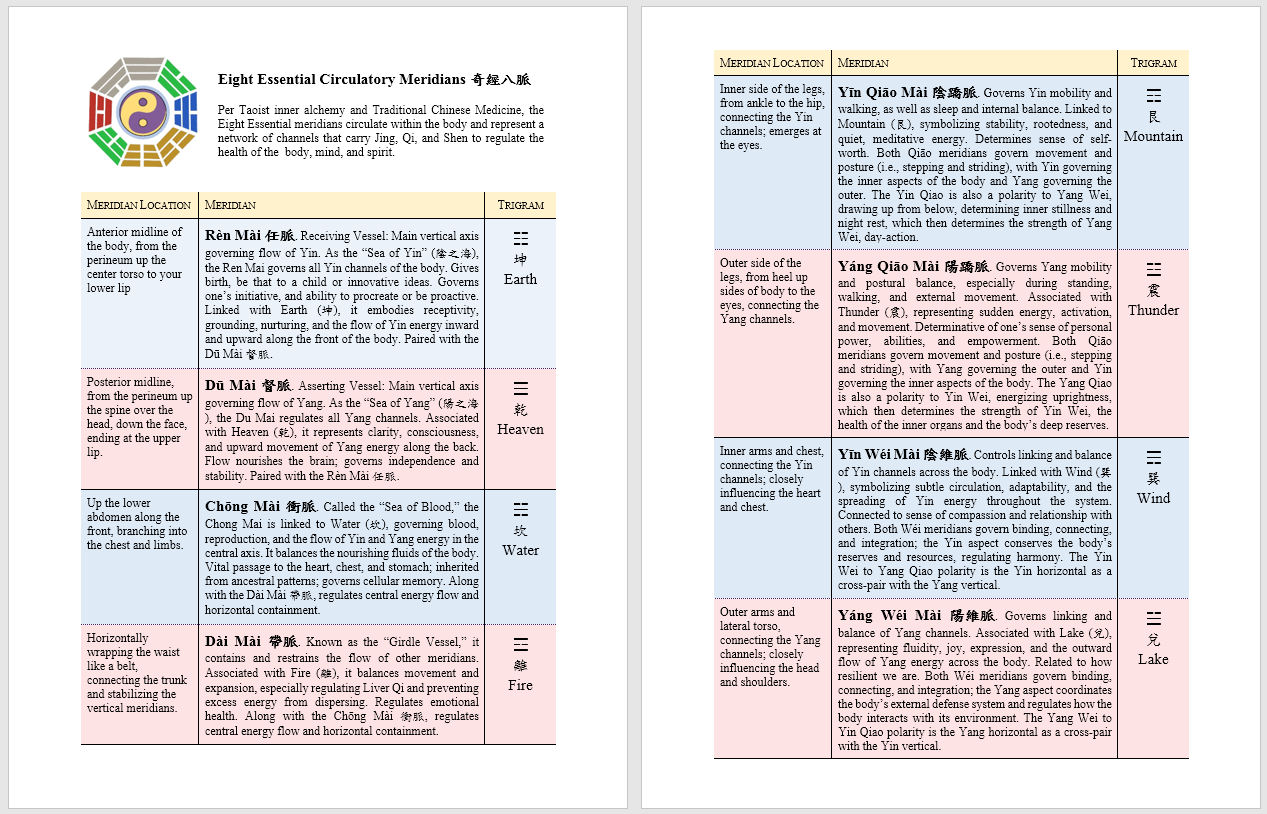
Eight Essential Circulatory Meridians 奇經八脈
(PDF Download)
Click on the above hyperlink to download a reference table on the Eight Meridians. In the Lesser Mandala, we focused on the Ren and Du meridians. The advancement of that cultivation practice means expanding focus from those two to the network of eight. To advance from the Lesser to the Greater, you expand the practice of circulating through Ren and Du to the Eight Meridians, which correspond to the eight trigrams, the cosmic compass that is the Zhouyi (Mandala of Change, also known as the I Ching, if you will).
If you’d like further reading on the eight meridians, sometimes described as the Eight Vessels, and how they correspond with the eight trigrams and charted to points on the body, see:
- Xiuzhen Shi Shu (Ten Books on the Cultivation of Perfection) 修真十書 , circa Yuan dynasty, a seminal text on inner alchemy mapping the Eight Vessels to the eight trigrams
- Scriptures of the Eightfold Practices of the Great Cavern Mysteries, in the Lingbao Tradition, 太上洞玄靈寶八門功課經, mapping out the eight gates and charting trigram correspondences to the body

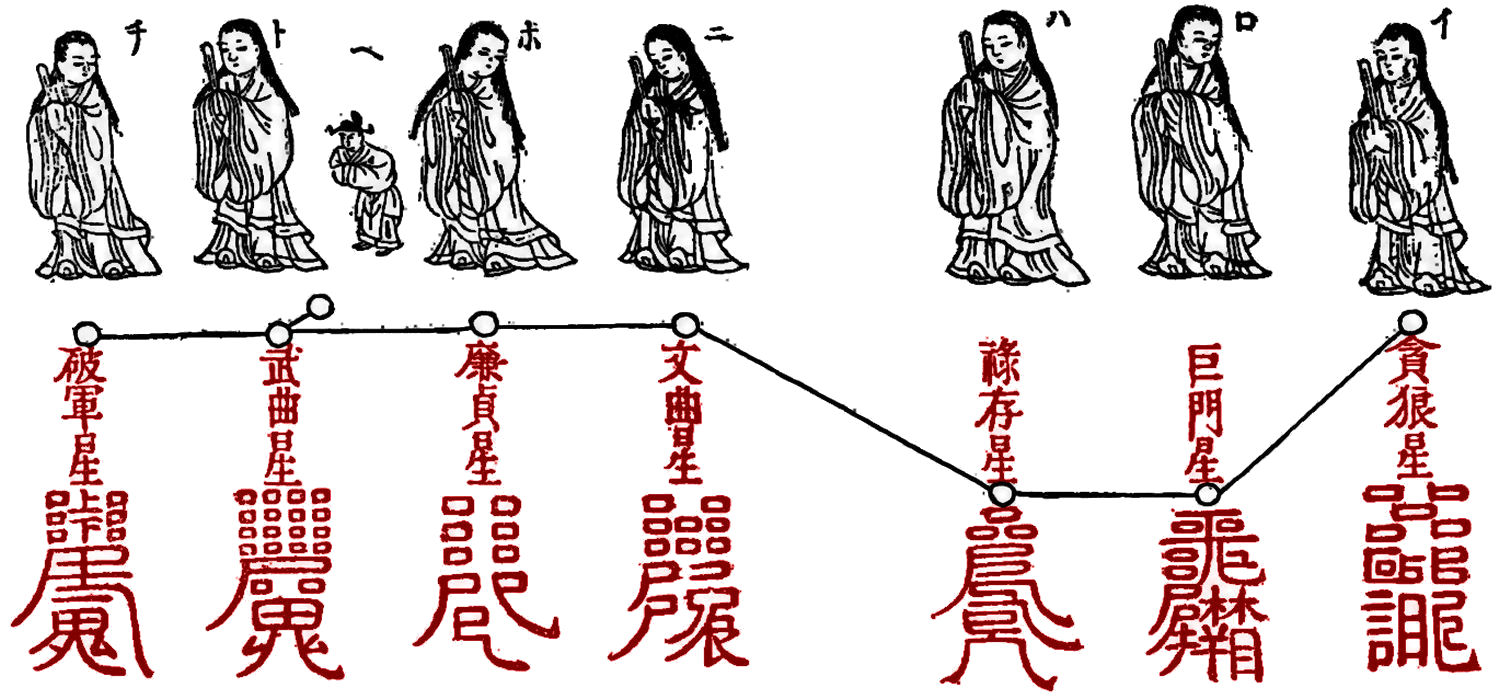
Function of Deity as Symbolism in Taoist Alchemy
In the video I talked about the value of assigning a face, name or epithet, form, and metaphorical story to facilitate our understanding of and attunement to abstract ideas. It raises a question you often hear: Is Taoism polytheistic? I mean, yes or no, depending on how you define the term.
It sure seems like Taoism, with its vast pantheon of gods, immortals, spirits, underworld kings, and what not, is polytheistic. Except the Taoist concept of deity isn’t quite aligned with Western theism. Taoist alchemists understand we’re assigning a face, name, form, story to a principle, natural force, or dimension of consciousness so that we, within our human cognitive limits, can somehow relate to these otherwise abstract ideas.
It’s a psychic or psychological technology. Invoking the Jade Emperor, it turns out, is a highly effective way of calling forth the ordering principle of Heaven, and invoking the Lady of the Nine Heavens seems to empower us with the strengths we seek to embody. Ritualists, Taoist priests and priestesses, and alchemists for millennia have realized that personifying aspects of nature helps us to harness what appears to be superhuman levels of control over those aspects of nature. Most Taoist practitioners understand gods as symbolic interfaces, even as we speak of it in terms of visions, encounters, or having a dialogue exchange with them.
That aspect of nature and reality can be represented by a formulaic combination of yin and yang energies, as they get represented in the I Ching hexagrams, or that aspect of nature and reality can be represented by a human-like form, because that’s familiar imagery to us, powerful imagery even. Taoist deities are symbolic interfaces, giving form, voice, and narrative to natural forces so that we humans can relate and work with them.
Thus, in Taoist alchemical texts on the Mandalas of Heaven, these practices often involve invocation of deities. That’s because one approach at attainment that has a track record of working is through invocation of deity. The Ba Gua eight trigrams, for instance, are often worked with by practitioners in the form of the Eight Immortals, the Wu Xing five elemental changing phases as the Five Celestial Dragons, exalted spirit guides corresponding to those five phases of change that you work with to master those five phases; yin and yang as the Queen Mother and Jade Emperor, not because yin and yang are gendered, but because for a lot of humans, gender helps with our understanding of the abstract principle.
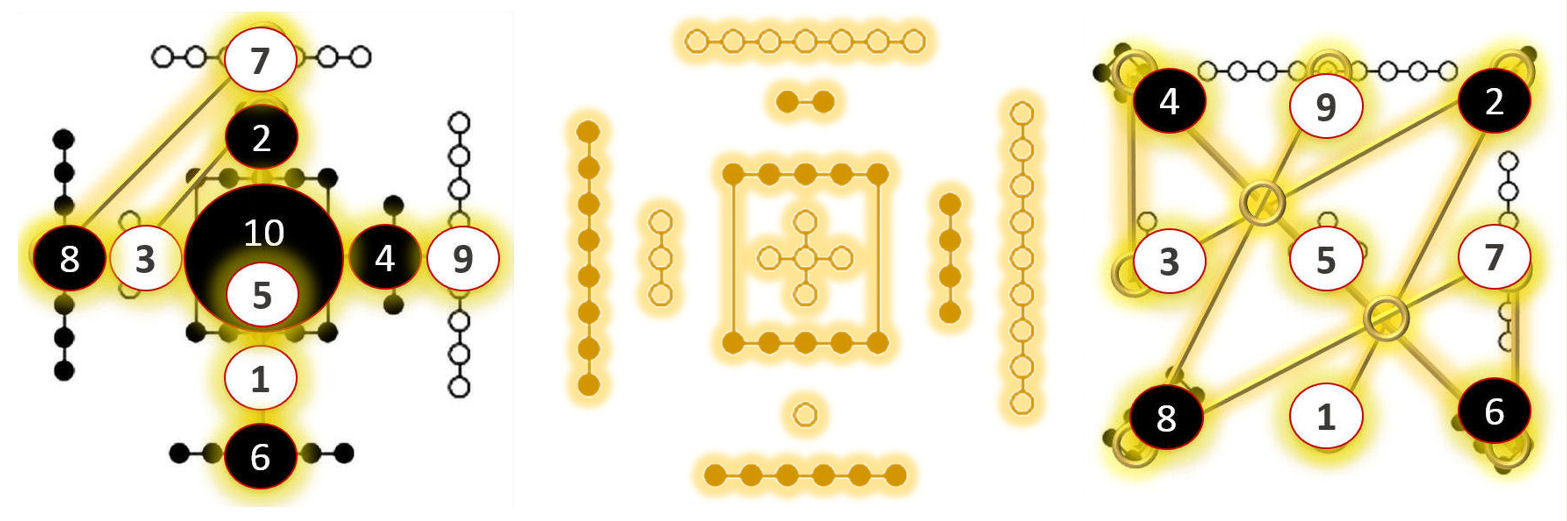
In the video we talked a lot about numerology. In Taoist alchemy, numbers are not merely a tool of measurement, but a symbolic language that impart knowledge on the phases and aspects of the Tao. Each number from one through nine encodes a principle of cosmology and cultivation.
To study numbers and their meaning in Taoism is to study the structure of reality itself. We learn how their values gain meaning to us only in relation to each other, and its through the interplay of numbers that we perceive systems, patterns, and can identify, control, even predict change.
The He Tu Lo Shu arrangements that pictorialize the relation of numbers in Taoist metaphysics is a map of inner and outer processes of refinement, i.e., inner alchemy and outer alchemy. Study, meditation on, and fully coming to terms with the rhythms of these numbers and what orders of the universe they reveal to you is very much part of the Greater Mandala of Heaven.
And the numerology also exemplifies Taoist theism: it’s complicated to try and talk about Taoist beliefs as decisively monotheistic or polytheistic. “The Tao gives rise to the One, the One gives rise to the Two, the Two gives rise to the Three, the Three gives rise to the Myriad Beings” (道生一,一生二,二生三,三生萬物) is Taoist theism in a nutshell.
Putting That All Together
The initial phase of your spiritual journey is thought exploration, to understand the Nine Forms as we covered them in the video lecture. But more pertinently, you need to critically assess what the Nine Forms means to you. Because the language of Taoist alchemy is symbolic. So what do the symbols represent to you? This interpretive point is crucial, because that’s how you start the attunement process. That’s how the Tao meets you where you are and how Divinity can, from where you are right now, take you to where you need to be.
In Taoist alchemy after cultivating your control over the two meridians for the Lesser Mandala, you advance on to the understanding of the eight meridians within the body, which correspond with the eight trigrams.
And you know what? Maybe that means sorting out how the universal principle of the Nine Forms applies to your culture-specific tradition, or your very specific Path. The “Greater Mandala of Heaven,” ultimately, is the orbital period of Jupiter and its metaphysical, esoteric, and spiritual implications.
Then after that initial phase of exploration, the actual journey begins. Which is to say that initial phase is more of a mapping exercise. The journey begins when you work your way back down, from 9, 8, 7 to 3, 2, 1, and upon union with the 1, transcend to 0, the luminous void, Hai Xu 還虛, that “fourth” phase beyond the refinement of Jing to Qi to Shen we covered in the video.
Your transition from Lesser to Greater begins when you can feel perfected resonance and attunement with the cycles of nature, both Time (astrology/astronomy) and Space (seasonal cycle). Because of this, many of these classical texts on the subject note that the minimum dedicated practice period is a full calendar (or solar) year. Another oft cited practice period is 100 days, which kinda checks out with respect to behavioral psychology — that’s about the amount of time it takes to fully integrate and form a productive habit. On a fun historical note, if you sow seeds in spring, then harvest time for grains is about 100 days from the day you sow seeds. Which is to say from planting a seed to harvesting its bounty is approximately 100 days.
So now you’ve refined the internal energies into Shen that there is now a natural lightness of Being. That refined lightness of Being by its nature becomes Non-Being. The canonical sources talk your ears off about wu wei and ziran.
In aggregate these source texts note that you can’t really force the Greater Mandala. You just have to focus your efforts and concentration on the Lesser Mandala, read the signs and omens on what each next step for you is to be, and steadily build and expand upon your holistic Lesser Mandala practices. Then at some point, spontaneously, seemingly effortlessly, you’ll come upon that Mysterious Gate (Xuán Guān 玄關) and know you’re ready to cross the threshold.
That Mysterious Gate 玄關, appears when the polarities merge, Water with Fire, Heaven with Earth, or the Dragon coupling with the Tiger, which is to say you realize the circular orbit is also expressed as that figure eight lemniscate.
Transmission of the Formula
My philosophy is it’s more productive to share with you the core principles and give good, strong guardrails to keep you on track. Because alternatively, when you give fixed, concretely detailed step by step instructions for something like this, you’re more prone to leading people astray.
Telling you what to look out for and giving you a map of the territories so you can best chart your own journey makes more sense than me being blindfolded and you being blindfolded and then me saying, okay, turn left, now take three steps forward, turn right, now spin clockwise in a circle, patting your head and rubbing your belly, seven more steps forward and voila you’re there!
The visual animated walk-through of the Greater Mandala of Heaven and the core principles behind it were crafted with excruciating intentionality. It was my way of transmitting to you a spirit map. The Way is to first find the “One” that is your milestone, where you want to start, and by starting there, the rest of the spirit map I’ve transmitted to you will fall into place. Because it will meet you where you are.
Then study the concept of Two and sort out for yourself what is your “Two.” And “Three,” the trinity, and what it means for you to operate with the function of Three. Go in order. Each number is your milestone until you arrive at Nine. You may end up staying at Nine for some time, and like the canons say, maybe you’ve got to step back, take some time off, and then return, notice you slipped back to Seven, and work your way back up to Nine again, and keep on doing this until the Nine unlocks the Ten and that golden luminous threshold of splendor, that figurative elixir appears to you — the Answer.
Inner Alchemy and Outer Alchemy
Twin disciplines in Taoist tradition are outer alchemy (waidan, 外丹) and inner alchemy (neidan, 內丹), the former being refinement of substances in the external world, and the latter being refinement of energy bodies within the human microcosm.
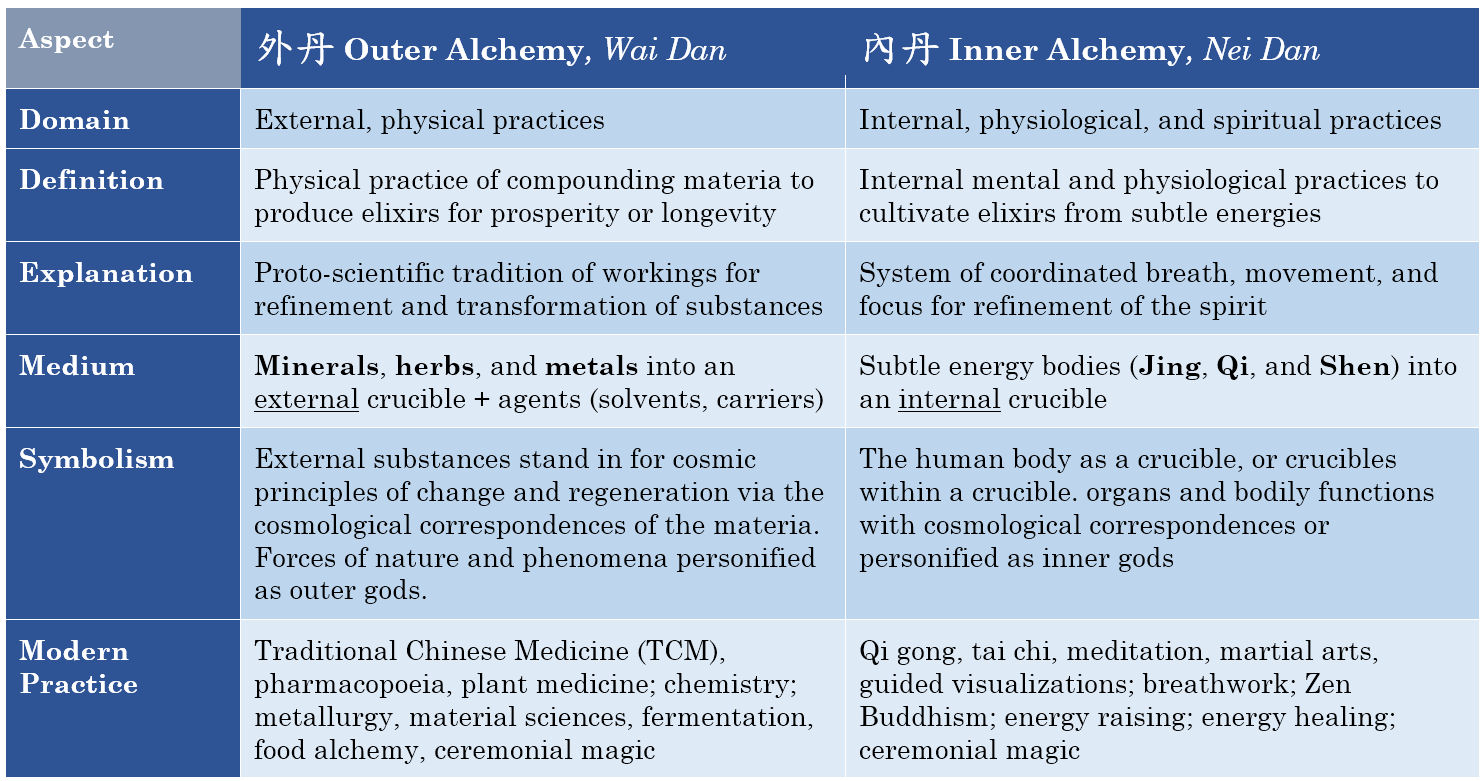
Here’s a comparison chart that summarizes the two prongs:
| Aspect | 外丹 Outer Alchemy, Wai Dan | 內丹 Inner Alchemy, Nei Dan |
| Domain | External, physical practices | Internal, physiological, and spiritual practices |
| Definition | Physical practice of compounding materia to produce elixirs for prosperity or longevity | Internal mental and physiological practices to cultivate elixirs from subtle energies |
| Explanation | Proto-scientific tradition of workings for refinement and transformation of substances | System of coordinated breath, movement, and focus for refinement of the spirit |
| Medium | Minerals, herbs, and metals into an external crucible + agents (solvents, carriers) | Subtle energy bodies (Jing, Qi, and Shen) into an internal crucible |
| Symbolism | External substances stand in for cosmic principles of change and regeneration via the cosmological correspondences of the materia. Forces of nature and phenomena personified as outer gods. | The human body as a crucible, or crucibles within a crucible. organs and bodily functions with cosmological correspondences or personified as inner gods |
| Modern Practice | Traditional Chinese Medicine (TCM), pharmacopoeia, plant medicine; chemistry; metallurgy, material sciences, fermentation, food alchemy, ceremonial magic | Qi gong, tai chi, meditation, martial arts, guided visualizations; breathwork; Zen Buddhism; energy raising; energy healing; ceremonial magic |
We learn from the yin-yang binary that one is not mutually exclusive of the other, and while in some ways they are polarities, they are equally interdependent and fluid. There is no separating division between dualism and non-dualism.
And here’s the above info as a fancy colorful chart:
(PDF Download)
For the JPG image file, just click on the above table to download.
Cultural Cross-Pollination
Permit leeway for a tangent; I assure you it’s relevant. This year, Shimon Sakaguchi, Mary E. Brunkow and Fred Ramsdell won the Nobel Prize in Medicine for their research on immune cells and genetics, the result of which is now laying the foundation for a new, emerging field of study in the treatment of autoimmune diseases. It started with Sakaguchi over in Japan conducting research, which he published and made accessible to the world of scientists. On the other side of the planet in the US, Brunkow and Ramsdell found Sakaguchi’s research and were able to build on it, and they publish their work. Sakaguchi then stumbles upon Brunkow and Ramsdell’s work based on his work and connects the dots. Combined together, the three scientists’ work produce one cohesive groundbreaking discovery in immunology. You can read more about it here at nobelprize.org.
What I love so much about this is why I believe in the cross-pollination of cultural knowledge, especially esoteric wisdom. When knowledge moves across boundaries, not just regional or cultural boundaries, but the boundaries of traditions, unexpected connections and innovations happen. When traditions share openly rather than remain insular, something new can be born, and that something new, in the realm of spirituality as in medicine, can be life-changing, even life-saving, for countless seekers. Sakaguchi, Brunkow, and Ramsdell cross-pollinating their knowledge now has huge implications for people with multiple sclerosis, rheumatoid arthritis, and increasing the success of organ transplants.
In the same way, cross-cultural pollination of esoteric traditions in the East and in the West can help us each better understand our own symbolic languages, illuminate otherwise overlooked correspondences, and amplify one another’s strengths. Just as the scientists’ independent yet interconnected findings unlocked new medical horizons, the synthesis of metaphysical traditions can reveal new ways of understanding consciousness, healing, the concept of the Great Medicine 大藥 in alchemy, and our (human) relationship with divinity.
There is nothing more consistent with the I Ching and Taoism than ensuring that wisdom remains dynamic.
Also, we shouldn’t forget — or dismiss — that Taoist alchemy itself came to be shaped by Buddhism and various other schools of thought, or how Western Hermeticism absorbed and reinterpreted elements of Egyptian, Jewish, and Islamic thought. Or how much of contemporary Western occultism was built on Eastern traditions, albeit often without acknowledgement. (Sigh.)

On the Lesser Mandala of Heaven 小周天
If you haven’t seen it already, we covered the preliminary Lesser Mandala of Heaven in Part 1 of this two-part lecture. Click on the above hyperlink for the video and companion write-up.
For Further Study
If you’ve already completed the Companion Course to I Ching, The Oracle, linked here, then you can skip most of the videos referenced below.
If you’re totally new to this subject and every other word I uttered was complete jargon, but your interest has been piqued and now you want to learn more, here are direct links to past stuff I made that might help to give you the background knowledge needed for this video on the Greater Mandala of Heaven to make sense:
- Shamanism Meets Taoism: The Hidden Link in 3,000 Years of Magic and Mysticism, establishes the origins, evolution, and core metaphysical principles of Taoist mysticism, the legacy of Wu shamanism. We introduce Pacing the Big Dipper and the essential foundations for understanding the framework underlying the Mandalas of Heaven.
- Taoist Magic for Beginners: How to Get Started, gives you a written outline and video that introduces Taoist folk magic, specifically through the framework of its eight forms of wu shu (magical craft). It kinda bugs me when people label Taoist folk magic as “low magic” and Taoist alchemy as “high magic,” but if you’re curious about how lay people in Asia perceive folk magic vs. Taoist alchemy, the energy it gives is similar to how people here divide up witchcraft vs. ceremonial magic (I’ve discussed this before here, if you’re curious).
- Taoist Metaphysics, giving you the metaphysical framework — cosmology, yin-yang, Ba Gua, Wu Xing, numerology, and the Lo Shu square — that underlies Taoist alchemical practice. Note: This video was made 6 years ago, and it shows.
- Wu Xing: Five Movements Toward Change 五行 · 오행, for a crash course on the five elemental changing phases in Taoist alchemy. If you’re keeping a study binder, there are downloadable notes and tables here.
- The Eight Trigrams (八卦, Bā Guà), for a deep-dive into the Ba Gua, eight trigrams that represent the fundamental building blocks of the universe. Covers the Early Heaven and Later Heaven arrangements, and why. Downloadable notes and tables here as well.
- The Lo Shu Magic Square (雒書, Luo Shu), for a deep-dive into the Lo Shu magic square and the Nine Palaces.
- Taoism: A Decolonized Introduction, for an introduction to this indigenous Chinese tradition, one that focuses on cultivating the mind, body, and spirit to achieve harmony between the self and nature.
- Wu Wei 無為 (Taoist Non-Action), one of the core principles of Taoist philosophy, which is referenced in the historical texts on the Mandalas of Heaven as the answer to how you attain the level of mastery of the Greater Heaven.
- Ziran 自然 (Taoist Path of Least Resistance), another core principle of Taoist philosophy, referenced in The Secret of the Golden Flower alchemical text as essential for understanding inner alchemy.
 benebell wen
Pingback: A Taoist Secret to Cultivating Personal Power – benebell wen
Pingback: Mandala of Heaven 周天: Taoist Alchemy Course – benebell wen