I’m compounding several different topics into one video and probably should have done separate videos for each topic, but for me, they’re all related to each other, and so I guess from that personal perspective, it makes sense for me to be presenting them in one bundle.
Upfront, let’s clarify: I’m not teaching, I’m sharing. I wanted to learn more, went out and attempted to learn more, and this video and companion blog post is just me passing on to you what I’ve learned.
Dragon Gods of the Earth 土地龍神
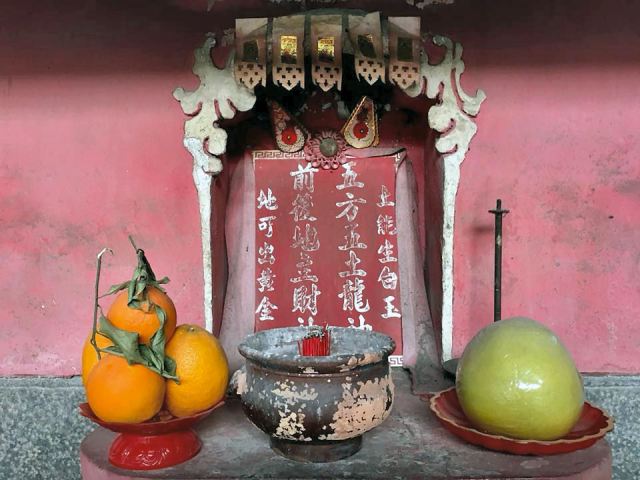
Dragon god(s) (土地龍神, tǔ dì lóong shén ) are personifications of the land, where mountains and rivers meet, and thus from a feng shui perspective, reveal dragon veins (龍脈, lóong mài).
Rituals (such as 化胎, Huàtāi; in Hakka, it’s pronounced Fā Tói) can be performed to harness the qi or powerful essence from these dragon veins to bless a home and bless lands that the Hakka now occupy to ensure good harvests, prosperity, safety, protection, and good health.
What’s distinct about Hakka dragon spirits veneration is its association with the earth rather than water. Traditionally in Chinese lore, dragon spirits/gods 龍神 and the Dragon King 龍王 are associated with the temperaments of the seas.
Even the concept of one dragon spirit emanating as five directional dragon spirits (covered in both the video and further down in this write-up) was associated with the East China Sea, Lake Qinghai (West), Lake Baikal (North), and the South China Sea.
The concept of dragon gods I’m referring to here, though, are of the earth, and are personifications of the earth. The soil of the hills and mountains are the dragon god’s flesh; stones and rocks are dragon bones; vegetation and the forests are the dragon god’s hair.
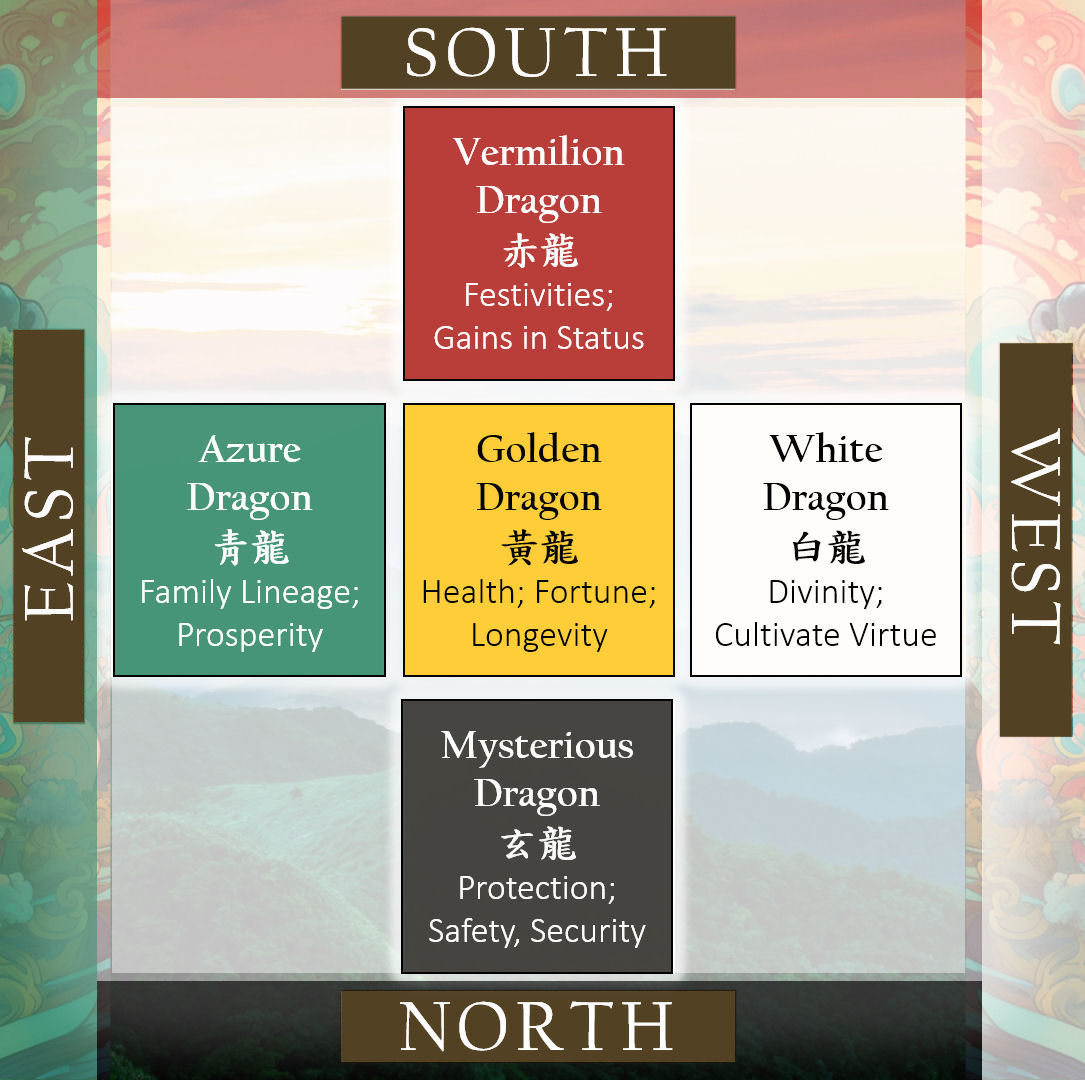
Superimposing dragon gods veneration with compass school feng shui is one of the hallmarks of this practice. To build a home, do any remodeling at all on the home, placement of the ancestor altar, and choosing which plot of land to farm or to mine requires first a divination to ensure that such intentions have the dragon god’s blessing, and feng shui measures to ensure that the construction is properly aligned with the dragon veins.
After construction is completed, a ceremonial ritual called 安龍謝土 (Ān lóng xiè tǔ) is performed, led by a priest or priestess, to placate the dragon god and to express gratitude for the dragon god’s blessings over the newly constructed building. The ritual consists of inviting in the dragon spirit (請龍), leading the dragon (牽龍), and calming or placating the dragon (安龍).
Any time humans modify the natural landscape, a shrine to the dragon god of the earth is set up. There isn’t necessarily a standardized way to do this, and often varies from household to household. Generally, there will likely be an incense pot made of a corrosion-resistant metal (copper, bronze, or brass; in modern times, stainless steel, galvanized steel, titanium) alongside a talismanic inscription “地龍神香座位” (Incense Throne of the Earth Dragon Spirit).
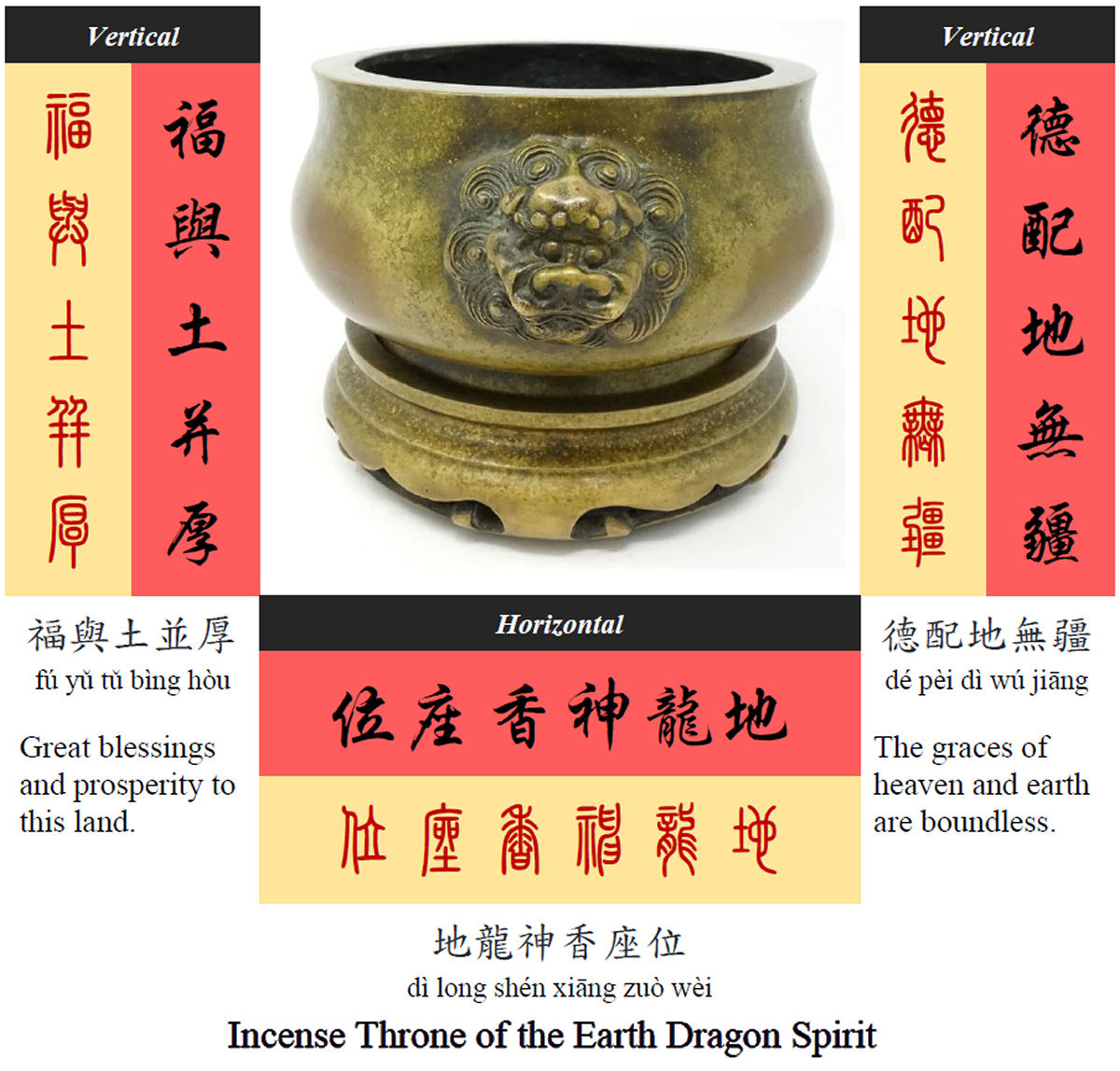
You might also see five stones placed around the shrine to represent the Wu Xing, or seven to represent both the Big Dipper significant to Taoist mysticism and the Sacred Seven (Wu Xing plus the sun and moon, yang and yin).
The dragon god of the earth 土地龍神 is arguably interchangeable with the god of the earth, Tudigong 土地公, which in Hakka might also be referenced as Bo Gong 伯公. Other epithets: Dragon God of the Earth who brings Fortune and Divine Favors 福德土地龍神; Dragon God of Fortune 福德龍神; or Earth Spirits 土神.
Further Reading
- “龍神,” Ministry of Education (Republic of China, Taiwan), Chinese Language Achievement Network [PDF]
- 《族群文化與文化產業》(2015) edited by 洪泉湖. ISBN: 9789861441450, on dragon gods of the earth in feng shui practice, the three dragon veins [three mountain kings], and the rituals of dragon gods veneration
- 《后土地母信仰研究》(2015) by 蕭登福. ISBN: 9789571722269, on the traditional veneration of earth gods, land spirits, and tutelary deities
- 《客家.翕相:臺三綫的田野紀實》(2018) by 彭啟原. ISBN: 9789860568943, on Hakka veneration of the dragon gods of the earth
- 《發現客家:嘉義沿山地區客家文化群體研究》(2012) by 池永歆, 謝錦綉. ISBN: 9789860346039, published by the Hakka Affairs Council 客家委員會, on the traditional folk religions of the Hakka
Feng Shui: Dragon Veins 龍脈
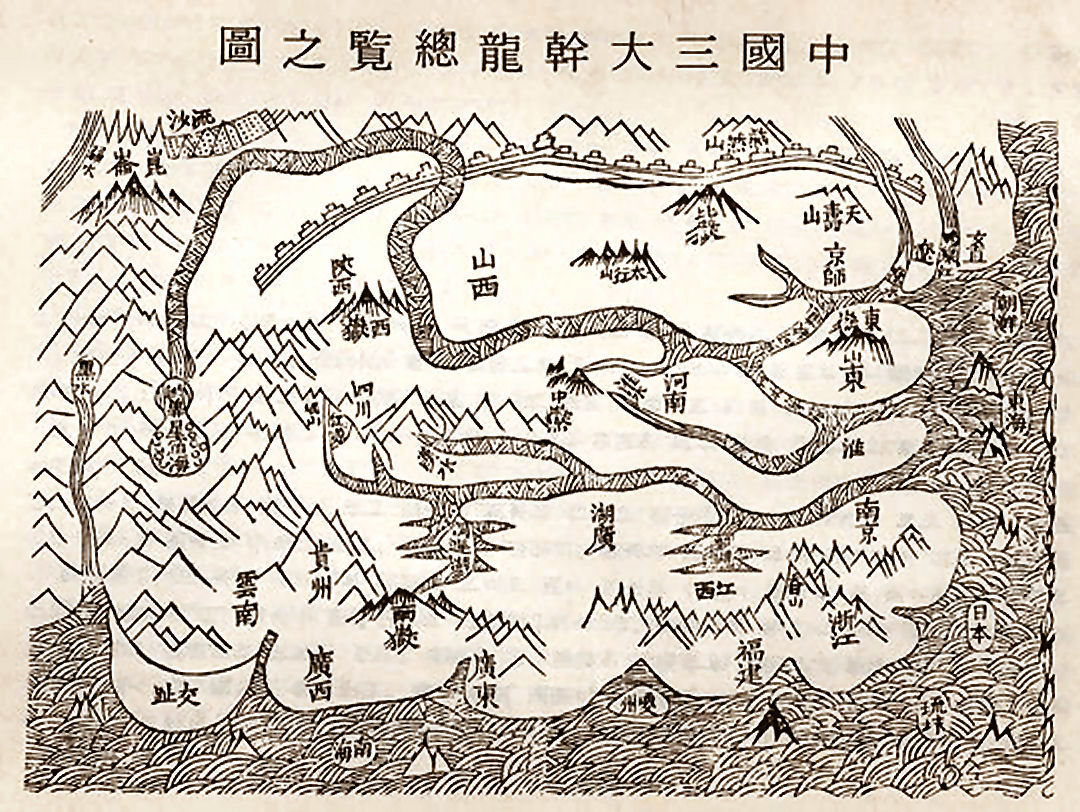
Per feng shui, the bedrock of China consists of Three Supreme Dragon Veins. They are located as follows:
- North of the Yellow River 北幹龍:走黃河以北廣大地區
- South of the Yellow River, north of the Yangtze River 中乾龍:走黃河以南,長江以北
- South of the Yangtze River 南幹龍:是長江以南廣大地區
These three were born from the primordial supreme dragon that was the Kunlun Mountains range. The one dragon god became the three, which eventually became the myriad dragon spirits of the earth. Dragon veins are what attune and connect you to the dragon spirits.
Additionally, there are spirit inhabitants that occupy your specific dwelling area (地主神, dì zhǔ shén). Altogether there is an entire regional ecosystem of land spirits, and you’re probably not going to want to do anything that might offend them. Moreover, all of these land spirits in addition to all the living organisms occupying the land thrive on the life essence of the dragon god, enriching the land through these dragon veins.
About the Hakka 客家
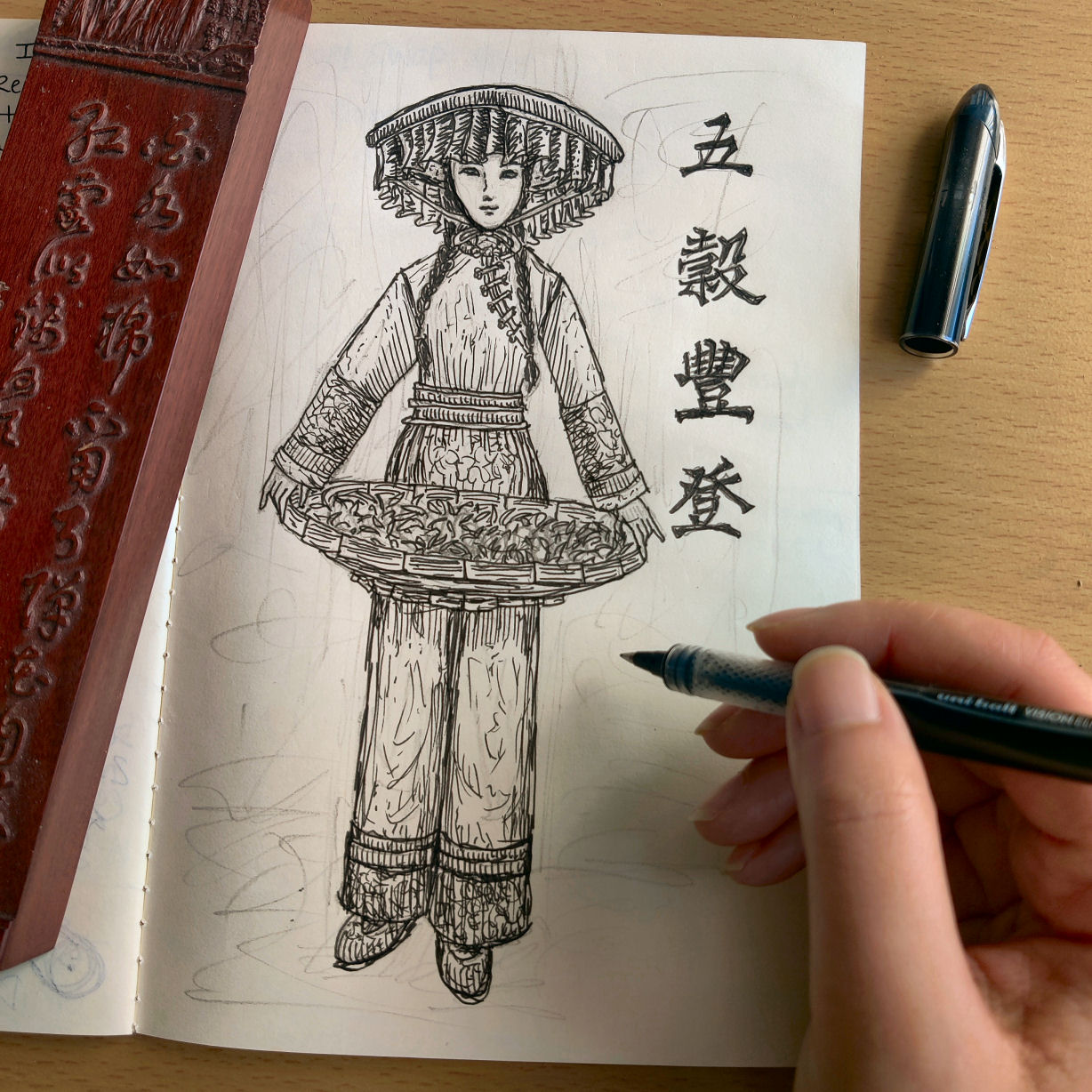
The Hakka 客家 were originally from the north central plains of China by the Yellow River, and while legends vary, the version I’m familiar with is of a clan exiled from the north some time during the Jin dynasty, around 400 AD. They migrated south, but everywhere they went, they were not welcomed, and so they continued migrating southward, then crossed the Pacific, and ended up all over Southeast Asia forming their own diasporas.
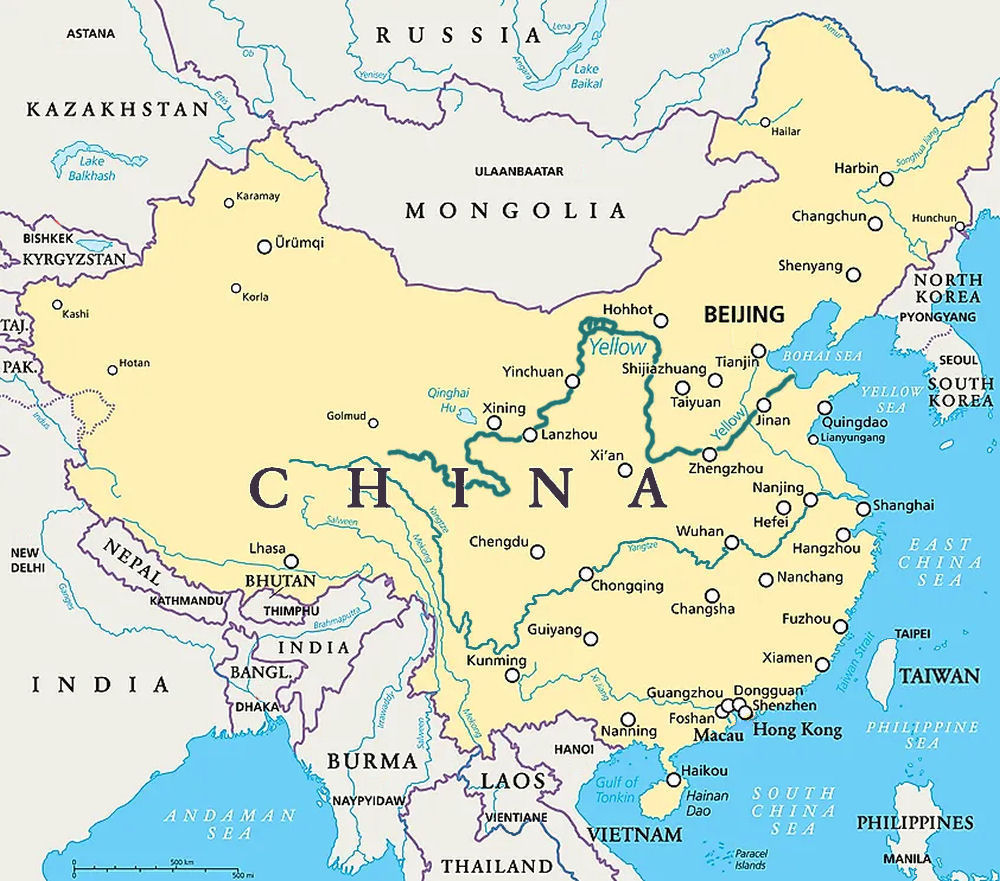
There were several waves of mass exoduses (exodi?) of Hakka leaving their northern plains homeland. 80% of modern-day Hakka paternal ancestry is northern Han, so it seems that theory has been confirmed.
Why they left depends on who you ask. Most Hakka take the position that we were persecuted and forced out of our original homeland.
Introduction to Hakka Studies 客家研究導論 (1933) by Luo Xianglin 羅香林 (1906 – 1978) documents five waves of Hakka migration out of the north Central Plains:
- During the Fall of the Jin dynasty, late 300s to early 400s AD
- Tang dynasty, 900s AD, when the kingdom fell into sociopolitical turmoil
- Song dynasty, 1127 AD, after the Jurchens took over the capital
- During the clash between the Ming and Qing, around 1661 AD
- Punti-Hakka clan wars of 1850s that drove many Hakka out of China and overseas
My aunt (dad’s sister) once told me that our family in particular left north China some time in the 1100s AD during the Song dynasty, so that would be the third wave. If we really did leave the north in the 1100s, then according to Hakka lore, the Hakka who left during this wave were from the imperial court. After the Jurchens overtook the capital and captured the emperor, a faction of the imperial court escaped south.
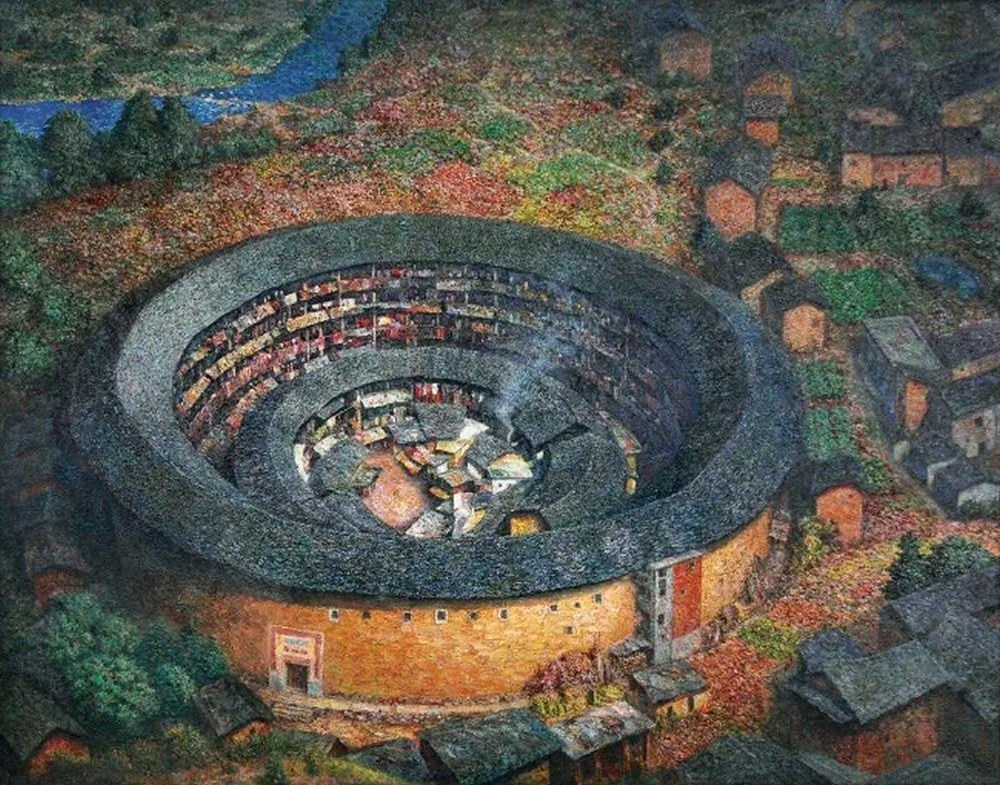
Perhaps what the Hakka are most known for is the architectural style of their homes. The clan would migrate to a new location, in effect be the outsiders, but then build something like what you see above adjacent to the dwellings of the locals. And then the Hakka tended to keep to themselves; they were fiercely tribal. They kept to their own customs, religious practices, language, and way of life. And weren’t too keen on assimilating. =P
So I get it. I get the animosity directed at the Hakka. Imagine if a troop of foreigners came to your hometown from who knows where, don’t speak your language, practice totally different customs, and build something like that tulou in your hometown, and then never mingle with the locals. I’m sure you’d be like, what the eff.
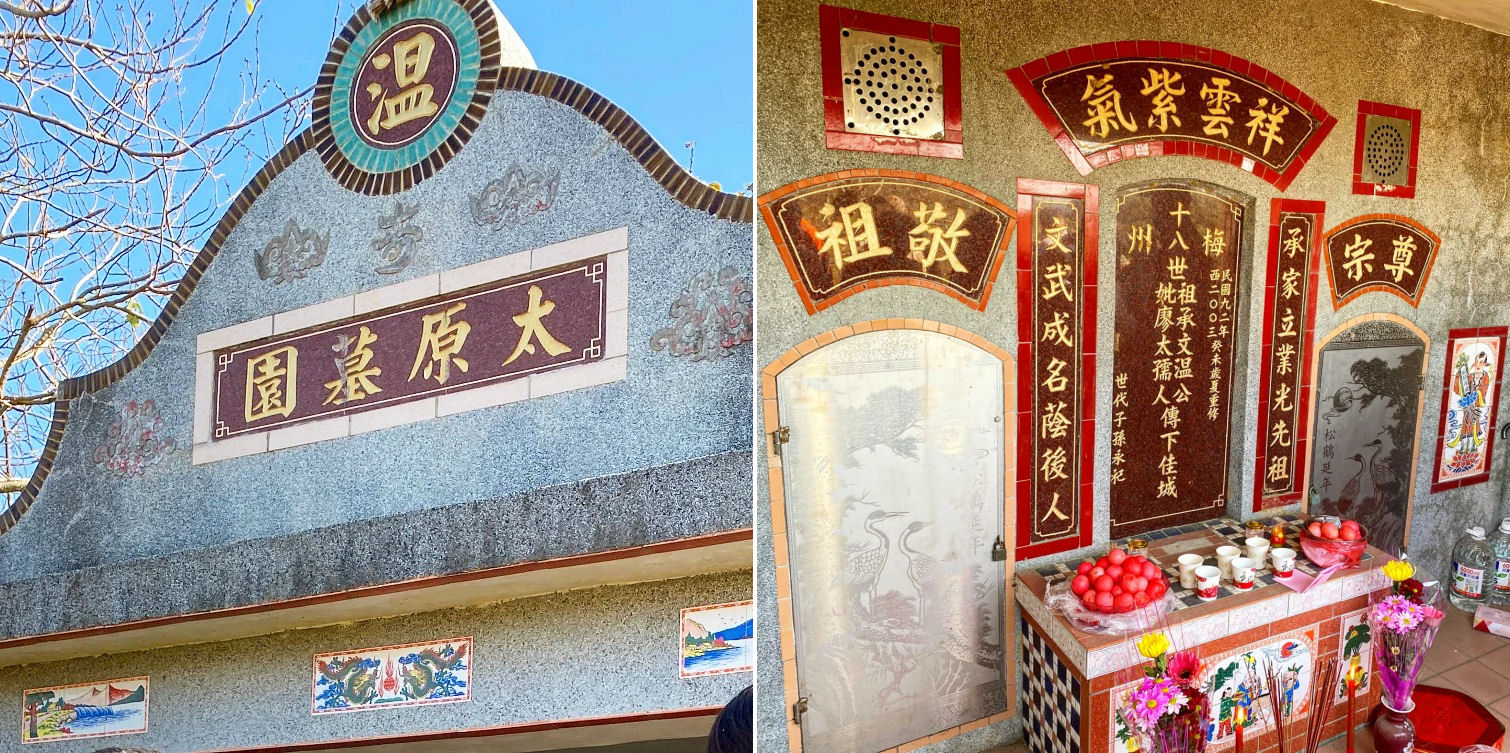
The Hakka side of my family is from Miaoli, Taiwan, where something like 60% to 70% of Taiwan’s Hakka reside, which is kind of crazy, considering that the Hakka only make up about 15% of Taiwan’s population. My guess? It’s the mountains in Miaoli that attracted them there. =)
The Wen clan were oolong tea farmers, and the specialty at our farm was red oolong. Here a video clip I shared on my Instagram a few years back:

Specific to the Miaoli area where the majority of Hakka now inhabit, prior to the Hakka, this region was inhabited by the Taokas 道卡斯族, Atayal 泰雅族, and Saisiyat 賽夏族 indigenous tribes. Many of the indigenous peoples were assimilated into the Hakka communities, though we have to acknowledge that many of the Atayal and Sasiyat were displaced as a result of the Hakka.
Some distinguishing characteristics of Hakka women: Hakka women never bound their feet for two reasons: (1) they had to be ready to run when the other Han villagers came to kill the Hakka [no clue if this is true, though it is popular lore], and (2) Hakka women worked the land equally alongside the men. Because the Hakka lived experience was that of extreme hardship and toil, we’re also known for being extremely frugal and hard-working. Characteristically, at least in the south to where they had migrated, Hakka women tended to be taller than the typical Han Chinese woman.
Considering the context of history and the time they were living in, there was greater gender equality between Hakka men and women than other Han men and women. In the realm of rites and rituals, you were more likely to find a Hakka priestess leading ceremonies than among typical Han Chinese.
There’s also this stereotype that Hakka women were built to work. Historically you weren’t going to find too many da xiao jieh 大小姐 among the Hakka (i.e., spoiled, pampered, and dependent girl who needs everything done for her and who isn’t world-wise). Though to be fair, that probably no longer holds true, as over the last few generations, many Hakka families have gained enormously in wealth… I’m sure we’re no longer lacking in bratty trust fund babies… =P
One custom associated with Hakka mothers that I found fascinating — back in the day, because patriarchy, excess daughters would get sold into slavery or servitude. (My maternal grandmother, my mom’s mom, was one such daughter who was sold into servitude.) However, rather than having to sell their daughters, which would be committing them to a life of bondage, Hakka women would kill the infant girls right after birth. They believed death was a mercy compared to bondage.
Dang.
Further Reading
- “Defining Hakka Identity: From History to Culture and Cuisine,” AsiaSociety.org
- “Origin and Migrations of the Hakkas,” by Hsieh T’ing-yü 谢廷玉, University of California, San Diego
- “Some Truths About Hakka,” by Wang Hanzhou, The World Hakka Business Association, en.whkba.org
- Introduction to Hakka Studies 客家研究導論 (1933) by Luo Xianglin 羅香林 (1906 – 1978)
An Endangered Folk Practice
The number of Hakka who still practice these native religious rituals, let alone the number who are preserving cultural knowledge of dragon gods and ritual practices, is dwindling. Dragon gods and land spirits veneration is becoming an endangered folk practice, as is the Hakka language itself.
For me, I do not need to believe the hills surrounding my home are literally the bodily form of a giant sleeping dragon whose spirit I wouldn’t want to disturb.
However, it would do me well to honor the hills as sacred, that to live in harmony with the land means to live sustainably.
Throne of the Dragon Spirit of the Earth: I like the idea of having an incense pot dedicated to honoring an ancestral heritage of fostering kinship with the local land spirits.
Place it on the ground someplace outdoors or by your front door. Perhaps where you live it makes more sense to place it by a back door. If that is not feasible, it’s perfectly okay for it to be indoors — place it on the floor underneath your home altar table. If you want to do as the Hakka would do, choose an earthenware or stone pot, or one made of non-corrosive metal.
Carefully choose five or seven stones, depending on which makes more sense to you, and arrange them in a circle around the incense pot. Given the specific layout of my home lot, I placed my incense pot underneath the backyard deck, on the ground at the base of a steep hill. And I went with seven stones for the Sacred Seven.
Divination to Commune with Earth Spirits: Use your go-to divination tool to activate your intuition and assess whether you have been living in harmony with the land you’re occupying. What is it that the land, personified as spirits, needs you to know?
Just like how you would check in with every human occupant of your home before you undertook major construction or remodeling, check in with the resident land spirits. Will your construction project interfere with the qi of the dragon veins? Is the construction project invasive to the local land spirits?
Would it really shock you if you found out that the traditional narrative of dragon gods feng shui aligns with the modern-day design and engineering factors that determine whether your construction project will hold? Was the higher success rates of Hakka miners due to following the dragon veins?
Maybe, come to think of it, I do believe in dragon gods and land spirits.
Maybe I always have. My ritual practices and my reverence for the majesty of the earth have always been my intuitive way of keeping such traditions alive.
Word List
- Book of Rites (or Rites of Zhou 周禮, Zhōu lǐ), 770 to 220 BCE (earliest record of dragon gods veneration; Hakka dragon veneration believed to descend from this)
- Dragon God(s) of the Earth, 土地龍神, Tǔdì lóong shén
- Azure Dragon of the East, 靑龍, Qīng lóong
- Golden Dragon of the Center, 黃龍, Huáng lóong
- Mysterious Dragon of the North, 玄龍, Xuán lóong
- Vermilion Dragon of the South, 赤龍, Hóng lóong
- White Dragon of the West, 白龍, Bái lóong
- Dragon gods/spirits, 龍神, lóong shén (invoked for rain)
- Dragon King, The, 龍王, Lóong Wáng
- Dragon Veins, 龍脈, lóong mài
- Earth God (Tudigong), 土地公, Tǔ dì gong
- Epithet: Bo Gong 伯公, Bógōng
- Epithet: Dragon God of Fortune 福德龍神, Fú dé lóong shén
- Epithet: Dragon God of the Earth who brings Fortune and Divine Favors 福德土地龍神, Fú dé tǔdì lóong shén
- Hakka, 客家, Kèjiā
- House Gods, 中霤, zhōng liù
- Inscription: “Great blessings and prosperity to this land,” 福與土並厚, Fú yǔ tǔ bìng hòu
- Inscription: “Incense Throne of the Earth Dragon God,” 地龍神香座位, De long shén xiāng zuò wèi
- Inscription: “The graces of heaven and earth are boundless,” 德配地無疆, Dé pèi dì wú jiāng
- Land Spirits specific to your dwelling, 地主神, dì zhǔ shén
- Land Spirits, 土神, dì shén
- Ritual: Ceremony to placate the dragon god and receive the earth spirits’ blessings, 安龍謝土, Ān lóng xiè tǔ
- Inviting the Dragon Spirit, 請龍, qǐng lóong (invoke the dragon spirit of the land you occupy)
- Leading the Dragon, 牽龍, qiān lóong (place your hand on the earth and visualize yourself drawing qi through the dragon veins toward the foundation of your dwelling)
- Calming the Dragon, 安龍, ān lóong (give the dragon spirit an offering)
- Ritual: Harnessing the qi of the dragon veins, 化胎, Huàtāi [Hakka: Fā Tói]
 benebell wen
Wow- Dragon Gods, Land Spirits; the Hakka was an amazing video clip. I really wish I could see Taiwan and temples there. My son has been to Hanoi in Vietnam so I am envious of his trip. By the way I got your book I Ching, the Oracle yesterday and I have read two chapters. It is so wonderful- It is full of information. I don’t know how you accomplished writing it. I live in New Jersey USA and I am not Hakka. Thanks for everything you do.
=Bao Radcliffe , bkrad@comcast. net
And that is my real first name.
LikeLiked by 1 person
Hi Benebell:
This is a repeat comment, I think I put it on your web page. Wow- Dragon Gods, Land Spirits; the Hakka was an amazing video clip. I really wish I could see Taiwan and temples there. My son has been to Hanoi in Vietnam so I am envious of his trip. By the way I got your book I Ching, the Oracle yesterday and I have read two chapters. It is so wonderful- It is full of information. I don’t know how you accomplished writing it. I live in New Jersey USA and I am not Hakka. Thanks for everything you do.
=Bao Radcliffe , bkrad@comcast. net
And that is my real first name.
>
LikeLiked by 1 person
do you know about a hakka king and queen who ruled for a long time around the mt sanqing area?
LikeLike
A fascinating insight into a culture I did not know about. Thank you. Energy very definitely feels different from place to place. It has been my experience. :thumbs up:
LikeLiked by 1 person
Very Interesting, and I intend to use some of the concepts given. I’m Afro-American with some Native american blood. But I think this is useful. Thank you..🙏🏾
LikeLiked by 1 person
This completely resonates with me. I live in Los Angeles in the Hollywood Hills and I do feel the land spirits. Hollywood is actually quite haunted and I learned long ago to check in with the science and spiritual side of land management. I am so glad you posted this because I love dragons 💖 and now the hills have even more meaning for me 🙏
LikeLiked by 1 person
Thank you for this multifaceted share and Dragon Earth wisdom!!!! And the great research too!🙏💕.
LikeLike
Thank you so much for this fascinating account of the believes held by your traditions. It makes me remember how much we Europeans lost of ancient wisdom, which led to a quite irreverent use of our land and as a consequence to all the threats to our environment. I love our little lizards as the remaining representatives of the once majestic dragons. It has always been my hope that we can return to at least part of the original knowledge, which must have existed here also in ancient times.
LikeLiked by 1 person
Hi Benebell,
Thank you for writing this piece on Hakka culture. Of all English written sources, I have not come across much on Hakka spiritual practices. I’d go as far to say there isn’t much information on Hakka culture in general since they vary. The dragon gods and preferred killing of excess daughters are new to me. My maternal grandmother was also a Hakka from Miaoli according to my mother and as the youngest, was offered to be adopted to a couple who were their friends and could not have children. This was offered by one of the grandparents and without approval from the mother.
I would love to hear whatever else you have to share about Hakka. I didn’t know anything about it or the English name for it until I first visited Taiwan for a teaching program for overseas Taiwanese descendants. I found out we had an ancestral hall although it is not in Miaoli but somewhere like Taipei so maybe they relocated. I am not sure how to read the consolidate plaque with all male ancestor names on it. I am also curious to know more of the hat women wear and came upon one source (Keeping Hakka Culture Alive, Part II: Hats and Songs (zolimacitymag.com) on the symbolic meaning of the string braids attached to the hats. It seems the hat (liangmao) is mostly worn by northerners according to Wikipedia.
On an entirely different note, I was told the adopted mother of my grandfather was found dead and they only found her head. This is in Taiwan. My guess is around 1935-1958 and they are not Hakka. If you have any theories as to why, I would love to hear. (I was told she was probably eaten by the indigenous since only the head remained. It could’ve been during Japanese occupation and WWII.)
Thank you for being an English source that can allow me to connect to my roots since Chinese or maybe Asian shamanism/spiritual/folk practices in general are on the secretive side. I think I first heard of you through a participant in an online free spiritual/witchy course (tarot, I think) in 2021 or 2022. I have already printed your AI I Ching and the oracle bone cards.
Thanks again and I look forward to discovering more knowledge on your site!
Best,
Wrene
LikeLike
Edit: Actually, I think the ancestral hall is in Guanxi, where my grandmother went after she was adopted. We were driving from New Taipei or Taipei so now I’m trying to track down where we went to see the relatives at the hall.
LikeLike
Pingback: Advanced Introduction to Taoist Alchemy – benebell wen