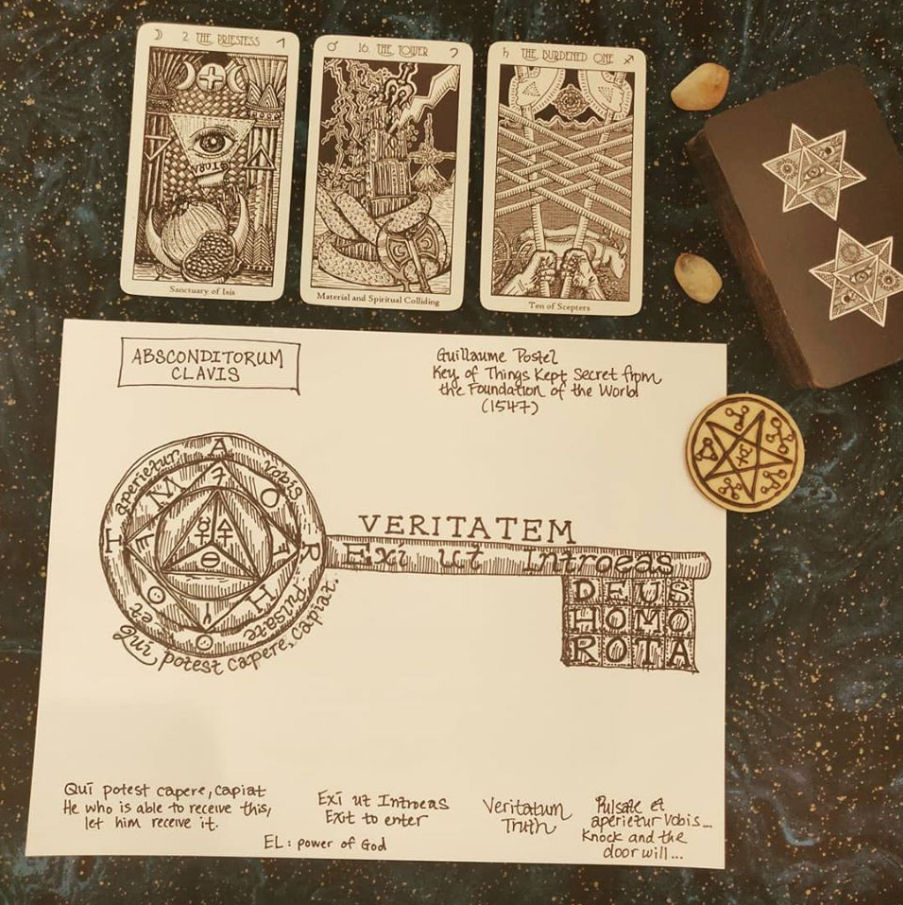
Published in 1547, Guillaume Postel’s Key of Things Kept Secret from the Foundation of the World (full title Clavis, Absconditorum a constitutione mundi clavis) proposed the notion of a universal wisdom and truth that underlies all religions, languages, and symbolic systems, and that there was a unifying language — a divine script — by way of symbolism and math (sacred geometry) with correspondences into each human language, which unlocks that universal wisdom and truth.
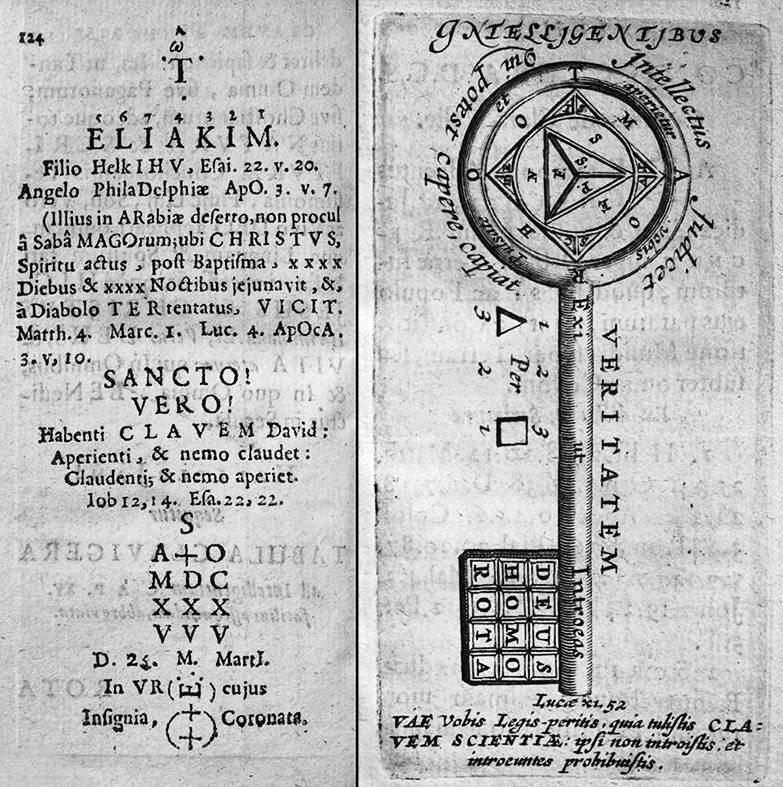
To access that unifying language, one would need a Key to decode from the language you speak now to that language, and French occultist and mystic Eliphas Levi would later revive this concept as the Key to the Great Mysteries, which he said was the tarot, and all this became a key principle in Western esotericism.

Guillaume Postel (1510 – 1581) was a French scholar, diplomat, Christian Kabbalist, and mystic who traveled widely across the Middle East where he learned Hebrew, Arabic, and Syriac. His Key of Things Kept Secret came at the height of the Renaissance’s prisca theologia movement, this intellectual current that believed all religions and philosophies derive from a single, ancient, and divine source. Postel sought to reconcile Christianity, Judaism, Islam, and all human traditions through what he called Orbis Concordia, or a universal harmony of the world. And the Key, the Clavis was the methodology for deciphering that prisca theologia.

Postel believed in the Eastern esoteric concept of soul dualism, though he framed it differently, i.e., instead of saying “yin and yang” aspects of soul, he said “female and male” aspects of the soul, with one being emotion and the other being intellect. Oh. Wow. Anima and animus, anyone? (Yeah, yeah, I know, not the same…) Nonetheless, bear in mind that Postel pre-dates Carl Jung by some odd 365 years.
| Concept | Postel’s View |
| The Key | The universal code that reveals divine order in all things |
| Basis | Hebrew Kabbalah + Christian theology + Hermetic correspondences |
| Purpose | To restore humanity to its original divine knowledge |
| Means | Study of sacred language, numbers, and symbols |
| Outcome | The reunification of all religions and nations under divine harmony |
The more you dig into Postel, the more interesting it gets. At one point he believed himself to be a prophetic interpreter in possession of such a Key, and that as a result, he is here to proclaim that there would be a female messiah, a Mater Mundi, who would usher in a new age of universal harmony. Needless to say, he eventually found himself a target of the 16th century Inquisition and was subsequently imprisoned and forced to recant his propositions. At one point, Clavis was even a banned text.
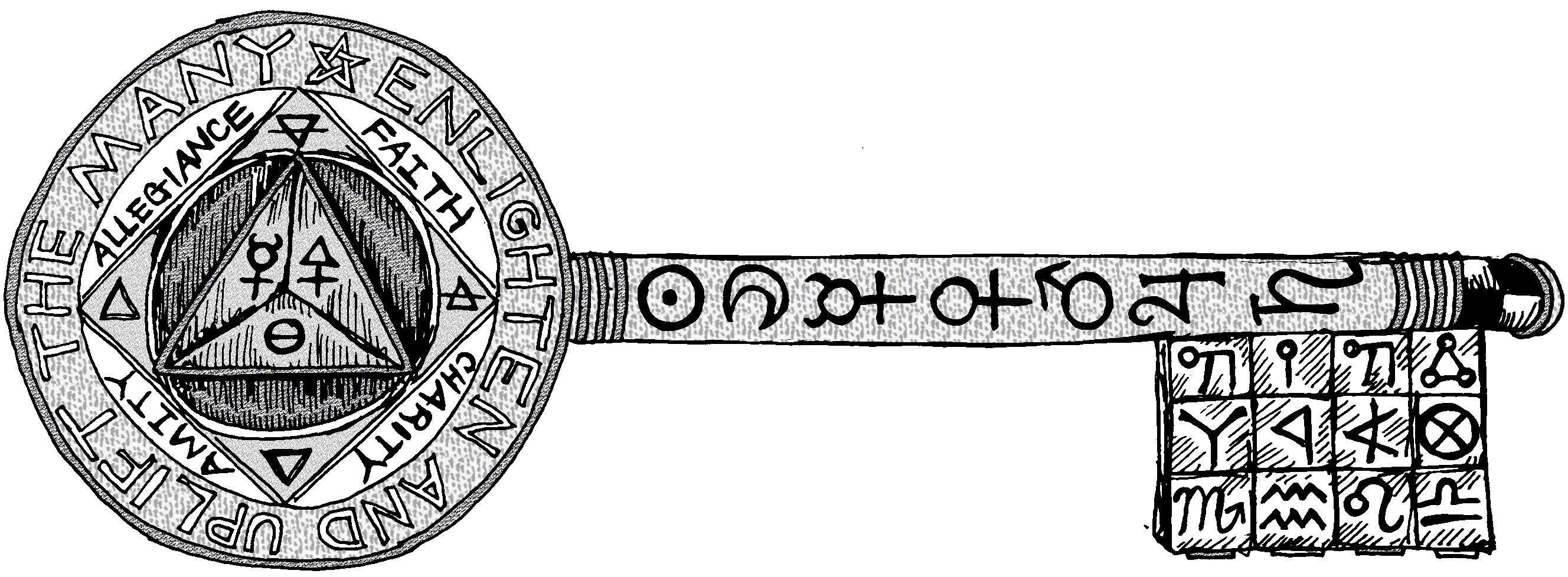
Postel’s Key endeavored to unlock a universal code for deciphering any mystery or esoteric wisdom, with the “translation” work happening by way of correspondences. In other words, the “Key” isn’t a physical instrument, but a methodology for interpreting Matter and Spirit.
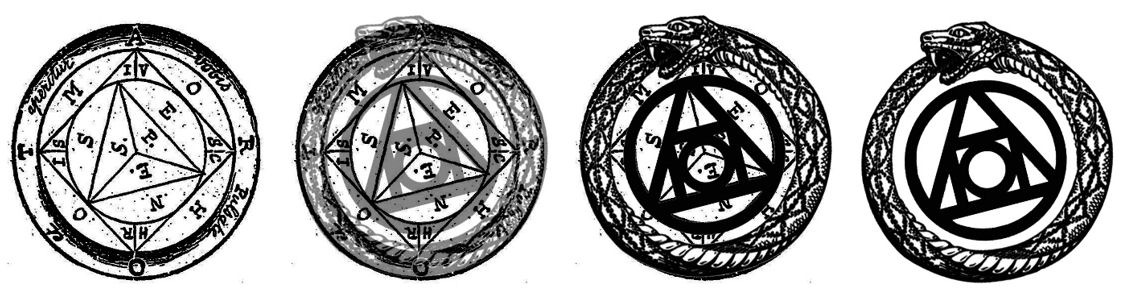
Though he was (probably) misquoted by Eliphas Levi in Transcendental Magic: The Doctrine and The Ritual, a text Arthur Edward Waite later translated into English, with Waite’s own footnotes and correx to the Levi text (oh, dear Mr. Waite…), the principle of ROTA – TARO and the trinity it represents– Deus, Homo, Rota– is an important cornerstone in Western occultism. So it’s still worth the time to try and understand it.

I’ve translated one of the correspondence tables in Postel’s work and provided it below, along with a side by side comparison of Postel’s ROTA-TARO wheel to Waite’s, pictured on Key 10, the Wheel of Fortune.

Oh dear, oh dear, because we don’t have enough element to directional correspondences for us to choose from… =) See below for what I mean.

Here’s more of where that came from, for the curious, though it’s in French:

In Levi’s Key to the Great Mysteries, the namesake of his text was a direct homage to Postel’s Clavis or Key, positing that the “Key” of which Postel speaks is the tarot, which itself was a “divine apparatus.”
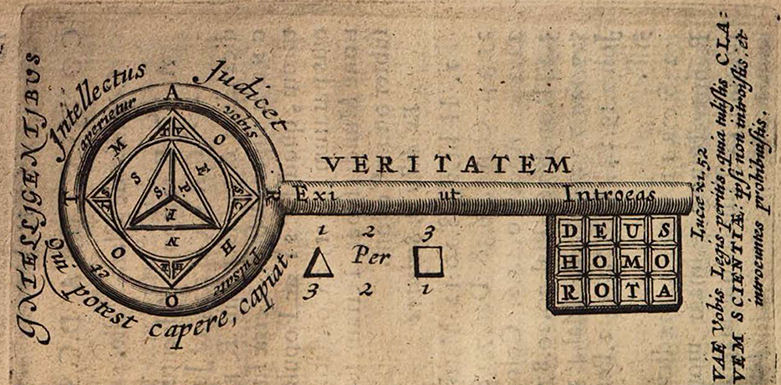
Levi believed that one could receive revelation of the design for such a Key to the Great Mysteries (through the tarot) that demonstrated unity of religion, science, mathematics, and magic. He sought to reconcile Kabbalistic, astrological, alchemical, and Hermetic correspondences through the tarot Keys. And the the master Key of all keys is what he refers to as Postel’s Key, or the Key of the Great Mysteries.
Then there’s the proposed connection between the Key and the Kabbalistic Tree of Life diagram. Both are maps that chart how we can navigate inner terrains and pathwork our divine ascent. The Key of the Mysteries is a schema mirroring the emanations and paths of the Tree of Life. One is a natural corollary to the other, i.e., derived from the same principles. Moreover, the Key becomes a cipher for understanding the Tree. The two are, according to Levi interpreting Postel, architecturally analogous.
And then the Tree of Life itself can fold into the Cube of Space, and the Cube of Space unfolds into the Kabbalistic Tree of Life. Such a Cube is a representation of the Sanctum Regnum, which is the inner temple that such a Key can unlock and give access to.
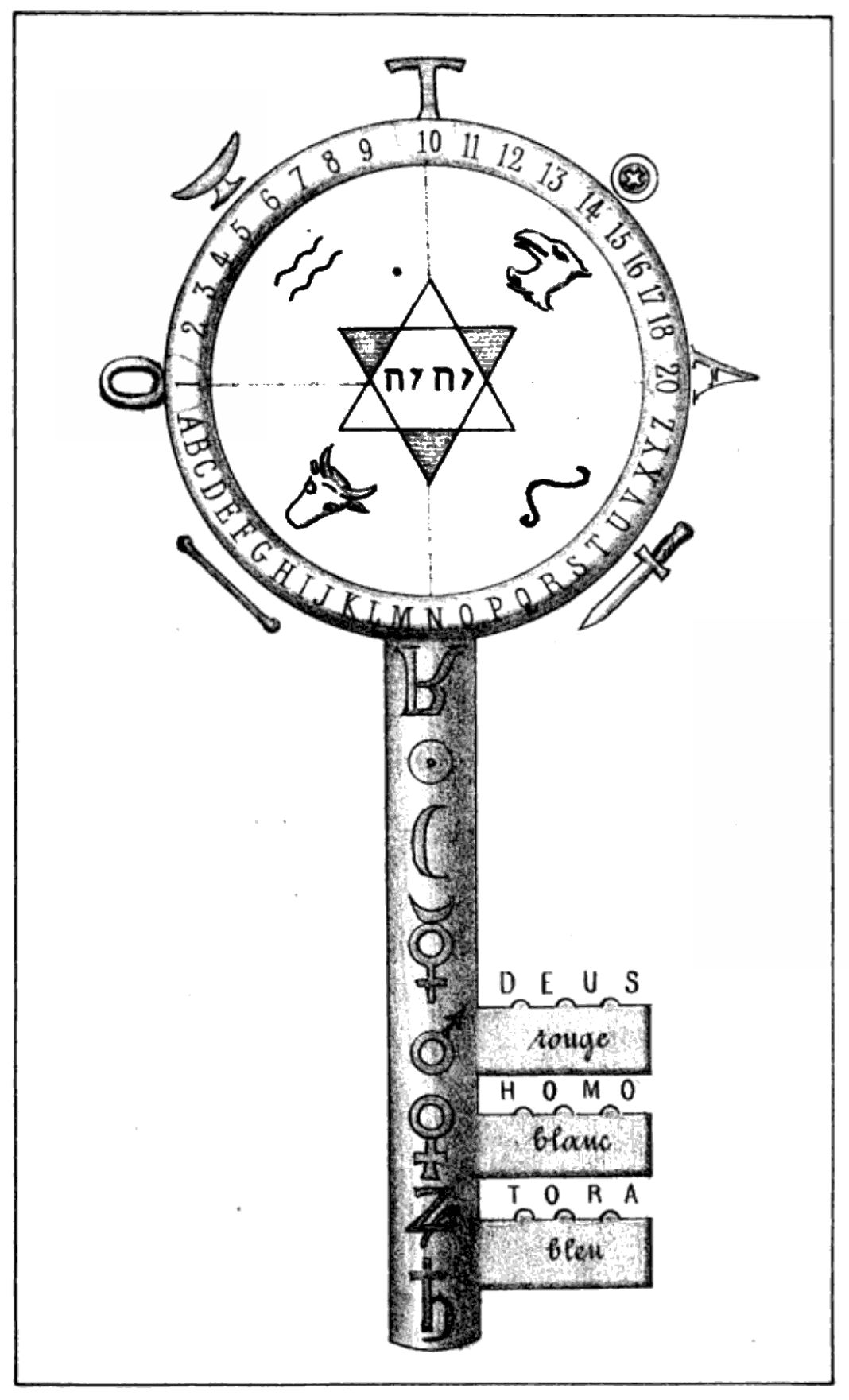
Postel’s Key thus became a reference to the building of a single system of knowledge that could unify religion, science, and mysticism using the structure of sacred language as the “key” to a divine hidden design. According to Postel, it was both a Kabbalistic grammar of creation and a prophecy of spiritual unity: the idea that when humanity learns to read the universe in the divine tongue again, all Mysteries could and would be unlocked.
 benebell wen
Wow, and yet once again, you cause us all to scratch our heads and ask…”Does she have extra hours in the day?” It all seems like PURE Magick!!!!
I adore all that you share, each of us in participation continue to grow in practice because of your wisdom and your willingness to share with the all of us. We are getting better at our Craft. Thank you for that!
LikeLiked by 2 people
Wow! Great find! I like this old key & philosophy But Waite/PCS illustrations stil my fav!^^ ok, good luck with your work can’t wait to see what you’ll do with these next?^^ lol
LikeLiked by 1 person
Pingback: Walk-Through of Key 1 to Key 11 in SKT III – benebell wen
Pingback: Walk-Through of Key 1 to Key 11 in SKT III – Indie News
Remarkable, iv had this key as my screen saver now for over a year and wondered why I was so attracted to it,, I now no why,, thank you for all the information…
LikeLike
Thank you so much, as always, Benebell… I am eternally grateful that you are so generous with your academic passion for the occult. I was wondering if you know what the abbreviations in the four corners of the inner square represent: the I.S., I.V., S.C., and H.R.? Also, I was able to figure out that the P.F.S. represents the Pater/Filius/Spiritus, but no idea what the N. S. E. represents. My best guess for the inner square is something or other with the cardinal directions and their associations with Earth, Air, Water, and Fire, but then again, those correspondences are not universal… Ah, well. Worth a shot to ask!
LikeLike
Hi There,
Did you know there is a very auspicious mosaic on the floor of Cologne Cathedral which includes the Wheel of Fortune and in the centre of the wheel it says “Deus in Rota est” which translates “God is in the wheel”.
I have a book about the mosaic, and there is an explanation included, which you will find interesting.
If you email me I will send you the photos from the book.
LikeLike