Guan Luo Yin 觀落陰 is a practice of wu shamanism 巫術 found primarily in the South Pacific. While methodologies will differ, one approach is as an astral journey to the underworld to see the spirits of those who have passed on; another is as a method of “remote viewing.”
Some traditions conceptualize the descent as beginning from the entrance to a cave at the base of a mountain (associated with the Kunlun Mountain). Others conceptualize it as a palace with many floors descending (as opposed to ascending the way floors of a building are constructed in the physical earthly world).
This video serves as an introduction to the practice.
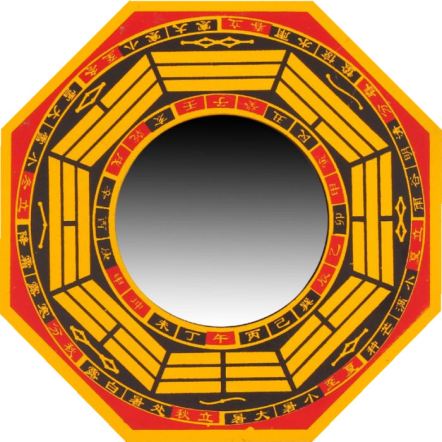
Learn a little more about this common ritual tool in traditional Asian folk magic. I’m inviting you to give the ba gua or eight trigrams mirror a try.
This video covers a few pointers on how to use a ba gua mirror to tell whether you’ve been hexed or cursed (a folksy practice that’s interesting to learn about, at the very elast), how a ba gua mirror can amplify your spell-crafting techniques, a simple intention-setting candle spell, how to make your own ba gua mirror if you can’t source one, and how to integrate this one tool and folk practice into what you’re already doing.
This is the continuation of a six-part video series I’m doing on Taoist and Buddhist Mysticism as it has been practiced historically and culturally. We are now on to Video 4.
4. Taoist Metaphysics
This video lecture will be a beginner-level overview of Taoist metaphysics, which will begin with the Taoist mythology for the origins of the universe, cover Taoist expressions and esoteric thought on reality as it has been created by our minds and by physical matter. Concepts of magic and non-physical entities will also be addressed.
This is the continuation of a six-part video series I’m doing on Taoist and Buddhist Mysticism as it has been practiced historically and culturally among the Han. Video 1 released earlier was the Introduction to Buddhist-Taoist Esotericism. We are now on to Video 2.
2. History of Taoist and Buddhist Mysticism in China
In this video lecture, we are going to cover over 4,000 years of history, going through the dynasties, beginning with the Xia, Shang, and Zhou, until we reach modern China. Our coverage will span beyond 4,000 years, preceding the Xia, to talk about shamanism in the Neolithic Era.
Works cited for everything covered in this lecture are in the end notes of The Tao of Craft (North Atlantic Books, 2016).
All videos in this series are closed-captioned for the deaf, hard of hearing, or those whose native tongue isn’t English. I’ve also made my best attempt at accommodating for the blind. If there is room for improvement in these regards, I’m open to friendly critique. Thank you!
Check out the “book trailer” I made by clicking above. Or just read below. I put book trailer in quotes because it’s not really a book trailer in the standard sense, as you’ll see.
After Holistic Tarot, I went to work on a book about feng shui. One of the chapters covered feng shui cures, and a common feng shui cure used in East Asian households is the Fu talisman. Growing up in the Western world, I’ve always laughed a little at the Fu talisman. It’s treated like a panacea. Bad feng shui? No problem– Fu talisman. Need a promotion at work? Fu talisman. No luck in finding love? Fu talisman. Weight loss? Yep, Fu talisman. And, of course, there’s also the fantastical–exorcisms and conjurings. How do you summon a demon, repel a hungry ghost, or invoke a tree spirit? Well, the same way you find love or lose weight, silly– a Fu talisman.
Needless to say, I’ve come to realize that’s not quite the right characterization of the Fu. Those would be, yep you’ve guessed it, common mainstream misconceptions of esoteric Taoist practices. In fact, the more I delved into the Fu, the more these centuries-old texts satiated my inner nerd. Not only were the alchemists and ceremonial magicians that thrived thousands of years ago deliberate, precise, detail-oriented, and thorough, much of it resonates closer to modern science than one might presume, though the vocabulary has changed. In The Tao of Craft, many of the end notes cover these parallels. The deeper I went down the rabbit hole of historic research (and experiential practice), the prouder I felt about being who I was, descending from the lines I descend from, and feeling a genuine affinity for my heritage.
 benebell wen