Whether you’re a tarot beginner (in which case may I suggest you check out “Introduction to Intuitive Tarot,” “Tarot and Pop Culture,” or “Unlocking the Major Arcana through Yoga”), proficient with tarot but looking to take your practice to the next level (ooh–check out my class on “Learning the Opening of the Key” *tooting my own horn*) or you’re aspiring to become a professional tarot reader (check out “Party Readings for Tarot Professionals” or “Tarot, from Hobby to Profession”), the first ever Tarot Summer School is a magnificent trove of tarot studies. A complete list of all course offerings is here, via this link. I’ll be a student, just like you, sitting in on all the courses. So many of them are getting me super excited!
There will also be campfire Q&A sessions where all enrolled students can come together (over the Internet; I don’t know how it works; it’s magic; you’ll have to ask headmistress Ethony) and I will try very hard to make it to one of those campfire sessions so if you want to chat with me, ask me your tarot questions, or whatever, you’ll want to enroll and gain access to the campfire Q&A.
Check out the below link to read all the course listings, meet the faculty, and watch everybody’s course introduction videos. It’s a really diverse group of tarot personalities.
And to give prospective students a free preview of my course, “Learning the Opening of the Key,” I’ve uploaded and made available the first video installment of the lecture series, the Introduction. Check it out:
If that sneak peek into my full course piqued your interest, then enroll today! It’s only $24 USD per course. Or get the lifetime access season’s pass for $199, which gets you all the courses this semester.
And if I did not manage to pique your interest, then… *shrug* doh. I did my best.
But do check out everybody else’s course offerings even if mine isn’t your cup of tea. I know at least one of those master classes is making you go “ooh!!” Embrace that “ooh!!” and your woo, and we the instructors at Tarot Readers Academy will see you at Tarot School this summer.
It begins around 25:11 when one of my favorite YouTube personalities Kelly-Ann Maddox talks about #TarotsoWhite and the “overwhelming lack of racial diversity in tarot and oracle decks.” Maddox covers it all. She acknowledges white privilege, too much whiteness in the human depictions on tarot decks, disappointment in the fetishization of people of color in the rare times they are actually portrayed (she gives the example of the Nubian queen), and wonders what it is like for us people of color to spend untold amounts of money on tarot and oracle decks only to flip through them to see that you’re not being represented.
Well. The reality is we’re used to it. Or at least I am. It wasn’t until around 2000 that my community was represented in the media beyond sage-y old kung-fu masters with broken English and fortune cookie wisdom, me-love-you-long-time, dragon ladies, geishas, or know-it-all nerds. I mean I guess I’m okay with the know-it-all nerd. I can sort of identify there.
The reality is I’m used to not seeing ordinary Asian faces in the media and tarot is no different. If I don’t see myself depicted on film, then what makes me think I should get to see myself depicted in the tarot courts? Instead, I get “pleasantly surprised” when I see non-stereotypical images of Asians, well, anywhere, and then doubly pleasantly surprised when it’s on a tarot card.
My first inclination is to say, as a person of color, the whiteness of tarot card imagery doesn’t bother me. But I can’t leave it at that. I have to ask myself why it doesn’t bother me. The reason why it doesn’t bother me is what I said before—by now I’m used to it. People of color are used to being invisible. And, well, that’s deeply problematic. So even if it doesn’t bother me, it should bother me just as it should bother every person of color. If it doesn’t bother you, then it will never change. And if it doesn’t change, then the racial paradigm will always leave us marginalized.
As for #TarotsoWhite, I really don’t know what to say on this topic. On one hand, I don’t want to think about race during a tarot reading. Anything in the imagery on a tarot deck that “stands out too much” (and I don’t mean in a semiotic way) can be distracting to me. Here’s the thing: I want to think about race. I want to talk about social justice. But maybe not during a tarot reading.
And I do find that sometimes racial diversity depicted on a deck can be distracting because—sad, sad fact—it’s not something we’re used to seeing. Racial diversity is really different for us. Seeing a token Asian dude or a Black woman doing something that is not stereotypical or fetishized is different, and it’s so different for our senses that it can actually become a distraction. It becomes your focal point because differences are always our focal points. Instead of turning my mental wheels on the symbolism of the pomegranates and what that omen holds for our seeker, I’m thinking, “Oh look! The High Priestess is an Asian chick! How neat!”
One comment you hear echoed among readers about #TarotsoWhite is that the whiteness in tarot is why they have a preference for abstract tarot and oracle decks where any human figures depicted are racially ambiguous. The subtext here is: “I want to be racially inclusive but I don’t want to think about race during a tarot reading and people of color depicted in tarot imagery is still kind of distracting so this is my best response.”
I get that. I dig it. I agree.
The catch is, if no one buys tarot and oracle decks featuring ordinary people of color (and by extension, tarot readers get used to seeing–and liking–decks that feature ordinary people of color), then deck creators and publishers won’t be inclined to feature ordinary people of color, and so we will never get to that point where the Asianness of an Asian High Priestess or the Blackness of a Black Emperor won’t distract us.
The only way for race to not be a distraction is for the topic of race to become boring. When the topic of race is boring, an Asian High Priestess and a Black Emperor will be no big deal for our subconscious to handle. Unfortunately, the topic of race is very interesting right now, especially given the racially charged climate we live in.
So if I, a person of color, don’t even want to think about race during a tarot reading, do other tarot readers want to think about race when they dish out the Celtic Cross? And if we don’t want to think about race in tarot but race featured in tarot makes us think about race in tarot, then do people really want to buy tarot decks that feature different races?
Well. We have to.
Social progress in the tarot world will only happen if it’s profitable for deck publishers to get on board with social progress. Otherwise, they’re going to throw out a few token people-of-color decks so as not to appear racist, and then stick primarily to the all-white Arcana cast. Frankly, it’s not profitable right now for deck publishers to feature people of color because even people of color don’t want to see people of color. Everybody wants to see white people.
Each one of us bears the responsibility of changing that dynamic. Tarot practitioners have to make a conscious, concerted effort to show deck publishers, by the power of our spending, that tarot decks with zero racial diversity are not profitable. It sort of has to be a forced change at first, you know, fake it ’til you make it, and eventually, racial diversity in tarot will finally feel natural to us.
But it’s a tall order because the race thing is so deeply engrained into us that most of us don’t even acknowledge it.
It’s like how my name “Benebell” can bother someone because [true story here–and this is the part that she figured was okay to say in public…] Benewell was the name of her [presumably White] Civil War ancestor and so my name Benebell becomes a nuisance and a point of distraction to her. The racialized reality is [here’s the part people would think is not okay to say in public…] Benebell distracts her because Benewell was an old white dude and Benebell is a young(ish) Asian girl.
The race issue, albeit subconscious, was the distraction, not the name issue. If I had been an old white dude, my name wouldn’t have bothered her as much. But it bothered her because of the race discrepancy. She just couldn’t get over an Asian girl “hijacking” her White ancestor’s name.
That subtle yet insidious anecdote extrapolated out to the tarot community at large explains why we find racial diversity in tarot distracting (though would die before we admit it). It’s because our brains have been wired for a very long time to envision a white High Priestess and a white Emperor, and a white Queen of Cups, and white kids in the Six of Cups, and white people fighting in the Five of Wands. When these people are not white, we can’t help but stop to think, “oh… hey.” And at its worst (like the Benebell vs. Benewell account) it’s a nuisance and at best, a point of distraction.
It’s just something we have to get over as tarot readers. Not only do we have to get over it, but we have to push homogeny out of profitability and convince publishers and deck creators that it’s just economic good sense to feature boring racial diversity. No Nubian queens or geishas, just plain, boring people of color, but, you know, decked out like the Queen of Swords or the hermaphrodite in The World.
Addendum.
The tarot and oracle decks that fetishize or exoticize race are popular because we can observe racial difference in a way that emphasizes difference. Somehow that’s okay for our subconscious to handle. It’s when different races, i.e., people of color, appear normal and run-of-the-mill that blows our [subconscious, and sometimes not so subconscious] minds. When people of color are depicted as the “other,” that’s okay, and we can work with that. That’s not distracting because the depictions play in to our preconceived stereotypes. Deck creators and publishers have to do better than that. Racial diversity and inclusion has to go beyond Afro-centric Timbuktu pharaohs of ancient Egypt Imperial China Japanese samurai culture art.
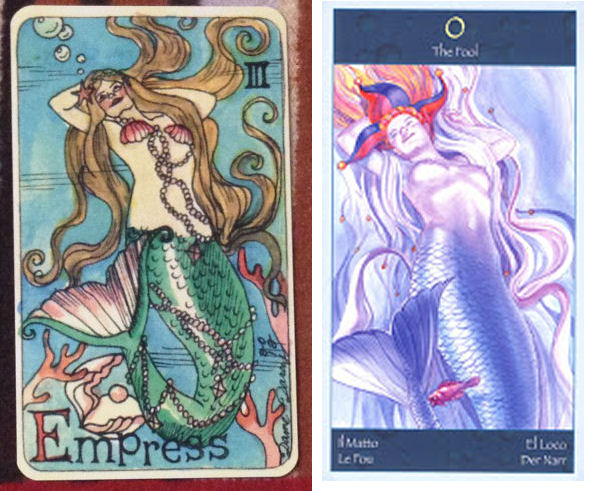
A friend of mine alerted me to a fascinating thread going on over at Aeclectic, “‘Recycled’ art in Dame Darcy deck.” Worth reading through. It seems there are allegations of copying or at the very least hostile reactions toward the striking similarity between some of the imagery in Dame Darcy’s mermaids deck and the Tarot of Mermaids by Lo Scarabeo published back in 2003. So I took a look for myself. I’ve created easy side by side comparisons of selected cards from both decks so you can be the judge for yourself. I didn’t discover any of these similarities on my own. They all came from the discoveries noted on the Aeclectic thread, which again, definitely read.
DD Empress vs ToM Fool
So this is the Empress versus the Fool from the two decks and there are clear differences, of course. But… fishy? Hmm…
This has been going on for a while already and I am having so much fun! However, I don’t know if I’m reaching enough folks, so here is a blog post. You can sign up to get on a list of folks who consent to possible free randomized divinatory readings to be delivered to your e-mail inbox, perhaps when you least expect it. This is offered alongside all my reading services that you can book. More info on my “Book a Reading” page. Scroll all the way down to see the info on the Free Randomized Divination Sign-up.
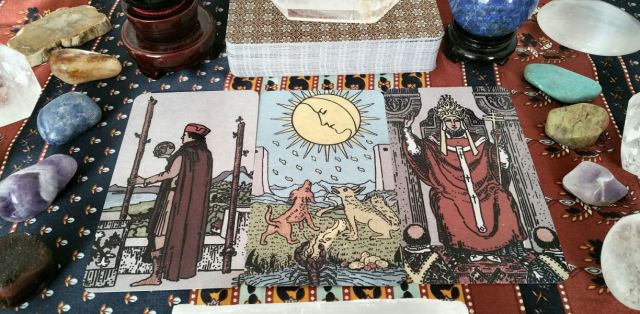
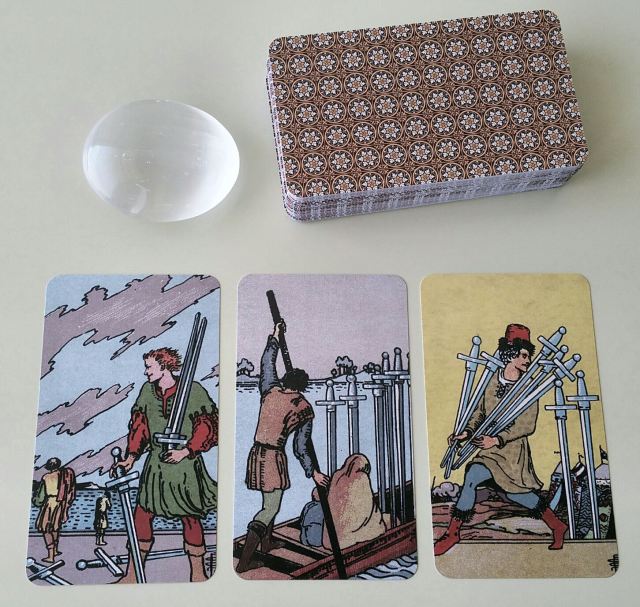
All participants were to take the above quote and run with it. The astrological correspondence for today is the 15th degree of the sign Aquarius, the fixed center of a fixed sign, with Aquarius expressed in Key 17: The Star card in the Major Arcana of tarot. The Star card is about “Awakening the Heart,” per Qabalistic correspondences subscribed to by the Golden Dawn. We can also look at the three decans of Aquarius in the Minor Arcana– the Five of Swords, Six of Swords, and Seven of Swords. Or let’s talk about how this mid-winter time of the year is a time of birthing– the quickening of seeds into the earth and the first litters of animals.
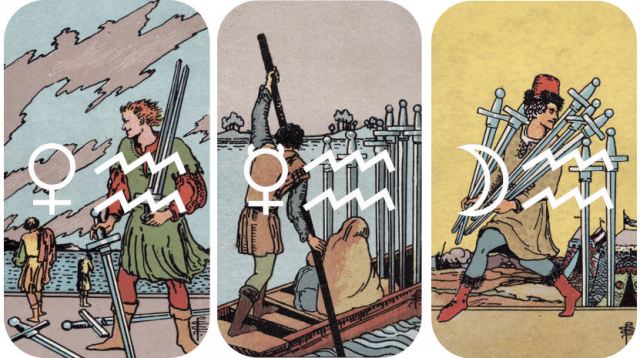
Those were the prompts we were given. We blogger participants were to take those prompts and write about something tarot-related. I’d like to talk about the Five, Six, and Seven of Swords in the Rider-Waite-Smith. For me–and the astrological correspondences may differ from reader to reader–the Five of Swords is Venus in Aquarius; the Six of Swords is Mercury in Aquarius; and the Seven of Swords is the Moon in Aquarius.
Perhaps these cards don’t immediately call to your mind an “awakening of the heart,” but in each of these cards, we see individuals who are on the verge of reaching that “still point” of their own center. In each scene, a specific spiritual seed is being planted in that moment that has been captured on the card.
In the Five of Swords, the figure in the foreground is beaming with victory for having defeated others, but we onlookers can finish that narrative– he is about to realize quite quickly that he is alone at the top, without friends, without camaraderie. Is his winning worth what he has lost? We know that he is about to experience an awakening of his heart, of realizing that winning isn’t everything.
As for the figures in the background who have been defeated, we can picture the next scene for each of these fellows. What do we ourselves do right after failure? We find a quiet corner to be alone and to lick our wounds. There is a moment of dark uncertainty, of not knowing exactly where we’ll go next with our lives, because defeat can feel like death. Yet it is this defeat (and also the realization that victory by unethical means puts us at an uneasy position of no support) that stimulates germination, triggering a growth within us. These figures are each at a still point, and to get past the defeat (and loneliness), there is no choice but to find their own center and then go from there. It is through an awakening of the heart that we get past our failures (or our ignorance) and move on. To me, the Venus in Aquarius correspondence speaks of an emotional awakening to come.
In the Six of Swords, the vast waters ahead of the figures in the boat represent that still point we head to when we’re trying to put distance between us and our past. While the Five of Swords shows us reaching the still point to experience an awakening of the heart, the Six of Swords shows us trying desperately to grasp at the still point, without success, because the boat is in movement, and we are in transit.
The hooded figure in the boat is said to be running away from a troubled past, with a prognostication that the future will bring smoother sailing. There is a paradox here, however. By the condition of the boat being in the water, the water cannot be smooth. The boat’s movement causes the rippling. Thus, the wisdom to be gained here is that so long as the boat is in movement, there can be no smooth waters. A still point at the center of the lake is required. That lake is a metaphor for our body of thoughts, the mind, noting the Mercury in Aquarius correspondence for the card. It is that future point when the figures in the boat come to a still point, no longer in transit, that their personal centers can become fixed and an awakening of their hearts can happen.
In the Seven of Swords, we see in the background the opposite of being fixed– we see the impermanence of the tents. If the Five of Swords is about an inevitable awakening to happen brought on by the circumstances we’re dealt with, and the Six of Swords is about the paradox of not being able to attain awakening when you run desperately to get to it, then the Seven of Swords, the Moon in Aquarius, is addressing what needs to happen at the subconscious level, noting the moon’s astrological attribution to our subconscious and the inner realm.
Toward an awakening is at the periphery of the consciousness for each of the figures in these cards, except the figure in the Seven of Swords. Even the victor in the Five of Swords is going to be forced toward awakening as soon as he realizes the isolation and loneliness that comes with his form of victory. But the figure in the Seven of Swords is unaware. The Moon in Aquarius correspondence for the Seven of Swords tells us that much is trapped in the subconscious. The figure in the Seven of Swords is entangled in the acts of both the Five and Six of Swords–simultaneously trying to gain an unfair advantage and trying to run away from trouble.
Yet I like to say that while the acts of the victor in the Five of Swords are intentional, they are not so by the figure in the Seven of Swords. Here is someone mischievous, but not devious. I do not see red hat red boots guy as malicious. He believes life has dealt him an unfair hand and he’s just trying to take control and gain his own edge. However, that is not stillness. His path is a far removed path from awakening of the heart. When the Seven of Swords appears in a reading, we must face our own disquiet and realize what we’re doing is not toward spiritual growth. We must take a deep dive into our subconscious to figure out what’s really motivating us.
The Five of Swords, with the numerical value five being closest to the “center,” also shows people who are closest to an awakening. As we move from the Six to the Seven, we move away from that center, and so germination cannot take hold. We can each identify with either the runaways in the Six of Swords or the runaway in the Seven of Swords. At every point, we identify with one or the other–each run an attempt to get to someplace better, but the Aquarian essence contains the true answer: finding the fixed position is what will awaken the heart.
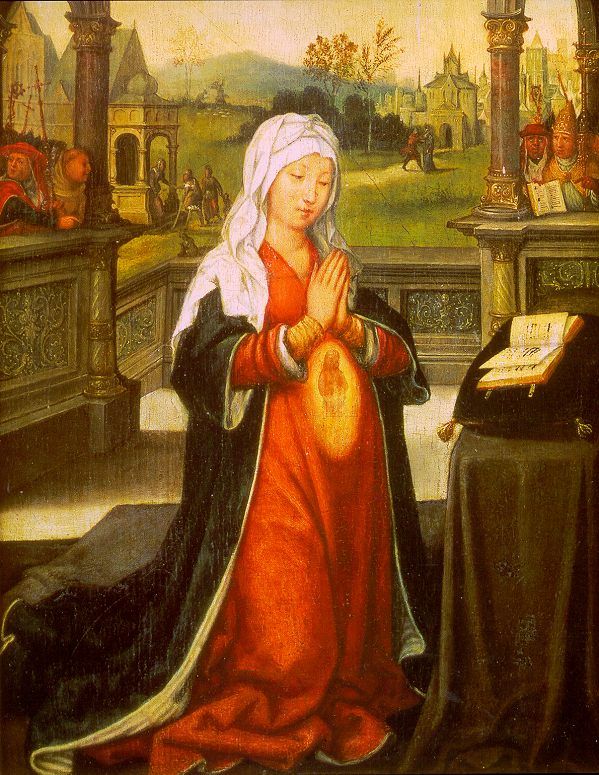
St. Anne Conceiving the Virgin Mary, by Jean Bellegambe (1480 -1535 )
Tarot readers often jest about the inevitable reading request, one that most tarot teachers instruct to be outside the bounds of tarot ethics to answer matter-of-factly, that one question that is so easy to postulate as the stupidest possible question to ask the tarot, and that is the question, “Am I pregnant?”
Inside, we smirk and giggle, and ask, “Why don’t you just take a pregnancy test?” and hoot a little at how ludicrous it is for someone to ask that question to the tarot, or to any divinatory medium. Even I have been guilty of thinking that response when such a question is presented. I mean, who in their right minds would go to a tarot reader and ask “am I pregnant?” How stupid do you have to be?
About as stupid as me.
Okay, actually, I’ve never presented that question to a tarot reader. But I am here to ask all of you tarot professionals who might not have experienced this side of life to hear me out and maybe, in the future, in your head and among your emotions, be sincerely able to show compassion.
Let me tell you what your favorite go-to tarot deck says about you. That’s right. I think I know you better than you know yourself. And all from knowing which tarot deck you like.
Visconti-Sforza Tarot by U.S. Games
Tarot de Marseille
You’re kind of an elitist snob. You think your tarot deck is more authentic than other people’s tarot decks and so that makes you better. When you’re talking about tarot, you make sure to emphasize that you read with the Marseille (no, you would say “TdM”) deck because you’re pretty sure that fact alone conveys the depth and breadth of your tarot knowledge.
Oswald Wirth Tarot by U.S. Games
Esoteric Tarot Deck Pre-1900
You’re an elitist snob. You’re probably a voracious reader of obscure books, especially books bearing titles that begin with “Liber.” You get all academic and historian-y when talking about witchcraft or ceremonial magic.
The Cartomancer is a quarterly journal just released this year. Its debut, the Summer 2015 issue was a huge hit. The only reason I’d heard of the magazine was because everyone I knew was buzzing on about it. The above is the Autumn 2015 issue.
You can buy each issue as an e-zine for $5.00 or the hard copy for $10.00. It’s worth the $10.00. The quality of the print magazine is spectacular, with heavy paper stock, vibrant colors, and absolutely stunning graphic design and layout. These are collectibles. A complete set of all printed issues of The Cartomancer is going to be worth something someday.
Setting aside the materialist reasons why this magazine rocks my world, check out the table of contents for Issue 2, the Autumn 2015 issue. You’re going to want to order your copy. Plus, your order goes toward supporting an awesome independent publishing house run by people who are passionate about tarot and working hard at making a living out of their passion! You’re supporting the very community that supports your tarot studies.
Jardim Zoológico de Brasília, Brasília, Brazil. Source: Daderot via Wikimedia Commons
One summer in my childhood I was forced to attend a Buddhist camp at a monastery where we woke up at the crack of dawn to do shaolin and meditate, ate vegetarian, prayed our gratitude to everyone we knew and ever met before we could eat said vegetarian food, and had to sit in uncomfortable cross-legged positions while listening to lectures.
There was one lecture I remember when a monk told us the parable of four blind men who came upon an elephant, felt it, and were describing the elephant based on what they were perceiving. I’m totally paraphrasing the details here, based on memory, but the point remains the same. One blind man came upon the elephant’s trunk, another the belly, another the leg, and another the tail, and each one concluded matter-of-factly about the whole character of the elephant based on that one part they were feeling. The elephant is long and cylindrical… No, are you crazy? The elephant is flat and wide… No, no, the elephant is like a column or pillar…
On February 21, 2015, North Atlantic Books hosted a free webinar where I talked about intuitive-creativity and tarot. You can check out a replay of the webinar above.
About the Webinar
Albert Einstein attributes his most ground-breaking insights not to logic or mathematics, but to intuition and inspiration or, as artists and writers often express it, to the muses. However, the one trait believed about the muses, about how intuition and inspiration hits us, is that it comes only when it comes, almost divinely, and the artist or writer cannot call upon it at will.
Yet through tarot, learn how to harness intuitive-creativity at will. Tarot facilitates the transcendent experience needed for the muses to speak to us. Learn how to use tarot to trigger your intuitive-creativity and apply the tarot fundamentals taught in my book, Holistic Tarot to remove creative blockages.
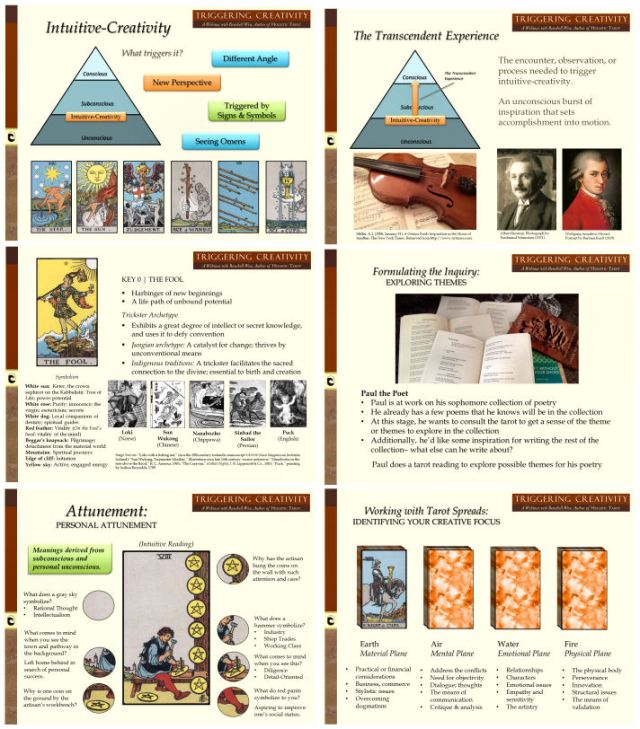
Presentation Slides Preview
In this 45-minute webinar that will be invaluable to any artist or writer, I’ll be lecturing about how to use tarot cards as an intuitive and inspirational tool for creative and artistic passion projects. The lecture will cover attunement, how to exercise the intuition muscle, and specific techniques for using tarot spreads to read about your creative projects.
When I say “intuitive-creativity,” I’m talking about the muses, about divine inspiration, about that “a-ha” moment. Learn how to use tarot to identify your creative focus, mind-map your project trajectory, perform character analysis if you’re writing a novel, explore the themes of your project in greater depth, and generally trigger your own inspiration with tarot card imagery.
Download the Handout
There is also a handout in PDF format that goes along with the webinar. Please be sure to download it as reference for the techniques and exercises discussed during the webinar.





 benebell wen