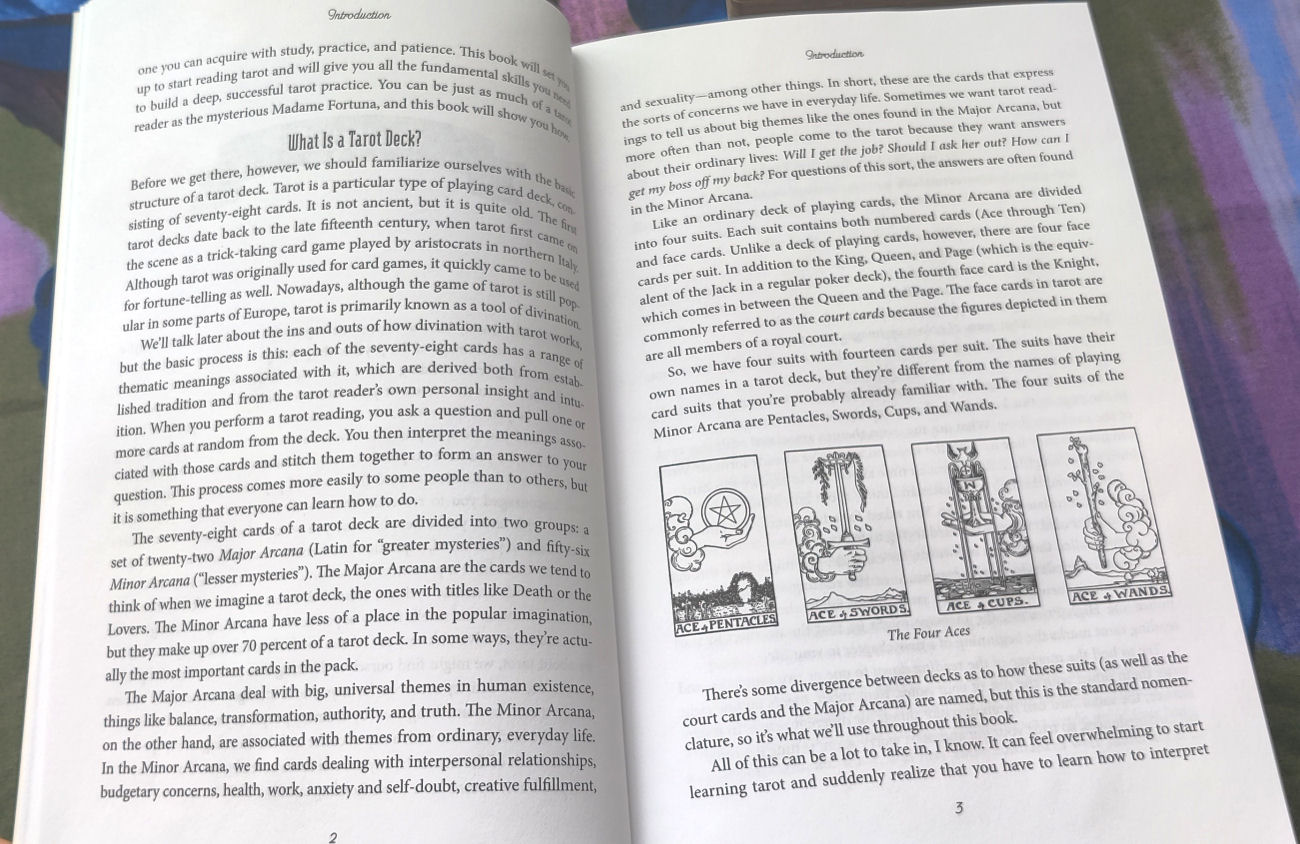
Tarot for Real Life by Jack Chanek, published by Llewellyn Books, presents one of the best approaches to learning tarot that you can find. I love its focus on the Minor Arcana rather than the Majors, though it most certainly gives due treatment to the Majors as well.
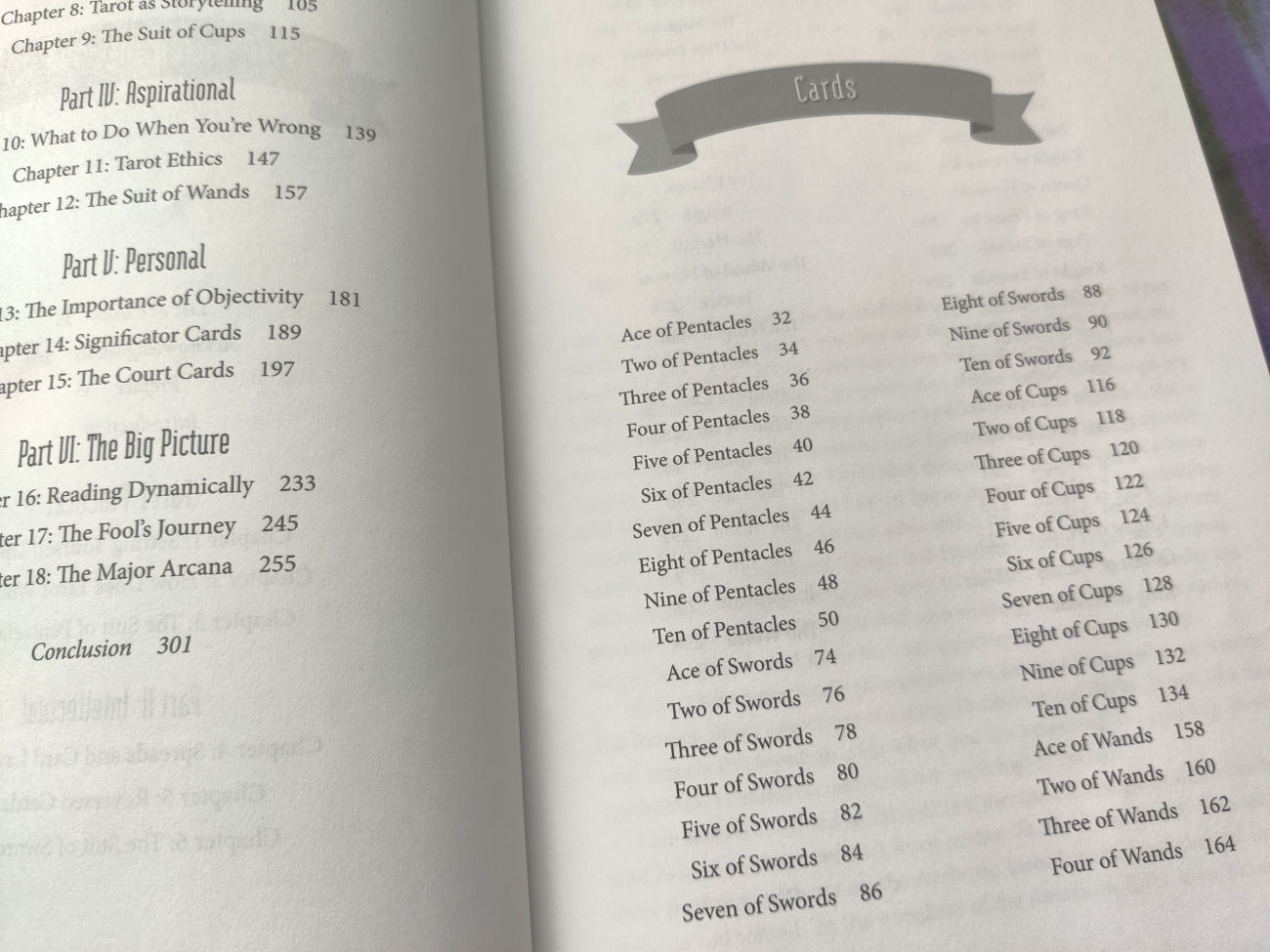
The structure and layout of the book also makes it user-friendly, and the go-to reference you’ll want at your fingertips. If you’re looking up a specific card, there’s a separate table of contents in the front pages just for the 78 cards.
The meat of the book is subdivided into six parts: Practical, Intellectual, Emotional, Aspirational, Personal, and The Big Picture. Respectively they correspond with discussions on the suit of Pentacles, Swords, Cups, Wands, the court cards (under Personal), and the Major Arcana (under The Big Picture).
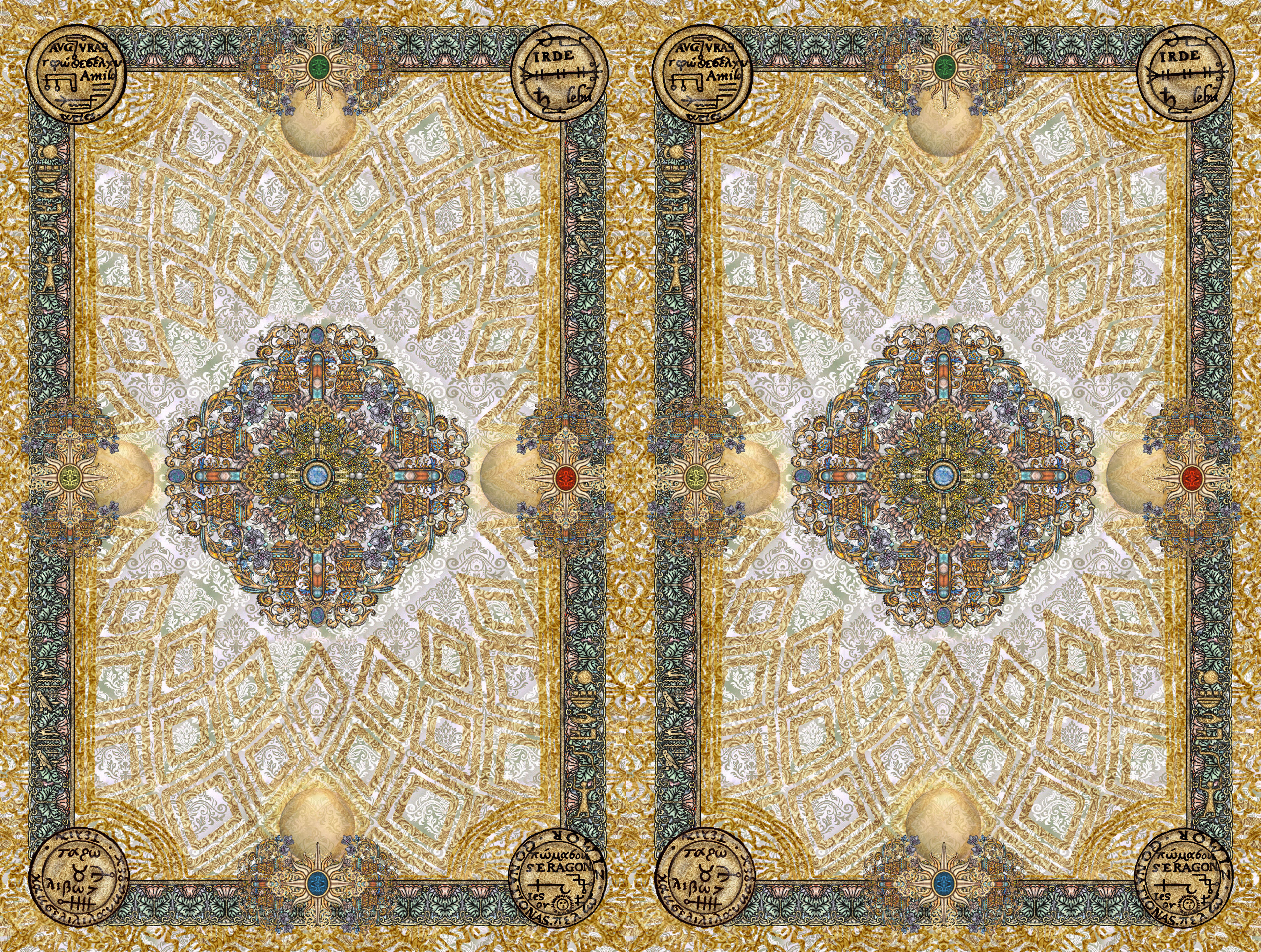
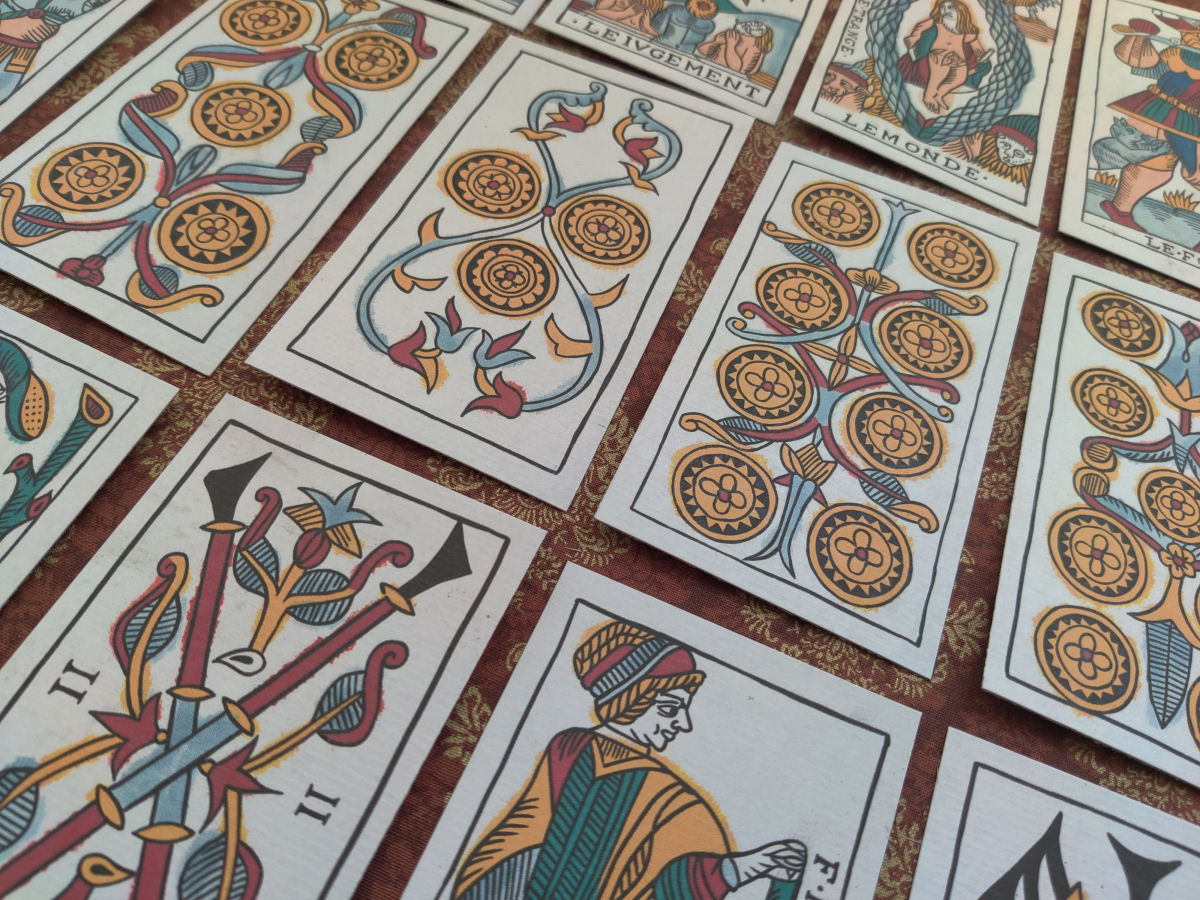
This masterpiece reproduction of the Jean Dodal Tarot by Justin Michael and Shell David (of East Tarot) is everything to me right now. It’s a fixture on the corner of my personal reading desk and when I’m catching up with old friends via zoom video calls, I’ll reach for this particular deck, sling some cards while we virtual-klink wine glasses, and read about Life.
I wish I could tell you that they’re selling these and you can buy one for yourself, but I’m not sure. You’ll need to reach out to either Justin Michael or Shell David directly to find out. Whatever the cost, having just one of such decks is worth your investment.
It becomes that prized tool. You’re not paying for just another tarot deck for your collection. Something like this is special. It’s the artisan craftsmanship and the personal touch that you’re investing in, which I truly believe is converted into energy and gets infused throughout the deck.
Dating back to around 1701, the Jean Dodal deck, one of the early iterations of the Tarot de Marseille tradition of tarots, were printed from woodcut engravings and hand-colored by stencil, produced primarily for export. Shell David’s restoration project is top notch, and Justin Michael’s printing and production– just, wow.
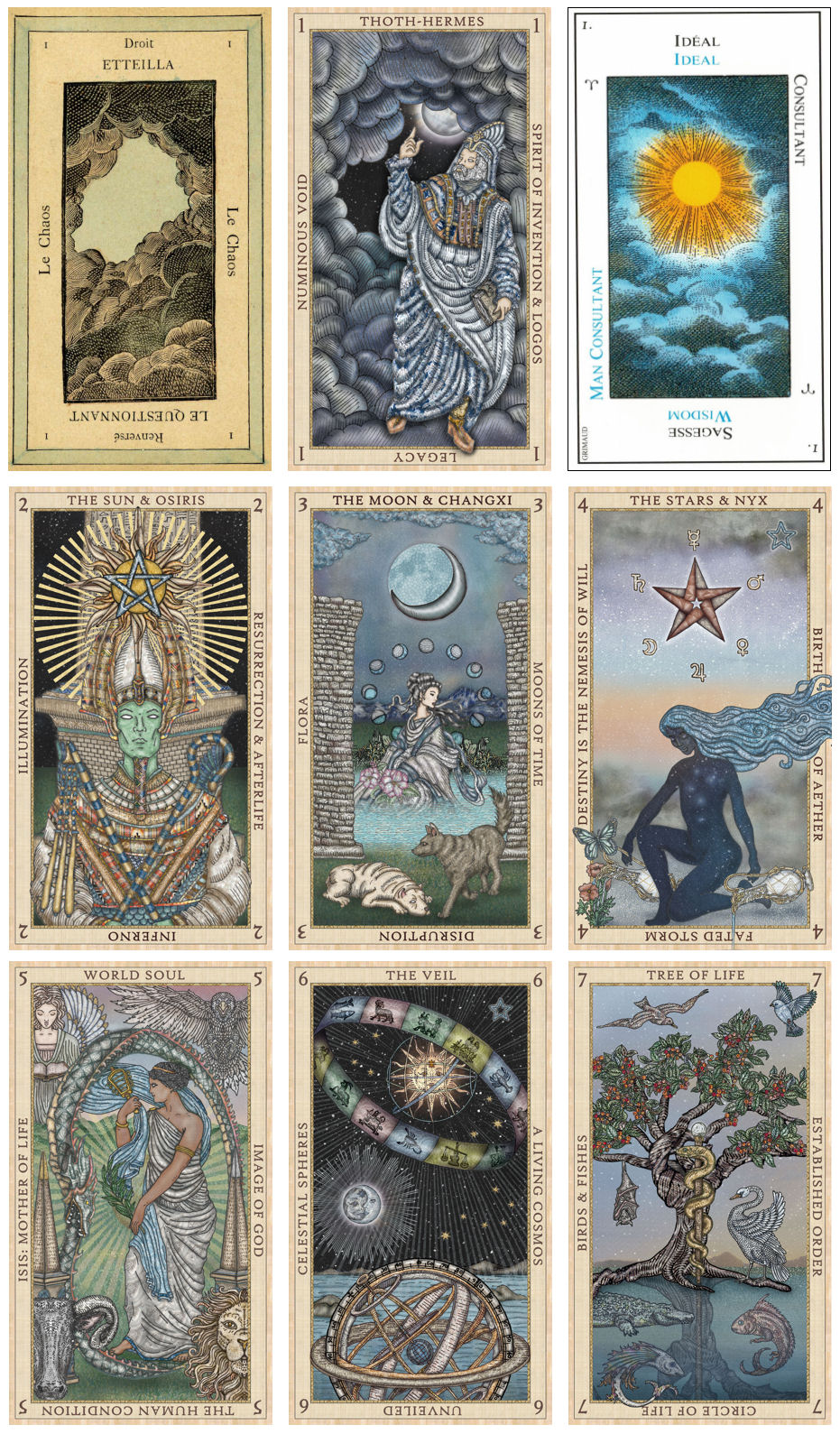
I’ve started a new project– a reconstruction of the Grand Etteilla. (The deck name won’t be “Etteilla Tarot Reconstruction,” I assure you. It’ll have some overly fancy name. That’s just a placeholder for now.)
The project premise I defined for myself was “reconstruction of the Etteilla,” but the first challenge presented was, which Etteilla? What do you mean by a “reconstruction” of the “Etteilla”? And then, like, the deeper I tried to philosophize on those questions, the faster my brain melted. =(
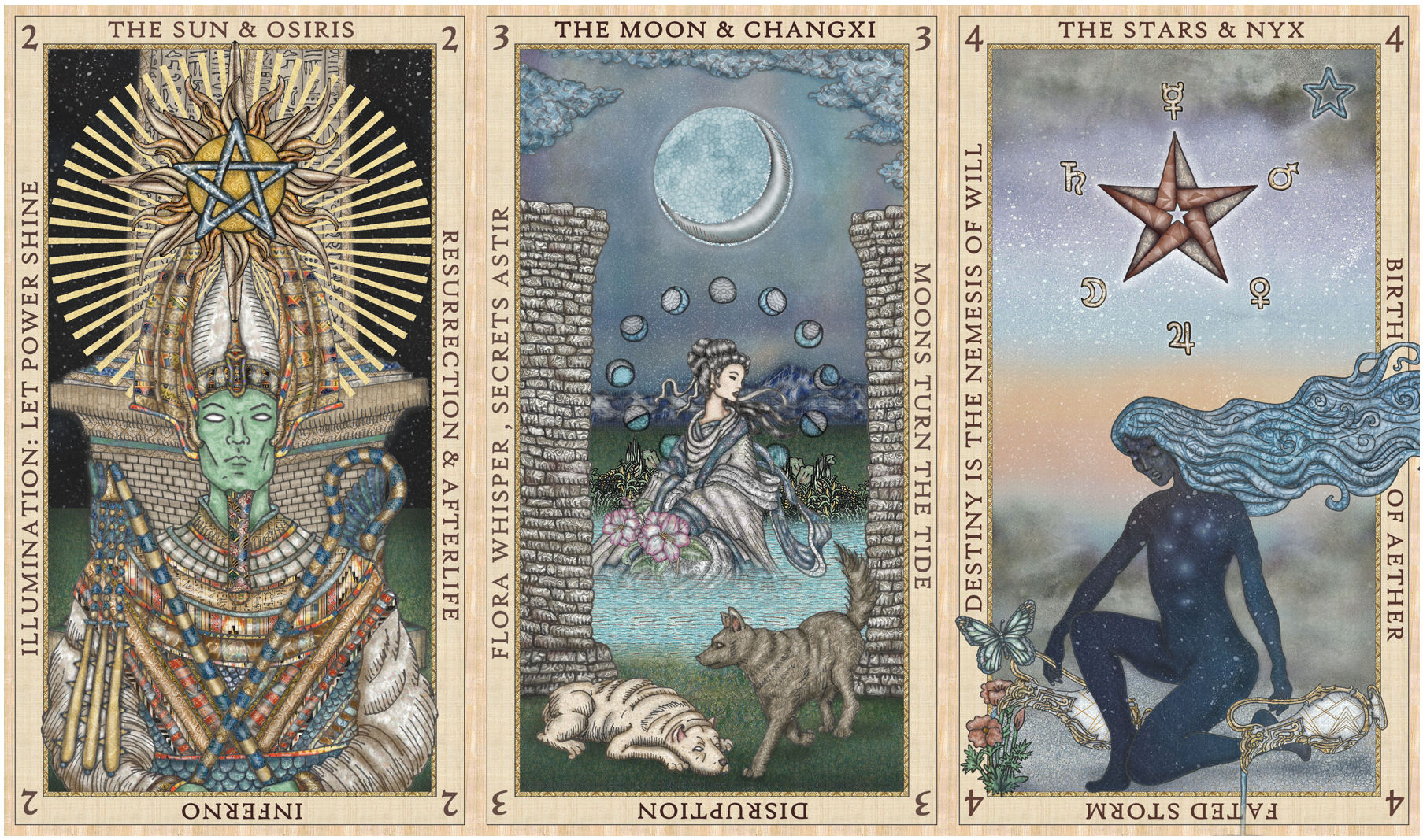
Here, I’m saying reconstruction because I will be rebuilding the deck with more overtly Hermetic references from the Divine Pymander, which I believe was Etteilla’s original intention. And while I want to stay true to the original imagery– I do– I’m also adamant that the overall approach needs to be updated.
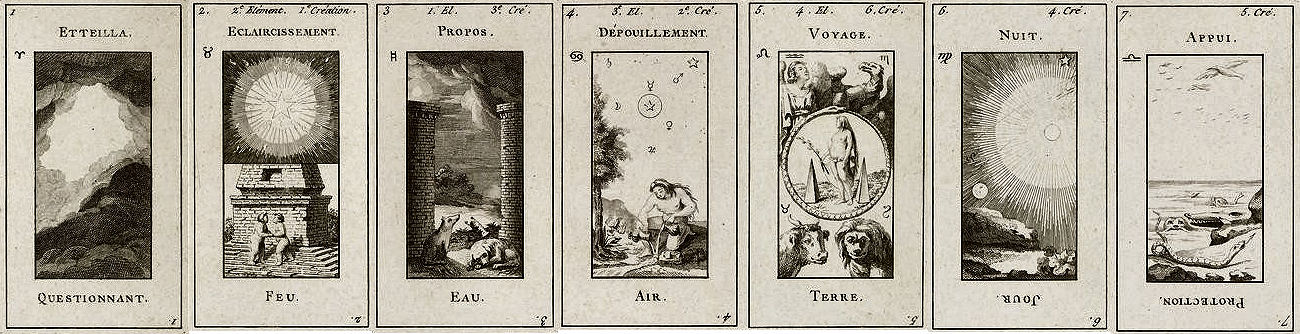
Livre de Thot Engravings by Pierre-Francois Basan (1723-1797)
Tarot historians designate three major iterations of the Etteilla: the Grand Etteilla I, which would be Etteilla’s own pack and its direct descendants, circa 1791; the Grand Etteilla II published as the grand livre de Thot under Julia Orsini, believed to be a pseudonym for the publisher, circa 1838; and the Grand Etteilla III published as the Grand jeu de l’Oracles des Dames, first printed by G. Regamey around 1865. Both II and III were produced by the most notable students of Etteilla’s school of cartomancy. [Decker, Depaulis, and Dummett]
But… (!!!) there’s no real consensus on that. So you’re going to find different Etteilla I, II, III designations in different places. As if I’m not confused enough. =)
There’s also the Jeu de la Princesse Tarot circa 1843 sandwiched somewhere in between II and III, considered an offspring of Etteilla I. Another edition of Jeu de la Princesse Tarot seven years later changed Card No. 1 from the Male Querent (or The Man who Consults) to Thoth and Card No. 8 (previously the Female Querent) to Princess Tarot–“Princess Tarot” being described as a priestess or seer of Thebes and Memphis. After that there were a few more versions of the Etteilla of varying styles.
Grand Etteilla Egyptian Tarot (France 1969)
A 1969 Grimaud version of the Grand Etteilla features astrological correspondences where the first twelve cards are the zodiac signs, Aries through Pisces. So Card 1: Chaos is Aries, Card 2: Light (The Sun card) is Taurus, Card 3: Flora (The Moon card) is Gemini, and so on.
Then the ten pip cards in the suit of Coins correspond with the Sacred Seven planets, Lot of Fortune, and two lunar nodes. So the Ace of Coins corresponds with the sun, the Two of Coins with Mercury, the Three of Coins with Venus, etc.
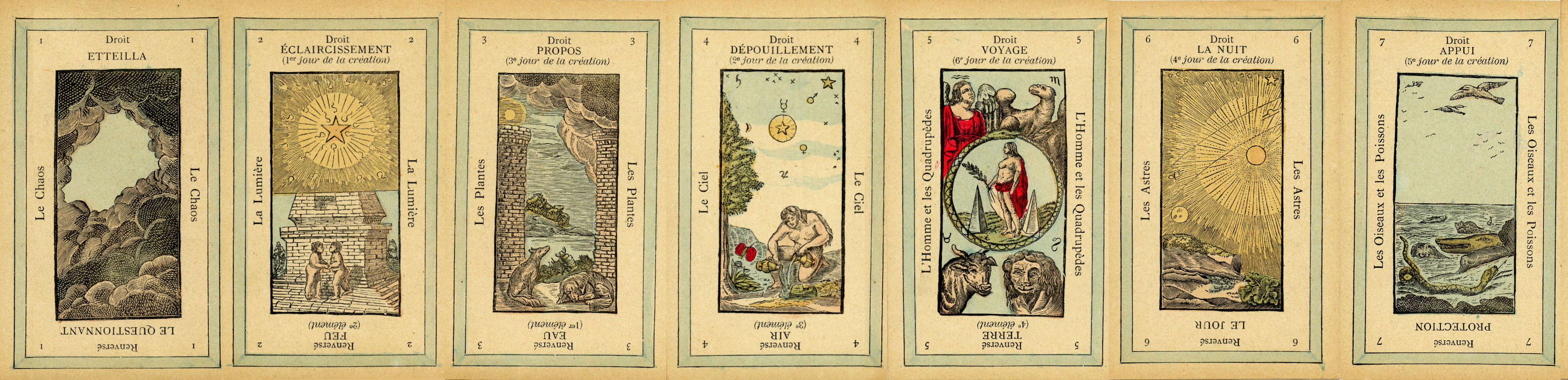
From Jeu Des 78 Tarots Égyptiens: Livre De Thot (Paris, 1800-1850) published by Z. Lismon
The first seven cards also signify genesis, expressive of Creation. Then Card No. 8 in the second septenary is the High Priestess (in some versions of Etteilla) or more frequently, titled Rest, for the Biblical seventh day of creation when God rested, which He then made holy.
Card No. 1
In the beginning…
Card No. 2 upright
Day 1 of Creation
Light
Card No. 3 upright
Day 3 of Creation
Land, Sea, and the Plant Kingdom
Card No. 4 upright
Day 2 of Creation
The Sky
Card No. 5 upright
Day 6 of Creation
Land Creatures & Humans*
Card No. 6 upright
Day 4 of Creation
Sun, Moon, and Stars
Card No. 7 upright
Day 5 of Creation
Sea Creatures & Sky Creatures
Card No. 8 upright
Day 7 of Creation
Rest
And here’s how I interpreted the order of Creation that’s expressed in the first seven cards, per the Corpus Hermeticum:
Card No. 1
Void / Chaos
Card No. 2
Light
Card No. 3
Time
Card No. 4
Space
Card No. 5
Matter
Card No. 6
Quintessence
Card No. 7
The Tree of Life / World Tree
Card No. 1 is the Male Querent while Card No. 8 is the Female Querent. The left two cards above are two different versions of the Male Querent card and the right two are versions of the Female Querent significator card. If you’re confused and secretly wondering if you’re dumb, don’t worry– I’m right there with you. I don’t get it either.
This is Video 14 in an educational series on the tarot cards. Closed captioning is provided for all videos in this series. A written transcript is also provided as a free pdf download.
The transcript for every video lecture is provided. You can go to the Video Series Homepage, scroll down to “CONTENTS LISTING,” and download the PDF transcript notes for each installment.
It’s not as easy to find good foundation primers on the Marseille system of tarot, so I’m pleased to share Reading and Understanding the Marseille Tarot by Anna Maria Morsucci and Antonella Aloi first published in 2018 by Lo Scarabeo and distributed by Llewellyn.
Morsucci is an Italian writer, former journalist, spiritual and life coach, who has organized numerous astrology and tarot conferences throughout Italy. Aloi is a psychologist, counselor, and director at the Italian Humanistic Counseling Center, with a background in communication sciences.
This is a comprehensive beginner’s guide to the Marseille Tarot that begins by defining what the tarot is: a deck of 78 cards grouped into 22 Major Arcana numbered 1 to 21 with an unnumbered or designated 0 Fool card, placed either at the beginning or end of the Major Arcana sequence, plus 56 Minor Arcana cards subdivided further into four suits– Wands, Swords, Chalices, and Pentacles.
I’m completely flummoxed at myself for not having posted a deck review or walk-through of Holly DeFount’s Incidental Tarot before. I’m still fairly sure I have, somewhere, and it’s simply a matter of me unable to find where I’ve posted it. =P
This is going to be a walk-through of the card images and sadly, at the time of this posting, I believe the deck is out of print. My main purpose for posting this is for you to discover how amazing this deck is and reach out to the deck creator with pleas requests for a reprint!
After noting the card drawn for each position in the 21-card spread, write down the keywords from the reference table onto your worksheet pages. The keywords themselves will support your arrival at the divinatory significance of the reading.
Tarot: The Path to Wisdom by Joseph D’Agostino was first published in 1976. A second edition was released in 1994, which is the copy of the book that I have.
I’m not sure whether this book was intended for beginners, but I’m guessing so, since it devotes most of its pages to card meanings, and gives the obligatory opening chapters on what the tarot is.
As a beginner’s guide to the tarot, it starts you off with instructions for two divinatory methods: the Celtic Cross and this 21-card tableau. . . . Beginner tarot books have come a long way since then. =)
I had the incredible opportunity of meeting Dr. Yolanda Robinson in London a few years back, where she gifted me with a copy of Studies on Mystical Tarot: The Court Cards, published in 2013.
Sourced from Studies on Mystical Tarot: The Court Cards (2013) by Yolanda M. Robinson
Robinson is a professor of transformational psychology and a member of BOTA, the Builders of the Adytum, a western mystery school tradition dedicated to the study of Qabalah and the Tarot. Studies on Mystical Tarot explores the tarot courts through a Rosicrucian lens, contextualizing the courts through Hermetic Qabalah and modes of inner alchemy.
This Sightsee the Tarot video installment will guide you through two self-reflection meditative exercises with the court cards in your favorite tarot deck. The first will focus on the four Kings to reaffirm your personal power and the second will be working with the Page of Pentacles.
Ancestral Tarot (Red Wheel Weiser, 2021) by Nancy Hendrickson, a genealogist and tarot master, is an incredible journey into self-discovery through ancestor work. This Sightsee the Tarot video is a guided meditation and three-card reading from Ancestral Tarot— how to commune with your Ancient Ones. You’ll find this spread in Chapter 5, Ancestors of Blood.








 benebell wen