Mindful Tarot: Bring a Peace-Filled, Compassionate Practice to the 78 Cards by Dr. Lisa Freinkel Tishman blends the principles of Zen Buddhist practice with the tarot. The result is a meaningful text that will develop your tarot reading skills at three levels: (1) mindful awareness of yourself and your querent, (2) a deeper relationship with your cards, and (3) a transformed understanding of the tarot system. Mindful Tarot is filled with exercises, reflective journaling prompts, analyses of all 78 cards, and step-by-step examples of Dr. Tishman’s own daily practice.
Tishman is an extensively published and celebrated poetry scholar, Zen Buddhist minister, certified mindfulness educator, and former humanities professor and dean at the University of Oregon (UO). She is also the founding director of UO’s Mindfulness-Based Stress Reduction program.
Tishman currently serves as an interfaith chaplain at Sacred Heart Medical Center in Springfield, Oregon. You can find a wealth of free resources and contact Tishman for her tarot reading or counseling services at Calyx Contemplative Care.
In this episode of Sightsee the Tarot, we explore Dr. Tishman’s mindful PULL approach to tarot reading and work through her signature Chariot spread.
Andy Matzner, author of The Tarot Activity Book (2013), is a licensed clinical social worker, psychotherapist, and tarot card reader. His book features creative activities with the tarot for mental and emotional wellness, designed to help facilitate self-awareness and personal transformation.
The approach to the tarot we’re adopting today is that of a tarot life coach and counselor. How can we work with the tarot archetypes in a way that brings out our creativity?
In this episode of Sightsee the Tarot, I share with you one of the activities from The Tarot Activity Book: working with a tarot card as your teacher, mentor, or guide.
A modified version of this course was first presented at the October 2018 UK Tarot Conference in London. This course was first offered as part of the Tarot Summer School 2019 lineup at the Tarot Readers Academy.
This is an advanced esoteric tarot course that will walk you through a 21-card Pyramid Reading designed to be a spiritual experience. The reading and purpose is built upon the Four Directives of the Magus: to know, to dare, to will, and to keep silent. The Four Directives and the blueprints to your inner temple divined through the Pyramid Reading will pave your Threefold Path of Wisdom: mastery over alchemy, astrology, and theurgy, and to understand their significance to the study of esoteric tarot.
Tarot and Astrology: The Pursuit of Destiny by Muriel Bruce Hasbrouck was first published in 1941. We’ll be working with the astrological correspondences for the cards as covered in the text. Since a copy of the book can be difficult to source, a great alternative reference source is Tarot Correspondences by T. Susan Chang. Links to both books are provided below.
In this episode of Sightsee the Tarot, we’ll be journaling through the tarot keys corresponding with our date of birth. Through analysis and self-reflection prompted by these cards, we’ll be answering six questions for ourselves:
What are the main attributes of your personality?
What are your natural strengths?
What are your natural weaknesses?
What is your one major character flaw?
What gifts, talents, or skills do you have to contribute to the world?
What is your life purpose?
There are two supplemental handouts you’ll want to download and have on hand while you watch the video. The first is the “Six Journaling Prompts” worksheet and the second is “The Tarot Keys to Your Birthday” reference tables. There are three (3) versions: one keyed to the RWS tarot, one to the Thoth, and one to my SKT deck. Download the version corresponding with the deck system you’re using. If you’re using a TdM deck, then I recommend working off the Thoth reference guide.
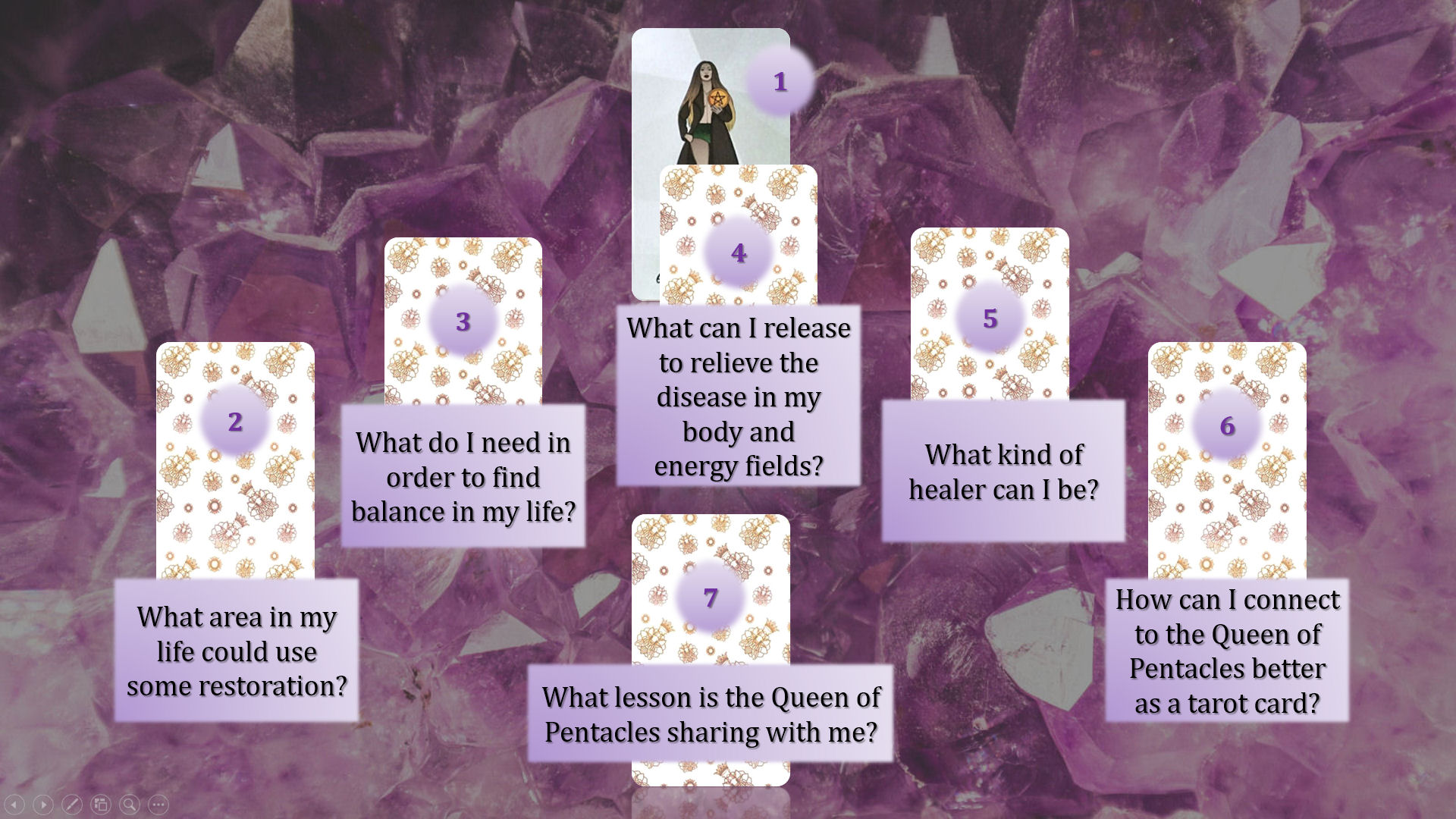
This guided tarot reading and journaling session will connect you to the Pillar of Healing power that the Queen of Pentacles rules over. Connecting to the Pillar of Healing through this meditative exercise can help to bring you some relief and calming to the physical aches and pains you’ve been suffering from.
Essentially, you’ll be invoking the Queen of Pentacles for the divine gifts she rules over and using energy healing techniques and guided meditation to help placate any physical pains or discomforts you’ve been feeling.
I’ve worked with Tori Hartman’s Chakra Wisdom Oracle cards since 2014 when it was first published, and the oracle deck is lovely. So I’ve been greatly anticipating the release of Chakra Wisdom Tarot. The Chakra Wisdom Tarot presents a fresh, contemporary, and innovative Western interpretation of the Eastern chakra correspondence traditions.
An understanding of Hartman’s interpretive approach might help lend context to both the Chakra Wisdom Tarot and her previous Chakra Wisdom Oracle cards. Hartman is a psychic and she approaches cartomancy as a magnifying tool for clairvoyance and claircognizance. A near-death experience over 20 years ago awakened clairvoyant and claircognizant abilities within her, transforming her life purpose. Since then, she has been a teacher of the spiritual and metaphysical arts. Once you understand the defined scope of Hartman’s approach, her cards and even her chakra interpretations make a lot more sense.
In the first grouping of cards, color-coded red for the First Chakra, as it’s referred to in this deck and book set, or Muladhara, relates to “The Route Taken.” These 11 cards center around the theme of family beliefs and shifting old ideas (per the guidebook). The element is Earth and in terms of planetary correspondences, Hartman attributes the First Chakra to the Sun, which is a provocative interpretation.
There are many surprising assignments in the deck, which I appreciate because they push the limitations of my preconceived notions. For example, the Ace of Cups is assigned correspondence to the root chakra. While that may be a significant divergence from my classical understanding of the tarot and my native Eastern metaphysical practices with the chakra systems, it’s certainly groundbreaking and revolutionary. I like when deck creators walk toward the cutting edge, and Chakra Wisdom Tarot certainly does that.
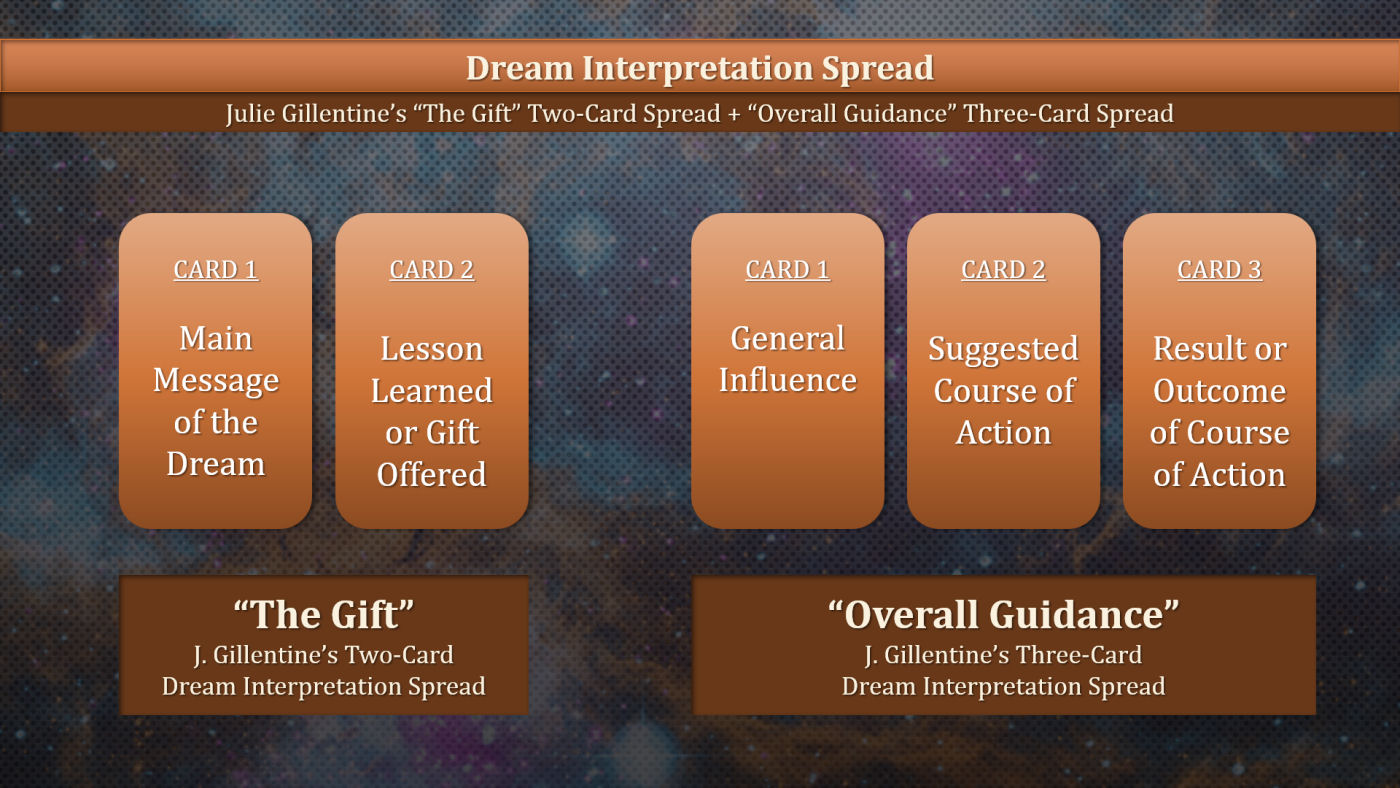
How might you use your tarot deck for dream interpretation? Julie Gillentine shows us in her book Tarot and Dream Interpretation (Llewellyn Books, 2003). In this video, I share how I use two of the dream interpretation tarot spreads designed by Gillentine.
Once upon a time, general readings–where the tarot reader doesn’t get the luxury of knowing a querent’s question ahead of time–was a norm.
Today, modern readers struggle with general readings.
Let’s go back to the late 40s and receive some instructions from Paul Foster Case on how we might be able to master the general reading. We’ll be delving in to The Tarot: A Key to the Wisdom of the Ages published in 1947. What we’ll be working through today, the Opening of the Four Worlds and part of the First Operation of the Opening of the Key reading method, was also featured in one of his earlier works from 1933, The Oracle of the Tarot: A Course on Tarot Divination.
Those of you who’ve gotten tarot readings from me before will recognize this reading method. I start every single reading I do, whether it’s a general or a specific question reading, with a preliminary divination derived from this First Operation, or the Opening of the Four Worlds.
Online Independent Study Course
I offer an online independent study course on the Opening of the Key,
The Opening of the Key is a five-operation inter-disciplinary divinatory procedure rooted in the adept traditions of the Hermetic Order of the Golden Dawn. Today, given the publicly available records of the procedure, it can be used by tarot practitioners from all backgrounds.
However, this course isn’t about learning the OOTK (though you will). It is about deepening your understanding of divination.
Through a series of eleven video lectures, a 50-page OOTK workbook, and a wealth of study guides, handouts, templates, and quick reference sheets, you will not only master the OOTK procedurally, but also learn basic astrology, numerology, and the Kabbalah.
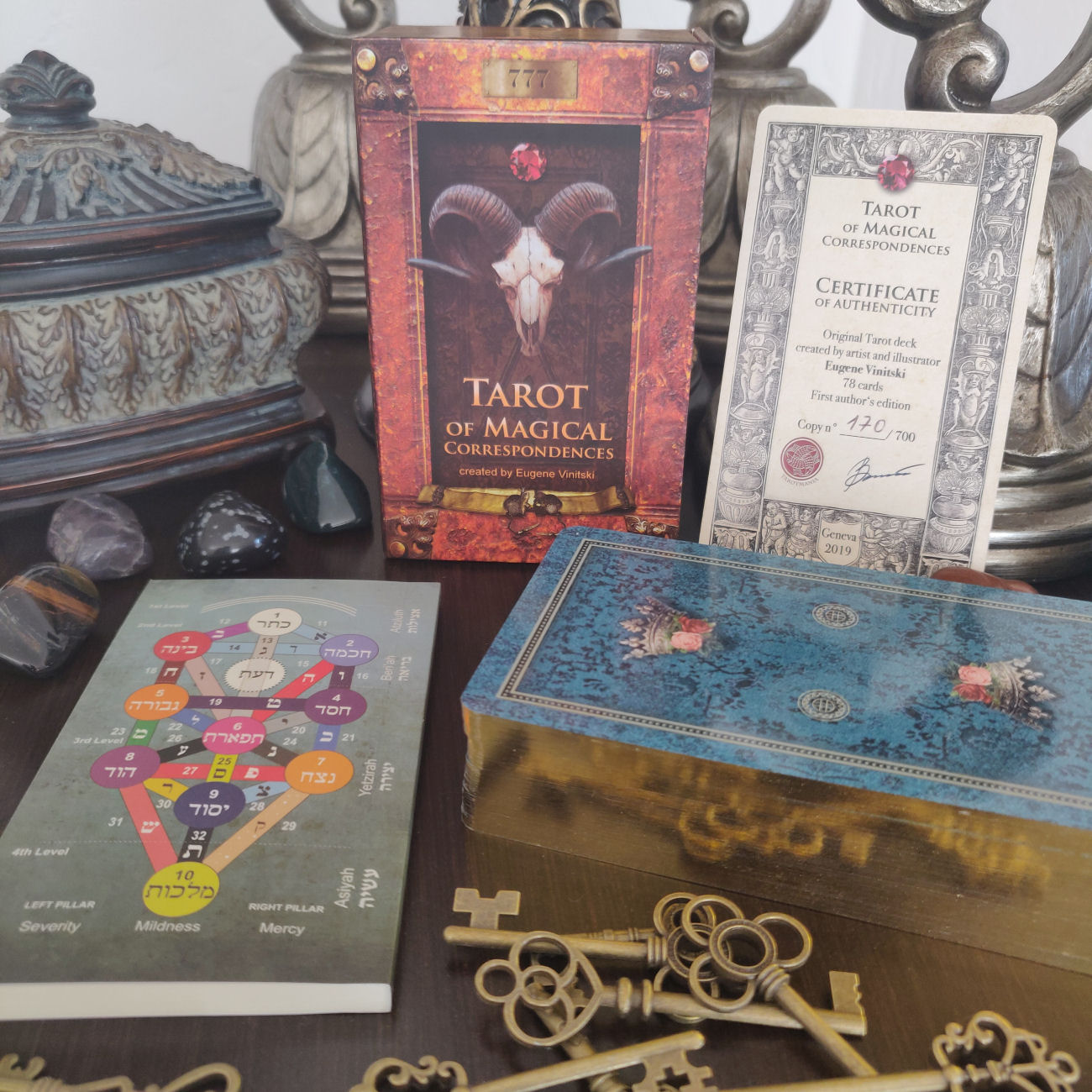
In Tarot of Magical Correspondences, Eugene Vinitski has designed a magician’s deck, and it’s spectacular. After Kabbalistic Tarot, which I’ve reviewed before here, Vinitski had acquired so much research and knowledge that hadn’t been incorporated into that deck, and so Tarot of Magical Correspondences was born, built upon the works of Eliphas Levi, Aleister Crowley, Manly P. Hall, Paul FOster Case, and Gareth Knight, among others.
The cardstock is thick, glossy, high quality, and the edges are gilded. You also get a guidebook packed with an impressive amount of information and substantive content, given its size. Each deck will also come with a Certificate of Authenticity numbered and signed by the deck creator. This is a limited edition deck, with only 700 copies available, so get yours over on Etsy while supplies last.
Vinitski notes that Tarot of Magical Correspondences is based largely on the works of Aleister Crowley, and the Kabbalistic references throughout are based on Golden Dawn attributions. Vinitski worked mainly off of Liber 777 by Crowley.
Tucked into one of Court de Gébelin’s essays on the tarot is this gem of a tarot reading method he instructs. I read the essay in French and in several English translations, hoping to confirm that I understood his instructions correctly, but there were still a few points here and there open to interpretation, so bear with me.
Court de Gébelin describes a fortune-telling method for either tarot or ordinary playing cards where you shuffle the deck, cut, and then proceed to draw the cards, one by one, as you call out a number (or card title) for each draw.
When the number (or card title) you called out matches the card, set that card aside. You’ll be reading all such cards in a free-form narrative string.
Cycle through the deck three times to cast three free-form narrative strings.
Here, I’d also like to note that I didn’t find any explicit direction from Court de Gébelin about reading with reversals (if there was, then my apologies; I missed it), so for kicks, if you’re following the video’s guided reading, then position all the cards in your deck upright and proceed without reversals.
Compare Court de Gébelin’s approach to the earlier historic episodes on MacGregor Mathers (1888) or Papus (1889) where reading with reversals was explicitly instructed.







 benebell wen