Consider these eight solar terms, their dates based on solar longitude (the path of the sun) and how they compare to close equivalents in the pagan Wheel of the Year:
The Four Beginnings 四立
1. 立春 Start of Spring Feb. 3–5
2. 立夏 Start of Summer May 5–7
3. 立秋 Start of Autumn Aug. 7–9
4. 立冬 Start of Winter Nov. 7–8
I apologize in advance if my mode of presentation here is going to be a bit overwhelming. In retrospect, I should have taken more time thinking on pedagogy and how best to organize this material so it’s less everything-all-at-once. =)
Now that I think about it some more, “witchcraft” is probably not even the right term to be using. “Folk magic” might be the better descriptive? What do you think?
Don’t forget– if it helps, turn the closed captioning on! =)
When I say “open tradition,” I mean a culture-specific practice of a magical system and set of doctrinal beliefs integrated into that practice that anyone at all can work with for themselves, that it’s free and open to the public.
When I say “closed tradition,” I mean a culture-specific practice of a magical system and set of doctrinal beliefs integrated into that practice that can only be honorably accessed if certain conditions are met, such as initiation, heredity, clan or ethnic group membership, or a formally established master-student bond.
Esoteric Taoist practices, broadly speaking, are openly accessible to anyone and all, but not anyone and not everyone who seeks it will find alignment with this Path. It’s for anyone, but it’s not for everyone.
But when we’re having this conversation about esoteric Taoist traditions here in the West, then to be clear, the conversation is probably more about cultural appropriation, spiritual gatekeeping, and how to engage respectfully with living traditions.
Taoism is, by the nature of the philosophy, even occult philosophy, is syncretic. It absorbs indigenous shamanic traditions, other established religious traditions, and in terms of the values that are the compass for how to navigate the syncretism, it’s nature. It’s the study and understanding of qi in nature.
It’s about nature, but humans are part of nature, and humans have minds that formulate ideas that become aggregated into establishments, you can’t ignore the establishments. So in reality, a human – the practitioner – will study how the many establishments engage with the qi in nature and then work with what works, for them. Since that’s Taoist mysticism in a nutshell, it’s an open practice.
Lineaged traditions, on the other hand, are unequivocally closed. Some are initiatory. Some are hereditary. Some are a combination of both. The premise is a group of people have cultivated an elite access to potent qi in nature through a highly-specialized methodology, and they aren’t about to share that methodology with just anyone. So there are very limited ways to access that specific methodology. Some form of ritualized transmission must take place to receive access.
But what about non-lineaged individuals crafting, say, Fu talismans, performing Taoist rituals, be that ones they’ve made up themselves or followed step by step from a canonical grimoire, or working with Taoist ritual tools? To be fair, that’s where it gets a bit more complicated, and political.
You’re going to encounter folks who say no, unless you’re lineaged, you cannot. That or it’s more of a warning that if you’re just chaotically doing it on your own, it’s way too easy and too high a risk of going off the rails and getting yourself into spiritual hot water. There’s a kernel of truth there, in my opinion, which is why I believe strongly in being religious and cultivating a strong moral compass and code of ethics first before dabbling with the occult. If there isn’t going to be a teacher there to rap your hands with a stick when you’ve been bad, then you’ve got to be disciplined enough to self-monitor.
Whereas I’ve always made my personal opinion clear. It’s open access with an asterisk. It won’t be me (and I don’t believe it should be another human) who puts up walls or locks the gate to keep you out. It’s gonna be the gods. It’s The Craft itself. The Esoteric Tao lets in who it lets in.
As for cultural appropriation, I’ve always taken the view that, you’ll know it when you see it. It’s hard to come up with a one-definition-applies-to-all-case-analyses metric for determining what’s okay and what’s not okay. Not to mention each person’s appetite for something possibly appropriative is gonna vary. Plus, overly-worrying about whether you yourself are culturally appropriating is more demonstrative of caring too much about yourself than actually caring about the cultural tradition you’re working with. If truly your heart is with the culture, you’ll naturally focus on its people, its communities, with an organic passion to learn as much as you can. I don’t have to tell you to be reverent; you just will. And if somebody has to remind you to be reverent, then buddy, I think you’re already in the wrong.
My third book, I Ching, The Oracle: A Practical Guide to the Book of Changes, published by North Atlantic Books, is forthcoming mid-2023. It’s my translation and annotations of the Oracle with cultural and historical references that honor the shamanic origins of the I Ching.
What it really is, though, is a magical grimoire. I began with an aspiration to write a grimoire on Taoist mysticism and magical practices, and then decided to do so through the framework of the I Ching. This is going to be a practical hands-on primer on East Asian modalities of witchcraft and folk magic. A deep-dive learning experience into the history and mythological references found in the Book of Changes is the bonus.
Leading up to the release of I Ching, The Oracle will be this series of videos where I lay the foundation for working with this third book. If this is of interest to you, stay tuned! ❤
I’m really excited about Mei Jin Lu’s The Wisdom of the Tao oracle cards published by U.S. Games. I’ll be covering both Volume I: Awakenings and Volume II: Strategy.
These oracle cards pictorialize Taoist philosophy in what is presented as “for the first time, a visionary system, incorporating teachings from Taoist masters, the power of nature’s elements, the revelations of zodiac animals, and the dynamic interactions among them.”
I received a question by letter, which I wanted to answer privately, but didn’t have an e-mail address or even mailing address. So here’s to hoping this post is seen by who it’s intended for. ❤
The question presented:
Dear Benebell,
I am a Taoist witch, but my religious family thinks I am a Baptist Christian and therefore against non-Baptist religious practices.
Last night my dad and I were watching a Taiwanese movie and an ancestor veneration scene came up. My dad began a conversation about Taoist traditions and said, “When I die, please don’t venerate me like a Catholic or Taoist would.”
I am a strong believer in ancestor veneration and plan to venerate both of my parents when they pass away.
I do not want to go against my father’s personal wishes as I love and respect him, but I also do not want his spirit to go un-venerated because I love him dearly.
What, in your opinion, is the best way to go about this?
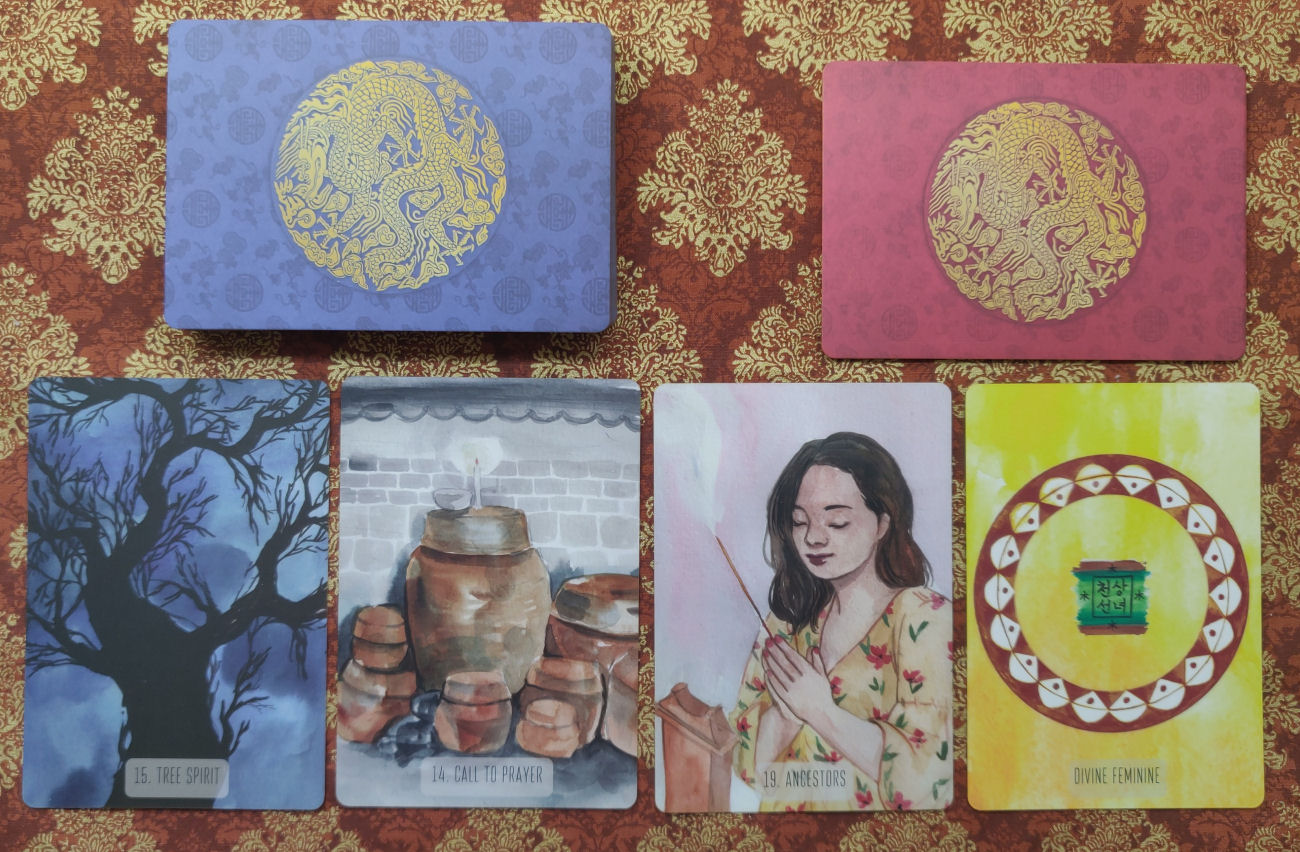
A treasure of a divination system in a box that you’ll cherish, Morning Calm Oracle by trained shaman Seo Kelleher invites you to engage with a world of spirits, divinities, and nature magic from the Land of the Morning Calm, a name of endearment given to Korea.
The box design, sigils, and the tactile experience of handling the cards are an exemplary representation of East Asian magic. Those who are sensitive to energy will even feel the difference in the vibrations of this deck in hand compared to other decks you might have in your collection.
I am enchanted by the effortless beauty and the beneficence of this deck. The artwork is done by Alodia Yap, whose artwork is moving and melodic. Yap’s art style here is impressionistic. It works in perfect harmony with what Kelleher set out to achieve.
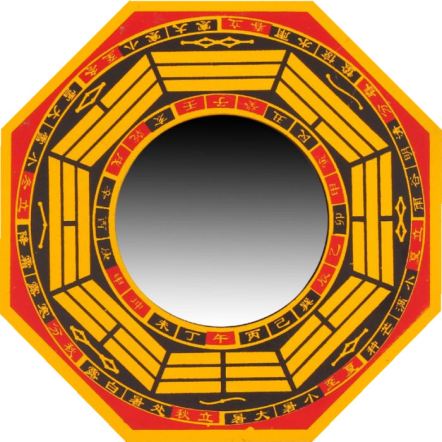
Learn a little more about this common ritual tool in traditional Asian folk magic. I’m inviting you to give the ba gua or eight trigrams mirror a try.
This video covers a few pointers on how to use a ba gua mirror to tell whether you’ve been hexed or cursed (a folksy practice that’s interesting to learn about, at the very elast), how a ba gua mirror can amplify your spell-crafting techniques, a simple intention-setting candle spell, how to make your own ba gua mirror if you can’t source one, and how to integrate this one tool and folk practice into what you’re already doing.
One of my favorite personal rewards from launching the Witchcraft Fundamentals course is the Google Group, where all of us are exchanging insights, asking tough questions, trying to answer tough questions, and getting to know each other. To give you a sampling of what that e-mail list-serv group is like, I’m sharing something I wrote on there in one of the threads started by a practitioner of both Eastern and Western metaphysics.
The question presented is, in short, how do you reconcile Eastern elemental-directional correspondences with Western elemental-directional correspondences?
By the way, scroll all the way down for the PDF downloads of this post, which you can then print out and tuck into whatever reference manual for your metaphysical studies you have going on.
IN THIS WESTERN WITCHCRAFT COURSE, you’ll learn fairly soon that there are different systems of elemental-directional correspondences even within the umbrella of Western occult philosophy, and we cover three of them in this course:
The Rat is the start of the zodiac cycle, much like Aries in the Western zodiac. Thus, any year of the Rat is going to be prognosticated as a year of beginnings, of starting over, and new opportunities that come your way.
The Rat is considered to be business-savvy and entrepreneurial, so sole proprietorships are going to be more prosperous than usual. It’s a lucky year for small businesses or new startup ventures.
With 2020 being the year of the Metal Rat, we’re going to see a global focus on technology.
Metal years, no matter what the animal sign, are also more prone to social conflicts, so we may see more of that across the world stage. This is a year of nations and leaders trying to show off their power.
On the other hand, in terms of culture and humanities, it should be a great year for music.
PLEASE NOTE: The following content only represents the downloadable handouts from an in-person live master class presented at the 2019 Masters of the Tarot Conference at the Omega Institute. No online equivalent to that master class is included here, and what’s accessible is just those supplemental handouts and a copy of the PowerPoint.
What are the Akashic Records? Are there special requisites before gaining access? What are its origins?






 benebell wen