In Part III, I’ll be tackling the issue of curses and hexes. First, a note for clarification: I’m going to separate out the distinction between practitioner and reader for the purpose of this post.
A practitioner is someone who works proactively with unseen energy and spirit influences, who, for lack of better terminology, can and will cast spells for hire.
A reader is someone who reads energy for hire, such as someone who does divinatory work, like a tarot reader or psychic.
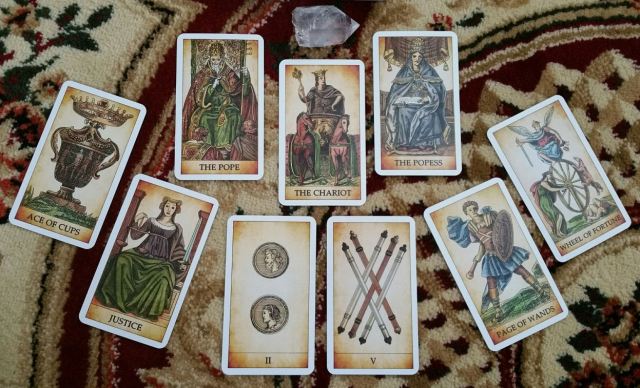
Deck Pictured: Russian Tarot of St. Petersburg (US Games)
I started a post series on tarot reading ethics last week and if you missed it, here is Part I on health, legal, and financial readings. I’ll be subdividing the discussion of tarot reading ethics into three parts. These posts will explore some of my personal thoughts and also professional opinions on certain oft-adopted ethical rules.
This is Part II of III, in which I’ll be tackling third party readings and reading for an onerous client.
I’ll be subdividing this topic into three parts. These posts will explore some of my personal thoughts and also professional opinions on certain oft-adopted ethical rules.
This is Part I of III, in which I’ll be tackling the question of reading for medical, legal, and financial concerns.
7/11/2017 Update: This is Part I of II only. I’ve decided against publishing Part III. Explained at the close of Part II.
7/18/17 Update: I’ve decided to proceed with sharing Part III, but it is a password-protected post. Please do not ping me with requests for the password. It is made available in closed circuits to those who have access to those circuits.
You often hear readers say that it’s against tarot ethics to do readings on health or legal questions. But why? Why are tarot readers discouraged from reading on health and legal issues?
It’s for legal reasons and, as far as I understand it, that’s pretty much the only reason. In most jurisdictions, there are codified laws against the “Unauthorized Practice of Medicine” and the “Unauthorized Practice of Law.” At best, it’s a misdemeanor and a fine of thousands of dollars. At worst, either one could be charged as a felony and carry several years of jail time. To get charged with such an offense would be the worst day of your tarot reading life.
The issue of general readings versus specific readings is pertinent to most divinatory forms, whether we’re talking tarot, astrology, the I Ching, or even in terms of configurations for feng shui analysis. Rather than frame this post as general commentary, I want to talk about my personal approach, and since most of the divinatory work I do for people are in the modes of tarot and astrology, that’s what I’ll focus on.
Let’s start with my definitions.
A general reading is when a seeker doesn’t have a cogent, cohesive question to present for divination, but just wants insight for moving forward at the particular juncture point the seeker is at. For example, a seeker sits down in front of a tarot reader and the reader simply begins casting cards and reporting back what the reader interprets from the cards. Another example is a solar returns or birthday chart reading in astrology. A reading service such as a twelve-month forecast is also considered a general reading. In theory for a general reading, any subject matter that comes up in the reading is game.
A specific reading is when a seeker has a question in mind that is narrowly tailored and will require a direct, responsive answer. For example, the seeker wants to know about romantic prospects up ahead, or which career path to take, or which of three possible office site locations would be optimal for setting up a business. Here, even a broadly-cast inquiry such as “just whatever comes up that’s money related in my life” is an inquiry I’ll tuck under the category of a specific reading.
One more point before we proceed. To debate which is better, general reading or specific reading methods, is absurd. Readers also come with different strengths. No reader is all-powerful. Some excel at the general reading. Others excel at the specific reading. Play to your own strengths. That’s all there is to it.
When you’re running a personal venture that’s heavily reliant on e-commerce, and you’re a small potato like me operating said venture out of your home in your pajamas, with a full face of makeup and nice shirt on only when you’re making a video, choosing which promotional tactics to work on can be hard and–for my fellow professional tarot readers–a very Seven of Cups sort of inquiry. You can’t do it all, because it’s just you. So how do you channel your marketing energies in the most productive way? I can’t answer that question for you, but I’ll share with you my experiences on what worked and what didn’t.
This post will address sponsored ads on Facebook, advertising via your own social media platforms and social media in general, blogging or vlogging content, newsletters or direct mailings, local bulletin boards, and giving away free stuff.
Sandalwood mala prayer beads and a smoky quartz cintamani stone.
My earliest memory of a psychic reading was in Taiwan with a nun at a monastery that my aunt, who is a nun, resided at. (Do I still refer to her as my aunt if she’s now a nun? I have no idea…) When you’re an Asian kid, grown-ups, especially grown-ups of the holy variety, don’t have names. They only have titles. So in Chinese, since we only spoke to her in Chinese, she was Shi Fu, or Teacher, and in English, privately amongst ourselves, she was The Psychic Nun. The aunt who is a nun is Auntie Nun. Auntie Nun is a little bit psychic while The Psychic Nun was full-on knew-your-past-life and knew-your-future psychic plus could-speak-to-the-dead so also medium. The Psychic Nun is referred to in the past tense because she’s no longer with us. I heard of her passing a few years after my maternal grandmother’s passing. It’s okay. She was like a billion years old already anyway and with all that good karma, is off to somewhere awesome.
Anyway, that introduction was way off-track from the subject matter of this post. This post is about go-to knick knacks in a tarot or divinatory reading space. I’m not asking about what you need to get your read on (because inevitably some holier-than-thou advanced tarot reader master will pipe up and say, “I don’t need anything but the power of my mind… I am not bound to materialism… toot toot“)–right, right, we all know that. But I’m asking what kind of knick knacks do you like in your reading space. I don’t need a pink toothbrush for effective dental hygiene but I like it when my toothbrush is pink, so I have a pink toothbrush. Get it?
I know this photo doesn’t convey a post on SEO exactly but it was the best I could do. Your brain doesn’t really care anyway. You just need there to be a picture here. So here you go.
I’m so unqualified to talk to you about search engine optimization that even the idea of this post is hilarious. My own site is not well-polished, littered with typos, I don’t hire any professionals to do any of anything for me, no fancy logo that I hired a freelancer in Portland to design for five figures, no impressive webpage design, no paid-for templates or infrastructure, just me on my home desktop with a mug of coffee, WordPress login, and access to Google search when I need to figure out how to do something.
Yet in terms of getting my name out there and generating buzz, I think I’m doing okay. In fact, I’m doing more than okay and it’s a total hoot how well I’m doing because I have no clue how I got here. Well I had no clue. To write this post, I did some deconstruction and tried to unpack the path I took to see if I might be able to offer some useful insights on, err… SEO.
Damn, I can’t even type that sentence with a straight face. It’s as absurd as me offering expert advice on molecular engineering. Anyway, take it or leave it, here are my observations on how to optimize your SEO.
Click on image for direct link to unlisted YouTube video.
A Free Online Course Presentation
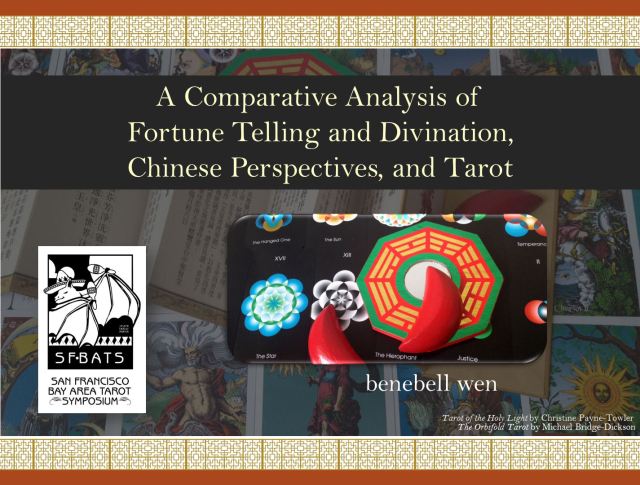
Is there any value to making a distinction between fortune telling and divination? How might Chinese perspectives compare to or inform Western perspectives? This free video (or audio) lecture will examine the etymological origins of the words for “fortune telling” and “divination” in the Chinese language, apply medieval esoteric Taoist texts to tarot reading, and propose a theoretical framework through which to read tarot, as either a fortune teller or a diviner, though the two are not mutually exclusive. We will then run a comparative analysis of that with Western perspectives and examine Western esoteric texts on the subject.
The video lecture is about 34 minutes in length. Click on the below to begin watching. Although it is in video form, you can also listen to it as an audio.
2025 June 15: Please note that the following course content was produced nearly a decade ago and may reflect the production standards and media quality that were even low for that time, so may foreseeably prove to be challenging for the present day user. We appreciate your understanding and grace as you engage with these materials.
Video Lecture Screenshot
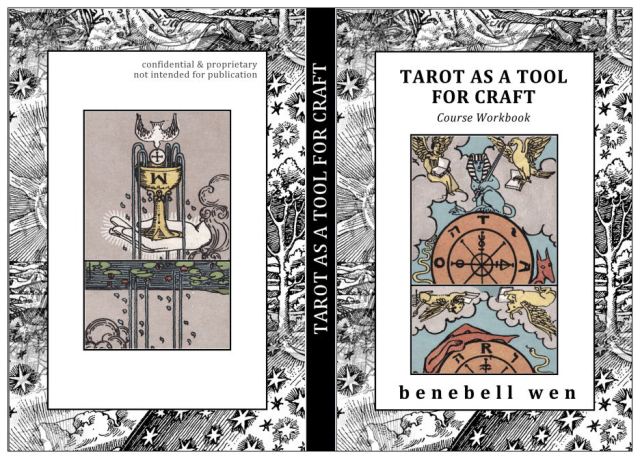
Tarot as a Tool for Craft is a FREE DOWNLOADABLE guided workbook course that teaches practitioners how to elevate tarot from a system of divination into a powerful tool for spellcraft, ritual, and magical workings. Rooted in Western esotericism and enriched by practical hands-on exercises, the course blends tarot theory, ceremonial ritual, sigil work, talismanic crafting, and energy channeling to help the student activate the cards as magical instruments. Through progressive lessons and experiential assignments, learners will explore how to work with tarot archetypes, construct effective magical workings, and cultivate a deeply personal practice integrating both high and low magic traditions.
An expansion on the talk I presented in 2016 at the Theosophical Society of the East Bay, this course covers how a practitioner of craft might use tarot, from triggering intuitive creativity for self-empowerment, divination, and amplifying psychic ability to communion with celestial contacts, mediumship, and summonings. This is an intermediate course that presumes proficiency with tarot. Subject matter also runs into esoteric and mystical applications of the tarot, so the tone of the course might not be right for everyone.
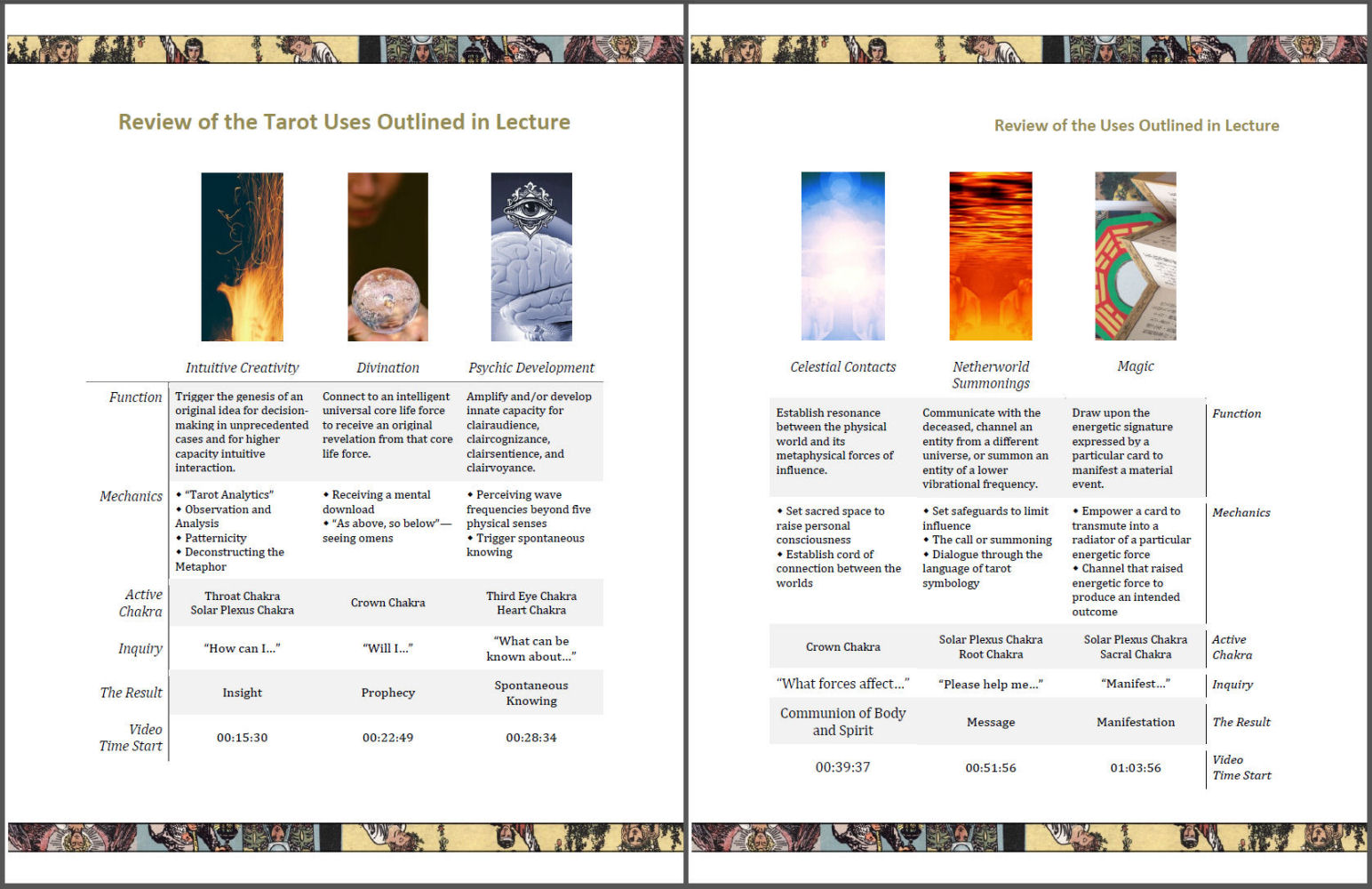
Workbook Page Spread Preview
Course Objectives
After completing this workbook course, you will:
Understand how to transform tarot cards from passive symbols into active magical tools.
Learn how to design and execute ritual spells using the tarot as both focus and channel.
Practice creating and charging talismans using tarot correspondences, sigils, and planetary hours.
Develop a personalized system of magical correspondences rooted in tarot structure.
Cultivate the mindset and discipline of a ceremonial magician working through a tarot framework.
Strengthen intuitive and psychic faculties through ritualized work with tarot archetypes and energies
Click image file to download the Workbook pdf
What my 2015 book Holistic Tarot taught was the first of the five pillars that are discussed in this course. This course deconstructs the form and mechanics of using tarot for:
Intuitive Creativity to achieve self-empowerment;
Divination to connect to what Paul Foster Case called the Cause of Causes—the Universal Intelligent Life Energy;
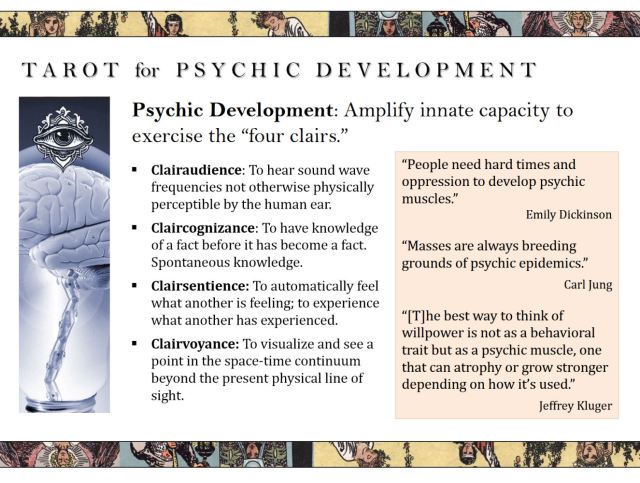
Psychic Readings both to amplify your innate psychic ability and to use tarot as a training tool for strengthening your psychic ability;
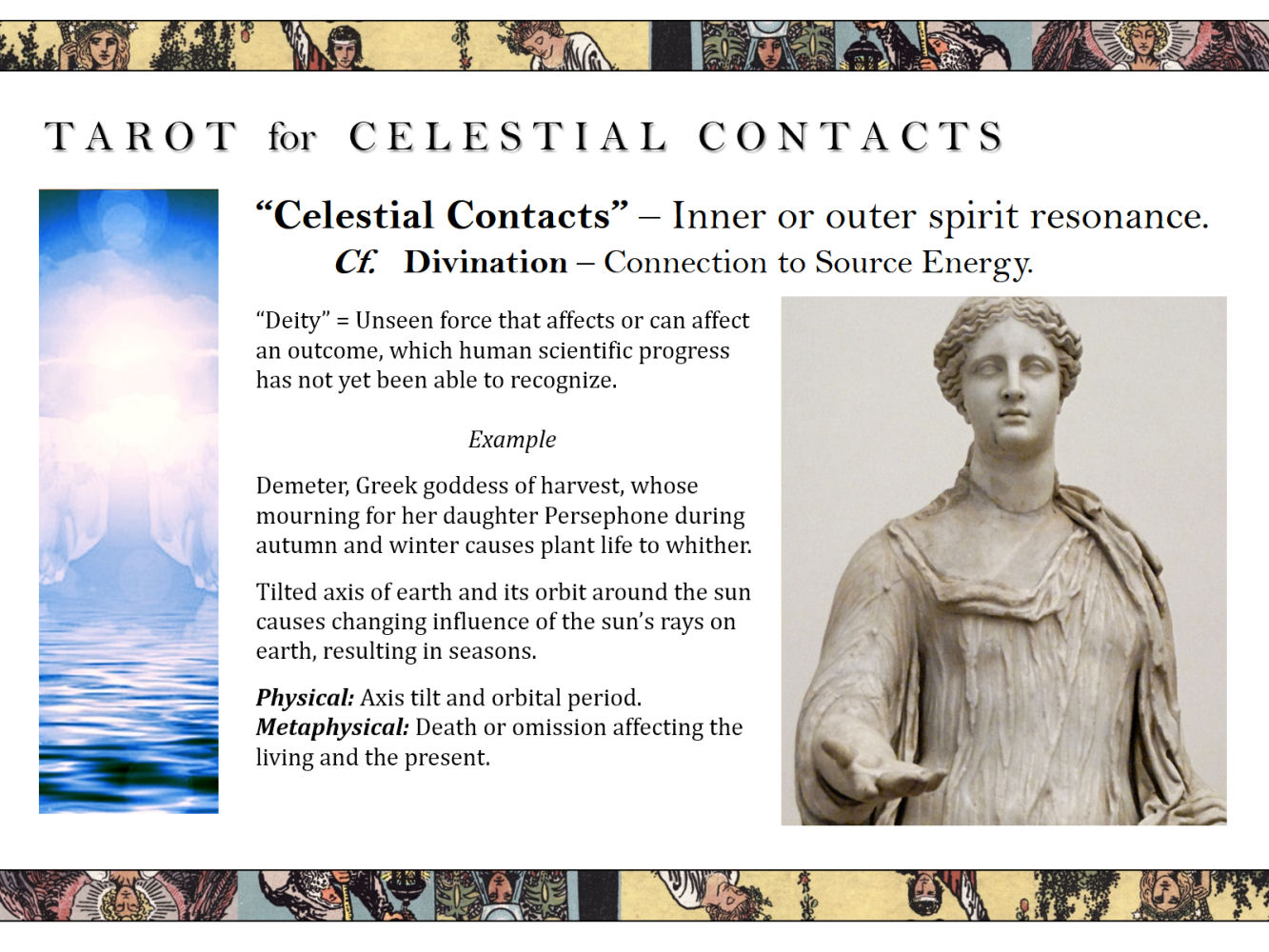
Celestial Contacts to connect with deities, angels, ascended masters, devas, or the metaphysical force affecting physical conditions; and
Netherworld Contacts and using tarot for mediumship, ancestral connections, or connecting to entities of nether-worlds and other-worlds.
Workbook Page Spread Preview
A workbook with exercises to help you learn and master the mechanics of such tarot operations will also be provided to supplement the video lecture.
Video Lecture Screenshot
Also, this is not a video lecture that you watch just one time. I propose that the video lecture and the workbook should be revisited routinely. Print out the workbook multiple times and routinely work through the exercises prompted in the workbook to help you advance and further develop the skills taught in the video lecture.
As it tends to be when you’re working with me, the workbook is the most important part of this course. The 49-page workbook is intended for use and re-use. Print it out many times throughout your development to work through the training exercises.
As it tends to be when you’re working with me, the workbook is the most important part of this course. The 49-page workbook is intended for use and re-use. Print it out many times throughout your development to work through the training exercises.
Workbook Page Spread Preview
The training exercises begin basic and analytical, compelling you to work with numerology, astrology, Kabbalistic references, and other forms of symbolism and system correspondences to broaden your working and experiential knowledge of the tarot.
Then the course deep-dives into training exercises for mediumship, using tarot for celestial contacts, using tarot in shamanic journeying, using tarot as talismans, and so much more. I hope you will be as thrilled and enthusiastic about this workbook as I felt when I went through the exercises for myself.
Workbook Page Spread Preview
I hope this workbook will be a game changer for you in terms of your relationship with tarot as your divinatory tool, especially if you’re looking to hone your psychic abilities, intuition, and experience various forms of mystical training. As I tend to do, I fuse together eastern and western esoteric principles.
Although this course presumes intermediate proficiency with the tarot prior to commencing, it is a beginner-level introduction to using the cards as living, breathing instruments of ritual magic and mysticism.
Your Course Instructor
Hi! I’m Benebell Wen, the author of Holistic Tarot (North Atlantic Books, 2015) and The Tao of Craft: Fu Sigils and Casting Talismans in the Eastern Esoteric Traditions (NAB, 2016). My background is in both law and classical studies, and so I strive to bring a synthesis of analytics-based scholarship, a practical teaching style, and yet also a deep initiatic understanding of occult systems.
WESTERN WITCHCRAFT I: This course is a 13-module immersive study of the first 12 chapters in Eliphas Levi’s Doctrine, Part I, of the greater collected work Transcendental Magic. There are 18 video lectures with a total run time of 9 hours along with a 363-page textbook/workbook. In addition, you’ll be getting a set of guided focused meditation for the magus videos. My recommendation is to work through the materials over a 13-week period. Both theory and practicum are covered. This course is structured after a one semester 400-level university elective.
This class is structured after a graduate-level course with a series of lectures plus guided tarot readings ritualized and crafted to show rather than tell you about tarot in witchcraft.
The lecture portion covers a comparative analysis of exoteric, psychology-based tarot reading vs. an esoteric, psychic-based tarot reading, and also tarot as a witch’s tool. We’ll cover the history and legacy of tarot in Western occultism, focusing in on applying Hermetic principles to the tarot. Then we’ll consider the role of tarot and witchcraft in the modern era.
Note: “Tarot, Occultism, and Modern Witchcraft” was first offered during Tarot Summer School 2018 at the Tarot Readers Academy.
Click on the above image to visit the product description page.
$25
The Metaphysician’s Day Planner
I juggle a full-time day job in corporate law with writing and publishing books, doing interviews and talks for the book tours, part-time professional tarot reader and astrologer, blogger, avid home cook, and pro bono legal work on the side, all while being a metaphysician and keeping myself buried in metaphysical studies, so I do get asked a lot about how I organize my day. How do I make sure I am on top of my schedule of court appearances, hearings, and conferences for work, my client reading list for tarot and astrology, food prep for the week and menu planning, domestic chores, personal health and fitness, and everything in between?
With a day planner, of course. There is a set way I organize and format my personal day planner to cover everything I do. And now I’d like to share it with you. I’ve put together a 2017 day planner and organizer for the metaphysician.
It’s part day planner–annual, quarterly, monthly, and daily. And it’s part grimoire.Carrying around metaphysical correspondences and quick reference sheets helps immensely with memory retention. It’s my approach to broadening and deepening my esoteric knowledge.
Out on the market right now you’ll see a ton of beautiful, vibrant, inspiring, mind-body-spirit-based day planners and calendars rolling out for sale now.
Mine is none of that.
So if you’re looking for something with lots of pastel colors, inspirational quotes, affirmations, and space for you to jot down your secret desires, then this is not it.
Rather, this is a glimpse into how I organize my life and how I balance professional and personal accomplishment with esoteric studies. I don’t spend three hours filling in blank workbook prompts on what I love about myself. I don’t need “go get ’em, tiger” quotes in sans serif font printed in glittery hues across my planner cover. Instead, my planner is about optimizing the hours of my day and getting stuff done. I need a day organizer that helps me get stuff done. I don’t want color, because color ink is expensive. I want substance and I want economy.
That’s what my day planner is all about. And I’d like to show it to you. I made one up for my sister Cindy, so you’re going to see screenshots of hers for illustration.












 benebell wen