Continuing from what I said in the video chat, if this is something you seriously want to do, then start by getting that three-ring binder. Though I think organizing it into eleven sections is sufficient, I noticed you can’t buy packs of just eleven binder dividers. They come in sets of 12, so that’s fine. Having a final “Miscellany” tab is always a good idea anyway.
The above video commentary is a short introduction to esoteric Buddhism, covering the distinctions between sutra-based Buddhism and tantric Buddhism. As noted at the end of the video, this write-up will give instructions to the “homework assignments,” practica[I don’t know why I’m such a nerd and called these “homework assignments”] intended to give you a firsthand experience with Buddhist folk magic.
Timestamp 11:39 Addendum: Oops, I cut out too much of the raw video chat and omitted the part where I talked about where I was going with this. =) So if you were left confused, it’s not you, it’s me. =) Continuing from what I am saying at this timestamp, if tantric esoteric Buddhist cultivation is characterized as a “shortcut” to the destination but one that’s far more dangerous and riskier terrain, then endeavoring to take this route all but requires a highly skilled guide to help you navigate the tougher terrain. It’s not a route you’d want to go at on your own or, worse yet, with a guide falsely self-proclaimed as a lama or spiritual leader who will lead you astray, or who isn’t equipped to help you deal with mara. Thus, the framing of the question shouldn’t be “is it open or closed,” but rather as “what, really, would be the most assured path for you?” Can you fully trust someone else’s claim of endowing you with the empowerment you’re seeking?
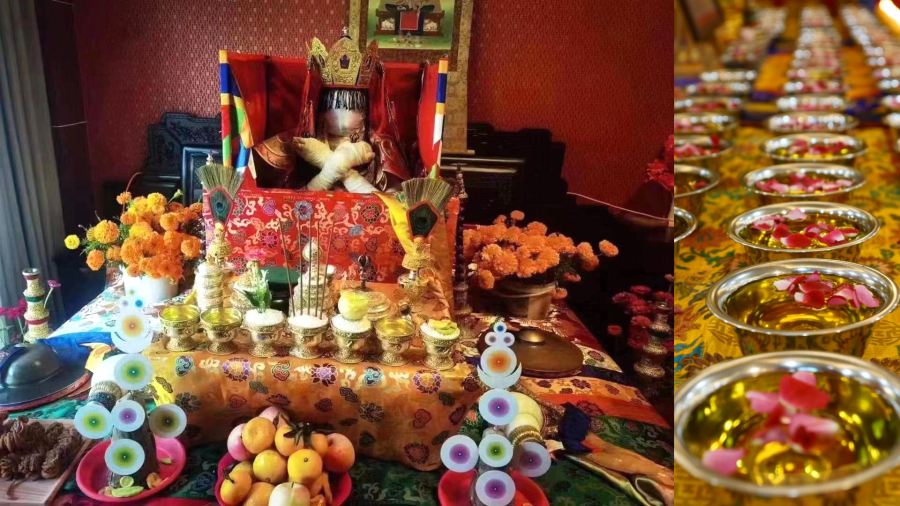
Taipei Katok Ten Directions Buddhist Association
As a beginner-level introduction, these practices are intended to be general enough for all, so you’ll be encouraged to piecemeal neutral elements often found in esoteric Buddhism and graft it onto your preexisting practice, and most importantly of all, your local environment.
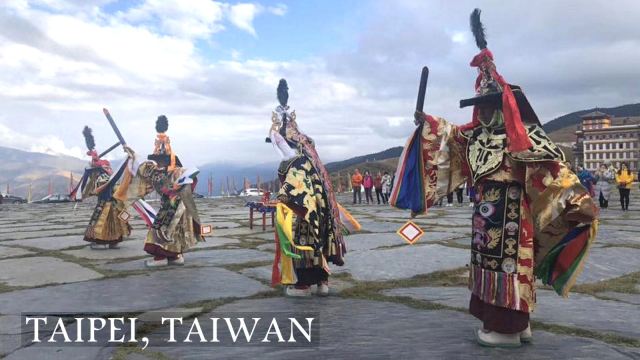
Taipei Katok Ten Directions Buddhist Association
Just like esoteric Buddhism takes on the indigenous practices and magical systems from the land it touches, be that Bön folk magic syncretized with Buddhism in Tibet, Taoist mysticism with Buddhism in China, Shinto in Japan, or tantric Buddhism melded with Tai and Hmong shamanic practices in Southeast Asia, you’ll be working with features of esoteric Buddhism syncretized with what’s native to you.
Click on the above image file to download and use freely (but reverently, please). The image file is in 400 dpi and should print okay at 9.5 inches x 9.5 inches. So don’t go much larger than that, but you can go smaller. Actually 11″ x 11″ should still be fine.
All the extra border is to allow for bleed margins.
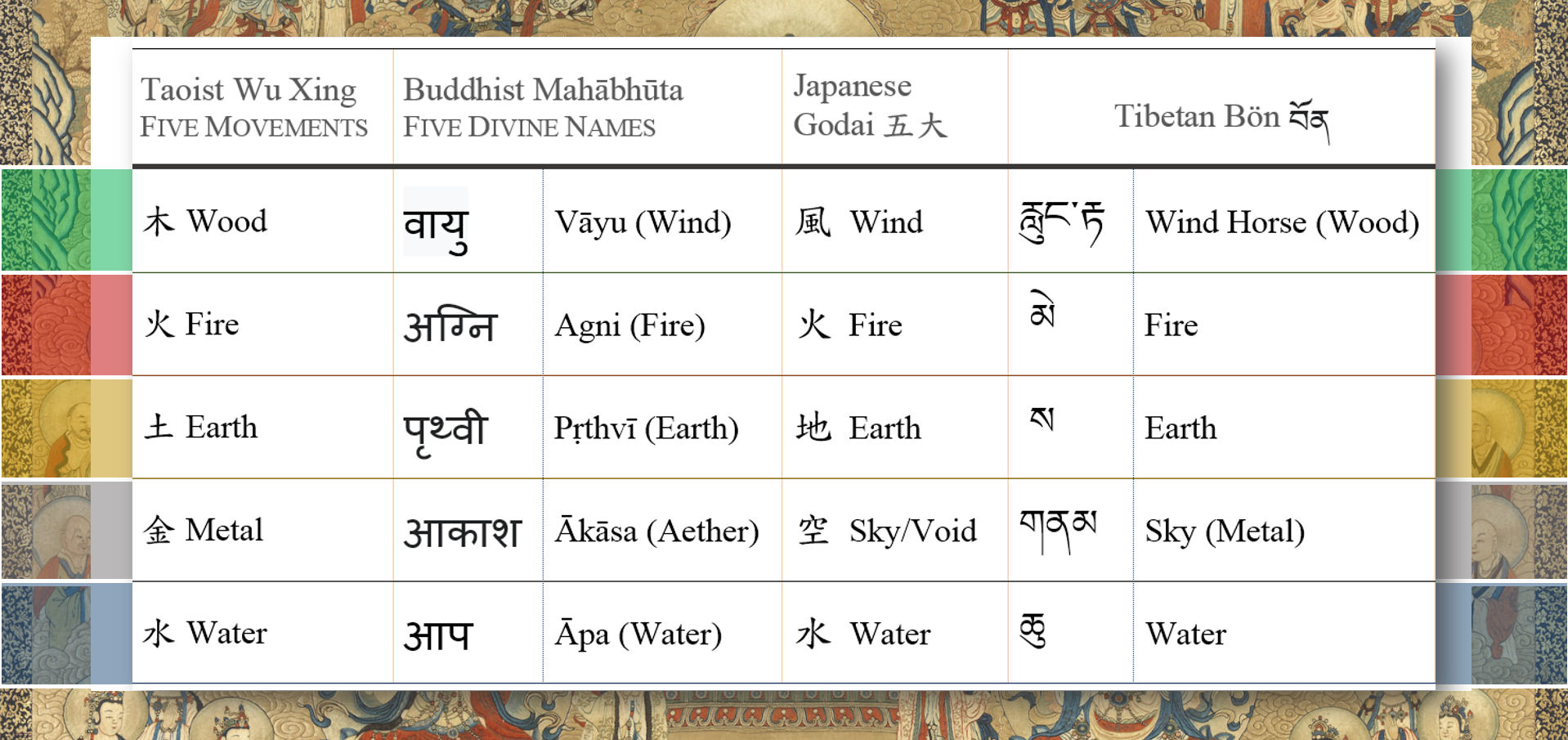
This is a crash course on the Wu Xing 五行, Five Dynamic Movements, though you’ll often see it called the Five Elements of East Asian metaphysics. These are five alchemical agents of change to describe how yin and yang qi create, destroy, and thus transform the physical world.
1/30/2023 Erratum Update: A few of the correspondence rows in the Metal and Earth columns got flip-flopped in the subsequent reference chart. If you downloaded the table before 1/30/2023, please delete it and re-download the rectified version. ❤
I say “East Asian” here because it’s not limited to any one culture, ethnic group, or nationality, not to mention the concept itself is much older than modern-day borders.
Consider these eight solar terms, their dates based on solar longitude (the path of the sun) and how they compare to close equivalents in the pagan Wheel of the Year:
The Four Beginnings 四立
1. 立春 Start of Spring Feb. 3–5
2. 立夏 Start of Summer May 5–7
3. 立秋 Start of Autumn Aug. 7–9
4. 立冬 Start of Winter Nov. 7–8
I apologize in advance if my mode of presentation here is going to be a bit overwhelming. In retrospect, I should have taken more time thinking on pedagogy and how best to organize this material so it’s less everything-all-at-once. =)
I received a question by letter, which I wanted to answer privately, but didn’t have an e-mail address or even mailing address. So here’s to hoping this post is seen by who it’s intended for. ❤
The question presented:
Dear Benebell,
I am a Taoist witch, but my religious family thinks I am a Baptist Christian and therefore against non-Baptist religious practices.
Last night my dad and I were watching a Taiwanese movie and an ancestor veneration scene came up. My dad began a conversation about Taoist traditions and said, “When I die, please don’t venerate me like a Catholic or Taoist would.”
I am a strong believer in ancestor veneration and plan to venerate both of my parents when they pass away.
I do not want to go against my father’s personal wishes as I love and respect him, but I also do not want his spirit to go un-venerated because I love him dearly.
What, in your opinion, is the best way to go about this?
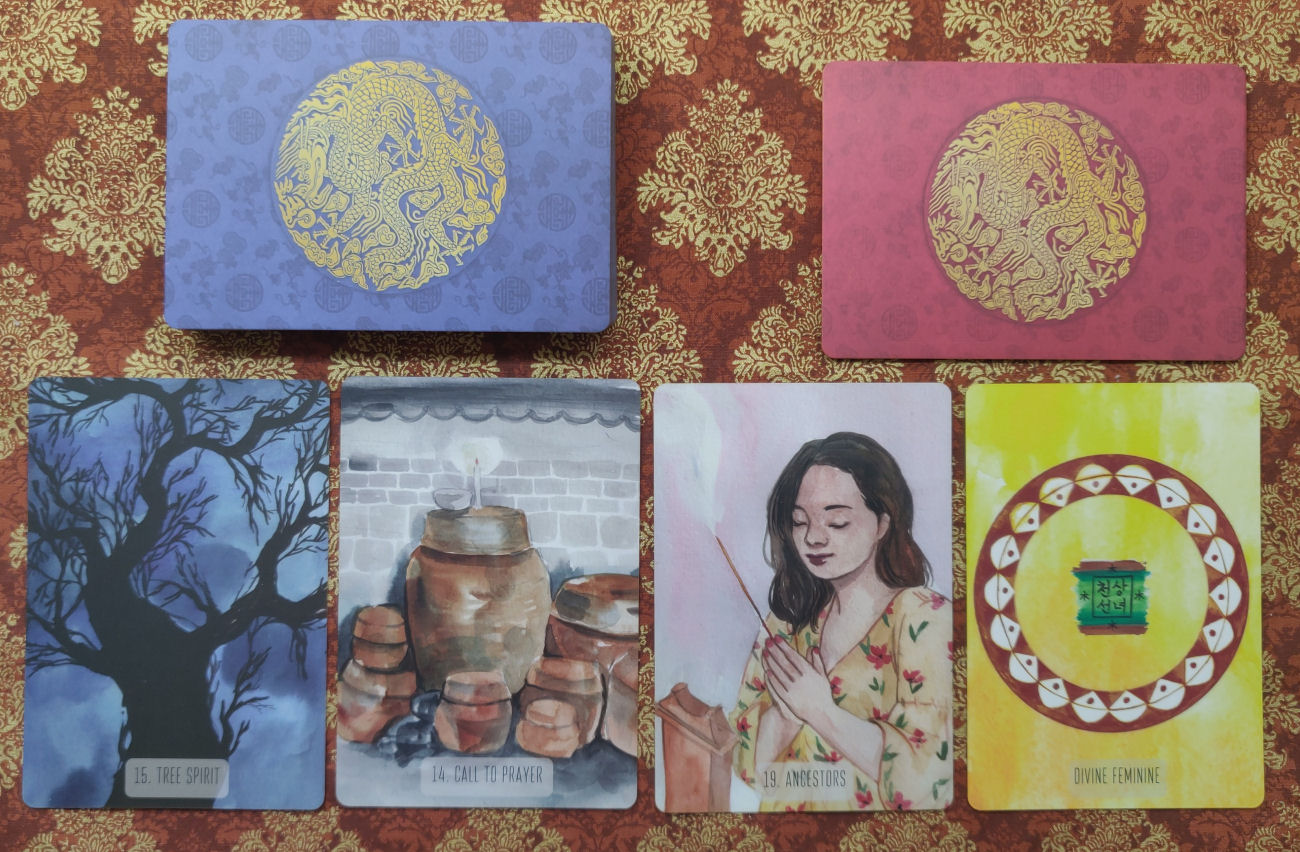
A treasure of a divination system in a box that you’ll cherish, Morning Calm Oracle by trained shaman Seo Kelleher invites you to engage with a world of spirits, divinities, and nature magic from the Land of the Morning Calm, a name of endearment given to Korea.
The box design, sigils, and the tactile experience of handling the cards are an exemplary representation of East Asian magic. Those who are sensitive to energy will even feel the difference in the vibrations of this deck in hand compared to other decks you might have in your collection.
I am enchanted by the effortless beauty and the beneficence of this deck. The artwork is done by Alodia Yap, whose artwork is moving and melodic. Yap’s art style here is impressionistic. It works in perfect harmony with what Kelleher set out to achieve.
The Rat is the start of the zodiac cycle, much like Aries in the Western zodiac. Thus, any year of the Rat is going to be prognosticated as a year of beginnings, of starting over, and new opportunities that come your way.
The Rat is considered to be business-savvy and entrepreneurial, so sole proprietorships are going to be more prosperous than usual. It’s a lucky year for small businesses or new startup ventures.
With 2020 being the year of the Metal Rat, we’re going to see a global focus on technology.
Metal years, no matter what the animal sign, are also more prone to social conflicts, so we may see more of that across the world stage. This is a year of nations and leaders trying to show off their power.
On the other hand, in terms of culture and humanities, it should be a great year for music.
Most Eastern esoteric paths espouse that a practitioner of any esoteric art should proactively cultivate and strengthen the personal Qi, or life force, because when you do any form of intense metaphysical work, you’re drawing from that pool of personal Qi. If you’re not mindful of replenishing that Qi, then the constant weakening of your life force from the occult work that you do (this includes divination) can cause physical and mental health concerns. So to maintain optimal wellbeing–and that’s physical, mental, and psychic-spiritual wellbeing–cultivation practices are necessary.
Image source: pxhere.com
The Metaphysician’s Qi
Divination, ceremonial ritual, mediumship, channeling, pathworking, spell-crafting, astral journeying—these practices are believed to exhaust a lot of your personal life force, and so as a metaphysician, you want to establish a routine practice of cultivating and strengthening your Qi, or life force, to maintain your wellbeing. Otherwise, you can become more susceptible to illness, both of the physical and mental variety.
Taking measures to cultivate and strengthen personal Qi is a practice everyone and anyone can benefit from, much like how everyone and anyone should be mindful of nutrition and physical exercise. However, the nutritional needs of your everyday office worker is very different from the nutritional needs of an Olympic swimmer. So we can make the comparison here of an occultist to the Olympic swimmer, because it’s considered an out-of-the-ordinary lifestyle, and so your nutritional needs– in this case psychic-spiritual nutritional needs– will be different from the average person.
Let’s cover six ways a metaphysician can cultivate Qi:









 benebell wen