Triggering Creativity with Tarot: Replay of a Free Webinar

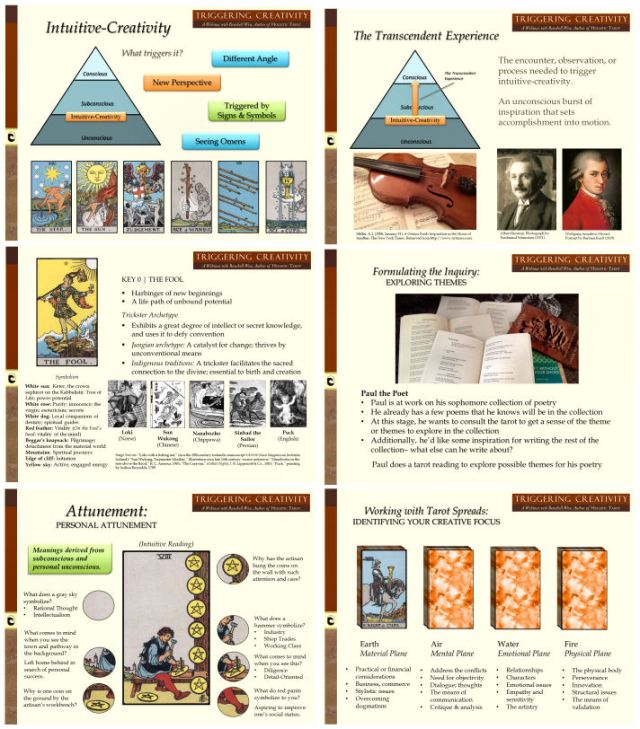
On February 21, 2015, North Atlantic Books hosted a free webinar where I talked about intuitive-creativity and tarot. You can check out a replay of the webinar above.

About the Webinar

Albert Einstein attributes his most ground-breaking insights not to logic or mathematics, but to intuition and inspiration or, as artists and writers often express it, to the muses. However, the one trait believed about the muses, about how intuition and inspiration hits us, is that it comes only when it comes, almost divinely, and the artist or writer cannot call upon it at will.

Yet through tarot, learn how to harness intuitive-creativity at will. Tarot facilitates the transcendent experience needed for the muses to speak to us. Learn how to use tarot to trigger your intuitive-creativity and apply the tarot fundamentals taught in my book, Holistic Tarot to remove creative blockages.

Preview_Slides
Presentation Slides Preview

In this 45-minute webinar that will be invaluable to any artist or writer, I’ll be lecturing about how to use tarot cards as an intuitive and inspirational tool for creative and artistic passion projects. The lecture will cover attunement, how to exercise the intuition muscle, and specific techniques for using tarot spreads to read about your creative projects.

When I say “intuitive-creativity,” I’m talking about the muses, about divine inspiration, about that “a-ha” moment. Learn how to use tarot to identify your creative focus, mind-map your project trajectory, perform character analysis if you’re writing a novel, explore the themes of your project in greater depth, and generally trigger your own inspiration with tarot card imagery.

Download the Handout

There is also a handout in PDF format that goes along with the webinar. Please be sure to download it as reference for the techniques and exercises discussed during the webinar.

CLICK TO DOWNLOAD THE HANDOUT

Preview_PDF

Holistic Tarot Free Study Guides: Advanced

Holistic Tarot Study Guides Advanced 4

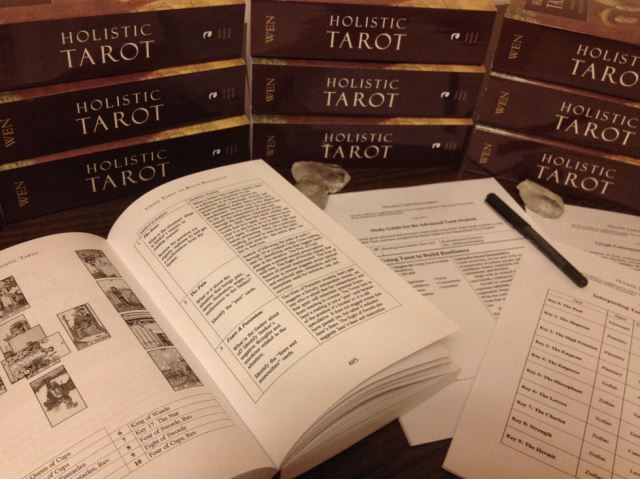
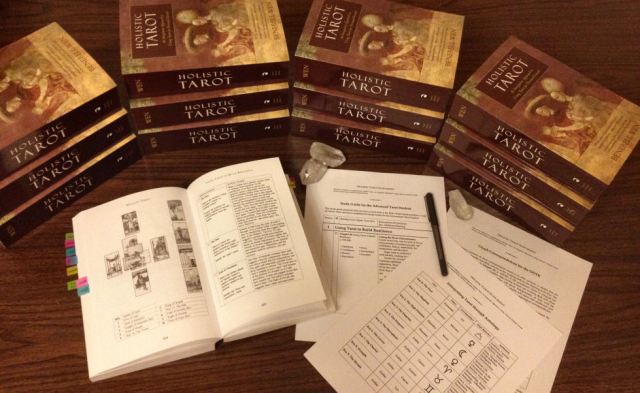
Okay, people, I get it. I’ve heard it. Holistic Tarot is a big book. How does one even wade through that thing? Fear not! I’ve got study guides! To demonstrate how the book can be used as a textbook for the independent study of tarot, I’ve created study guides that will help you navigate the book at a beginner level, intermediate, and advanced. Here are the first two study guides:

Don’t forget the supplements! Those are very helpful (or so I claim). Be sure to check out all Holistic Tarot study guides and supplemental downloads here.

Now I bring you the Study Guide for the Advanced Tarot Student, and also for the tarot practitioner who is seeking to go professional. If your objective is to go professional, however, this study guide alone (and the Holistic Tarot text) is not going to suffice. That’s why I have several great book recommendations in the study guide that I know will be indispensable to the aspiring professional.

Who might find the Advanced study guide helpful?

The Advanced study guide may be right for you if…

  • you have been reading Holistic Tarot by following along through the Beginner and Intermediate study guides and now see there are still chapters that the guides didn’t cover and you want to cover those chapters, or
  • you’ve been studying tarot for some time under the Rider-Waite-Smith system, are proficient at the Intermediate level, and now you want more, or
  • you’re thinking about going professional with tarot and offering your reading services to the public.

If that sounds like you and you want to continue your studies with Holistic Tarot, then download this study guide and the recommended supplements.

Holistic Tarot Study Guides Advanced 3

STUDY GUIDE FOR THE ADVANCED TAROT STUDENT

Click on the radio button below to download the PDF.

download-study-guide

The Study Guide for the Advanced Tarot Student presumes that you have completed the Study Guide for the Intermediate Tarot Student, are proficient with the Rider-Waite-Smith tradition, and have a copy of the Holistic Tarot book. For Session 4 in the Advanced Study Guide, it is also recommended that you have a Tarot de Marseille deck and a Thoth deck to work with. Click on the above button to download the PDF. Also be sure to download and save the below supplements. Note: In traditional esoteric tarot teaching approaches, astrology and the Qabalah basics would be taught at the beginner’s level concomitant with the tarot basics. The approach here is to integrate these areas of knowledge after a strong foundation in tarot has been built.

Supplemental Downloads

Sample Code of Ethical Conduct for Tarot Professionals

DOCX

PDF

Glyph Correspondences for the Opening of the Key

PDF

Interpreting Tarot through Astrology

PDF

Sample Written Reading Templates

DOCX

PDF

Log of Professional Readings, Events, and Parties

DOCX

PDF

Detailed Summary of Professional Readings Log

DOCX

PDF

Sample Privacy Terms for Tarot Reading Websites

DOCX

PDF

Sample Schedule of Fees and Terms of Service

DOCX

PDF

Sample Services Agreement (for Parties and Events)

DOCX

PDF

You can order your copy of the book on Amazon, through the publisher’s website at North Atlantic Books, or through the distributor, Random House.

All Holistic Tarot study guides and supplements are available for free download here on this website at HOLISTIC TAROT STUDY GUIDES. I hope these study guides are helpful in your learning and if you do use the Advanced Guide, please let me know about your experience with it!

Holistic Tarot Free Study Guides: For Intermediates

HolisticTarot_Intermediate_2

My first book Holistic Tarot was released in paperback this past Tuesday, January 6, and I am grateful for the overwhelming support I have received. First, thank you.

To demonstrate how the book can be used as a textbook for independent study of tarot, I’ve created these study guides that will help you navigate the book at a beginner level, intermediate, and advanced. I talked about the Beginner Level here and we’ll get to the Advanced shortly.

The following Study Guide is for an Intermediate student in tarot learning under the Rider-Waite-Smith system.

You are Intermediate if…

  • you have a working tarot journal of some sort;
  • you can draw any one of the 78 cards and interpret it with semi-confidence;
  • you have a basic, working knowledge of all RWS card meanings;
  • you’re familiar with the Celtic Cross spread and read proficiently with it;
  • okay, you don’t want to brag, but you’re kind of a pro with the three-card reading (or some other simple spread equivalent);
  • you’ve dabbled with different tarot spreads before and have a strong sense of what works and doesn’t work for you; and
  • you’ve done a minimum of 50 tarot readings (closed book, that is!).

If that sounds like you and you want to continue your studies with Holistic Tarot, then download this study guide and the recommended supplements.

HolisticTarot_Intermediate_1

STUDY GUIDE FOR THE INTERMEDIATE TAROT STUDENT

Click on the radio button below to download the PDF.

download-study-guide

Supplemental Downloads

Reading with Signifiers

PDF

First Operation Practice Log

DOCX

PDF

Court Cards Practice Exercises

PDF

Elemental Dignities and Affinities

PDF

Daily Readings

DOCX

PDF

Ruminations on the Major Arcana

DOCX

PDF

The Three Septenaries

PDF

Card Counting (Majority View)

PDF

Worksheet for Devising Your Own Spread

PDF

You can order your copy of the book on Amazon, through the publisher’s website at North Atlantic Books, or through the distributor, Random House.

All Holistic Tarot study guides and supplements are available for free download here on this website at HOLISTIC TAROT STUDY GUIDES. I hope these study guides are helpful in your learning and if you do use the Intermediate’s Guide, please let me know about your experience with it!

Holistic Tarot Free Study Guides: For Beginners

Holistic Tarot by Benebell Wen Beginner Study Guide 2

Holistic Tarot is now out in stores! You can order your copy of the book on Amazon, through the publisher’s website at North Atlantic Books, or through the distributor, Random House.

I hope you will find the book to be a timeless go-to reference source for all your tarot needs, but I also know that the sheer size of it can be intimidating.

So. I’ve created study guides and supplements for free download that will help you navigate the book and learn tarot. These study guides and supplements contain additional exercises and information that dovetail on the contents of the book.

The guides are subdivided into sessions with suggested reading, practice work, ruminations, and supplemental downloads that will help you learn tarot on your own and at your own pace. They will help you navigate the book, whether you’re reading at the beginner, intermediate, or advanced level.

Holistic Tarot by Benebell Wen Beginner Study Guide 3

If you’re just starting out, I recommend following the Study Guide for the Beginner Tarot Student, a syllabus for learning tarot on your own with the Holistic Tarot text.

You are a Beginner if…

  • you are not sure exactly how many cards are in a standard tarot deck;
  • some of the imagery on the Rider-Waite-Smith deck seem a bit intimidating to you;
  • you’re kind of wondering what all this Rider-Waite-Smith tradition talk is all about;
  • when I say “tarot journal,” you draw a blank;
  • you are not familiar with the Celtic Cross; and
  • you find it incredulous that anyone in this world could know from memory the meanings to all those cards.

STUDY GUIDE FOR THE BEGINNER TAROT STUDENT

Click on the radio button below to download the PDF.

download-study-guide

Supplemental Downloads

Rider-Waite-Smith Flash Cards for Rote Study

DOCX

Log of Celtic Cross Practice Readings (Version: Waite Cross)

PDF

Tarot Spreads Practice: Quick Reference Sheets from Appendix A (for printing convenience)

PDF

Log of Readings

DOCX

PDF

Morning Routine Reading Practice (Template) DOCX

Beginner Guide Created: 12/17/2014

All Holistic Tarot study guides and supplements are available for free download here on this website at HOLISTIC TAROT STUDY GUIDES.

I hope these study guides are helpful in your learning and if you do use the Beginner’s Guide, please let me know about your experience with it!

Self-Guided Intermediate Tarot Course: Integrating the Five Components of Circumstance

screenshot

DOWNLOAD COURSE PRESENTATION

(Note: Must watch in Slide Show format, due to layered animations.)

I’ve created a self-guided intermediate tarot course on a cross-cultural interpretive framework for reading tarot that I have not seen anyone present before. The Five Components of Circumstance is a cosmological theory based on the Chinese maxim that one’s fortune is based on five factors: 1) fate, 2) luck, 3) feng shui, 4) karma, and 5) education. That theory is a cornerstone in Chinese metaphysics and is used to diagnose an individual’s personal formula for success.

By integrating Five Components analysis with tarot reading, the tarot practitioner will have a new set of vocabulary for interpreting a spread, any spread in fact, and can more precisely pinpoint the strengths and weaknesses in a querent and what adjustments need to be made to expedite the querent’s goals.

Continue reading “Self-Guided Intermediate Tarot Course: Integrating the Five Components of Circumstance”

The First Operation: Adapting a Traditional Method in the “Opening of the Key” to Contemporary Tarot Applications

The First Operation is the first step to an extensive divination method called the “Opening of the Key,” a method associated with the Golden Dawn approach to tarot reading. Paul Foster Case’s book, Oracle of the Tarot (1933) provides a great instructional on the First Operation. A PDF of the book can be downloaded HEREFor a recent publication on “Opening of the Key,” read “The Golden Dawn Opening of the Key Method” by Marcus Katz of Tarot Professionals, linked HERE.

Now I’ve extracted the First Operation method from the Opening of the Key to use contemporaneously with modern approaches to tarot reading.

Selecting the Signifier

There are many ways of selecting a signifier card, also known as the significator. A classic “old school” Golden Dawn approach is to use The Magician for a male and The High Priestess for a female. However, I was taught to use court cards. The following is my court card approach to selecting the signifier:

Astrol. Signs, Sun Sign Dates

Suit

Court Card Signifier
Aries, MAR 21 – APR 19

WANDS

PAGE for young female
Leo, JUL 23 – AUG 22 KNIGHT for young male
Sagittarius, NOV 22 – DEC 21 QUEEN for adult female
KING for adult male
Cancer, JUN 21 – JUL 22

CUPS

PAGE for young female
Scorpio, OCT 23 – NOV 21 KNIGHT for young male
Pisces, FEB 19 – MAR 20 QUEEN for adult female
KING for adult male
Libra, SEPT 23 – OCT 22

SWORDS

PAGE for young female
Aquarius, JAN 20 – FEB 18 KNIGHT for young male
Gemini, MAY 21 – JUN 20 QUEEN for adult female
KING for adult male
Capricorn, DEC 22 – JAN 19

PENTACLES

PAGE for young female
Taurus, APR 20 – MAY 20 KNIGHT for young male
Virgo, AUG 23 – SEPT 22 QUEEN for adult female
KING for adult male

Continue reading “The First Operation: Adapting a Traditional Method in the “Opening of the Key” to Contemporary Tarot Applications”

A 10-Week Independent Study Course with Paul Foster Case: A Review of Oracle of the Tarot (1933).

Paul_Foster_CasePaul Foster Case (1884 – 1954) is one of the most influential American occultists on modern tarot studies. His approach to tarot is influenced heavily by Western astrology and the Hermetic Qabalah, as evidenced in his tarot divination course, Oracle of the Tarot, and other writings, such as An Introduction to the Study of Tarot (1920) or The Tarot: A Key to the Wisdom of the Ages (1947). Oracle is keyed to the Knapp-Hall Tarot, which was first published by J. Augustus Knapp and Manly P. Hall in 1929. The Knapp-Hall Tarot differs significantly from the Marseille, Rider-Waite-Smith, or Thoth interpretive traditions, so the card meanings in Oracle, in particular from the Minor Arcana, are not readily transferrable to the Marseille, Rider-Waite-Smith, or Thoth systems. Nonetheless, Oracle offers the beginner and intermediate student a strong foundation in the basics and anatomy of tarot.

Case opens the book with a strong statement: “TAROT divination is not fortune-telling. The practice of fortune-telling is based on the false notion that human life is governed by luck, chance, or fate–by obscure powers at work outside the personality. True divination rests upon the occult truth that the causes of all events in human life are really internal.” He thus begins by distinguishing divination from fortune-telling. Divination is an inward reflection process of using tarot to tap into the superconscious. The tarot utilizes imagery and symbols that communicate in the language of the superconscious and thus understanding tarot is in its essence the learning of a new language.

The introductory Lesson 1 warns the tarot practitioner to take tarot divination seriously and reviews a few ethical guidelines, in particular the practitioner’s duty of confidentiality and impartiality. Practitioners must remain non-judgmental when conducting tarot readings. Lesson 1 also subdivides tarot decks into exoteric and esoteric decks. Case provides the Knapp-Hall Tarot as an example of an exoteric deck, or one that operates in the realm of public knowledge, with imagery that more closely resembles the tarot deck originally used for playing games, and contrasts that with the Rider Tarot (or Rider-Waite-Smith), which he refers to as an esoteric deck. Esoteric tarot decks are the versions of tarot re-interpreted by occultists and used specifically for divination or other spiritual exercises.

Note that it is unclear and somewhat contradictory as to why Case expends the first half of the Introduction to describe tarot divination as an internalized process, but then applies an exoteric deck to teach divination, rather than an esoteric deck, which would seem to be more aligned with the internalized process of tarot divination. What’s more, the subsequent lessons in Oracle repeatedly reference esoteric tarot traditions.

The 10 lessons of Oracle are meant to be studied over a course of 10 weeks.

Lesson 1 then proceeds to describe the anatomy of the Major and Minor Arcana (referred to as the Major Trumps and Minor Trumps in Oracle). Case claims that his Hebrew letter attributions for the Major Arcana are the “correct” attributions and that preceding claims by such authors as Papus were wrong. Case sources his attributions from Eliphas Levi (1810 – 1875), a French occultist and influential writer on tarot. Case claims that his Hebrew letter attributions are better aligned with the standard astrological attributions of the Major Arcana, which he provides as follows:

Case’s Hebrew and Astrological Attributions in the Major Arcana

Key

Major Arcana Hebrew Attribution Astrological Attribution

0

Le Fou (The Fool) Aleph (A) Air; Uranus

1

Le Bateleur (The Magician) Beth (B) Mercury

2

La Papesse (The High Priestess) Gimel (G) The Moon

3

L’imperatrice (The Empress) Daleth (D) Venus

4

L’empereur (The Emperor) Heh (H) Aries

5

Le Pape (The Hierophant) Vau (V) Taurus

6

L’amoureux (The Lovers) Zain (Z) Gemini

7

Le Chariot (The Chariot) Cheth (Ch) Cancer

8

La Justice (Justice) Lamed (L) Libra

9

L’ermite (The Hermit) Yod (I) Virgo

10

La Roue de la Fortune (Wheel of Fortune) Kaph (K) Jupiter

11

La Force (Strength) Teth (T) Leo

12

Le Pendu (The Hanged Man) Mem (M) Water; Neptune

13

La Mort (Death) Nun (N) Scorpio

14

La Temperance (Temperance) Samekh (S) Sagittarius

15

La Diable (The Devil) Ayin (O) Capricorn

16

Le Feu Du Ciel (The Tower) Peh (P) Mars

17

Les Etoiles (The Star) Tzaddi (Tz) Aquarius

18

La Lune (The Moon) Qoph (Q) Pisces

19

Le Soleil (The Sun) Resh (R) The Sun

20

Le Jugement (Judgement) Shin (Sh) Fire; Pluto; Vulcan

21

Le Monde (The World) Tau (Th) Saturn; Earth

He attributes the Minor Arcana as follows:

Attributions in the Minor Arcana

Suit Divinatory Representation

Elemental Attribution

WANDS Work, enterprise, ideas; the energies of the spiritual plane or archetypal world (Plato’s world of ideas)

FIRE

CUPS Desires, hopes, wishes; emotional activities; the states and forces of the mental plane, the creative world in which mental patterns are formulated

WATER

SWORDS Action, and therefore conflict of forces; the states and activities of the astral plane; the formative world of unseen forces, which build the conditions of the physical plane

AIR

COINS orPENTACLES Things, possessions; the concrete objects and bodies of the physical plane; the objectification of the energies and forces of the higher worlds or planes represented by Wands, Cups, and Swords

EARTH

As for significator cards, Case’s approach is to simply use Key 1: The Magician for male seekers and Key 2: The High Priestess for female seekers. That differs from the more popular modern approach of using the court cards as significators.

Oracle also teaches an initial divinatory method called the First Operation, which seems to be an antiquated practice now, as few modern tarot practitioners adopt the First Operation. It is nonetheless a method that the serious tarot practitioner should be familiar with. The First Operation is to be performed prior to a question. The significator card is shuffled in with the full tarot deck and then cut into four piles as follows:
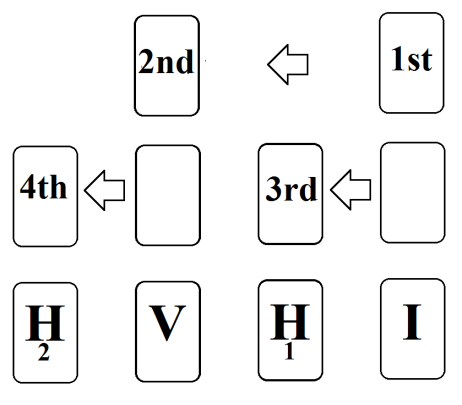
case4

The tarot practitioner then proceeds to locate the pile that the significator card is in. That pile, be it I, H1, V, or H2 (reading right to left respectively), will indicate the nature of the seeker’s question. The four piles correspond with the Hebrew letters Yod (I), Heh (H), Vau (V), Heh (H), which is a transliteration of the four constants forming the Hebrew name of the Supreme Being, again showing the strong influence of Qabalistic tenets on Case.

The four piles of the First Operation correspond as follows:

I

Personal Development; Health & Wellness. Seeker is asking about matters of personal development, such as work or career. Could indicate an interest in beginning a new venture or carrying out a new idea. Pile is also associated with the physical, such as body, health, or wellness issues.

H 1

Love, Marriage, Family. Seeker is asking about emotions, feelings, personal relationships, or desires. This pile pertains to the domestic sphere and interpersonal matters.

V

Politics, Ambitions, Social, Intellectual. Seeker is asking about ambitions and high aspirations. This pile could also pertain to conflict resolution, imbalances or disappointments. This is also the pile that corresponds with the Seeker’s intellectual faculties.

H 2

Money, Business, Property. Seeker is asking about a material matter, finances, property, or wealth.

If the significator card is in a corresponding pile that is consistent with the seeker’s question topic, then the First Operation has confirmed that the subsequent tarot reading will be accurate as applied to the question at hand. If, however, the significator card appears in a pile during the First Operation that is not consistent with the seeker’s question topic, then it shows that right now is not an appropriate time for the tarot to answer such a question.

Lessons 2, 3, 4, and 5 deconstruct the Suit of Wands, Cups, Swords, and Coins (Pentacles) respectively, keyed to the Knapp-Hall Tarot. Contained in the lessons are also simple 3-card spreads for divining past, present, and probable future influences.

Lesson 6 on the Major Trumps (Major Arcana) can be applicable to the prevailing tarot interpretive systems used today, though note that the Key 8 referenced in Case’s Oracle is “La Justice” (Justice) and Key 11 in Oracle is “La Force” (Strength), which is similar to the Marseille, but the reverse of the Rider-Waite-Smith (Key 8 is Strength and Key 11 is Justice).

Case claims that the timing of events can be revealed by looking at the astrological attributions of the cards, and the lessons in Oracle set about explaining how the 12 astrological houses can be used to divine the timing of events. From there, Lessons 7, 8, 9, and 10 teach complex tarot spreads, most notably combining astrology, the Tree of Life, and tarot, and further provides an overview of elemental dignities. Lesson 10 also provides an overview of numerology and its application to tarot.

Though some of the historic references in the book have since been disproved as myth, Oracle of the Tarot is still a work that every serious tarot student should have read. Not having read Paul Foster Case if you are a tarot practitioner is like not having read Anton Chekhov if you are serious about writing literary fiction. Though written over 80 years ago and keyed to a tarot deck that is, as of this writing, long out of print, Oracle nonetheless holds relevance today and every practitioner, no matter how advanced, will find at least one nugget of new information from Oracle.

So. Can Oracle teach tarot in 10 weeks? An operable foundation in tarot, yes, probably, though generally I am doubtful of any program that claims it can teach tarot in anything under 10 years. Learning tarot is nothing like learning to ride a bike. It’s really more like learning to play violin. In 10 weeks time you can probably learn no more than just how to properly hold the bow.

NOTE. You can download a PDF copy of OracleOracle of the Tarot by Paul Foster Case (1933). Download by CLICKING HERE (Source Credit: TarotWorks).

UPDATE (6/2/13). Read more about the First Operation: The First Operation: Adapting a Traditional Method in the “Opening of the Key” to Contemporary Tarot Applications.