
The White Numen Tarot illustrated by Alba Ballesta Gonzalez and published this year by Liminal 11 has been generating quite a buzz in the social-influencing sector of the tarot community. And it’s in no small part because of the animated and vivid illustration work. The scenes appeal to your intuition, giving this deck high readability and great as a beginner’s deck.
If you enjoy action-adventure comic book illustrations, then this deck is for you.
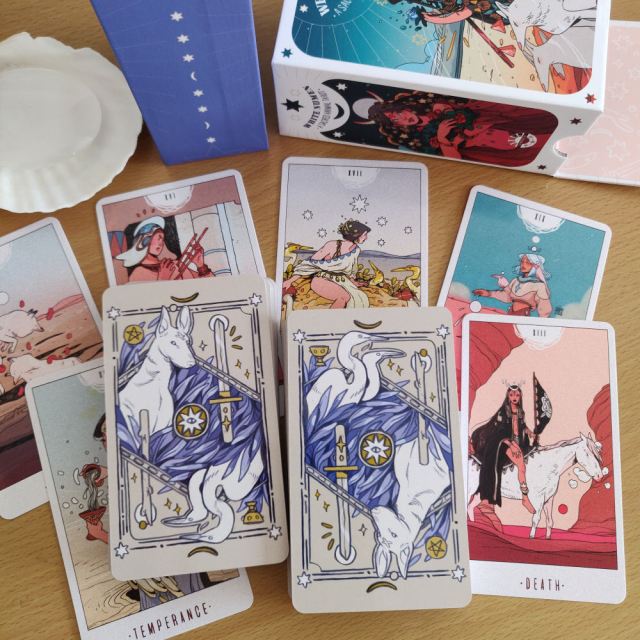
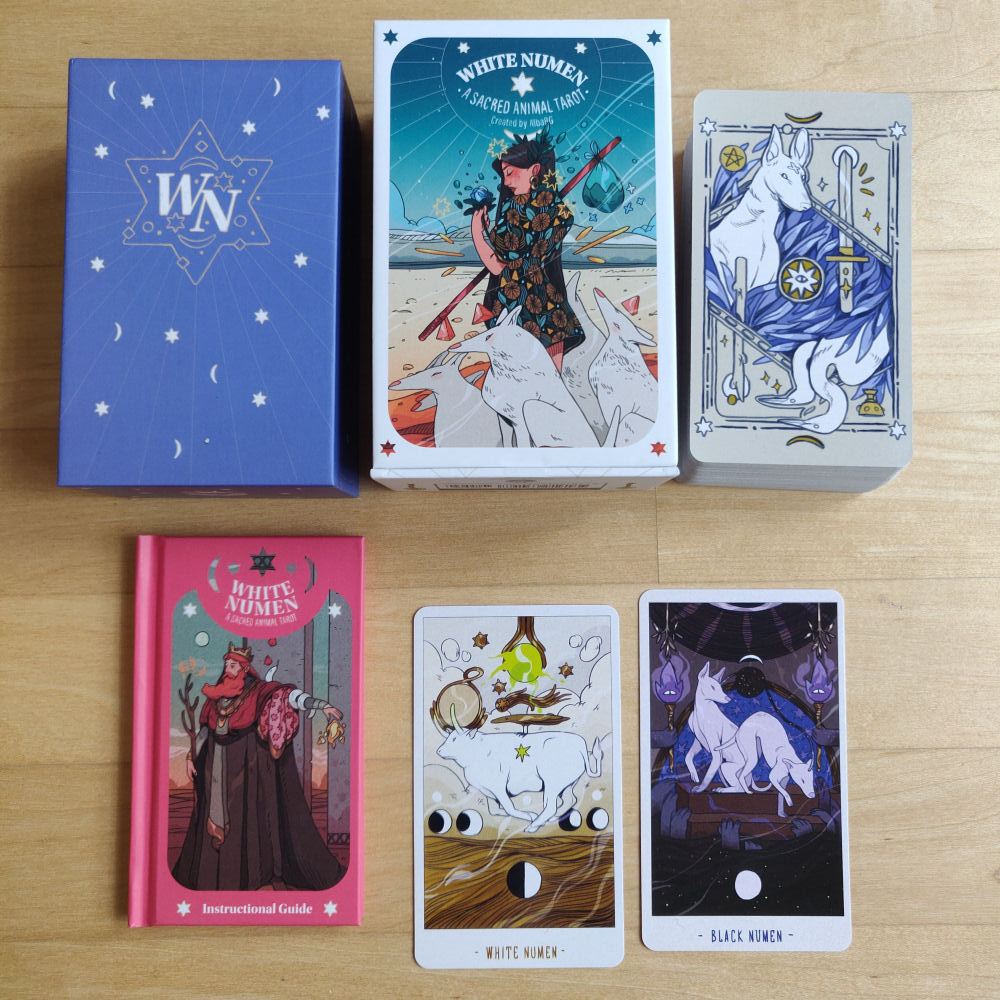
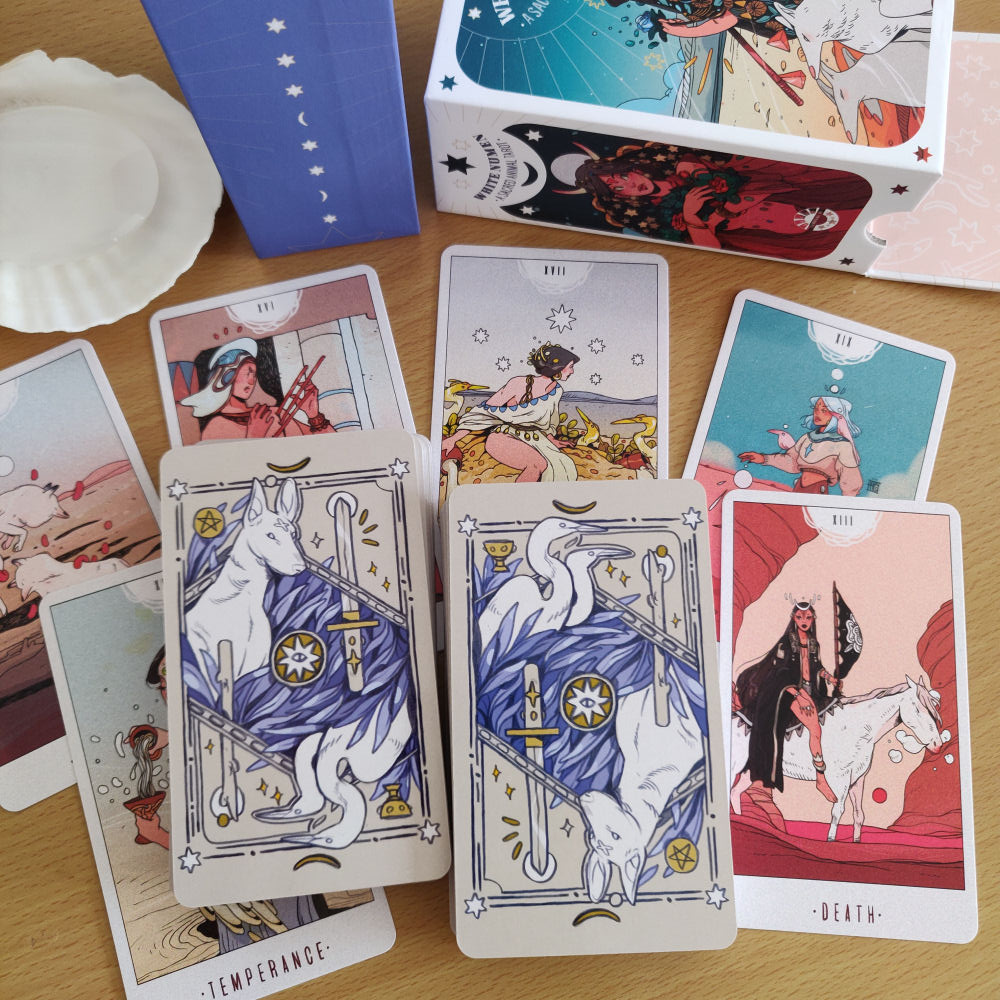
The intentional non-reversible card back here works with the deck’s premise of the numen, which is most present in the animal kingdom. And thus paleolithic humanity revered animals as symbols of the gods and their divine messengers. Upright on the card back is the dog, suggesting earthbound energies, or that’s how I interpret it. Reversed, you’re looking at two cranes, which to me suggests ethereal or divine sky energies.
A recurring theme of dualism is expressed in the two bonus cards: White Numen, featuring the sacred bull of heaven, a Mesopotamian animal emblem of the celestial realm, and Black Numen, featuring jackals, an Egyptian animal emblem of the underworld. I also like the moon phases iconography here, with the full moon on the Black Numen and the other moon phases, centering the quarter, on the White Numen.

The full-color hardcover little companion booklet gives a single-page explanation for each card. I was hoping I would be able to report back on how well the bonus cards read, but oddly enough, even after a dozen readings with the deck, both for others and for myself, neither card ever came up. But that was just me. Maybe for you the two cards will come up every time. In any event, they’re an intriguing addition.

This is an RWS-based deck done in what I think is probably some extent of mixed media, a combination of analogue hand sketching, maybe some traditional media, and digital art. You can check out the artist’s YouTube channel, where she has a lot of really interesting videos on her process.
She begins with the line work, sketching out shapes, then filling those shapes in with detail, and planning out the composition. Then she goes in with color. Finally, she uses digital effects to add texture. I learned a great deal about illustration work from watching her YouTube channel, so I highly recommend it to those interested in illustrating their own tarot or oracle decks.

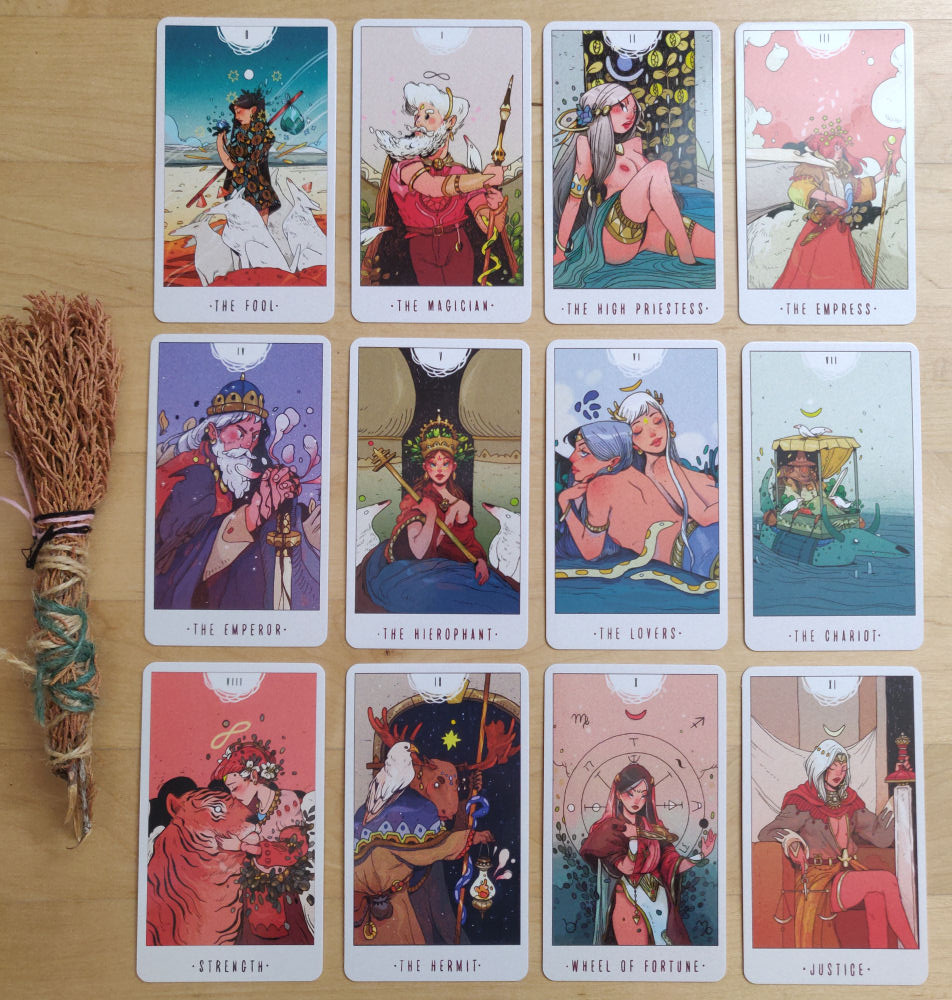
I’m curious whether the white fill inside the O, the tip of the A and the Tria Prima alchemical symbols inside the wheel of Key 10: Wheel of Fortune was intentional or an oversight during the digital art editing phase. 🙂

With the deck centering the principle of numen, light and lighting will be significant, and you can see the artist’s attention to that in how light and shadow is applied. Of particular note is how she uses these colored circles over the crowns, beneath the palms or feet, or strategically placed corresponding to chakra points in the body.
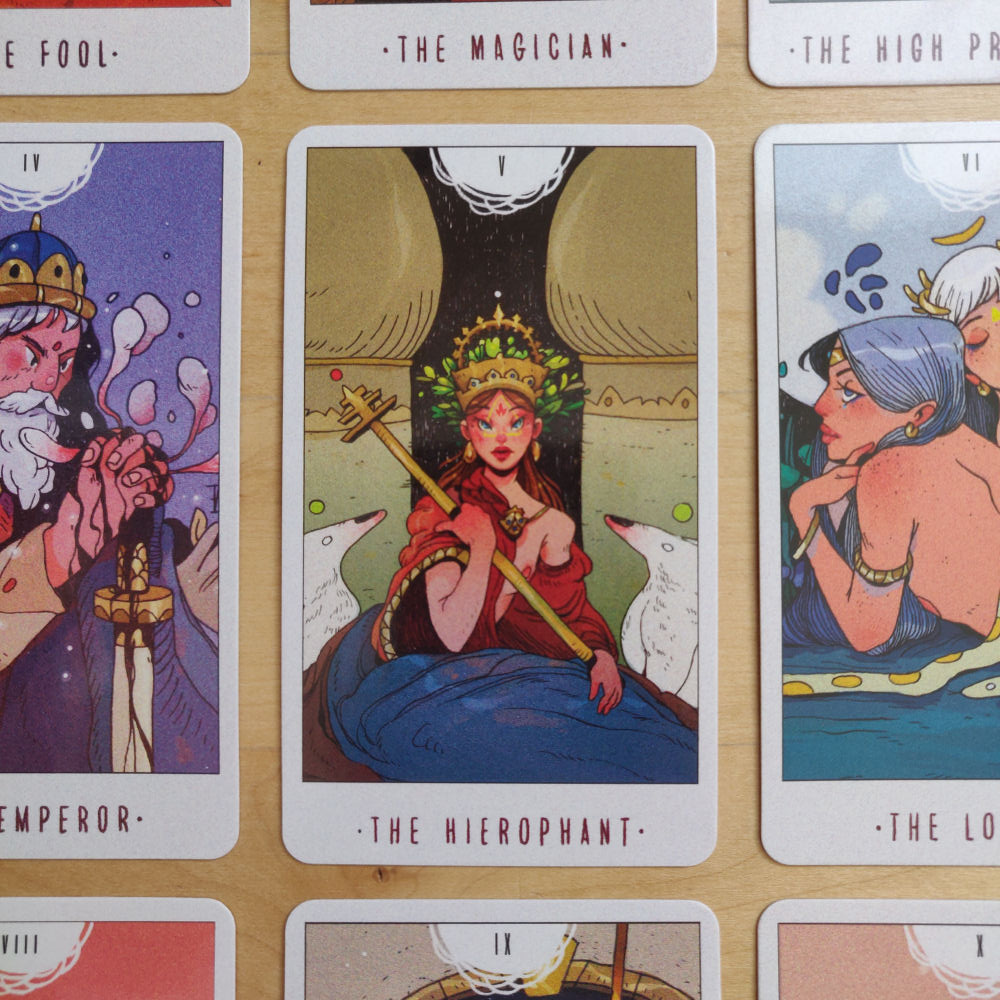
For example, here in The Hierophant card, notice the illuminated golden triangle on the hierophant’s face. The light is illuminating from within, and emanating out. The companion guidebook even talks about the three branches of authority here– the conscious, the subconscious, and the superconscious. Yet she is not the one who holds the power– the two psychopomps or animal spirit guides on either side of her, are who hold the power. Thus, while you think the focus is the human, returning to the deck’s subtitle, the Sacred Animal Tarot, we begin to see its thesis.
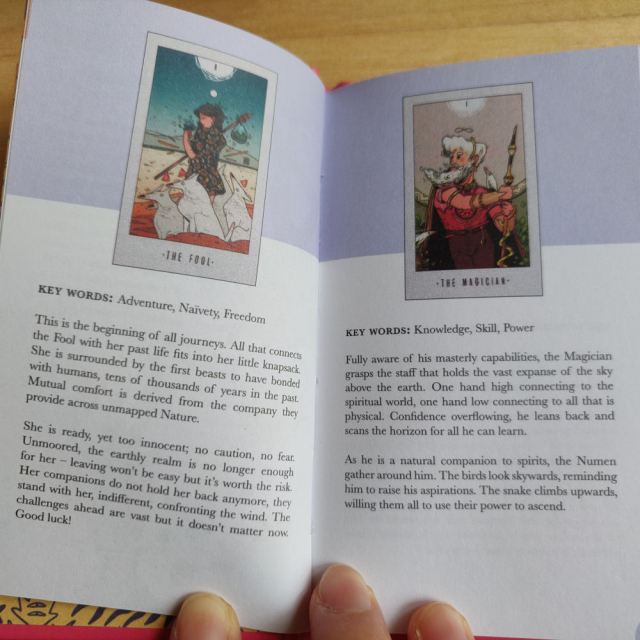
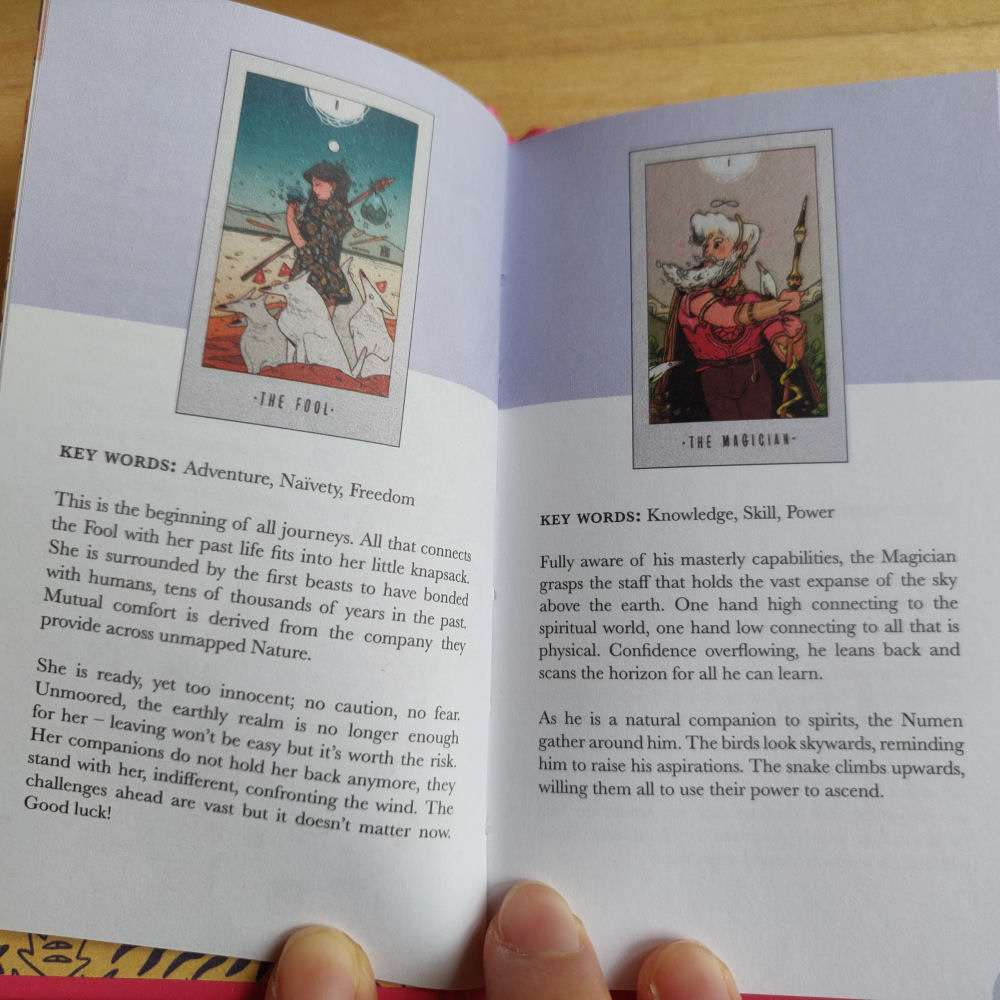
Each Major Arcanum is given a full page in the guidebook, with keywords to help out the beginner, a description of the card’s imagery, and how to interpret the card in a reading. The emphasis of the card meanings is spiritual, however, so the meanings provided in the guidebook alone may be a challenge to apply if you’re presenting mundane inquiries. If you’re a total tarot beginner, then you’re going to need to acquire another reference source for card meanings and learning how to read the cards.

A nice touch to the white borders is a textured effect that softens the frame. It achieves a sense of visual balance so that the overall design is easy on the eyes. The finish on the cardstock is high-gloss, giving the deck an effortless slip when shuffling or fanning the cards out across a reading table. A signature from the publishing house Liminal 11’s packaging is the magnetic flap that opens at the bottom of the box, and that’s what you’ll get with this deck.
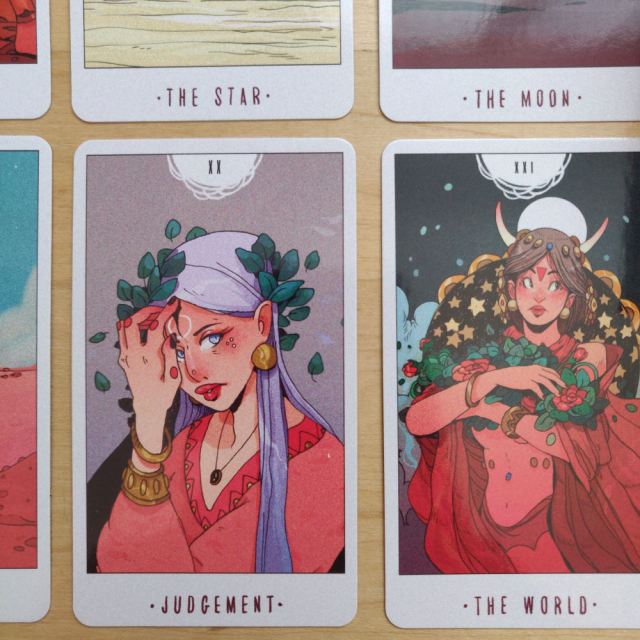
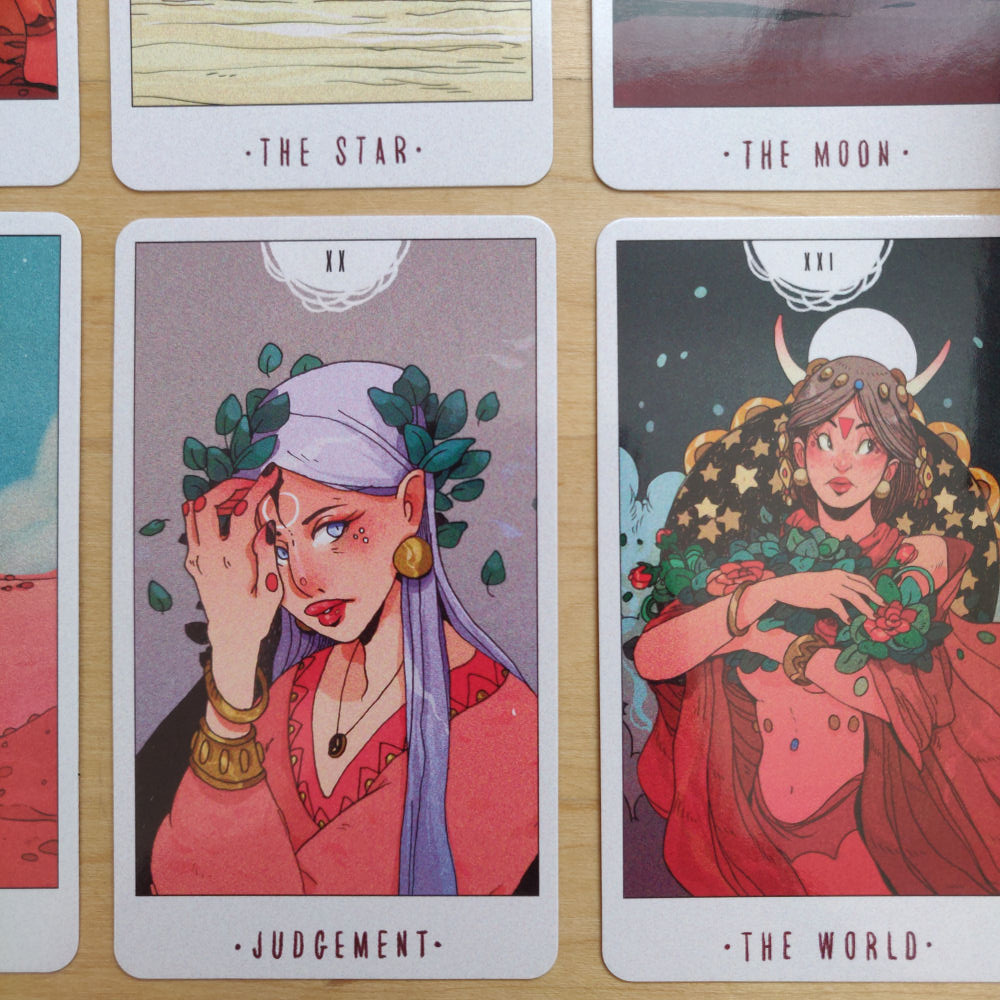
Like the subtle light reference in The Hierophant, here in Key XX: Judgement, the artist directs our attention to the white ring on her forehead, which is broken at the point where her finger touches. This symbolizes “the circular nature of time, [which] has been broken in order for a profound shift in development to begin.” The guidebook tells us that the Judgement card here is about something calling to us from “the abyss within to the infinite beyond.” The divinatory message here is to change and evolve.

By the way, I love the full-color guidebook and couldn’t help noticing the beautiful graphic design and layout. It features more close-up viewings of Alba’s art.
If you’re interested in this deck, I recommend that you watch a livestream chat between Alba and Darren Shill from Liminal 11. In that chat, Alba shares how she came up with the concept for this deck, which started with the Majors in 2018.
Before the deck even came into being, she has always been fascinated with the concept of the numen, which she describes as the idea of a mysterious power emanating from animals. Numen means “no human” in Latin, she notes. Here, she’s perhaps referencing Nietzsche and this idea of the wild human spirit, before we domesticated and thus tainted ourselves. “An animal which could speak said: ‘Humanity is a prejudice of which we animals at least are free.’” (Nietzsche)
Alba talks about how the evolution of theology in humankind came in three stages. The first stage is associated with the numen, when animals were praised as gods. This was the stage of humanity and our spirituality that she wanted to convey in this deck– representing a state of being when the numen is most palpably present.
The reason for the name White Numen: A Sacred Animal Tarot isn’t so much literal, meaning the deck will be depicting actual animals, though there is that. Every time animals appear in the cards, it’s significant, symbolic, and a representation of the divine.
Rather, this is a sacred animal tarot in the sense that the human societies depicted here are in that paleolithic stage of religion and relationship with the cosmos, where animals are gods, are messengers of the gods, and are treated as sacred. It’s the idealization and aspiration of humanity as animals because that’s when we are finally free of our prejudices.
With the artist’s intentions in mind, let’s proceed through the Minors.
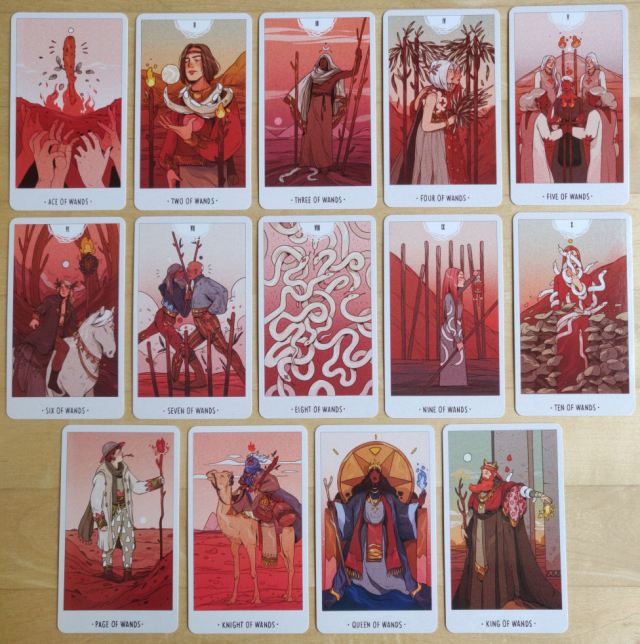
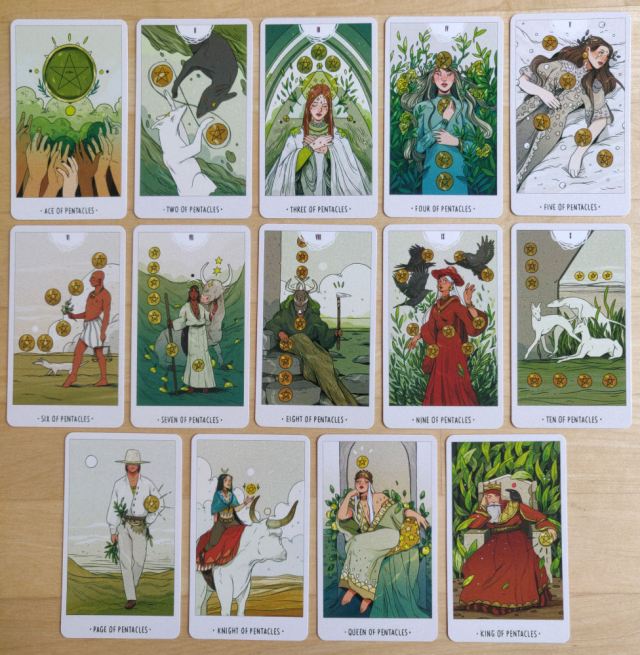
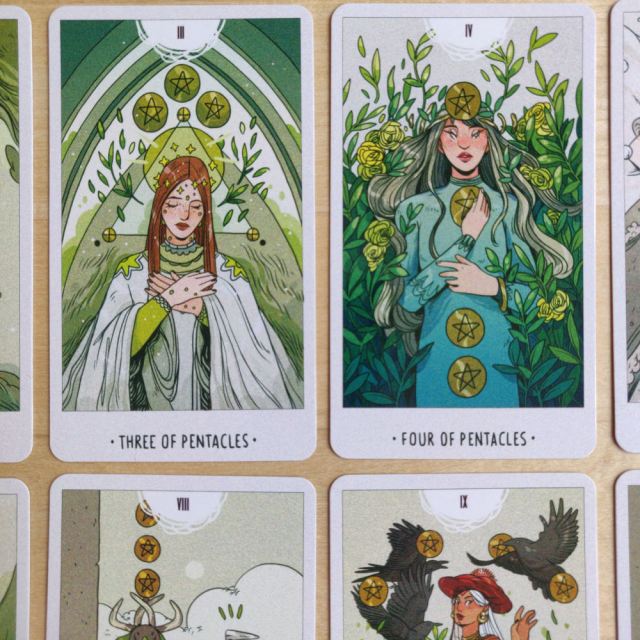
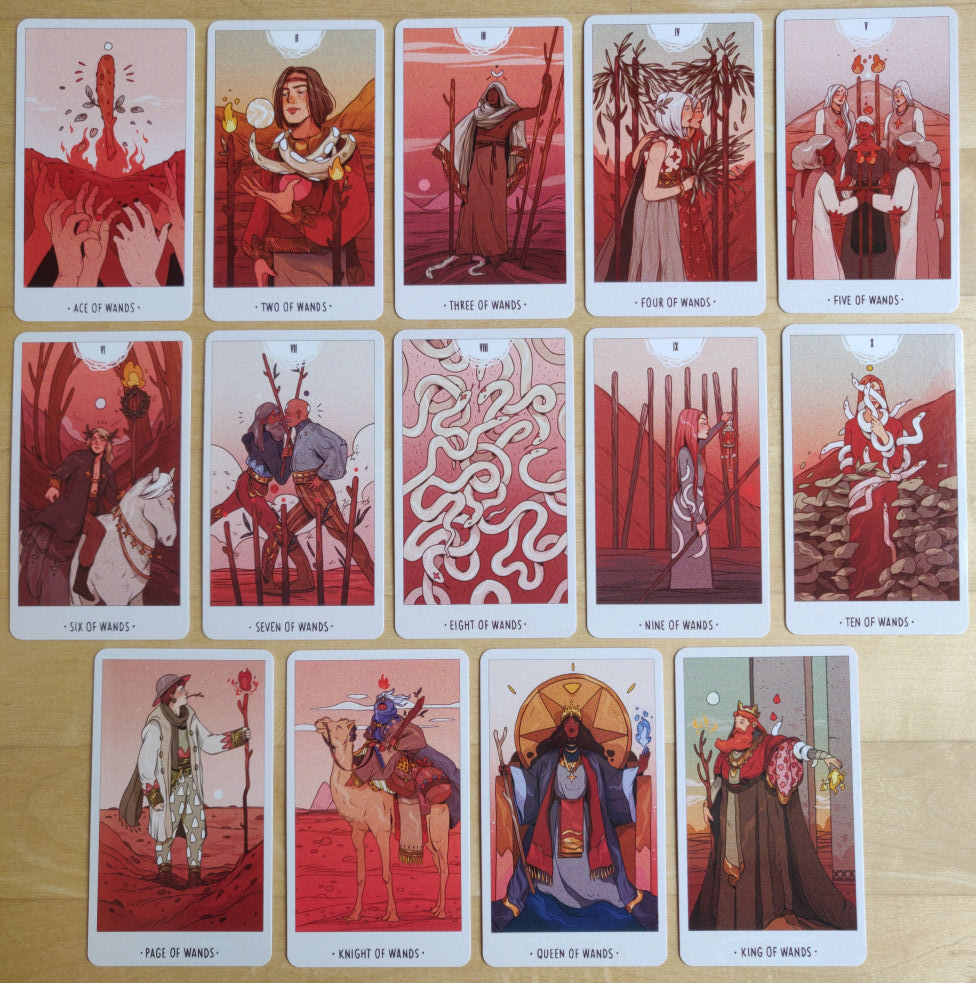
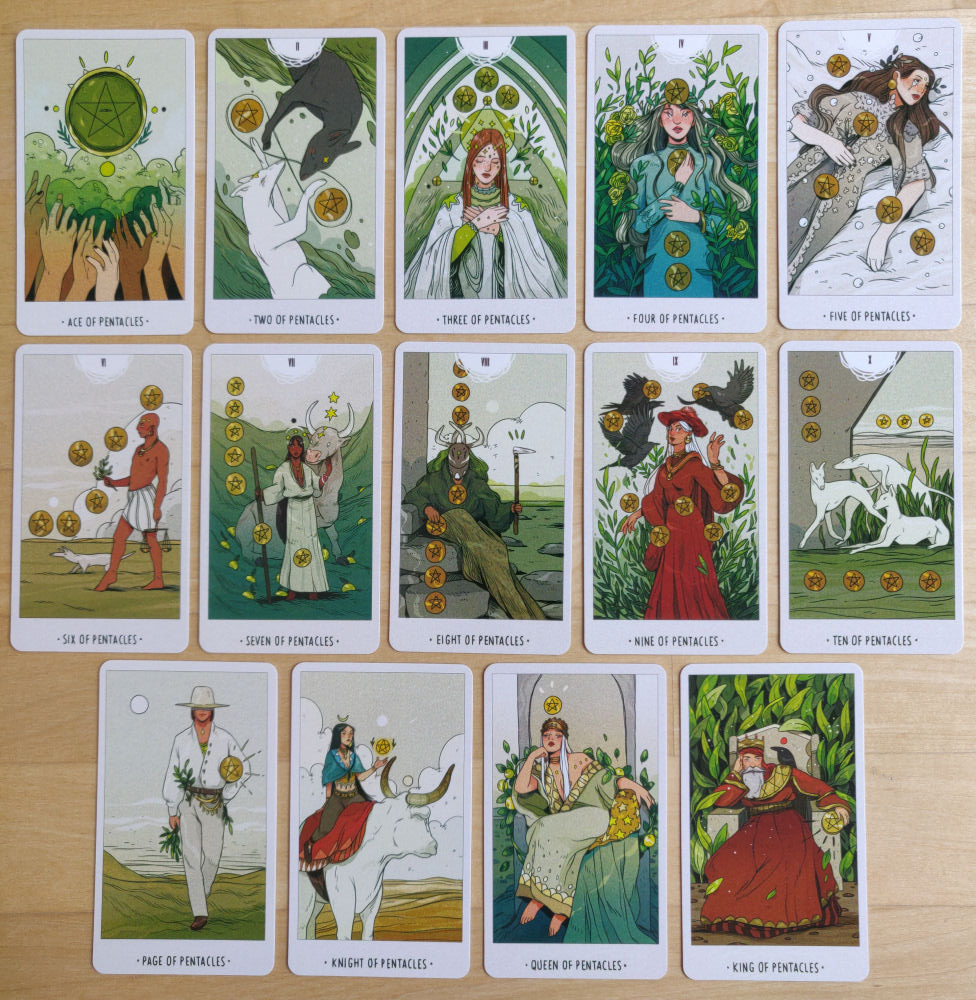
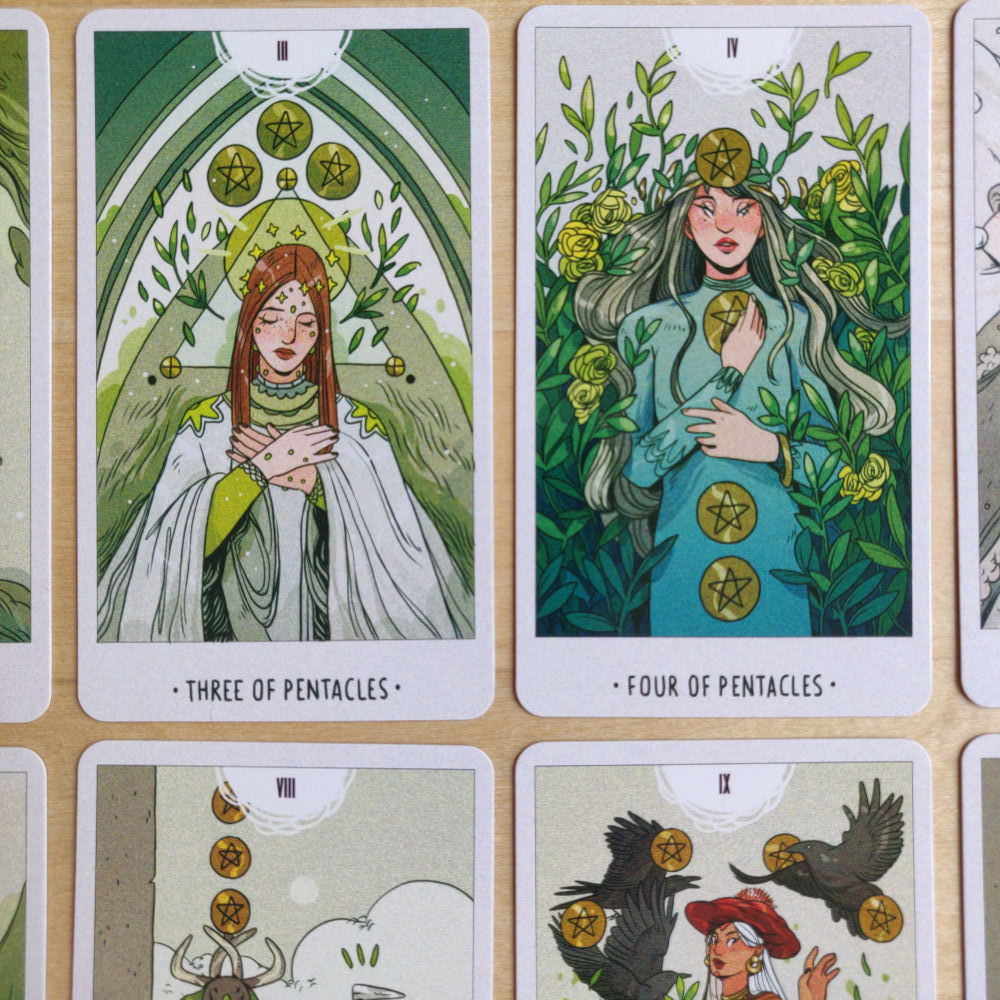
Here you’re going to see how the Minor suits are color-coded, and it’s done in such a way that — I don’t know why, but — reminds me of Avatar: The Last Airbender. The four suits are set up in such a way that they feel like four nations, each with the power to bend that nation’s corresponding element– fire, water, air, or earth.

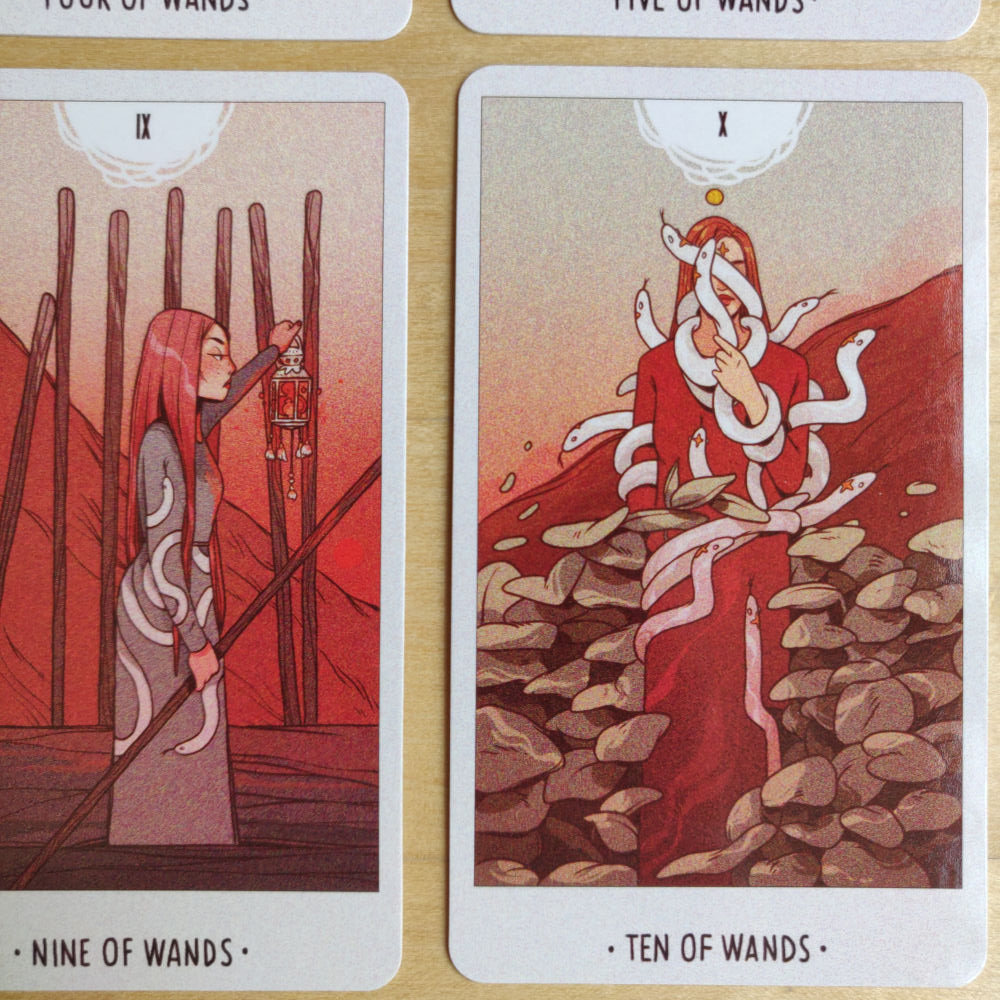
The repeating white snake imagery here intrigued me. You begin with the Two of Wands, coiled around the human figure’s shoulders. You see it under the right foot in the Three of Wands. Then it reappears with all its white snake friends in the Eight of Wands to represent how “everything flows with spontaneity, grace, and speed” (from the guidebook).

Then it’s featured on the figure’s dress in the Nine of Wands, and then wrapped around the figure in the Ten of Wands. Here in the Ten of Wands, notice the golden medallion of light at the crown, or above the figure’s head, symbolizing her zen state of being despite the physical situation she’s thrust in.
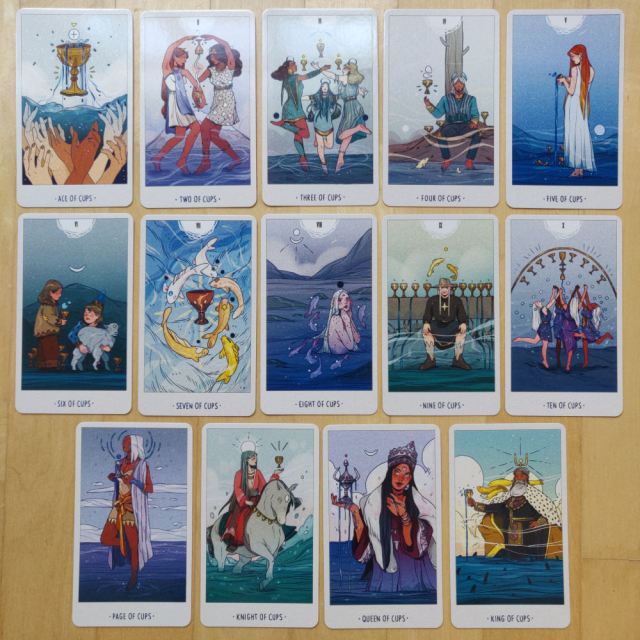
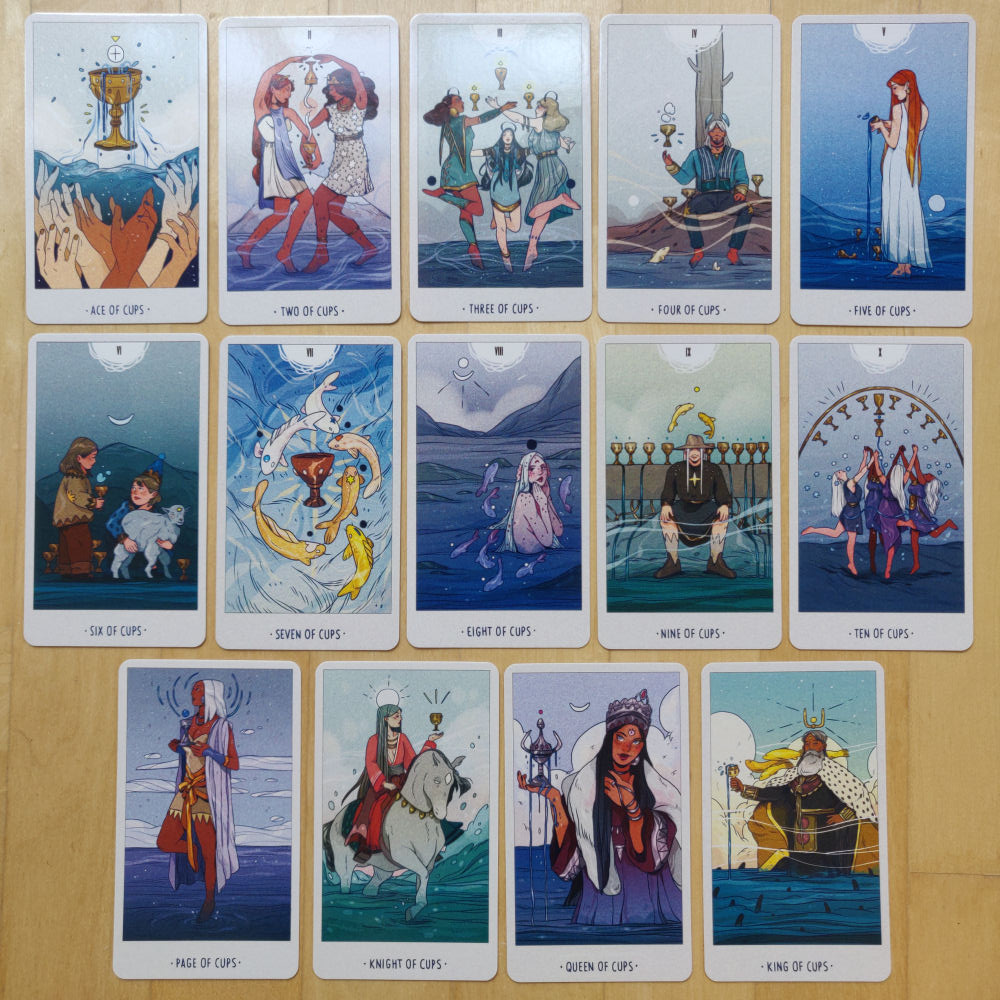
In the suit of Cups you see an interactive relationship between wild soul humans and sacred animals associated with the element water. Notice how in the backdrop, the landscape is always natural and untamed. There is a fantasy style to the art, suggesting that the worlds of this deck are more astral and conceptual than historically Paleolithic.
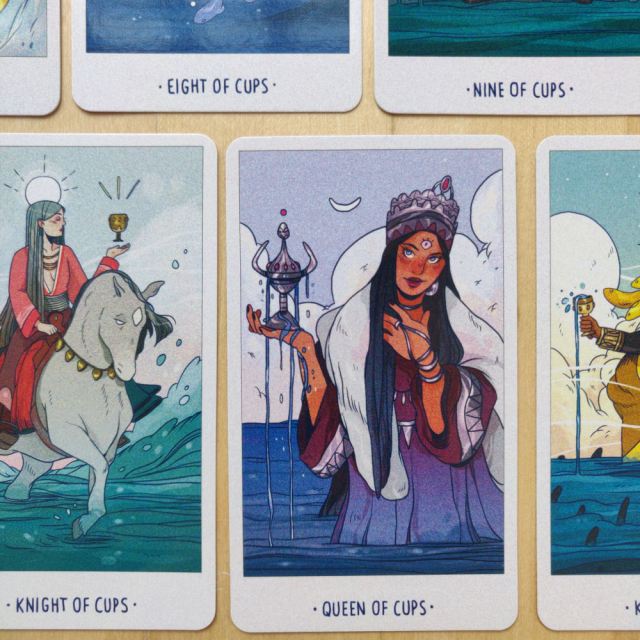
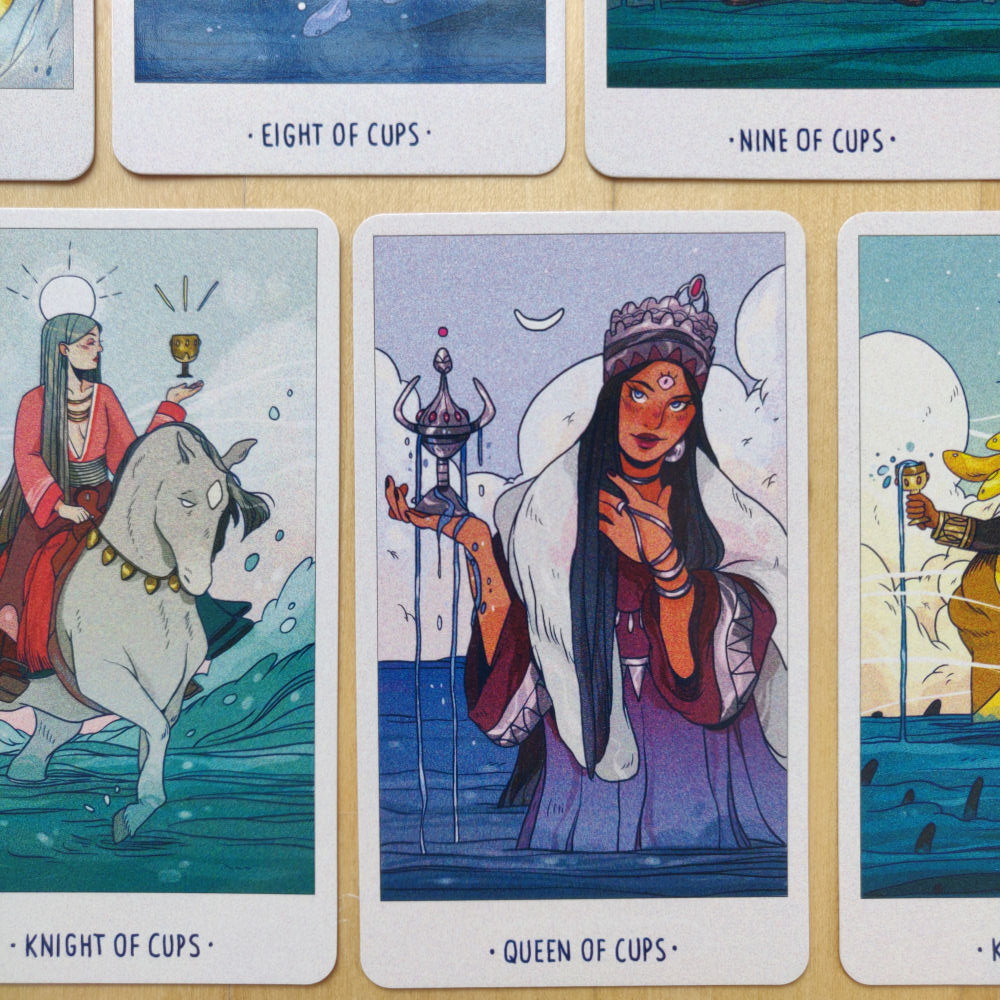
I love the way Gonzalez draws the figures, and you can see that appeal I’m talking about here in the Queen of Cups. The red circle above the chalice she’s holding is reminiscent of the way these colored circles appear as a detail throughout the deck’s imagery, like earlier in the Ten of Wands.

What comes to my mind when I see the illuminated shapes, such as the stars over each chalice here, and the circles hovering over the dangers’ feet in the Three of Cups is representations of the Taoist trinitarian energy concept of jing, qi, and shen, or, well, numen. Here, the black circles at the figures’ feet represents shadow, perhaps an oft not spoken about inherent restlessness in Three of Cups energy.
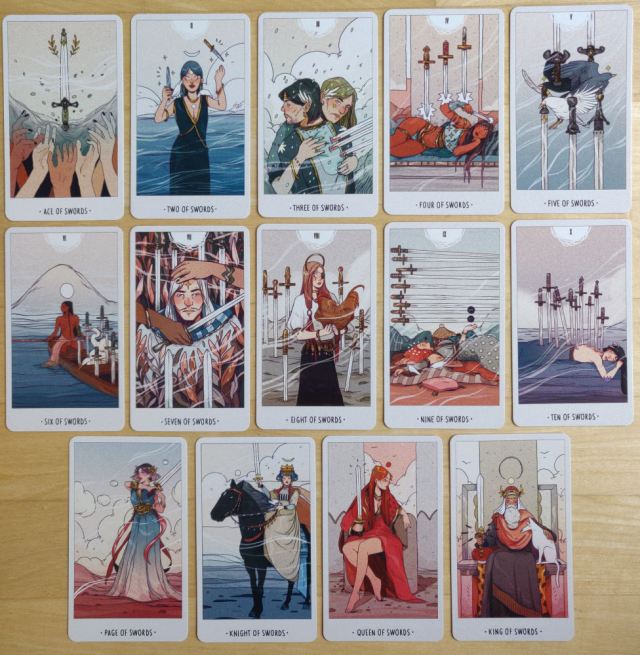
There are some really interesting takes on the cards here in the suit of Swords. Let’s start with the Ace. I love how you see many different hands vying for grasp of the sword’s hilt. The card feels competitive, aggressive, and the use of solid black in the negative space where the hands are versus the use of an ethereal white with wispy clouds where the sword’s blade is symbolic of a dual nature to this card, and that’s exactly what the card entry says in the guidebook– whosoever reaches out and grabs a hold of that sword will receive both a blessing and a curse.
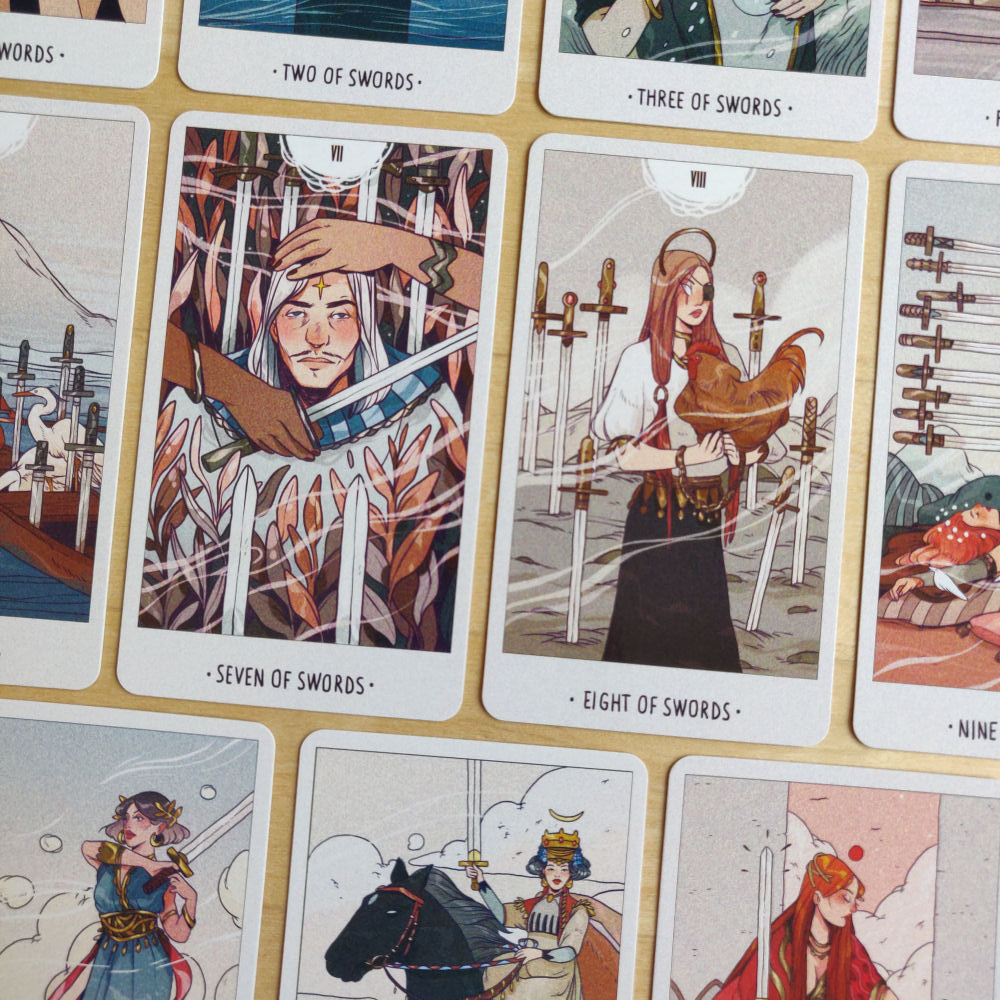
Then there’s that Three of Swords, again a really interesting take that feels unique. Seven of Swords as well. Noting where those colored circle symbols are in the card reveal the entry points of numen. Returning to the Two of Swords, you see the white circle over her heard and also over her third eye.
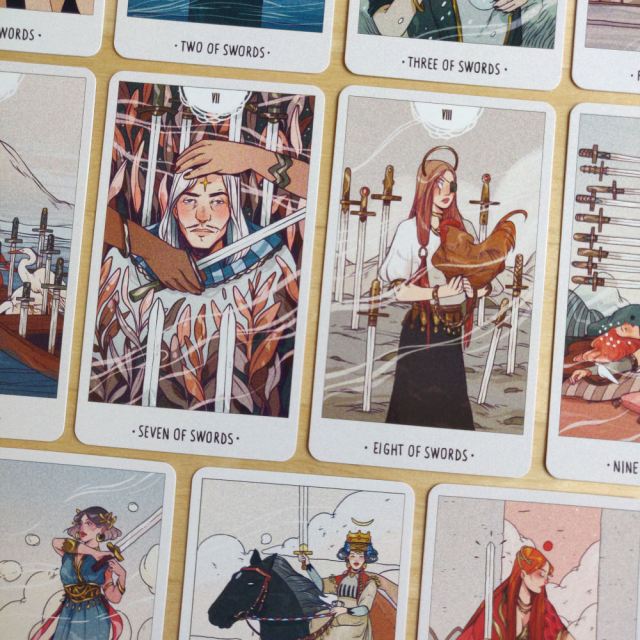
And wow, that Seven of Swords! The description for the card: “Punishment for betrayal. . . Normative morality and the consequences of breaking its rules.” The calm expression on the figure’s face seems to suggest that he kinda knows he had this coming. He’s not surprised that this is happening. Sharing how animal symbolism plays out in this deck, the rooster in the Eight of Swords is chained to the figure, representing “the passage of time and untapped empowerment” (the guidebook). For me, a rooster also symbolizes vanity and pride.
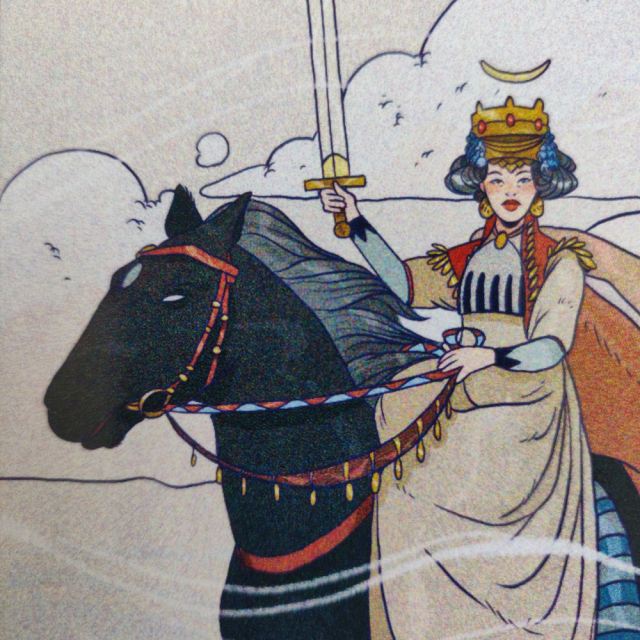
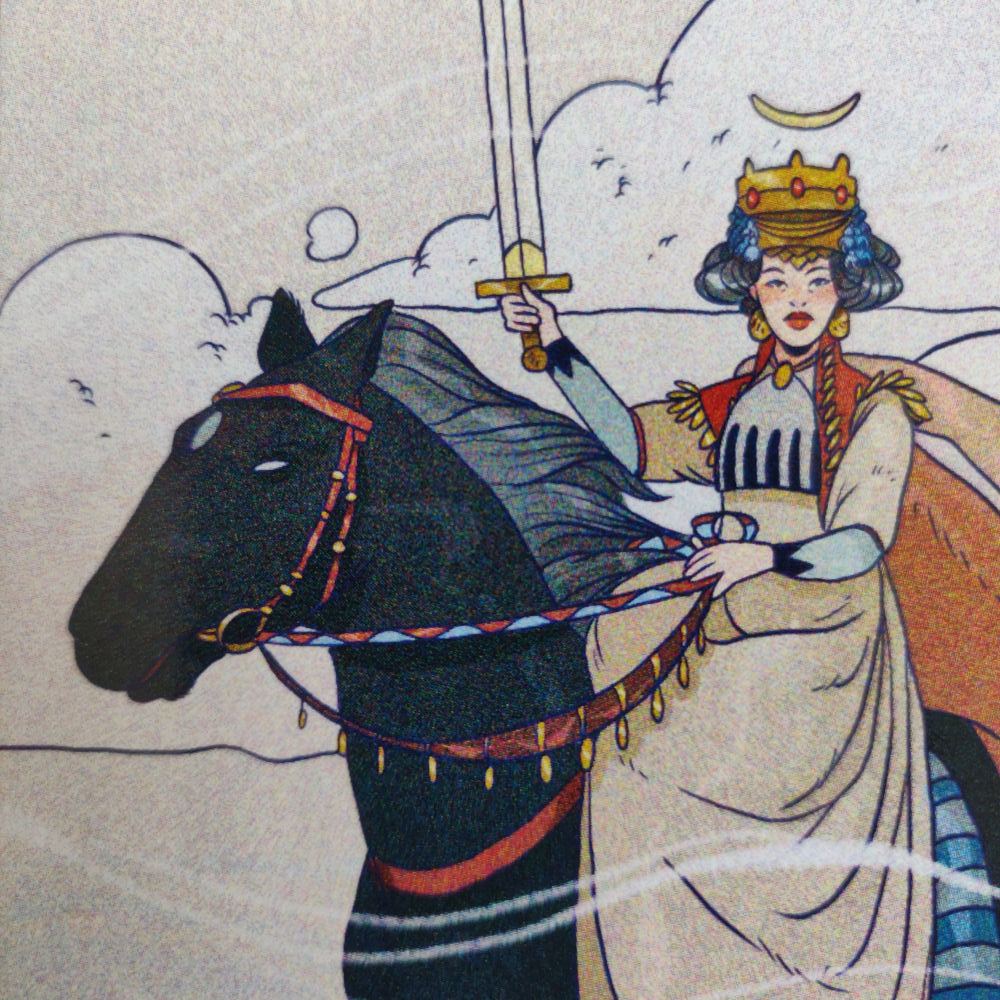
There is so much personality expressed in the human and animal figures. I love the way wind is depicted in this close-up of the Queen of Swords, blowing through the horse’s hair. The horse is even squinting from the wind.
From the videos I’ve seen on her YouTube channel, Alba has an effervescent personality and really inspires joy in you while you watch. In some her videos, I couldn’t help noticing the bookshelves in the background with Japanese language art books. And then it clicked– you really do see a distinctly East Asian animation style from her.

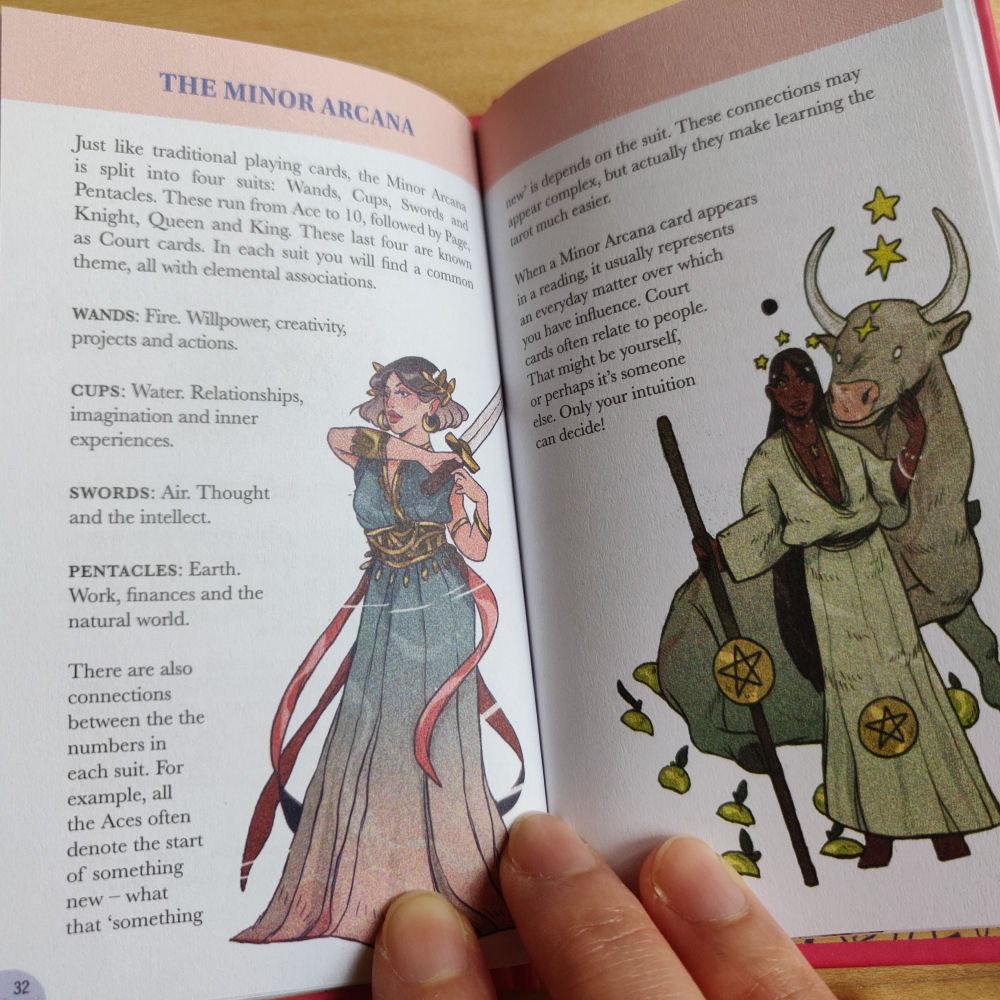
While the Majors are given a full-page treatment per card, card descriptions and ascribed meanings for the Minors are shortened, which is pretty common in standard companion booklets and even in many tarot books.

When reading with the deck, I found myself relying more on elemental correspondences and considering the chemistry of the elements present in the reading. I also begin a line of inquiry from what relationship I can discern between humanity and animal in the images. Then ask: how is the numen present here? Likewise, in what ways is the numen present in the situation I’m inquiring about, and what are the cards telling me about the nature and course of that numen?
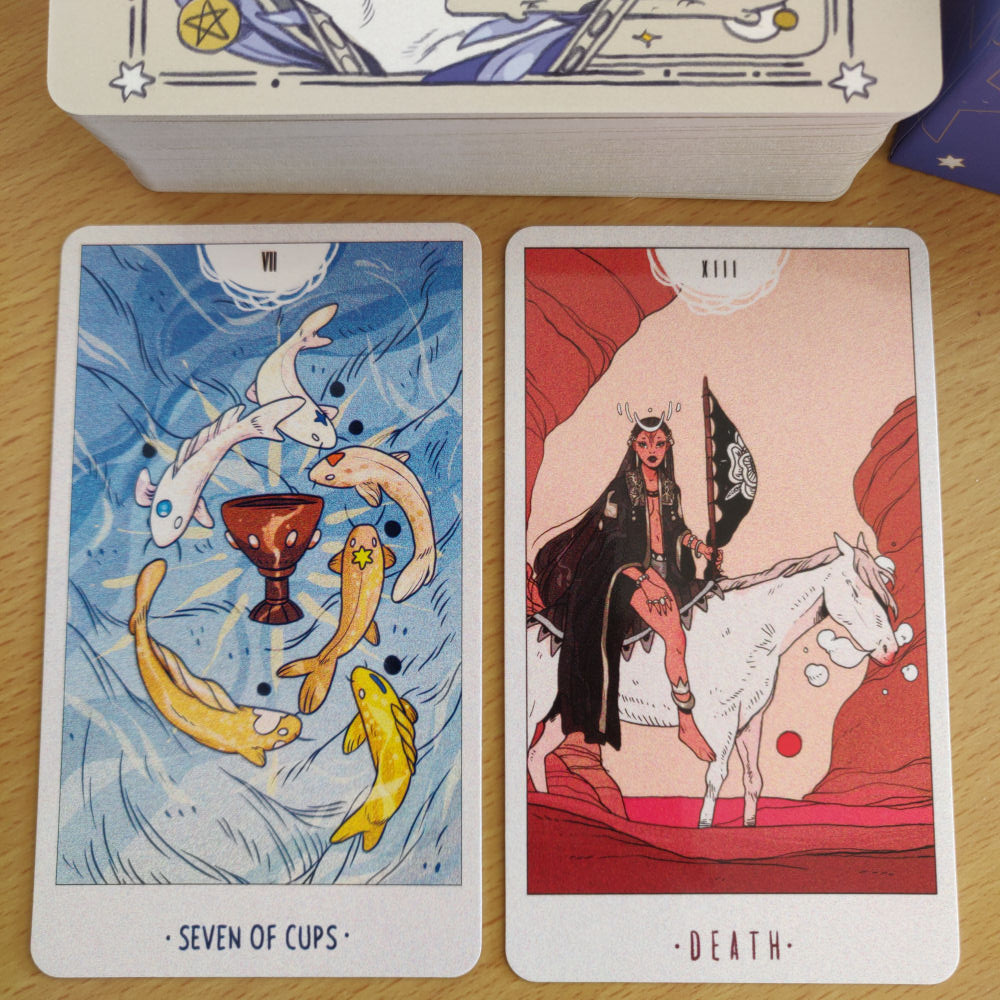
In the above close-up of the Seven of Cups, you’ll notice the black circles, which indicate shadow aspects of the numen, or Black Numen. Having learned a little more about the artist’s process through her YouTube channel, it’s apparent that color symbolism is very important to her. While it’s more common to see strong water elements in the Death card, here the landscape is a very Scorpio-red, for the astrological correspondence.
To order the White Numen Tarot Standard Edition from Liminal 11, visit here.
For the Special Limited Edition in a tin box that comes with an additional astrology-based oracle deck, visit here.

FTC Disclosure: In accordance with Title 16 of the U.S. Code of Federal Regulations Part 255, “Guides Concerning Use of Endorsements and Testimonials in Advertising,” I received this deck from its creator for prospective review. Everything I’ve said here is sincere and accurately reflects my opinion of the deck.













 benebell wen