Charging Fees for Tarot Readings

Whether it is appropriate to charge fees for tarot readings and other similar spiritual or divination services is a divisive and controversial topic, even though I don’t think it should be. The conclusion seems rather simple and unequivocal to me: yes of course one may charge fees for tarot reading just as one may charge for any sort of professional service, though when it comes to tarot, due to its more spiritual nature, we must be even more cognizant of ethics.

Yet indulge me for a moment while I reflect.

When I was a child, I met several Buddhists with an inexplicable empathic or intuitive connection to the universe and none of them charged fees when they interpreted their visions for seekers. At most they would accept donations. They would be conscientious of how they used the money from these donations: only for necessities; only for further helping others.

Their approach has always stuck with me, perhaps because of how impressionable my young mind was back then. Couple that with growing up in a Puritan society and that is probably why I feel intense bouts of guilt when I charge people for tarot readings.

IMG_1220

And so I don’t. Instead, I insist that I’m okay with giving the readings free, but will accept donations of any amount. I say this with the hope that the donation amount will be proportionate to their satisfaction with my work. If I provided zero insight and could not have been more wrong about their situation, then truly I am okay with nonpayment. If, however, they left feeling inspired, enriched, and empowered, then I hope they’ll show their gratitude by giving money that will reaffirm to me that I’m doing something right and continue on with my tarot reading adventures. Do not let my offer of free readings “for donations” fool you: I am very, very human, and very, very capitalistic. It is impossible for me to not measure the value of my tarot readings to others by the dollar amount I find in the coffers.

So when I get nothing, I feel like that’s my value. Imagine how that must feel after diligent focus on a tarot reading. Performing a one-card reading, thinking about it thoroughly, and writing up an assessment for the seeker takes 20 to 30 minutes, and that’s just for one card. I am very meticulous about how to apply that one card to the seeker’s question. Most of my readings are through written e-mails now, so then I need to write up something coherent. That, too, takes time. Ten plus cards can take up to an hour plus or minus. Many times, especially after repeat exploitation from seekers, I literally want to stop offering tarot readings altogether. I don’t think I even expect that much.

When you dine out at a restaurant, you expect to pay for the food and services. So when you request a tarot reader and the reader offers them “free, but accepting donations,” at least consider donating the cost of one restaurant meal. Isn’t that reasonable and the very least one can offer for another person’s time? In fact, when you request any kind of professional service at all, you expect to pay. So why would anyone go out of their way to seek a tarot reading and not expect to pay? Why would anyone take the initiative to contact me for a tarot reading and then not even consider how much time it must have taken me to do a reading and how much money they would want from a stranger if they put in that kind of time, commitment, and diligence for someone they didn’t even know? The more I advance down that line of thought, the angrier I get at the selfishness and lack of consideration of others. Is my time free? What makes them think I do not need to be compensated for in any way whatsoever for the work I do? Especially when I devote so much of myself to my work?

And that is when I start to think that the professional readers who charge $100 for their readings got it right. What is something I often say to seekers? Do not ever let others determine your self worth. You define your own worth. And yet here I am, a hypocrite, letting others determine the worth of my tarot readings rather than defining it myself.

Yet before I can change my mind and start charging for my services, that guilty conscience kicks in. I don’t know where it comes from, but I wish I could send it back.

More than that, though, I wish others applied the golden rule. I know I am.

UPDATE: I’ve since changed my mind on this topic, but instead of deleting the post, I’d like to leave it up and simply add this note. The tarot reader offers a very specific form of guidance and provides insight in a way that I have not seen any other service be able to do. On a certain intellectual level, I do not believe in charging fees for healing (as in doctors, medicine) or advocacy (as in lawyers and the practice of law). Generally the idea of commodifying social service is, again on a certain philosophical level, loathsome to me. However, in the reality we live in, money is the current that keeps society thriving and what governs the quality of our lives. So a tarot reader charging for services is no different from a doctor or lawyer, restaurant owner or plumber charging for their services rendered. If anything, given the nature of the work a tarot professional does, this should be an occupation held in high esteem, at the same level as other high professionals.

Myth of the Divination-Fulfilling Prophecy

There is a view, a fear of so-called divinatory practices that many hold, which I don’t think had a name before. I’m hereby referencing it as the Divination-Fulfilling Prophecy.

“I’m afraid to get a tarot reading. If the cards predict something terrible, then I’m scared that it will happen for sure, because the cards predicted it. Tarot reading is a form of tempting fate. As long as I never get a tarot reading or partake in divination practices, then my future remains uncertain, and that’s better.”

As a tarot practitioner I often hear that sentiment from would-be seekers. A commonly held belief of the tarot, or any form of divination for that matter, is that it possesses the power to fulfill its own prophecy. If the tarot predicts an unfortunate outcome, then even if a person’s future was unfixed before, the power of that prediction will now make the unfortunate outcome fixed for sure. Thereafter, nothing a person does can prevent the outcome because the act of the divination has caused the future to become fixed. Had a person not sought divination, then that future would have remained unfixed. I refer to this belief as the myth of the divination-fulfilling prophecy. The divination-fulfilling prophecy assumes that the tarot, or any divination tool, possesses the power to nullify free will, and divination simply does not have that kind of power. I find the divination-fulfilling prophecy concept to be gravely suspect. I hope this article will explain why.

Continue reading “Myth of the Divination-Fulfilling Prophecy”

Tarot: The Path to Wisdom by Joseph D’Agostino – A Review

Tarot: The Path to Wisdom

Author: Joseph D’Agostino

York Beach, Maine: Samuel Weiser, Inc., 1994

ISBN: 0-87728-819-4

117 pages

tarot-path-to-wisdom-dagostino

D’Agostino’s Tarot: The Path to Wisdom is a book that I have owned since the 90s when it was first published. As a beginner’s book, it leaves a lot to be desired, and that would be my fault since Path is not intended as a beginner’s book. The intermediate tarot practitioner who has a strong foundation of the card meanings and can read with several card spreads will find Path to be an excellent companion for studying the Major Arcana. Path focuses on the Majors and provides a comprehensive overview of symbolism and interpretation of each major arcanum. D’Agostino draws from psychological sciences, historical context, esoteric philosophies, and general Western symbology to interpret the Majors. The book is keyed to the Rider-Waite deck and offers practical applications for using tarot.

An entire chapter is devoted to each of the twenty-two cards and at the end of each section are exercises for meditation. A table on the following page briefly summarizes D’Agostino’s suggested meditation exercises for each Major Arcanum. The meditation exercises can be further developed as creative writing exercises. One could conceivably use the meditation purpose concepts proffered by D’Agostino to free-write, e.g., meditate on The High Priestess to free-write about memory, use The Chariot to write on the theme of willpower, The Devil card to write on the theme of adversity, etc.

D’Agostino’s Meditative Applications of the Major Arcana

Major Arcanum Meditative Purpose
Key 0 The Fool To dispel frustration or depression
Key I The Magician For attention to detail; Power of concentration
Key II The High Priestess To improve memory
Key III The Empress To improve powers of imagination
Key IV The Emperor To increase ability to see reality
Key V The Hierophant To amplify receptivity to inner self
Key VI The Lovers To increase ability of discrimination
Key VII The Chariot To expand willpower
Key VIII Strength To expand influence and power of suggestion
Key IX The Hermit To enhance confidence
Key X Wheel of Fortune To accelerate synchronization of the person with the universe
Key XI Justice To establish greater degree of equilibrium
Key XII The Hanged Man To reverse undesirable habits, thoughts, or action
Key XIII Death To gain insight into emotional and reproductive instincts
Key XIV Temperance To accelerate the transformation of the personality
Key XV The Devil To understand adversity
Key XVI The Tower To dispel undesirable personality patterns
Key XVII The Star To improve powers of meditation
Key XVIII The Moon To reorganize the subconscious aspect of personality
Key XIX The Sun To regenerate the mind
Key XX Judgement To inspire a great awakening
Key XXI The World To know thyself

What is most compelling about Path is the insight and detail D’Agostino offers for each Major Arcanum. He writes on the planetary influences on each card, Biblical references, angelic depictions, and describes each card’s imagery in detail. The reader will surely pick up on elements of the Rider-Waite that he or she might not have noticed before.

The latter half of the book explains how tarot is used for divination. The book also provides concise divinatory interpretations of all 78 cards, although the glossary is too basic for an intermediate or advanced student, but too sparse for the beginner. Thus I found that particular section generally unhelpful.

As D’Agostino writes, “Each tarot card is constructed to evoke only positive states of consciousness, therefore daily meditation upon its symbol will stimulate your consciousness with the most creative aspects of your being.” So consider the above table and try a few of the suggested meditation exercises. Jot down your impressions in your tarot journal.

For an intermediate level text that focuses on the Major Arcana, the tarot practitioner can reach for Path. It is a welcomed addition to my reference library, but I would not recommend it to the beginner and much of the text may be seen as too simplified to the advanced practitioner.

——–

Joseph D’Agostino is classically trained as a musician, having graduated from Julliard in Clarinet and Composition. He worked with the Mascagni Opera and toured the U.S. and Europe.

I Ching Dead Moon Oracle Deck: Gothic Asian?

Name of Deck : I Ching Dead Moon Oracle Deck
ISBN : 978-0738732602
Publisher : Lo Scarabeo
Publication Date : March 5, 2012
Card Size : 2.5” x 4.5”
Authors/Illustrators : Luis Royo
Total No. of Cards : 64

I love the I Ching Dead Moon oracle deck by Luis Royo… As a collector’s item, that is.

Royo’s artwork in Dead Moon is what I’ll describe as East Asian post-punk gothic rock that borrows imagery from Japanese samurai culture and imperial China, altogether with lots of blood, wild black hair, and intricate tattoos. And the consistent depiction of inclement weather in the backdrop.

In other words, awesome.

Sure, there’s some hypersexualization and exotification of Asian women in there, but let’s just agree that post-colonial social politics will be beyond the scope of this deck review.

Without question Royo’s Dead Moon deck is one of the best on the market when it comes to art. It is an oracle deck, however, and not tarot in the traditional sense. As it is based on the I Ching, the oracle deck has 64 rather than 78 cards, each corresponding with one of the hexagrams from the I Ching. However, the Dead Moon I Ching deck is haphazard with the illustrations. They don’t necessarily correspond with the hexagram it’s supposed to represent. Other I Ching oracle decks, such as the I Ching Tarot by Kwan Lau, depict images that the illustrator believes represents the meaning of the hexagram. If that was Royo’s intention, then it may have failed, at least for me.

deadmoonhx2

For example, Hexagram 2, Kun, or Earth, represents stability, support, strength, fertility, nourishment, etc. It’s a hexagram that reminds us to be calm and receptive to the natural world around us. In other I Ching oracle decks I’ve come across, Hexagram 2 is usually represented by a tree or a Mother Earth type figure. In the Dead Moon deck, we’ve got a half-naked forlorn looking woman who is kneeling, looking down. There may or may not be a waterfall in the background. It’s an incredible work of art, no question, but perhaps not the most comprehensive image to symbolize Hexagram 2. Not to mention there are no words on any of the cards to suggest what the hexagram you’re looking at is, other than the number. So either you know it or you don’t. No hints, anywhere.

As a result I found it difficult to use. When the I Ching is used on its own for divination, you consult the book after yarrow stalks or tossing coins or what have you. When the tarot is used on its own for divination, you interpret the meaning through the imagery and symbolism on the cards. A divination fusion of I Ching and tarot, one would think, would mean the ability to interpret the meaning of the hexagram via the imagery and symbolism on the oracle card. For Dead Moon, not so much.

deadmoon4

For instance, Hexagram 9, Shiao Chu, is about restraint and propriety. I just don’t get that from the card’s imagery. In fact, the woman on that card looks sexually inviting. Hexagram 11, Tai, is about reaping the fruits of your labor; success. Stunning artwork in Hexagram 11, but it makes no sense as applied to the meaning of Hexagram 11. Hexagram 22, Bin, is about grace and beauty. The image of the woman depicted therein kind of works for me but also kind of doesn’t. If I didn’t know the meaning of Hexagram 22 prior to encountering that card, I would not have guessed “grace and beauty.” Maybe melancholy.

The deck did not work for me when I applied traditional I Ching divination techniques and it did not work when I applied it to my go-to tarot and cartomancy spreads. I know I said that that post-colonial social politics is beyond the scope of this review, but the scantily clad, sexually objectified Asian women were offensive to me. Aren’t we beyond that kind of antifeminist and racist behavior yet?

deadmoon3

What’s more, to use Dead Moon as an oracle deck, the practitioner would need to be quite advanced and highly knowledgeable already of the 64 hexagrams. With no keywords, no card titles, illustrations that for the most part have little to do with the hexagrams, none of the symbolism of the original I Ching, and a barebones booklet that offers a shallow interpretation of Tao, if you don’t know the I Ching going into the Dead Moon, you won’t learn much about it after using the deck. Truth be told, I found the artsy-gothic-lots-of-sexy-Asian-women-and-hot-warriors deck of cards unappealing as a representation of the Tao, which I deeply regard.

deadmoon2

Dead Moon is not a tarot deck in the traditional sense and will be a leap for tarot readers to use. So from a marketing standpoint, who exactly is Royo targeting?

Collectors.

The I Ching Dead Moon is going to be a favorite in any tarot/oracle deck collection. The art is beautiful and the dark ambiance of the deck is altogether thrilling. However, for me, that is where the Dead Moon’s purpose ends. It does not work for divination under either of the two esoteric paradigms it claims to be inspired by, tarot or I Ching. It is pretty to look at and that is about it.

Eden Gray’s Mastering the Tarot

edengray

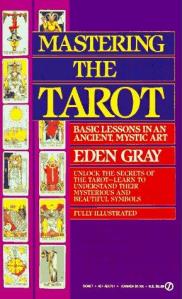
Mastering the Tarot: Basic Lessons in an Ancient Mystic Art

Author: Eden Gray

New York: Signet, 1971

ISBN: 0-451-16781-3

221 pages

My first books on cartomancy came from the public library, which segued into my introduction to tarot, but after acquiring the Rider Waite to begin my serious study, the book I picked up was Eden Gray’s Mastering the Tarot. Mastering, Gray’s fourth publication, is now considered one of the seminal modern works on the tarot. Concise, comprehensive, and timeless, Mastering has remained one of my go-to references from my personal tarot library. In spite of my many new book acquisitions over the last fifteen years, I find myself returning repeatedly to Gray’s book.

Mastering is subdivided into lessons. Lesson 1, Preliminary Steps, will help familiarize the reader with the cards. Basic structure is explained, as are logistical matters, such as caring for the cards. Lesson 2 sets forth general observations and patterns in the Minor Arcana. An overview of suit associations is provided. Then the subsequent Lessons 3, 4, and 5 provide interpretations for the pip cards, or Aces through Tens, in the Minor Arcana. A one page profile is devoted to each card, with a description of the card’s symbolism, a standard interpretation of the card upright, and a standard interpretation of the card in reverse. Gray’s interpretations seem heavily influenced by the Golden Dawn school of thought. The card lessons are organized in sets, by number (e.g., all four Aces side by side, all four Twos, all four Threes, etc.), deviating from the majority of tarot reference books, which group the cards by suits (e.g., the suit of Wands, Ace through King, then the suit of Cups, suit of Swords, suit of Pentacles). Gray’s organization worked for me because like Gray, I integrate numerology into my approach and thus chapters sectioned off by numbers helped to reinforce into my memory the numerological attributions of the cards. Lesson 6 reviews the court cards, Pages through Kings, and then Lessons 7 through 10 provides the interpretations for the Major Arcana, grouped in thirds. Gray seems to maintain a substantially literal interpretation of court cards, though she does gloss through a few figurative interpretations. Overall, card interpretations take up about 56% of the book, so in terms of reference manuals keyed to the Rider-Waite-Smith system, Mastering is the book to have.

However, for the beginner tarot practitioner with no prior experience, Mastering may leave a lot to be desired. As mentioned, the book comprises mostly of card interpretation. The basic learning steps from new tarot deck to reading spreads is rather sparse in Mastering. Lesson 11 does offer a chapter on how to read cards, shuffling, selecting significators, and synthesizing card meanings, but all of that is consolidated into a single chapter. For the intermediate practitioner or even the quick learner, that won’t be a problem; but it does make Mastering an ill fit for the true beginner.

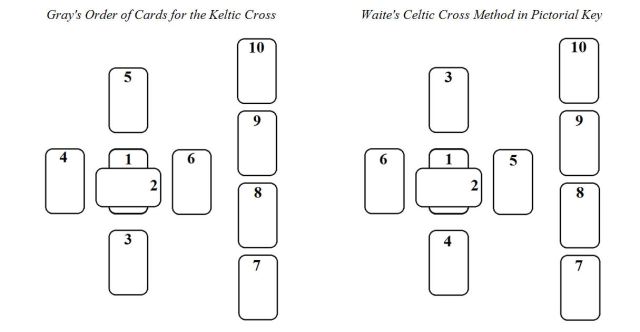
The main tarot spread that the book teaches is the Keltic Cross Method, which Gray devotes an entire chapter to. Although Gray’s card interpretations are rooted in the Golden Dawn system, her order of the cards in the Keltic Cross spread differs from the Celtic Cross Method suggested by A. E. Waite, an adept from the Golden Dawn. The diagram on the following page of Waite’s Celtic Cross Method is from his book Pictorial Key to the Tarot (1911). It is provided here to compare with Gray’s Keltic Cross. I have adopted Gray’s ordering of the cards.

grayvswaite

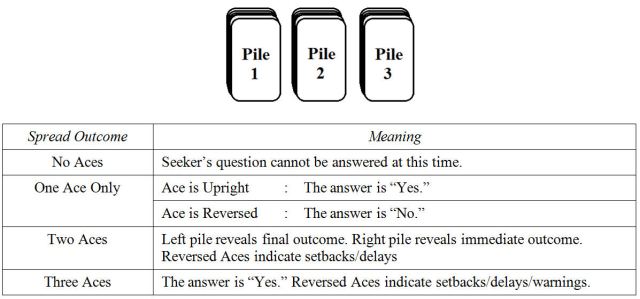
Waite’s order of cards in the Celtic Cross spread seems to be inspired by the Catholic sign of the cross while Gray’s Keltic Cross approach makes more chronological sense, i.e., lay down the foundation and past first. Gray also provides sample readings with the Keltic Cross, which help the reader understand the spread’s practical application. A few more spreads are explained in a subsequent lesson, though they seem to be added as an afterthought. One spread from Lesson 14 struck my fancy, though: the Three Aces spread. For yes or no inquiries, after shuffling, turn the cards over one by one facing up and stop when either an Ace is turned or the 13th card, whichever comes first. Once an Ace or the 13th card is drawn, move on to start a second pile to the right of the first pile. Again, stop at either an Ace or, if no Ace is drawn before the 13th card, then up to the 13th card. Continue until three piles are formed. If no Aces are drawn, the question cannot be answered. One upright Ace indicates a “Yes.” One reversed Ace indicates a “No.” If there are two Aces, the one to the left reveals the final outcome; the one to the right reveals the immediate outcome. Three Aces mean “Yes,” though reversed Aces suggest setbacks or delays. Gray’s Three Aces spread is one of my favorites for quick questions.

3acesspread

Most tarot practitioners integrate an esoteric or philosophical paradigm with their approach to tarot and for Eden Gray, her approach is influenced heavily by astrology. The ending lessons in Mastering associate tarot and astrology, applying astrological concepts to tarot divination theory and additional spreads. The astrology enthusiast will find Lessons 15, 16, and 17 highly informative.

The final lesson of the book, Lesson 18, covers tarot ethics, “The Use and Misuse of the Tarot.” Her chapter on ethics, however, can be summarized into one rule: don’t read the tarot in a way that fills other people’s heads with negative ideas about themselves or their futures. She dedicates an entire chapter to convey that singular message, though indeed it is an important one.

My only negative criticism of the book is not even a fair critique. The opening pages present tarot as an ancient mystical art passed down to us from the Egyptians and gypsies, which most of us now understand to be an unverifiable myth. The tarot was conceived as a card game, one played predominantly by the wealthy, and though cartomancy generally endured throughout history, using the tarot for divination only became popularized in the 1900s, most notably by the Hermetic Order of the Golden Dawn. However at the time of the book’s publication, the 1970s, portraying tarot as an ancient mystical art was the trend. It is not clear that Ms. Gray would have had access to any kind of information or research that ran counter to that presupposition. Thus, the “historical” introductory overview of tarot in Mastering that frames it as having “ancient mystical origins” is more of a reflection of the times than it is of Gray’s work.

Mastering the Tarot has had a considerable influence over the formative years of my tarot education. As important as the works of Papus, Paul Foster Case, and A. E. Waite’s card interpretations are to tarot studies today, Eden Gray will undoubtedly join their ranks in 50 years time, if she hasn’t already.