30 Day Tarot Challenge Meme (Questions 21-25)

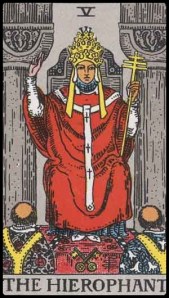
MajorArcana_Key_5_The_HierophantDay 5 of the challenge. 5 more questions.

See previous postings:

Questions 1-5 (Day 1)

Questions 6-10 (Day 2).

Questions 11-15 (Day 3).

Questions 16-20 (Day 4).

21. How do you feel when you do readings?

I try to feel the energies surrounding the client. It’s important to be open and empathic during a reading so that I can best serve the seeker.

22. Do you charge money or ask for other types of compensation for your readings/services?

Right now I don’t charge money. I ask for donations, token gifts to my loved ones on my behalf (hehe), or I agree to exchanges. I’ve been known to work for food. Boy do I love them cupcakes, especially the ones with buttercream. One client made me macaroons! ::heart:: I looove French macaroons.

23. What question do you most often ask the deck (or, ask on behalf of another)?

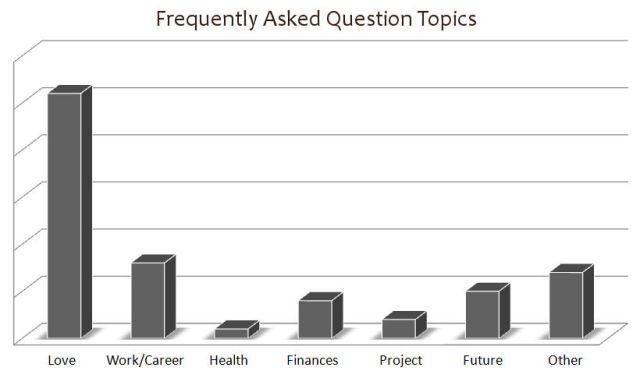
For myself I ask questions such as “how do I” or “what do I need to know about” that pertain to specific creative projects or ventures. That’s it. When I am reading for others, I can offer you statistics. About 51% of the questions clients ask are love related. 15% to 20% are work related. Now see the below bar graph for the frequency of question topics that clients ask me to read for.

bargraph

24. How accurate do you believe your readings are (or, do they accurately convey messages from spirits/deity)?

Quite unremarkably, it depends. When I’m “in the zone,” I would like to say I am really accurate and can connect deeply to what’s going on in the client’s life. When I’m not in the zone, bleh. I go a-fishing. Or really, I just stop the reading and say, “hey, look, we’ve got to continue this some other time.”

25. What was the most dramatic/meaningful reading you ever did? (Not necessarily the most accurate.)

My answer will sound like a cop-out but it isn’t intended to be. Every reading I have ever done has been meaningful. The free one-card readings I do through FTN are meaningful in the moment. Otherwise, I wouldn’t bother doing them. Every full reading session I have done has been memorable. I can remember specific cards drawn for people who were complete strangers in readings done years ago. Some readings were dramatic because it touched the client to such a degree that tears were shed on sight. Others were meaningful because of how eerily accurate they were.  All readings for myself are meaningful because I don’t even bother consulting the tarot unless it’s something important.

If I had to choose one, I would say the reading I did for an established writer. The writer was struggling with a sophomore novel after the debut book received immense critical acclaim. There was a great deal of pressure to deliver the same success that the first book enjoyed. Writer’s block was setting in hard. The reading I did helped that writer move past the writer’s block and, in the end, published a second book that has been much talked about and praised in literary circles. That was cool.

Subsequent Updates:

Questions 26-30 (Day 6).

30 Day Tarot Challenge Meme (Questions 16-20)

It is now Day 4 of the meme, yet I’m two thirds of my way through the challenge since I’ve decided to tackle the 30 questions in 6 days rather than the full 30 days.

See previous postings:

Questions 1-5 (Day 1)

Questions 6-10 (Day 2).

Questions 11-15 (Day 3).

Now, on to the questions:

16. Do you ever use the Major Arcana without the Minor Arcana or vice versa?

Yes. I might use only the Major Arcana if I am interested in understanding the archetypes at play in a particular matter. If I have a question that is focused in one particular area, such as a work/career question, I may shuffle only the Wands and draw a single Wands card for insight, or if I have a love/relationships question, I will draw a single card from the Cups, etc.

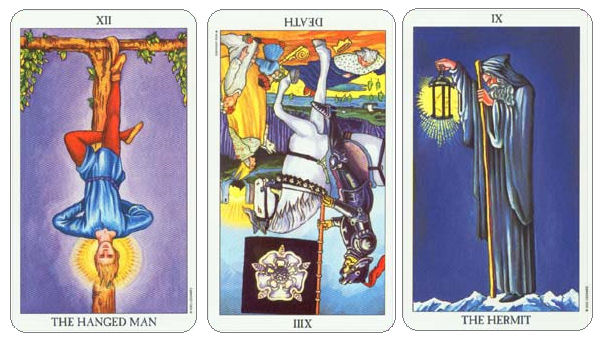
3majorsradiantriderwaite

17. Do you do readings using reversals? Why or why not?

Yes. Every detail and nuance matters. When a card appears in reverse, it indicates a different shade of the meaning associated with that particular card from the color it would otherwise take on upright. How a card in reverse interacts with the other cards in a spread landscape is also relevant, very relevant in fact. I can’t imagine myself not reading with reversals, though I do know many amazing professionals who don’t observe them.

18. Do you feel a “connection” to your cards?

Yes. What’s interesting is I have that old ass deck of Marseille I was talking about in Day 1 and a 20-ish year old Rider-Waite. For some time I thought I liked those particular tarot systems because they were more accurate for me than the others, but one day I picked up a brand new deck of the Tarot de Marseille and a brand new Rider-Waite and they just didn’t do it for me. I realized it isn’t the tarot systems that I was connected to; it was those two particular tarot decks that I have handled for so many years. I’ve “connected” to those cards deeply and it had little to do with the tarot systems they represented, but it was that particular deck that worked well in my hands.

19. Do you feel/think the cards “think” or have their own consciousness? What do you believe makes the cards “tick”?

No. The cards are just objects. We make them “tick.” We’re using our inner qi to will the cards into a cohesive pattern that will make sense to us and help us make sense of our lives.

20. Do you read for yourself and/or for others? Why or why not?

Yes, I do read for myself, though less frequently these days. These days I primarily read for others.

Subsequent Updates:

Questions 21-25 (Day 5).

Questions 26-30 (Day 6).

30 Day Tarot Challenge Meme (Questions 11-15)

It is Day 3 of the meme, which should correspond with Days 11 through 15, since each question is supposed to take up a full day of contemplation. Instead, I’m truncating it down to 5 questions per day to finish off the challenge.

See previous postings:

Questions 1-5 (Day 1)

Questions 6-10 (Day 2)

11. What spread do you use most often/prefer and why?

I used to have a strong preference for the Celtic Cross, but really the only reason for that was habit. I knew the spread like the back of my hand and it was comfortable. My practice has evolved and now there is no single spread that I use most often. I listen carefully to the client’s needs and usually custom-tailor a spread for that client.

12. Have you ever created your own spread? If so, how effective is it? (Feel free to show the spread.)

Yes. All the time. If it would serve the client, then I will incorporate the client’s religious beliefs, faiths, traditions, culture, or just his or her specific inquiry needs into the spread that I devise. My spreads are generally based on some sort of cross or sigil. I have found that these tailor-made spreads are astonishingly effective when applied in the most precise way to both the client and the question.

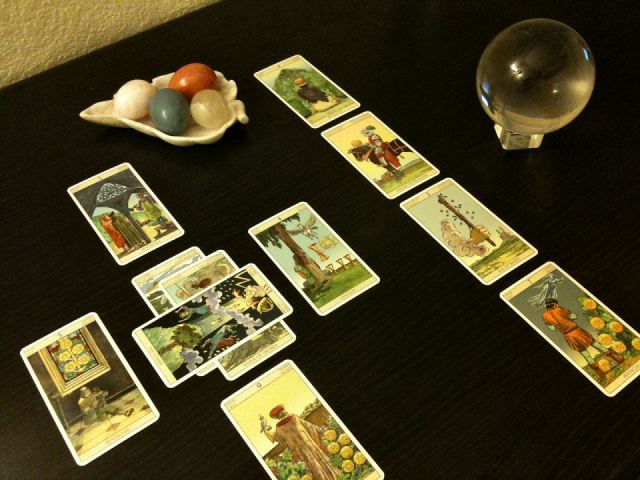
Here is one example of a spread I recently devised, called The Insight Cross:

Insight_Cross_Spread

13. Is there a card that continuously stumps you when it is drawn? Why do you believe this to be so?

Key 18, The Moon often stumps me. When it is the only card drawn, I get the meaning. However, when I need to understand it in the context of other cards, or even in the context of a client’s specific question, it is often difficult for me to explain The Moon as it pertains to our everyday life. Intellectually most of us can understand The Moon, but extrapolating its application is a little more elusive for me.

14. For what purposes do you usually use the Tarot?

These days, only to read for others. I do not read tarot for myself. Instead, I will patron another professional tarot practitioner for a reading. It supports their tarot business and I feel it’s more objective than me reading for myself.

15. How much emphasis do you put on the textbook meanings for cards, and how much stress do you place on the “feeling” you get from cards through their artwork/symbolism, etc. Do you do both, or one or the other?

My analysis begins with the classical meanings for the cards. However, I cannot stress enough how important it is to look at the overall landscape of a spread and see how the cards relate to one another. From there, exercise intuition to truly understand the holistic meaning of the card as it directly pertains to the client’s inquiry. How that can be done artfully and accurately is learned only through practice, practice, and more practice. You need to gain a great deal of experience before you understand the depths of intuitive reading.

Subsequent Updates:

Questions 16-20 (Day 4).

Questions 21-25 (Day 5).

Questions 26-30 (Day 6).

30 Day Tarot Challenge Meme (Questions 6-10)

I’m having fun with an internet meme that’s been circulating among tarot bloggers, and that is the 30 Day Tarot Challenge, though I’m blazing through it in 6 days, 5 questions each day. Perhaps that is defeating the original purpose of the meme, which is to ponder thoughtfully on each inquiry. I’ve adjusted that purpose a bit.

This is Day #2.

See previous postings on the meme:

Questions 1-10 (Day 1)

celticcross

6. What was the first spread you learned?

The Celtic Cross. For many years, it was the only spread I used. That was the old school way of teaching beginners. Thankfully, tarot tutelage has changed these last few decades and students are now beginning with a more manageable number of cards.

7. What is your favorite card (both in terms of deck’s artwork and divinatory meaning)?

Ace of Cups. Upright, that is.robinwood_aceofcups

8. Which card do you dread pulling the most?

I’ve reached a point where I don’t dread any of the cards, but that comes with acquiring wrinkles and lines on your face, in other words age. After a while, life simply stops unnerving you. Tragedy and comedy will come as they come. You learn to roll with the punches, as they say. However, when reading for people who are not familiar with tarot, I dread pulling the Death card, because I have to be really artful about explaining the card to them and calming them down.

9. What card do you pull the most often? Why do you think that is the case?

Two of Pentacles or Ten of Wands, with seemingly equal frequency. It is the way of our modern world, I suppose. Everyone’s busy. Everyone is overburdened and juggling a bunch of responsibilities at once.

10. What card best represents your personality (or, is most often pulled to represent you in a spread)?

Queen of Swords.

Subsequent Updates:

Questions 11-15 (Day 3).

Questions 16-20 (Day 4).

Questions 21-25 (Day 5).

Questions 26-30 (Day 6).

A Tarot Meme: 30 Questions (Questions 1-5)

I first came across this meme by way of Calamity’s Child on her blog post here, “30-day Tarot Challenge.” The meme seems to have originated with 78 Keys (link here), but just google “30 Day Tarot Challenge” and you’ll pull up many tarot bloggers who’ve taken on the challenge. Fascinating reads, so I suggest you read all of them. I’m a little late to the game, but the questions intrigue me and I would like to explore my answers via this blog, 5 questions at a time.

Instead of 30 days, I’ll wing them in 6 days. So here’s #1-5.

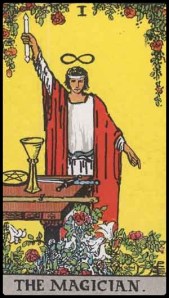
MajorArcana_Key_1_The_Magician1. What introduced you/got you involved in Tarot?

A deck was given to me from a friend as a gift, which is what first sparked my interest. I floundered with it for a bit, until I met a seasoned tarot reader who taught me the basics. From there my interest developed into a serious study of the art.

2. What was your first deck and why/how did you get it?

Technically my very first deck was a used Marseille deck obtained at a garage sale when I was a kid, but I didn’t know what it was. I thought it was a deck of playing cards (well, which it is, but you know what I mean) with random extra cards. I just didnt think much of it, probably because I was 9. In junior high a friend gave me the Tarot Nova. That’s when I began to learn about tarot and nurtured my interest. Later on I realized that the old deck of “extra cards” I had stashed in my family basement was the Tarot de Marseille.

3. Do you have more than one deck that you use and if so do you have a favorite? If not, why do you like the deck you have chosen?

When reading for others, I use the Rider-Waite, the Robin Wood, or the Goddess Tarot, selecting the deck based on the seeker’s particular inquiry. I may also from time to time use either the Marseille or the Thoth, usually upon request. When reading for myself, I gravitate toward the Marseille. Also, who am I kidding, I’m an avid deck collector and love to play around with the deck du jour, so at any given time I am probably fascinated with a different deck based on what I recently got my hands on.

4. How long have you been reading the Tarot?

About 15 years.

5. When and where did you give your first reading?

My first reading for someone else wasn’t until very late in my practice, and it was kind of an accident. I was meeting a sorority sister and her new boyfriend at her place, and then we were all headed out somewhere. When I arrived, she wasn’t ready yet, so she asked me to sit in the living room with her boyfriend. The two of us sat there awkwardly waiting for her. To break the silence, I asked him if he’d like a tarot reading, since I happened to have a deck in my knapsack. He said sure. The reading turned out to be eerily accurate, to the point where he thought my sorority sister and I were a fraud, and that she had previously told me all his deep family secrets (which she hadn’t!) and I was using the info to prank him into believing I was psychic (which I’m not!). Actually, in retrospect, it was pretty funny and the accuracy of that first reading definitely gave me pause.

Subsequent Updates:

Questions 6-10 (Day 2).

Questions 11-15 (Day 3).

Questions 16-20 (Day 4).

Questions 21-25 (Day 5).

Questions 26-30 (Day 6).

In Defense of the Rider-Waite

riderwaitedefense

I am grateful that I did not access the Internet during my formative years of learning tarot. Communities of self-proclaimed advanced tarot practitioners have brought into being the supercilious notion that the Rider-Waite or Rider Waite Smith (RWS) tarot deck is a “beginner’s deck” and that a high level practitioner will have moved beyond the RWS into another more specialized deck.

What hooey.

These practitioners need to revisit the RWS and re-evaluate for themselves how well they truly understand the RWS. Are they really using the symbology contained in the deck to its full extent? Do they understand the elemental influences, astronomical, seasonal, and the nuances of every last bird in the sky, leaf, and blade of grass?

As I have said, as of the present there are three prevailing tarot deck systems. The Marseille with the pip cards, the RWS, and the Thoth. The three are very different from one another and every practitioner should be fluent with reading all three. From there, you will find that you gravitate more toward one of those three. That will most likely become your primary reading deck.

The three systems have inspired numerous contemporary derivative decks. These decks are generally based on one of the foregoing three systems, or are a hybrid. Most of these derivative decks are created to reconcile an omission in one of the three main systems. A basic example of that are the fancy, beautifully illustrated RWS decks that are aesthetically more pleasing to the eye than the original RWS. There are decks that attempt to better flesh out the interpretive methods of the Golden Dawn. Others fuse the foundation of the tarot with imagery that is more specific to a particular faith, philosophy, or culture. All of these decks are legitimate reading decks and if you find yourself connecting to one more so than the RWS, then that’s really great for you.

However, it does not mean you’re now more advanced. People start with the RWS not because it’s a beginner’s deck, but because it is a traditional system. The Marseille is another traditional system, but not everyone has developed and honed their intuitive abilities to a point where they can read pip cards meaningfully. The RWS is like Tchaikovsky’s Violin Concerto in D Major while the Thoth is like Stravinsky and the classical musician will have attempted to master both, but neither one is hardly considered “beginner” stuff. Playing Vyacheslav Artyomov or Gheorghi Arnaoudov doesn’t make you more advanced than the fellow working on the Tchaikovsky piece.

So please do not listen to the snobbery, my dear RWS reader. If that was your first reading deck and still remains your only reading deck, then that is what works for you. That shouldn’t even be said in a patronizing way. Seriously. RWS is an incredibly complex deck and anyone who thinks it’s the training wheels of tarot is someone who still has a beginner, rudimentary understanding of the study.

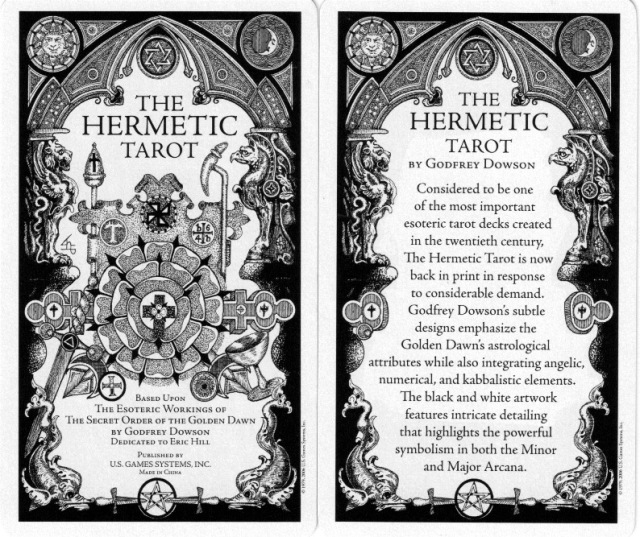
The Hermetic Tarot by Godfrey Dowson: A Powerful Divination Deck and a Suggested Triquetra Spread

bellwen-HermeticTarot2

hermetic

The Hermetic Tarot by Godfrey Dowson is a masterpiece. The tone of the deck and Dowson’s artwork invokes the full spectrum of powers within the tarot practitioner for spiritual divinatory work. As a Golden Dawn study deck, the card images are fundamentally focused on alchemical and astrological references such as the decans in the Minor Arcana, with the deck outfitted for theurgy. It can be integrated into personal rituals, meditations, and ceremonies and in fact is probably far better suited for such work than, say, the Marseille, Rider-Waite-Smith, or even the Thoth decks.

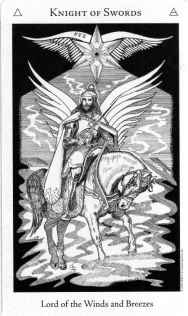
bellwen-Hermetic-KnightGodfrey Dowson draws heavily from elemental dignities and affinities, Western astrology as interpreted by the Golden Dawn, and the Qabalah. Corresponding alchemical symbols for the four elements and astrological symbols are embedded into each card to denote the attributions. In the Major Arcana, the Key’s corresponding Hebrew letter appears on the top left corner. In the court cards, the alchemical symbol corresponding with the classical element that the card itself represents appears on the top left and the symbol for the element corresponding with the suit appears on the top right. The Knight of Swords, for example, represents Fire (for the Knight) on Air (for the suit of Swords). For practitioners who adopt interpretive methods reliant on elemental dignities and affinities, that is a godsend. The backs of the cards are illustrated with the Hermetic Rose and hexagrams. As they are non-reversible, it may not be an ideal deck for reading with reversals. That being said, the little white booklet that accompanies the Hermetic Tarot provides the meanings of the cards in the “ill-dignified” position, as reversals are called in the booklet, which suggests that the deck is nevertheless intended for reading with reversals.

The anatomy of the Hermetic Tarot is the same as the Rider-Waite-Smith (RWS) (e.g., VIII is Strength and XI is Justice or their equivalents) and there is substantial crossover of subscribed card meanings to render the Hermetic Tarot user-friendly for anyone familiar with the RWS. At the end of this deck review are correspondence tables that compare the RWS with the Hermetic Tarot. Note the card titles assigned to each card in the Hermetic deck. The essences of the cards as denoted by the titles are almost transferrable onto the RWS.

Continue reading “The Hermetic Tarot by Godfrey Dowson: A Powerful Divination Deck and a Suggested Triquetra Spread”

Your Life Path, Pythagorean Numerology, and Your Name

Numerology has fascinated me since childhood, back when I would input into a calculator telephone numbers or dates of birth of crushes with mine and stare at the sums or products like they might mean something. Since I have never been good at mathematics, it is only natural that I’d gravitate toward pseudomathematics. =)

Life Path numbers purport to reveal insights about your innate capabilities (and weaknesses). Furthermore, our development is divided into three stages, each corresponding with one third of our life span and the potential for accomplishments during that stage. Life Paths are based on your date of birth. Take for example John, who was born on December 26, 1978. To calculate the three stages of development for John, take the sums of the month, the day, and the year as follows and if a sum is 10 or greater, add the digits again until the sum is a single digit:

1.  Life Path = Month + Day + Year

2.  Life Path = 12 + 26 + 1978

3.  Life Path = (1 + 2) + (2 + 6) + (1 + 9 + 7 + 8)

4.  Life Path = 3 + 8 + 25

5.  Life Path = 3 + 8 + (2+ 5)

6.  Life Path = 3 + 8 + 7   [Note: These 3 numbers represent the 3 stages.]

7.  Life Path = 18

8.  Life Path = (1 + 8)

9.  Life Path = 9

John’s ultimate Life Path is 9. The Life Path represents what his innate capabilities (and weaknesses) collectively can achieve with great success if John exercises his will in a way to nurture those capabilities and manage those weaknesses.

Note  Line 6 above. These 3 numbers represent the 3 stages of John’s personal development.

In the first third of his life. which is the number corresponding with the Month, Life Path 3 qualities will govern; these are the qualities he must pay closer attention to, that will either guide him toward achievement or hinder him in the future if he does not adequately manage these qualities.

The second stage of his life, and this best represents the core of his Self, his essence, corresponds with the Day sum, or 8. This represents his inclinations, what he will seem to naturally gravitate toward, and what will probably make him quite happy, but isn’t representative of the zenith of his potential.

The third and last stage of his life, which is the number corresponding with the Year, is denoted by Life Path 7. This represents his personality and outlook in his final days, the ideal state for him when he leaves this world. The third stage number is how he will find his peace.

These three numbers are not mutually exclusive. They cannot be cannot be analyzed singly in isolation from one another. They must be looked at as a whole for an informed and complete picture of John.

Now, back to the ultimate Life Path for John, which is in Line 9 above, or Life Path 9. This is the zenith of his potential, unlike the number noted in the second stage of his life. Note that the number of his second stage represents what he will most likely become, the personality he is most likely and will most easily manifest. The ultimate Life Path is the full spectrum of his capabilities. It is what he can achieve and it is the great difference that he can make in this world should he choose to live up to that high path.

The correspondences for the Life Path numbers are as follows:

Continue reading “Your Life Path, Pythagorean Numerology, and Your Name”

A 10-Week Independent Study Course with Paul Foster Case: A Review of Oracle of the Tarot (1933).

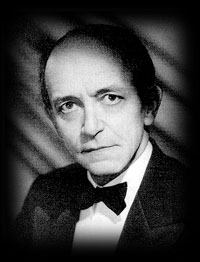
Paul_Foster_CasePaul Foster Case (1884 – 1954) is one of the most influential American occultists on modern tarot studies. His approach to tarot is influenced heavily by Western astrology and the Hermetic Qabalah, as evidenced in his tarot divination course, Oracle of the Tarot, and other writings, such as An Introduction to the Study of Tarot (1920) or The Tarot: A Key to the Wisdom of the Ages (1947). Oracle is keyed to the Knapp-Hall Tarot, which was first published by J. Augustus Knapp and Manly P. Hall in 1929. The Knapp-Hall Tarot differs significantly from the Marseille, Rider-Waite-Smith, or Thoth interpretive traditions, so the card meanings in Oracle, in particular from the Minor Arcana, are not readily transferrable to the Marseille, Rider-Waite-Smith, or Thoth systems. Nonetheless, Oracle offers the beginner and intermediate student a strong foundation in the basics and anatomy of tarot.

Case opens the book with a strong statement: “TAROT divination is not fortune-telling. The practice of fortune-telling is based on the false notion that human life is governed by luck, chance, or fate–by obscure powers at work outside the personality. True divination rests upon the occult truth that the causes of all events in human life are really internal.” He thus begins by distinguishing divination from fortune-telling. Divination is an inward reflection process of using tarot to tap into the superconscious. The tarot utilizes imagery and symbols that communicate in the language of the superconscious and thus understanding tarot is in its essence the learning of a new language.

The introductory Lesson 1 warns the tarot practitioner to take tarot divination seriously and reviews a few ethical guidelines, in particular the practitioner’s duty of confidentiality and impartiality. Practitioners must remain non-judgmental when conducting tarot readings. Lesson 1 also subdivides tarot decks into exoteric and esoteric decks. Case provides the Knapp-Hall Tarot as an example of an exoteric deck, or one that operates in the realm of public knowledge, with imagery that more closely resembles the tarot deck originally used for playing games, and contrasts that with the Rider Tarot (or Rider-Waite-Smith), which he refers to as an esoteric deck. Esoteric tarot decks are the versions of tarot re-interpreted by occultists and used specifically for divination or other spiritual exercises.

Note that it is unclear and somewhat contradictory as to why Case expends the first half of the Introduction to describe tarot divination as an internalized process, but then applies an exoteric deck to teach divination, rather than an esoteric deck, which would seem to be more aligned with the internalized process of tarot divination. What’s more, the subsequent lessons in Oracle repeatedly reference esoteric tarot traditions.

The 10 lessons of Oracle are meant to be studied over a course of 10 weeks.

Lesson 1 then proceeds to describe the anatomy of the Major and Minor Arcana (referred to as the Major Trumps and Minor Trumps in Oracle). Case claims that his Hebrew letter attributions for the Major Arcana are the “correct” attributions and that preceding claims by such authors as Papus were wrong. Case sources his attributions from Eliphas Levi (1810 – 1875), a French occultist and influential writer on tarot. Case claims that his Hebrew letter attributions are better aligned with the standard astrological attributions of the Major Arcana, which he provides as follows:

Case’s Hebrew and Astrological Attributions in the Major Arcana

Key

Major Arcana Hebrew Attribution Astrological Attribution

0

Le Fou (The Fool) Aleph (A) Air; Uranus

1

Le Bateleur (The Magician) Beth (B) Mercury

2

La Papesse (The High Priestess) Gimel (G) The Moon

3

L’imperatrice (The Empress) Daleth (D) Venus

4

L’empereur (The Emperor) Heh (H) Aries

5

Le Pape (The Hierophant) Vau (V) Taurus

6

L’amoureux (The Lovers) Zain (Z) Gemini

7

Le Chariot (The Chariot) Cheth (Ch) Cancer

8

La Justice (Justice) Lamed (L) Libra

9

L’ermite (The Hermit) Yod (I) Virgo

10

La Roue de la Fortune (Wheel of Fortune) Kaph (K) Jupiter

11

La Force (Strength) Teth (T) Leo

12

Le Pendu (The Hanged Man) Mem (M) Water; Neptune

13

La Mort (Death) Nun (N) Scorpio

14

La Temperance (Temperance) Samekh (S) Sagittarius

15

La Diable (The Devil) Ayin (O) Capricorn

16

Le Feu Du Ciel (The Tower) Peh (P) Mars

17

Les Etoiles (The Star) Tzaddi (Tz) Aquarius

18

La Lune (The Moon) Qoph (Q) Pisces

19

Le Soleil (The Sun) Resh (R) The Sun

20

Le Jugement (Judgement) Shin (Sh) Fire; Pluto; Vulcan

21

Le Monde (The World) Tau (Th) Saturn; Earth

He attributes the Minor Arcana as follows:

Attributions in the Minor Arcana

Suit Divinatory Representation

Elemental Attribution

WANDS Work, enterprise, ideas; the energies of the spiritual plane or archetypal world (Plato’s world of ideas)

FIRE

CUPS Desires, hopes, wishes; emotional activities; the states and forces of the mental plane, the creative world in which mental patterns are formulated

WATER

SWORDS Action, and therefore conflict of forces; the states and activities of the astral plane; the formative world of unseen forces, which build the conditions of the physical plane

AIR

COINS orPENTACLES Things, possessions; the concrete objects and bodies of the physical plane; the objectification of the energies and forces of the higher worlds or planes represented by Wands, Cups, and Swords

EARTH

As for significator cards, Case’s approach is to simply use Key 1: The Magician for male seekers and Key 2: The High Priestess for female seekers. That differs from the more popular modern approach of using the court cards as significators.

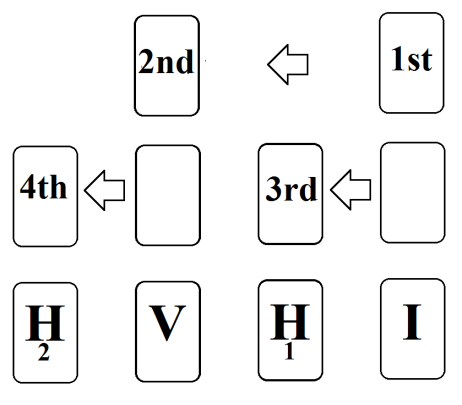
Oracle also teaches an initial divinatory method called the First Operation, which seems to be an antiquated practice now, as few modern tarot practitioners adopt the First Operation. It is nonetheless a method that the serious tarot practitioner should be familiar with. The First Operation is to be performed prior to a question. The significator card is shuffled in with the full tarot deck and then cut into four piles as follows:
case4

The tarot practitioner then proceeds to locate the pile that the significator card is in. That pile, be it I, H1, V, or H2 (reading right to left respectively), will indicate the nature of the seeker’s question. The four piles correspond with the Hebrew letters Yod (I), Heh (H), Vau (V), Heh (H), which is a transliteration of the four constants forming the Hebrew name of the Supreme Being, again showing the strong influence of Qabalistic tenets on Case.

The four piles of the First Operation correspond as follows:

I

Personal Development; Health & Wellness. Seeker is asking about matters of personal development, such as work or career. Could indicate an interest in beginning a new venture or carrying out a new idea. Pile is also associated with the physical, such as body, health, or wellness issues.

H 1

Love, Marriage, Family. Seeker is asking about emotions, feelings, personal relationships, or desires. This pile pertains to the domestic sphere and interpersonal matters.

V

Politics, Ambitions, Social, Intellectual. Seeker is asking about ambitions and high aspirations. This pile could also pertain to conflict resolution, imbalances or disappointments. This is also the pile that corresponds with the Seeker’s intellectual faculties.

H 2

Money, Business, Property. Seeker is asking about a material matter, finances, property, or wealth.

If the significator card is in a corresponding pile that is consistent with the seeker’s question topic, then the First Operation has confirmed that the subsequent tarot reading will be accurate as applied to the question at hand. If, however, the significator card appears in a pile during the First Operation that is not consistent with the seeker’s question topic, then it shows that right now is not an appropriate time for the tarot to answer such a question.

Lessons 2, 3, 4, and 5 deconstruct the Suit of Wands, Cups, Swords, and Coins (Pentacles) respectively, keyed to the Knapp-Hall Tarot. Contained in the lessons are also simple 3-card spreads for divining past, present, and probable future influences.

Lesson 6 on the Major Trumps (Major Arcana) can be applicable to the prevailing tarot interpretive systems used today, though note that the Key 8 referenced in Case’s Oracle is “La Justice” (Justice) and Key 11 in Oracle is “La Force” (Strength), which is similar to the Marseille, but the reverse of the Rider-Waite-Smith (Key 8 is Strength and Key 11 is Justice).

Case claims that the timing of events can be revealed by looking at the astrological attributions of the cards, and the lessons in Oracle set about explaining how the 12 astrological houses can be used to divine the timing of events. From there, Lessons 7, 8, 9, and 10 teach complex tarot spreads, most notably combining astrology, the Tree of Life, and tarot, and further provides an overview of elemental dignities. Lesson 10 also provides an overview of numerology and its application to tarot.

Though some of the historic references in the book have since been disproved as myth, Oracle of the Tarot is still a work that every serious tarot student should have read. Not having read Paul Foster Case if you are a tarot practitioner is like not having read Anton Chekhov if you are serious about writing literary fiction. Though written over 80 years ago and keyed to a tarot deck that is, as of this writing, long out of print, Oracle nonetheless holds relevance today and every practitioner, no matter how advanced, will find at least one nugget of new information from Oracle.

So. Can Oracle teach tarot in 10 weeks? An operable foundation in tarot, yes, probably, though generally I am doubtful of any program that claims it can teach tarot in anything under 10 years. Learning tarot is nothing like learning to ride a bike. It’s really more like learning to play violin. In 10 weeks time you can probably learn no more than just how to properly hold the bow.

NOTE. You can download a PDF copy of OracleOracle of the Tarot by Paul Foster Case (1933). Download by CLICKING HERE (Source Credit: TarotWorks).

UPDATE (6/2/13). Read more about the First Operation: The First Operation: Adapting a Traditional Method in the “Opening of the Key” to Contemporary Tarot Applications.

Yin and Yang Crystals

yinandyangcrystals

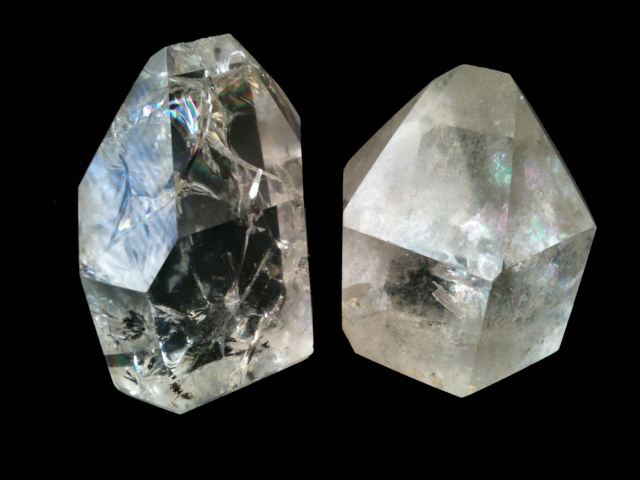
The crystal pictured to the left above is considered a yang crystal. The one to the right is a yin.

Yang crystals are glass-clear and transparent. There may be fire-like refractions of rainbows inside. Yang crystals are power crystals. They’re an amazing supplement to our work when we are seeking creative, active energies, power, strength, ambition, control, and aggressive healing. The elements of fire and air tend to be dominant. In other words, they correspond with the Wands and Swords of the Minor Arcana.

Yin crystals are milky white and translucent. The rainbows they refract are subtle, muted, and soft. Yin crystals are receptive. They channel love, enhance communication, spirituality, and intuition. They help us make sense of emotions. In yin crystals, the elements of water and earth tend to be dominant. They correspond with the Cups and Pentacles of the Minor Arcana.

As applied to tarot, when reading for questions about work, career, professional or personal development, creative projects, or ambitions, I like to keep a yang crystal nearby.

When reading about love, relationships, making sense of emotions or internal flux, I like to keep a yin crystal nearby.

For questions about finances, wealth, or property, it will depend on the question. Yang crystals are helpful around questions about wealth creation and asset acquisition. Yin crystals are helpful around questions about wealth management or the nurturing of what one currently has already.

IMG_1249

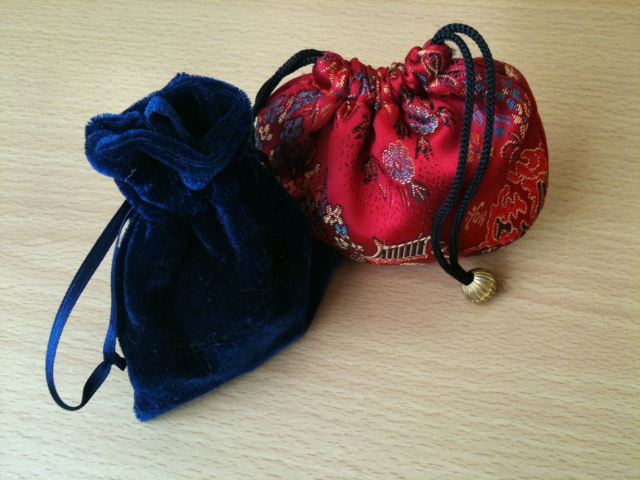
Not that it’s necessary, but I keep the yang crystal in the red pouch and the yin in the blue. Just totally random info I wanted to share.

Anyway, I recommend to practitioners to have in their arsenal both yin and yang crystals. Don’t take my word for the differences between the two: just handle both and you’ll see for yourself. (Psst… a set of a yin and a yang crystal also make for a great gift to your favorite metaphysics buddy!)