Cleansing a Tarot Deck

Image1

Many traditional Asian societies follow the lunar calendar (I once litigated a case involving an elder Taiwanese woman and all the document evidence she had was dated per the lunar calendar, which completely tripped us lawyers up and a lot of conversion work had to be done, but that is neither here nor there; just mentioning it to affirm that it really is still used today) and the super-traditional even believe that certain energies are more dominant during certain phases of the moon. Not kidding: they’d schedule major surgeries around certain phases of the moon because they believe they’ll bleed less and chances of success will be higher. They consult the Chinese almanac, which is based around the lunar calendar, for everything, from when to launch a business or throw a wedding ceremony to the optimal time for a funeral.

I’ll say that I haven’t lived or observed the universe long enough to confirm whether there is any validity to following moon phases, but if it worked for my ancestors and there is no actual adverse effects from continuing the tradition and it makes me personally feel closer to my heritage, then why the heck not. My mom was adamant about calibrating Hubby’s and my engagement and marriage to moon phases. Did it work? So far so good I’d say.

Anyway, that was a long tangent of an introduction. Sorry. This post is about cleansing a tarot deck.

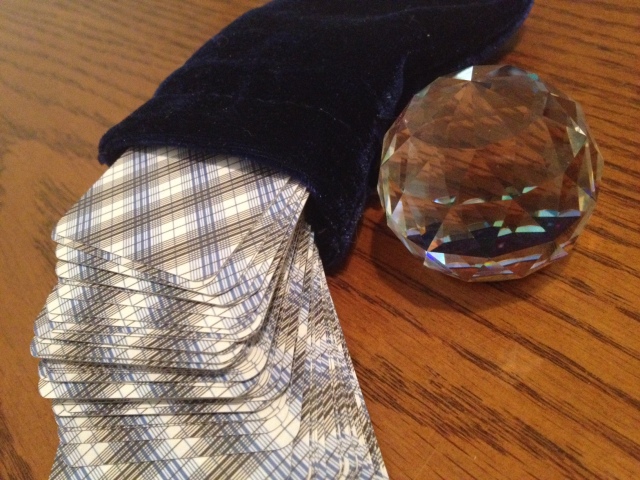
1 cleansing tarot deck

To demonstrate, I’m using the DruidCraft Tarot deck by Philip and Stephanie Carr-Gomm and Will Worthington (a highly recommended deck, by the way; though there is a great bit of nudity in the illustrations, which I understand why would be featured in a Wiccan-Druid-based deck, but just does not resonate well with me).

Continue reading “Cleansing a Tarot Deck”

Self-Guided Intermediate Tarot Course: Integrating the Five Components of Circumstance

screenshot

DOWNLOAD COURSE PRESENTATION

(Note: Must watch in Slide Show format, due to layered animations.)

I’ve created a self-guided intermediate tarot course on a cross-cultural interpretive framework for reading tarot that I have not seen anyone present before. The Five Components of Circumstance is a cosmological theory based on the Chinese maxim that one’s fortune is based on five factors: 1) fate, 2) luck, 3) feng shui, 4) karma, and 5) education. That theory is a cornerstone in Chinese metaphysics and is used to diagnose an individual’s personal formula for success.

By integrating Five Components analysis with tarot reading, the tarot practitioner will have a new set of vocabulary for interpreting a spread, any spread in fact, and can more precisely pinpoint the strengths and weaknesses in a querent and what adjustments need to be made to expedite the querent’s goals.

Continue reading “Self-Guided Intermediate Tarot Course: Integrating the Five Components of Circumstance”

The Unindemnified Cost of Tarot Reading

tarotspi

I am preaching to the choir when I write this to an audience of tarot practitioners: If your personal energy could be quantified like battery life, then reading tarot for others will drain it like streaming a movie on your smartphone over 4G connection. Reading tarot depletes me in a way I cannot fully convey. Sometimes I get the sense that non-tarot practitioners who request tarot readings from me don’t have any idea.

On its face, a tarot reading seems to be an effortless dealing of a deck of cards, and then blurting phrases based in some part on the card imagery. What could be so hard about that?

Tarot is a tool, a metaphysical one if you will, that connects two individuals’ energetic fields together for the duration of a reading. The nature of the relationship between practitioner and seeker is that of give and take, respectively. A practitioner feels his or her energy draining out and going into the cards to provide the reading that the seeker is receiving. Seekers often talk about readings being rejuvenating, cathartic, an enriching experience. They’re picking up on that channeling effect. In contrast, tarot readers talk about feeling exhausted, needing to recharge.

Very few tarot readers make enough cash from their readings to compensate for their time spent. That, though, we will chalk up to simple economics and just acknowledge that at least from a free market standpoint, that part is fair.

I draft business contracts for a living and almost every one of them contains an indemnification clause. Indemnification is often one of the main points of negotiation and contention between the parties. In the course of a commercial dealing, some poo always makes its way to the fan– costs of damage resulting from the initial transaction that weren’t accounted for in the contract price– and everybody needs to figure out who owes what to who and how much to compensate for the loss. That’s indemnification.

When I make reference to the unindemnified price of tarot readings, I’m talking about that energetic loss that tarot practitioners sustain but no one accounts for, or heck, even acknowledge. Some seekers can be borderline parasitic, though I believe never intentionally so. Most tarot practitioners are by nature empaths and so of course their first inclination will be to yield and give and feel.

As an empath with a law degree, when I first started my legal career, I felt every client’s problem and took home a briefcase of emotional baggage every night. I’d think about their issues in the shower, while brushing my teeth, before I fell asleep, the first thing when I woke up, while I made my coffee… Yet senior partners at the firm seemed to master such control. They compartmentalized. One might be tempted to say they were apathetic, that they were desensitized, or they did not care. That is not true at all. They cared and they cared deeply about their clients. But they have been at this a long time and they know that to truly be in a position to help as many as possible, they needed to take care of themselves first. Selfishness is a form of selflessness. They knew exactly when it was time to step away from a case, recharge themselves, and live their own lives for a change, instead of living for others, which is exactly what lawyers do, though they rarely get seen by that side of them.

Tarot practitioners must take a cue from these partners. Newbies rarely possess the prudence to know when they must step away and focus on themselves. They get caught up in the exhilaration of uplifting others–an admirable trait–but ironically (since we are tarot readers…) fail to foresee the pending crash. That is why burn-out is such a problem among startup tarot practitioners.

There is no indemnification for that spiritual energy drain that is part of the tarot reader’s work. Thus we are the ones who must keep ourselves in check. Always take time to recharge and learn to say “no.”

Tarot or Psychic Scams: Why Tarot Practice Should Be Regulated

The above video is old, uploaded several years back, but I came across it yesterday and the news is certainly relevant to this day: alleged psychics who use tarot and other arts to scam people of money. This news broadcast is about scams near my neck of the woods, the Bay Area in California.

When driving downtown, you do see many glass window neon sign “psychic” fortune-telling shops like the ones depicted in the broadcast. People like the alleged psychic tarot reader interviewed in the broadcast cause me to shudder with disgust.

In every professional field, there are the scam artists, the cons, the good-for-nothing bottom-feeding scum of the profession that will rob you of your money and not provide any quality services in return. Lawyers (we definitely get a bad rep for that), doctors even, plastic surgeons especially, accountants, every profession. However, such professionals are still taken quite seriously by the public at large because of overall strict regulation and licensure requirements. At the end of the day, as long as you the consumer do your due diligence, the likelihood of getting scammed by one of these professionals can be diminished greatly. In tarot reading, not so much, because there are no regulatory or licensing requirements, no schooling minimums you’re expected to meet before you can hang out a neon sign and call yourself a Tarot Reader.

To start, I cannot believe the scam-artist Tarot Reader in the broadcast declared that he was 99.99% accurate. Who does that? Ethical lawyers, no matter how skilled or experienced, would never tell you that you are 99.99% likely to win (or lose). They may say you have a strong, compelling case, but then will always follow that up with a caveat: prepare a contingency for the ever fickle winds of change. The strongest cases can fall apart at the eleventh hour, and the weakest cases with no rational chance of victory can prevail. Tarot readers could do well to give such advice to their clients, especially since such a philosophy couldn’t apply more pertinently to an art like tarot reading.

Next, according to the broadcast, the decoy asked about her husband’s colon cancer. Per the American Tarot Association’s guidelines, there are two red flags right there. First, do not do readings to diagnose a health condition. You can read about how one might go about coping with what’s happening, but do not diagnose. Second, do not read for third parties. The practitioner can rephrase the question for the decoy and have her ask about her role in supporting her husband right now, but she shouldn’t be asking on behalf of the husband, not unless he’s present and consenting.

Then, as a tarot practitioner who also uses the Rider-Waite-Smith system, the next part interested me greatly. I will say that chances are the producers, who probably don’t know much about tarot, reenacted the tarot reading being referenced just for cool footage, but if it is based on the actual reading the scam-artist Tarot Reader gave to the decoy, it will make any RWS reader scratch his or her head.

Continue reading “Tarot or Psychic Scams: Why Tarot Practice Should Be Regulated”

Are You Psychic? The Sum of Intuition and Ego

candle-up-close

As children my younger sister would say she was psychic and tell me about her psychic experiences. I recall, for better or worse, vehemently discouraging such a line of thought. I would tell her that she is not a psychic and if she continued to say she was, then she was a liar. Dismayed, she eventually stopped announcing that she was a psychic to us sisters and maybe even stopped letting herself acknowledge so-called “psychic” experiences when she had them. In retrospect I regret my harsh and ignorant stance, but at the time (and I was a tween myself) I believed it was for her own good: she couldn’t run around in public telling people she was psychic. How would people take her intellect seriously if she did?

Now I have always been convinced that my sister may have had strong intuitive abilities for what may be beyond the five physical senses, not unlike the way all the women from my maternal line are drawn to the preternatural. My grandmother, my mother, my first cousins descending from my grandmother, and my sisters all display a heightened awareness of the logically inexplicable. But psychic?

I saw it this way: when you are a voracious reader, at some point you will want to give it a try and become a writer yourself. Likewise, if you’re fascinated by metaphysics and occult phenomenon, at some point you will want to be part of it, and maybe even convince yourself that you’re psychic. Not too different from how I try to convince myself that I’m a writer even though I have yet to publish a damn thing.

Sure, I am convinced that intuition is real. Intuition is the perception of a truth, occurring incident, circumstance, or event independent of any logical reasoning, actual knowledge, experience, or cognitive deductive process. It is synchronicity. It is a prickling of what is about to happen before it happens. It is the sensation of energies that you can’t physically see, hear, smell, touch, or taste, a sensation for when those energies are in balance and when they are out of balance, and the enigmatic knowing of how you might be able to balance it if you were to try.

Being intuitive is like being detail-oriented, or organized, or calculating differential equations. Not everybody is detail-oriented, organized, or able to do math, but anybody can be with enough effort. It is just a skill, albeit a remarkably empowering one when we use it. It might also be a trait. Some seem naturally disposed to it and others need to really work to acquire the skill. I guess somehow those who seem naturally disposed to being intuitive have come to be referred to as psychic.

My question is: where on the continuum of intuitive ability must one be for that person to qualify as “psychic”?

Continue reading “Are You Psychic? The Sum of Intuition and Ego”

Synchronicity: A Personal Story

whole

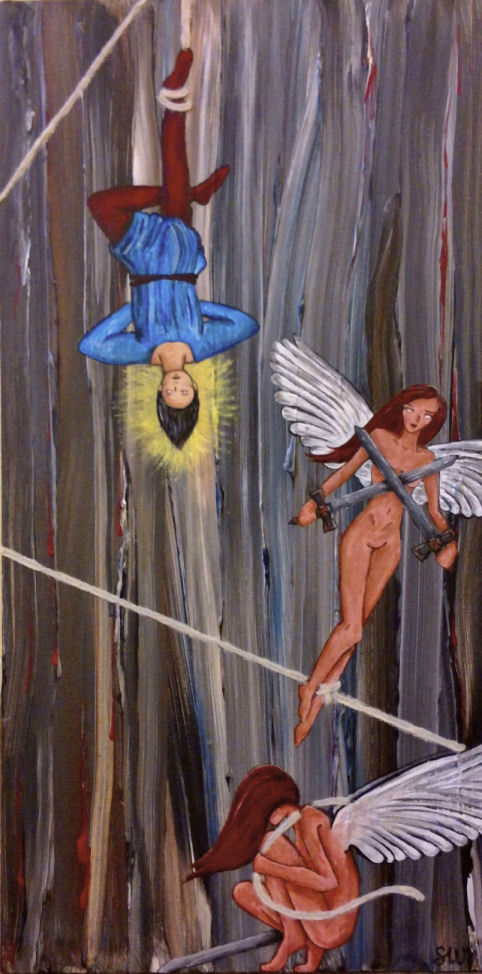
Within the family this is old news but I never got around to talking about it. A while back, the Hubby went to Peru and we missed each other terribly. To pass the time at home by myself, I got into painting. I hesitate to post photos because they’re not great paintings. They’re just amateur hobbyist paintings. Like George Bush but actually his paintings weren’t half bad. Anyway I digress.

One weekend I painted what you see above. For fun, I took a picture of the painting and e-mailed it to the Hubby. However, the day I e-mailed it he wasn’t somewhere accessible to the Internet, so he didn’t see it until the day after.

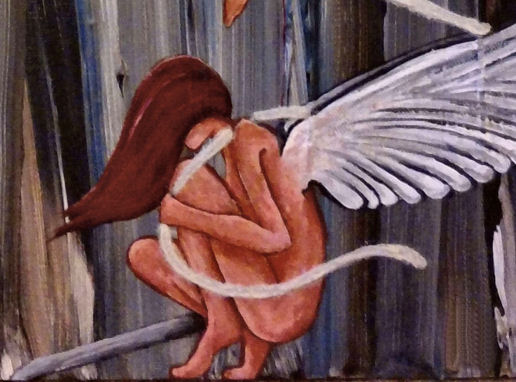
While I was painting that painting, he was on a hike through Machu Picchu. On the hike, he and his friend saw a barebacked fellow with a very conspicuous tattoo of a nude woman rolled up in a fetal position, hair forward in her face, with angel wings and sword, and appearing up on tip toes. It was memorable because jokingly, the friend pointed at the tattoo and said to my Hubby, “Your wife would be ecstatic if you came home with a tat like that.” The two laughed it off and continued on their hike.

The next day when he had access to Internet, he saw my e-mail sent from the night before with the image attachment of my painting. He showed it to the friend he was with, the one who pointed out the tattoo. “Holy shit,” he said, “that’s exactly what we saw the other day.”

zoomin

It was confirmed again when Hubby’s friend visited our house. He saw the painting and remarked about the peculiarity of the coincidence. It was unexplainable how they could be seeing an image as a giant tattoo on someone’s back in Peru while I painted it on a canvas in California. It was a synchronicity, a coincidence that I don’t know how to rationalize and yet feel ever so compelled to come up with a reasonable explanation. My want for an explanation is even tempting me to indulge in irrational, fanciful ideas.

The painting is now hung up on our bedroom wall, but Hubby doesn’t like it. “It’s weird,” he says about it. “Can’t you paint mountains and lakes like normal people?”

When I finished I titled the painting Galatians 3.19.

Why, then, was the law given at all? It was added because of transgressions until the Seed to whom the promise referred had come. The law was given through angels and entrusted to a mediator.

The painting is my critique of law and dissent. If the law was ordained by angels to prevent humans from indulging in their strong propensities for evil, then how and why is it that the same law can oppress righteous and moral dissenters? In the painting, the man hung (reminiscent of The Hanged Man from the tarot) is innocent. However, what’s unclear is whether he has been hung for dissent against the authorities in power or whether he has allowed himself to be hung as a sacrifice for a greater good. And is he in fact the “Seed to whom the promise referred”? If yes, what is the irony that he manifests on earth as a dissenter and the authorities in power use the same law ordained by the angels to silence him?

It was intentional to me that the angels’ objectives in the painting are unclear. The angel at the bottom, the one Hubby and his friend saw as a tattoo on someone’s back, is holding a rope taut, but is it to protect the hanged man and keep him from falling or is she the one who strung him up for the hanging?

The angel with the two swords is my rendition of Justice. Justice as it is administered to humans is not blindfolded, but rather blind. There are no scales for balancing. There are two swords to keep the dissenters in check and justice as it is applied to humanity is just the balance of those two swords. Justice is not free to be fair and impartial about the law. She is bound by that law and thus Justice can only be as incorruptible or fair as the actual laws, which are neither incorruptible nor fair because by its design, innocents become collateral damage.

Funnier yet to me is while Hubby was in Peru, a riot broke up, one he was in the middle of. He even got tear-gassed. The whole thing still spooks me out.

Minchiate Cards for Divination: My Review

minchiate

It is said that like tarot, the origins of the minchiate are not verifiable, but was probably a card game played in the late medieval period. The version I have at home is a reproduction of the Etruria deck from 18th century Florence. Like tarot, the imagery on the cards and scope of the depictions seem extraordinarily well suited for spiritual, metaphysical, or divination work and in many ways, the minchiate even more so than tarot.

There are 97 cards in total, consisting of trumps like tarot, 22 with the addition of 4 cards representing the theological virtues, 4 cards representing the elements, and 12 cards representing the zodiac signs. That’s 41 trumps and 56 numbered cards, with the numbered cards similar to tarot: 4 suits, Ace through Ten, and then 4 court cards.

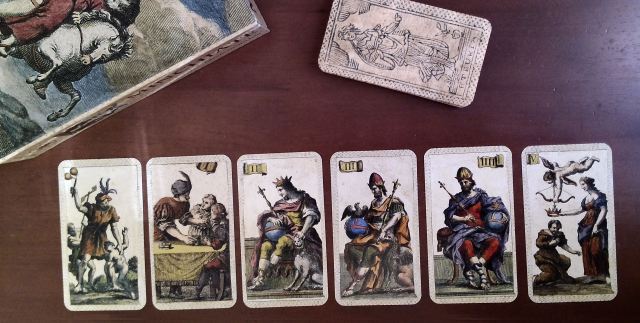
The photograph below shows the unnumbered Madman (corresponding with tarot’s The Fool) and Keys I, II, III, IIII (IV), and V. Key I is the Performer, which corresponds with tarot’s The Magician. Keys II, III, and IIII (IV) in the minchiate are the Grand Duke, the Western Emperor, and the Eastern Emperor, which some say correspond with tarot’s Empress, Emperor, and Hierophant respectively. Key V is Love, corresponding with tarot’s Key VI, The Lovers.

The numbering of the keys in the Minchiate is significantly different from the tarot. For example, in minchiate the Temperance card is Key VI while in tarot it is Key XIV. There is no Hermit card per se, but there is Father Time, which is said to correspond with the Hermit. Most notably, the final card of the Trumps is not The World as in tarot, but rather the Trumpets, corresponding with the tarot Judgement card.
Minchiate_Trumps0to5

After the minchiate Key XV The Tower, there are the four theological virtues: Key XVI, Hope; Key XVII, Prudence; Key XVIII, Faith, and Key XIX, Charity. See below.

Minchiate_4Virtues

Although there is no direct correspondent in minchiate to the tarot High Priestess card, some speculate that the Faith card corresponds with the High Priestess. For me, in the Etruria deck, the illustrations are confusing. The picture on the first card above calls to mind Faith for me, but it’s the Hope card. The second card (left to right) reminds me of vanity for some reason, rather than a virtue, and yet it’s Prudence. The third card shows a woman, likely from the laboring class, looking at or reading something. It only somewhat fits my conception of Faith. The last card, Charity– either you know the meaning or you don’t. Little about the card’s imagery strikes me as denoting charity. But hey, this is all just me.
Michiate_4Elements

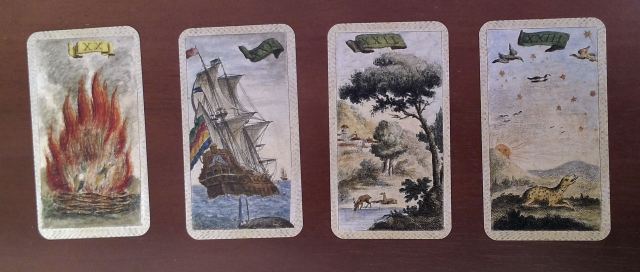
Following the four theological virtues are the four classical elements in the following order: Fire, Water, Earth, and Air. (Compare that to the order of the elements per the contemporary majority view in tarot practice: Fire, Water, Air, and Earth.) When the Fire card appears in a reading, it suggests the relevance of innovation, passion, ambition, and leadership. The Water card denotes alliances, intuition, and compassion. The Earth card, stability, conservatism, conviction, and resourcefulness. Air, idealism, intellectualism, communication, and also ambition, though the Fire-based ambition usually relates to progress while the Air-based ambition relates to conquest.

Minchiate_12ZodiacSigns

In the minchiate there are also cards for the 12 signs of the zodiac. Pictured above in the numerical order they appear in the trumps:

Top Row (L to R): Libra, Virgo, Scorpio, Aries, Capricorn, Sagittarius

Bottom Row (L to R): Cancer, Pisces, Aquarius, Leo, Taurus, Gemini

After the Trumps, the 56 numbered cards in the minchiate are similar to the tarot. There are four suits and their correspondences are as follows: Wands for work or career; Chalices (Cups) for emotions and relationships; Pentacles for money matters; and Swords for the abstract and philosophical. Among the court cards, Knaves (or Pages) denote education and learning; Knights about courage, action, and choice; Queens about a relationship; and Kings about decision-making and authority. Note further that the minchiate correspondents to the Pages are specifically 2 Knaves for the active suits (Fire and Air) and 2 Maids for the passive suits (Water and Earth).

Continue reading “Minchiate Cards for Divination: My Review”

What Is Tarot Reading? (The Hocus Pocus Version)

I came across a Howcast production on “What Is Tarot Reading?”–

The host of the Howcast, Paula Roberts declares with dogmatic conviction that “No real psychic reads for themselves.” The rationale, claims Roberts, has to do with the issue of objectivity. One cannot objectively read for oneself.

There is nothing objective about tarot readings, however. In fact, she starts off by saying there are different ways to read tarot, one being the mechanical approach where you assign a set meaning to each card and then apply those meanings objectively. What an interesting thing for her to say, considering that would be the only time tarot readings are objective, which she agrees with and yet contradicts when she says a psychic cannot read for herself due to the lack of objectivity. Um… what?

A good tarot reading isn’t a trial where a verdict has to be rendered. Of course if a tarot reading was like a trial, then I’d agree with Roberts and say you cannot render your own verdict. But tarot isn’t about objectivity at all. It is the unabashed embrace of the subjective. When you read for yourself, it is about what the signs and symbols of tarot mean to you and the significance of those meanings to you. Whether you are reading for others or for yourself, the interpretive process is wholly subjective, completely within the confines of the mind, though therein lies its power.

A tarot reading, at least a good one, has a way of triggering the mind into action and that action then becomes externalized, objective. The whole objective part happens much later in time, however, after the tarot practitioner and Seeker have parted ways.

If we want to take this one step further into the beyond, let’s say there is a universal life force that connects us all, that unifies the space-time continuum into one unit. I’ve heard it referred to as the Akashic records by some, especially psychics. Psychics contend that they have a stronger connection to the Akashic records than others and that is how they retrieve psychic knowledge that seem to defy the space-time continuum, i.e., they can see the future, the far past, talk to dead people, know what’s going on someplace far away, blah blah.

Let’s diagram this. We’ll illustrate the Akashic records or universal qi/life force as a unit circle.

psychiccircle

In theory, a psychic can connect to any point on the unit circle (aka the Akashic records aka the universal life force that connects us all and defies the space-time continuum) and see into certain information for a particular person, place, or event. If so, then why can’t a psychic read for him or herself? Is it because the psychic’s own consciousness is so opaque when it comes to the self that the psychic can’t reach past it to access the Akashic records?

I’m not claiming I have any idea. I’m just saying that you can read tarot for yourself and to say that no real psychic, whatever the hell that means, does it is just Roberts’ way of imposing her position onto others. There is no concrete limitation like that applied uniformly across the board. Maybe she cannot use the tarot for divination purposes for herself, but that for sure doesn’t mean others cannot do so effectively.

True, there are many ways to read tarot, as Roberts mentioned, and I refer to this so-called “psychic” approach to tarot reading as the hocus pocus version because that’s what it reminds me of: birthday party magicians who are able to wow the naïve but there is nothing special, gifted, or magical about what they do; it’s a mechanical application that anyone can learn. Likewise, tarot requires your intuition, but it’s something we all have and like our muscles, it’s something that can be developed and enhanced with training.

No “psychic” will read tarot for him or herself. Pah, I say. Psychics can. Most simply choose not to for philosophical reasons.

Like my application of tarot, predictive readings and fortunetelling do more harm than good. It takes wisdom to distinguish between what you should know and what level of your brain you should know it at (conscious, subconscious, unconscious…). Those with wisdom and strong intuitive abilities will opt not to bring to their conscious certain information from their unconscious because through their wisdom, they understand that knowing such information about themselves won’t be beneficial.

However, for some of these psychics, this is only a self-imposed philosophy. They understand that everyone is different and if someone feels he or she could be helped by knowing and the psychic can help tap into that knowledge, then the psychic will. In that case, the psychic has opted– out of voluntary will– not to read for herself, but to remain open to reading for others. It has nothing to do with whether she can or cannot read for herself. It’s about imposing one personal moral philosophy on the self but not imposing the same on others.

Amethyst Crystal: The Healer’s Stone

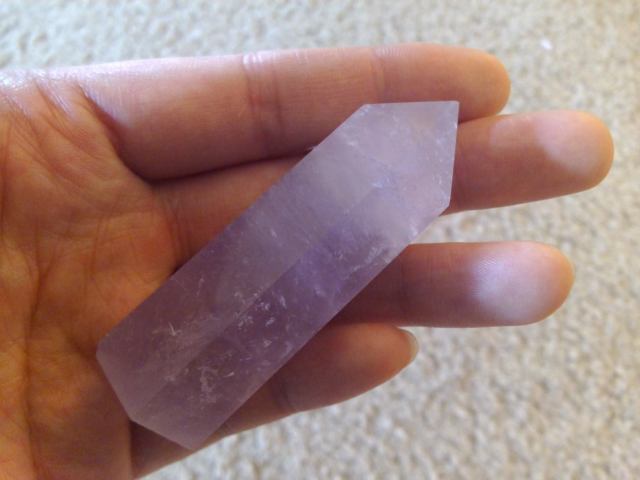
amethyst

In ancient times, the amethyst was believed to ward off drunkenness and to help its wearer maintain a calm, sober mind. Soldiers often incorporated the amethyst into their armor, or at least that’s what I read. The amethyst was also a stone of the high priests and is referenced in several verses in the Bible, namely Exodus and Revelations. What I find most interesting of all is across many cultures and civilizations, the amethyst has consistently been considered a healer’s stone, one with potent healing properties, for both physical and mental ailments.

The hubby visited Peru recently and brought me back the above amethyst crystal. There were hundreds upon hundreds of crystals at the little shop in Cusco but that one resonated with him as the one I’d like most.

Amethyst is a crystalline quartz that can range from a light pastel purple like the one pictured to a deep, rich purple with blue undertones. Generally I see the light amethysts as conducive of channeling intuition and energies helpful to attaining secret knowledge or wisdom. Dark amethysts are perhaps more practical for the everyday objectives: channeling energies that will help attract power and affluence. The light amethyst crystal is perfect for me, as I’ve been seeking a more spiritual path these days.

When reading tarot for issues that involve healing of some kind, I’ll be keeping this amethyst crystal nearby.