A Taoist Secret to Cultivating Personal Power

  1. Lesser Mandala of Heaven: A Taoist Secret to Cultivating Personal Power
  2. Greater Mandala of Heaven: Advanced Introduction to Taoist Alchemy

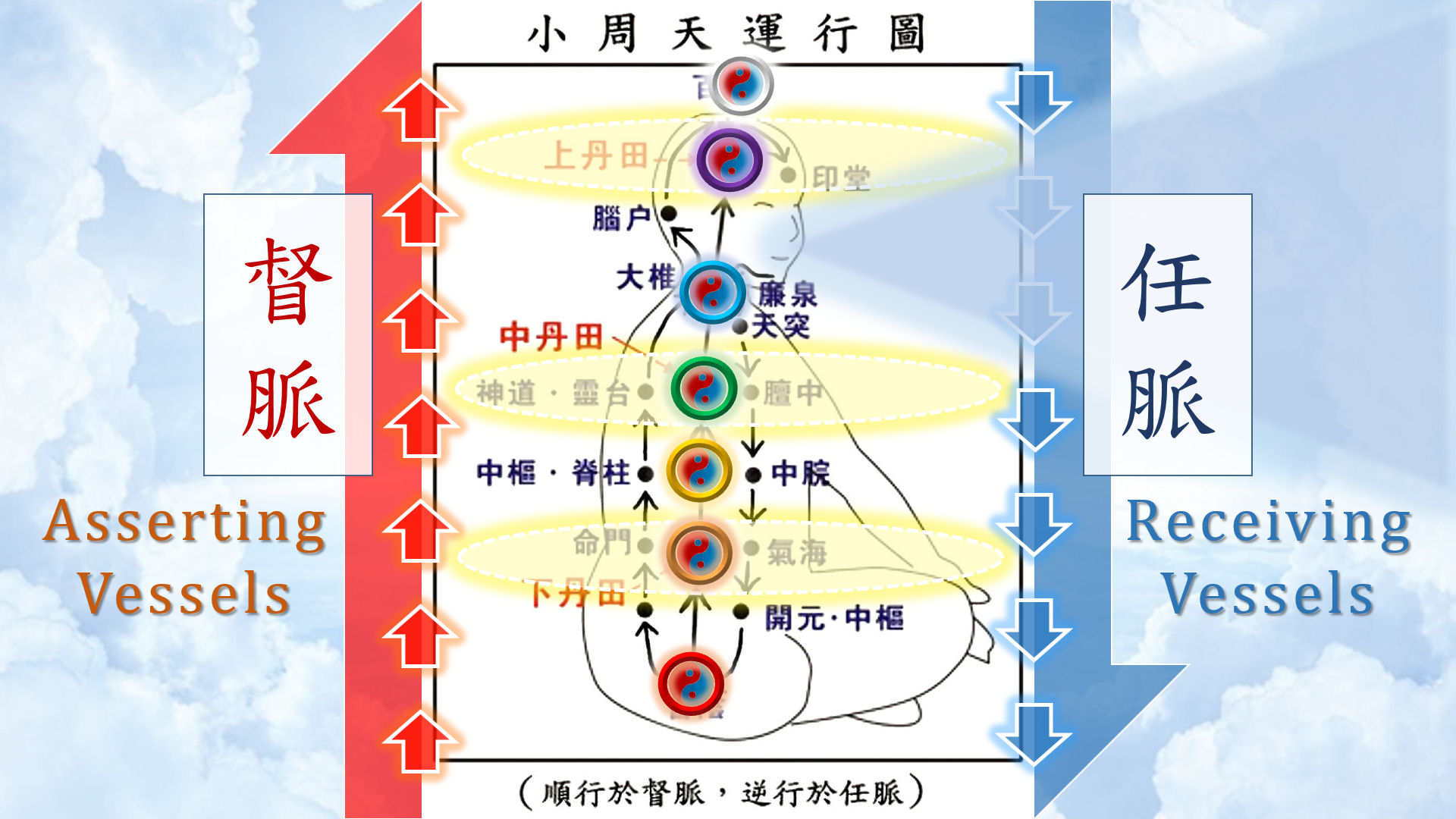
This video introduces a Taoist secret breathwork practice known as the Lesser Mandala of Heaven, or Xiao Zhou Tian 小周天. Rooted in classic Taoist inner alchemy (內丹, neidan), it teaches you to unlock a hidden energy circuit that runs through your body, up the spinal Du 督 meridian and down the frontal Ren 任 meridian, forming a continuous loop of vitality.

By circulating breath and intention along this hidden energy path, you harmonize the body’s three dantian 丹田, or energy centers, with the three realms and cycles of the universe. Taoist masters believe this alignment refines your essence, restores internal balance, and elevates your personal power.

This orbit is set up to attune with the cyclical convection current of nature: heat rises and expands, as it rises, it then cools, contracts, becomes denser, and so the denser, cooler flow sinks down, contracting.

The video is timestamped, and you’ll find a step-by-step guided practice on how to direct breath up and down this internal orbit, transforming your body into a living mandala and tuning it to the rhythmic cycles of nature.

This practice is more typically transmitted from teacher to disciple, but here, let’s see if we can offer a more direct and more easily accessible method.

Whether your goal is improved health, increasing your energy reservoir so you can get more done in a day, or to unlock your mystical potential, this is a cultivation technique worth your while to learn.

Continue reading “A Taoist Secret to Cultivating Personal Power”

Essential Oils: My (Hopefully) Holistic Perspective

Two of my current go-to blends. “Anti-Itch Oil” consisting of tea tree oil, eucalyptus, and lavender really does (at least for hubby and me, and all the friends and family I give this to) alleviate minor itching and bug bites. It also clears my sinuses, and helps with congestion. The blend of frankincense, rosemary, and peppermint smells like petrichor! That after-rain scent! This one’s a great massage oil to soothe tense muscles, carpal tunnel, and I also use it as a hair and scalp treatment oil.

Essential oils get a really bad rep these days, and for good reason. Beyond the scams and pyramid schemes, its contemporary New Age associations with “this can cure cancer” claims and people replacing evidence-based healthcare with fragrance blends is why people are – and should be – skeptical.

Not only is there insufficient scientific and medical research to conclusively make claims, but often it’s misused, or people are uninformed about how to use plant extract essences. They definitely can cause skin irritation, allergic reactions, and in extreme cases of misuse, adversely interfere with your body’s regular functions (this is why those who are pregnant, trying to get pregnant, and young developing children need to heighten their discernment around use of essential oils). Some concentrated plant essences can also interact adversely with prescription medications.

Then of course there are the sweeping claims in the realm of magical thinking. This oil blend will bring you luck in love and romance, or this will exorcise demons, or this will help you to manifest wealth. This oil is for glamour magic. That oil is a cure-all.

The historical origins of the term “snake oil” is synchronistically telling here, actually. When Chinese laborers immigrated to the United States to work on the Transcontinental Railroad in the 1800s, they used a traditional Chinese medicine containing actual snake oil. Per TCM, fat extracted from non-venomous water snakes rendered into an oil, mixed with ginger and camphor extracts was a legitimate medicinal remedy for joint pain and muscle inflammation, which the railroad workers would use. Americans then capitalized on that idea by selling fake snake oil as a magical, mystical ancient Chinese remedy for all ailments. Hence the term “snake oil” came to mean a fraudulent health hype, when actually, the original source material wasn’t fraudulent at all.

Similarly, there are bona fide legitimate uses for essential oils, but capitalistic bad faith sellers of fake stuff give essential oils a bad name. Sadly.

Continue reading “Essential Oils: My (Hopefully) Holistic Perspective”

Overview of Western Art Movements: Art History Timeline (Handout Download)

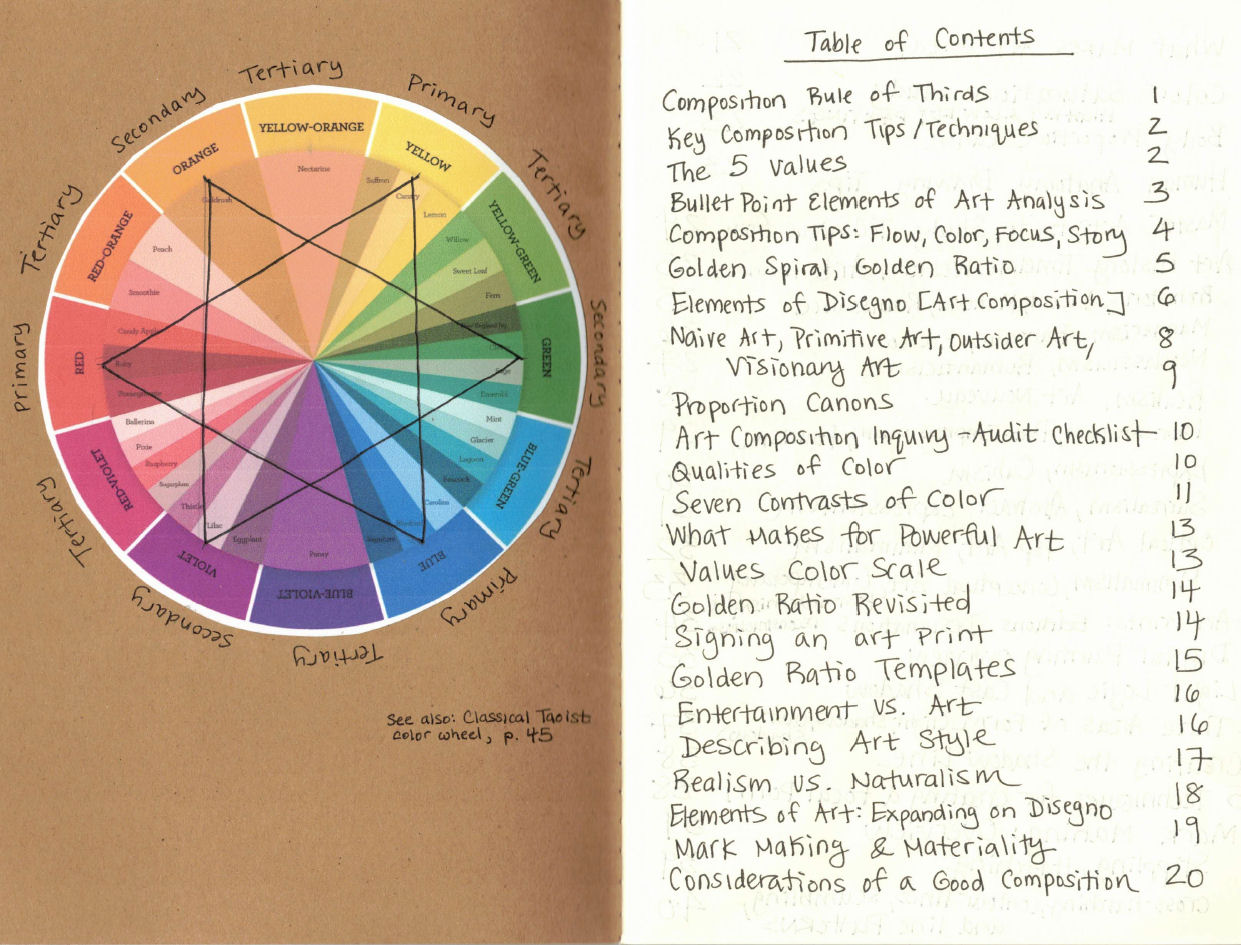
Back in 2021 after completing SKT the Third, I shared a scan of my personal art study notes here, “Download My Art Study Journal.”

I converted the handwritten notes from pages 25 – 33, and integrating notes from other pages in that notebook into the following cleaned-up and expanded handout:

Download Handout

Art History Timeline

PDF

DOCX

The PDF file will be easier to work with. However, for those who want to cut and paste or edit the contents in the handout to create something more custom-tailored to your own needs and purposes, feel free to do so from the DOCX file.

Continue reading “Overview of Western Art Movements: Art History Timeline (Handout Download)”

Critiquing Your Own Art (Handbook)

I’ve written about my self-taught art journey during the pandemic here. I found a bunch of MFA art program syllabuses online and aggregated them together into my own curriculum, then scoured the interwebs for online courses, video lectures, tutorials, books, blogs, anything and everything I could get my hands on to learn composition and the core principles of art making.

You can also download my art study journal here, which is what this handbook, a free download, is based on.

Critiquing Your Own Art

PDF Download

It reads as if after you’ve produced a work of art, you’re supposed to run through the checklist of items for review page after page in this handbook and self-audit how well you did in each of the categories. Yes and no.

It’s funny, whenever I endeavor to unpack something into its parts to analyze, people accuse me of being too analytical at the cost of creativity and intuition.

But if you observe me in the everyday, you’d think me a hypocrite, because in life, I very much operate off intuition rather than pure, cold logic. I go off my feelings way more than I go off rational deduction.

Yet rational analysis is the necessary checks and balances to your supposed intuition. Your intuition can get tainted by bias. So you have to be hyper self-aware and mindful.

While I would be the first to agree that you do not need a checklist to determine and define what is or is not great art, there is some value to deconstructing why we consider certain pieces “great art” and others not.

And if you can deconstruct that, can you then use it as elements to construct “great art”? I don’t know, but why not try? Even if you fail, you’re going to learn valuable lessons from that failure, so I welcome it, don’t you?

If anything, this sort of guided checklist helps you to more likely spot areas for improvement in your craft.

Anyway, that’s how this handbook got started, and you’ll see that the contents are extracted from that art study journal from 2021, which I kept as reference throughout 2020 while I was working on the Spirit Keeper’s Tarot. I converted the content into, well, a bunch of concrete, tangible points for consideration when critiquing your own art.

It’s not like every single one of the points in this handbook will be 100% applicable to you. It’s more about using it as a general reference, to help you navigate self-assessment of your craft.

Here’s the MS Word doc version for those who want to cut and paste around, and change it up to make it personalized:

Critiquing Your Own Art

DOCX Download

The content within this handbook is free for you to use, share, adapt, and build upon in any way that serves you, be that for personal or commercial purposes. Whether you distribute the PDF or DOCX as-is, remix it into your own content, my goal is for this to reach those who will benefit from it. So do whatever you Will with it.

The Ten of Swords. Ego-Death. Soul Wound. The Double-Cross.

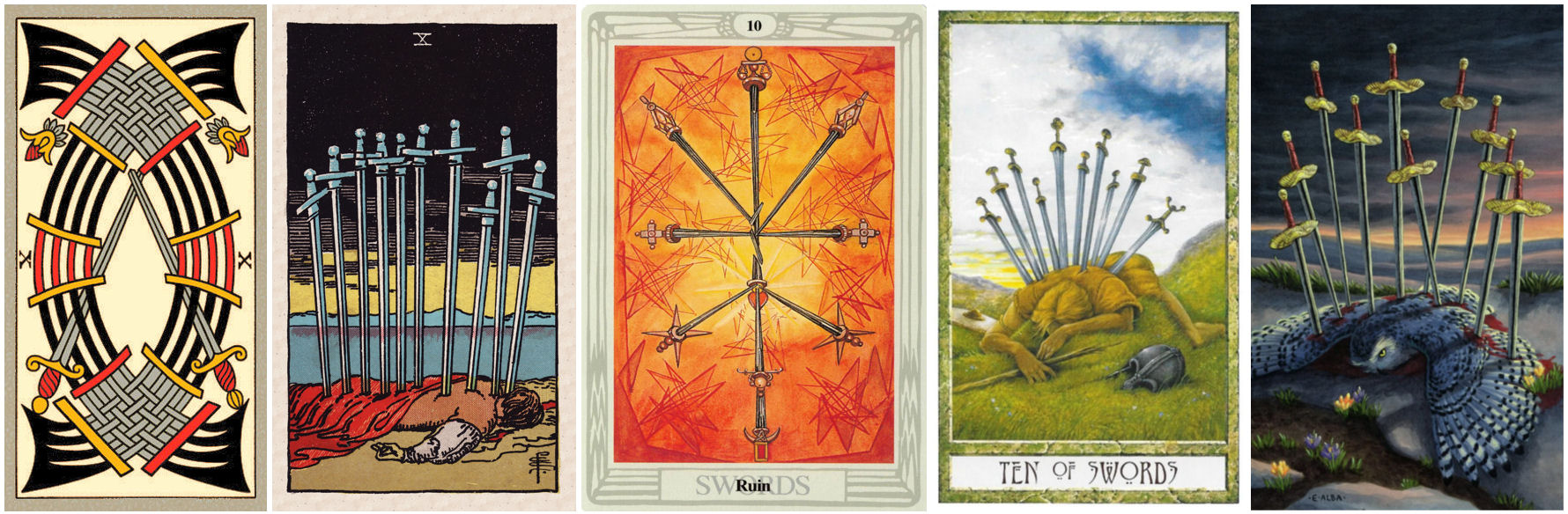
Left or Right – Which one do you prefer? The left G-rated version that leans more into psychological pain? Or the right bloody version that leans more into the physical manifestation of our suffering?

First three left to right are representative of the TdM, RWS, and Thoth, respectively; fourth is from the DruidCraft Tarot, and fifth is from the Tarot of the Owls by Elisabeth Alba and Pamela Chen

The Ten of Swords in tarot has come to be associated with betrayal, treachery, backstabbing, the pain of being double-crossed, and the breach of trust. So how a deck creator illustrates the Ten of Swords reveals a lot about their unconscious processing of these themes.

It’s also the soul wound, a crisis of faith, where faith and reason are at war. It’s the mob mentality vs. individuality. Seeing an artist’s rendering of the Ten of Swords will reveal to you that artist’s relationship to the archetype of the ego-death.

At least that’s always been my impression.

Continue reading “The Ten of Swords. Ego-Death. Soul Wound. The Double-Cross.”

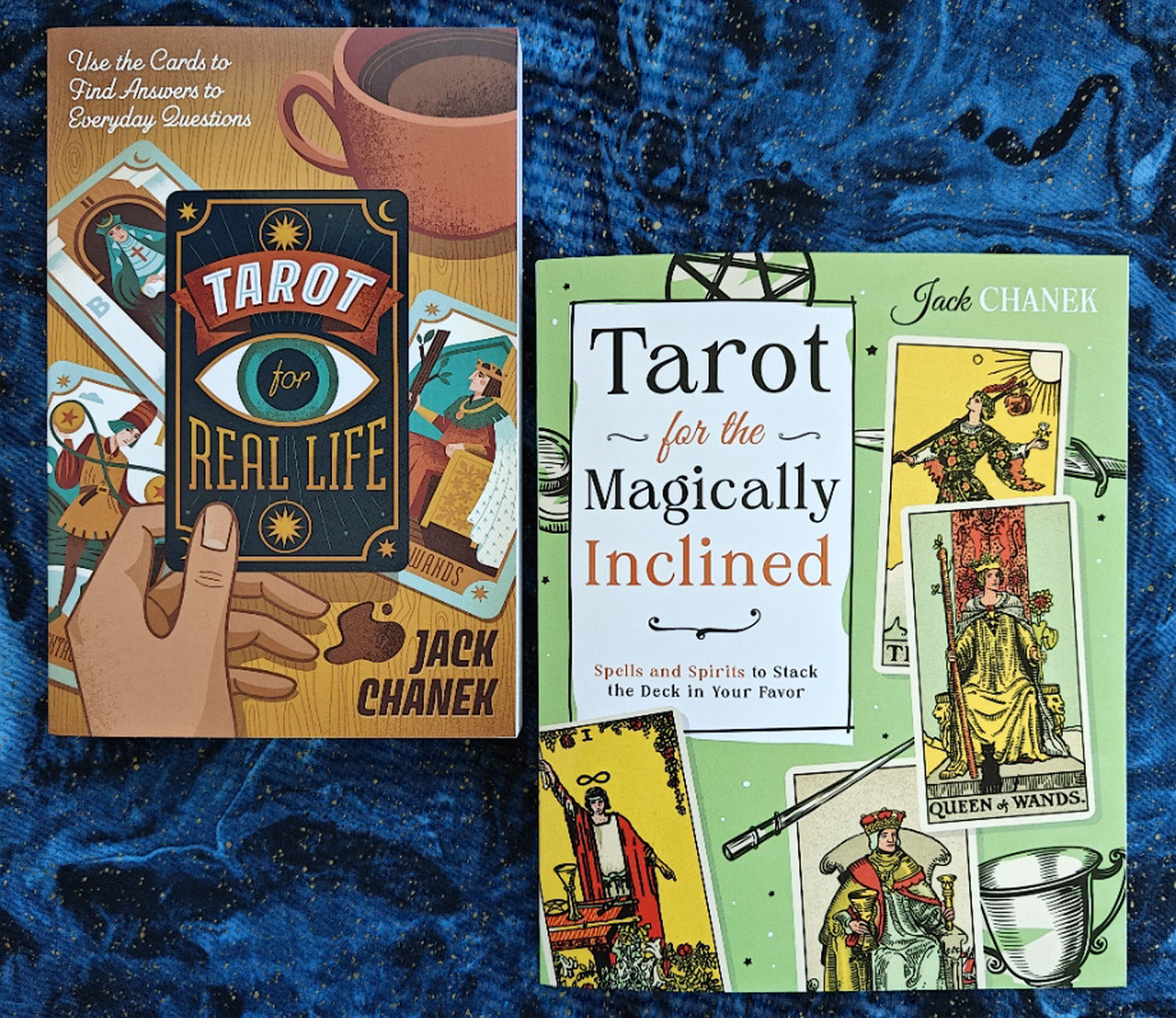
Tarot for the Magically Inclined by Jack Chanek

This is a wonderful sequel to Jack Chanek’s Tarot for Real Life, a down-to-earth primer that de-mystifies the tarot, whereas here in Tarot for the Magically Inclined: Spells and Spirits to Stack the Deck in Your Favor, we delve straight into the mysteries of the tarot.

Continue reading “Tarot for the Magically Inclined by Jack Chanek”

Monetizing Mysticism (Here We Go Again?)

I’ll be sharing random snapshots of my witchy bookshelves just because.

I was listening to the podcast (a great one, by the way) Occultish Behavior: The Unholy Hour with Ivy Corvus and Justin Bennett, Episode 4: The Monetization of Magic where Ivy and Justin share their thoughts on paid endorsements, paywalls, charging for online courses, and so much more. They explore a spectrum of opinions, which I think so many of us can resonate with. These are observations I myself have been grappling with, so it was really fruitful to hear their perspectives.

Tangentially related are other recent thought pieces I’ve been enjoying: Thorn Mooney’s “Reflections on Community” and Kelly-Ann Maddox speaking on “Buying the Witchcraft Aesthetic.”

As a collective we cycle back to this subject for conversation every few years. A year ago that #Occultea tag had lots of pagan and witchy content creators addressing social media witchcraft, grifters, aesthetics, consumerism, and gatekeeping. Consumerism in spirituality comes up frequently in the tarot community, which I’ve previously chimed in on here (Tarot Tube and Classism) two years ago, touching on many of the topics Ivy and Justin cover in this podcast episode, specific to tarot social media spaces, rather than the broader witchy/pagan space.

When we monetize the teaching of sacred knowledge, we complicate and maybe even risk committing sacrilege. But if we don’t meet humans where they are and provide monetary compensation, they’re not going to share their work.

For many holding sincere religious beliefs around how they’ve divinely received the sacred knowledge, trying to put a dollar and cents price tag on the value of that knowledge is intuitively icky. And yet if we don’t value that knowledge — and we demonstrate value by paying for it — then these sacred cultural traditions risk going extinct.

It seems like the majority agree that people should be adequately compensated for their work, but also we judge that at some point it’s just greedy, gross, and profane. We don’t want you to starve, but if you get too popular and start selling your stuff for too much, we’ll knock you off your high horse.

It’s funny how an oft-repeated tenet in the artist/creator community is “charge what you’re worth,” except when you do, you get vilified. If you charge a “grotesque” amount of money for your work, you’re perceived as having an inflated ego, and you’ll get accusingly asked, “What makes you think your work is worth so much.” Which also is a silly question to ask, because if the creator is doing business right, then the clear answer is the marketplace. The marketplace has accepted that their work is worth that much. It’s not ego. It’s capitalism. Okay maybe it’s both.

We all agree that some sort of balanced approach is best, but we disagree on what “balanced approach” means. Where do you draw the line and why do you draw the line there? Is charging $30 for an online course on planetary ritual magic okay? What about charging $300? $3,000? You say it depends on the content of that course, but how do we even apply an objective standard for review?

As an author and educational content creator of topics in mysticism, I struggle a lot with what a “balanced approach” means to me. I want to produce diligently researched, comprehensive, substantive educational videos on YouTube, but it’s a lot of work. It’s time-consuming, and at this point in my life, time is very precious. So if I’m going to invest my time and energy into making free educational videos to increase equitable accessibility to sacred knowledge, then I want to be compensated for that work, but how? Do I want money? Initially I think, no, I don’t need money for it. I just need something in exchange to feel like it’s fair, to feel like my investment sacrifice of time was worth it. But what?

Continue reading “Monetizing Mysticism (Here We Go Again?)”

“Tarot and Oracle Card Reading” from the For Dummies Learning Series

You’re probably quite familiar with the “For Dummies” learning series that were popularized in the 90s. The book series published by Wiley & Sons de-mystifies difficult subjects and is known for accessible, easy-to-understand, plainspoken writing. Wiley could not have chosen a better author for the task than my dear friend Charles Harrington.

Although the “For Dummies” series catches a kitschy rep, this is in all seriousness a legit, no-nonsense, superb beginner’s book on tarot and oracle decks — and I love the dual coverage this compact yet comprehensive book packs for you.

Continue reading ““Tarot and Oracle Card Reading” from the For Dummies Learning Series”

My 30 Days on the Ketogenic Diet

Thank goodness uni (sea urchin) is keto-friendly!

I guess I’ll start with the ending spoiler: this was not for me. Yet if keto was a cult (sometimes I think it is), the Hubby says he’d join in a heartbeat (he jokes, but you get what he’s saying). The Hubby now swears by keto.

Everything about having to be on a ketogenic diet fundamentally runs against my impulses, inclinations, my intuition, my preferred lifestyle, my joie de vivre, like this was 30 days of stripping away the meaning of life from me.

Also, at the tail end of this blog post I’ll share some woo thoughts on keto, and what I felt like was the impact of a ketogenic diet on those who are psychic or hyper-intuitive.

Keto-Compliant Huli Huli Chicken over Green Beans in Garlic Sauce

Balancing out the text reviewing my 30 days of keto will be keto food pics. I’ll also share a pdf download of 30 days of keto dinners. On weekends I meal-prepped for weekday breakfasts and lunches, i.e., fridge fully stocked with soft-boiled eggs, various seasoned ingredients to easily build salads, foods cut and at the ready for easy charcuterie boards.

30 Days Keto: Meal Plan Print-Out

In case you’re curious, here’s a print-out of what we ate for 30 days:

Click here for the PDF

To any keto purists reading this, yes, our meal planning included several vegetables considered “not keto-friendly,” but are nutrient-packed. I found that I had to integrate “not keto-friendly” vegetables into our meal planning to avoid vitamin deficiencies.

The problem with the keto diet (if I may…) is the high risk of nutrient deficiencies, and if you eat “dirty keto” (more on that later), then you’re probably taking in way too much sodium, way too much bad fats, etc. If you aren’t hyper-aware of what exactly you’re eating just to stay keto, you’re putting yourself at a much higher risk for elevated cholesterol, liver stress, kidney stones, and if you already have digestive issues and lack of gut microbiome diversity, you’re gonna exacerbate those conditions if you’re not super-careful on keto.

Before we continue, in case it’s not overtly obvious to you already, I’m not a nutrition scientist, I’m not an anything at all that would remotely qualify me to talk about dieting or ketogenesis. This is just a lay person cooking food in a lay people kinda way and sharing my lay person opinions on something I know nothing about (but experienced for 30 days).

Local Northern California white surgeon roe (aka cheap caviar)

Oh, and one more thing about that print-out of meal prep. Cuisine-wise, it’s primarily East Asian, but California (specifically Bay Area) influenced, as “farm to table” as practicable, local and seasonal. If that’s not your palate, then the print-out is going to be quite useless to you. =P

Continue reading “My 30 Days on the Ketogenic Diet”

Learning the Opening of the Key (OOTK) – Course is Now Free

Opening of the Four Worlds

Just a note for those who might be interested: the “Learning the Opening of the Key” video and workbook course from 9 years ago is now freely available.

You’ll first want to click onto the below hyperlinked page to download the workbook PDF and all supplemental materials:

Learning the Opening of the Key (Online Course)

Continue reading “Learning the Opening of the Key (OOTK) – Course is Now Free”