
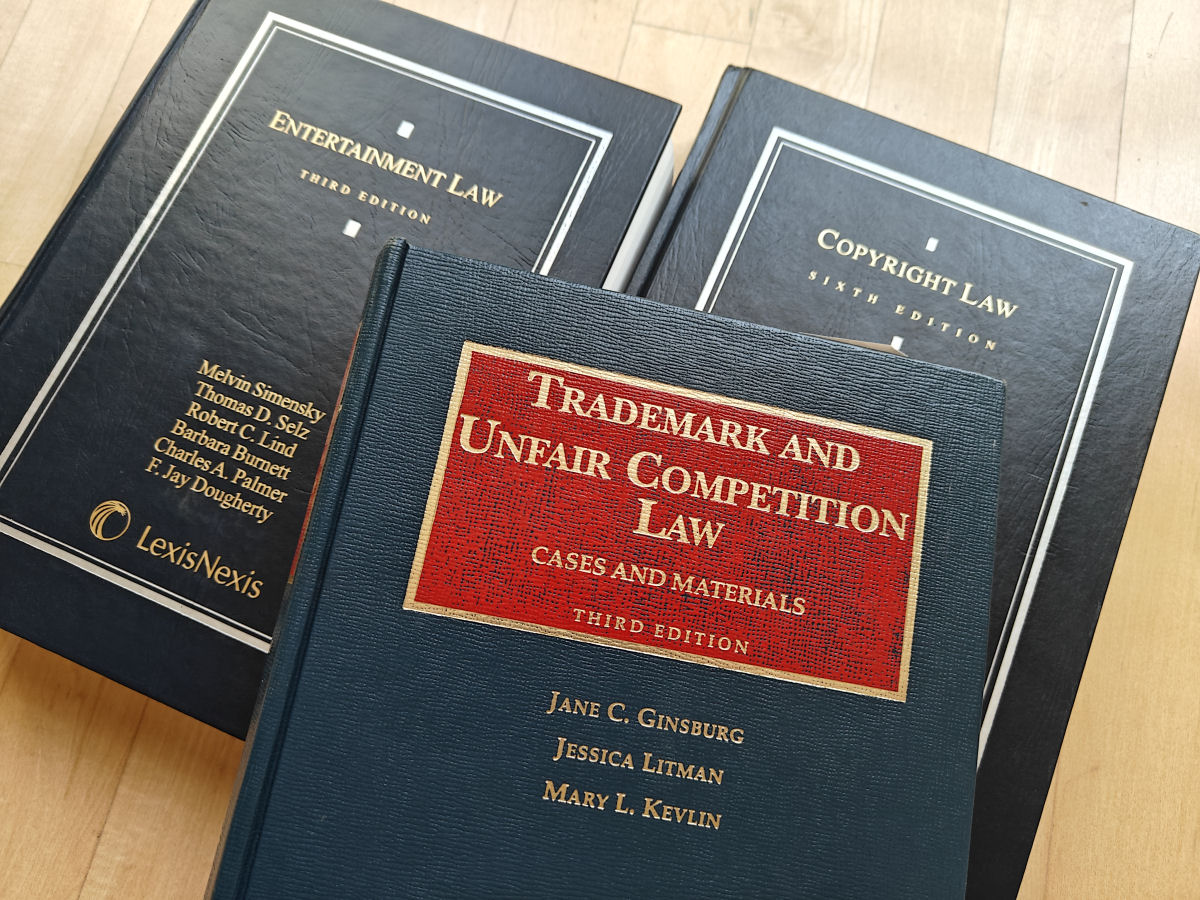
If you’re not a very disciplined, organized, love-to-do-research, always-did-your-homework Type A personality with strong Virgo vibes, then skip this blog post entirely and do not try to DIY intellectual property law. Hire an attorney.
Even if you are all that, this is not legal advice. I am not your attorney. This is a free-for-all blog post you came across on the internet, on a website about fruity-tutti metaphysical arts no less, so if you leave with even a few nuggets of insight to get you started on the right track, call it a win. Which is to say, do not blissfully rely on what I’ve said here. Apply critical thinking.
But… For an attorney to do the due diligence, put together the application, and steer your trademark through registration with the USPTO, it can cost around $2,500 if it’s a simple, un-problematic trademark. And if you’ve got unique circumstances or someone ends up challenging your mark, then the fees will skyrocket out of control.
If that sounds like way more than you’re willing to spend, well the good news is technically you can file a trademark without a lawyer. Yes, technically it can be DIY, though that comes with quite a bit of risk. If you do it wrong, your application will get rejected, you won’t get your trademark registered, and you will be out of pocket the $250 or $350 you paid for the filing fee (no refunds).
Nevertheless, I’ve always been a do-it-yourself (DIY) type and if you’re kinda like that too, and you are willing to roll up your sleeves and do a lot of research, homework, and study yourself, and you accept the risks of DIY trademark registration, then maybe you don’t need to hire a lawyer or take your chances with one of those discount run-of-the-mill legal services websites. Maybe you can shoot your shot and try to register your trademark on your own.
Here are the basics.
What is a Trademark?
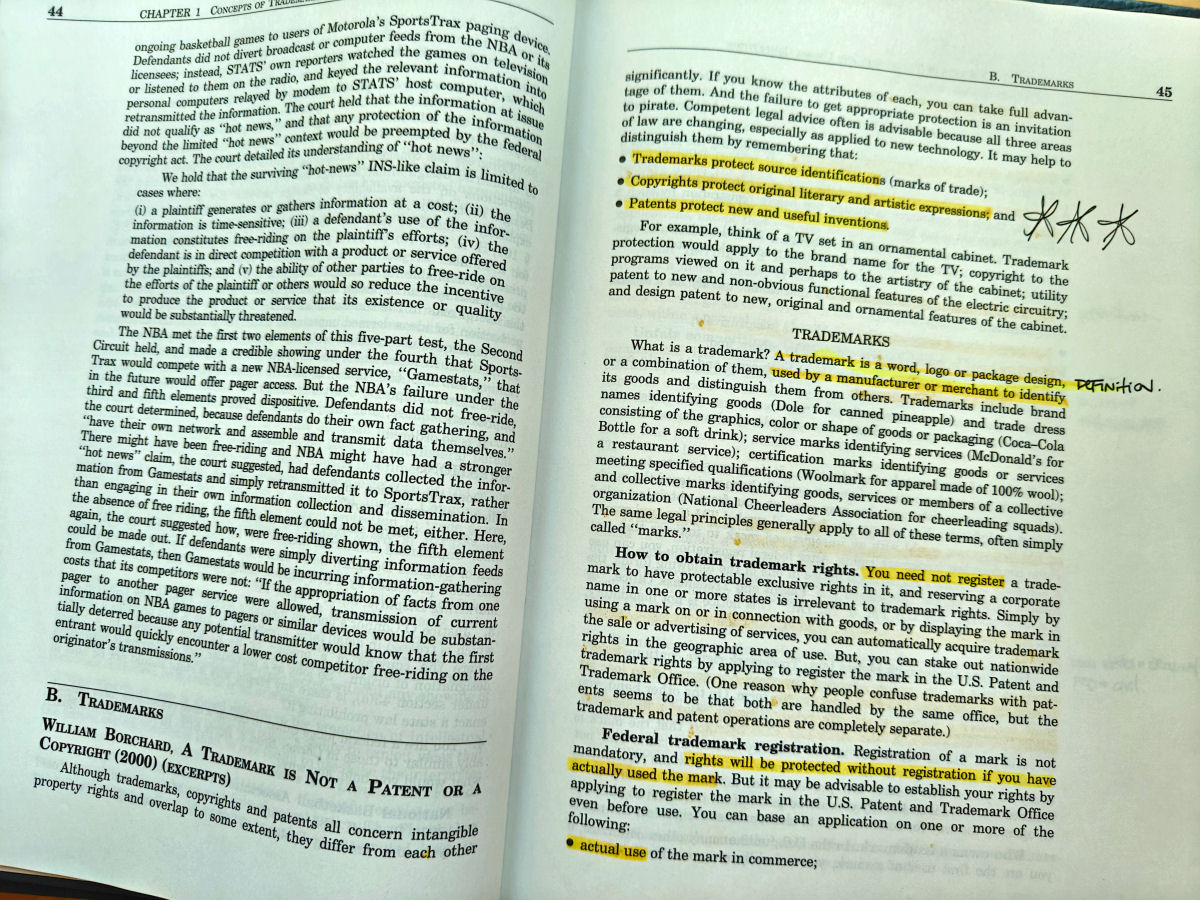
A trademark is a word, phrase, logo, or other graphic symbol used in a commercial setting to distinguish a product or service from other products or services in the same industry. Basically, it’s your brand’s signature.
Trademarks indicate origin or ownership, help with consumer protection, i.e., consumers know what to expect from the product or service, and is a form of marketing and advertisement, especially if you’ve done a good job safeguarding the goodwill associated with your trademark.
Elements of a Trademark
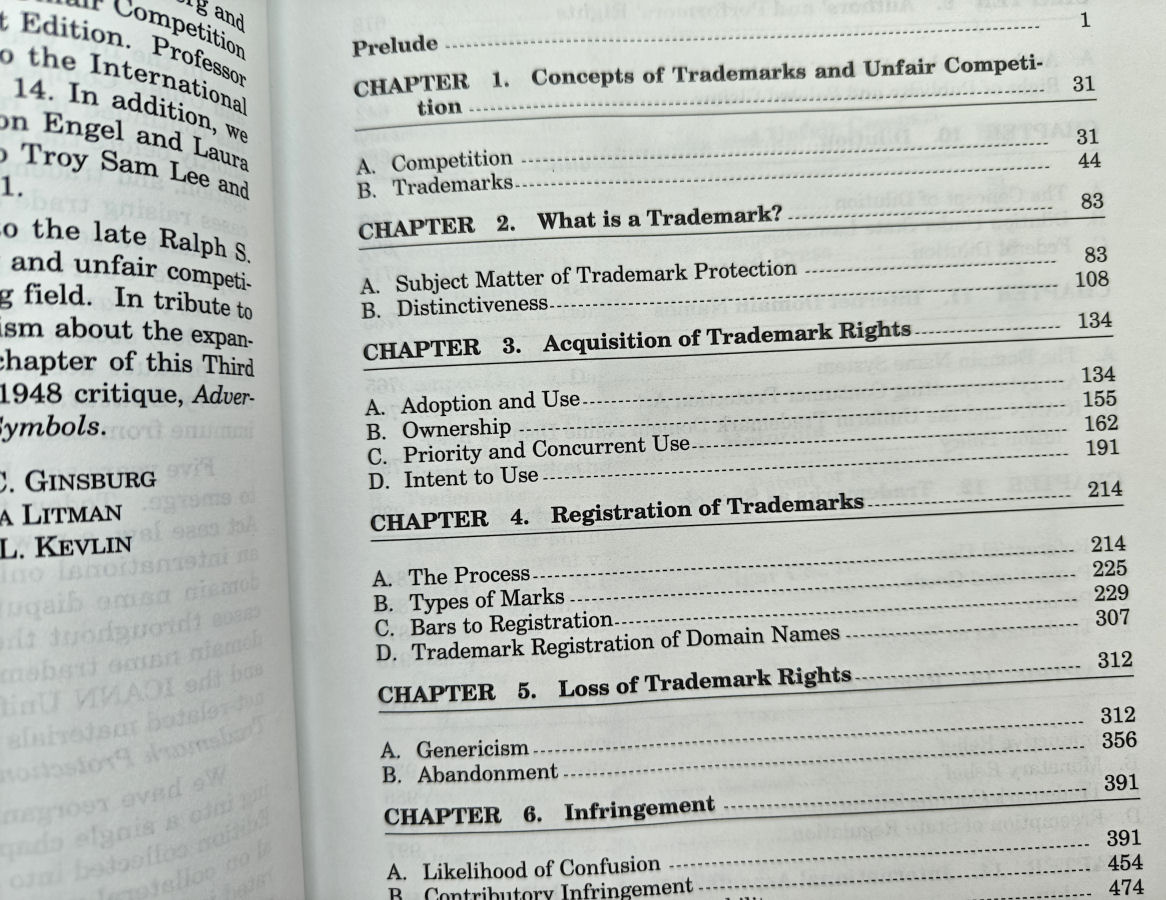
For a bona fide trademark to receive federal protection, it must meet all of the following elemental requirements:
- It must be distinctive (and not merely generic or descriptive), both inherently distinctive and distinctive in the marketplace.
- It must be affixed to a product or service that is actually sold in the marketplace.
- It must be registered with the USPTO.
To use the symbol “®” with your trademark, it must be registered with the USPTO. Otherwise, if it is unregistered, you use “TM” after the mark to designate that it is under common law protection only. If you do not register with the USPTO but meet elements 1 and 2, then what you may have is a common law trademark, which is still afforded some protections.
Registration is not necessary for protectible exclusive rights. Simply by using your mark in connection with the goods or services, or by displaying it in advertising and marketing materials, you automatically acquire trademark rights in the geographic area of use.
To stake out nationwide trademark rights, you’ll want to apply for federal trademark registration, and that’s with the US Patents and Trademark Office (USPTO).
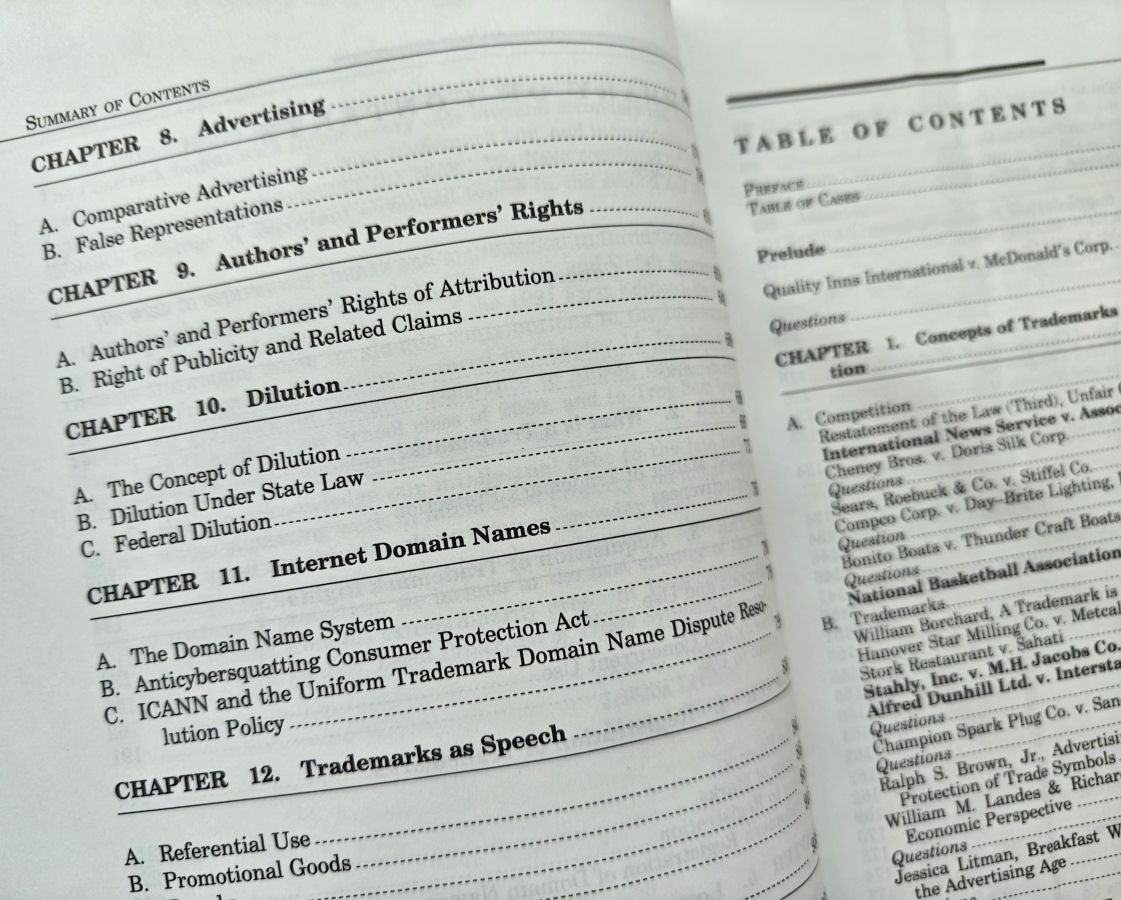
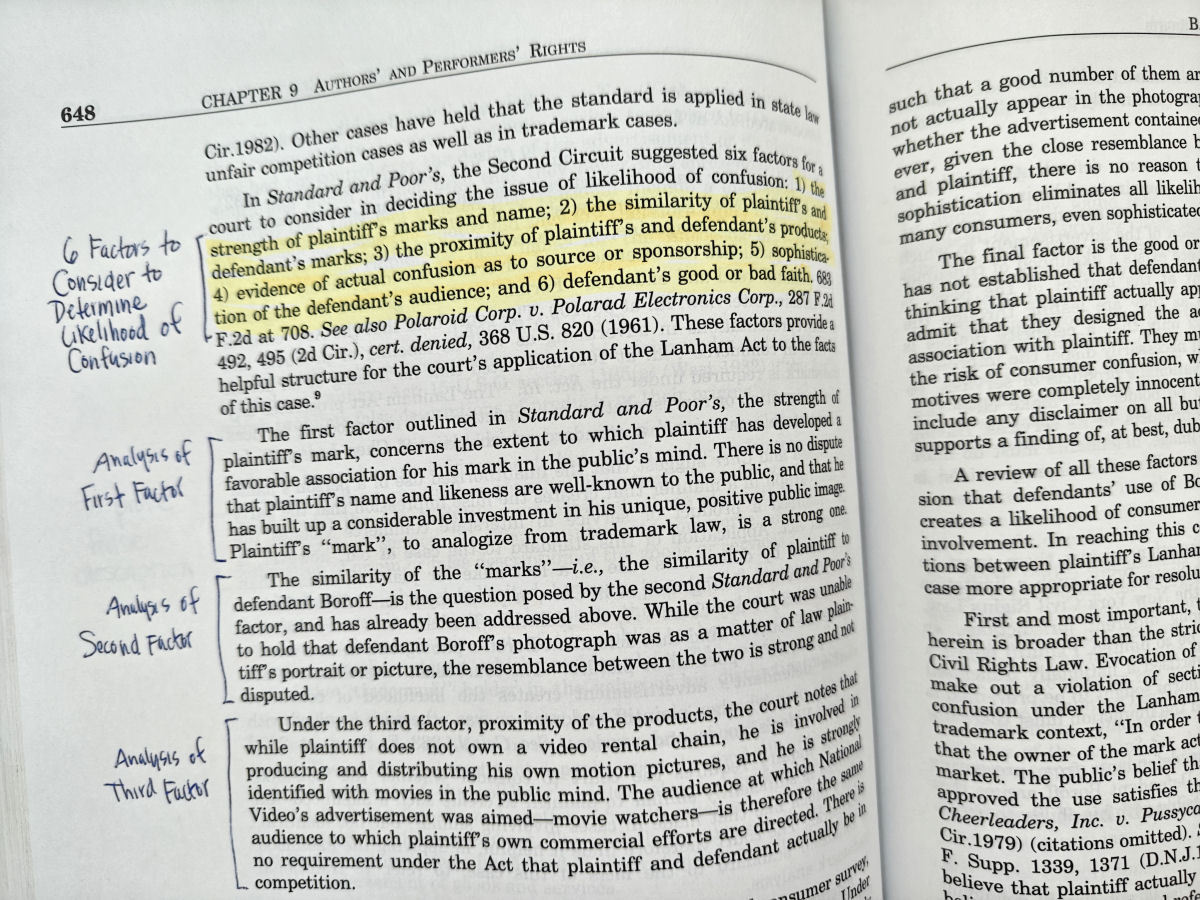
CLICK HERE TO DOWNLOAD my old law school outline on US trademark law and unfair competition. It’s 96 pages of useless information that is more than you practicably need to know, but there you go. It does provide the nuts and bolts that further explains the above list of elements and how to interpret those elements. Also, maybe it’s a fun and entertaining glimpse into what law school is like.

The USPTO also provides a wealth of quality info on trademark basics and the registration process, linked here and hyperlinked to the image above, so be sure to check it out and get your study on.
How Long Does the Trademark Last?
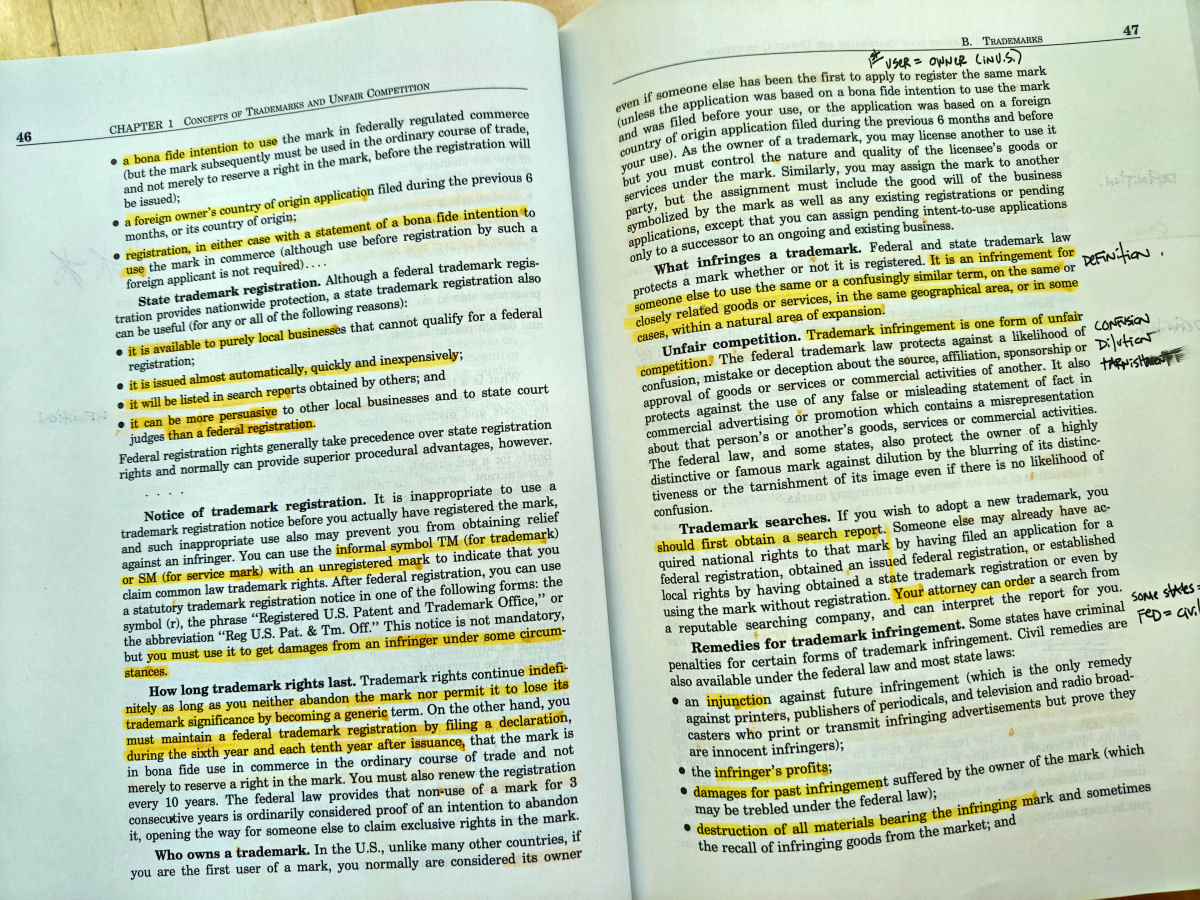
Indefinitely. As long as you have not abandoned the trademark or permitted it to lose its trademark significance by becoming a generic term.
However, to maintain a federal registered trademark, you will need to file a declaration every 6th and 10th year after issuance. You’ll also need to renew your registration with the USPTO every 10 years.
Non-use of the trademark for 3 consecutive years is considered proof of an intention to abandon it and opens the way for another to come in and grab up the rights to that trademark.
Clearance Searching

First, you’re gonna have to make sure nobody else in your industry is already using this trademark. This preliminary due diligence process is often called clearance searching. A great place to start is to search the USPTO Trademark System.
The big reason to hire a lawyer is this clearance searching process. They’ll scour the state business registration databases, domain names, and more to leave no stone unturned. The risk with doing it yourself is possibly having overlooked a preexisting trademark or something so similar that they have grounds to challenge your registration.
Oh, and also, a trademark attorney will have the experience to assess whether your proposed mark is distinctive enough to pass muster. We all think our trademark is so special, so unique, of course it’s “distinctive!” According to the law, it might not be. And a lawyer is the one best positioned to do that legal analysis for you.
Thus, if you DIY your trademark registration, the risk is you find out $250 later that your mark was not distinctive enough, or that someone else is already using that mark and so again, you’re out the $250 because your application is denied.
Some diligent research and scouring of the internets can help reduce that risk. So go nuts with your sleuthing.
Gather These Documents Ahead of Time
Before you start the online application process, gather the following documents and have them at the ready:
- Credit card for payment of the filing fee
- The International Class (IC) that you will be filing your trademark under. You can file for multiple ICs if your trademark spans multiple industries, but this will cost extra $$.
- Date of first use of your trademark. When was your trademark first used in commerce?
- You will need document evidence to prove this.
- An example might be an invoice of your first bill of sale that has your trademark on it, or website domain details.
- A purchase order or dated marketing/advertising materials with that trademark name on it will suffice.
- A minimum of three (3) specimens of use.
- A specimen for a mark is something that was used in connection with the product or services in that IC during the course of selling or advertising the product or service.
- Examples of specimens to upload include a sign, photo of the signage, brochure about the services, an advertisement, a business card or stationary showing the trademark used in connection with the services, or a photograph showing the mark as used in rendering or advertising the services (photograph of a display stand where you’re selling the stuff and the stand features signage with the trademark clearly visible).
- Specimens must (1) reference the type of service rendered for the specimen and (2) reference the actual trademark itself.
Your federal trademark registration is going to be public. Keep that in mind. If there is any information, such as a personal home address, anything at all you want to keep private, then you need to find a workaround. Remember: everything in your registration is going to be public. Anyone who knows how to work the USPTO database will be able to find it.
IC, International Class What?
CLICK HERE TO DOWNLOAD a listing of the International Classes. Basically, it’s designating what type of product or service you’re trademarking.
For example, if you want to trademark your tarot or oracle deck name, then that’s going to be Class 16, for paper goods and printed matter. If your product is more like a toy or board game, then it’s probably going to be Class 28, for toys, games, and sporting articles.
If you’re selling essential oils, lotions and potions, it might be Class 3, for cosmetics and cleaning preparations. The hyperlinked download I referenced will have explanatory notes to help guide your determination of which IC (Class) to file under. If you’re selling jewelry, then it’s Class 14, jewelry, precious metals, or with precious stones, and their alloys and goods in precious metals or coated therewith.
For education and entertainment services, providing training, or sporting and cultural activities, running a conference or festival event, then you’re Class 41, which includes services consisting of all forms of education, entertainment, amusement, recreation, or presentation of works of visual art or literature to the public for cultural or educational purposes.
TEAS Plus Application for a Word Mark
This blog post will explain the TEAS Plus application form only. TEAS Plus is the cheaper of two filing options, but has more upfront requirements (everything listed in the previous section), whereas even if you don’t have all your ducks in a row, you can still apply for a trademark via TEAS Standard, but your lack of preparation and foresight will cost you an extra $100. (As of this writing, the TEAS Plus filing fee is $250 per IC, whereas the TEAS Standard is $350 per IC.)
Also, this DIY how-to is for a basic word mark only. For example, you want to register a trademark for your business name JOLAMENA TAROT. Meaning, you will be confirming that, “The mark consists of standard characters, without claim to any particular font, style, size, or color.”
If your mark includes color, a stylized font, non-English words, non-Latin characters or symbols, or the name or portrait of a living person, then additional statements and a slightly more complex application process will apply. Personally, with some critical and creative thinking, and having done the homework, you can totally still DIY it. You just need to prepare the additional statements.
Online Filing Process
First you’ve got to register for a USPTO.gov account. CLICK HERE and follow the form prompts. Once you log in, the homepage will have a column of options that look a bit like this:

Click on “File an application.” Then from the drop-down menu, click on “File a TEAS application.”
Then follow the instructions page by page. The following screen shots will give you an idea of the information you will need to have at the ready for input.

I’m using my hypothetical “Jolamena Tarot” trademark application to illustrate. And let’s say that mark is owned by Abigail Artist. Above you will see the information you will need to submit.

Let’s say that Jolamena Tarot wants to sell tarot and oracle decks. That would be International Class (IC) 16, as noted in the sample form above, filed on a Section 1(a) basis, because Abigail has already been using the mark in commerce as early as December 21, 2013.
Remember that for each IC you file under, it’s $250. So if you want to file under two different industries, or categories of goods/services, then that’s $250 x 2 = $500 to file your trademark under two categories of goods or services.
Note that at least one of the specimens that Abigail uploads must document use of “Jolamena Tarot” on December 21, 2013 for her to claim that use date.
Remember earlier when I mentioned possible added complexities, such as if part of the wording of your trademark is a foreign word, or a transliteration of a word? Or maybe actually you’ve filed a trademark before, but it lapsed and got cancelled, and now you are filing a new registration, so there’s a prior registration?

That’s where the “Additional Statements” section comes in to play. You’ll follow the prompts in the form, and tell the truth, and when your truth-telling leads to a new set of prompts, fill those sections in. The above shows the possible Additional Statements you may need to file, based on your situation, so if any of those five look like they may apply to your case, then have your written Additional Statements ready to go.
Psst… Cheat Codes
Go to the USPTO Trademark Search database LINKED HERE and type in any brand names you know of for sure that has a registered mark to see what their filing looks like. The biggest names in your industry most likely have federal registered marks, so look them up. What IC codes did they use? How did they describe their goods or services?
If you know of registered brand names with similar issues as yours, e.g., the mark includes a foreign word that you need to provide the English translation of, the trademark intentionally includes trademarking colors for trade dress, etc., then look them up. Reverse engineer and see how they applied for their mark and what approaches you can replicate.
Specific to the world of tarot, in the search bar, type in just “TAROT” and you will see the thousands of trademarks with the word “TAROT” in it. Take your time studying these registrations, which ICs they went with, try to figure out why they went with those ICs, and how they worded their application. Take notes. Replicate what applies to your situation.

Click on any of the results and you will see a profile page with the trademark’s Status. Click on the “Documents” tab and you can click into, view, and even download any of the documents that the trademark owner filed with the USPTO.
Take a look at the specimens that business submitted to successfully register their trademark. Click on the “Maintenance” tab to see their Section 8 and Section 9 filings, where applicable.
Future Section 8 and Section 9 Filings
Even after your application has been approved and your trademark registered, your work is not done! You will need to file a Declaration of Use after 5 years of using the trademark, or you might lose it. After 10 years of use, you have to file another Declaration. And then every 10 years, you must continue to file a Renewal of Registration of the mark, and each time, you have to pay a filing fee of a couple hundred bucks.
Fortunately, the USPTO will send you an email reminder, but still, you’ve got to stay on top of that! So make sure your application’s email address of record is up to date, because that’s where the reminders will be sent. When they send you that email reminder, you’ve got to click in to the hyperlinked form and submit your Declaration and/or Renewal.
Is it worth it? Do I have to register?
This really depends on the nature of your business, and the specific factors of your business use. For example, I did not register a trademark for my Spirit Keeper’s Tarot deck name, because in a cost-benefit risk-reward balancing analysis, I was like meh. But back when I was running a boutique business selling my original design handbags and fashion accessories, I definitely registered a trademark for that brand name (and even filed a design patent).
Do you have to register a federal trademark for your metaphysical business name? Or the metaphysical conference you run? I mean, it’s up to you. Really.
You do not need a federal registration to have a protected trademark in the region(s) where you sell your good or service. That’s called a common law trademark. It won’t give you nation-wide protection, and someone who does have a registered trademark with your name has priority over you.
Greater legal protections are also afforded to federally registered marks. You can sue in federal court. You have more rights and leverage when it comes to blocking counterfeit products from entering the country. You can register your trademark with Customs and they’ll be on the look-out for you and not let counterfeit versions of your stuff into the country. You also have legal priority when it comes to going after people for infringement. Even something like proving you own a registered trademark can help you win take-down notices and get counterfeit stuff off the internet.
If it will help you sleep better at night and you have the funds to spare, then go for it. If you’re a penny pincher like me, then I think you’ve got some thinking to do. Sometimes it’s more financially prudent to go for the informed risk.
These are not decisions that I can make for you or give further advice on. Ultimately it’s up to your own comfort levels when it comes to risk and spending.
“Wait, who are you? Do you actually know this stuff?”
I’m a corporate transactions attorney licensed to practice law in California and New York. Since I was in VC (venture capital) in the San Francisco Bay Area, much of that experience was in IP (intellectual property) law, and specifically, both trademark registration and trademark litigation, where I’ve been both plaintiff’s and defendant’s counsel in federal district court, fought oppositions, handled inter partes proceedings before the Trademark Trial and Appeal Board, and trademark appeals. Although I’m speaking from experience, the information provided here is general, and for public education purposes only.
A significant portion of my past legal experience has also been in entertainment law, and in advocating for authors’ and artists’ rights. As someone who self-identifies as both a published author and artist, I bring a sincere passion for defending authors’ and artists’ rights.
However, I have not practiced trademark law since pre-covid times. Post-covid my legal career has transitioned to other areas of the law. So some of my working knowledge may be outdated.

LEGAL DISCLAIMER
No attorney-client relationship is formed on the basis of this free educational content (I hope that’s really obvious to everyone).
Nothing in this blog post can or should be construed as legal advice. The materials provided are for general educational purposes only.
Do not rely on anything herein to make important decisions that could have a detrimental impact on your legal rights. Such educational materials can only present general rules and guidelines; it cannot account for unique circumstances. Even the slightest change in the fact pattern could affect the legal analysis. When in doubt, always consult with an IP attorney who can assess the specific facts of your case and therefore provide an informed legal opinion.
YOU MAY ALSO BE INTERESTED IN…
- Copyright Law and Tarot: Handbook Download
- Tarot Business and Legal Forms (Free Contract Templates)
- Sole Proprietorship in the Sacred Arts: A Preliminary Guidebook on Business Models, Voice, Brand Identity, Building a Reputation, Creating Value, and Prosperity Consciousness
- Writing and Publishing Nonfiction: A Complete Course
- Wills & Trusts: Estate Planning Kit (Free Download)
 benebell wen
I lost you at your services were not free. Others call me nerdy when I go to the international patent classification to divine what patents need to be discovered to change the course of humanity. I have not had much time but ended on the generation, conversion or distribution of electricity. My luck would be to create a portal for people to escape a hellish world then get sued for some infringement or another. (Abuse of power) Emperor rx. Happy and safe travels.
LikeLike