
also known as the Wen Shi Zhen Jing: Sutra of Magical Spells and Aphorisms for Attaining Primordial Truth
The more recognized naming convention for the sutra is the Guan Yinzi (闕尹子) or Wen Shi Zhen Jing (文始真經) attributed to the gatekeeper who Laozi encountered.
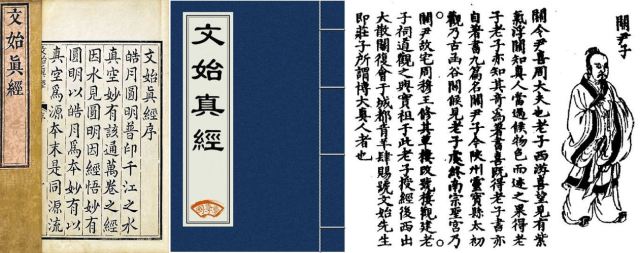
The Guan Yinzi (or Wen Shi Zhen Jing)
According to lore, the gatekeeper at the Western Pass, named Yinxi 尹喜, later given the name Wenshi (文始), transcribed the teachings of Laozi and that text became the Tao Te Ching (道德經). Alternate tellings have Laozi writing the teachings down into two books himself, which the gatekeeper then receives.
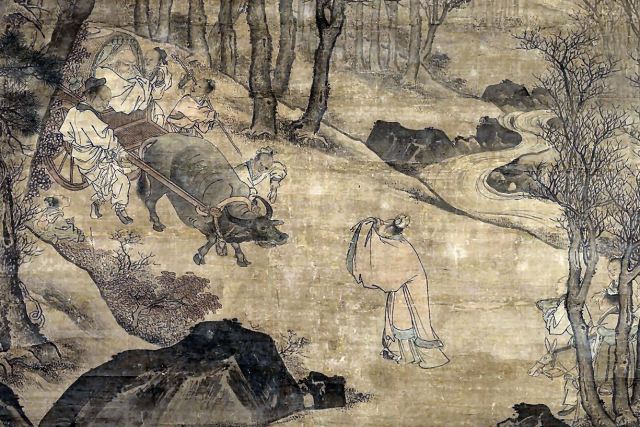
After receiving Laozi’s teachings, the gatekeeper attains enlightenment and subsequently writes his own book, which becomes known as the Guan Yinzi 闕尹子. Guan 闕 means gatekeeper. Yinzi 尹子 means “Master Yin” (like how Laozi means “Master Lao”), an honorific that Yinxi 尹喜 is given upon mastering the Tao.
Historically among Taoist alchemists, mystics, and ceremonial magicians, the Guan Yinzi is treated as a book of magical spells and powerful cultivation practices hidden in plain sight. It is a nine-chapter esoteric Taoist sutra and canonized sacred text attributed to the Three Sovereigns (三皇, San Huang) tradition of Taoist ritual magic. It also became the principal text for a mystical Taoist lineage named after the gatekeeper, the Wenshi School (文始派).
The nine chapters are titled as follows:
- 一宇 One Universe
- 二柱 Two Pillars
- 三極 Three Thrones
- 四符 Four Talismans (or Seals)
- 五鑑 Five Patterns (or Formulas/Rubrics)
- 六匕 Six Daggers
- 七釜 Seven Cauldrons
- 八籌 Eight Manifestations
- 九藥 Nine Medicines / Nine Poisons
The origins of the text is attributed to the time of Laozi, around 6th century BC, though the oldest documented reference we have to it is circa 400 BC in the Liezi 列子, a classical text on Taoist philosophy. Around 400 AD, the text is canonized in the Daozang 道藏 (Taoist Canons).

Seminal Text in the Three Sovereigns Magical Tradition
The Three Sovereigns tradition is best known for its volumes of talismans and instructions on Fu talisman crafting, cultivation practices of inner alchemy, and coded outer alchemical recipes for magical elixirs. Inextricable from the Three Sovereigns tradition of sigil magic are its grimoires on summoning spirits and demons.
Three Sovereigns (三皇) is considered a northern magical clan-specific tradition that migrated south with aristocratic refugees from fallen imperial courts. In the south, it syncretized with local folk religious and wu shamanic practices.
Over the millennia many offshoot lineages sprung from the Three Sovereigns, often family and clan-based. The belief was that access to the tradition’s established pillars of magical power had to be inherited or through merited transfer of qi from lineaged master to worthy pupil.
Occult Beliefs Around the Guan Yinzi
It’s long been held among Taoist alchemists, occultists, and mystics that the Guan Yinzi is written in code, or riddles. The chapter titles hint at the arcane knowledge you are to receive from that respective chapter text, but then the chapter text itself is far from being immediately comprehensible.
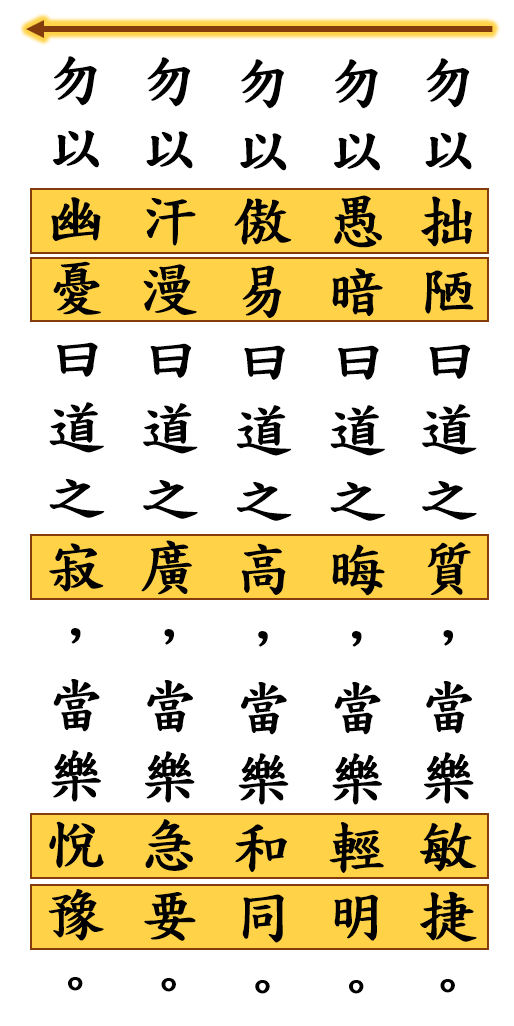
A surface-level textual reading gives you proverbs and axioms that on its face, contain general wisdom, not unlike the Tao Te Ching.
The excerpt from the Nine Elixirs chapter (keeping it neutral; you can lean toward interpreting it as either Medicines or Poisons) is about not blaming the Tao for being difficult simply because you don’t understand it, but rather, be content with what parts of it you can understand; likewise, don’t extol the Tao’s profundity in a way that self-congratulates your superiority, but rather, be content that the Tao’s profundity empowers you to possess a sincere affinity for all sentient beings.
Now take a look at the pathways formed by that line text. The pathways reveal a five by five (five lines, each consisting of five ideograms) pattern, which is a reference back to the chapter Five Patterns.
Here’s another example of how to “read” the Sutra:
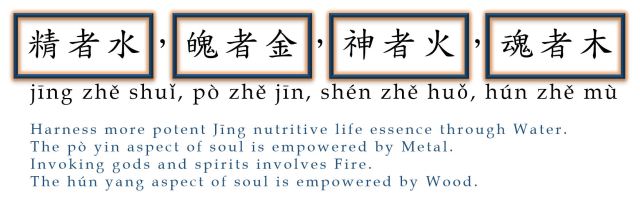
The sentence structure of Chapter 4: Four Talismans is repetitive with its references to two pairings, Fire-Water and Wood-Metal, which were presented earlier in Chapter 2: Two Pillars. When you take apart the Chapter 4 text and rearrange the passages into groupings by Water, Metal, Fire, and Wood, you end up with instructions on how to craft four talismans.

A deep-dive of the text is required to retrieve the text’s occulted meaning. Formulas, step by step instructions, and more detailed insight of the arcane teachings need to be retrieved by solving the riddles or treating the line text as a labyrinth and routing a path through the maze of words.
The Six Daggers chapter may suggest soul migration and astral flight, providing a coded glossary of symbols and omens. It also references two states of consciousness and having to discern which state is the “dream” state and which is “reality.” The Daggers chapter is to be studied in tandem with the subsequent Seven Cauldrons chapter, i.e., interplay and mergers between the yang attribute of daggers and the yin attribute of cauldrons.
As for the final Chapter 9, Nine Medicines or Nine Poisons, depending on how you interpret the context around the word yao 藥, for those who manage to “crack the code” of this Sutra, you can either use its secret teachings to master the Nine Medicines and become a powerful healer or you can use the secret teachings to master the Nine Poisons and become a powerful destroyer.
English Translation and Annotations
My bucket list of personal projects is getting longer and longer… A personal project I’ve started is translating and annotating both the Tao Te Ching and the Wen Shi Zhen Jing, the two texts presented together. “With what time?!” is the pressing question. Sigh.
 benebell wen
I am always blown away by the depth of your scholarship. Thank you.
LikeLiked by 1 person
Pingback: 觀音子 – Benebell Wen - FanFare Holistic Blog
hi wen, as an american-born shanghai who recently came into knowledge of their own Wu indigeneity and their Lu shamanic bloodline, this has been SO instrumental for study and cultivation of my own arts. from the bottom of my heart, thank you ❤
恭喜發財,身體健康,春節快樂!
吳巫悟无,
吳巫畫華.
LikeLike
Why not translate the Wen Shi Zhen Jing first and make adjustments to existing translations of the Tao Te Ching where needed? Working with what is already available reduces the amount of work considerable. And you could still refine or start a whole new translation of the Tao Te Ching later.
LikeLike
I appreciate you translating and help with understand the text. I will be patient but I wanted to share my gratitude and excitement for your work. Please keep us updated!
LikeLike
The intersection between Tarot and I-Ching has confounded many scholars.
LikeLike
Please start with Guan Yinzi 🙏 The reason is of course selfish. I already found the translation of Tao Te Ching that satisfies me. As for the Guan Yinzi, not yet.
LikeLike
This is amazing work, the video and blogpost. Do you have a link for a digital version of the Wushang miaodao wenshi zhenjing 無上妙道文始真經, even if it is in chinese?
Regardless, thanks so much for all the work you put in here.
LikeLike
Pingback: Taoist Magic for Beginners: How to Get Started – benebell wen
Pingback: Just a random life update. – benebell wen
so wonderful!
LikeLike
Pingback: 600 BCE? Song Dynasty?: The Daoist Classic Guan Yinzi, a Translation Attempt, Chapter One | 高大伟 David Cowhig's Translation Blog
佩服
LikeLike
Pingback: Song Dynasty?: Daoist Classic Guan Yinzi, a Translation, Chapter Two | 高大伟 David Cowhig's Translation Blog