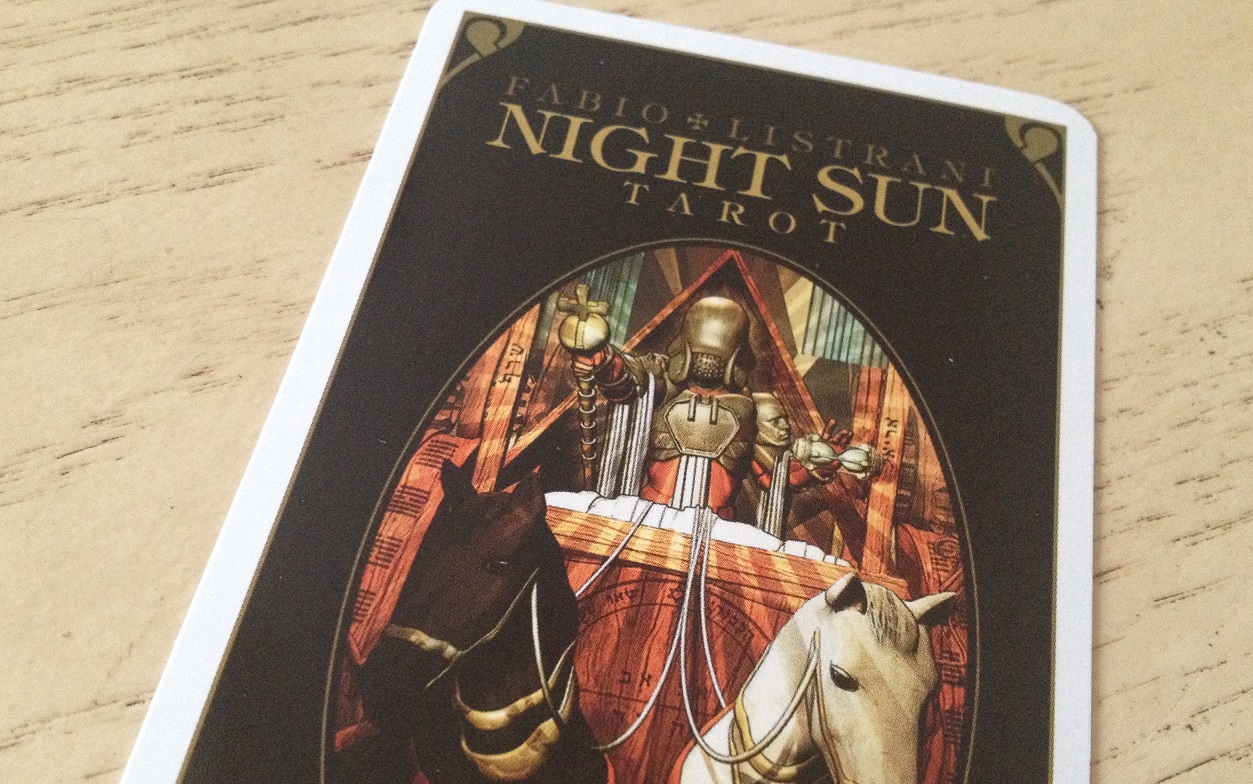
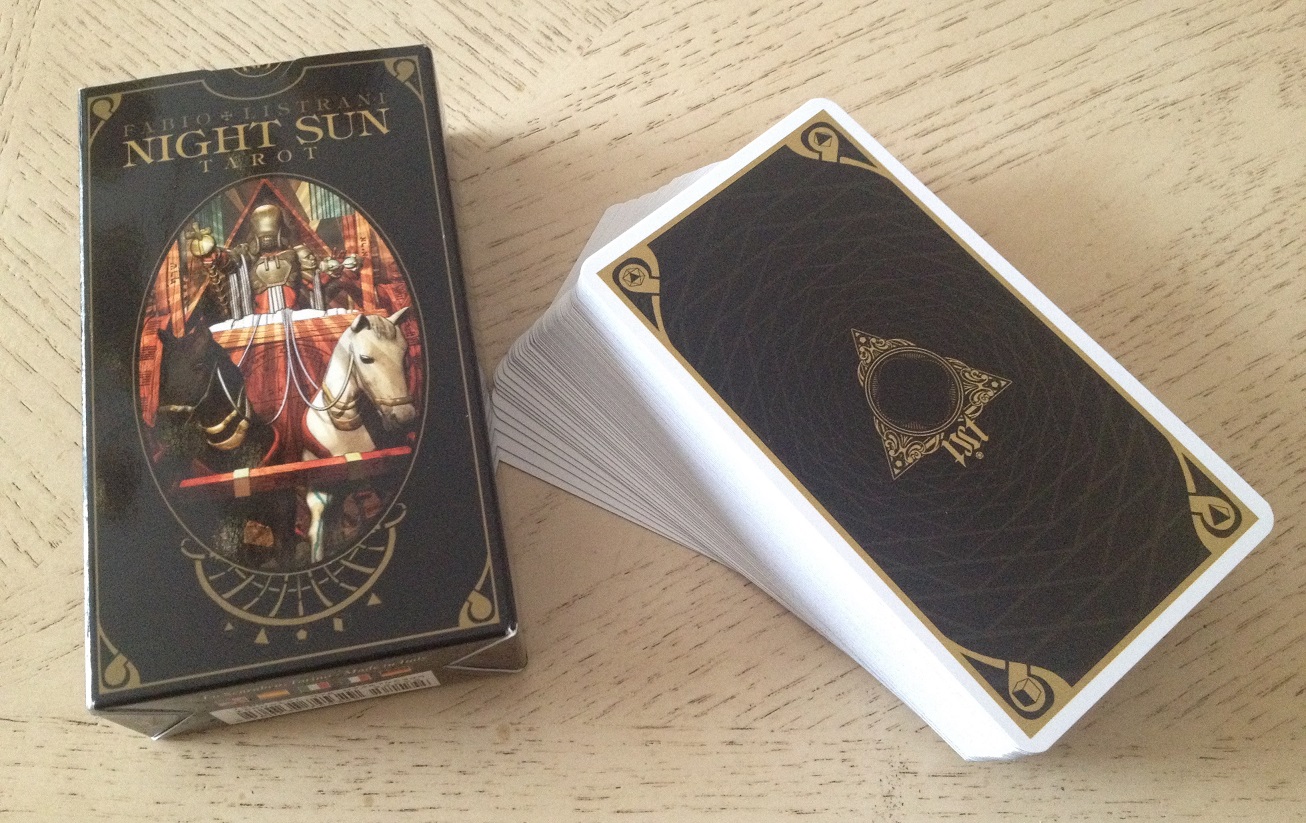
Fabio Listrani’s Night Sun Tarot is one of those decks I couldn’t wait to get my little hands on. I would consider this an esoteric tarot deck. On the Majors, you have the astrological, elemental, and Hebrew letter correspondences in the card corners. In the Minors, you have the elementals and decanates. I usually have to hand-write these onto my working decks, but here on the Night Sun, the work is done for you, and done beautifully.
There is a strong Modern Age comic book art style to the Night Sun Tarot, with digitally rendered illustrations. Fabio Listrani, the brainchild behind this exquisite deck, is an Italian artist and graphic designer whose work tends toward the science fiction/fantasy genres of art. He seamlessly blends Eastern and Western esoteric symbolism and cultural references, and updates esoteric tarot for the 21st century with this very original, insightful, and groundbreaking new deck.
I kept dragging my feet on whether to join the Tarot Mucha bandwagon, but here it is, and sometimes you just have to give in to the tarot reader majority when they’re all gushing over a certain deck, because they tend to be right. There are so many reasons to get this deck that I don’t even know how to process my thoughts and begin this review.
I’m loving it so much and will probably find myself using it in professional reading settings. It’s also a fantastic starter deck for a beginner reader who wants to commence study with the RWS tradition but may be having a hard time connecting artistically to the original Rider-Waite-Smith deck.
While there is no historical verification that tarot descended from mahjong, their striking similarity in structure and the cosmological or philosophical correspondences associated with the playing pieces is still worth noting. Both seem to be subdivided into Trump cards and Minors, and within the Minors, further subdivisions into suits, with each suit numbered into pip cards or tiles. Both were intended for games, but both are also used for divination.
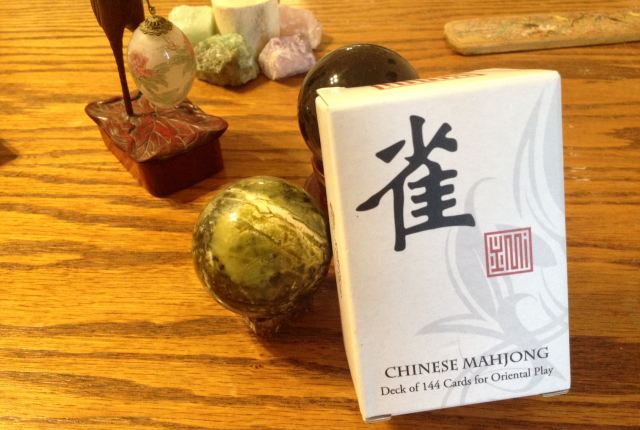
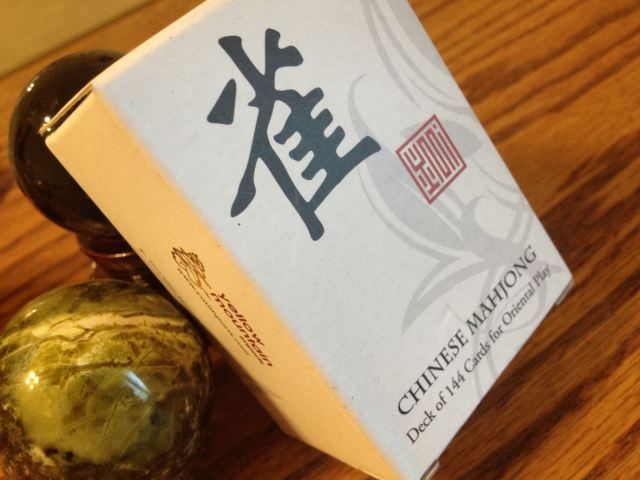
Recently I’ve been inspired to hunt down my own mahjong set, but there is a reason Chinese people get special tables for mahjong– the darn thing takes up a lot of space. There’s just a crap ton of tiles that make annoying clicking sounds when you shuffle, and the tiles remind me of Joy Luck Club or something, I don’t know. I knew I wouldn’t be using my set for games, and it’d be strictly for divination study. Intuitively, a whole set of mahjong tiles (the standard click-clack ones Chinese folk play with) didn’t feel right in my reading room, my personal sacred space. So. I opted for a more discrete alternative– mahjong in the form of cards. They have that now! It’s awesome. It’s a deck of 144 cards.
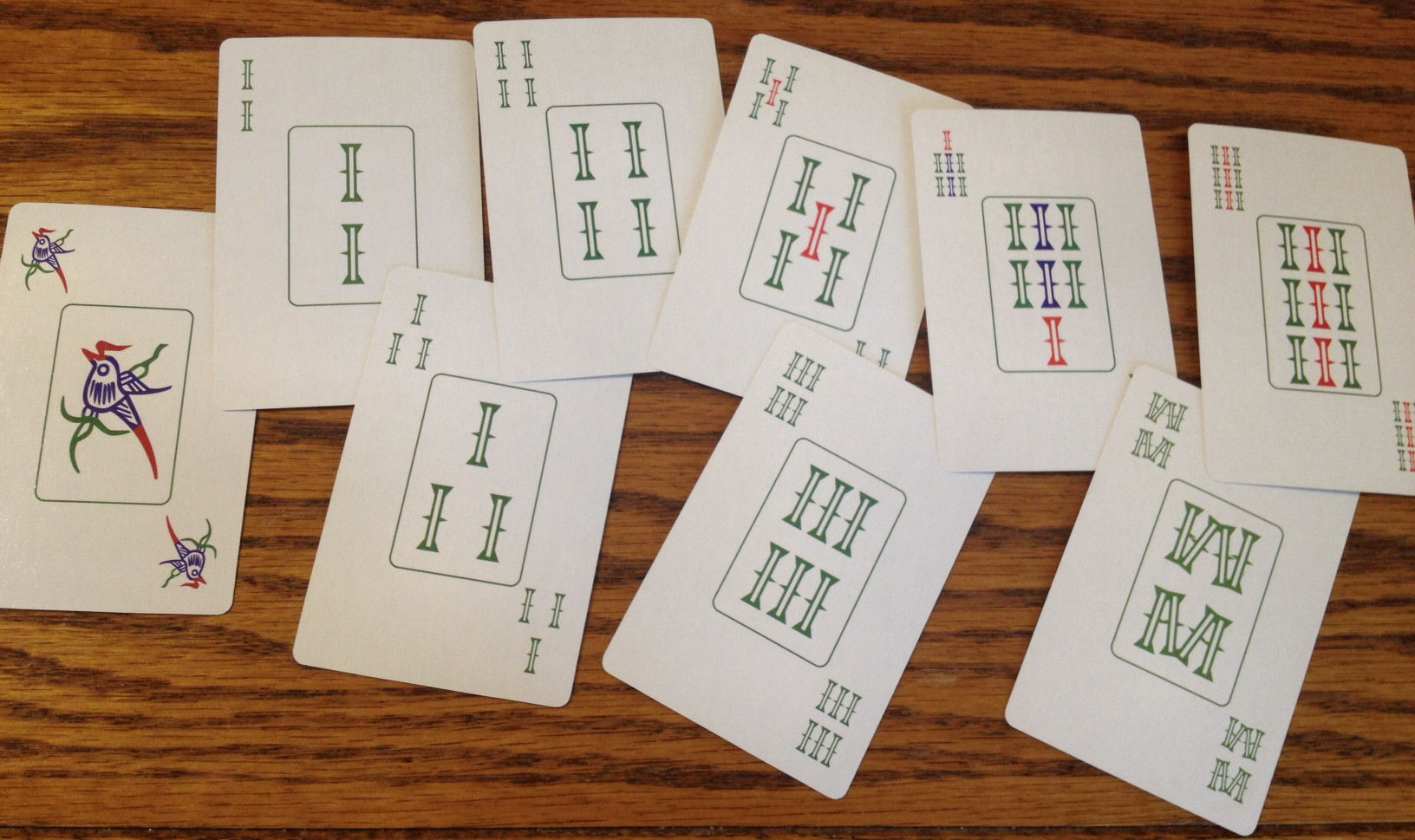
I’m using a cute little deck referred to simply as “Chinese Mahjong: Deck of 144 Cards for Oriental Play” published by Yellow Mountain Imports. You can get it off Amazon for all of five bucks. It’s great. The card quality is kind of meh. They didn’t produce this particular deck with esoteric or spiritual work in mind, that’s for sure. There’s a tacky high-gloss laminate and as you can see from the photos, it’s very, very basic in card imagery.
Mah Jong “Minors,” Suit of WheelsMah Jong “Minors,” Suit of BambooMah Jong “Minors,” Suit of Characters
Mahjong consists of 3 suits: Wheels, Bamboo, and Characters. The 3 suits are correspondent with Heaven, Earth, and Man, after the Chinese cosmological concept of the Trinity of Lucks.
Heaven Luck represents circumstances you’re born into, beyond your control, like the social class of your parents or innate talents and physical attributes, i.e. nature. Heaven Luck is believed to be pre-ordained.
Earth Luck is your geographical location, and how where you are affects what you do or who you become, i.e., nurture. Earth Luck is your environment and how your environment helps or hinders your success.
Man Luck is free will, what you do with yourself, the choices you make, your education, your actions, behavior, attitude, etc.
Additionally, Wheels often indicate life circumstances, events, conditions, or things that “happen” to you, things beyond your control that you’re just going to have to figure out how to deal with, the cards you’ll get dealt; Bamboo will talk about wealth, finances, money matters, security; Characters talk about career, education.
Super-traditionally here, marriage was seen as orchestrated by the fates, and so might get expressed in a reading through the Wheels, or if some important things were about to go down, with the Honors or Supreme Honors (more on that later). So it wasn’t like in tarot divination where you might have a whole suit (i.e., Cups) associated with love, relationships, and our emotional plane. The emotional plane wasn’t really seen as this whole separate matter that might require its own suit. So there wasn’t a suit for it. Interesting cultural differences here, me thinks.
When I first saw the Prisma Visions tarot by James R. Eads, I knew I wanted it. Then after I learned more about it, the continuing narrative of the Minor Arcana cards forming four long, exquisite landscapes, and the bold symbolist-surrealist imagery in the Major Arcana, I knew I had to have it.
I love the bordered Majors juxtaposed with the borderless Minors (shown later). Eads’ art here is a contemporary tribute to French Impressionism and Post-Impressionism, calling to mind Monet, Renoir, Van Gogh, and even some Degas. You can view all the images on the Prisma Visions website, here, though I’ll provide some samples in this review.
I love the flip top box and pretty much the design for every part of this deck and its packaging.
You have a modernized all-seeing eye on the card backs, and while the card backs are not reversible, I still read with reversals when using this deck.
The gilded silver edges are an exquisite detail. You’ve got a thick, heavy, and durable cardstock here, so the cards are thicker than traditionally published tarot decks. I do love the thicker cardstock. There is a semi-gloss finish to the cards. It’s not the full on glossy of, say, typical Hay House oracle decks, and it isn’t the papery matte finish that I tend to prefer.
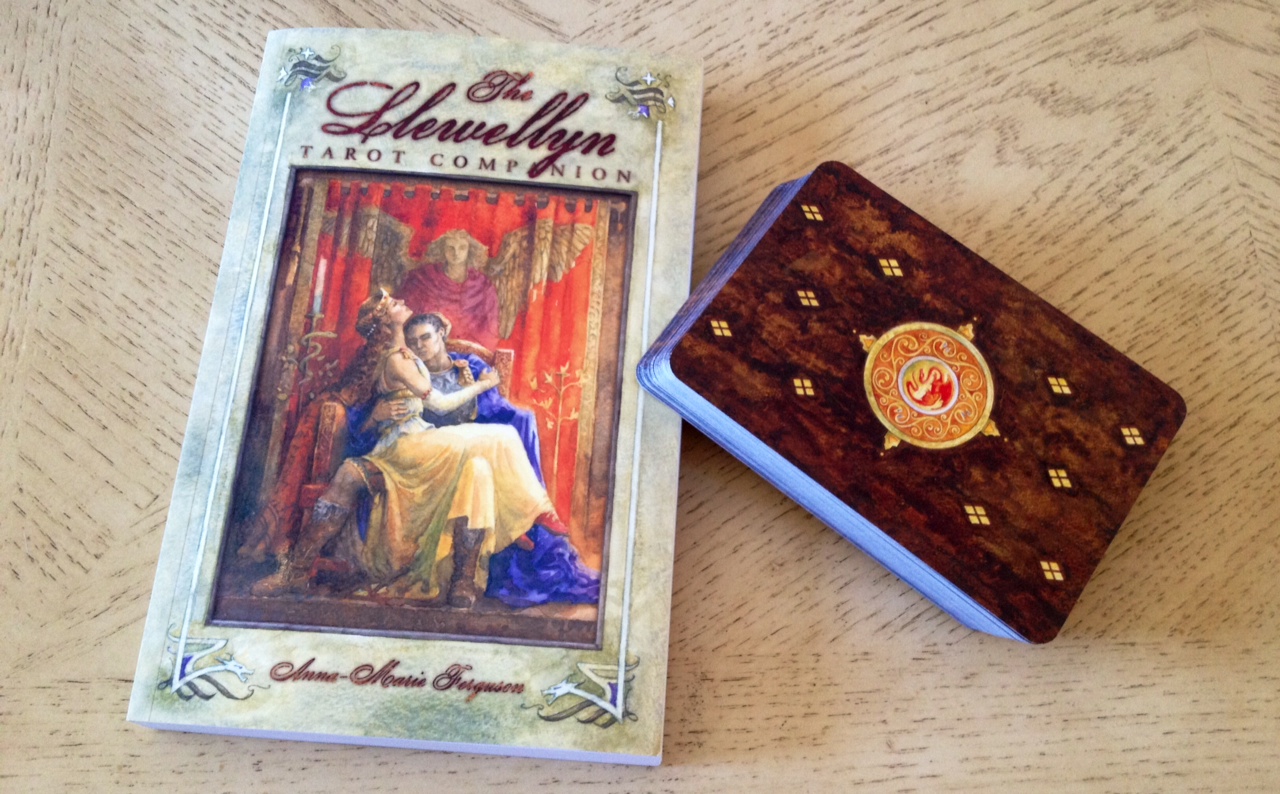
I’m always looking for RWS-based tarot decks that I can recommend for beginners who aren’t visually ready for the original RWS, and I’ve found one: the Llewellyn Tarot by Anna-Marie Ferguson and published by Llewellyn Worldwide. This deck has climbed up to my top five recommended beginner tarot decks or, heck, anyone interested in the Wales and Welsh culture of the Middle Ages.
The deck comes with a really comprehensive 5″ x 8″ guidebook that does a good job introducing tarot to the beginner but also has so much traditional Welsh folklore and mythology that I found it to be an incredible read, and should be equally enlightening to any seasoned tarotist. The cards themselves are 3.125″ x 4.5″, with thick borders all around. I’ve seen many tarot readers trim their copy of this deck and I’ve got to say, it looks a lot better trimmed.
The soft watercolor paintings by Ferguson (of the Arthurian Tarot fame) transport the Rider-Waite-Smith imagery to medieval Wales, bringing to life Celtic legends, deities, and mythic figures. Although it is a distinctly different style from Kris Waldherr‘s art, something about Ferguson’s work here reminded me of the Goddess Tarot.
Tarot Pink Promotional Banner by Roxi Sim, Creator of the Pearls of Wisdom Tarot
Tarot Pink for Cancer is a collaborative tarot deck project organized by Ron Leong, founder of Tarot eCards, a digital app for storing electronic versions of whole tarot decks on your smartphone. The mission of the collaborative tarot deck project is to raise funds for breast cancer research. The concept is to reach beyond the tarot community and introduce tarot to the greater public as a tool for emotional, spiritual, and physical healing, with a focus on fighting breast cancer.
The theme of the deck is “Tarot Pink,” with an emphasis on the tarot’s ability to inspire, empower, and support in a person’s physical wellness journey. Although the financial cause is dedicated to breast cancer research, the deck itself is keyed to all forms of physical healing and the path to wellness. The color pink evokes that healing, compassion, empathy, and soft, understanding, non-judgmental support.
You’re going to want to get this deck. Mary Greer is writing an introduction in the guidebook. You’ve got contributions from some of the biggest names in the tarot world: Robert Place of Alchemical Tarot and Tarot of the Sevenfold Mystery; Ciro Marchetti of Gilded Tarot and Legacy of the Divine; Eric Dunne of Tarot Illuminati; Marie White of The Mary-el Tarot; Kris Waldherr of The Goddess Tarot; Pamela Steele of Steele Wizard Tarot; Mary Griffin of The Hezicos Tarot; Emily Carding of The Transparent Oracle and Tarot of the Sidhe; Roxi Sim of Pearls of Wisdom Tarot; Major Tom Schick of Major Tom’s Tarot of Marseille; James Ricklef of Tarot of the Masters; Carrie Paris of the Magpie Oracle; J. R. Rivera of Beautiful Creatures Tarot, and oh my goodness, so many more.
You are going to recognize a lot of the names on the contributors list. Tarot Pink will be available as both a mobile app. and a printed deck. The app. will be available as early as July, 2015 and the printed deck available in September, 2015. Please support our efforts over at Indiegogo and please help share news of this deck and our fundraising via social media with #TarotPink.
This is definitely going to be a keepsake deck. A lot of incredible folk have infused these cards with the kind of positive, empowering Qi energy that would help in any path to healing, so use it for yourself, use it for those reading the cards for their healing journey, get it as an inspirational gift for someone, or heck, get it as a collector’s deck. Considering the kind of efforts that have been devoted to the creation of Tarot Pink and the practitioners who’ve worked on it, this deck is going to vibrate at a very cool higher frequency, if you ask me.
If nothing else, please get the tarot app for your smartphone. It’s only a $2 donation. Do it! That is less than your morning cup of joe!
I was so honored and red with delight when Ron invited me to contribute to this amazing project. I hope by sharing about my card contribution, you’ll be inspired to go out and read about all the other amazing tarot people and artists and what they’ve done for this deck. And then, of course, actually get a copy! I’m not sure I have the authority to show you other works, so I won’t, but you have to go searching for them. My below doodle looks rinky-dink compared to what others have done. AH-MAZING! stuff.
Go forth to plan out an ambitious future. You are called to aspire for the horizon beyond. The orb symbolizes healing and the power that love has for overcoming obstacles. Gaze into that orb and you will see: you walk the path of a soldier. Progress.
The caption underneath the card image is the card meaning blurb that will be accompanying the smartphone app version of the deck. The deck’s accompanying guidebook will have a longer description, which I’m providing after the jump. Continue reading “Tarot Pink, a Collaboration Deck: My Two of Wands”→
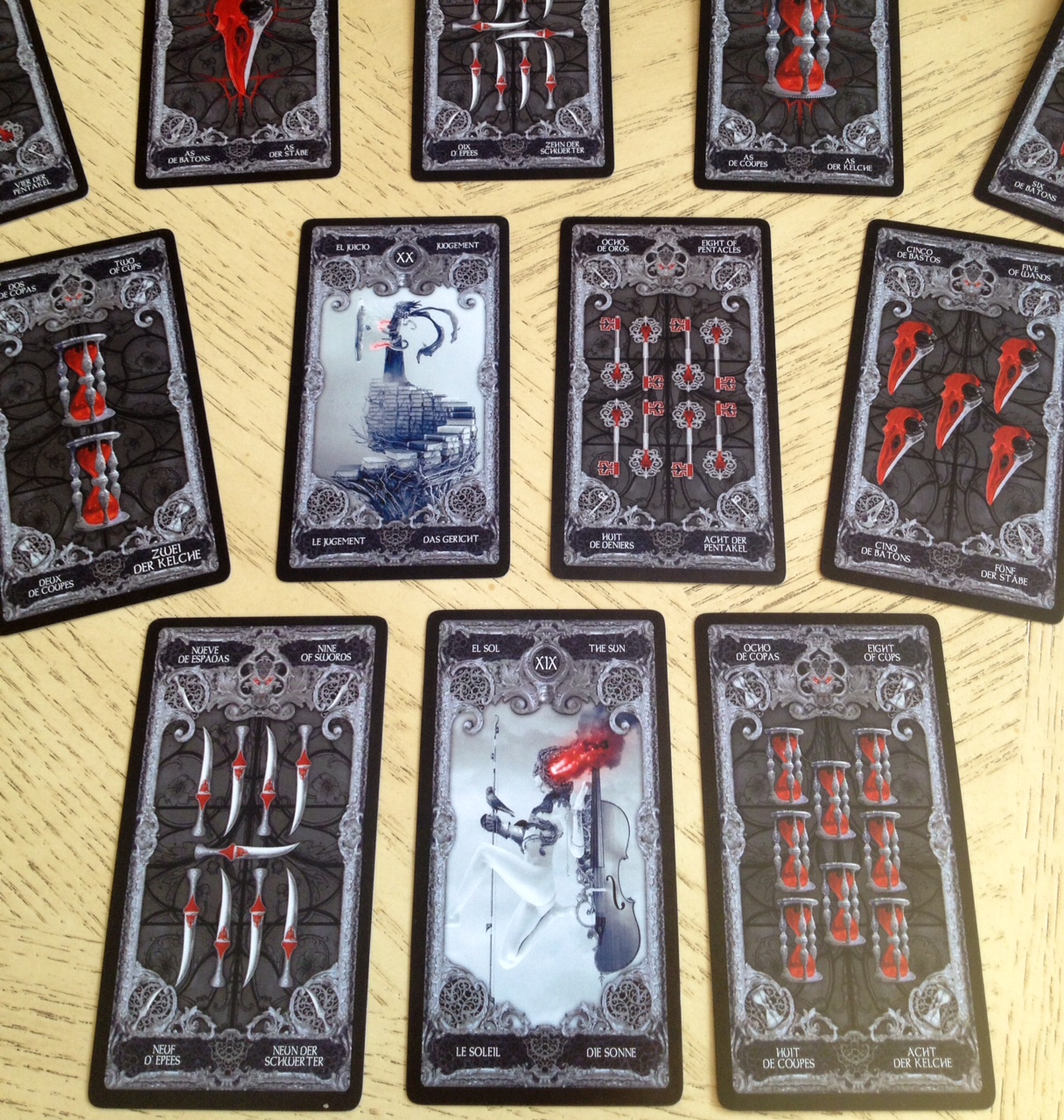
The XIII Tarot by Nekro, published in 2014 by Fournier/Lo Scarabeo (and distributed in North America by Llewellyn) is a Gothic-inspired art deck with ornamental detailing, intense, evocative emotion, and a macabre motif. The art is in grayscale, with select sections of each card digitally enhanced a brilliant red.
The audience for the XIII Tarot deck is going to be aficionados of dark/gothic tarot decks, though without illustrated pips, it’s going to be better suited for Marseille readers.
Many of the reviews for the deck that I read on Amazon complain about the non-illustrated pips, but that didn’t bother me. You just have to know what you’re getting, as a deck buyer. In the context of Nekro’s highly detailed artwork, I like the non-illustrated pips. Illustrated pips, given Nekro’s highly detailed art work, along with the already highly detailed Majors might have been overkill.
Notice how the Majors stand out in a reading spread with the XIII Tarot.
When the cards are set out in spreads, the images on the Majors step forward beautifully, the Courts speak to us in their respective voices, and the pips provide supplemental information. For me, the deck reads quite well, but I see how visual-spatial-right-brained readers are going to prefer the illustrated pips that you might find in other Gothic decks like the Dark Grimoire Tarot by Michele Penco also by Lo Scarabeo, or the Bohemian Gothic Tarot by Alex Ukolov and Karen Mahony, which sadly, is now out of print (I believe).
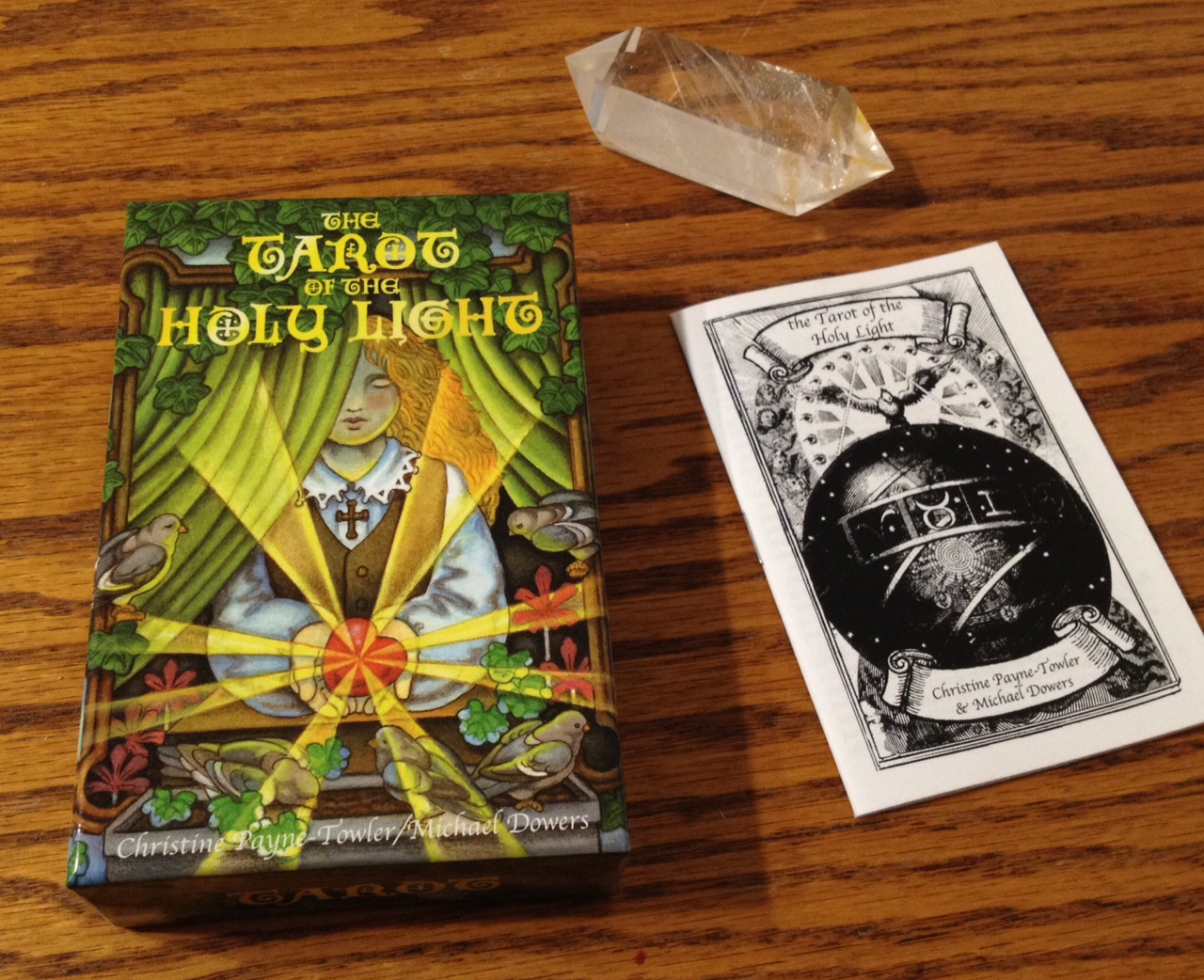
Back in 2011, Christine Payne-Towler came out with Tarot of the Holy Light, illustrated by comic book artist Michael Dowers. It was self-published by her via Noreah Press.
However, for reasons unbeknownst to me, I didn’t become aware of the deck’s existence until last year. You can order the deck over at Tarot University. This deck, along with Christine Payne-Towler, is going down in tarot history, mark my words, and while far be it for me to tell you what to do, I’d get a copy of this deck while it’s still available.
The Tarot of the Holy Light, with its little white booklet
Anyone who has explored esoteric tarot has heard of Christine Payne-Towler. She’s written some of the most compelling, provocative articles on tarot scholarship available, many of which you can find at Tarot.com or at ArkLetters. Payne-Towler is one of my tarot heroines.
Jardim Zoológico de Brasília, Brasília, Brazil. Source: Daderot via Wikimedia Commons
One summer in my childhood I was forced to attend a Buddhist camp at a monastery where we woke up at the crack of dawn to do shaolin and meditate, ate vegetarian, prayed our gratitude to everyone we knew and ever met before we could eat said vegetarian food, and had to sit in uncomfortable cross-legged positions while listening to lectures.
There was one lecture I remember when a monk told us the parable of four blind men who came upon an elephant, felt it, and were describing the elephant based on what they were perceiving. I’m totally paraphrasing the details here, based on memory, but the point remains the same. One blind man came upon the elephant’s trunk, another the belly, another the leg, and another the tail, and each one concluded matter-of-factly about the whole character of the elephant based on that one part they were feeling. The elephant is long and cylindrical… No, are you crazy? The elephant is flat and wide… No, no, the elephant is like a column or pillar…
I totally swiped this deck interview idea from Kate at Daily Tarot Girl. Read her blog post about it here. I was gifted the Witches Tarot, a deck created by Ellen Dugan and illustrated by Mark Evans. It’s a Rider-Waite-Smith based deck with photographic digital art that is a near seamless blending of realism and fantasy.
The cards are 2.75″ x 4.60″, a typical size for tarot, though perhaps a smidge smaller, which means they shuffle great in my hands, fan out just beautifully across a tabletop, and are very easy to work with. It’s published by Llewellyn and has a pretty standard Llewellyn/Lo Scarabeo cardstock quality. For an RWS tarot practitioner who likes modern digital art, the Witches Tarot would make an incredible workhorse reading deck.
The cardbacks are so pretty. There’s a galactic vibe to it and at the center, the triple goddess symbol, with the waxing crescent, full moon, and waning crescent moon. The backs are not reversible, however, as one edge is reddish and the other bluish. I’ve opted not to read with reversals when using this deck.
Now, without further ado, let’s interview the Witches Tarot with Kate’s suggested questions.
BENEBELL: What is your main mission or message in this world?
WITCHES TAROT [WT]: Page of Swords
The page is represented by a tall, thin teenage boy on a green plain. He wears a talisman with a hawk around his neck. This card, per the Companion guidebook is about thinking quickly and active decisively. However, use wit, not brute force. Per the traditional attribution of the card, that of messages, the hawk symbolizes messages. What an appropriate card to respond to the question with! In the Witches Tarot deck is embedded Ellen Dugan’s message, a message about her belief systems, her traditions and how she has integrated those traditions with the Rider-Waite-Smith tarot, and a quick and natural wit about the deck’s style that will attract its followers.









 benebell wen