This is Part II of what we started in Part I on the Lesser Mandala of Heaven. Part II covers the Greater Mandala of Heaven, and in doing so, provides an advanced introduction to Taoist alchemy.
In this introduction, I want to explore the inner logic that underlies one of the world’s most sophisticated (in my opinion) systems of spiritual cultivation. I intend for this intro to be a deep-dive into the heart of Taoist alchemy by delineating the Greater Mandala of Heaven.
The ultimate goal of Taoist alchemy is to transform the finite into the infinite, matter into spirit, and limitation into transcendence. We cover this ground by first understanding the distinction made between inner alchemy and outer alchemy.
Philosophically, this is a system and tradition that presents a compelling perspective on how Change happens.
Historical Textual References
In addition to the two texts mentioned in Part I, these are some of the oft-cited sources of insight on the Greater Mandala of Heaven 大周天. The titles are hyperlinked to the full texts over at ctext.org (the Chinese Text Project). While CTP as a site has its limitations, it’s one of the best free, accessible, and online databases for primary sources of pre-modern Chinese texts, so it’s the most user-friendly for folks like you and me.
I had such a great experience recording the first chapter of my audiobook that I had to share, and memorialize in a blog post. My publisher North Atlantic Books arranged for me to record at Live Oak Studio in Berkeley, a truly fantastic place. This is for the third book, I Ching, The Oracle.
To be standing where music legends and NYT bestselling authors once stood! ::faints::
Now I kinda wish I had the backbone to ask if I could take some photos of the engineer’s setup, you know, that station in front of the glassed-in studio space with all the colorful levers and buttons. =) But it seemed like his space and I didn’t want to intrude. So, womp, womp, sad face, no impressive sound-engineer’s-giant-keyboard pics for my social media. (Do blogs even count as social media anymore?)
This was my first time in a recording studio,* and certainly my first time recording my voice narrating my own book. I left the experience with a lot of admiration for professional voice actors and audiobook narrators. Like the voice actor we chose for narrating the I Ching audiobook — he sounds like one of those National Geographic or History channel voiceover guys! It’s a skill, and maybe dare say even a talent.
*Technically, I’ve been in a recording studio before, with an entire symphony, as one violinist in a sea of violinists in the violin section of said symphony. But for sure this was my first time in a recording studio for totally-me reasons.
Just because you wrote the Thing doesn’t mean you can competently read the Thing aloud, especially since I would not call my writing style “conversational.” So when you read it aloud and your writing style departs from your personal “conversational” style of speaking, it comes across as awkward.
Fortunately, the sound engineer was fantastic. He coached me really well, telling me when I was speaking 10% too fast and needed to slow down, when my energy wasn’t matching my last paragraph, and flagging words that had just the most subtle stumble, or even when I was getting a bit too loud with my breathing (lol). I have confirmed that audiobook narration is not necessarily the best profession for you if you have asthma (I have asthma).
This audiobook recording experience left me with the unequivocal acknowledgement that I write very long run-on sentences. The sound engineer had to stop and teach me how to breathe. If you come to a really long sentence, even if it doesn’t have punctuation, put in breath marks as if it did have periods, otherwise you’ll run out of breath, as I did when I was reading my own damn book.
More fun tips I’ve learned: Apparently, eat a crisp apple before you start recording voice narration. I don’t know if that’s just folklore or if it’s scientifically legit, but a lot of voice actors swear by it, and believe it’s a thing. It’s supposed to help your voice be at its tip-top condition.
And don’t wear “loud” clothes while you’re recording. So for instance James was wearing a nylon jacket and sporty pants or something that goes swish swish every time he moved even a little, so he wasn’t allowed in the recording booth. Fortunately I’m a nerd who reads all the homework assignment materials ahead of time, so I knew to wear “soft, quiet” clothes.
To be a competent voice actor, you almost have to over enunciate words. So many of us lay people don’t realize that we mumble when we speak. There were several instances when the sound engineer stopped me and offered guidance on how to over-enunciate, because I was jumbling my words and it wasn’t as crisp as it could or should be.
For I Ching, The Oracle, I’ll be doing the voice narration for Chapter 1, the Introduction only. A pro audiobook narrator, Wyntner Woody, will be narrating the rest of it, speaking both the classical Chinese text of the Zhouyi and the English translation and annotations.
The Hubby (a native Beijingnese speaker) and I listened and re-listened– and re-listened– to the finalist list of audition reels. We debated, we re-listened, we looked up each one of their bios… which is to say we put a lot of heavy thought into who to choose. There were many different and competing factors for consideration, hence the debating and long deliberation time as we wracked our brains over who to go with.
For the audition, each voice actor recorded about a page or two from one of the introductory expository chapters and then recorded Hexagram 1, both the classical Chinese and the English. We (and particularly Hubby, because he’s the native standard Chinese speaker; the Mandarin I speak is not standard) ultimately went with Wyntner because of his more precise standard Chinese pronunciation.
Why didn’t I want to narrate the entirety of my own book? This is the analogy I give. Since I grew up listening to southern Taiwanese people (deep south) whose primary tongue is Minnan/Hokkien speaking Mandarin Chinese, my Mandarin pronunciation is not “standard Chinese.” If I had narrated my own I Ching book, it would be akin to listening to someone narrate Shakespeare with a heavy southern drawl. If you’re looking to voice Shakespeare, you’re looking for a particular way of pronunciation, right? Same here.
That and time constraints. I think the total was going to be something like 20 hours of straight narration, which means lord knows how many hours buffered around those core 20 to get those final 20 hours right.
Due to my full-time job, I would only be able to work weekends, and then you would have to coordinate with the studio’s schedule and available time slots. So ultimately it did not make sense for me to narrate my own book, and for the publisher to hire a pro.
Oh by the way, I learned that reading aloud 9,000 words equals about 1 hour of studio time. So the way they estimate how much studio time to book is based on word count. It’s not an exact accurate science, but ballpark more or less, 9,000 words is 1 hour of recorded audio.
Hubby, wearing “loud” clothes, and therefore banned from the recording booth.
Plus, James (the hubby) is more of an audiobook listener than I am, and he says that any time he sees that the book is narrated by the author, he skips it and won’t listen, because it has been his experience, as a consumer of audiobooks, that the author’s narration tends to be a bit too amateur to listen comfortably to for dozens of hours on end, and that you really do need a pro to do it. Voice acting is totally a skill. Not just anybody can or should be narrating audiobooks.
There are other interesting issues that come up with bilingual (even multilingual) narration. So, for example, Wyntner pronounces “I Ching” as you would in Mandarin Chinese, per pin yin, even when it’s in the context of an English sentence, whereas when the context is English, I just pronounce “I Ching” and even “yin and yang” the way a typical American would pronounce those words.
But then in other instances, mid-sentence while speaking English I’ll hop over and pronounce it as you would in Chinese. Wyntner is super consistent with his stylistic approach, whereas I, a lay speaker, am very inconsistent. Sometimes I pronounce “Tao Te Ching” the way you would in Chinese, per pin yin, and then other times, without explanation or rationale, I’ll pronounce it the way average Americans might pronounce it.
It’s a phenomenon you’ll observe — native Chinese speakers and non-Chinese expat/foreign speakers speaking Chinese will switch pronunciation midstream in English, and try to pronounce Chinese words as you would per pin yin, but Asian Americans do not. Asian Americans pronounce in the Chinese way when speaking Chinese, and then pronounce it the white people way when speaking English.
For example, when James pronounces his own Chinese surname in English, he’ll kind of give it a proper Chinese pronunciation to it. Whereas when I pronounce my own Chinese surname in English, I’ll just pronounce it the way white people might pronounce it, and don’t bother giving the proper pronunciation. But obv. will pronounce it the “right” way when I’m speaking Chinese. Or how you’ll hear Wyntner pronounce yang as “yahng,” with the soft-A like “ah,” which is correct, whereas I just go with the Americanized hard-A “yayng,” like “yay,” which is incorrect but has become normalized.
In any case, Hubby and I are both super glad we went with Wyntner, and we cannot wait for the final result to be out in the world!
James is currently proofing Wyntner’s narrations, listening to the entire audiobook, and he reports that my book is actually very, very interesting! =) Yay! James says that my I Ching book is so interesting to listen to that he even paused between sections to go look stuff up and read more on the history! I’ve earned myself a new fan, in the form of Hubby! =D [I mean, it’s not like he read a single page of Holistic Tarot or The Tao of Craft, so this is ah-mazing!]
As for the I Ching audiobook, it is going to be significantly different from the printed book, for many reasons. One, the audiobook omits all the exercises (basically the whole “grimoire” part of the book), the entire divination how-to section (so the audiobook has nothing in there that teaches you how to do the divination procedure, whereas the printed book dedicates a big whopping chapter to all the ways), and any passages that reference tables, charts, or images had to go, or be rewritten so that you’re not making references to phantom visuals.
The I Ching audiobook’s purpose, as I see it, is to hear the classical Chinese recitations of the hexagram verses side by side with the English translation and then my annotations. The chapters that cover the history, mythology, and cultural lore of the I Ching also makes sense as an audiobook. But the more practical hands-on elements, I feel, need to be either in printed book form, with the written instructions plus illustrative images, or as a video tutorial.
Also, the audiobook does not include any of the end notes. In a few select instances, Wyntner recommended that he include a few additional statements to integrate some of what I wrote in the end notes, as he felt the explanatory material in the end notes would help provide clarity to the text, and we agreed.
I rewrote a lot of the annotations and commentaries to the Zhouyi translations (the actual I Ching text) so it would read better as an audiobook. Also, I totally rewrote the Introduction that I narrated. About half of it stayed the same as the printed version of the Intro, but then about half of it is net new. Even two hours before heading to the recording studio I was still on my computer rewriting passages!
In any event, unlike the challenges, obstacles, and frustrations I encountered during the publisher-author collaboration phase of the print book for I Ching, I really, genuinely enjoyed my experience during the publisher-author collaboration phase for the audio book version.
Apologies! The I Ching and the Practitioner online course is no longer available.
However, if you’re interested in studying the I Ching through the lens of Taoist mysticism, my third book with North Atlantic Books, I Ching, The Oracle: A Practical Guide to the Book of Changes is forthcoming in the summer of 2023.
The text will be an updated translation of the Oracle, with a full roster of practicum that will introduce you to East Asian occultism and ritual magic.
I’m going to walk you through an easy beginner’s methodology for I Ching and tarot divination. We’ll be doing a simple one card tarot draw plus casting I Ching hexagrams by the coin toss method. So in addition to the instructions here for the I Ching divination, I’m presuming you have a tarot deck and know how to operate one. If not, no worries. This doesn’t need to be I Ching and tarot. It can just be I Ching! 🙂
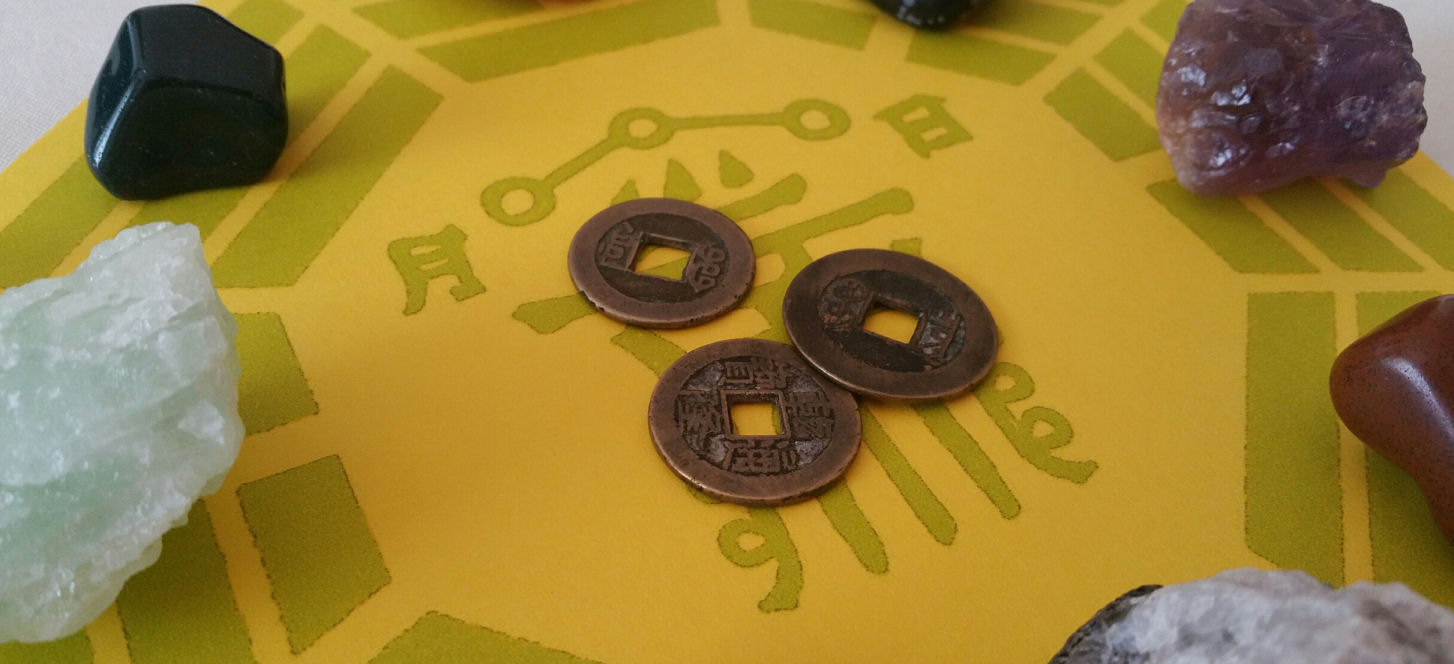
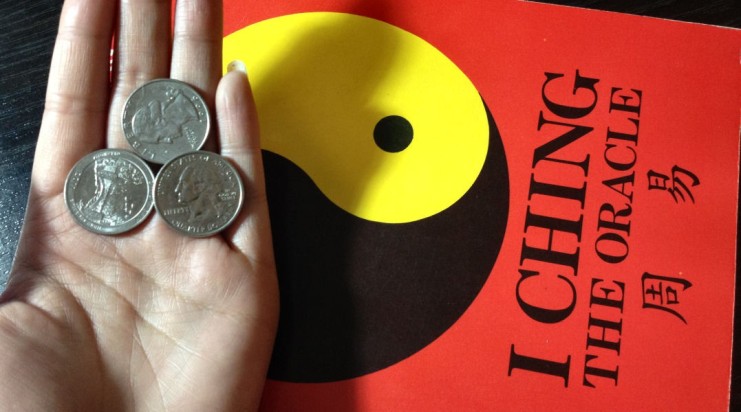
I use traditional coins for my personal practice, but we won’t be needing those today. Any three coins of the same value in your change purse will do. Go find three pennies, or three nickels, or three quarters–whatever pleases you. And give them a good wash.
Here I’m using disinfectant soap and water. Dry them thoroughly. You can use a towel. Anything. Just be practical.
I heard about the Haindl Tarot not too long ago through the grapevine of tarot readers I know. Yet this deck was first published back in 1990. Hermann Haindl (1927-2013) is a German artist known for his surreal art and incorporation of mythology.
Rachel Pollack has penned companion books for this deck that come highly, highly recommended by pretty much every tarot practitioner I know. I haven’t dived into them yet, but will. At this stage, I’m interested in connecting with the deck directly to see what I can glean, and then I’ll be consulting Pollack’s books on the Haindl.
The Haindl Tarot is a truly remarkable deck for any tarot enthusiast to work with.
For the Majors, each card corresponds with a letter in the Hebrew alphabet per Qabalistic tradition, from The Fool as Aleph, Key 1: The Magician as Beth, Key 2: The High Priestess as Gimel, and so on. Each card also corresponds with an Anglo-Saxon rune. At this point in my personal tarot practice, I don’t work much with Hebrew alphabet or rune correspondences in tarot, but the astrological correspondences on the bottom right corners of the cards excite me.
Preview of Select Majors. Click on photo to enlarge.
The paintings are surreal with subdued, subtle coloring. I’ve filtered these photographs to add greater contrast for clarity purposes, but in hindsight I wish I hadn’t. Now you can’t see the light, ethereal quality of the original coloring. In person, the art is not quite as bold as they seem to appear in these photos. The art seems to mirror the stream of consciousness of our minds, which results in an incredibly powerful and evocative tarot deck to work with.
I’ve fallen in love… with the Tao Oracle deck by Ma Deva Padma published by St. Martin’s Press. This is the I Ching oracle deck. It’s a deck of 64 cards based on the 64 hexagrams of the I Ching Book of Changes. Padma’s paintings are emotional, textured, and fully expressive of each of the hexagrams they represent. A quote from the artist: “The evolution and creation of my paintings is sparked by a deep and intensely personal journey into the realm of the subconscious — the kingdom of archetypes and the home of mysterious symbols.”
The deck is beautifully packaged in a sturdy high-gloss box. It comes with a 310-page perfect-bound guidebook that contains the author’s personal interpretations of the 64 hexagrams. St. Martin’s Press really out-does the more popular tarot and oracle deck publishers du jour. I cannot praise the quality of this deck enough.
For the month of December, 2014, ending right before New Year’s Eve, I am offering I Ching divinations in exchange for following me on Twitter.
Okay come on. That’s like basically free, people. And if you’re already following me on Twitter, then it is free. Just let me know!
These are not full readings, by the way, and you will be meeting me half-way in terms of work. Let me explain.
I’ve been tackling my own translation and annotations of the I Ching so that I no longer need to work off any of the current English translations. So that’s what I’ll be using for these divinations–my own work product.
To get your I Ching divination from me, here’s what you have to do:









 benebell wen