Buddhist Perspective on Death and Rebirth

This video lecture is on what happens when we die, from a Mahayana Buddhist perspective. We also cover East Asian funerary customs, Buddhist beliefs and practices.

I wanted the video talk itself to be more philosophical and to provide a concept overview.

However, one of my key objectives for putting this out there publicly is to help Diasporic Asians who feel culturally removed from traditional Buddhist practices, but who then find themselves in a situation where they must provide a Buddhist funeral or engage in practices to help honor the departing or departed Buddhist elder.

When you’re in the midst of grief, you don’t want an exploratory ruminating video on concept; you want a checklist. You just need somebody to tell you what to do because you don’t have the mental bandwidth to think. So in that spirit, here is a checklist:

Buddhist Last Rites

PDF  |  DOCX

It goes without saying that the above-linked downloadable checklist is a loose guide of general recommendations only. Always prioritize family tradition, your culture’s specific Buddhist traditions, and what makes the most sense for you.

Continue reading “Buddhist Perspective on Death and Rebirth”

Home is Here: Practicing Antiracism with the Engaged Eightfold Path by Rev. Liên Shutt

Rev. Liên Shutt is a Sōtō Zen Buddhist priest, educator, and licensed social worker who was born into the Pure Land traditions in Vietnam, then did their meditation training in North American Zen and Insight (Vipassana) Buddhism.

A co-founder of Buddhists of Color and Access to Zen, Rev. Shutt facilitates the Engaged Four Noble Truths program, a restorative framework for meeting any given critical need, especially when applied to oppressive forces and systems. In 2020, that program was called upon to help meet critical needs emerging as a result of the pandemic, and after the murder of George Floyd, to help facilitate ways Buddhist practice can address racial justice.

“This book is for all who have been hurt and harmed by the system of white supremacy and other systemic wrongs,” writes Shutt, “and for those seeking restoration and healing.”

Continue reading “Home is Here: Practicing Antiracism with the Engaged Eightfold Path by Rev. Liên Shutt”

Blue and black, white and gold? The parable of the elephant, witness testimony, and the relationship of artist and critic.

Jardim Zoológico de Brasília, Brasília, Brazil. Source: Daderot via Wikimedia Commons

One summer in my childhood I was forced to attend a Buddhist camp at a monastery where we woke up at the crack of dawn to do shaolin and meditate, ate vegetarian, prayed our gratitude to everyone we knew and ever met before we could eat said vegetarian food, and had to sit in uncomfortable cross-legged positions while listening to lectures.

There was one lecture I remember when a monk told us the parable of four blind men who came upon an elephant, felt it, and were describing the elephant based on what they were perceiving. I’m totally paraphrasing the details here, based on memory, but the point remains the same. One blind man came upon the elephant’s trunk, another the belly, another the leg, and another the tail, and each one concluded matter-of-factly about the whole character of the elephant based on that one part they were feeling. The elephant is long and cylindrical… No, are you crazy? The elephant is flat and wide… No, no, the elephant is like a column or pillar…

Continue reading “Blue and black, white and gold? The parable of the elephant, witness testimony, and the relationship of artist and critic.”

Pagan Practices and Chinese Folk Religions

1

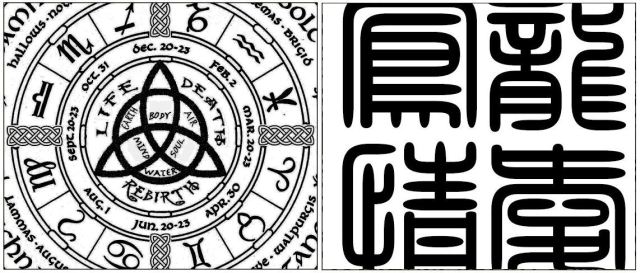
Left image of pagan Wheel of the Year from Biblical Connection.

Right image of a Taoist Fu sigil.

I don’t have educational degrees that would qualify me to write about any of this, so please understand that I am writing my observations within that non-expert context. Lately I’ve been fascinated with pagan and neopagan belief systems, mostly for how strikingly similar paganism is to Chinese Taoist-based folk religion.

Here’s how I understand paganism in context: Back in the day across Europe, Abrahamic religions rose to dominance, became institutionalized, and began setting up centralized bodies of authority that often started in the cities and spread its influence from there. At the fringes of the countryside, however, pagan faiths endured among the minority. These pagan faiths were polytheistic, though pantheist, strongly nature-based, and because they believed that everything was connected, it was thought that certain herbs, incantations of words, ritualistic conduct, and representations of elements could be harnessed to manifest intentions–in other words, magic exists.

Replace a few specifics from the previous paragraph and you could apply it to the relationship between Confucianism (and to a great extent Buddhism) and Chinese folk religions. These folk religions were looked upon in the same way pagan faiths were looked upon by the Christians. Those who practice pagan/neo-pagan religions (like Wicca, Druidism, Heathenry, or some form of pagan reconstructionism) tend to keep their faiths concealed or strictly private. That’s less of an issue among those who practice Chinese folk religions, and so you’ll see altars set up in Chinese businesses that still pay homage to the faiths of their [often agricultural] ancestors. However, like what pagans experience, those who still practice Chinese folk religions are considered fringe.

Continue reading “Pagan Practices and Chinese Folk Religions”

What Buddhism Says About Magic

I met the Venerable Sheng-Yen, a Buddhist monk, teacher, and scholar, when I was too young and too immature to have appreciated the encounter. For that I will always be regretful for not being more open and receptive when I had the chance. Here, though, the Internet is a wonderful thing. Apparently, many of Ven. Sheng-Yen’s lectures have been recorded and posted onto YouTube. The lectures are in Mandarin Chinese, but there’s English subtitles. The one of highest interest to those in tarot practice might be what the Shi Fu had to say about magic, the supernatural, and psychic workings.

I highly recommend watching the video in the entirety, but if you can’t I’ll summarize.

A question is presented to the Shi Fu (Shi Fu is the honorific we use to refer to any master teacher): What are his thoughts on supernatural powers (in other words, magical practice or working with spiritual energies) and does he think it really exists?

Continue reading “What Buddhism Says About Magic”

The Parable Sutra: Nihilist Twist on Noah’s Ark?

parable_sutra

Sutras are Buddhist texts that memorialize a particular teaching, not unlike Sunday school parables (which I got big doses of as a kid: Bible Study classes in some offshoot wing of a church, playing tag or hide-and-seek in said church, and daring one another to utter H-E-double-hockey-sticks in God’s house will forever be ingrained in my memory). Recently I got into reading sutras and came across one that I felt compelled to illustrate. In jest, I tell people this is the kind of bedtime story I’d tell my kid if I had one. Here’s how it goes:

Continue reading “The Parable Sutra: Nihilist Twist on Noah’s Ark?”