I’m enjoying my new foray into video making on YouTube, but this one I could have taken a bit more time on. I thought of the topic in the morning, shot part of the video at that time as soon as the idea came to me, drew the doodles at work, outlined some notes, then recorded the rest of it after I came home. As a result, I don’t think I explained my thought cogently enough. The guideline I set for myself is it has to be under 15 minutes, so quite a bit of cutting had to be done as well. Sigh.
Anyway, the point of the video is I experienced deity as energy first, not realizing that was deity, and then was first taught personification of deity and monotheism through Christianity when I was nine. For most of my life I’ve been fascinated with religion and mythology, passionately inquisitive of what different people believed about deity.
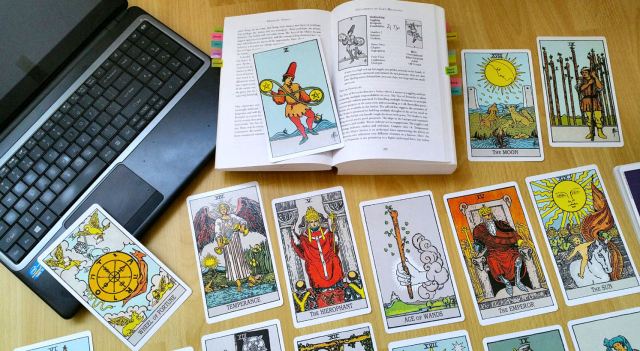
Deck pictured: Giant Rider-Waite-Smith Tarot by AGM Muller
If you go searching for free tarot resources on the interwebs, you’ll go down a deep rabbit hole of content and for the beginner, that itself could be just as daunting as the process of having to learn tarot. Which one do you really start-start with? Isn’t there an easy linked “Lesson 1” and then you can just go from there?
Here I’ve compiled for you a list of five (5) beginner sources that are essentially free online tarot courses. These courses are self-paced, yet guided by a tarot master, structured, and with substantive content I’ve vetted, reviewed and felt, wow, yeah, okay, this is good stuff. Also, in assembling this list, I tried to look for resources that had some nice polish to them, were well-designed, well-produced, aesthetically-pleasing, and not too smarmy with any efforts to sell you something.
So, to be fair, there were several pretty good sites that I’ve left out from this list because ultimately, it was geared toward selling you something. An important criterion was the site had to be, overall, leaning more toward “educational purposes” than toward “promotional purposes.” Another important criterion was that the tarot lessons were well-organized and easy to follow.
Tarot OG Bonnie Cehovet and an awesome human being (I know, I met her) shared a really cool tarot spread that I now must re-share. Check out her article here. It’s a ten-card “Who am I” spread where you ask your tarot deck to tell you about you. You’re going to want to try this one out for yourself, too, and when you do, be sure to share it and tag Bonnie Cehovet. (Twitter handle: @bonnie_cehovet).
And you know what? This would be a great spread to try today, during the Total Solar Eclipse. For those of you of a Chinese Taoist bent, Ghost Month also begins today, so you can modify this tarot spread and bring in mediumship. Use tarot to contact someone who has passed on who knew you well. Think of someone you would have gone to for life advice, perhaps a relative you would have had a heart to heart with, who knew you well, and so would have been able to see you more objectively than you see yourself and thus answer these questions for you.
Okay, here are the questions. Set out the cards in any arrangement you like, but with the intention of these ten points:
A Facebook group called The Wiccan Circle has uploaded the digital files to hundreds maybe thousands of books by pagan authors and are disseminating those copyrighted books for free download. I wanted to get to the bottom of it on my own, so I put in a request to join the group. Unfortunately, I still haven’t been let in, hehe, so truth be told, at this point I don’t actually have any personal knowledge of the allegations. I’m relying entirely on Ward’s reporting of the facts.
For this particular post, I want to address why copyright infringement claims under the DMCA (Digital Millennium Copyright Act) are so difficult to follow through with, from a lawyer’s perspective. I’m a corporate transactions attorney who works in-house at a venture capital firm in the Silicon Valley, so I know my way around intellectual property law. I’ve tried major copyright infringement, trademark, and patent suits in both state and federal court, some of those cases making headlines in the news. I’ve worked in entertainment law and represented independent artists and writers against major production companies in Hollywood, major cosmetics companies, and more. That’s the background context I’m coming from in writing this post.
In Part III, I’ll be tackling the issue of curses and hexes. First, a note for clarification: I’m going to separate out the distinction between practitioner and reader for the purpose of this post.
A practitioner is someone who works proactively with unseen energy and spirit influences, who, for lack of better terminology, can and will cast spells for hire.
A reader is someone who reads energy for hire, such as someone who does divinatory work, like a tarot reader or psychic.
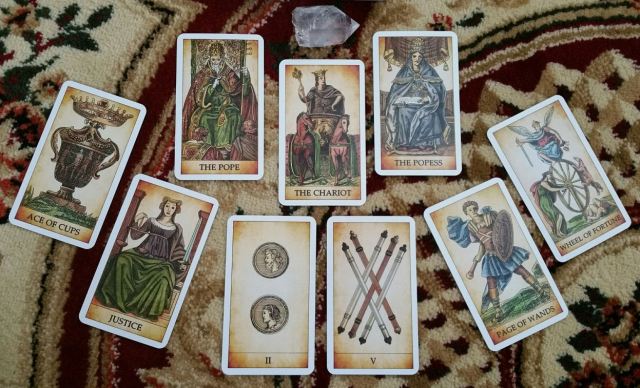
Deck Pictured: Russian Tarot of St. Petersburg (US Games)
I started a post series on tarot reading ethics last week and if you missed it, here is Part I on health, legal, and financial readings. I’ll be subdividing the discussion of tarot reading ethics into three parts. These posts will explore some of my personal thoughts and also professional opinions on certain oft-adopted ethical rules.
This is Part II of III, in which I’ll be tackling third party readings and reading for an onerous client.
I’ll be subdividing this topic into three parts. These posts will explore some of my personal thoughts and also professional opinions on certain oft-adopted ethical rules.
This is Part I of III, in which I’ll be tackling the question of reading for medical, legal, and financial concerns.
7/11/2017 Update: This is Part I of II only. I’ve decided against publishing Part III. Explained at the close of Part II.
7/18/17 Update: I’ve decided to proceed with sharing Part III, but it is a password-protected post. Please do not ping me with requests for the password. It is made available in closed circuits to those who have access to those circuits.
You often hear readers say that it’s against tarot ethics to do readings on health or legal questions. But why? Why are tarot readers discouraged from reading on health and legal issues?
It’s for legal reasons and, as far as I understand it, that’s pretty much the only reason. In most jurisdictions, there are codified laws against the “Unauthorized Practice of Medicine” and the “Unauthorized Practice of Law.” At best, it’s a misdemeanor and a fine of thousands of dollars. At worst, either one could be charged as a felony and carry several years of jail time. To get charged with such an offense would be the worst day of your tarot reading life.
The issue of general readings versus specific readings is pertinent to most divinatory forms, whether we’re talking tarot, astrology, the I Ching, or even in terms of configurations for feng shui analysis. Rather than frame this post as general commentary, I want to talk about my personal approach, and since most of the divinatory work I do for people are in the modes of tarot and astrology, that’s what I’ll focus on.
Let’s start with my definitions.
A general reading is when a seeker doesn’t have a cogent, cohesive question to present for divination, but just wants insight for moving forward at the particular juncture point the seeker is at. For example, a seeker sits down in front of a tarot reader and the reader simply begins casting cards and reporting back what the reader interprets from the cards. Another example is a solar returns or birthday chart reading in astrology. A reading service such as a twelve-month forecast is also considered a general reading. In theory for a general reading, any subject matter that comes up in the reading is game.
A specific reading is when a seeker has a question in mind that is narrowly tailored and will require a direct, responsive answer. For example, the seeker wants to know about romantic prospects up ahead, or which career path to take, or which of three possible office site locations would be optimal for setting up a business. Here, even a broadly-cast inquiry such as “just whatever comes up that’s money related in my life” is an inquiry I’ll tuck under the category of a specific reading.
One more point before we proceed. To debate which is better, general reading or specific reading methods, is absurd. Readers also come with different strengths. No reader is all-powerful. Some excel at the general reading. Others excel at the specific reading. Play to your own strengths. That’s all there is to it.
When you’re running a personal venture that’s heavily reliant on e-commerce, and you’re a small potato like me operating said venture out of your home in your pajamas, with a full face of makeup and nice shirt on only when you’re making a video, choosing which promotional tactics to work on can be hard and–for my fellow professional tarot readers–a very Seven of Cups sort of inquiry. You can’t do it all, because it’s just you. So how do you channel your marketing energies in the most productive way? I can’t answer that question for you, but I’ll share with you my experiences on what worked and what didn’t.
This post will address sponsored ads on Facebook, advertising via your own social media platforms and social media in general, blogging or vlogging content, newsletters or direct mailings, local bulletin boards, and giving away free stuff.




 benebell wen