The Book of Maps Vitruvian Edition is going to be a significantly larger volume book than the First Ediiton, with new chapters.
A collection of those chapters are intended to showcase the more practical side of the Spirit Keeper’s Tarot, especially how a professional tarot reader or one who reads tarot for others might be able put the deck into everyday use.
SIGHTSEE THE TAROT is a video series on my YouTube channel that takes you on a tour of the tarot, from discovering new books and tarot thought leaders to workshopping classic tarot spreads and tinkering with particular tarot decks.
Together, we’ll work through specialized reading techniques, provocative topics in the world of tarot, or explore notable perspectives and points of view. I’ll guide you every step of the way through these hands-on presentations. Pause as needed and resume the video only when you’re ready for the next step.
When you can’t have an in-person tarot instructor in your home with you or you can’t physically make it out to a tarot conference, this Sightsee the Tarot series is the next best thing.
In 2018, The Black Tarot launched a successful Kickstarter campaign. You can read more about the deck here on its official website. The minimalism of the deck is so intuitively well-attuned to our current zeitgeist, what with the KonMari tidying up speak joy method raging across the nation while every beauty, lifestyle, and health guru on social media is pushing the minimalism aesthetic. So the Black Tarot comes to us during interesting times.
Stay with me here: I envision a fashionista with her hair expertly tousled, smoky eyes, silver studded rings on every finger, wearing black and heather gray, boots, and telling me the story of my life and what’s to come with this deck. Something about this deck just feels so in tune with what’s going on around us at the moment.
The deck comes in a tuck box and one single card deftly sums up everything you need to know about its point of view and the structure of the suits.
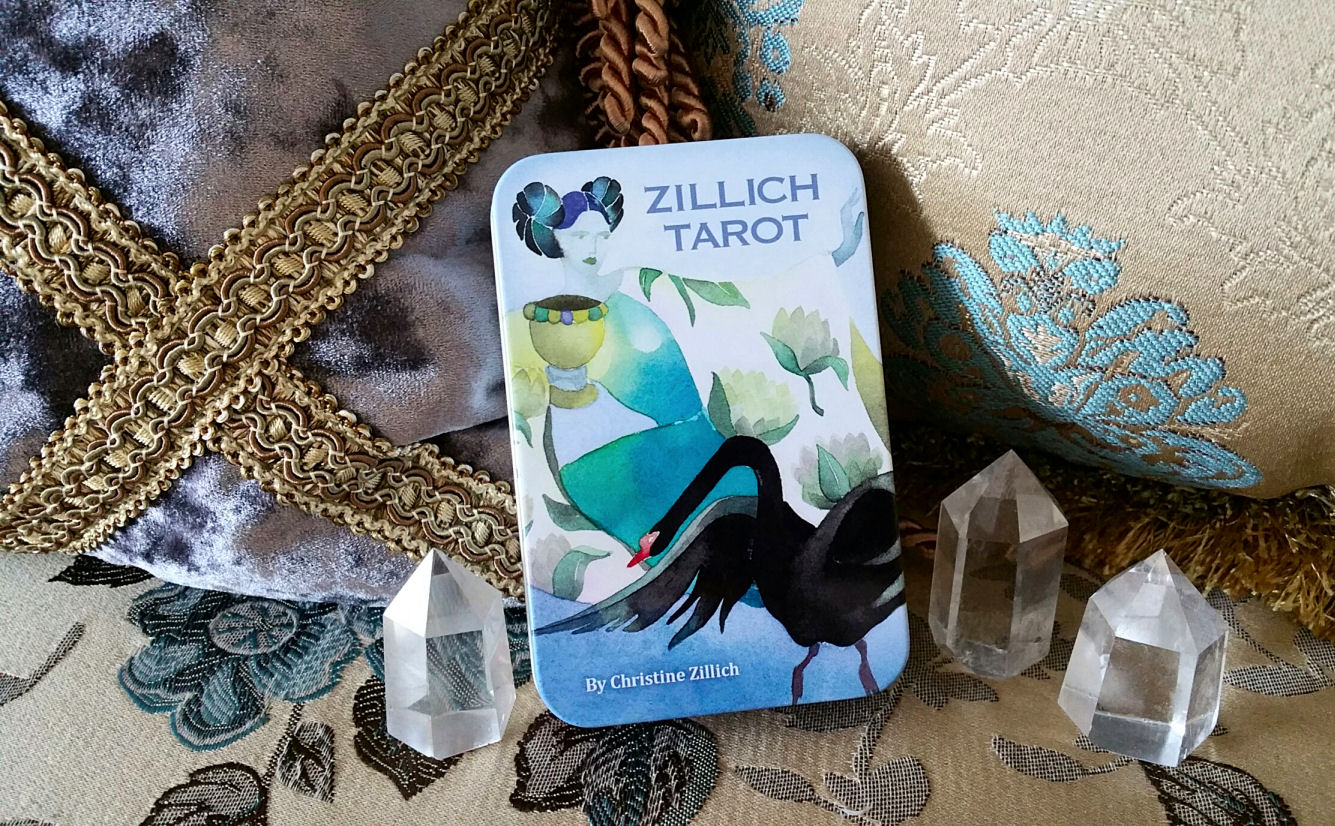
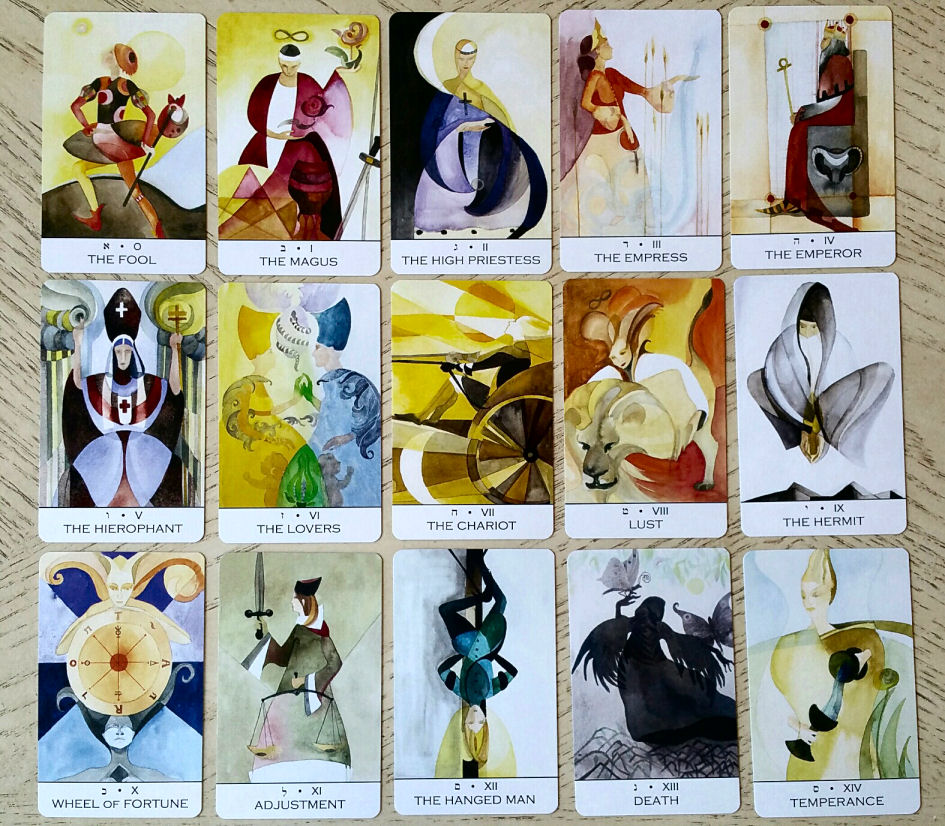
Those of you who attended Readers Studio 2018 in New York will recognize this deck as having come in the event gift bags, courtesy of U.S. Games. The artwork is done in watercolors by German artist Christine Zillich. The deck art blends mythological, astrological, and Kabbalistic symbolism, featuring Crowley’s keywords on the pips.
Click on photo for enlarged view.
The cards are petite at 2.25″ x 3.75″ (compared to standard tarot size: 2.75″ x 4.75″) and remind me more of a typical Lenormand size deck. You get the deck in a keepsake metal tin. I love the blue-purple tones of the reversible card backs. I know I’m getting nitpicky here, but there’s just the slightest imbalance in terms of vertical spacing in the white caption boxes at the bottoms of the cards–there’s not enough space between the bottom edge of the artwork and the first line of text, compared to the amount of spacing between the bottom edge of the card and the last line of text.
There’s a typo with the roman numeral for Key 21: The Universe, but it doesn’t really bother me. While Key 20 (XX) in the Thoth deck is titled Aeon and in the RWS is Judgement, here in Zillich, it’s Justice, which confused me, so I turned to the LWB. Indeed the card is supposed to be titled “Justice,” so this isn’t a typo on the card (unless it’s a typo that appears on both the card and in the LWB…)
The description of the artwork for Key XX reads in relevant part: “Golden light from heavenly trumpets awakens the dead. . . . An old age ends and a new era begins. The eternal consciousness is reborn in the spirit of the primordial fire.” So that sounds very Judgement-y and Aeon-y to me. Assuming the keyword “Justice” for Key XX is correct, I’m not entirely sure how justice fits in to the card, even with the deck creators’ own meaning attributions for Key XX.
Click on photo for enlarged view.
The abstract cubist style pays a clear homage to Lady Frieda Harris’s style. That Death card is just absolutely beautiful and to me, almost has a dark goddess vibe to it. Some of the symbolic renderings in the Majors feel more RWS to me than Thoth, like how Key 8, while titled Lust, is positioned as it would be in the RWS (whereas Crowley goes through quite the trouble explaining white Lust/Strength “should” be Key 11) and Key 11 is Justice/Adjustment. Also, the depictions, most notably in The Hermit card, or even the Wheel of Fortune feel more RWS than Thothian.
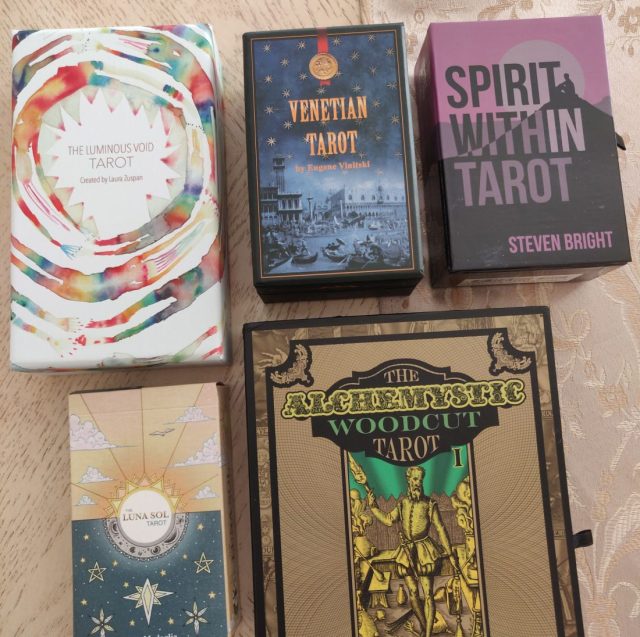
In 2018 we saw so many incredibly innovative and ground-breaking decks to name that I could not reduce it down to just five. This was a difficult list to make and I wish I could name more. I even thought about doing a special mentions section, but then even that would get unduly long!
These are my top five tarot decks from 2018, though two of these decks were published in 2017. Also, my own deck, Spirit Keeper’s Tarot, was disqualified, since come on. I can’t pick my own deck.
Here I want to address the intangible costs to being an indie tarot or oracle deck creator. Oh, and yeah, be forewarned that this is a very, very long and rambling blog post.
If you believe that the particular tarot deck a reader chooses to work the closest with reflects the character, aura, and essence of the reader, then the Luna Sol Tarot says to me that those who gravitate toward this deck are compassionate, loving, soulful, and forward-thinking, with values rooted in pluralism, inclusiveness, and diversity of both culture and beliefs.
Mike Medaglia is a comics illustrator with a Zen Buddhist background, along with being one of the co-founders of Liminal 11, the publisher of the Luna Sol Tarot. You may recognize his work from his previous contributions the Huffington Post and Elephant Journal. Thankfully for us tarot readers, Medaglia has now directed his attentions to creating a tarot deck and Luna Sol Tarot is a modern spiritual wonder.
Click image for enlarged close-up view of Majors.
With a muted color palette and timeless, ethereal quality to the art, this is a deck for meditation, self-reflection, inner child work, and daily wisdom. With his background in comic book illustration, Medaglia expertly tells a story of a thousand words in each picture, every card in this deck magically unraveling a full narrative arc with a beginning, middle, and end of a story that you’ll pick up on effortlessly. There’s such a beautiful Libran harmony and aesthetic balance to Luna Sol.
Back in September of this year, I posted cost projections for self-publishing a tarot deck, “What Does it Cost to Self-Publish a Tarot Deck?” linked here. I think it’s worth your while to compare the projections from that previous post with the actual calculated and accounted for figures I’m providing here.
At this time we have completed packing and shipping out all sold decks and I’ve got a tally for you of actual costs. In other words, this is what I actually spent out of my pocket to produce Spirit Keeper’s Tarot and its companion guidebook, The Book of Maps, alongside an analysis of what I’ve actually earned in terms of income.
In a future post that will supplement this one, I want to talk about the intangible costs of independent publishing, everything from opportunity cost and work-life balance to the cost on your mental health and wellness. For now, this post will be about actual calculated dollars and cents only.
Chang’s Tarot Correspondences is tailored to all levels of tarot proficiency, whether you’ve “been reading for decades” or “you just picked up your first deck,” (as noted in the Introduction). “Correspondences,” she writes, “are patterns and connections inherited from esoteric systems. In tarot, correspondences line up with specific cards.”
Working with tarot correspondences is premised on the doctrine of sympathy, a Hermetic principle that the way one system goes with the other is part and parcel to the magic that happens. Correspondences, notes Chang, are the bridge between worlds. And I couldn’t agree with her more.
Video installment #11 in the orientation course series for the Spirit Keeper’s Tarot is a guided meditative tarot reading rendered through accessing the Akashic Records. The direct link to the video on YouTube is here or you can check out the entire course series on this page here.
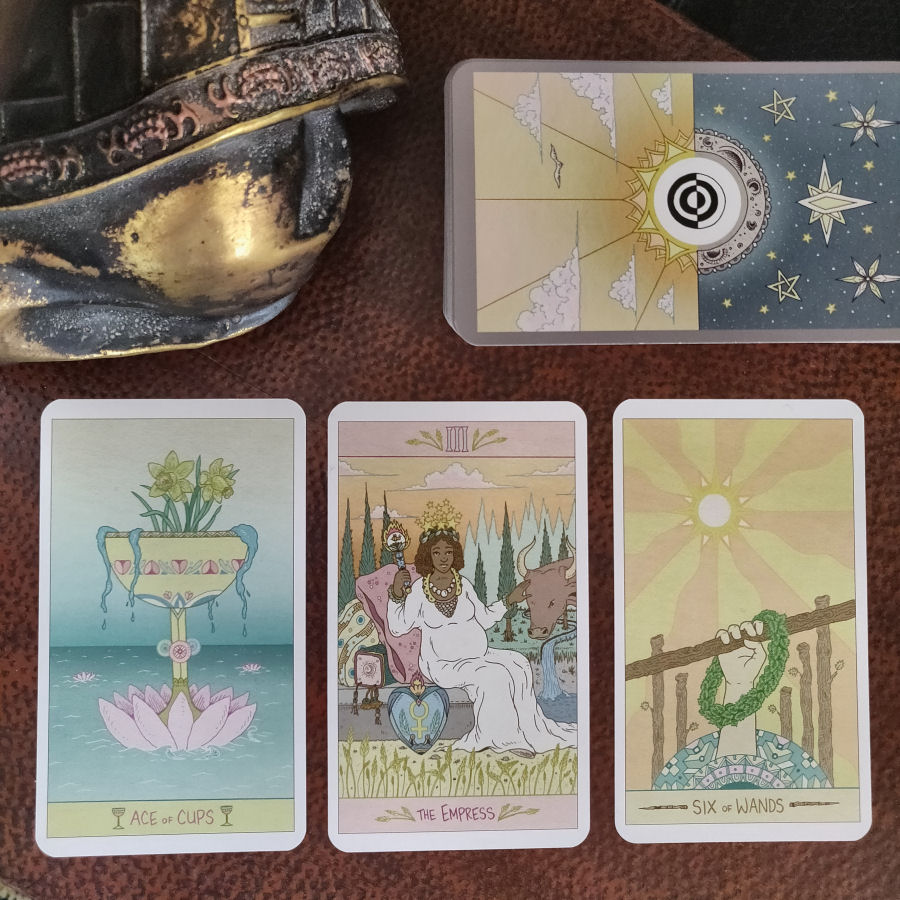
In this post I’ll be documenting an Akashic Tarot Reading I did for myself, guided by Video #11. I’m using it as a case study so that it might help round out your own approach with the reading exercise and to think about how you can interpret your own results from the Records.







 benebell wen