I Ching and the 60-Year Lunar-Solar Calendar Cycle

My Instagram post from five days ago noted that 2024 (or more accurately, year of the Wood Dragon) corresponds with hexagram 43. Some have been describing it as a forecast or prediction. That’s not entirely accurate, so I thought I’d clarify.

It’s not so much a forecast as it is an application of I Ching theory.

Continue reading “I Ching and the 60-Year Lunar-Solar Calendar Cycle”

Why is the word “feminist” triggering? Disappointing realizations.

So I posted this video yesterday:

When I made this video, I genuinely did not think there’d be anything controversial about it. I will even continue the assumption now and say that if you actually watch it in the entirety, you, too, would not reach the conclusion that it’s trying to be anti-male. Nor will you find it laced with any ulterior motive of gender politics.

Heck, now in retrospect, I probably could have titled the video “Tao Te Ching & the Divine Feminine.” Right? It’s just that I have a complicated relationship with the concept of “divine feminine” hence I went with “feminist metaphysics.”

Within hours of its posting, I received the following comments:

This blog post starts with my reaction to the above responses, but then I’ll go off on a tangent to share some unfiltered ramblings with respect to Eurocentric Taoism and cultural appropriation.

Continue reading “Why is the word “feminist” triggering? Disappointing realizations.”

Dragon Gods, Land Spirits; the Hakka

I’m compounding several different topics into one video and probably should have done separate videos for each topic, but for me, they’re all related to each other, and so I guess from that personal perspective, it makes sense for me to be presenting them in one bundle.

Upfront, let’s clarify: I’m not teaching, I’m sharing. I wanted to learn more, went out and attempted to learn more, and this video and companion blog post is just me passing on to you what I’ve learned.

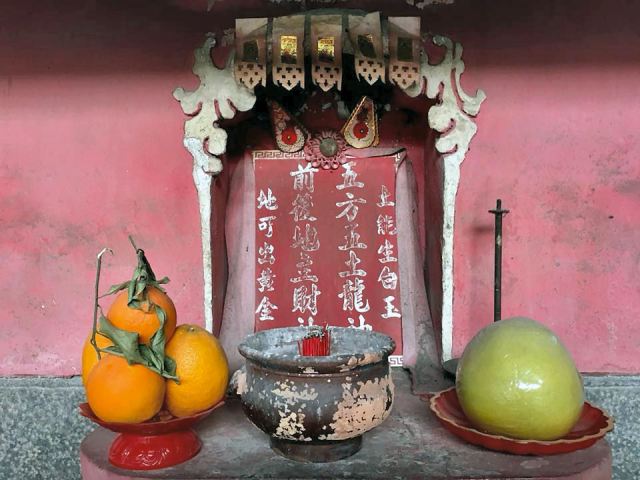
Dragon Gods of the Earth 土地龍神

Image Source: 香港古蹟行腳

Dragon god(s) (土地龍神, tǔ dì lóong shén ) are personifications of the land, where mountains and rivers meet, and thus from a feng shui perspective, reveal dragon veins (龍脈, lóong mài).

Rituals (such as 化胎, Huàtāi; in Hakka, it’s pronounced Fā Tói) can be performed to harness the qi or powerful essence from these dragon veins to bless a home and bless lands that the Hakka now occupy to ensure good harvests, prosperity, safety, protection, and good health.

What’s distinct about Hakka dragon spirits veneration is its association with the earth rather than water. Traditionally in Chinese lore, dragon spirits/gods 龍神 and the Dragon King 龍王 are associated with the temperaments of the seas.

Continue reading “Dragon Gods, Land Spirits; the Hakka”

Your Inner Palace 元辰宮 and the Akashic Records

This blog post is an addendum and continuation after what I discuss in the video linked above.

The Akashic Records is very much a Western conception, right? The Theosophists of the 19th century formulated a mash-up of Eastern and Western esoteric traditions and from that mash-up came its most popular legacy– the Akashic Records.

Most of us get that the “Akashic” part was inspired by the akasha, a fifth element or essence found in various Asian traditions, associated with the sky, space, aether, and in Buddhism, even a state of mind. But what about the “Records” part?

But first, I’d like to start with the discussion on akasha and godhead.

Continue reading “Your Inner Palace 元辰宮 and the Akashic Records”

Descent into the Underworld: Guan Luo Yin, a Wu shamanistic practice

Guan Luo Yin 觀落陰 is a practice of wu shamanism 巫術 found primarily in the South Pacific. While methodologies will differ, one approach is as an astral journey to the underworld to see the spirits of those who have passed on; another is as a method of “remote viewing.”

Some traditions conceptualize the descent as beginning from the entrance to a cave at the base of a mountain (associated with the Kunlun Mountain). Others conceptualize it as a palace with many floors descending (as opposed to ascending the way floors of a building are constructed in the physical earthly world).

This video serves as an introduction to the practice.

See also:

I Ching Divination with Moon Blocks

I’ve covered moon block (Jiao Bei, 筊杯) divination before here in a past Tinkering Bell video. And this downloadable PDF linked here is a quick reference sheet for using moon blocks.

When you walk into a Buddhist or Taoist temple anywhere in the southern regions of the Mainland, Taiwan, Singapore, Malaysia, heck– just in general the East Asian cultural sphere– you are going to see moon blocks. Baskets full of moon blocks. It’s so you can ask your question of the patron divinity or spirit, then toss the moon blocks and receive an answer from beyond.

Moon blocks can also be used for divination with the Zhouyi (I Ching).

Continue reading “I Ching Divination with Moon Blocks”

Changes to the YouTube Channel and Access to Past Videos

In an effort to curate the publicly visible videos on the Benebell Wen YouTube channel, many past videos are now unlisted but still publicly available via the Playlists tab.

For a ballpark sense of how many videos are now unlisted, as of this posting only 129 of 405 total videos are publicly visible in the general Videos tab and thus only those 129 videos are searchable on the YouTube platform.

Continue reading “Changes to the YouTube Channel and Access to Past Videos”

Lady of the Nine Heavens and the I Ching

This video is part of a companion course series leading up to the release of my third book, I Ching, The Oracle. I’ve covered this topic previously here, “Mysterious Lady of the Ninth Heaven (Jiu Tian Xuan Nü, 九天玄女).” However, given the personal relevance, we’re revisiting the Lady of the Nine Heavens, now within the context of my Purpose for publishing this new translation of the Book of Changes.

Continue reading “Lady of the Nine Heavens and the I Ching”

Ba Gua: The Eight Trigrams

This video lecture course is an overview of the eight trigrams (八卦, Bā Guà). It is part of a companion course series leading up to the release of my third book, I Ching, The Oracle.

Ba Gua Correspondences Table

My goofy mnemonic for remembering the order of the trigrams

Timestamps provided in the video description box (you’ll have to watch on the YouTube platform). Apologies, the editing and audio are a bit choppy. The timing of the slides and voiceover narration are off in a few places.

Continue reading “Ba Gua: The Eight Trigrams”

Taoist Magic for Beginners: How to Get Started

This is a companion write-up to the above video.

Continuing from what I said in the video chat, if this is something you seriously want to do, then start by getting that three-ring binder. Though I think organizing it into eleven sections is sufficient, I noticed you can’t buy packs of just eleven binder dividers. They come in sets of 12, so that’s fine. Having a final “Miscellany” tab is always a good idea anyway.

Continue reading “Taoist Magic for Beginners: How to Get Started”