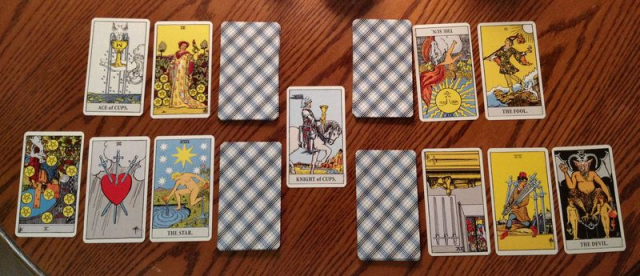
A deformed Celtic Cross due to space constraints. The Mary-el Tarot.
At the intermediate level, every tarot practitioner should have a repertoire of at least 7 spreads. Now note that as an advanced reader, you will have fully developed your personal practice approach and may have only one spread that you always use, no matter the inquiry or situation, or a repertoire of spreads that are very different from the ones mentioned here, or an altogether different intuitive approach to readings. All that is developed with time, however, so at the intermediate level, expose yourself to as much as possible and master a minimum of 7 spreads to empower yourself as the most adaptable and efficient reader you can be.
In my own practice I customize and design new spreads on a case by case basis. I also employ a variety of techniques to answer questions–operations from various Golden Dawn methodology (or my adaptation of it), card counting, etc. However, I do insist tarot students who have gained a proficient understanding of the card meanings and who know the basics of tarot interpretation to begin building their repertoire. There are 7 spreads you should know by heart at any given time:
A 3 card reading spread
A 4 card reading spread (or a 5 card reading spread)
Lumping every professional tarot reader into a single category is not helpful. If you’re seeking out the services of a professional tarot reader, think about what kind of professional you’re looking for. Based on my experiences and observations, here are the different types I’ve seen:
TRADITIONAL READERS
When you think of the traditional practice of tarot reading, you’ll think of the Psychic, the Intuitive, the Empathic, or even the Holistic Reader (the Holistic may be straddling the line between Traditional and Modern–more on that later).
Each one brings a specific style and approach to the practice.
Psychic Tarot Reader. I don’t know what “psychic” means so I’m going to go fast and loose with the term. Some are self-proclaimed psychics and some have been called psychic so often by their clients that they end up reluctantly accepting the term in their title. The Psychic Tarot Reader is someone who, independent of the tarot cards, possesses the ability to see the forking paths we take, past, present, and future. They are able to, with remarkable accuracy, gauge people’s paths into the future and so, in that specific sense, seem to have the ability to see the future. In the alternative, they might be one who has a knack for communicating with other-worldly (so-called supernatural) spirits. Physiologically from birth, these readers have a particular gift, though that gift can be trained and improved (or suppressed). Now, put a deck of tarot cards in their hands and something magical, well, psychic, happens. My only concern with Psychic Tarot Readers is they make up about 1% of tarot readers, if even that, and so from the standpoint of a lay person, differentiating between a legitimate Psychic Tarot Reader and a charlatan is not easy.
Intuitive Tarot Reader. The Intuitive Tarot Reader is also someone who possesses a remarkable gift, though it is a bit different from being psychic. The Intuitive Tarot Reader has this uncanny ability to pinpoint the truth. From somewhere hardly rational, they can help you separate fact from fiction in absolutely the most rational sense. Intuitive Readers are like Swords: they cut away at all the irrelevant underbrush and help clear the path for you toward understanding.
Empathic Tarot Reader. If the Intuitive is someone who can make a beeline for the truth in any situation, the Empathic Tarot Reader is someone who feels exactly what you feel, who can sense energies in an environment and extract accurate emotional data from those energies. Since emotions are our truths, what the Empathic and the Intuitive do aren’t terribly different. They get to the same destination through different means. Empathic Readers are like the Cups (or Chalices). Empathics are incredible spiritual counselors. (That, however, should be distinguished from licensed counselors.) Empathics feel what you feel and because of that, understand you in a way no one else seems to understand you. That mutual sense of understanding can be cathartic and validating and just what was needed to help you move onward.
Holistic Tarot Reader. The Holistic Tarot Reader incorporates other practices with tarot to provide, well, a holistic experience. They’ll bring in numerology and astrology and runes and after the tarot reading, maybe draw an oracle card, or consult the I Ching. They have a sense of what incense can stimulate what, what gemstones and crystals amplify what energies, and generally draw from an expansive body of learned knowledge to integrate with the reading. In terms of how they read cards, they consider the context of the tarot signs and symbols, the esoteric knowledge that such imagery reference, and apply metaphors and archetypes to help you understand the fuller context of your situation. Intuitive and Empathic Readers may also be Holistic with their practice, but not all Holistic Tarot Readers are Intuitive or Empathic.
NOTE: Very few professional tarot readers fit neatly into just one of those categories. Each one will be a combination of the above, though they may be predominantly Intuitive or predominantly Empathic. Psychic Readers tend to be both. However, not all Intuitive and Empathic Readers are Psychic. Hope that makes sense. Also, very few tarot readers are one trick ponies, and so most of them are going to be Holistic to some degree.
MODERN READERS
Though we live in modern times, most tarot readers today still follow a traditional practice, as set forth above. Yet a few new types have cropped up in the last decade or so.
Holistic Tarot Reader. See above under Traditional. While Holistic Tarot Readers have probably been around since the early ages of tarot reading, a more defined approach with holism in mind did not come about until recently, so I include them in both listings, Traditional and Modern. The modern Holistic Reader may incorporate reiki, for example, or feng shui, or they’ll talk to you about chakras during your tarot reading. Your sessions with them might get heavily influenced by transpersonal psychology.
The Tarot Counselor. This professional is a licensed counselor, social worker, or therapist. The law says this person can get paid for counseling services because said person has received the proper institutionalized education necessary. In addition, the Tarot Counselor is a skilled tarot reader and integrates tarot into his or her counseling work. I don’t know if maybe it’s just the group I hang around or what, but from my vantage point, this type of tarot reader is growing steadily in numbers. The psychoanalytical aspect of tarot reading is becoming more popularly recognized today and looking less and less occult. If you’re looking for a counselor or therapist, consider one who uses tarot.
The Tarot Life Coach. It’s my understanding that life coaches do not need to be licensed or certified, but certainly correct me if I am wrong. Anyone can start a business service as a Life Coach with no required education, training, licensing, or certification (kind of like tarot readers). In a nutshell, Life Coaches help you identify your goals and then help you formulate a strategic plan to accomplish those goals. Then, they’re supposed to be there for you every step of the way to motivate you. Again, the incredible power and utility of tarot is recognized by modern professionals and many Life Coaches work with it to help their clients.
The Tarot Interpreter. The Tarot Interpreter sees tarot as a book, a prophetic text or simply, a tool that reflects that which is in the unconscious into the conscious plane so that such information can become of use. Book or tool, someone with specialized knowledge and a wealth of experience with the cards can read tarot in an optimally precise way. Like one of those TI-85 calculators– any dope can pick one up and use it, but without that specialized knowledge and training, good luck doing anything interesting with one! The Tarot Interpreter works as a translator. You approach the tarot directly, in effect, and then the Tarot Interpreter translates the language (the signs and symbols) of tarot to one you might better understand.
* * *
Tarot professionals will develop their own style of reading and that style is typically a hybrid of some of the above types. I’d say I’m a Holistic Tarot Reader and Tarot Interpreter mix. While it would be nice to see tarot professionals offering key information about their reading styles so that you can discern what type of reader they are, that might not happen. My recommendation is to review the above to figure out what type of tarot reader you’re looking for, and then find one with a reading approach that reflects that type.
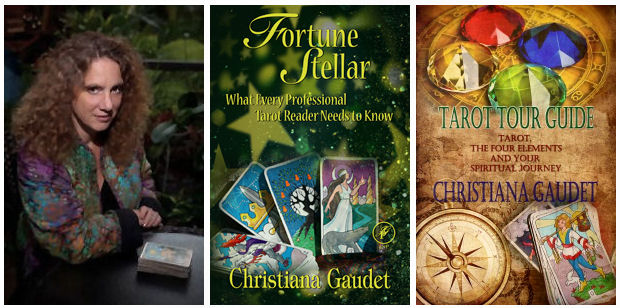
I had heard her name here and there because, really, who does tarot and hasn’t heard of Christiana Gaudet? Both of her books, Fortune Stellar: What Every Professional Tarot Reader Needs to Know (Juniper Gardens Press, 2010) and Tarot Tour Guide: Tarot, the Four Elements, and Your Spiritual Journey (Juniper Gardens Press, 2012) are essential to any halfway decent tarot library, but that’s not why I’m writing this. I’m writing about the tarot info galore she’s provided that is readily available for your consumption. She demonstrates generosity and knowledge and I aspire to be a tarot practitioner like her.
I’ve been watching her YouTube channel during every free moment I have. When I watch her, I get great vibes from her aura, so I watched video after video, disbelieving of the wealth of tarot resources here. No matter what stage of tarot study you are at, whether you just picked up a deck, are still making heads and tails of the Celtic Cross, or you’ve been reading professionally for decades, you have something to learn from Ms. Gaudet.
From her YouTube channel, I learned about Christiana’s Psychic Café, which is an online streaming show that takes place on The Para Encounters Network (PEN) every Sunday at 9 pm. The recorded video is then uploaded on YouTube and you can enjoy it at your leisure from Ms. Gaudet’s channel. I love hearing from professional tarot readers and others in various metaphysical or spiritual practices. Her guests are always entertaining. For the most part they’re incredible, impressive, and I’m in awe. There are a few times you cringe, though, and you watch to learn what not to do. But that’s important, too, so either way, there’s much to absorb on Christiana’s Psychic Café. Coolest yet is when different generations of tarot readers converge.
Then there’s her blog, Tarot Trends, which is all empowering substantive content. Also be sure to subscribe to her weekly e-mail newsletter. Ordinarily I dislike e-mail newsletters to my inbox and the ones I do get I don’t even open let alone read. However, I read Tarot Topics when it arrives because I always know there’s something in there I’ll learn from. Sorry if this little post seems neither here nor there, but I just had to share my latest discovery. Amazing!
Here’s how it went down. Stacey H., an editor over at Best American Poetry asked if I’d like to guest-write for a week. Insecure about having nothing of note to write about, I brainstormed weeks in advance, and only got up to 4 pieces. A week is 5. Argh. I posed the question to myself: As a writer/poet who might be convinced to be interested in tarot if given a compelling enough reason, what topic at the intersection of writing and tarot might interest me? Well, duh. How do I use tarot to help along my writing? I figured I’d try to write about that. Finally. 5 pieces.
Tons have been written about using tarot cards as writing prompts, but that doesn’t interest me too much as a writer/poet. Now… reading tarot for my writing specifically… that concept is intriguing.
Then I had to put the hat of the tarot practitioner back on. Can I do it? Is reading tarot for what amounts to a manuscript (more often than not an incomplete unfinished manuscript no less) being the querent-client something that can even be done? I read for people, don’t I, and in every instance, people who are more or less incomplete, unfinished manuscripts. So why not a book? Oh, for sure, after this endeavor I can no longer laugh at practitioners who read tarot for cats and dogs…
I spent some time thinking about how it could be done, my approach, crafting the techniques to be employed, and how I’d even go about selecting a signifier card for a manuscript, and then reached out to my arm’s length network. Stacey H., the editor, was the first to reply and asked if she could help spread the word by re-posting my call. Go for it! I still kept one eye on my own circle. Then she said she found someone. Oh dear. A complete stranger.
Heck, why not. That is how I “met” Amy G. From our initial terse e-mail exchanges, I couldn’t get a sense of who she was and truly, as she says in her response piece, which I will link later, I didn’t read her manuscript and knew very little about her poetry. In fact, prior to reading tarot for her, I swear I have never read any of her poetry, or writings of any kind for that matter, other than the e-mail exchanges. This exercise was as much for me as it was for her, to see if it could be done, and so I didn’t want anything to cause any sort of bias at all. I wanted to know as little about her and her work as possible.
First, the signifier. Intuitively without even looking at the cards, just going through the archive of memories of the cards in my mind, I gravitated toward the Knight of Cups, but then the Rational Side of me said, “No, that’s not an appropriate signifier. She’s female. The knight is a boy.” However, it just felt right and the more I pressured myself to seek out another signifier, the more wrong every other card felt. So, I surrendered. Knight of Cups it is. Whatever. If she ends up thinking it is ridiculous, so be it.
Once I set my mind and heart to it, though, without direct interaction with her, when the cards were set down, I have to say, I really felt like I was getting to know her. It’s a funny thing to say, especially to the skeptic, but it’s my best way of articulating what happened. I felt her poetry, if that makes any sense, and it was really, really freakin’ beautiful poetry. I made a mental note to myself to look up her work after the tarot reading, because it just felt it would be aligned with what I love to read.
It was well after the tarot reading that I got to know Amy’s writing and my feelings were right on. I really do love her poetry and even her casual blog posts at Best American Poetry, posts that are always filled with fire, spirit, humor, truth.
The universe has a lovely, balanced way of always making sure we’re “compensated.” Now that I’ve been reading some of Amy’s poetry, I get why there was this meeting of the spirits. Her poetry helps to express and validate some of what I’ve been going through in my personal life, and does so in ways I couldn’t have done for myself. Had this whole situation, any part of it really, never taken place, I’m honestly not sure I would have ever had the pleasure of coming across Amy’s work. That was the bargained-for exchange that I didn’t even know I bargained for.
I am the guest blogger this week over at Best American Poetry and am feeling a bit like a fraud since I’m not a poet, at least not since the angry-histrionic adolescent years of poems about boys who won’t give me the time of day, printed in font size 14 in comic sans or some other curly girly font and center-aligned down the page. Hm, actually in college there was a brief period of doing slam poetry on themes of an Asian Diaspora ravaged by post-colonial ambivalence and cultural imperialism but that period is really best left forgotten too. I am, however, an avid consumer of poetry and have bookshelves at home filled with poetry collections and chapbooks, half of poets you’ve all heard of and half of poets you’ve probably never heard of.
I’m trying to think of when I first learned about the Best American Poetry series, and it turns out I can’t seem to remember a time when I was aware of literature and not aware of BAP. I read it in high school, college, and even recall sending a letter to David Lehman directly one time about a decade ago telling him I felt the BAP series didn’t include a fair representation of Asian American poets. The current series has been much better, I think, about diverse representation.
This week BAP is letting a tarot reader (me) run loose on their blog (http://blog.bestamericanpoetry.com/) and here’s what’s going to happen:
I am preaching to the choir when I write this to an audience of tarot practitioners: If your personal energy could be quantified like battery life, then reading tarot for others will drain it like streaming a movie on your smartphone over 4G connection. Reading tarot depletes me in a way I cannot fully convey. Sometimes I get the sense that non-tarot practitioners who request tarot readings from me don’t have any idea.
On its face, a tarot reading seems to be an effortless dealing of a deck of cards, and then blurting phrases based in some part on the card imagery. What could be so hard about that?
Tarot is a tool, a metaphysical one if you will, that connects two individuals’ energetic fields together for the duration of a reading. The nature of the relationship between practitioner and seeker is that of give and take, respectively. A practitioner feels his or her energy draining out and going into the cards to provide the reading that the seeker is receiving. Seekers often talk about readings being rejuvenating, cathartic, an enriching experience. They’re picking up on that channeling effect. In contrast, tarot readers talk about feeling exhausted, needing to recharge.
Very few tarot readers make enough cash from their readings to compensate for their time spent. That, though, we will chalk up to simple economics and just acknowledge that at least from a free market standpoint, that part is fair.
I draft business contracts for a living and almost every one of them contains an indemnification clause. Indemnification is often one of the main points of negotiation and contention between the parties. In the course of a commercial dealing, some poo always makes its way to the fan– costs of damage resulting from the initial transaction that weren’t accounted for in the contract price– and everybody needs to figure out who owes what to who and how much to compensate for the loss. That’s indemnification.
When I make reference to the unindemnified price of tarot readings, I’m talking about that energetic loss that tarot practitioners sustain but no one accounts for, or heck, even acknowledge. Some seekers can be borderline parasitic, though I believe never intentionally so. Most tarot practitioners are by nature empaths and so of course their first inclination will be to yield and give and feel.
As an empath with a law degree, when I first started my legal career, I felt every client’s problem and took home a briefcase of emotional baggage every night. I’d think about their issues in the shower, while brushing my teeth, before I fell asleep, the first thing when I woke up, while I made my coffee… Yet senior partners at the firm seemed to master such control. They compartmentalized. One might be tempted to say they were apathetic, that they were desensitized, or they did not care. That is not true at all. They cared and they cared deeply about their clients. But they have been at this a long time and they know that to truly be in a position to help as many as possible, they needed to take care of themselves first. Selfishness is a form of selflessness. They knew exactly when it was time to step away from a case, recharge themselves, and live their own lives for a change, instead of living for others, which is exactly what lawyers do, though they rarely get seen by that side of them.
Tarot practitioners must take a cue from these partners. Newbies rarely possess the prudence to know when they must step away and focus on themselves. They get caught up in the exhilaration of uplifting others–an admirable trait–but ironically (since we are tarot readers…) fail to foresee the pending crash. That is why burn-out is such a problem among startup tarot practitioners.
There is no indemnification for that spiritual energy drain that is part of the tarot reader’s work. Thus we are the ones who must keep ourselves in check. Always take time to recharge and learn to say “no.”
The above video is old, uploaded several years back, but I came across it yesterday and the news is certainly relevant to this day: alleged psychics who use tarot and other arts to scam people of money. This news broadcast is about scams near my neck of the woods, the Bay Area in California.
When driving downtown, you do see many glass window neon sign “psychic” fortune-telling shops like the ones depicted in the broadcast. People like the alleged psychic tarot reader interviewed in the broadcast cause me to shudder with disgust.
In every professional field, there are the scam artists, the cons, the good-for-nothing bottom-feeding scum of the profession that will rob you of your money and not provide any quality services in return. Lawyers (we definitely get a bad rep for that), doctors even, plastic surgeons especially, accountants, every profession. However, such professionals are still taken quite seriously by the public at large because of overall strict regulation and licensure requirements. At the end of the day, as long as you the consumer do your due diligence, the likelihood of getting scammed by one of these professionals can be diminished greatly. In tarot reading, not so much, because there are no regulatory or licensing requirements, no schooling minimums you’re expected to meet before you can hang out a neon sign and call yourself a Tarot Reader.
To start, I cannot believe the scam-artist Tarot Reader in the broadcast declared that he was 99.99% accurate. Who does that? Ethical lawyers, no matter how skilled or experienced, would never tell you that you are 99.99% likely to win (or lose). They may say you have a strong, compelling case, but then will always follow that up with a caveat: prepare a contingency for the ever fickle winds of change. The strongest cases can fall apart at the eleventh hour, and the weakest cases with no rational chance of victory can prevail. Tarot readers could do well to give such advice to their clients, especially since such a philosophy couldn’t apply more pertinently to an art like tarot reading.
Next, according to the broadcast, the decoy asked about her husband’s colon cancer. Per the American Tarot Association’s guidelines, there are two red flags right there. First, do not do readings to diagnose a health condition. You can read about how one might go about coping with what’s happening, but do not diagnose. Second, do not read for third parties. The practitioner can rephrase the question for the decoy and have her ask about her role in supporting her husband right now, but she shouldn’t be asking on behalf of the husband, not unless he’s present and consenting.
Then, as a tarot practitioner who also uses the Rider-Waite-Smith system, the next part interested me greatly. I will say that chances are the producers, who probably don’t know much about tarot, reenacted the tarot reading being referenced just for cool footage, but if it is based on the actual reading the scam-artist Tarot Reader gave to the decoy, it will make any RWS reader scratch his or her head.
As children my younger sister would say she was psychic and tell me about her psychic experiences. I recall, for better or worse, vehemently discouraging such a line of thought. I would tell her that she is not a psychic and if she continued to say she was, then she was a liar. Dismayed, she eventually stopped announcing that she was a psychic to us sisters and maybe even stopped letting herself acknowledge so-called “psychic” experiences when she had them. In retrospect I regret my harsh and ignorant stance, but at the time (and I was a tween myself) I believed it was for her own good: she couldn’t run around in public telling people she was psychic. How would people take her intellect seriously if she did?
Now I have always been convinced that my sister may have had strong intuitive abilities for what may be beyond the five physical senses, not unlike the way all the women from my maternal line are drawn to the preternatural. My grandmother, my mother, my first cousins descending from my grandmother, and my sisters all display a heightened awareness of the logically inexplicable. But psychic?
I saw it this way: when you are a voracious reader, at some point you will want to give it a try and become a writer yourself. Likewise, if you’re fascinated by metaphysics and occult phenomenon, at some point you will want to be part of it, and maybe even convince yourself that you’re psychic. Not too different from how I try to convince myself that I’m a writer even though I have yet to publish a damn thing.
Sure, I am convinced that intuition is real. Intuition is the perception of a truth, occurring incident, circumstance, or event independent of any logical reasoning, actual knowledge, experience, or cognitive deductive process. It is synchronicity. It is a prickling of what is about to happen before it happens. It is the sensation of energies that you can’t physically see, hear, smell, touch, or taste, a sensation for when those energies are in balance and when they are out of balance, and the enigmatic knowing of how you might be able to balance it if you were to try.
Being intuitive is like being detail-oriented, or organized, or calculating differential equations. Not everybody is detail-oriented, organized, or able to do math, but anybody can be with enough effort. It is just a skill, albeit a remarkably empowering one when we use it. It might also be a trait. Some seem naturally disposed to it and others need to really work to acquire the skill. I guess somehow those who seem naturally disposed to being intuitive have come to be referred to as psychic.
My question is: where on the continuum of intuitive ability must one be for that person to qualify as “psychic”?
People of color, especially Asians, form associations around their race for every topic– blogging, voting, golfing, farming, realtors, lawyers, doctors, chess players, musicians, journalists, kidney donors, Republicans, Democrats, pole dancing, basketball, you name it, there is probably a group of Asians who have formed an association. Yet there are no Asian American tarot associations, no gatherings of Diasporic Asians who are interested in tarot. Why not?
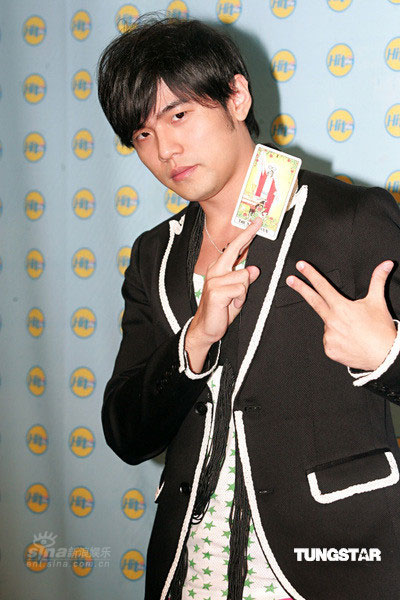
I was surprised to find that tarot is more common in Asia than I first expected. For those not in the know, the above photo is of a Taiwanese celebrity, Jay Chou, a music, singer-songwriter, and actor. He was in the 2011 film Green Hornet. Chou purportedly consulted the tarot to ask about the success of his forthcoming music albums. Link: http://jaychoustudio.com/archives/jay-chous-career-and-love-told-through-tarot-cards-deeply-influenced-by-rumours/900 (last visited 4/30/2013).
Jolin Tsai, another Taiwanese pop sensation, features tarot divination in one of her music videos. Seems like it isn’t quite as taboo for mainstream public figures in East Asia to associate themselves with tarot as it seems to be here in the U.S. We seem to be irrevocably Puritan when it comes to our open-mindedness to such practices.
I ended the article with this, and a silly quoted statement from my friend:
[Asian tarot readers] see no problems with the few individual Asian tarot readers who exist to assimilate into the greater tarot associations at large rather than group-identifying with Asians only.
“That’s because only white-washed Asians do tarot,” said one of my friends. “Asian Americans who are anchored solidly in the Asian American community aren’t into that kind of stuff. If they were, there’d be an Asian American tarot group like the one you’re asking about. The absence of such an Asian American tarot group is your proof that activist Asian Americans aren’t into it.”
. . . Have you had any experiences with the tarot? With Asians who practice tarot? And why the heck isn’t there an Asian American tarot association?
In spite of how common and acceptable tarot practice is in East Asia and its seeming endorsement from Asian celebrities, in the States, Asian Americans consider tarot to be “white-washed,” meaning Asians who reject their ethnic heritage to act as whitebread as possible are the ones who are thought to be tarot practitioners. Interesting juxtaposition there.
One of the commenters below the post, Jonathan V, an Asian American male tarot reader, pointed out an authenticity and exotification issue that I immediately related to, since I also practice both tarot and I Ching. There tends to be doubt about the “authenticity” of my tarot readings, but then non-Asians seem to love it when I use I Ching. I’m suddenly an “authentic” I Ching divination practitioner simply because of how I look. I look the part, i.e., I’m Asian. Nevermind that I was born and raised here and just as competent and just as inept as the next John or Jane Doe I Ching student over.
In any event, I hope that article expands the dialogue of Asian American tarot practitioners and the correlation of tarot to race and culture.
I read tarot privately for 15 years before I heard about certification through the Tarot Certification Board of America (TCBA). In November 2012, just for the experience, because after I learned it existed, tarot certification made it on my bucket list, I applied for the first level of certification and over the next few months, made my way to the level of certified tarot master.
The folks behind the TCBA are fantastic people. I have had an incredible, pleasurable, rewarding experience with every one I interacted with, from the examiners to the mentors to the board directors. I literally have not one negative thing to say about them. And yet I want to proceed with my account of the certification experience objectively and critically. So here you go. I warn you this is going to be a long posting. I’ve tried to compensate for the verbosity by including cartoon caricatures of my certification journey, comics I’ve created with the help of bitstrips.com.





 benebell wen