Master strategic communication, executive presence, and people skills with “Speak with Power, Lead with Trust.” This powerful workbook offers tactical drills, emotional intelligence training, and leadership communication strategies to help you build trust, influence, and authority in any professional environment.
I would rather not share this publicly, except geez do I wish someone had spared me so many failures and missteps simply by sharing something like this with me earlier, back when I was just starting out in my career, and life.
When you come from an immigrant family…
From a lower socioeconomic background and then suddenly for your career leap into an environment where everyone comes from so much more privilege and status than you ever knew…
When you’re a person of color and what goes for communication and people skills in your culture is not at all the same as what goes for communication and people skills in this society…
When you’re the only woman in a male-dominated industry…
When you’re neurodivergent and an introvert…
…when any of these situations are familiar to you, often a big obstacle that holds you back from the level of success you would otherwise enjoy is this: you’re terrible at corporate-friendly communication and people skills.
I know I am.
In my head I think I’m smiling, warm, affable, speaking clearly, slowly, and concisely, in a structured organized manner…
…in reality I’m looking nervous, shifty, I’m rambling off on tangents, I’m info-dumping on you, and I can’t seem to get to the point.
Because I never had a workbook like this, my growth and improvement rate was slooooow. Like how many times did many, many people have to tell me I speak way too fast and am rambling and info-dumping before I made any effort to speak slower and enunciate better. How often did I cross my arms and slouch and avoid eye contact at important social gatherings and as a result made terrible first impressions with a load of very important people. Either I over-share or I under-share, and can never seem to “strategically share to present micro-vulnerability as a signal of authenticity.” (Like, did you even know that is a thing someone has methodically and intentionally thought through??)
This is a free downloadable workbook based on strategic communication skills development and pattern-rewiring for executive leadership presence, with pretty easy-to-follow actionable techniques, skill development, and practice exercises to improve your people skills, your “executive presence,” and just all around be better at communicating to others.
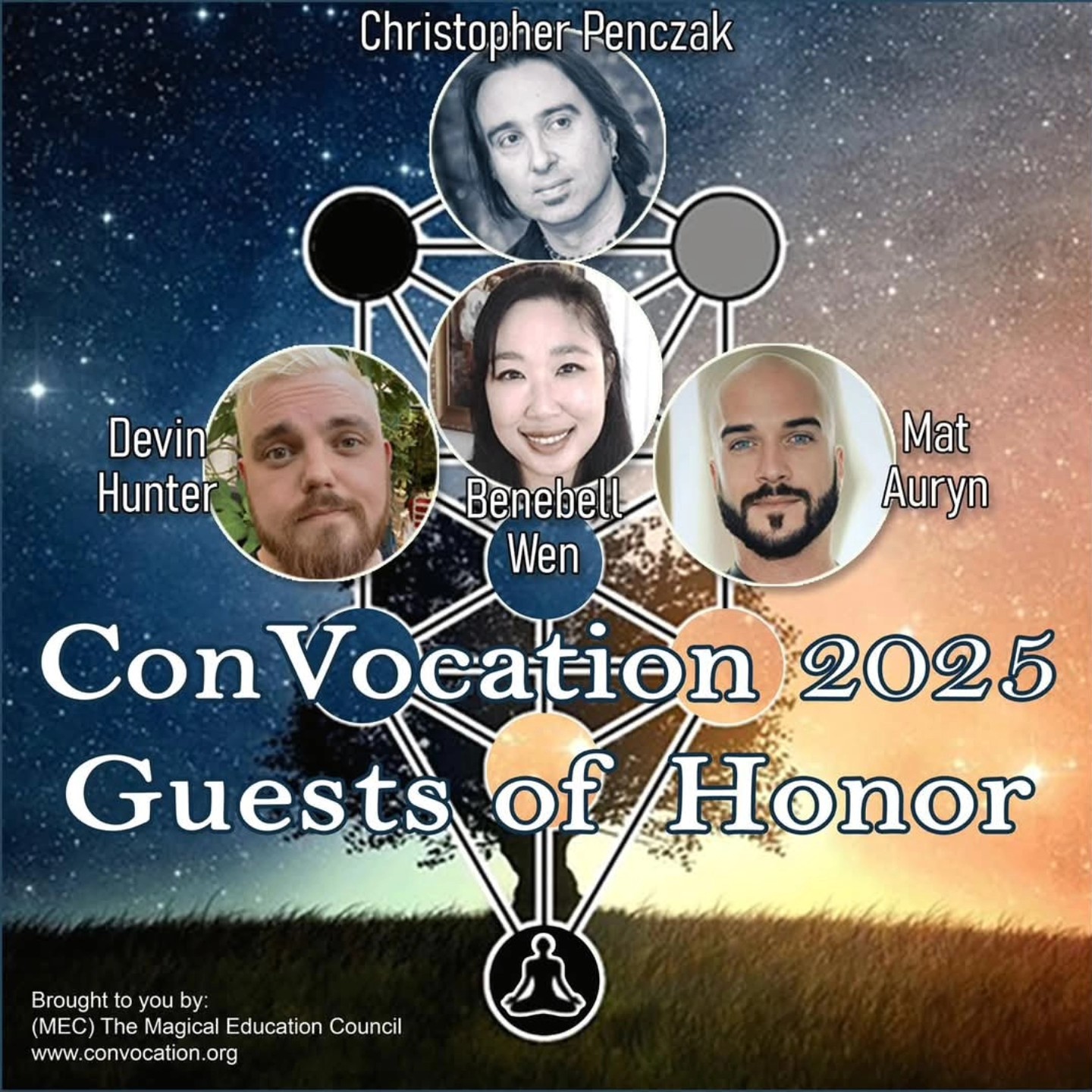
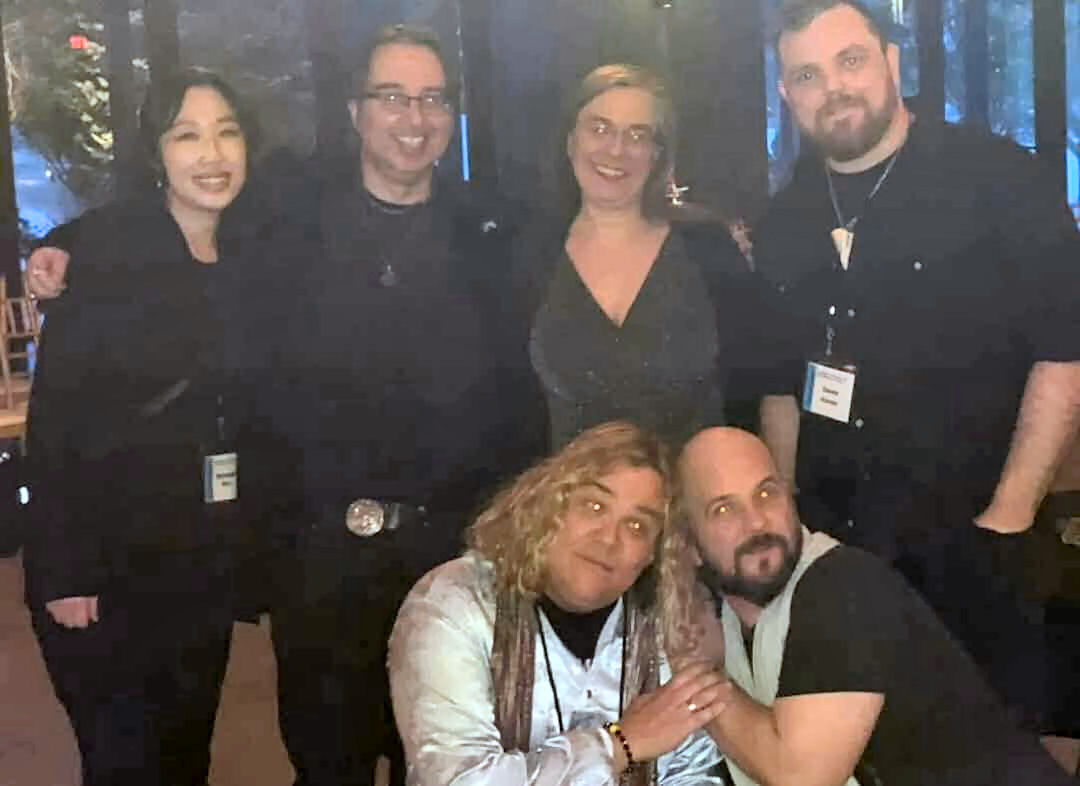
I was invited as a Guest of Honor Headliner to speak at this year’s ConVocation, and this is my recap of the event, as it was also my very first time (1) attending ConVocation and (2) attending a pagan event in the Midwest. ConVocation is a pagan conference that has been going strong in the Upper Midwest since 1995, and truly what sets it apart is how community-oriented it is.
Photo via Barb Milburn Stenger of Celtic Readings (celticreadings.com)
My write-up is coming out a bit later than planned, as I had initially hoped to include some of the official event photos from David Loken-Rozian‘s 2025 ConVocation album onto his Flickr. Since the album isn’t available yet, I’ve decided to go ahead and post this recap, so apologies for lack of people pics. I don’t know why I always forget to take photos of people at events; I have a dozen photos of snow and trees, food, rocks, and clouds, but none of people. Argh.
I had such a great experience recording the first chapter of my audiobook that I had to share, and memorialize in a blog post. My publisher North Atlantic Books arranged for me to record at Live Oak Studio in Berkeley, a truly fantastic place. This is for the third book, I Ching, The Oracle.
To be standing where music legends and NYT bestselling authors once stood! ::faints::
Now I kinda wish I had the backbone to ask if I could take some photos of the engineer’s setup, you know, that station in front of the glassed-in studio space with all the colorful levers and buttons. =) But it seemed like his space and I didn’t want to intrude. So, womp, womp, sad face, no impressive sound-engineer’s-giant-keyboard pics for my social media. (Do blogs even count as social media anymore?)
This was my first time in a recording studio,* and certainly my first time recording my voice narrating my own book. I left the experience with a lot of admiration for professional voice actors and audiobook narrators. Like the voice actor we chose for narrating the I Ching audiobook — he sounds like one of those National Geographic or History channel voiceover guys! It’s a skill, and maybe dare say even a talent.
*Technically, I’ve been in a recording studio before, with an entire symphony, as one violinist in a sea of violinists in the violin section of said symphony. But for sure this was my first time in a recording studio for totally-me reasons.
Just because you wrote the Thing doesn’t mean you can competently read the Thing aloud, especially since I would not call my writing style “conversational.” So when you read it aloud and your writing style departs from your personal “conversational” style of speaking, it comes across as awkward.
Fortunately, the sound engineer was fantastic. He coached me really well, telling me when I was speaking 10% too fast and needed to slow down, when my energy wasn’t matching my last paragraph, and flagging words that had just the most subtle stumble, or even when I was getting a bit too loud with my breathing (lol). I have confirmed that audiobook narration is not necessarily the best profession for you if you have asthma (I have asthma).
This audiobook recording experience left me with the unequivocal acknowledgement that I write very long run-on sentences. The sound engineer had to stop and teach me how to breathe. If you come to a really long sentence, even if it doesn’t have punctuation, put in breath marks as if it did have periods, otherwise you’ll run out of breath, as I did when I was reading my own damn book.
More fun tips I’ve learned: Apparently, eat a crisp apple before you start recording voice narration. I don’t know if that’s just folklore or if it’s scientifically legit, but a lot of voice actors swear by it, and believe it’s a thing. It’s supposed to help your voice be at its tip-top condition.
And don’t wear “loud” clothes while you’re recording. So for instance James was wearing a nylon jacket and sporty pants or something that goes swish swish every time he moved even a little, so he wasn’t allowed in the recording booth. Fortunately I’m a nerd who reads all the homework assignment materials ahead of time, so I knew to wear “soft, quiet” clothes.
To be a competent voice actor, you almost have to over enunciate words. So many of us lay people don’t realize that we mumble when we speak. There were several instances when the sound engineer stopped me and offered guidance on how to over-enunciate, because I was jumbling my words and it wasn’t as crisp as it could or should be.
For I Ching, The Oracle, I’ll be doing the voice narration for Chapter 1, the Introduction only. A pro audiobook narrator, Wyntner Woody, will be narrating the rest of it, speaking both the classical Chinese text of the Zhouyi and the English translation and annotations.
The Hubby (a native Beijingnese speaker) and I listened and re-listened– and re-listened– to the finalist list of audition reels. We debated, we re-listened, we looked up each one of their bios… which is to say we put a lot of heavy thought into who to choose. There were many different and competing factors for consideration, hence the debating and long deliberation time as we wracked our brains over who to go with.
For the audition, each voice actor recorded about a page or two from one of the introductory expository chapters and then recorded Hexagram 1, both the classical Chinese and the English. We (and particularly Hubby, because he’s the native standard Chinese speaker; the Mandarin I speak is not standard) ultimately went with Wyntner because of his more precise standard Chinese pronunciation.
Why didn’t I want to narrate the entirety of my own book? This is the analogy I give. Since I grew up listening to southern Taiwanese people (deep south) whose primary tongue is Minnan/Hokkien speaking Mandarin Chinese, my Mandarin pronunciation is not “standard Chinese.” If I had narrated my own I Ching book, it would be akin to listening to someone narrate Shakespeare with a heavy southern drawl. If you’re looking to voice Shakespeare, you’re looking for a particular way of pronunciation, right? Same here.
That and time constraints. I think the total was going to be something like 20 hours of straight narration, which means lord knows how many hours buffered around those core 20 to get those final 20 hours right.
Due to my full-time job, I would only be able to work weekends, and then you would have to coordinate with the studio’s schedule and available time slots. So ultimately it did not make sense for me to narrate my own book, and for the publisher to hire a pro.
Oh by the way, I learned that reading aloud 9,000 words equals about 1 hour of studio time. So the way they estimate how much studio time to book is based on word count. It’s not an exact accurate science, but ballpark more or less, 9,000 words is 1 hour of recorded audio.
Hubby, wearing “loud” clothes, and therefore banned from the recording booth.
Plus, James (the hubby) is more of an audiobook listener than I am, and he says that any time he sees that the book is narrated by the author, he skips it and won’t listen, because it has been his experience, as a consumer of audiobooks, that the author’s narration tends to be a bit too amateur to listen comfortably to for dozens of hours on end, and that you really do need a pro to do it. Voice acting is totally a skill. Not just anybody can or should be narrating audiobooks.
There are other interesting issues that come up with bilingual (even multilingual) narration. So, for example, Wyntner pronounces “I Ching” as you would in Mandarin Chinese, per pin yin, even when it’s in the context of an English sentence, whereas when the context is English, I just pronounce “I Ching” and even “yin and yang” the way a typical American would pronounce those words.
But then in other instances, mid-sentence while speaking English I’ll hop over and pronounce it as you would in Chinese. Wyntner is super consistent with his stylistic approach, whereas I, a lay speaker, am very inconsistent. Sometimes I pronounce “Tao Te Ching” the way you would in Chinese, per pin yin, and then other times, without explanation or rationale, I’ll pronounce it the way average Americans might pronounce it.
It’s a phenomenon you’ll observe — native Chinese speakers and non-Chinese expat/foreign speakers speaking Chinese will switch pronunciation midstream in English, and try to pronounce Chinese words as you would per pin yin, but Asian Americans do not. Asian Americans pronounce in the Chinese way when speaking Chinese, and then pronounce it the white people way when speaking English.
For example, when James pronounces his own Chinese surname in English, he’ll kind of give it a proper Chinese pronunciation to it. Whereas when I pronounce my own Chinese surname in English, I’ll just pronounce it the way white people might pronounce it, and don’t bother giving the proper pronunciation. But obv. will pronounce it the “right” way when I’m speaking Chinese. Or how you’ll hear Wyntner pronounce yang as “yahng,” with the soft-A like “ah,” which is correct, whereas I just go with the Americanized hard-A “yayng,” like “yay,” which is incorrect but has become normalized.
In any case, Hubby and I are both super glad we went with Wyntner, and we cannot wait for the final result to be out in the world!
James is currently proofing Wyntner’s narrations, listening to the entire audiobook, and he reports that my book is actually very, very interesting! =) Yay! James says that my I Ching book is so interesting to listen to that he even paused between sections to go look stuff up and read more on the history! I’ve earned myself a new fan, in the form of Hubby! =D [I mean, it’s not like he read a single page of Holistic Tarot or The Tao of Craft, so this is ah-mazing!]
As for the I Ching audiobook, it is going to be significantly different from the printed book, for many reasons. One, the audiobook omits all the exercises (basically the whole “grimoire” part of the book), the entire divination how-to section (so the audiobook has nothing in there that teaches you how to do the divination procedure, whereas the printed book dedicates a big whopping chapter to all the ways), and any passages that reference tables, charts, or images had to go, or be rewritten so that you’re not making references to phantom visuals.
The I Ching audiobook’s purpose, as I see it, is to hear the classical Chinese recitations of the hexagram verses side by side with the English translation and then my annotations. The chapters that cover the history, mythology, and cultural lore of the I Ching also makes sense as an audiobook. But the more practical hands-on elements, I feel, need to be either in printed book form, with the written instructions plus illustrative images, or as a video tutorial.
Also, the audiobook does not include any of the end notes. In a few select instances, Wyntner recommended that he include a few additional statements to integrate some of what I wrote in the end notes, as he felt the explanatory material in the end notes would help provide clarity to the text, and we agreed.
I rewrote a lot of the annotations and commentaries to the Zhouyi translations (the actual I Ching text) so it would read better as an audiobook. Also, I totally rewrote the Introduction that I narrated. About half of it stayed the same as the printed version of the Intro, but then about half of it is net new. Even two hours before heading to the recording studio I was still on my computer rewriting passages!
In any event, unlike the challenges, obstacles, and frustrations I encountered during the publisher-author collaboration phase of the print book for I Ching, I really, genuinely enjoyed my experience during the publisher-author collaboration phase for the audio book version.
I have had a straggly streak of white hair at the crown of my head since adolescence. I believe it’s known colloquially as a Mallen streak, and medically as poliosis circumscripta, when a patch of hair at the front or crown of your head goes white due to hypopigmentation, i.e., low melanin.
It’s often associated with autoimmune conditions, which funny enough, is itself associated with the hyper-sensitivity that results in psychic and mediumship abilities. The Mallen streak condition is also linked to seriously bad eyesight or hearing, meaning if you have one, you’re more likely to have the other, which is funnier yet, because that’s associated with amplified clairvoyance and clairaudience.
Aligned with all that, since medieval times a Mallen streak has been considered a marker of divergent, anomalous, or maligned personalities, a birthmark that points to witchcraft and transgression. In Chinese folk tradition, a woman’s hair turning white or getting streaks of white in an untimely way is a sign of supernatural influence.
Lord have mercy that the tarot card you were drawing on your birthday isn’t an omen of what’s to come for the year. Because I was “called” to work on the Five of Swords. Or I was “pulled” to, I dunno, I find all that New Agey jargon a bit fluffy but there it is. “I was called to” just means I don’t have a logical explanation for why I did what I did.
Anyone else notice the intensity of recent conversations swirling around so-called girl bosses and trad wives?
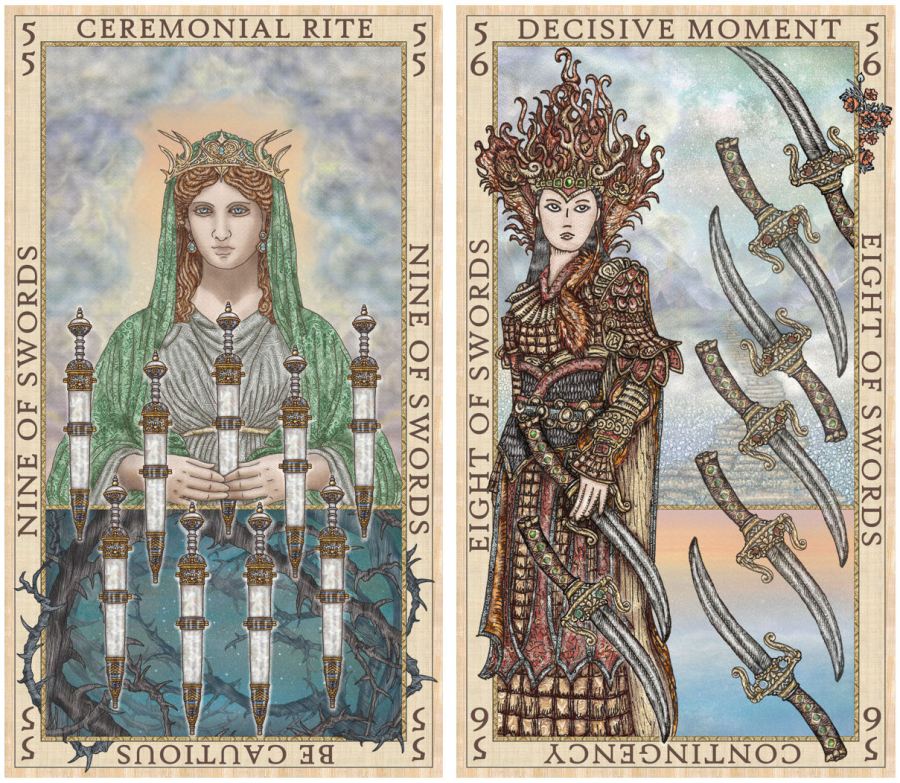
Funny enough, as I nosily listen in on video essays, podcasts, and commentaries, I’ve been sketching the Eight and Nine of Swords from my Etteilla deck.
Now you’re like, wait what does the Eight and Nine of Swords in the tarot have to do with girl bosses and trad wives?
I thought nothing. But the illustrations I seem to have subconsciously done at this time sure are amusing.
Chronologically I worked on Card 56, the Eight of Swords first, which appears to give off girl boss energy, then moved on to Card 55, the Nine of Swords, which one might identify with trad wife.
This blog post is another installment of my Etteilla Tarot art project status updates.
At the same time I thought it’d be fun to pepper in some rambling on this whole trad wives, girl bosses conversation du jour.
I kind of feel bleh for talking about AI so much, but everyone in every nook and corner of my life, personal and professional, is talking about it, so it’s hard to avoid wanting to chime in.
When you’ve got multiple thumbs in varying (and very different) pies, you’re exposed to a diversity of opinions, and wow is it diverse. If you’re only mingling in liberal arts circles, then you’re not hearing, truly hearing, the discussions about AI happening in the scientific circles, and if you’re only mingling in scientific circles, then you’re not hearing, truly hearing, the discussions about AI happening in the liberal arts circles. And so it’s been interesting hopping from one camp over to the other and back to witness the contrast.
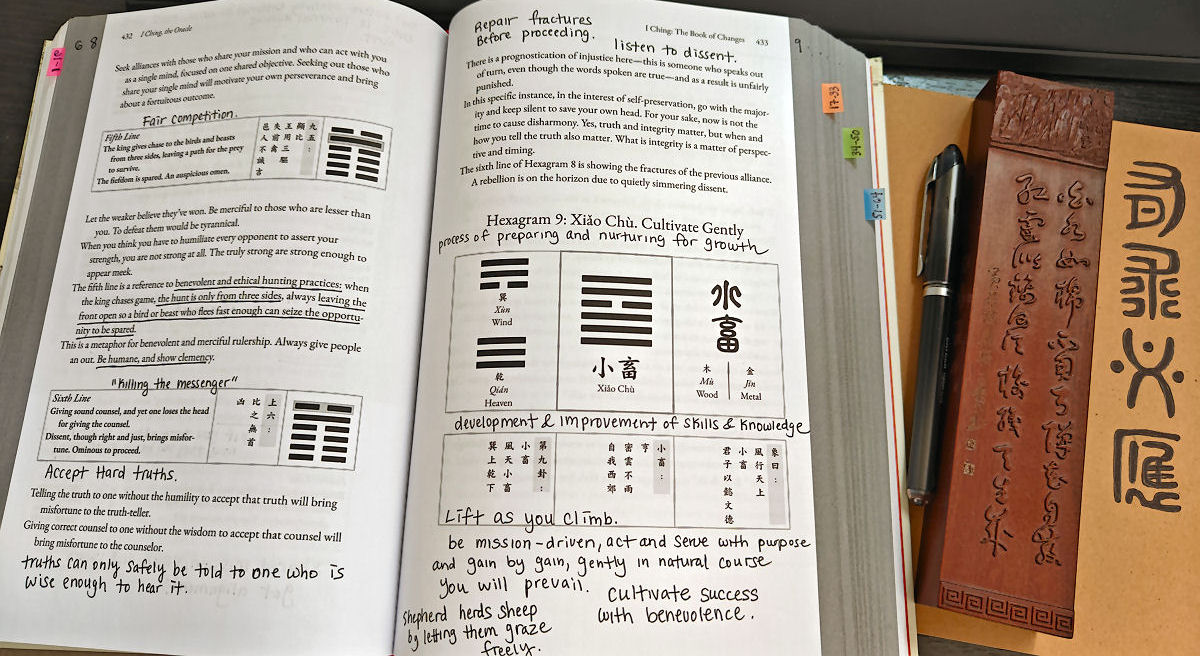
Just thought it’d be fun to share some snapshots of how I mark up my copy of I Ching, The Oracle with notes.
Every facet of my disposition – even fate, the cards I’ve been dealt in life – seems to be on a cusp. Astrologically by both Eastern and Western charts I’m a cusp baby. Cultural identity wise, mine is the hyphenated experience. I’m agnostic when it comes to party lines, but you’ll certainly hear the far right calling me too woke, and the far left calling me too trad.
I’m often too structured and austere for the creative arts community and too sensitive, too mystical-leaning for the corporate world. I like agendas, strategic plans, and realistic goal-setting; I value efficiency, utility, and productivity, all attributes that do not go over well with the creative arts community. I also account for unseen influences, trust my psychic impulses, and value empathy, compassion, mercy, softness, vulnerability, and kindness, attributes heavily frowned upon in the corporate world.
I came upon a TikTok video presenting these seven questions for getting to know someone better and it inspired me to answer these questions in a blog post myself, to share with you a little more about me.
I hope likewise you’ll choose one of the seven questions to answer in the comments section or treat it as a tag and answer all seven on your platform.
Plenty of authors and artists prefer keeping their next big project under wraps until it’s ready for launch. And that’s a wise decision. I’m not very wise though. Plus, it’s not like you can rely on what I say about my “next” project anyway, because I keep on changing my mind.







 benebell wen