The Generation Gap Between Tarot Practitioners

Photograph that is unrelated to the topic at hand but posting here for the visual effect notwithstanding because your eyeballs need there to be a photo here and I couldn't source one that would be related.
Photograph that is unrelated to the topic at hand but posting here for the visual effect notwithstanding because your eyeballs need there to be a photo here and I couldn’t source one that would be related.

First off, naturally I will be speaking in generalizations.

People my age are sandwiched somewhere in between the Old Guard and the Millennial Readers.

Although my mother is not a tarot reader, she’s a metaphysical reader/practitioner of sorts and I’m super sure that had tarot been accessible to her as a young one, she would have totally become a tarot reader. Instead, she reads other stuff. Like your face. No, I kid, but oh no, I don’t. She really does.

I can see her attitude reflected in many of the Old Guard tarot readers. “I’m not normal. Tarot is not normal. Damn straight this is fringe. Deal with it.”

There’s an unabashed embrace of marginalized culture. There’s no embarrassment with dressing woo-woo as you walk among normal society. You can almost see traces of a hedge witch mentality.

Although she has never come outright to say so, I get the distinct sense that she doesn’t want everyone and the mainstream to become diviners, mediums, shamans, and practitioners of craft. There is a tacit yet clear exclusionary attitude. Or at least that’s always been the impression I got. She doesn’t want (let alone buy in to the ideas of) Mediumship 101, “everybody’s psychic,” or “pay me $300 and I will certify you as a bona fide tarot master.” (Hi. Certified tarot master here.)

Meanwhile millennial readers apply general business and marketing tactics to tarot–e.g., general PR and marketing principles to tarot business, coaching anyone and everyone to become diviners, mediums, shamans, and practitioners of craft, if you so choose. There are efforts to establish tarot into mainstream culture.

There is a pop psychology approach to tarot (which I have been pegged and critiqued as adopting, so apparently I’m in this camp) that strives to normalize divination practices or astrology, and to talk about spell-crafting as the law of attraction and “yay for positive thinking.”

However, at the heart of the millennial approach is the notion of accessibility, a socialist attitude toward the metaphysics. We can all have equal access to the Divine, to metaphysical energy work. (I confess, that is the attitude I adopt. That line sums up my opinion.) Metaphysics is for everyone. This is not paranormal, it’s normal. You don’t need anybody else to help you connect to the Divine. You only need you.

Okay, so as circumstances would have it, I’m now only a couple paragraphs in and I’ve already changed my mind.

Maybe I haven’t changed my mind exactly, but it is for sure vacillating. Is it really a generational thing? Or is it just a two-different-schools-of-thought thing? Is my personal anecdotal evidence and direct observations even reliable?

I’m in effect just looking around me, only to the point I am able to physically see, and making gross generalizations about what else is out there based on only what I see. Is what I happen to see an accurate microcosmic sampling of the macro? I don’t know. I really don’t.

However, there is for sure a determined voice among the occultists and metaphysicians who say that “occult” means concealed, and we are not to remove the veil for all. Only those who choose the path should or even can go beyond that veil to see for themselves what is there, and then come back with divinatory or revelatory information as needed, like an appointed messenger.

Is that way of thinking a bit reminiscent of limiting literacy to the elite so that the proletariat must rely on figures of authority (like a priest or priestess) for Divine insights? That was the way of institutionalized Western religion for ages. Is it hypocritical when metaphysicians repudiate that kind of authoritarian approach to religion, pursue occultism because they’re anti-authoritarian and want the answers for themselves, but then once they’ve found those answers, act in the same exclusionary manner?

I’ve observed that the Old Guard, Mom inclusive, have this sense that what they do “isn’t for everyone.” She would probably opine that not anyone can just pick up a grimoire, follow something in there, and yield results. Only certain people can do that. As I said, there’s a staunch exclusionary attitude. I’m also sure if I introduced her to the 21st century spiritual coaching power of manifestation business model, she’d find it absurd.

Actually, she wouldn’t. She’s pretty open-minded. She’d be surprised at first, but then come around. “Okay, all right, I get it. I wouldn’t have thought of that but I get it.” For instance, it might take her some time to grasp the idea that, say, I’m holding an online webinar course on Learning the Opening of the Key for Tarot Summer School and teaching occult theories to a whole bunch of people I’ve never even met, all at once. Perhaps in her view, spirituality, divination, and woo-based teaching is done one pupil at a time, a single teacher to pupil relationship that is honed over several years, not in 60 minutes.

Whereas maybe I do have a more “free love” attitude here. We’re entering a social era where notions once reserved in the New Age or even occult category run as an undercurrent through mainstream society. Corporate offices pay for yoga classes and meditation retreats for their employees. Businesses far from the woo will consider feng shui tips and tricks. Law firms invite in tarot and palm readers for their company Christmas party. Silicon Valley high-tech companies will hire a witch to cast a circle of protection around their computers, protecting them from hackers. All true stories here. I doubt any of this would have happened even 20 years ago. Things are changing.

As woo practitioners such as tarot readers converge more with the corporate and mainstream worlds, they adopt corporate and mainstream commercial strategies to advance their tarot business. Corporate and mainstream businesses converge more with woo practitioners and adopt woo into their environments because hey, “anything to help us earn more money. If that’s a spell or feng shui, then let’s do it.”

So admittedly, there was no point or core thesis to this post. I just thought I’d ramble on some thoughts of late.

Magical Parenting: The Metaphysician Mother

mom-young

Or father. I’ve been hearing a lot about parenting for pagans and wanted to add my own thoughts. However, I won’t be talking about it from the perspective of the parent. I want to talk about it from the perspective of the child.

Now, my parents are not pagan, mostly because that word is not in their vocabulary. They’re Taiwanese immigrants. However, my mother is a metaphysical practitioner, though she wouldn’t see it that way. What she thinks she does is as natural as cooking, praying, dreaming, meditating, and just using what you have within reach to manifest what you want.

I think that is an important point. Growing up, I never saw what she did as “occult,” though living in the Western society has made me realize that Westerners would define what she does as totally occult. Paying attention to equinoxes and solstices, knowing when the veil was thinnest, when to honor the dead, what to do when there was heightened spirit activity, calling upon the elements of nature and combining it with recitations to make things happen, understanding the phases of the moon– these weren’t seen as pagan.

“After their deaths, in my dreams I went down to the realm your late auntie and uncle were trapped in and it was so cold and dark. They told me they were hungry. So we burned offerings and chanted prayers for them and then many nights later I visited them again. I saw that they were now in a different, better realm, very happy and at peace.” (Mom, paraphrased)

I’ve come to understand that in the Western society, that is absolutely bonkers, but in Mom’s world, that was perfectly normal. And accepted at face value. After a death in the family, she’d relay her dreams and all the relatives would just nod. Yeah, that makes sense, they’d confirm. Okay, let’s burn offerings and chant prayers. And then they’d all wait for Mom’s post-dream-shamanic-travels to verify that the offerings and chanting worked. Mom always said that dead people liked to call to her from the post-mortem realms they were in, and so she’d go to them in her dream state to bring back messages for the living. God, growing up when that happened, I’d cover my ears and run out of the room and make it clear to all who’d listen that I thought all of this was batshit crazy.

Continue reading “Magical Parenting: The Metaphysician Mother”

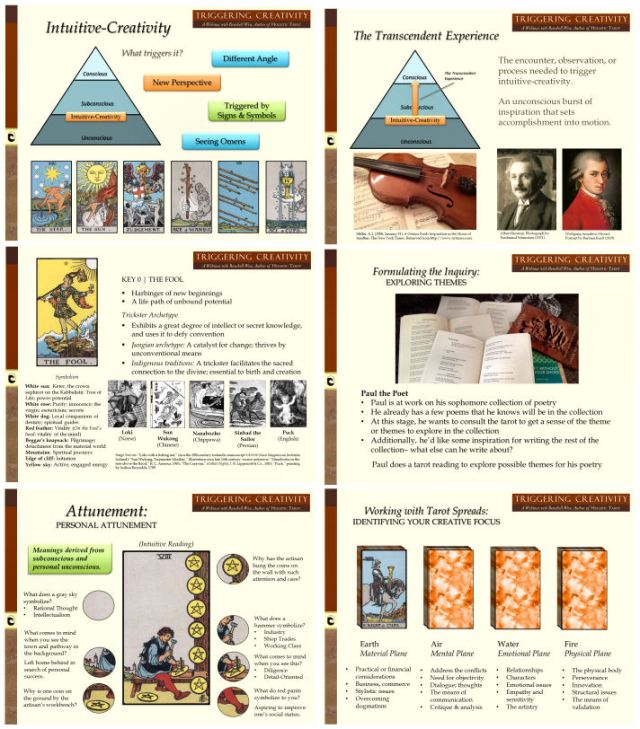
Triggering Creativity with Tarot: Replay of a Free Webinar

On February 21, 2015, North Atlantic Books hosted a free webinar where I talked about intuitive-creativity and tarot. You can check out a replay of the webinar above.

About the Webinar

Albert Einstein attributes his most ground-breaking insights not to logic or mathematics, but to intuition and inspiration or, as artists and writers often express it, to the muses. However, the one trait believed about the muses, about how intuition and inspiration hits us, is that it comes only when it comes, almost divinely, and the artist or writer cannot call upon it at will.

Yet through tarot, learn how to harness intuitive-creativity at will. Tarot facilitates the transcendent experience needed for the muses to speak to us. Learn how to use tarot to trigger your intuitive-creativity and apply the tarot fundamentals taught in my book, Holistic Tarot to remove creative blockages.

Preview_Slides
Presentation Slides Preview

In this 45-minute webinar that will be invaluable to any artist or writer, I’ll be lecturing about how to use tarot cards as an intuitive and inspirational tool for creative and artistic passion projects. The lecture will cover attunement, how to exercise the intuition muscle, and specific techniques for using tarot spreads to read about your creative projects.

When I say “intuitive-creativity,” I’m talking about the muses, about divine inspiration, about that “a-ha” moment. Learn how to use tarot to identify your creative focus, mind-map your project trajectory, perform character analysis if you’re writing a novel, explore the themes of your project in greater depth, and generally trigger your own inspiration with tarot card imagery.

Download the Handout

There is also a handout in PDF format that goes along with the webinar. Please be sure to download it as reference for the techniques and exercises discussed during the webinar.

CLICK TO DOWNLOAD THE HANDOUT

Preview_PDF

This Is Goofy: The Radio Is Talking To Me

Italiano: Radio Marea (1950) by Fabiomoie

So I’m driving to work in the morning stuck in a rush hour traffic jam. My car is effectively parked on the freeway and I’m running late for a meeting. I mutter obscenities and am freaking out about whether I’ll make it to my meeting on time. Just then my finger inadvertently pushes the change-radio-station button on my car steering wheel and it’s Avril Lavigne’s “Complicated,” or a snippet of it.

Chill out, whatcha yellin’ for?

That’s all I hear before I hit the change-station button again and I catch the start of my current #1 favorite song, Enrique Inglesias – “Bailando.”

I’m happy now. Super happy. Because “Bailando” makes me happy. Also it’s not easy to catch the start of a song you like off the radio. You always land on it mid-way through or near the end. This time, I got to hear “Bailando” in the entirety. A gift from the Universe.

What? . . . It is.

That wasn’t the first time stuff streaming out from the radio made sense with what was going on with me in the moment. I gave a shallow example, but it was the most recent. Other times much more serious stuff was going on when randomized snippets of songs from the radio didn’t seem so random and played just when they needed to be played.

The other day an author, psychologist, and acclaimed academic had on the signature line of his e-mail the following quote: “Coincidence is God’s way of remaining anonymous.” ― Albert Einstein.

Yes, I thought. Yes.

Not that I’m saying God has nothing better to do than to talk to me through the lyrics of pop music playing on radio stations. But still.

tarotspread

Anyway I did have a tarot point in all this. So often the messages we get from tarot are like those inexplicable coincidental (or synchronous) moments with the radio. I’m not claiming that those weirdly-timed snippets of pop songs are a form of divination. (Radiomancy? Hey, it’s got an Urban Dictionary entry; must be a real thing.) But it’s a synchronicity that, given the timing and given what’s going on in our lives at that moment, takes on personal significance that causes us to reevaluate what we’re doing or where we’re headed. It’s a moment of strong connection between ourselves and something bigger and greater, something that often feels divine.

Like many a tarot reader, I get that handful of clients who either want to be willfully ignorant of my ethical approach to tarot or who, in spite of knowing that I don’t do fortune-telling come to me anyway wanting me to tell them their fortunes. They are always the same clients who end up disappointed when I don’t tell them that their futures hold great riches and it will all be a beautiful fairytale ending, happily ever after with their preferred lovers. Worse yet, I feel used and my skills abused.

Yes, tarot does shine the way for us and can help illuminate our life path so we see clearer, but it doesn’t give us an easy solution. There are no easy solutions and if you’re getting a tarot reading with the hope of hearing an easy solution to your problems, then I’m afraid you don’t possess the wisdom to properly use tarot as a tool and really shouldn’t be going to readings at all.

Hearing “Bailando” on the radio didn’t solve the traffic jam. It didn’t change any of the conditions of the road I was driving on. However, it changed my mindset. And made the condition not only bearable, but pleasant. That moment of connection with the divine, that coincidence, that so-called radiomancy wasn’t about making the traffic jam go away or asking or wondering whether I would make it to my meeting on time. It was about me, and how I’d spend every moment of my time on that freeway. I could spend it cussing and wondering about the unknown, or I could roll with it and sing to “Bailando.”

Often the messages we get through tarot are synchronous, coincidental in ways that convince you it wasn’t just a coincidence, but because the message didn’t contain the answers or easy solutions we wanted to hear, we dismiss it and miss that moment of connection with God. And what a shame that would be.

Pagan Practices and Chinese Folk Religions

1

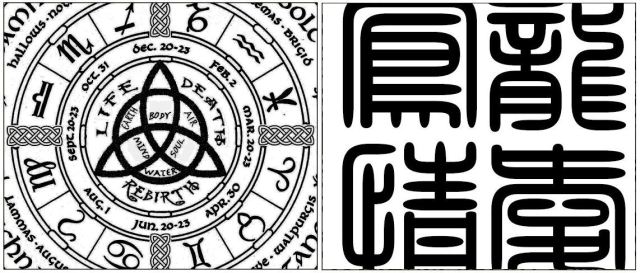
Left image of pagan Wheel of the Year from Biblical Connection.

Right image of a Taoist Fu sigil.

I don’t have educational degrees that would qualify me to write about any of this, so please understand that I am writing my observations within that non-expert context. Lately I’ve been fascinated with pagan and neopagan belief systems, mostly for how strikingly similar paganism is to Chinese Taoist-based folk religion.

Here’s how I understand paganism in context: Back in the day across Europe, Abrahamic religions rose to dominance, became institutionalized, and began setting up centralized bodies of authority that often started in the cities and spread its influence from there. At the fringes of the countryside, however, pagan faiths endured among the minority. These pagan faiths were polytheistic, though pantheist, strongly nature-based, and because they believed that everything was connected, it was thought that certain herbs, incantations of words, ritualistic conduct, and representations of elements could be harnessed to manifest intentions–in other words, magic exists.

Replace a few specifics from the previous paragraph and you could apply it to the relationship between Confucianism (and to a great extent Buddhism) and Chinese folk religions. These folk religions were looked upon in the same way pagan faiths were looked upon by the Christians. Those who practice pagan/neo-pagan religions (like Wicca, Druidism, Heathenry, or some form of pagan reconstructionism) tend to keep their faiths concealed or strictly private. That’s less of an issue among those who practice Chinese folk religions, and so you’ll see altars set up in Chinese businesses that still pay homage to the faiths of their [often agricultural] ancestors. However, like what pagans experience, those who still practice Chinese folk religions are considered fringe.

Continue reading “Pagan Practices and Chinese Folk Religions”

Cleansing a Tarot Deck

Image1

Many traditional Asian societies follow the lunar calendar (I once litigated a case involving an elder Taiwanese woman and all the document evidence she had was dated per the lunar calendar, which completely tripped us lawyers up and a lot of conversion work had to be done, but that is neither here nor there; just mentioning it to affirm that it really is still used today) and the super-traditional even believe that certain energies are more dominant during certain phases of the moon. Not kidding: they’d schedule major surgeries around certain phases of the moon because they believe they’ll bleed less and chances of success will be higher. They consult the Chinese almanac, which is based around the lunar calendar, for everything, from when to launch a business or throw a wedding ceremony to the optimal time for a funeral.

I’ll say that I haven’t lived or observed the universe long enough to confirm whether there is any validity to following moon phases, but if it worked for my ancestors and there is no actual adverse effects from continuing the tradition and it makes me personally feel closer to my heritage, then why the heck not. My mom was adamant about calibrating Hubby’s and my engagement and marriage to moon phases. Did it work? So far so good I’d say.

Anyway, that was a long tangent of an introduction. Sorry. This post is about cleansing a tarot deck.

1 cleansing tarot deck

To demonstrate, I’m using the DruidCraft Tarot deck by Philip and Stephanie Carr-Gomm and Will Worthington (a highly recommended deck, by the way; though there is a great bit of nudity in the illustrations, which I understand why would be featured in a Wiccan-Druid-based deck, but just does not resonate well with me).

Continue reading “Cleansing a Tarot Deck”

Self-Guided Intermediate Tarot Course: Integrating the Five Components of Circumstance

screenshot

DOWNLOAD COURSE PRESENTATION

(Note: Must watch in Slide Show format, due to layered animations.)

I’ve created a self-guided intermediate tarot course on a cross-cultural interpretive framework for reading tarot that I have not seen anyone present before. The Five Components of Circumstance is a cosmological theory based on the Chinese maxim that one’s fortune is based on five factors: 1) fate, 2) luck, 3) feng shui, 4) karma, and 5) education. That theory is a cornerstone in Chinese metaphysics and is used to diagnose an individual’s personal formula for success.

By integrating Five Components analysis with tarot reading, the tarot practitioner will have a new set of vocabulary for interpreting a spread, any spread in fact, and can more precisely pinpoint the strengths and weaknesses in a querent and what adjustments need to be made to expedite the querent’s goals.

Continue reading “Self-Guided Intermediate Tarot Course: Integrating the Five Components of Circumstance”

Amethyst Crystal: The Healer’s Stone

amethyst

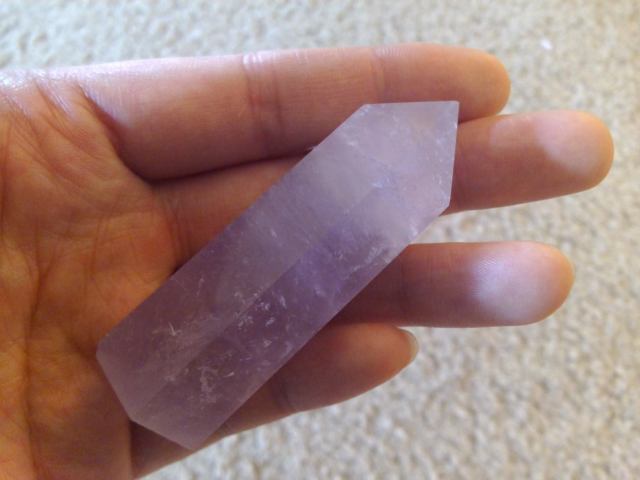
In ancient times, the amethyst was believed to ward off drunkenness and to help its wearer maintain a calm, sober mind. Soldiers often incorporated the amethyst into their armor, or at least that’s what I read. The amethyst was also a stone of the high priests and is referenced in several verses in the Bible, namely Exodus and Revelations. What I find most interesting of all is across many cultures and civilizations, the amethyst has consistently been considered a healer’s stone, one with potent healing properties, for both physical and mental ailments.

The hubby visited Peru recently and brought me back the above amethyst crystal. There were hundreds upon hundreds of crystals at the little shop in Cusco but that one resonated with him as the one I’d like most.

Amethyst is a crystalline quartz that can range from a light pastel purple like the one pictured to a deep, rich purple with blue undertones. Generally I see the light amethysts as conducive of channeling intuition and energies helpful to attaining secret knowledge or wisdom. Dark amethysts are perhaps more practical for the everyday objectives: channeling energies that will help attract power and affluence. The light amethyst crystal is perfect for me, as I’ve been seeking a more spiritual path these days.

When reading tarot for issues that involve healing of some kind, I’ll be keeping this amethyst crystal nearby.

A Tarot Deck Library: The Hobby of Collecting

alldecks

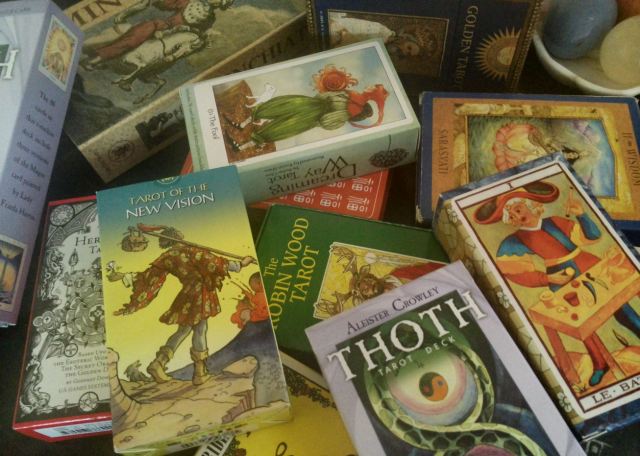
I will start by saying that you only need one tarot deck to be a practitioner. Every deck over one is excess. That being said, if you’re a tarot enthusiast, there will be no convincing you to stop hoarding tarot decks. I mean, you probably only need one pair of shoes, and yet I have fifty. I like to collect. So if you, too, must collect, then at least try to keep your collecting focused. This post will offer tips on building a tarot deck library.

Continue reading “A Tarot Deck Library: The Hobby of Collecting”

Myth of the Divination-Fulfilling Prophecy

There is a view, a fear of so-called divinatory practices that many hold, which I don’t think had a name before. I’m hereby referencing it as the Divination-Fulfilling Prophecy.

“I’m afraid to get a tarot reading. If the cards predict something terrible, then I’m scared that it will happen for sure, because the cards predicted it. Tarot reading is a form of tempting fate. As long as I never get a tarot reading or partake in divination practices, then my future remains uncertain, and that’s better.”

As a tarot practitioner I often hear that sentiment from would-be seekers. A commonly held belief of the tarot, or any form of divination for that matter, is that it possesses the power to fulfill its own prophecy. If the tarot predicts an unfortunate outcome, then even if a person’s future was unfixed before, the power of that prediction will now make the unfortunate outcome fixed for sure. Thereafter, nothing a person does can prevent the outcome because the act of the divination has caused the future to become fixed. Had a person not sought divination, then that future would have remained unfixed. I refer to this belief as the myth of the divination-fulfilling prophecy. The divination-fulfilling prophecy assumes that the tarot, or any divination tool, possesses the power to nullify free will, and divination simply does not have that kind of power. I find the divination-fulfilling prophecy concept to be gravely suspect. I hope this article will explain why.

Continue reading “Myth of the Divination-Fulfilling Prophecy”