The Journey of Love oracle deck by Alana Fairchild and illustrated by two artists, Rassouli and Richard Cohn, was published by Llewellyn (Blue Angel Publishing) in 2014. It’s printed in the same style common among modern oracle decks right now, with the larger dimensions, sticky high-gloss finishes, and vibrant contemporary art.
There are 70 cards in total, along with a sizable perfect-bound guidebook. Alana Fairchild has rapidly ascended to the top of the New Age Movement. She is based out of Australia and is the bestselling author/creator of guided meditation CDs, books on angels and crystals, etc., and exquisite oracle decks that tend to be inspired by the divine feminine. There’s the Kuan Yin Oracle deck, the Isis Oracle, Mother Mary Oracle, and Sacred Rebels, among others. I have the Kuan Yin deck (my review posted here), this one, and the Sacred Rebels (review forthcoming). I love the Sacred Rebels deck, like, a lot, but I might actually love this one, the Journey of Love oracle more.
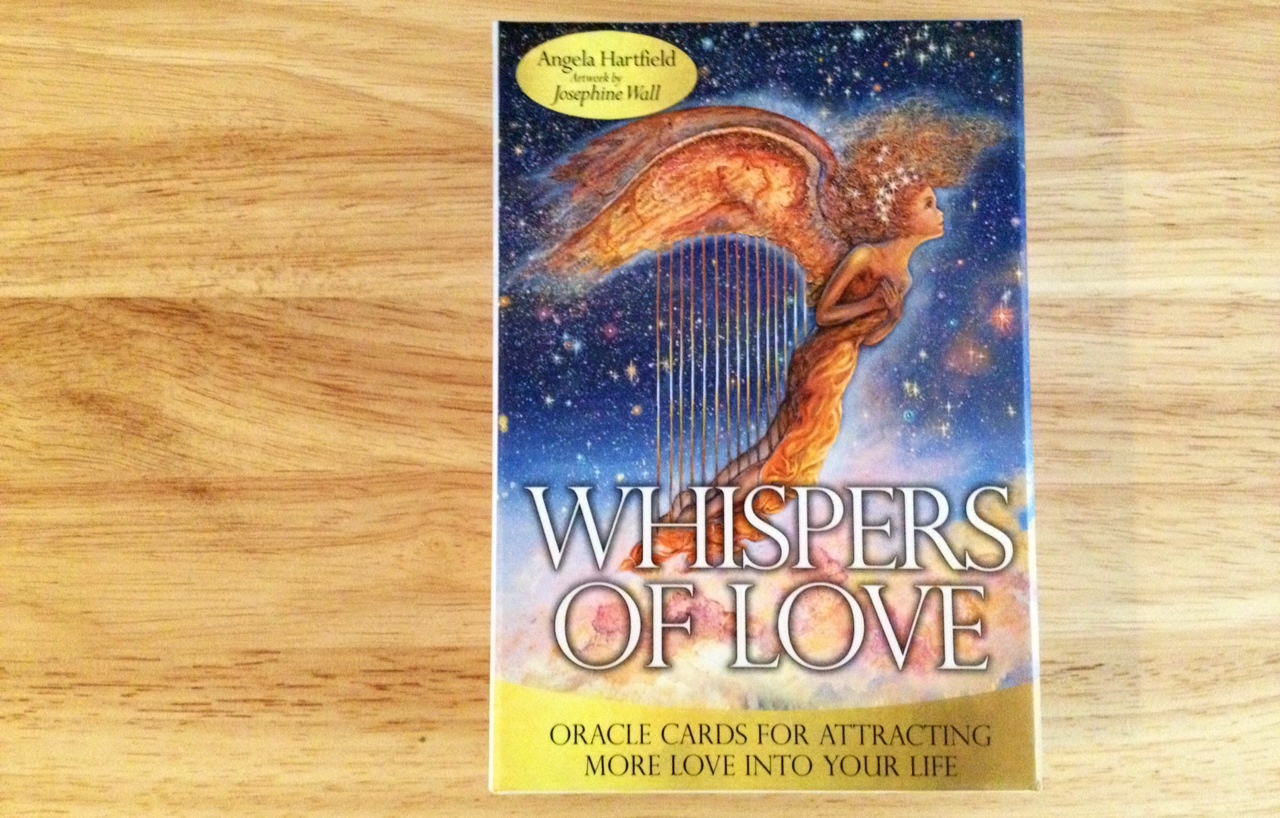
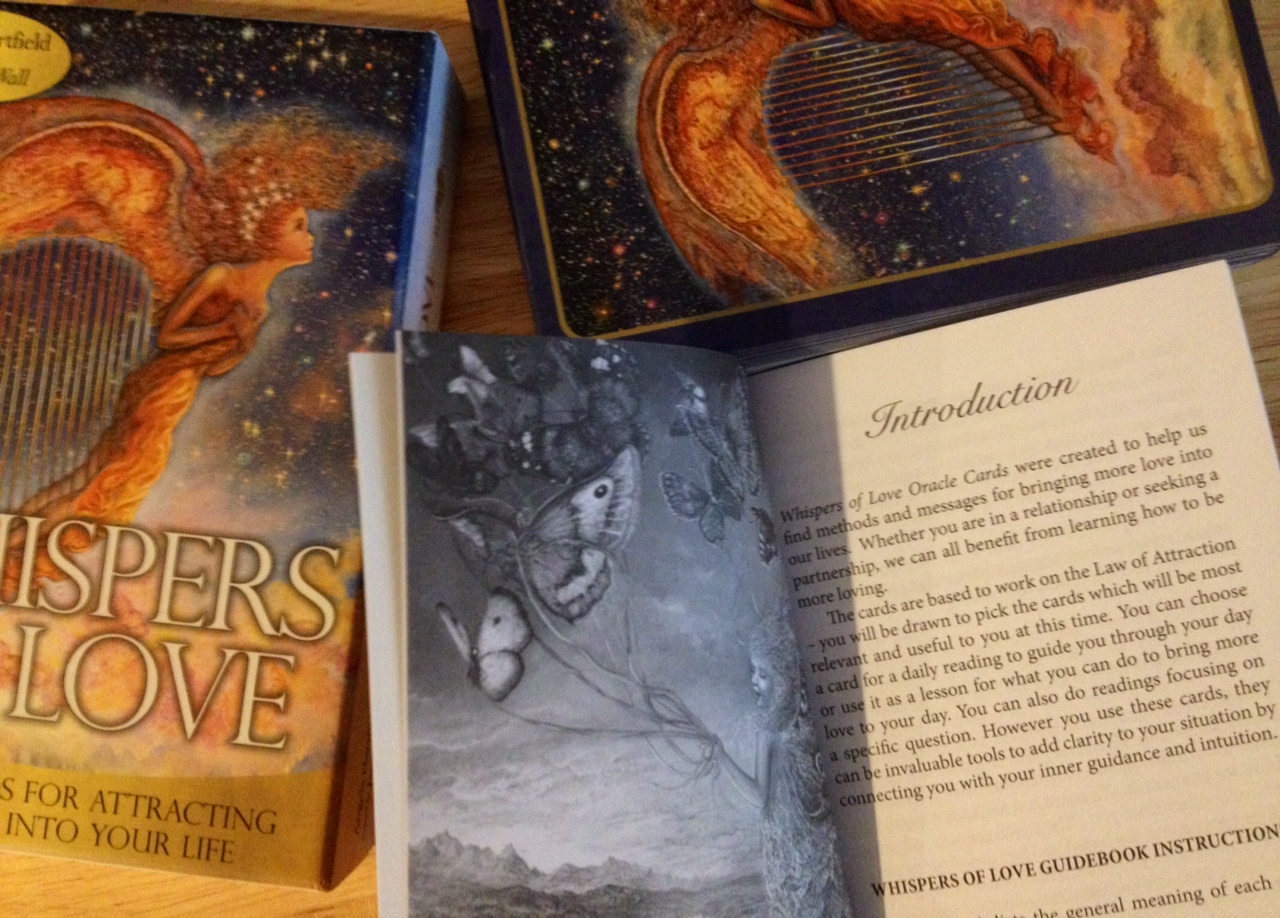
Whispers of Love is my first Blue Angel oracle deck that comes with a matte finish instead of the usual high gloss and I am loving it. I hope they stay with this finish and subsequent decks are printed in matte. The feel to the touch is fantastic; shuffling is fantastic; I love the swishy sound these matte finished cards make compared to the tacky-sticky glossed ones; and they photograph beautifully, with no glare. Here is one high-quality deck and I am thrilled.
The Whispers of Love oracle cards were conceived by Angela Hartfield, an ascribed angel channeler, psychic medium, and intuitive healer. Per the biography on Hartfield’s website, “Her angelic assistance focuses on the empowerment technique of helping individuals learn how to get help and guidance from the angels, spirit guide, Archangels, departed loved ones and Ascended Masters.”
Hartfield created Whispers of Love to bring insights and messages for building stronger interpersonal relationships. This is a deck about relationships, though not necessarily romantic. If you’re trying to make sense of your relations with a colleague at the office, why your boss is acting the way she’s acting, or how to handle a minor dispute with your neighbor, this would be a great deck to reach for. Of course, if you’re seeking guidance on a romantic relationship, then this would be your deck.
While there is no historical verification that tarot descended from mahjong, their striking similarity in structure and the cosmological or philosophical correspondences associated with the playing pieces is still worth noting. Both seem to be subdivided into Trump cards and Minors, and within the Minors, further subdivisions into suits, with each suit numbered into pip cards or tiles. Both were intended for games, but both are also used for divination.
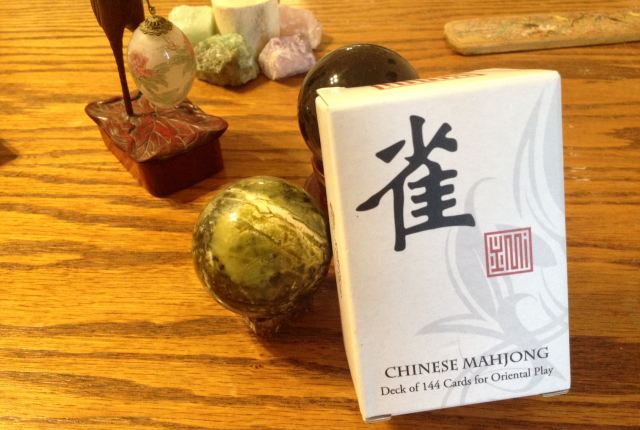
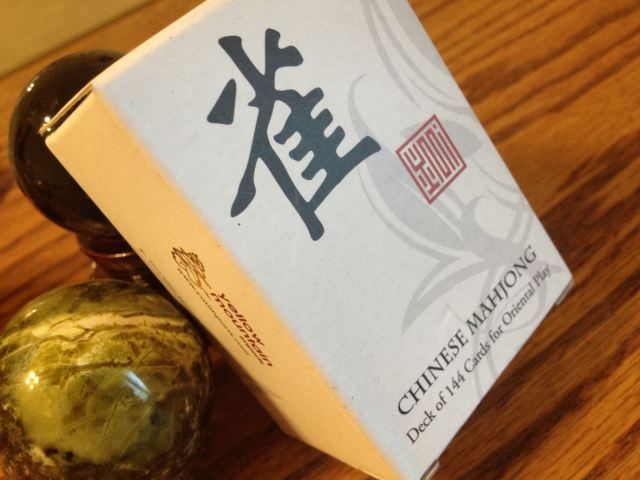
Recently I’ve been inspired to hunt down my own mahjong set, but there is a reason Chinese people get special tables for mahjong– the darn thing takes up a lot of space. There’s just a crap ton of tiles that make annoying clicking sounds when you shuffle, and the tiles remind me of Joy Luck Club or something, I don’t know. I knew I wouldn’t be using my set for games, and it’d be strictly for divination study. Intuitively, a whole set of mahjong tiles (the standard click-clack ones Chinese folk play with) didn’t feel right in my reading room, my personal sacred space. So. I opted for a more discrete alternative– mahjong in the form of cards. They have that now! It’s awesome. It’s a deck of 144 cards.
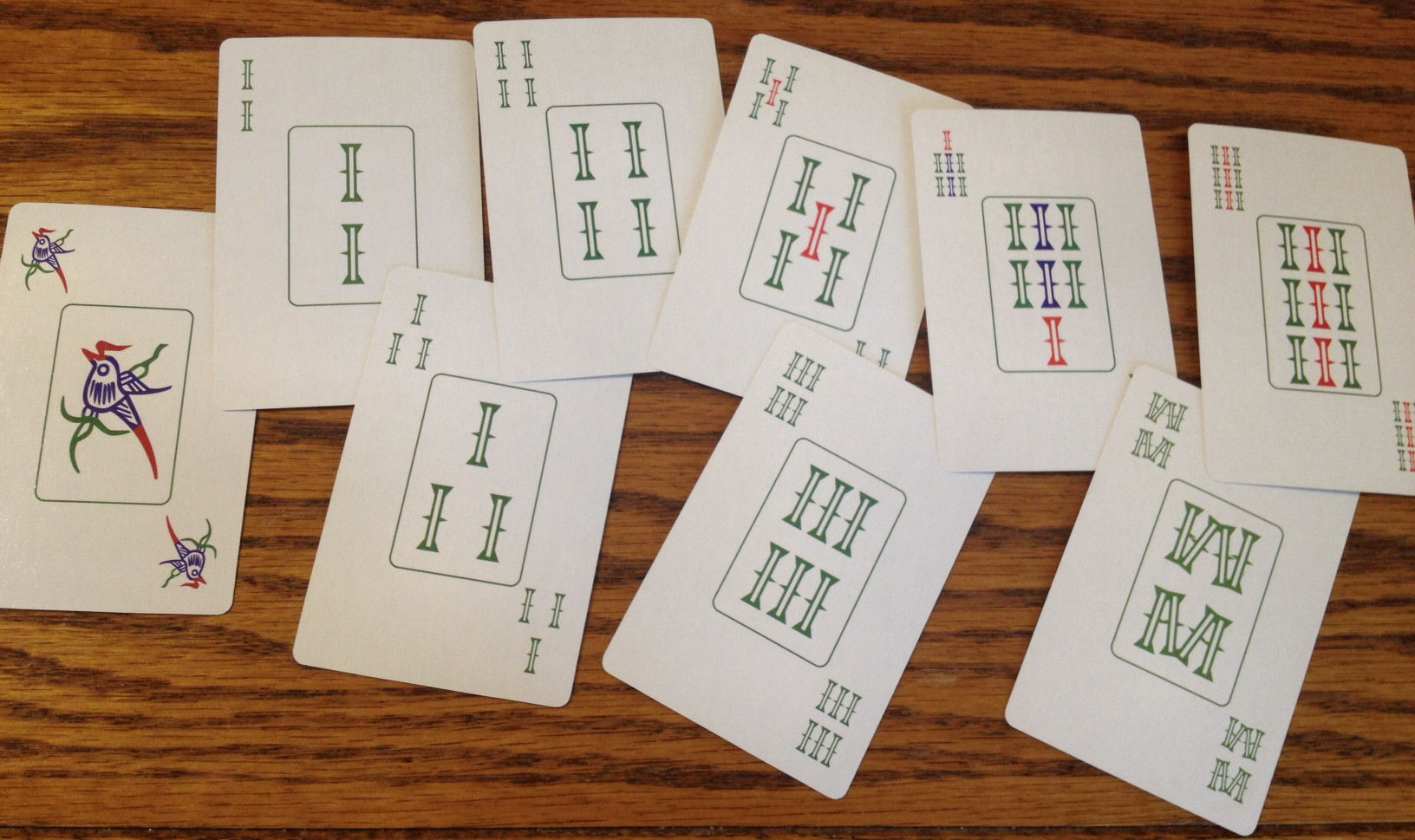
I’m using a cute little deck referred to simply as “Chinese Mahjong: Deck of 144 Cards for Oriental Play” published by Yellow Mountain Imports. You can get it off Amazon for all of five bucks. It’s great. The card quality is kind of meh. They didn’t produce this particular deck with esoteric or spiritual work in mind, that’s for sure. There’s a tacky high-gloss laminate and as you can see from the photos, it’s very, very basic in card imagery.
Mah Jong “Minors,” Suit of WheelsMah Jong “Minors,” Suit of BambooMah Jong “Minors,” Suit of Characters
Mahjong consists of 3 suits: Wheels, Bamboo, and Characters. The 3 suits are correspondent with Heaven, Earth, and Man, after the Chinese cosmological concept of the Trinity of Lucks.
Heaven Luck represents circumstances you’re born into, beyond your control, like the social class of your parents or innate talents and physical attributes, i.e. nature. Heaven Luck is believed to be pre-ordained.
Earth Luck is your geographical location, and how where you are affects what you do or who you become, i.e., nurture. Earth Luck is your environment and how your environment helps or hinders your success.
Man Luck is free will, what you do with yourself, the choices you make, your education, your actions, behavior, attitude, etc.
Additionally, Wheels often indicate life circumstances, events, conditions, or things that “happen” to you, things beyond your control that you’re just going to have to figure out how to deal with, the cards you’ll get dealt; Bamboo will talk about wealth, finances, money matters, security; Characters talk about career, education.
Super-traditionally here, marriage was seen as orchestrated by the fates, and so might get expressed in a reading through the Wheels, or if some important things were about to go down, with the Honors or Supreme Honors (more on that later). So it wasn’t like in tarot divination where you might have a whole suit (i.e., Cups) associated with love, relationships, and our emotional plane. The emotional plane wasn’t really seen as this whole separate matter that might require its own suit. So there wasn’t a suit for it. Interesting cultural differences here, me thinks.
The Resonance Oracle by Dara Caplan is a deck of 40 cards, 40 exquisite works of art with accompanying messages that were said to have been channeled through the deck’s creator, Ms. Caplan. The deck is “created with the magic and energy of intent,” or as the book also describes it, the power of attraction.
Lately I’ve been curious about channeling, so I am intrigued by the premise of this deck. The cards come in a high-gloss, sturdy box with a magnetic top flap. I’m surprised at how few Schiffer decks I have, so it’s nice to get to work with this one. The deck set is made in China, though overall I have few complaints about the quality.
The card backs are not reversible with a naturalist feel to the art, and based on the Guidebook, it doesn’t appear to be a deck intended for reading with reversals, though one card in the deck got me scratching my head about the reversals. We’ll get to that later on.
One really neat attribute to this deck you’ll notice right away is that all the cards are horizontal, in landscape, and not the typical vertical setting we’re used to. I really like that. I also like the modern sensitivity, for example in the “Communication” card, seeing the Blackberry.
I can’t tell if it’s the printing quality or if it’s the artwork itself, but this is a very dark deck, as in very dark, saturated colors in the paintings and dark borders on the cards. The art is done on black backgrounds, and so given the style of art, as a publisher I might have opted for a matte finish, instead of the super-high-glossy finish that this deck comes in. These cards are so shiny, I had trouble taking photos. There was a glare in every pictures and you could see the reflection of my camera on the cards.
* Note: I looked up Caplan’s artwork online and it really is the print quality. Her art has a much more balanced quality between light and dark when you see the works on a computer screen, but in these cards, all the colors muddle together a bit and look dark. However, the dark muddle look ultimately works for the deck’s purposes, so I like it. It really sets the right mood.
Let’s try something a bit different from my usual deck reviews. Here’s a one minute video offering you a substantial sampling of the card images. Set to public domain Edvard Grieg’s Sonata in A Minor for Cello, Opus 36, the second movement. Something about the vibe of this deck just said Grieg to me. So here we go (promise it’s short–just 1 minute!):
Way of the Horse: Equine Archetypes for Self-Discovery is a magnificent oracle deck by Linda Kohanov with paintings by Kim McElroy. The set is published by New World Library, a California-based New Age independent publisher that has published the likes of Joseph Campbell before.
I love horses. I always have. As a kid, I got this how-to-draw book on horses and I lugged that book and a sketchpad everywhere until I mastered– okay, “mastered”– the art of drawing horses. I then ended up marrying Hubby, who was born in the year of the Horse per the Chinese zodiac. So the spirit of horses and I have a thing.
Thus, it’s no surprise that I connected to the Way of the Horse oracle deck right away. It’s also a beautifully packaged book and deck set. Good job, New World Library! Wow. What an absolutely magnificent product to behold.
The box set includes a slot for the hardcover book, a book that has that 1980s library book vibe to it, or at least that’s my impression. Then the back half slot opens up (and closes magnetically) to reveal the deck.
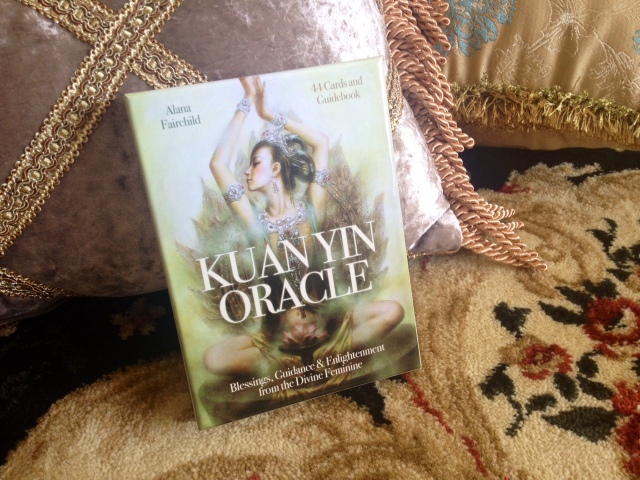
The Kuan Yin oracle deck by Alana Fairchild with art by Chinese painter Zeng Hao caught my attention as soon as it came out on the market. It’s published by Blue Angel, an affiliate partner with Llewellyn. I wanted the deck for Zeng Hao’s breathtaking artwork and also because it’s Kuan Yin.
Both my paternal and maternal grandmothers venerated Kuan Yin and so did my husband’s maternal grandmother. My mother has an altar in our home for Kuan Yin. When I was little and afraid of the dark, not wanting to go to sleep, crying out for mommy, my mother would come in to my room and tell me to recite this mantra that included Kuan Yin’s name, which would keep me protected. Kuan Yin is the energy I invoke any time I seek protection or personal fearlessness. I never really thought of her as the “Divine Feminine,” but okay I can work with that interpretation.
(As a practicing Buddhist who has studied at monasteries since the age of ten, I’ve literally never heard Kuan Yin associated with the “Divine Feminine” until white people got involved. Just saying.)
To kick off this review, let’s start with a divination for you. Look at the three cards above and choose one, left, center, or right. Be receptive to what message most needs to be conveyed to you right now. Hold that thought. Continue reading “The Kuan Yin Oracle Deck: A Review”→
A Sea of Calm is a self-published 52-card mandala oracle deck by Fiona Stolze. I got a deck from the second printing and just love the artwork. In true contemporary oracle deck form, each card features a keyword or phrase, which can be applied to the divinatory exercise at hand. The deck has a calming, soft energy with exquisite mandala art by Stolze. These are paintings on silk printed onto borderless cards with captions like “Embracing the Divine Feminine,” “Thy Will Be Done,” or “Synthesis.”
The cards are a good fit in my hands, at 2.75″ x 4.75″ and altogether make for a rather slim deck, so it transports easily alongside a tarot deck. The deck description on Stolze’s website notes that the deck is ideal for meditation and contemplation.
Mandalas are, in a nutshell, an art form intended to express the artist’s perspective of the universe, or a certain part of the universe. Religiously, they’re used to help establish sacred space. Thus, an oracle deck of mandala art would be ideal for practitioners who use tarot or oracle decks in meditation. I’d imagine they’d work pretty well, too, for work on the astral plane.
I’ve fallen in love… with the Tao Oracle deck by Ma Deva Padma published by St. Martin’s Press. This is the I Ching oracle deck. It’s a deck of 64 cards based on the 64 hexagrams of the I Ching Book of Changes. Padma’s paintings are emotional, textured, and fully expressive of each of the hexagrams they represent. A quote from the artist: “The evolution and creation of my paintings is sparked by a deep and intensely personal journey into the realm of the subconscious — the kingdom of archetypes and the home of mysterious symbols.”
The deck is beautifully packaged in a sturdy high-gloss box. It comes with a 310-page perfect-bound guidebook that contains the author’s personal interpretations of the 64 hexagrams. St. Martin’s Press really out-does the more popular tarot and oracle deck publishers du jour. I cannot praise the quality of this deck enough.
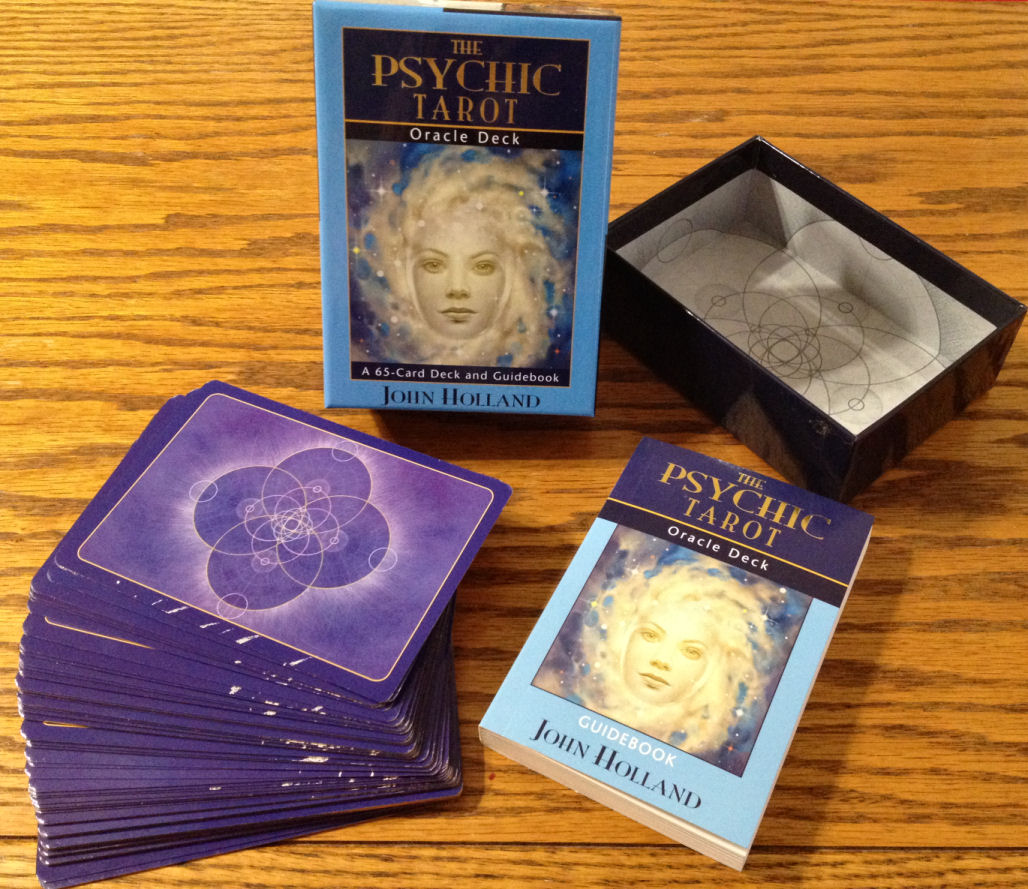
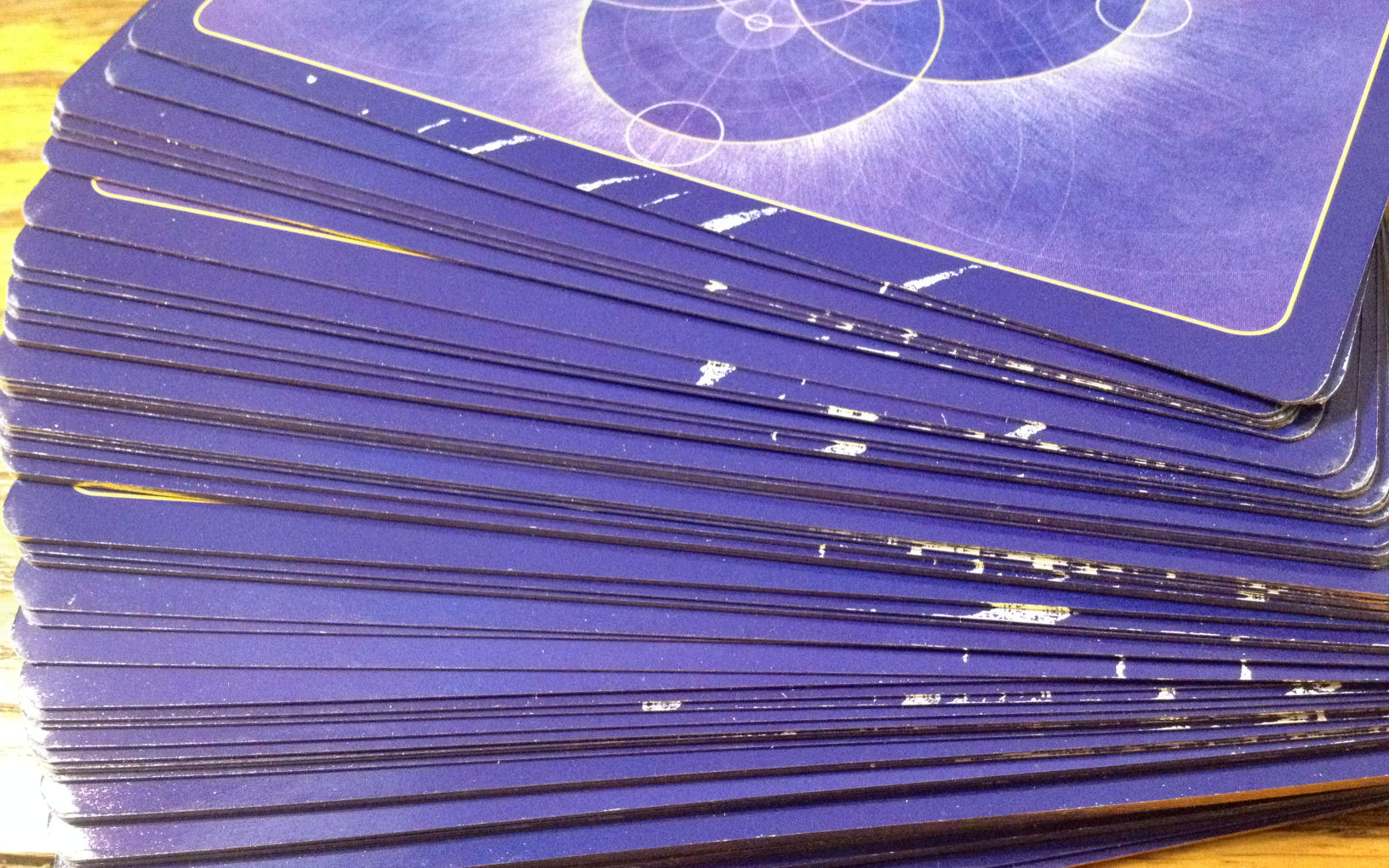
I’m not liking the Psychic Tarot oracle deck at all. I mean, let’s just start with the above photo of the cards. Look at the quality. This is a brand new deck mind you. I bought it still encased in shrinkwrap. All that white stuff you see along the edges of the card backs is how these cards came, brand new.
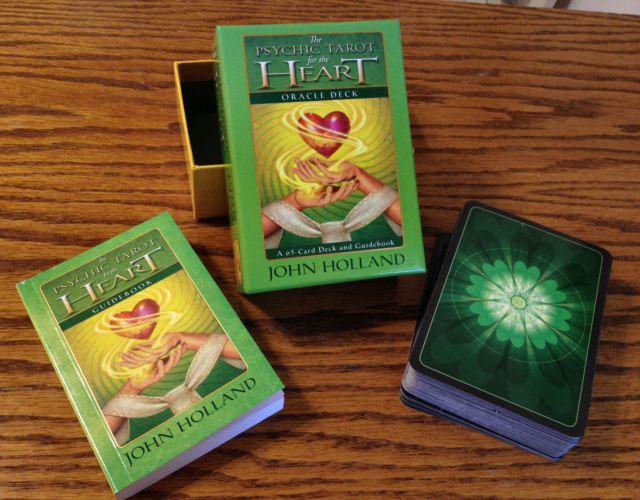
It’s a fortuitous thing that I got my hands on the Psychic Tarot for the Heart before this one, otherwise I’m not sure I would have had the mind to give the Heart one a try. Earlier I reviewed Psychic Tarot for the Heart here.
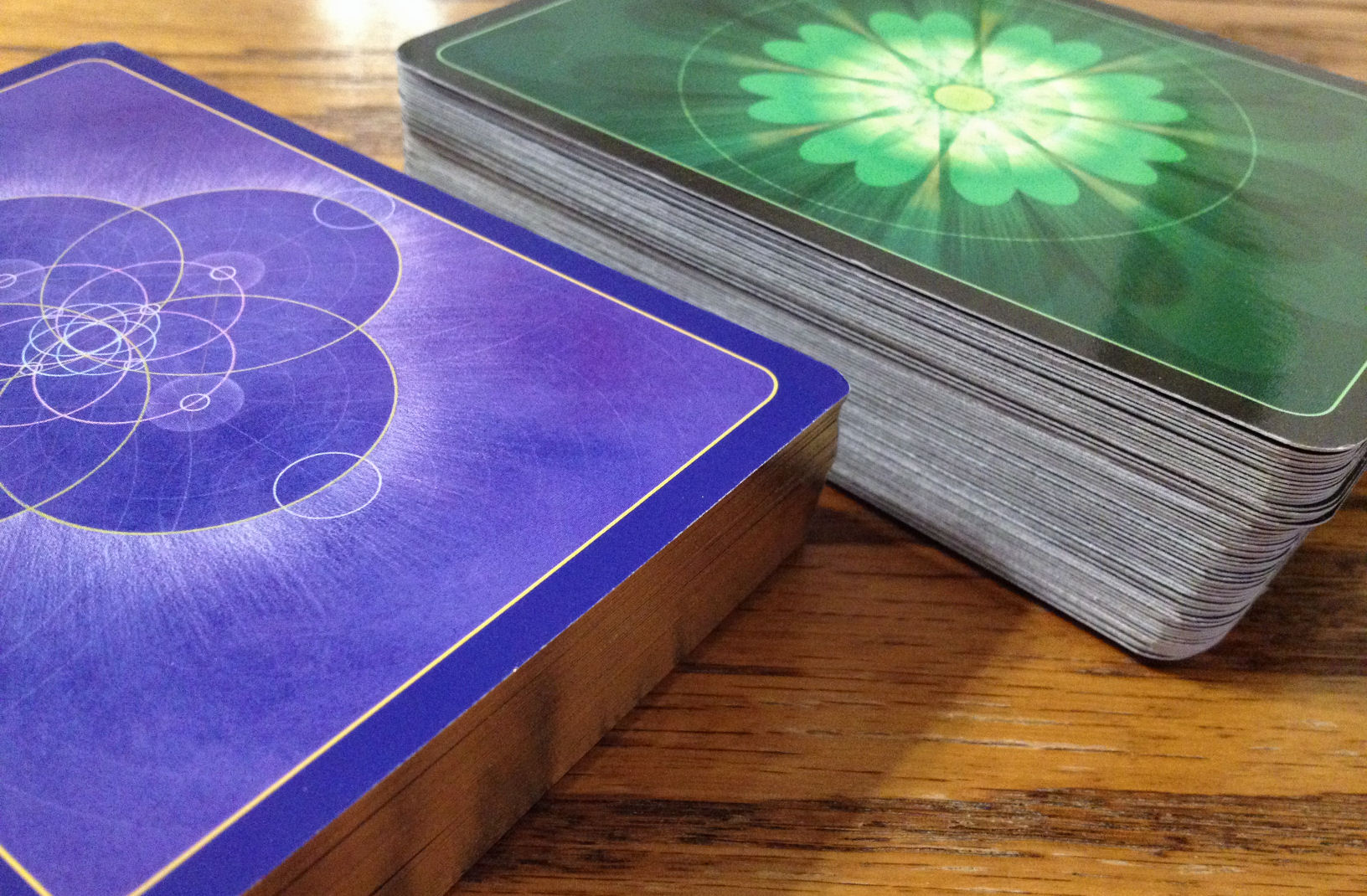
Here is a close-up of the cards. I’m digging the reference to sacred geometry on the card backs and throughout the packaging (such as the interior of the box that the cards come in), but if returning these cards and getting a refund wasn’t such a hassle, I have to tell you, that is exactly what I would have done.
And…here’s the front of the cards. It wasn’t that the plastic wrap peeled the coloring of the cards off. That was my first hypothesis, but the plastic wrap was clear. It came like this! Many of the cards from the center of the deck, which wouldn’t have come in touch with plastic wrap or anything sticky, had that white scrape-y stuff.
I believe both the Psychic Tarot and the Psychic Tarot for the Heart oracle decks have the same number of cards, but look at the thickness of the Psychic Tarot deck compared to the Heart one. Yes, I am dazzled by the gold gilded edges of the Psychic Tarot, but that wasn’t enough to appease me. I much, much, much prefer the Heart one over this deck. I’m so bummed. And the backs of the Psychic Tarot are so nice, too!
The Psychic Tarot for the Heart oracle deck by renowned American psychic medium and author John Holland is keenly accurate. I recommend having it on hand, whether you know nothing about tarot and oracle cards or you’re a pro. It’s great for pulling cards when a sub-issue raised during a tarot reading might need supplemental information, which is how I use it. If you’re not that into tarot, then this is a really great deck to have, because you simply ask a question, pull a card, and the keyword you get pretty much answers that question and in this deck, a picture truly does tell a thousand words. The end. You don’t have to learn any traditions or take this deck to bed and study each card symbol by symbol. I can’t put my finger on why exactly this deck works so well, but it does.
However, I’m not so sure it’s suitable for professional readers as the exclusive tool. If you’re programmed to read tarot and love tarot and eat, sleep, and breathe tarot, then I would surmise that the Psychic Tarot for the Heart oracle deck won’t be right for you. That said, I highly recommend this deck for gift-giving, especially to those who are not full-force into tarot but are looking for a go-to oracle deck that will answer questions succinctly and be really spot on in its assessment of a given situation. On a mass consumption level, it’s actually a fantastic oracle deck for asking quick questions and getting quick answers. The messages and affirmations in the accompanying Guidebook are empowering and I really mean it– it’s an extraordinary oracle deck [for someone not that into tarot] to consult everyday.
Tarot folk can get very set in our ways, which isn’t a good thing, but because of how set we can be, sometimes getting such a person to try out an oracle deck like this one may be a hard sell. If, however, you’re someone who loves oracle decks already, then without reservation I’m telling you you’re going to like this deck.
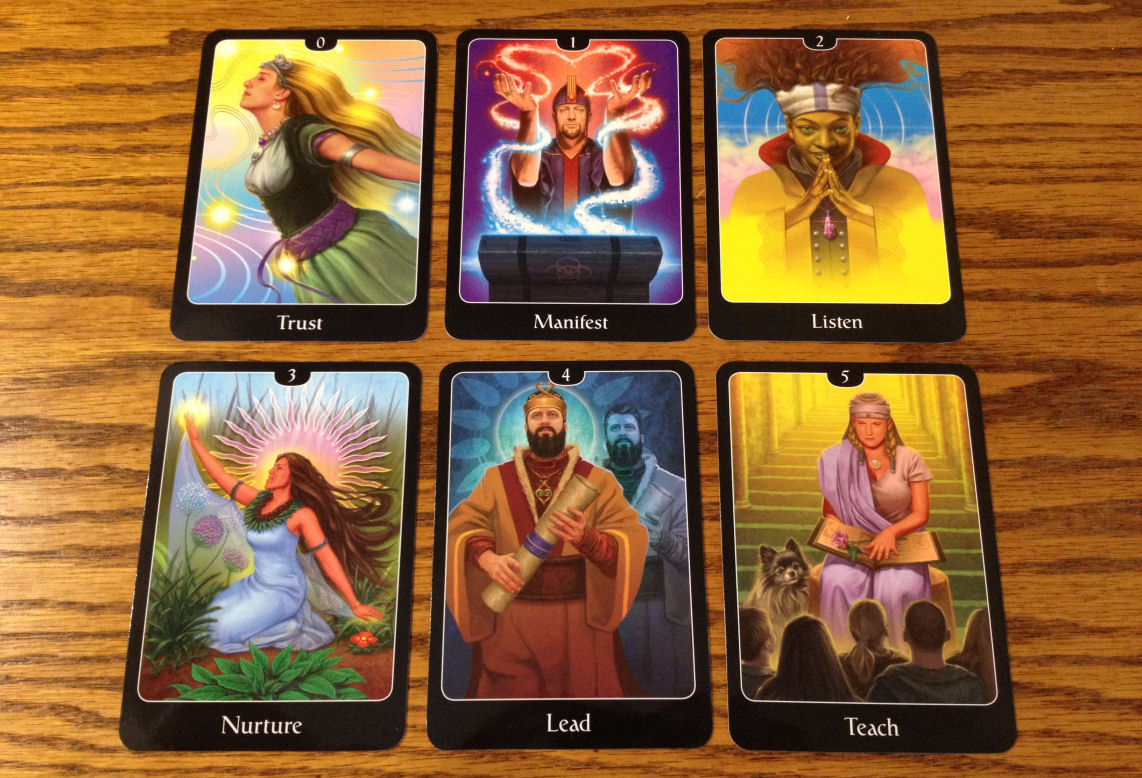
Keys 0-5 in the Psychic Tarot for the Heart Oracle Deck








 benebell wen