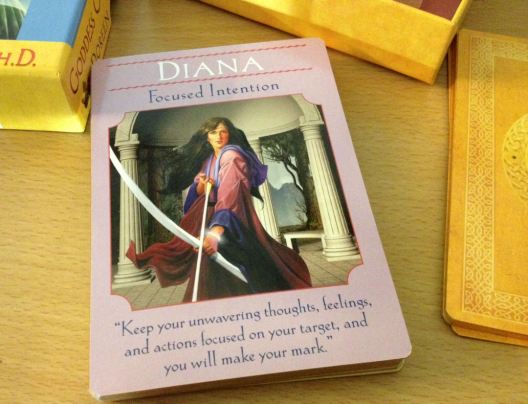
A Review of Doreen Virtue’s Goddess Guidance Oracle Cards

goddessguidance_2

Here’s the thing. I’m such a snot. I didn’t want to like this deck. Oh no. I wanted to sneer at it. I wanted to toss my chin and hand up in the air and say, “What fluff!” But…

…I like it. I do. I really like this oracle deck. Deep down, I’m just a big fluffy bunny rabbit tarot practitioner. Because I really like Doreen Virtue’s Goddess Guidance oracle cards.

Continue reading “A Review of Doreen Virtue’s Goddess Guidance Oracle Cards”

The Poet Tarot: A Divinatory Tool for Poets and Writers

0_PoetTarot

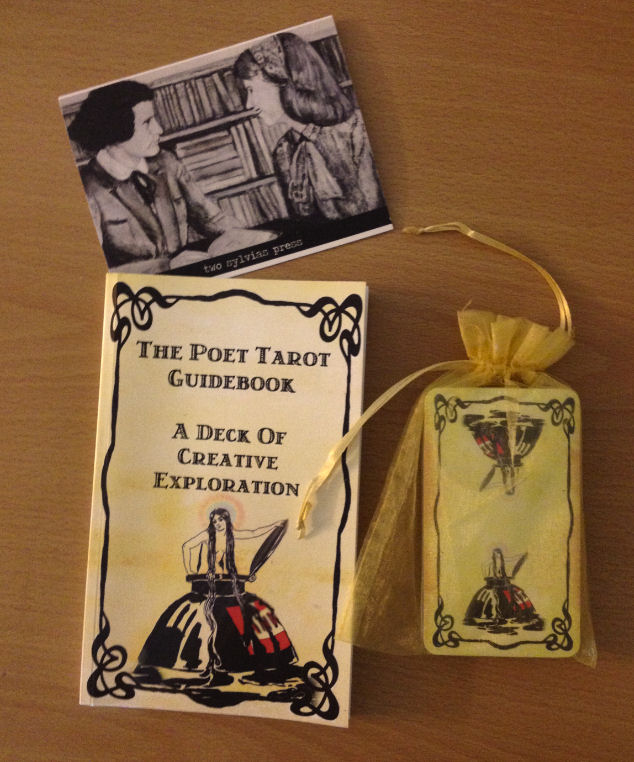
The Poet Tarot published by Two Sylvias Press has just made its debut at the 2014 AWP Conference in Seattle. It was created by Kelli Russell Agodon, who is herself a writer, editor, and poet, and Annette Spaulding-Convy, also a poet. I received an advance review copy and am loving it! This will be one of those amazing decks I use when reading for poets, writers, and artists.

There may be some debate as to whether the Poet Tarot is a tarot deck or whether it is an oracle deck, but more on that later. I tend to see it more as an oracle deck for reasons I’ll explain.

Poet_Tarot_11

The deck comes in a yellow organza drawstring pouch along with a guidebook, and you will definitely need the guidebook. The dimensions of the cards are about 2.75″ x 4.75″, which for me is the perfect size to shuffle with. They’re very snug in the hands. The guidebook is 5″ x 8″ and while that would not bother me ordinarily, I can’t imagine using the Poet Tarot deck without the guidebook, and so for that, if both were the same size, I could put both in the same pretty cedar box and keep them together on my writing desk, no problem. I have to imagine that as writers come, I’m not alone in that sentiment. Due to the specific nature and purpose of this deck, it would just make more sense to have the guidebook be the same size as the cards, with the intention that the two will always accompany one another.

2_Majors_1

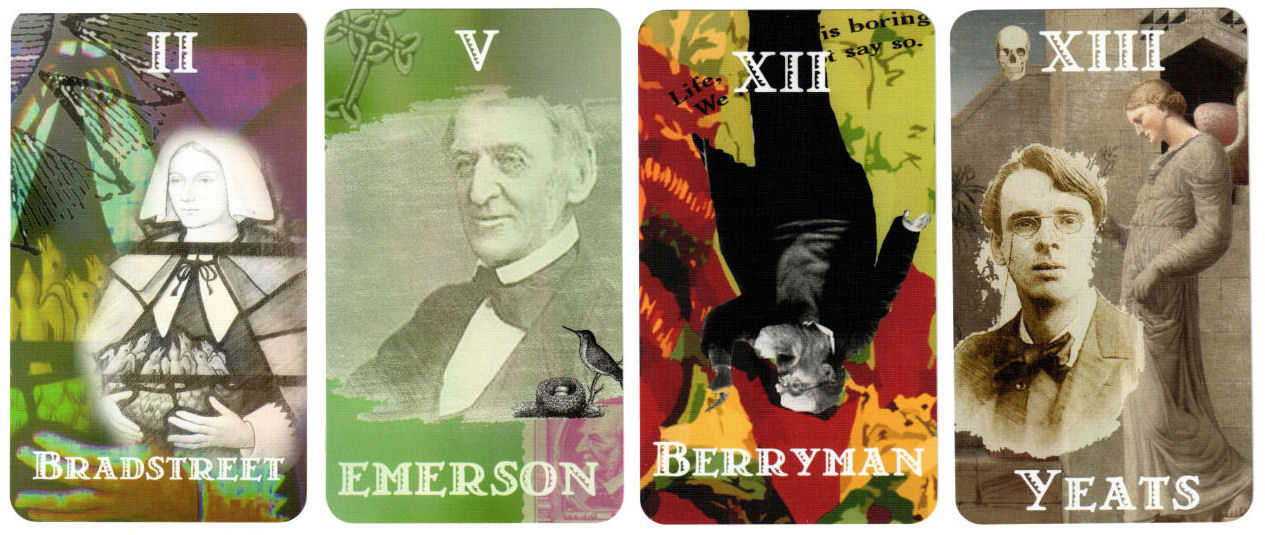
The art of the deck is in a digital collage form that blends Victorian art and imagery with poet busts in a wholly contemporary style. It’s really breathtaking to look through and has a natural appeal to most 21st century writer sensibilities. They’re borderless like many contemporary decks today, and the borderless design suits the deck well.

Once you hold this deck, you’ll know that every aspect of it was designed for the writer in mind. I just want this deck (and its guidebook) in an ornate wood box in the corner of my writing desk next to Strunk & White. You know what I mean?

The cards are subdivided into the Poets (Major Arcana) and the Suits. The Suits are Quills, Muses, Mentors, and Letterpresses, corresponding with Wands, Cups, Swords, and Pentacles respectively. The four suits represent the four stages of the creative writing process: Quills for creation, Muses for inspiration, Mentors for revision, and Letterpresses for completion. I really love the thoughtful way Agodon and Spaulding-Convy have designed the Poet Tarot deck.

Continue reading “The Poet Tarot: A Divinatory Tool for Poets and Writers”

Minchiate Cards for Divination: My Review

minchiate

It is said that like tarot, the origins of the minchiate are not verifiable, but was probably a card game played in the late medieval period. The version I have at home is a reproduction of the Etruria deck from 18th century Florence. Like tarot, the imagery on the cards and scope of the depictions seem extraordinarily well suited for spiritual, metaphysical, or divination work and in many ways, the minchiate even more so than tarot.

There are 97 cards in total, consisting of trumps like tarot, 22 with the addition of 4 cards representing the theological virtues, 4 cards representing the elements, and 12 cards representing the zodiac signs. That’s 41 trumps and 56 numbered cards, with the numbered cards similar to tarot: 4 suits, Ace through Ten, and then 4 court cards.

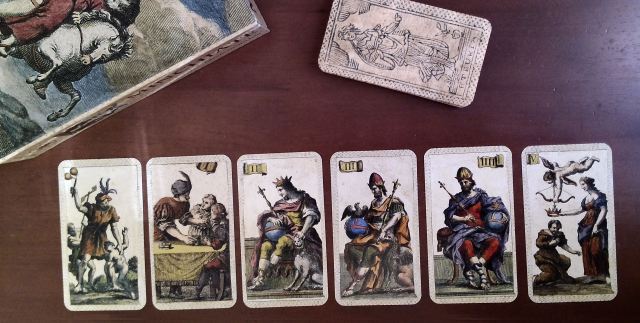
The photograph below shows the unnumbered Madman (corresponding with tarot’s The Fool) and Keys I, II, III, IIII (IV), and V. Key I is the Performer, which corresponds with tarot’s The Magician. Keys II, III, and IIII (IV) in the minchiate are the Grand Duke, the Western Emperor, and the Eastern Emperor, which some say correspond with tarot’s Empress, Emperor, and Hierophant respectively. Key V is Love, corresponding with tarot’s Key VI, The Lovers.

The numbering of the keys in the Minchiate is significantly different from the tarot. For example, in minchiate the Temperance card is Key VI while in tarot it is Key XIV. There is no Hermit card per se, but there is Father Time, which is said to correspond with the Hermit. Most notably, the final card of the Trumps is not The World as in tarot, but rather the Trumpets, corresponding with the tarot Judgement card.
Minchiate_Trumps0to5

After the minchiate Key XV The Tower, there are the four theological virtues: Key XVI, Hope; Key XVII, Prudence; Key XVIII, Faith, and Key XIX, Charity. See below.

Minchiate_4Virtues

Although there is no direct correspondent in minchiate to the tarot High Priestess card, some speculate that the Faith card corresponds with the High Priestess. For me, in the Etruria deck, the illustrations are confusing. The picture on the first card above calls to mind Faith for me, but it’s the Hope card. The second card (left to right) reminds me of vanity for some reason, rather than a virtue, and yet it’s Prudence. The third card shows a woman, likely from the laboring class, looking at or reading something. It only somewhat fits my conception of Faith. The last card, Charity– either you know the meaning or you don’t. Little about the card’s imagery strikes me as denoting charity. But hey, this is all just me.
Michiate_4Elements

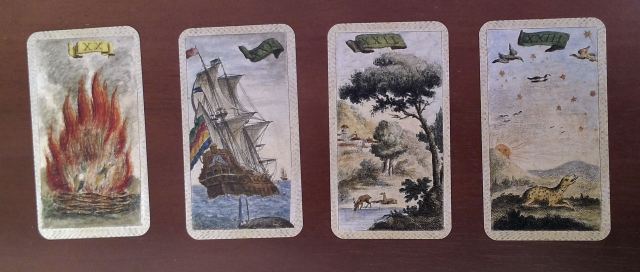
Following the four theological virtues are the four classical elements in the following order: Fire, Water, Earth, and Air. (Compare that to the order of the elements per the contemporary majority view in tarot practice: Fire, Water, Air, and Earth.) When the Fire card appears in a reading, it suggests the relevance of innovation, passion, ambition, and leadership. The Water card denotes alliances, intuition, and compassion. The Earth card, stability, conservatism, conviction, and resourcefulness. Air, idealism, intellectualism, communication, and also ambition, though the Fire-based ambition usually relates to progress while the Air-based ambition relates to conquest.

Minchiate_12ZodiacSigns

In the minchiate there are also cards for the 12 signs of the zodiac. Pictured above in the numerical order they appear in the trumps:

Top Row (L to R): Libra, Virgo, Scorpio, Aries, Capricorn, Sagittarius

Bottom Row (L to R): Cancer, Pisces, Aquarius, Leo, Taurus, Gemini

After the Trumps, the 56 numbered cards in the minchiate are similar to the tarot. There are four suits and their correspondences are as follows: Wands for work or career; Chalices (Cups) for emotions and relationships; Pentacles for money matters; and Swords for the abstract and philosophical. Among the court cards, Knaves (or Pages) denote education and learning; Knights about courage, action, and choice; Queens about a relationship; and Kings about decision-making and authority. Note further that the minchiate correspondents to the Pages are specifically 2 Knaves for the active suits (Fire and Air) and 2 Maids for the passive suits (Water and Earth).

Continue reading “Minchiate Cards for Divination: My Review”

The Lenormand: Nutshell Summary of the Petite Lenormand, from History to Practice

lenormand1

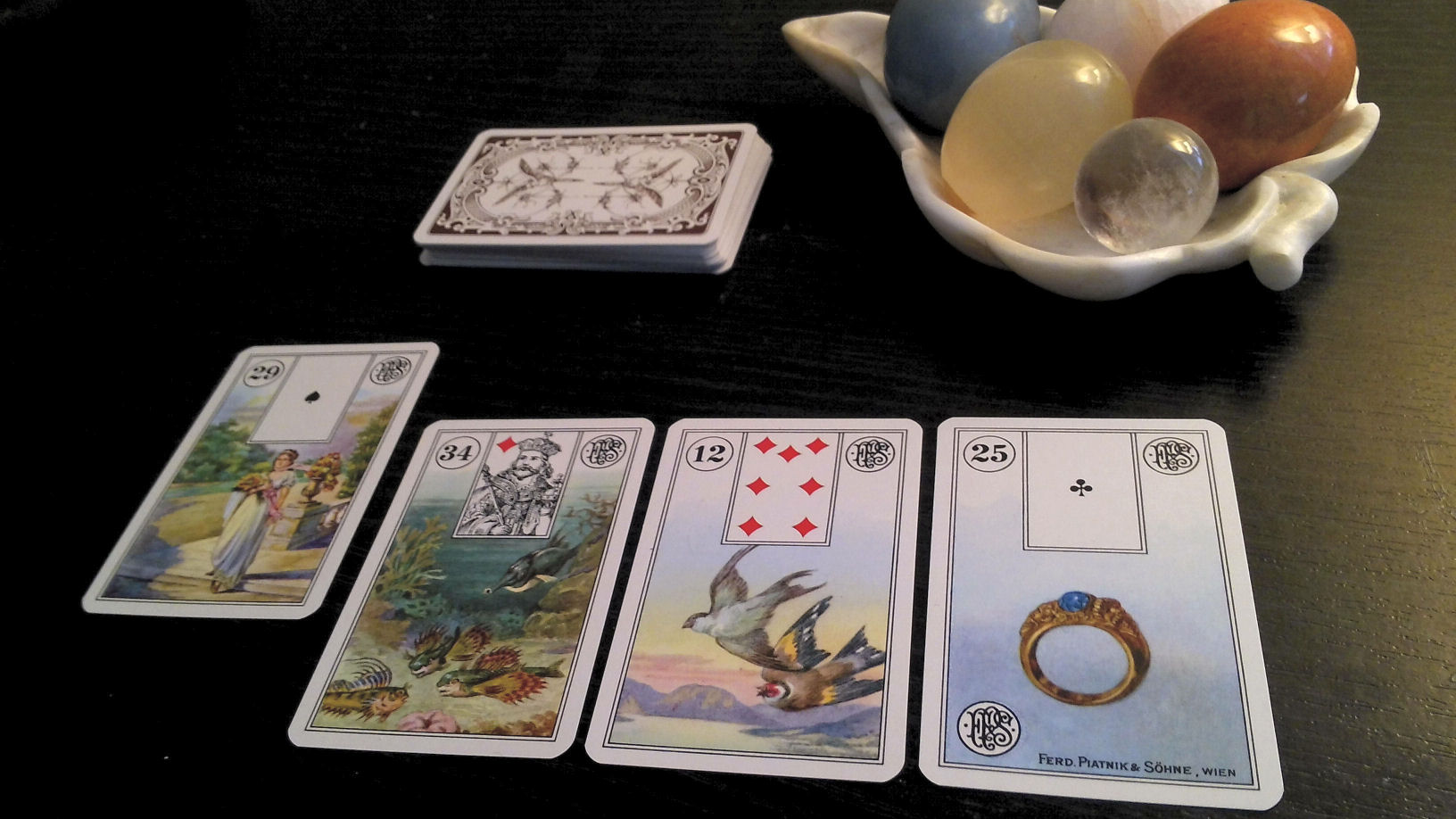
The popularity of Lenormand cards seem to have been revived for contemporary times, at least here in the U.S. Lately it seems that every tarot enthusiast will go through a phase of intrigue for these Lenormands. Well the other day a student asked me to guide her studies of the Lenormands. From there, I decided to write this nutshell summary. For the tarot enthusiast who has now suddenly taken on an interest in Lenormand cards, this post will serve as an introduction.

Overview

They’re oracle cards, not tarot, and generally speaking, they’re sub-divided into 2 kinds: the Petit Lenormand, with 36 cards total, which is the more popular version here in the U.S., and the Grand Jeu Lenormand, with 54 cards. I have not yet dabbled with the Grand Jeu Lenormand due to difficulties in getting a deck where I live (that is, for an economically reasonable price…because, sure, you can buy anything via the Internet these days), so I’ll focus on the Petit Lenormand only.

The oracle cards are named after Marie Anne Lenormand, who is considered one of the greatest and most influential French cartomancers of all time. However, the cards were not conceived by her. They were conceived after her death and may or may not have even been based on any of the cards used by Marie Anne Lenormand. They’re called “Lenormand cards” pretty much for marketing purposes. In fact, they may not even be French. Johann Kaspar Hechtel, a German businessman and factory owner, is credited with designing the Petit Lenormand cartomancy deck, initially as a parlour game called “The Game of Hope.” So in many ways, the name “Lenormand cards” might be a bit misleading.

Continue reading “The Lenormand: Nutshell Summary of the Petite Lenormand, from History to Practice”

Tarot on Shahs of Sunset?

shahsofsunset1

Okay, so it looks more like straightforward cartomancy than it does tarot, but still. Also, it looks like I have to own up to a guilty pleasure before proceeding: yes, that’s right, I’ve been watching BravoTV’s Shahs of Sunset, a reality show that follows a cast of socialite Persian Americans in Beverly Hills.  In Season 2, Episode 2, two of the main cast members, Asa and Reza consult with a Persian psychic, Shohreh.

shahsofsunset2

Sitting in a Los Angeles cafe, Habibi Cafe to be exact, Shohreh uses a deck of oversize cards to read about Reza. From what I could see, there are pip cards, as opposed to the pictured suits of the RWS, Thoth, or other contemporary decks.

shahsofsunset3

Also, whatever it was the psychic told Reza, he seemed thoroughly impressed. And where did she get that oversize deck? I want one.

Yes, this was a meaningless post. Just happy to see cartomancy get some air time.

I Ching Dead Moon Oracle Deck: Gothic Asian?

Name of Deck : I Ching Dead Moon Oracle Deck
ISBN : 978-0738732602
Publisher : Lo Scarabeo
Publication Date : March 5, 2012
Card Size : 2.5” x 4.5”
Authors/Illustrators : Luis Royo
Total No. of Cards : 64

I love the I Ching Dead Moon oracle deck by Luis Royo… As a collector’s item, that is.

Royo’s artwork in Dead Moon is what I’ll describe as East Asian post-punk gothic rock that borrows imagery from Japanese samurai culture and imperial China, altogether with lots of blood, wild black hair, and intricate tattoos. And the consistent depiction of inclement weather in the backdrop.

In other words, awesome.

Sure, there’s some hypersexualization and exotification of Asian women in there, but let’s just agree that post-colonial social politics will be beyond the scope of this deck review.

Without question Royo’s Dead Moon deck is one of the best on the market when it comes to art. It is an oracle deck, however, and not tarot in the traditional sense. As it is based on the I Ching, the oracle deck has 64 rather than 78 cards, each corresponding with one of the hexagrams from the I Ching. However, the Dead Moon I Ching deck is haphazard with the illustrations. They don’t necessarily correspond with the hexagram it’s supposed to represent. Other I Ching oracle decks, such as the I Ching Tarot by Kwan Lau, depict images that the illustrator believes represents the meaning of the hexagram. If that was Royo’s intention, then it may have failed, at least for me.

deadmoonhx2

For example, Hexagram 2, Kun, or Earth, represents stability, support, strength, fertility, nourishment, etc. It’s a hexagram that reminds us to be calm and receptive to the natural world around us. In other I Ching oracle decks I’ve come across, Hexagram 2 is usually represented by a tree or a Mother Earth type figure. In the Dead Moon deck, we’ve got a half-naked forlorn looking woman who is kneeling, looking down. There may or may not be a waterfall in the background. It’s an incredible work of art, no question, but perhaps not the most comprehensive image to symbolize Hexagram 2. Not to mention there are no words on any of the cards to suggest what the hexagram you’re looking at is, other than the number. So either you know it or you don’t. No hints, anywhere.

As a result I found it difficult to use. When the I Ching is used on its own for divination, you consult the book after yarrow stalks or tossing coins or what have you. When the tarot is used on its own for divination, you interpret the meaning through the imagery and symbolism on the cards. A divination fusion of I Ching and tarot, one would think, would mean the ability to interpret the meaning of the hexagram via the imagery and symbolism on the oracle card. For Dead Moon, not so much.

deadmoon4

For instance, Hexagram 9, Shiao Chu, is about restraint and propriety. I just don’t get that from the card’s imagery. In fact, the woman on that card looks sexually inviting. Hexagram 11, Tai, is about reaping the fruits of your labor; success. Stunning artwork in Hexagram 11, but it makes no sense as applied to the meaning of Hexagram 11. Hexagram 22, Bin, is about grace and beauty. The image of the woman depicted therein kind of works for me but also kind of doesn’t. If I didn’t know the meaning of Hexagram 22 prior to encountering that card, I would not have guessed “grace and beauty.” Maybe melancholy.

The deck did not work for me when I applied traditional I Ching divination techniques and it did not work when I applied it to my go-to tarot and cartomancy spreads. I know I said that that post-colonial social politics is beyond the scope of this review, but the scantily clad, sexually objectified Asian women were offensive to me. Aren’t we beyond that kind of antifeminist and racist behavior yet?

deadmoon3

What’s more, to use Dead Moon as an oracle deck, the practitioner would need to be quite advanced and highly knowledgeable already of the 64 hexagrams. With no keywords, no card titles, illustrations that for the most part have little to do with the hexagrams, none of the symbolism of the original I Ching, and a barebones booklet that offers a shallow interpretation of Tao, if you don’t know the I Ching going into the Dead Moon, you won’t learn much about it after using the deck. Truth be told, I found the artsy-gothic-lots-of-sexy-Asian-women-and-hot-warriors deck of cards unappealing as a representation of the Tao, which I deeply regard.

deadmoon2

Dead Moon is not a tarot deck in the traditional sense and will be a leap for tarot readers to use. So from a marketing standpoint, who exactly is Royo targeting?

Collectors.

The I Ching Dead Moon is going to be a favorite in any tarot/oracle deck collection. The art is beautiful and the dark ambiance of the deck is altogether thrilling. However, for me, that is where the Dead Moon’s purpose ends. It does not work for divination under either of the two esoteric paradigms it claims to be inspired by, tarot or I Ching. It is pretty to look at and that is about it.