I recount this as calmly as possible. That is said more for my frame of mind than yours.
I had stumbled upon a fortune teller in Chinatown sitting at a makeshift tabletop. The chairs were miniature and when sitting, your knees would be up next to your ears. What had intrigued me to stop and listen in was her method of fortune telling: the tarot. You don’t see tarot divination that often among the Chinese, so of course I had to observe. A young woman about 20-ish years of age and her friend sat across from the fortuneteller. From what I overheard, the question was about love.
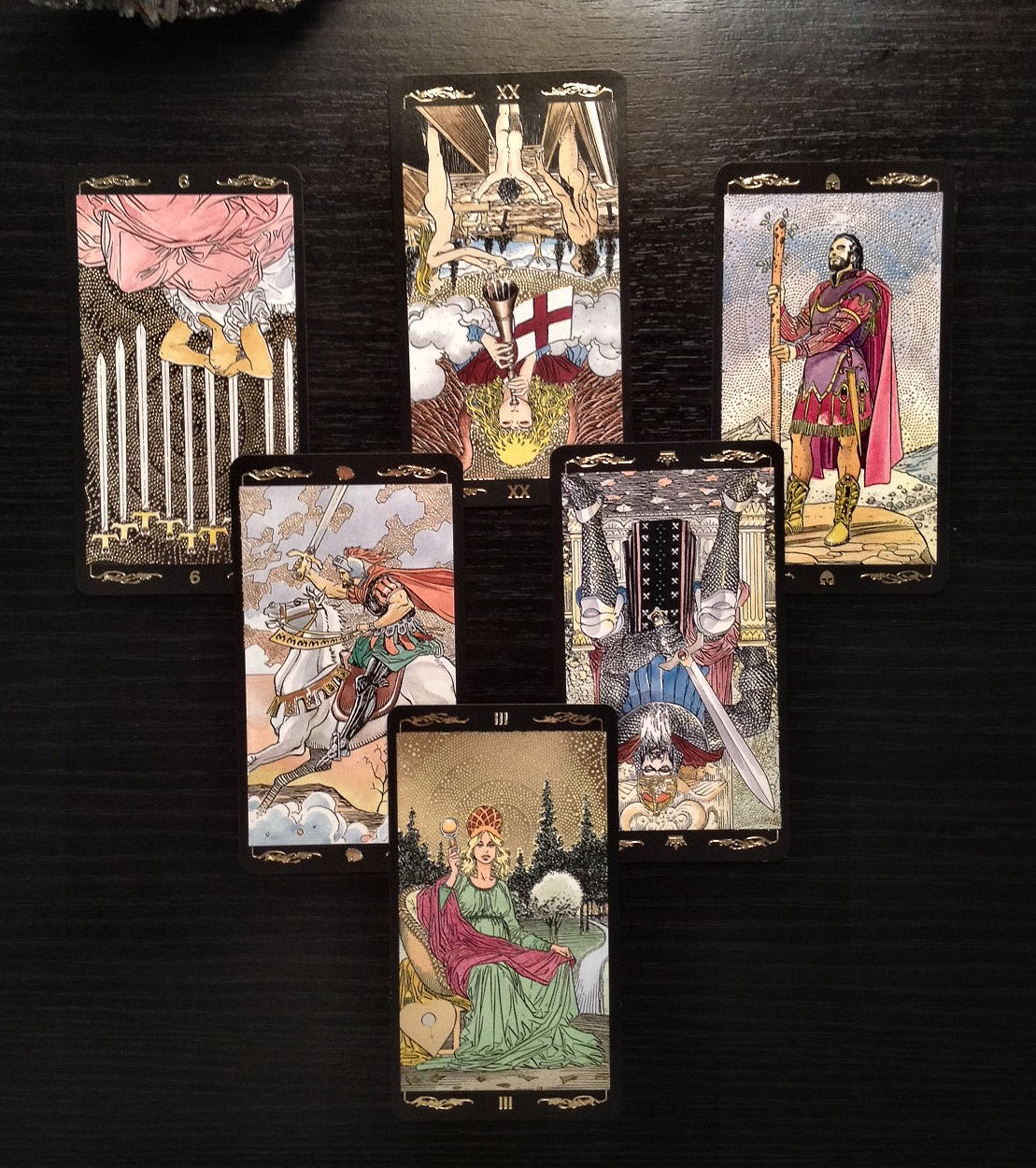
The fortune teller used what appeared to be a Marseille-based deck. I couldn’t figure out a discrete way to take photographs, so let’s assume my memory is good and go with the below reenactment, using the CBD Tarot de Marseille.
I don’t have educational degrees that would qualify me to write about any of this, so please understand that I am writing my observations within that non-expert context. Lately I’ve been fascinated with pagan and neopagan belief systems, mostly for how strikingly similar paganism is to Chinese Taoist-based folk religion.
Here’s how I understand paganism in context: Back in the day across Europe, Abrahamic religions rose to dominance, became institutionalized, and began setting up centralized bodies of authority that often started in the cities and spread its influence from there. At the fringes of the countryside, however, pagan faiths endured among the minority. These pagan faiths were polytheistic, though pantheist, strongly nature-based, and because they believed that everything was connected, it was thought that certain herbs, incantations of words, ritualistic conduct, and representations of elements could be harnessed to manifest intentions–in other words, magic exists.
Replace a few specifics from the previous paragraph and you could apply it to the relationship between Confucianism (and to a great extent Buddhism) and Chinese folk religions. These folk religions were looked upon in the same way pagan faiths were looked upon by the Christians. Those who practice pagan/neo-pagan religions (like Wicca, Druidism, Heathenry, or some form of pagan reconstructionism) tend to keep their faiths concealed or strictly private. That’s less of an issue among those who practice Chinese folk religions, and so you’ll see altars set up in Chinese businesses that still pay homage to the faiths of their [often agricultural] ancestors. However, like what pagans experience, those who still practice Chinese folk religions are considered fringe.
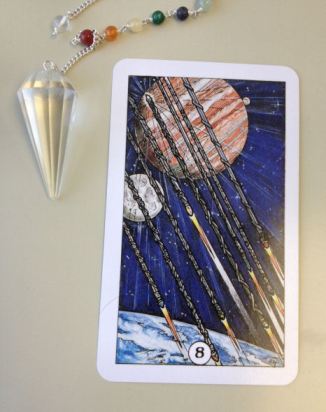
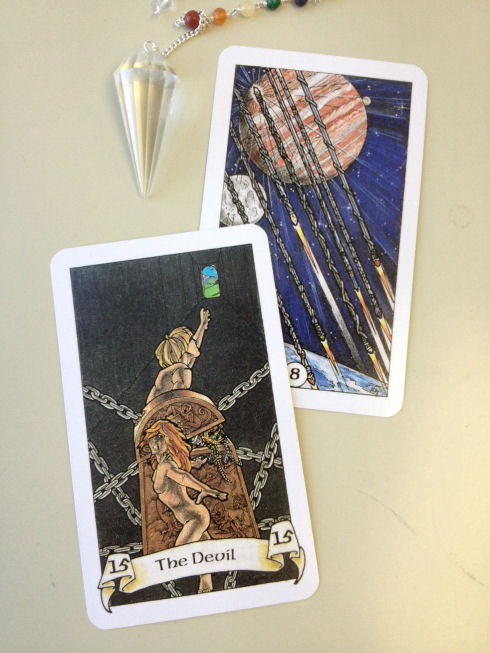
I did not want to post about this. The tragedy hit a bit close to home for me and both Hubby and I have been on top of the updates about the situation in as real-time as it can get. This afternoon I spent some time concentrating on the matter and had my trusty Robin Wood tarot deck on hand. I went through the deck to select a signifier and from the Robin Wood deck, the Eight of Wands leapt out at me as the signifier to read with for Malaysia Airlines Flight 370. Quietly, and what was going to be privately, I drew a single card for the matter. What happened next took me by surprise.
I drew Key 15: The Devil. If that isn’t compelling enough, look at the imagery on the card. I happened to select the Robin Wood tarot to read with, which is a deck with a unique take on The Devil card, different from the traditional systems.
And I’m just going to leave the posting at that. I wasn’t going to share, but wow, just wow. I may not be a mathematician, but I believe the probability of me drawing that card for this reading is about 1.2%.
from the CBD Tarot de Marseille by Yoav Ben-Dov (cbdtarot.com)
I grew up trained to fear the number 4. In any scenario where I had to be assigned a number, I would sit there praying that the number 4 would not appear in my assignment and dreading that it would. If my seat number in the exam room had a 4 in it, I’d take it as an omen of impending failure.
I’m not the only one. There’s a name for it: tetraphobia. If they’ve got a name for it, it means I’m not alone. The Taiwanese and South Korean navies avoid assigning the number 4 to their ships. In Hong Kong, Taiwan, Japan, and many other parts of East Asia, you’ll hardly ever see a 4th floor. It’s the 1st floor, 2nd, 3rd, and then 5th. For a race stereotyped to be good at math you’d think they’d know how to count. Hospitals don’t have a 4th floor for sure, and no room number in those hospitals will have a 4 in it.
To the Chinese, 4 means death. 4 means bad luck. 4 means misfortune. 4 means you’re going to suck at life. 4 means you are not a Chosen One. Chosen Ones never get number 4. They get, well, 1. Or 8. Chinese people love the number 8 the way tarot readers love the Ace of Cups or The World card. As for The World card, by most counts it is the 22nd card in the Majors and the theosophic reduction of 22, 2 + 2, is 4 and so take that tetraphobic Chinese people!
I guess back in the day in Chinese grammar schools, the concept of homonyms got glossed over. Everybody there missed the lesson on how a homonym is when two words sound the same but have different meanings. Different. So even though pronouncing the number 4 in most East Asian languages and dialects sounds the same way one might pronounce the word for death, the two words should still retain their different meanings.
Not so to the Chinese. Just because the number 4 sounds like the word for death, suddenly 4 means death. There’s some serious issues with logical reasoning there, which is hilarious to me, because in the Western tradition, 4 means logic, rationality. More on that later.
When I first started study of the tarot, especially when reading with a Marseille deck, numerological associations for the number 4 tripped me up. The numerological association for 4 seemed all too clear: you were doomed. 4 in batons? You’re doomed to fail at work. 4 of cups? You’re doomed to fail in love. You get the pattern. Growing up in the Chinese culture meant I hyperventilated just a little when the number 4 appeared in my life.
Tarot helped me overcome that fear of the number 4. Don’t laugh. I’m serious.
The Emperor might not be all sunshine and rainbows, but it is still a strong card with an empowering message. In western numerology, 4 symbolizes stability, like the four legs of a table or chair, the four corners of the universe, the four elements, the telegrammaton YHVH. 4 is the number of rationalism. Hey, I like rationalism– 44 means great power and physical vigor. 444 is said to be an omen of the Divine’s presence.
When four Fours appear in a tarot spread, there will be peace and order. The Four of Wands in the Rider Waite Smith deck is all about prosperity. The Four of Cups: introspection. Introspection is hardly death and doom. Four of Swords: repose, recuperation; not your preferred state of being but there is a positive message latent in the card–the loved ones awaiting your return depicted in the stained glass window, the secret weapon underneath you– whereas the number 4 according to the Chinese is straight up bad, no nuances.
Those of Life Path 4 are indispensable to a society. They’re our builders, our planners, our architects, the designers of all social constructs. People of Life Path 4 make things happen. Donald Trump, Oprah Winfrey, and Bill Gates are all 4s. Leonardo da Vinci, Mark Twain, J. P. Morgan, Paul McCartney? All 4s with 4s littered throughout their numerology charts.
Even more intriguing is how 4 is so not a big deal even in traditional Chinese metaphysics. Take the I Ching hexagrams. Hexagram 4 suggests naiveté, not death. Hexagram 14 is abundance, validation, all good stuff, like the Four of Wands. Hexagram 24 hints at progress. Hexagram 34 is a powerful, positive omen. So okay, Hexagram 44 is getting a bit darker. Entropy ain’t great news, but still. Hexagram 54 is back to positive again. I’m using the terms positive and negative very loosely here, by the way, as neither tarot nor the I Ching can be characterized with absolutes. And Hexagram 64 is like the Judgement card, give or take huge liberties with the interpretation.
The Four Pillars of Destiny (四柱命理學), which is said to date back to the Song Dynasty, is founded on the idea that there are four components to mapping out a person’s destiny chart. That destiny chart, based on month, day, year, and time (the four pillars) of birth, is supposed to be a playbook of your life. Four for life, people, not four for death!
Understanding quells fears. It is now my dedicated mission to alleviate tetraphobia among the Chinese. Or– okay– at the very least, the Chinese in my arm’s length social network…
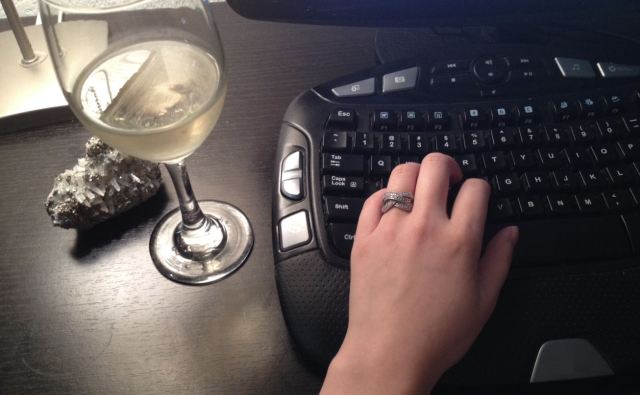
Two glasses of Riesling in and I started thinking psh!— why the heck not? Hubby and I have been house hunting for some time now and we know nothing– nothing— about the real estate market. We both consider ourselves newbies to the Bay Area, California, and for the last few months, shot out offers here and there without knowing a thing about what we were doing. Being the diligent OCD types that we are, we’ve spoken to countless so-called real estate experts, agents, gurus, read all the projections, forecasts, and journals. And none of it is helping or assuaging any of our fears.
Hubby, completely joking, says, “Why don’t you do a tarot reading for the real estate market?”
“Really?” I ask, brightening.
“No,” he says back immediately.
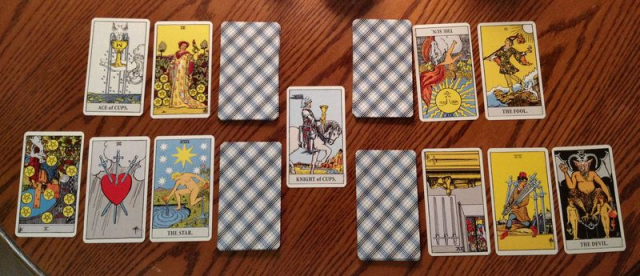
Too late. He planted the idea. I went a little more specific, though. I honed in on the Alameda County real estate market, since that’s where we’re looking to buy.
Here’s how it went down. Stacey H., an editor over at Best American Poetry asked if I’d like to guest-write for a week. Insecure about having nothing of note to write about, I brainstormed weeks in advance, and only got up to 4 pieces. A week is 5. Argh. I posed the question to myself: As a writer/poet who might be convinced to be interested in tarot if given a compelling enough reason, what topic at the intersection of writing and tarot might interest me? Well, duh. How do I use tarot to help along my writing? I figured I’d try to write about that. Finally. 5 pieces.
Tons have been written about using tarot cards as writing prompts, but that doesn’t interest me too much as a writer/poet. Now… reading tarot for my writing specifically… that concept is intriguing.
Then I had to put the hat of the tarot practitioner back on. Can I do it? Is reading tarot for what amounts to a manuscript (more often than not an incomplete unfinished manuscript no less) being the querent-client something that can even be done? I read for people, don’t I, and in every instance, people who are more or less incomplete, unfinished manuscripts. So why not a book? Oh, for sure, after this endeavor I can no longer laugh at practitioners who read tarot for cats and dogs…
I spent some time thinking about how it could be done, my approach, crafting the techniques to be employed, and how I’d even go about selecting a signifier card for a manuscript, and then reached out to my arm’s length network. Stacey H., the editor, was the first to reply and asked if she could help spread the word by re-posting my call. Go for it! I still kept one eye on my own circle. Then she said she found someone. Oh dear. A complete stranger.
Heck, why not. That is how I “met” Amy G. From our initial terse e-mail exchanges, I couldn’t get a sense of who she was and truly, as she says in her response piece, which I will link later, I didn’t read her manuscript and knew very little about her poetry. In fact, prior to reading tarot for her, I swear I have never read any of her poetry, or writings of any kind for that matter, other than the e-mail exchanges. This exercise was as much for me as it was for her, to see if it could be done, and so I didn’t want anything to cause any sort of bias at all. I wanted to know as little about her and her work as possible.
First, the signifier. Intuitively without even looking at the cards, just going through the archive of memories of the cards in my mind, I gravitated toward the Knight of Cups, but then the Rational Side of me said, “No, that’s not an appropriate signifier. She’s female. The knight is a boy.” However, it just felt right and the more I pressured myself to seek out another signifier, the more wrong every other card felt. So, I surrendered. Knight of Cups it is. Whatever. If she ends up thinking it is ridiculous, so be it.
Once I set my mind and heart to it, though, without direct interaction with her, when the cards were set down, I have to say, I really felt like I was getting to know her. It’s a funny thing to say, especially to the skeptic, but it’s my best way of articulating what happened. I felt her poetry, if that makes any sense, and it was really, really freakin’ beautiful poetry. I made a mental note to myself to look up her work after the tarot reading, because it just felt it would be aligned with what I love to read.
It was well after the tarot reading that I got to know Amy’s writing and my feelings were right on. I really do love her poetry and even her casual blog posts at Best American Poetry, posts that are always filled with fire, spirit, humor, truth.
The universe has a lovely, balanced way of always making sure we’re “compensated.” Now that I’ve been reading some of Amy’s poetry, I get why there was this meeting of the spirits. Her poetry helps to express and validate some of what I’ve been going through in my personal life, and does so in ways I couldn’t have done for myself. Had this whole situation, any part of it really, never taken place, I’m honestly not sure I would have ever had the pleasure of coming across Amy’s work. That was the bargained-for exchange that I didn’t even know I bargained for.
I am the guest blogger this week over at Best American Poetry and am feeling a bit like a fraud since I’m not a poet, at least not since the angry-histrionic adolescent years of poems about boys who won’t give me the time of day, printed in font size 14 in comic sans or some other curly girly font and center-aligned down the page. Hm, actually in college there was a brief period of doing slam poetry on themes of an Asian Diaspora ravaged by post-colonial ambivalence and cultural imperialism but that period is really best left forgotten too. I am, however, an avid consumer of poetry and have bookshelves at home filled with poetry collections and chapbooks, half of poets you’ve all heard of and half of poets you’ve probably never heard of.
I’m trying to think of when I first learned about the Best American Poetry series, and it turns out I can’t seem to remember a time when I was aware of literature and not aware of BAP. I read it in high school, college, and even recall sending a letter to David Lehman directly one time about a decade ago telling him I felt the BAP series didn’t include a fair representation of Asian American poets. The current series has been much better, I think, about diverse representation.
This week BAP is letting a tarot reader (me) run loose on their blog (http://blog.bestamericanpoetry.com/) and here’s what’s going to happen:
Hubby is the Year of the Horse, which means this year, 2014, is going to be a year of major changes and flux in his life. At least that’s what the Chinese believe. It’s called your Ben Ming Nian. Every lunar year is governed by a zodiac house and there are 12 of them. When a lunar year is your zodiac house of birth, you will be experiencing a great deal of flux that year, which can be great if you’re careful and proactive, but can quickly become misfortune if left unchecked (chaos theory? entropy?).
Growing up I’d hear about the Grand Duke Tai Sui. Every 12 years the Grand Duke reigns over a different zodiac house and when he’s in your house, you better move out or risk offending him. Move out, good luck. Stay put, bad luck.
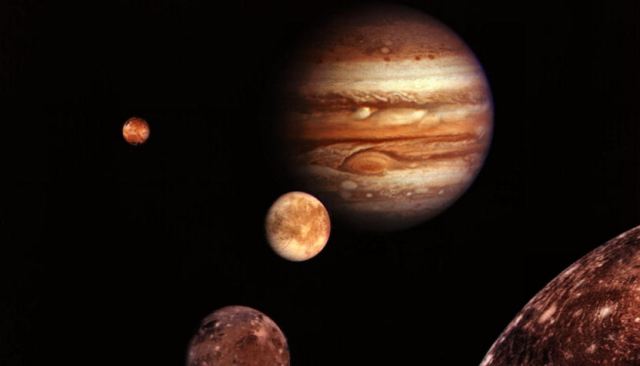
Turns out he’s Jupiter. Sorta. Jupiter’s shadow.
Jupiter’s orbital period is 12 years and each year it appears to be in a different cardinal direction in the sky at particular degrees, and that corresponds with one of the 12 zodiac houses of the lunar calendar. Since it’s also the largest planet in the solar system and bright enough to cast shadows on earth, it is believed that the energies of Jupiter can greatly affect the personal energies of those on earth. It can exert interfering energetic waves on the earth’s magnetic fields and thus affect our personal Qi. It most affects the personal Qi (energy) of those born in a year corresponding with the zodiac house that Jupiter is in that year.
As Jupiter, up in the sky, is observed rotating in its 12-year cycle, it casts a spiritual shadow on earth, creating a terrestrial counterpart, or court martial that governs the mandates of Jupiter up in the sky. That terrestrial counterpart is Tai Sui. It’s the authority who speaks on behalf of Jupiter.
So while Tai Sui isn’t exactly per se Jupiter, Tai Sui is like the earthly counterpart to the celestial embodiment of Jupiter. Tai Sui is the spiritual shadow on earth that Jupiter from up high casts. Tai Sui is Jupiter’s spokesperson on Earth.
Astronomically (and astrologically), Tai Sui is positioned in opposition to the placement of Jupiter. Tai Sui is the Earthly Branch of the corresponding Jupiterian year. Thus, for example, in a Year of the Horse, Tai Sui resides in the Horse position.
When Grand Duke Tai Sui is seated in your house, your personal Qi will be thrown for a ride, which can be a really good thing if you know how to keep it in check, but can be an awful thing if you don’t. Enter fun Chinese superstitions. They’ve got all sorts of talismans, rituals, and other incredible ways to “please the Grand Duke” and avoid “offending him.” Basically, know that your personal Qi will be in flux and be aware and conscious of how to navigate that Qi in flux so that it doesn’t afflict you but rather, supports you.
Now my Hubby is an interesting character. He is a full on skeptic… until shit hits the fan. His year went off on a rocky start and he’s worried about his Ben Ming Nian. Ben Ming Nian just means it’s the year of the zodiac house that you were born in. He was born in the year of the Horse and now it is the year of the Horse. It’s his Ben Ming Nian, you would say.
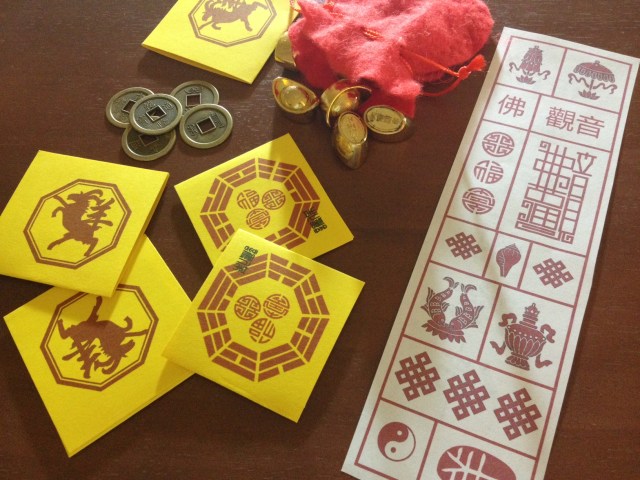
You would be surprised, floored really, how many perfectly intelligent and rational Chinese people flock to temples and energetic practitioners to try to get their good mojo on for their Ben Ming Nian. Hubby knows that a few years ago it was my little sister’s Ben Ming Nian and her year, too, started off hellish. I assembled some happy charms and sent them to her. By that year’s end, she met a wonderful guy who is still the love of her life right now (they’re making plans to marry soon) and she got an offer to work at the biggest law firm in the country, in the city she loves, Manhattan. So this year, 2014, Hubby nagged me to do the same for him.
I met the Venerable Sheng-Yen, a Buddhist monk, teacher, and scholar, when I was too young and too immature to have appreciated the encounter. For that I will always be regretful for not being more open and receptive when I had the chance. Here, though, the Internet is a wonderful thing. Apparently, many of Ven. Sheng-Yen’s lectures have been recorded and posted onto YouTube. The lectures are in Mandarin Chinese, but there’s English subtitles. The one of highest interest to those in tarot practice might be what the Shi Fu had to say about magic, the supernatural, and psychic workings.
I highly recommend watching the video in the entirety, but if you can’t I’ll summarize.
A question is presented to the Shi Fu (Shi Fu is the honorific we use to refer to any master teacher): What are his thoughts on supernatural powers (in other words, magical practice or working with spiritual energies) and does he think it really exists?
Many traditional Asian societies follow the lunar calendar (I once litigated a case involving an elder Taiwanese woman and all the document evidence she had was dated per the lunar calendar, which completely tripped us lawyers up and a lot of conversion work had to be done, but that is neither here nor there; just mentioning it to affirm that it really is still used today) and the super-traditional even believe that certain energies are more dominant during certain phases of the moon. Not kidding: they’d schedule major surgeries around certain phases of the moon because they believe they’ll bleed less and chances of success will be higher. They consult the Chinese almanac, which is based around the lunar calendar, for everything, from when to launch a business or throw a wedding ceremony to the optimal time for a funeral.
I’ll say that I haven’t lived or observed the universe long enough to confirm whether there is any validity to following moon phases, but if it worked for my ancestors and there is no actual adverse effects from continuing the tradition and it makes me personally feel closer to my heritage, then why the heck not. My mom was adamant about calibrating Hubby’s and my engagement and marriage to moon phases. Did it work? So far so good I’d say.
Anyway, that was a long tangent of an introduction. Sorry. This post is about cleansing a tarot deck.
To demonstrate, I’m using the DruidCraft Tarot deck by Philip and Stephanie Carr-Gomm and Will Worthington (a highly recommended deck, by the way; though there is a great bit of nudity in the illustrations, which I understand why would be featured in a Wiccan-Druid-based deck, but just does not resonate well with me).






 benebell wen